

South America Residential Water Treatment Equipment Market size and share Analysis 2026-2033
The Global South America Residential Water Treatment Equipment Market is expected to grow at a CAGR of 8.4% and reach USD 8.01 Bn by 2033. In 2026, it will be worth USD 4.55 Bn in 2026. Due to concerns over poor quality drinking water, increasing numbers of people living in cities, and rising demand for safe drinking water solutions at home, the overall demand for water has increased significantly.
Key Takeaways
- According the reverse osmosis technology was the most widely used form of treatment, providing 42% of the market share by 2026 based on a total volume perspective. Market Analysis for 2026 reveals that 84.5 percent of Urban Centers/Latin America and Caribbean had access to Safe Drinking Water at the end of 2024. Therefore, the potential number of people having access to Safe Drinking Water during this period was approximately 459.7 million people. (US-EPA)
- Brazil will maintain the highest percentage of market share with a 47% share of the total market in 2026. In 2024, over 86.3% of households in Brazil used the public water system; however, a staggering 17% of all Brazilians continued to have no access to potable water, further highlighting that a tremendous amount of water (39.9%) was wasted in the distribution process, thus driving continued strong demand for residential drinking water treatment solutions. (Brazil Gov)
Segmental Insights
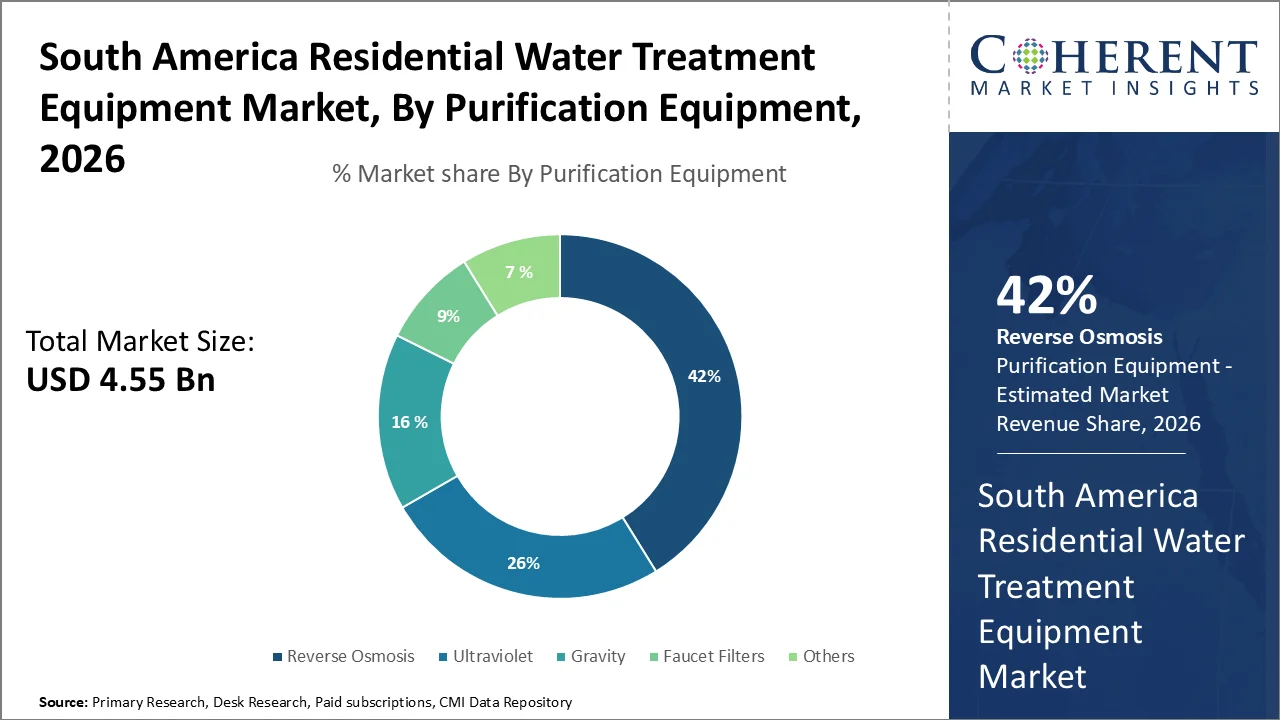
By Purification Equipment, the Reverse Osmosis dominates with 42% of market share in 2026.
Reverse osmosis accounted for the largest proportion of sales in the purification equipment market in 2026, comprising 42% of total revenue. In 2026, reverse osmosis emerged as the leading form of residential water purification system in South America. Reverse osmosis currently has the largest market share among purification systems due to the increasing number of households wanting to use systems that can effectively remove dissolved solids, metals and other contaminants that are hard to remove using conventional filtration techniques. The strength of this segment is supported by the presence of service gaps in the region where access to safe drinking water is not readily available, by 2024, an estimated 84.5% of urban areas in Latin America and the Caribbean had access to safely managed drinking water, which is equivalent to approximately 459.7 million people in total. As a result, there will be an enormous potential market for advanced in-home water purification systems. (US-EPA)
Reverse osmosis is popular because it is capable of removing a wide variety of contaminants. The U.S. EPA has stated that reverse osmosis systems are effective in removing lead, copper, chromium, and arsenic, thus they may appeal to residential customers who wish to have drinking water that is as clean as possible. Additionally, the efficiency of reverse osmosis systems has improved over the years; for example, the point-of-use reverse osmosis systems that are recognized by the U.S. EPA WaterSense Program consume approximately 2.3 gallons of water per gallon of treated water whereas, the traditional point of use reverse osmosis systems consume greater than 5 gallons. Therefore, a typical residential user of point-of-use reverse osmosis systems will save over 3,100 gallons of water each year with the use of a point-of-use reverse osmosis system. (US-EPA)
Waterdrop launched its MASTER WHS01 whole-house RO system at KBIS 2026 on February 28, 2026. It is built around a 0.0001 μm membrane. The company also launched the MASTER X14 under-sink RO system, which has a flow rate of 1,400 GPD. On December 18, 2025, NSF said that NSF/ANSI 58 was the main certification framework for point-of-use RO systems. (Water Drop)
- Current Industry Events of 2026
- Market Size Estimation
- Regional Breakdown
- Competitive Landscape
- Customer Intelligence
- Segmental Analysis
- Pricing Analysis
- Key Market Drivers, Challenges & Future Trends
- Customized Insights Section
Key Market Trends Shaping the South America Residential Water Treatment Equipment Market
- In Brazil and, by extension, South America's residential treatment market, spending on water security is becoming a major driver of demand. The Brazilian federal government stated that the "Water for All" strategy will spend BRL 30.8 billion by 2026. This includes BRL 11.8 billion for water infrastructure and BRL 4.4 billion for revitalizing watersheds. As water quality, availability, and reliability become more public issues in the region's largest market, this is making people more interested in purifying their own water.
- Although there is rapid modernization of water utilities, household treatment at the last mile will continue to be of utmost importance to consumers. For example, in 2025 the Rio Grande Water Treatment Plant in São Paulo had its capacity increased by 500 LPS, at a cost of USD 120 million, enhancing the quality of life of over 120,000 residents. In addition, the Alto da Boa Vista plant was also modernized for an additional cost of USD 25 million. Both facilities exemplify Brazil's path of progress, i.e., increased central infrastructure improvements, and continued strong demand for purification in homes for the purpose of providing water that tastes better, smells better, and provides quality improvements at the household level.
Current Events and Their Impact on South America Residential Water Treatment Equipment Market
Current Events | Description and Its Impact |
NSF highlights NSF/ANSI 58 for reverse osmosis systems |
|
Brazil’s Sanitation Investment Drive Accelerates in 2026 |
|
Country Analysis
Brazil
Business opportunities abound in South America because of the country's size, population and constant needs for water security. By 2024, the World Bank estimates 88% of the population will reside in urban areas of Brazil; the Federal Government's Sao Francisco Integration Project intends to improve drinking water quality for over 12 million residents living in 390 municipalities. As consumer awareness increases about the risk of drinking water and will lead to higher demand for under-sink purifying devices, compact multi-stage systems, and replacement filters in cities where many do not trust the quality of their municipal supply of water.
Argentina
In Argentina, the recent occurrence of drought conditions to much of the country has made many aware of the need for clean/drinkable water. The World Meteorological Organization (WMO) reported that from the effects of these droughts, the country's GDP was impacted by a decline of 3%. In addition, the last four months of 2022 received less than 50% of the average amount of rain making it the driest year in 35 years. The combination of these circumstances creates an opportunity for people to explore options available to filter, treat, store and use drinking water within their residences.
Chile
Chile is an important market because the government has put money into better ways to manage water because of the country's long-term water stress. On June 12, 2024, the World Bank approved assistance for the implementation of the Just Water Transition Program in Chile. According to the program's project documentation, the total investment in this project from January 1, 2022, to December 31, 2027, is estimated to be approximately $1.8723 billion. This provides an excellent justification for the installation of high-end residential treatment systems over the long-term, particularly for homes located in urban areas where the requirements governing access to clean, safe drinking water will be progressively more stringent (Gonzalez-Castilla, 2022).
Market Report Scope
South America Residential Water Treatment Equipment Market Report Coverage
| Report Coverage | Details | ||
|---|---|---|---|
| Base Year: | 2025 | Market Size in 2026: | USD 4.55 Bn |
| Historical Data for: | 2020 To 2024 | Forecast Period: | 2026 To 2033 |
| Forecast Period 2026 to 2033 CAGR: | 8.4% | 2033 Value Projection: | USD 8.01 Bn |
| Geographies covered: |
| ||
| Segments covered: |
| ||
| Companies covered: | 3M Company, Pentair plc, Culligan International, A. O. Smith Corporation, Unilever Pureit, Electrolux AB, LG Electronics, Panasonic Corporation, Atlas Filtri, IBBL, Lorenzetti S.A., Midea Group | ||
Who are the Major Companies in South America Residential Water Treatment Equipment Market?
Major companies in the South America Residential Water Treatment Equipment Market include 3M Company, Pentair plc, Culligan International, A. O. Smith Corporation, Unilever Pureit, Electrolux AB, LG Electronics, Panasonic Corporation, Atlas Filtri, IBBL, Lorenzetti S.A., Midea Group.
Key News
On March 18, 2025, Electrolux introduced a new water purifier in Brazil that employs a compressor. The company stated that the new model is five times more energy-efficient in terms of cooling, has a refrigerant that has a 99.9% lower environmental impact than older models, and can purify 3,000 liters of water per filter. Electrolux has also announced that it is exploring the possibility of expanding into additional Latin American markets, which is encouraging for the demand for high-end home purifiers. (Electrolux)
Analysts Opinion
The biggest structural boost for the South America Residential Water Treatment Equipment Market comes from Brazil's lack of infrastructure and spending on water security. The federal government wants to spend BRL 30.8 billion on "Water for All" projects by 2026. About 17% of Brazilians still don't have piped water, and 39.9% of the water that is produced is lost in distribution. Because of this, household demand for purification should stay strong. The market will be affected by the faster spread of point-of-use and high-end multi-stage systems.
Market Segmentation
- By Purification Equipment
- Reverse Osmosis
- Ultra Violet
- Gravity
- Faucet Filters
- Others
- By Region
- Argentina
- Brazil
- Chile
- Peru
- Venezuela
- Rest of South America
Sources
Primary Research interviews
- Residential water purifier manufacturers
- Reverse osmosis system suppliers
- Membrane and cartridge suppliers
- Household appliance distributors
- Water treatment equipment dealers
- E-commerce sellers of home filtration systems
- Municipal water quality experts
- Drinking water utility officials
- Certification and testing professionals
- Residential plumbing contractors
- Large-format retail channel partners across Brazil, Argentina, Chile, and other South American countries
Databases
- WHO/UNICEF Joint Monitoring Programme (JMP)
- World Bank Open Data
- UN Comtrade Database
- ITC Trade Map
- OECD Data
- FAOSTAT
- Brazil IBGE
- Argentina INDEC
- Chile INE
- SISAGUA (Brazil)
- ANA Brazil databases
- SNIS Brazil
- SISS Chile
- National customs and trade statistics portals
Magazines
- Water Quality Products
- Water & Wastes Digest
- WaterWorld
- Smart Water Magazine
- Water Technology
- Filtration + Separation Magazine
Journals
- Water Research
- Journal of Water Process Engineering
- Desalination
- Water Supply
- Journal of Environmental Management
- npj Clean Water
- Environmental Science: Water Research & Technology
Newspapers
- Valor Economico
- Folha de S.Paulo
- O Globo
- La Nacion
- Clarin
- El Mercurio
- Diario Financiero
Associations
- ALADYR (Latin American Association of Desalination and Reuse)
- AIDIS (Inter-American Association of Sanitary and Environmental Engineering)
- ABES (Brazilian Association of Sanitary and Environmental Engineering)
- Water Quality Association (WQA)
- International Water Association (IWA)
- National drinking water and sanitation associations across South America
Public Domain sources
- World Health Organization (WHO)
- UNICEF
- World Bank
- OECD
- United Nations Environment Programme (UNEP)
- Economic Commission for Latin America and the Caribbean (ECLAC/CEPAL)
- World Meteorological Organization (WMO)
- Ministries of Health, Environment, Housing, Water Resources, and Sanitation across South American countries
- Agencia Nacional de Aguas e Saneamento Bssico (ANA)
- SNIS Brazil
- SISS Chile
- National census bureaus
- Public water quality monitoring portals
Proprietary Elements
- CMI Data Analytics Tool
- Proprietary CMI Existing Repository of information for last 10 years
Get access to 250+ pages report
Every segment, forecast, competitor profile and data table behind the analysis above — available for instant download.
- ESOMAR Member
- ISO 9001:2015 Certified
- D-U-N-S Registered
- GDPR & CCPA Compliant
Missing comfort of reading report in your local language? Find your preferred language:
Transform your Strategy with Exclusive Trending Reports
Frequently Asked Questions
By 2033, the market is expected to be worth USD 8.01 Bn. This means that there will be a lot of long-term demand for home water purification systems.
In 2026, the Reverse Osmosis segment will have the largest market share, with 42% of the total. It is the most common kind of cleaning equipment.
Reverse osmosis is the best option because it can remove different pollutants, such as dissolved solids, salts, lead, arsenic, and other chemicals. It also makes consumers trust the company more by raising the standards for certification and making the membrane work better.
In 2026, Brazil will have the largest market share in the region, with 47%. This is because a lot of people live in cities, and there are still places where people can't get safe drinking water and sanitation.