

Global Digital Battlefield Market and Forecast - 2026-2033
The global digital battlefield market is estimated to be valued at USD 80.94 Bn in 2026 and is expected to reach USD 240.04 Bn by 2033, exhibiting a compound annual growth rate (CAGR) of 16.8% from 2026 to 2033.
Key Takeaways of the Global Digital Battlefield Market
- The hardware segment is expected to lead the market holding a share of 55.6% in 2026.
- The artificial intelligence segment is projected to hold a prominent market share of 32.3% in 2026.
- The land segment is projected to hold a prominent market share of 38.8% in 2026.
- North America, expected to hold a share of 39.8% in 2026, dominates the market.
- Asia Pacific is expected to be the fastest growing regional market with a share of 24.6% in 2026.
Market Overview
The notable rise of the global digital battlefield sector shows growing spending on cyber-combat tools, while nations push forward defense upgrades worldwide. Demand for stronger cybersecurity setups alongside unified command platforms is fueling market growth right now.
Recent trends in the digital battlefield market show growing use of artificial intelligence to improve decisions and automation. At the same time, cloud platforms along with IoT tools are reshaping how forces exchange info and process live data. A stronger emphasis on cyber protection combined with advancements in robotics drives progress, leading to smarter, quicker, more effective combat environments.
Current Events and Its Impact
Current Events | Description and their Impact |
Adani – DRDO Collaboration |
|
Electronic Travel Authorization |
|
Segmental Insights
- Current Industry Events of 2026
- Market Size Estimation
- Regional Breakdown
- Competitive Landscape
- Customer Intelligence
- Segmental Analysis
- Pricing Analysis
- Key Market Drivers, Challenges & Future Trends
- Customized Insights Section
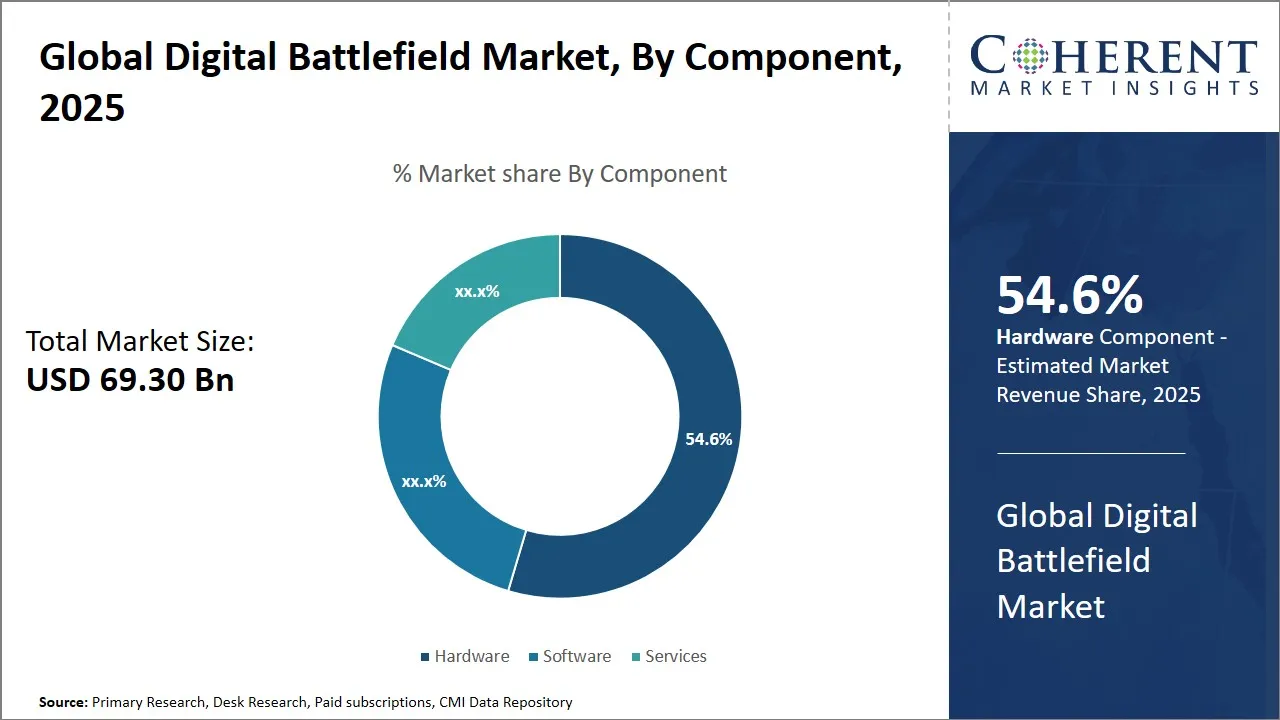
Global Digital Battlefield Market Insights, By Component – Hardware’s Dominance is Driven by Operational Necessity and Technological Precision
In terms of component, hardware is expected to contribute the highest share of 55.6% in the global digital battlefield market in 2026. This rise is largely due to its key function, supporting advanced technology in military and monitoring tasks. Battlefield gear consists of essential components. Sensors connect through communication modules, drones integrate via autonomous vehicles, whereas jammers follow in sequence - each element helps troops stay alert, shift positions correctly, respond quickly once combat starts. Relying on dependable technology ensures operations continue steadily amid disorder or high-pressure situations.
A major cause of growing hardware needs is ongoing improvements in defense technology - modern devices require small yet powerful components handling intense processing, threat detection, or secure communication. Compact systems allow easier mobility while using less energy, enabling troops to advance quicker and operate longer without recharge. At the same time, integrating machines with innovations such as intelligent software, networked detectors, or high-speed radio links improves teamwork between teams and shortens response times in battle.
For instance, on February 11, 2025, ideaForge Technology Limited, a global leader in drone technology, unveiled its latest range of advanced UAV platforms and solutions including NETRA 5, SWITCH V2, Tactical UAV (Concept) and Logistics UAV (Concept) today at Aero India 2025.
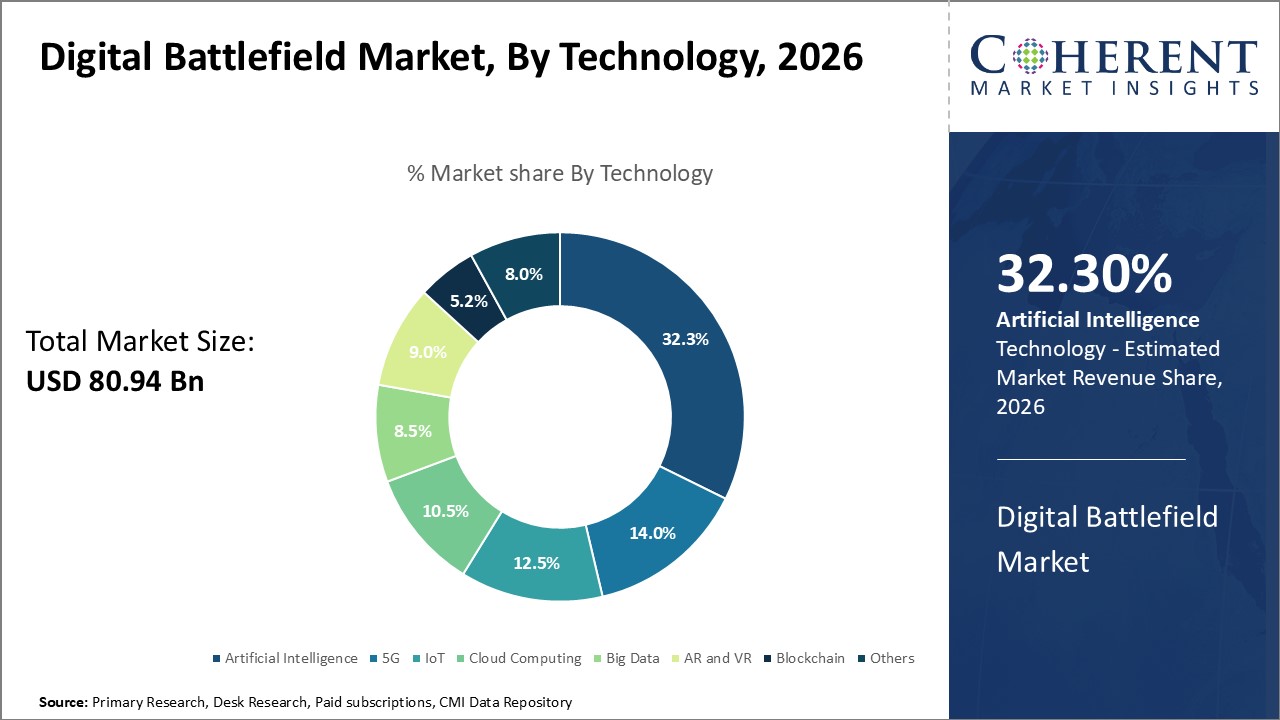
Global Digital Battlefield Market Insights, By Technology – Artificial Intelligence as the Strategic Cornerstone of Digital Warfare Due to Enhanced Decision Making
In terms of technology, artificial intelligence is projected to command the highest share of 32.3% in the global digital battlefield market in 2026. The growth comes from the need to boost combat strength while simplifying complex choices. Owing to artificial intelligence, military setups process vast data swiftly, detecting patterns, foreseeing threats, allocating resources better, which sharpens response times in operations. It works across various areas of digital conflict, linking tasks like monitoring, intel gathering, self-operating arms, along with online security measures. This makes it an indispensable component in modern military strategy.
A key reason AI is advancing is the volume and complexity of battlefield data keeps rising. Owing to machine learning, this info gets analyzed in real time, giving commanders reliable predictions while speeding up choices. Moreover, intelligent systems boost military drone performance, allowing self-navigation, object detection, or dynamic task adjustments without ongoing operator input which cuts delays while raising chances of mission completion.
Global Digital Battlefield Market Insights, By Platform – Land Platforms Lead Due to Tactical Versatility and Integrated Defense Systems
In terms of platform, the land segment hold the highest share of 38.8% in the global digital battlefield market in 2026. This dominance comes from their key position as the most adaptable and widely used part of military actions. Because ground troops still handle main defensive and offensive tasks in numerous conflicts, they need tech designed for land-based combat challenges. Such systems combine various digital elements - command setups, scouting teams, protected vehicles, and gear for foot soldiers, linked through modern signal and detection infrastructure.
The focus on irregular warfare and city fighting calls for better field awareness and accurate strikes, pushing militaries to use digital tools built for ground vehicles. Solutions like live maps, AR displays for troops, or networked radios help units move together and react quickly amid tough environments. Also, turning land-based logistics digital boosts efficiency which is key during extended missions.
Cyber Warfare Resilience & Defense Readiness
Region | Approx. Cyber Resilience Score | Approx. Threat Simulation Loss Rate (%) | Approx. Compliance Level (%) | Approx. Autonomous Systems Deployment (%) |
North America | 82 | 11 | 95 | 52 |
Europe | 79 | 13 | 92 | 47 |
Asia-Pacific | 81 | 12 | 93 | 50 |
Latin America | 72 | 18 | 86 | 38 |
Middle East & Africa | 77 | 15 | 89 | 44 |
Regional Insights
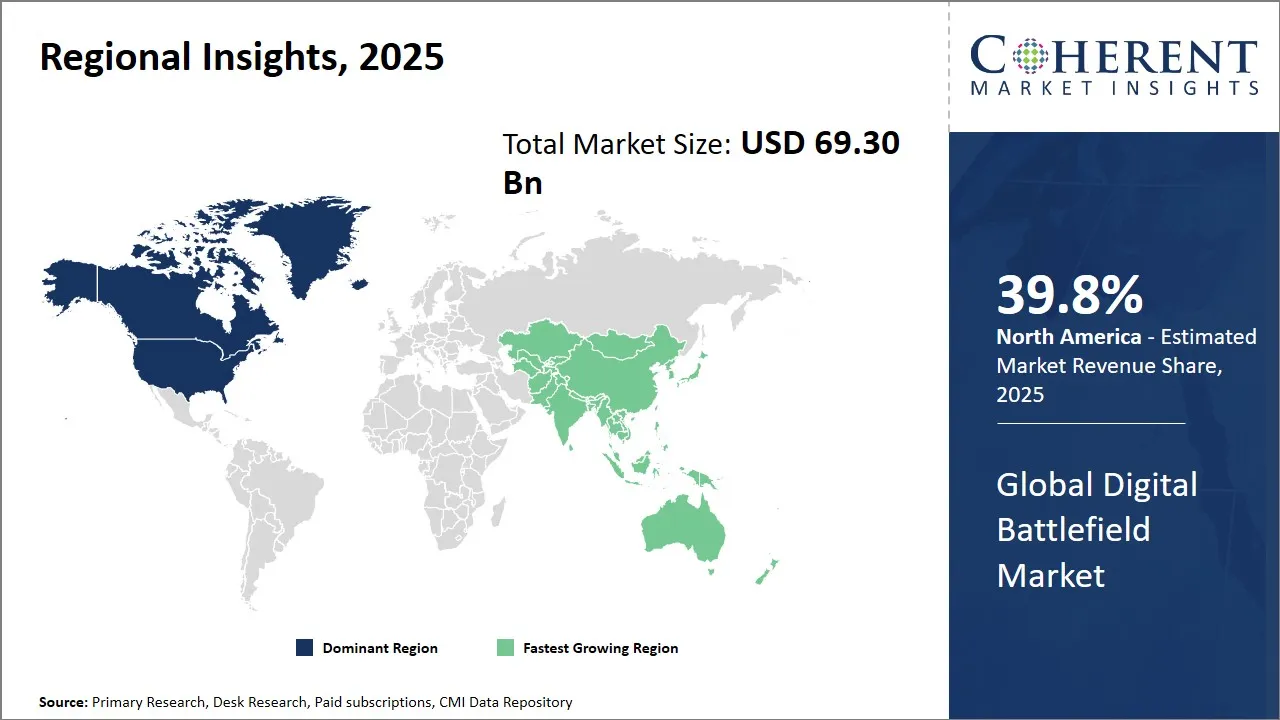
North America Digital Battlefield Market Analysis and Trends
North America is the leader in the global digital battlefield market with an estimated share of 39.8% in 2026. In North America, strong defense networks help lead the global digital battlefield market, backed by high public funding alongside cutting-edge technology setups. The U.S., as a top military force, pushes ahead due to large defense spending combined with fast upgrades in combat technology.
Policies here stress better real-time awareness, self-operating tools, and stronger cyber defenses, promoting new solutions through active deployment. Major firms like Lockheed Martin, Raytheon, Northrop Grumman, and Boeing play central roles - building connected battle systems, secure communications, along with smart AI-driven tactics. The close cooperation among government bodies, defense firms, and tech startups fosters steady progress. In addition, North America gains from broad trading ties that help send advanced combat systems abroad.
Asia Pacific Digital Battlefield Market Analysis and Trends
Asia Pacific global digital battlefield market is expected to exhibit the fastest growth and hold a market share of 24.6% in 2026. Asia Pacific shows the fastest expansion in the global digital battlefield market, driven by higher military spending, security tensions, and tech upgrades in developing nations. Nations such as India, Australia, Japan, or South Korea boost funding for digital warfare tools to improve coordination, intel gathering, besides monitoring missions. The industry grows more dynamic, since authorities focus on homegrown innovation while still relying on overseas supplies to strengthen autonomy.
Major firms involve local enterprises such as Bharat Electronics Limited, alongside Larsen & Toubro, together with global names like Thales or BAE Systems engaging in joint ventures through collaborative efforts. Government programs pushing digital upgrades, stronger cyber defenses, or artificial intelligence in military tech are speeding up adoption of battlefield digitization. Shifts in trade within the area mirror planned buying strategies, along with joint efforts in defense work, helping expansion continue.
Global Digital Battlefield Market Outlook for Key Countries
U.S. Digital Battlefield Market Analysis and Trends
The U.S. digital combat sector features cutting-edge development, supported by robust military research budgets; collaboration between the DoD, DARPA, and private contractors fuel progress. Firms like Lockheed Martin together with Northrop Grumman focus on connected combat systems rather than isolated platforms, at the same time pushing progress in unmanned aircraft use plus digital defense solutions. Priority continues to lie in combining smart software with real-time analytics, where reliable links are key for lasting operational advantage.
India Digital Battlefield Market Analysis and Trends
India’s digital battlefield market is changing fast, driven by military upgrades along with a push for local production via the "Make in India" plan. Private firms are being invited to join forces with international partners which speeds up the use of intelligent infantry technology, signal disruption tools, and real-time command platforms. Firms such as Bharat Electronics Limited and Tata Advanced Systems play major roles, strengthening national cyber-physical battle readiness.
China Digital Battlefield Market Analysis and Trends
China stays ahead in using big digital systems for combat, owing to strong local arms production alongside state backing for updating armed forces. Instead of just combining tools, it’s prioritizing how AI works with fast networks and remote data storage in war planning - firms like China Electronics Tech Group are central here. Moreover, spending on hacking capabilities plus self-operating weapons is growing, strengthening its power both nearby and worldwide.
U.K. Digital Battlefield Market Analysis and Trends
The U.K. digital battlefield market prioritizes modern battlefield communication systems and electronic warfare tools. Companies such as BAE Systems, alongside Leonardo UK, deliver high-tech systems that improve real-time awareness while ensuring compatibility with NATO units. Instead of traditional methods, defense strategies now support digital upgrades via collaborations with universities and emerging tech firms - driving progress in tactical AI and protected networks.
Australia Digital Battlefield Market Analysis and Trends
Australia boosts its digital battlefield market through focused efforts on independence and upgrading military tools due to shifting regional threats. Funding flows into high-tech command setups, autonomous vehicles, or cybersecurity solutions. Companies including Austal work alongside global partners such as Lockheed Martin, helping expand local tech strength. These partnerships prioritize connected systems and unified operational networks.
Market Players, Key Development, and Competitive Intelligence
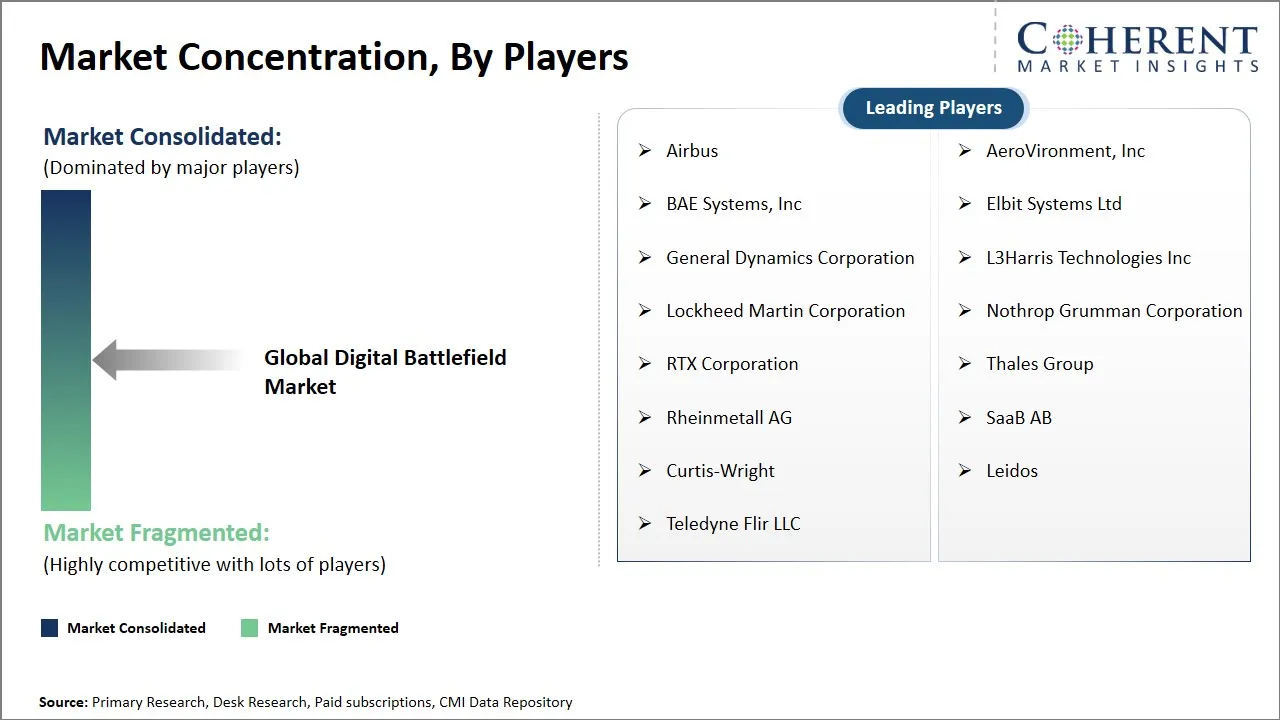
Key Developments
- On February 10, 2025, Zen Technologies Limited, a top Indian firm in anti-drone systems and defense training, introduced advanced combat tools at Aero India 2025. This move highlights the country’s growing strength in modern warfare technology.
- On, April 9, 2024, Ansys announced a collaboration with BAE Systems, Inc., using new methods to speed up digital engineering use in the Department of Defense. Following updated DoD Directive 5000.97, Ansys will support BAE Systems’ clients shift from outdated workflows, focusing instead on improved system development via model-based techniques. While reducing reliance on legacy practices, this effort emphasizes smarter design processes that enhance how systems are built, delivered, and managed.
Top Strategies Followed by Digital Battlefield Market Players
- The competitive landscape of the global digital battlefield market is distinguished by diverse strategies employed by players across different tiers to secure and expand their market share. Established players dominate the industry by investing heavily in research and development (R&D) to innovate high-performance products that meet the evolving needs of defense and security sectors. Their R&D efforts focus on enhancing product capabilities such as real-time data integration, advanced sensor technologies, and robust cybersecurity features.
- On March 12, 2024, L3Harris Technologies boosted U.S. Army operations using the new Hawkeye III Lite VSAT. This upgrade offers strong, flexible satellite communications. Instead of bulkier units, these terminals use a compact build while supporting fast data transfer; that helps troops stay connected during quick movements or shifting combat conditions.
- Mid-level players in the digital battlefield market focus primarily on delivering cost-effective solutions that offer a balanced mix of quality and affordability. Recognizing the increasing demand from price-sensitive consumers such as smaller defense agencies and emerging economies, these players design products that maintain essential functionalities while optimizing manufacturing and operational costs. To enhance their market position, mid-level companies actively pursue collaborations and partnerships that bolster their production capabilities and technological know-how.
- Small-scale players in the global digital battlefield market thrive by carving out specialized niches through innovative and customized product offerings. These companies often emphasize unique features or cutting-edge technologies such as artificial intelligence, machine learning, or miniaturization to differentiate themselves from larger competitors. By focusing on highly specialized applications or emerging technological trends, small players attract customers looking for tailored solutions not offered by mainstream providers. To enhance their competitive edge and facilitate market entry, they commonly build local alliances with startups, research institutions, or regional manufacturers.
Market Report Scope
Digital Battlefield Market Report Coverage
| Report Coverage | Details | ||
|---|---|---|---|
| Base Year: | 2025 | Market Size in 2026: | USD 80.94 Bn |
| Historical Data for: | 2020 To 2024 | Forecast Period: | 2026 To 2033 |
| Forecast Period 2026 to 2033 CAGR: | 16.8% | 2033 Value Projection: | USD 240.04 Bn |
| Geographies covered: |
| ||
| Segments covered: |
| ||
| Companies covered: | Airbus, AeroVironment, Inc, BAE Systems, Inc, Elbit Systems Ltd, General Dynamics Corporation, L3Harris Technologies Inc, Lockheed Martin Corporation, Nothrop Grumman Corporation, RTX Corporation, Thales Group, Rheinmetall AG, SaaB AB, Curtis-Wright, Leidos, and Teledyne Flir LLC | ||
| Growth Drivers: |
| ||
| Restraints & Challenges: |
| ||
Market Dynamics
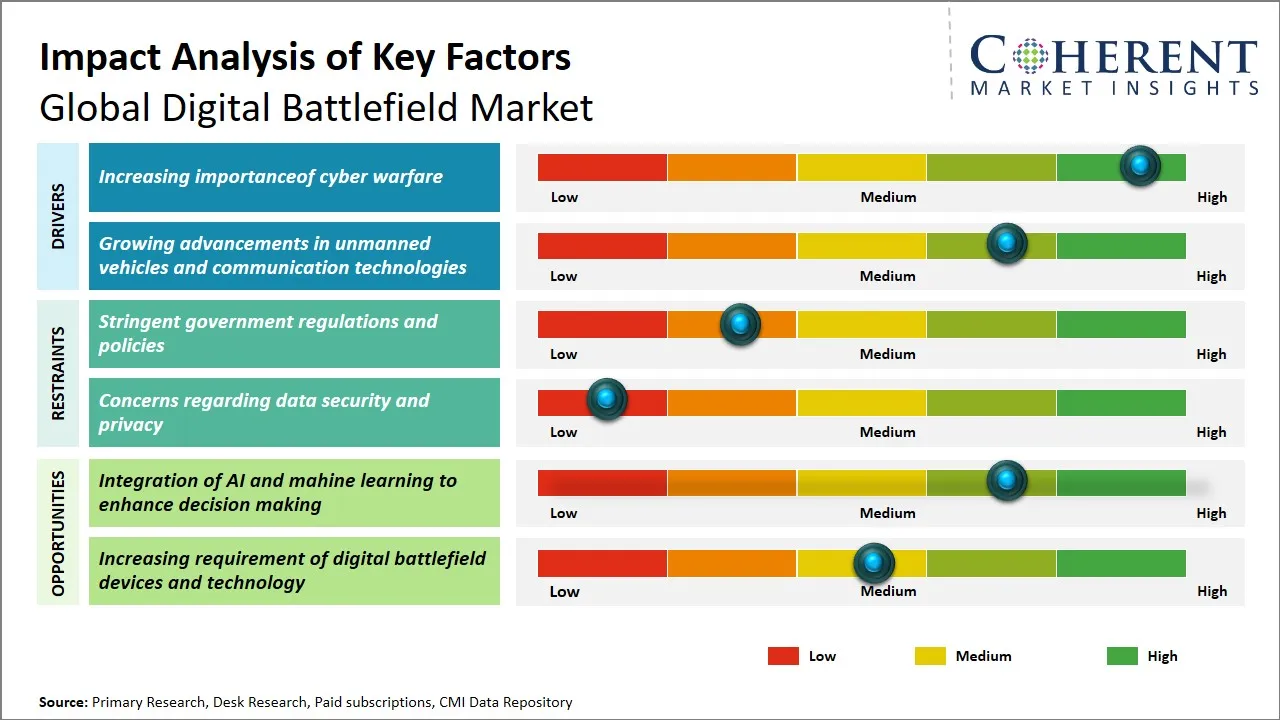
Global Digital Battlefield Market Driver - Increasing Importance of Cyber Warfare
The growing use of digital tools in military actions has boosted the role of cyber conflict, pushing expansion in the worldwide digital battlefield market. Modern militaries are facing complex hacking attempts that are capable of interrupting vital links and weakening operational commands. They are investing heavily in protection. With global conflicts shifting, countries now focus on building stronger online defenses while also preparing countermeasures in virtual spaces. Viewing cyberspace as an active battleground leads to demand for smarter defense platforms combining live monitoring, adaptable security protocols, and stable network frameworks. The mix of classic combat with online tactics pushes military groups to spend more on cybersecurity, protecting key national goals. As a result, digital conflict is fueling progress in technology used on virtual fronts, shaping how armed forces prepare and gain edge.
For instance, on December 5, 2025, U.S. and Canadian cyber authorities reported that hackers tied to China deployed advanced malicious software to breach several undisclosed government and tech organizations, staying hidden for extended periods. These activities represent a recent case of Chinese operatives going after vital systems, slipping into secure digital environments while setting up persistent entry points - allowing interference or damage down the line.
Global Digital Battlefield Market Opportunity - Integration of AI and Machine Learning to Enhance Decision Making
The use of artificial intelligence together with machine learning opens new chances to change how choices are made in today’s digital combat environment. Since current warfare depends more on huge volumes of information from sources like satellites, drones, internet-connected sensors, or cyber tools, these technologies can sort through data far quicker plus more precisely than before.
Such speed allows instant understanding of active situations, spotting dangers early, and forecasting possible outcomes - key elements for fast, useful actions. With smart algorithm designs, AI detects trends, weighs potential threats, while testing different war-game setups, assisting leaders and experts shape better plans along with smarter deployment of assets. Furthermore, machine learning gets better over time by using fresh information, which helps battlefield tech adjust quickly and stay reliable. Because AI automates key tasks in command setups, mistakes drop while performance rises - especially during intense operations. Also, such advances help build self-driving vehicles and remote-operated units, boosting strategic edge in combat zones. As militaries focus more on connected digital systems, AI and ML are becoming essential - not optional - for progress and advantage in modern defense markets.
Analyst Opinion (Expert Opinion)
- Modern combat depends more on data use, self-flying drones, tools to stop enemy drones, or linked communication networks. Government spending rises quickly and so does private military technology investment, through joint ventures between state and industry. These collaborations often include sharing knowledge and resources while building local research efforts to boost preparations. The sector is not just about weapons anymore. It includes code, artificial intelligence systems and also unified digital backbones.
- Early investment in AI for military use gives some nations a strong edge, allowing quick threat detection and response. Growth looks likely as governments focus on independence, safe data links, or flexible drone tech. Continued progress, solid local production, together with global partnerships may define future leaders as digital combat tools becoming key to defense plans ahead.
Speak to the analyst
Want personalized insights?
Take the findings above to one of our principal consultants, or have the report rebuilt around the segments, geographies and competitors you actually track.
Market Segmentation
- Component Insights (Revenue, USD Bn, 2021 - 2033)
- Hardware
- Software
- Services
- Technology Insights (Revenue, USD Bn, 2021 - 2033)
- Artificial Intelligence
- 5G
- IoT
- Blockchain
- Cloud Computing
- Big Data
- AR and VR
- Others
- Platform Insights (Revenue, USD Bn, 2021 - 2033)
- Land
- Naval
- Air
- Space
- Regional Insights (Revenue, USD Bn, 2021 - 2033)
- North America
- U.S.
- Canada
- Latin America
- Brazil
- Argentina
- Mexico
- Rest of Latin America
- Europe
- Germany
- U.K.
- Spain
- France
- Italy
- Russia
- Rest of Europe
- Asia Pacific
- China
- India
- Japan
- Australia
- South Korea
- ASEAN
- Rest of Asia Pacific
- Middle East
- GCC Countries
- Israel
- Rest of Middle East
- Africa
- South Africa
- North Africa
- Central Africa
- North America
- Key Players Insights
- Airbus
- AeroVironment, Inc
- BAE Systems, Inc
- Elbit Systems Ltd
- General Dynamics Corporation
- L3Harris Technologies Inc
- Lockheed Martin Corporation
- Nothrop Grumman Corporation
- RTX Corporation
- Thales Group
- Rheinmetall AG
- SaaB AB
- Curtis-Wright
- Leidos
- Teledyne Flir LLC
Sources
Primary Research Interviews
- Defense Technology Manufacturers
- Military Command and Control System Integrators
- Government Defense Procurement Officials
- Cybersecurity and Electronic Warfare Specialists
Databases
- Jane's Defense Database
- Stockholm International Peace Research Institute (SIPRI) Database
- Global Defense Trade Database
- Military Technology Intelligence Database
Magazines
- Defense News Magazine
- Military Technology Magazine
- C4ISRNET Magazine
- Defense Systems Magazine
- Jane's Defense Weekly
Journals
- Journal of Defense Management
- International Journal of Advanced Research in Computer Science
- IEEE Transactions on Aerospace and Electronic Systems
Newspapers
- Defense Daily
- Breaking Defense
- Military Times
- The Defense Post
- Aviation Week & Space Technology
Associations
- Association of the United States Army (AUSA)
- International Association of Defense Counsel (IADC)
- National Defense Industrial Association (NDIA)
- Association of Old Crows (Electronic Warfare)
- Military Communications and Electronics Association (AFCEA)
Public Domain Sources
- U.S. Department of Defense Publications
- NATO Research and Technology Reports
- Government Accountability Office (GAO) Reports
- Congressional Budget Office Defense Studies
- International Defense Organizations White Papers
Proprietary Elements
- CMI Data Analytics Tool
- Proprietary CMI Existing Repository of information for last 8 years
Get access to 250+ pages report
Every segment, forecast, competitor profile and data table behind the analysis above — available for instant download.
- ESOMAR Member
- ISO 9001:2015 Certified
- D-U-N-S Registered
- GDPR & CCPA Compliant
Missing comfort of reading report in your local language? Find your preferred language:
Transform your Strategy with Exclusive Trending Reports
Frequently Asked Questions
The global digital battlefield market is estimated to be valued at USD 80.94 Bn in 2026 and is expected to reach USD 240.04 Bn by 2033.
The CAGR of global digital battlefield market is projected to be 16.8% from 2026 to 2033.
Increasing importance of cyber warfare and growing advancements in unmanned vehicles and communication technologies are the major factors driving the growth of the global digital battlefield market.
Stringent government regulations and policies and concerns regarding data security and privacy are the major factors hampering the growth of the global digital battlefield market.
In terms of component, hardware is estimated to dominate the market revenue share in 2026.
AI enhances autonomous decision-making, threat detection, and predictive analytics on the battlefield
Countries like India and Turkey are expanding indigenous R&D, public-private partnerships, and UAV production to strengthen self-reliance.