

Global DNA Forensic Market Size and Forecast – 2026 To 2033
The global DNA forensic market is expected to grow from USD 3.60 Bn in 2026 to USD 6 Bn by 2033, registering a compound annual growth rate (CAGR) of 6.3% from 2026 to 2033. The global DNA forensic market is driven by increasing government need for forensic laboratories. On February 4, 2025, PowerPlex 35GY System, the first 8-color STR analysis chemistry, was approved by the Federal Bureau of Investigation for use in the National DNA Index System (NDIS).
Key Takeaways of the Global DNA Forensic Market
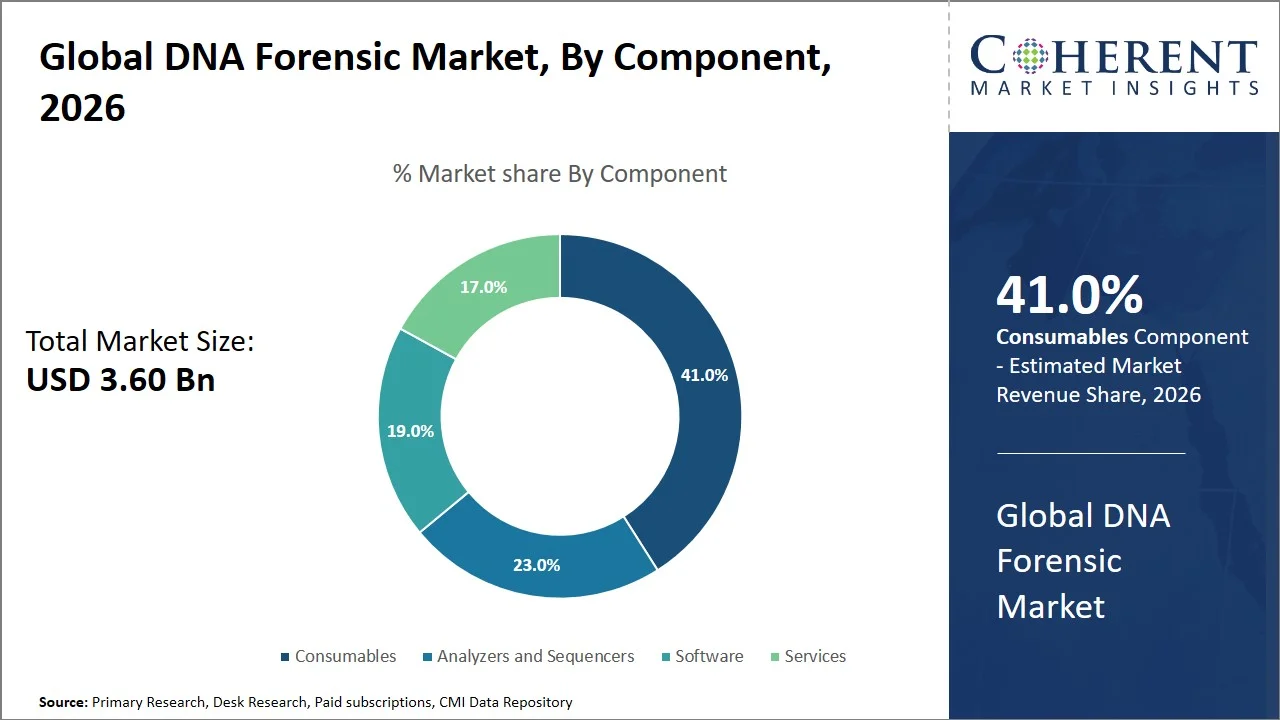
- The Consumables segment is expected to account for 41.0 % of the global DNA forensic market share in 2026. Growing adoption of rapid DNA testing is driving the growth of the segment. On July 7, 2026, Thermo Fisher Scientific received Federal Bureau of Investigation approval for its RapidINTEL Plus Cartridge. The approval allows RapidHIT ID to generate Rapid DNA crime-scene profiles eligible for National DNA Index System uploading.
- The Polymerase Chain Reaction Amplification segment is estimated to capture 39.0 % of the market share in 2026. Growing demand for degraded sample analysis is majorly driving the growth of the segment. On May 18, 2025, Othram introduced SNPSuite for offline forensic DNA analysis. The company specifically highlights improved tolerance for degraded samples through Single Nucleotide Polymorphism methods.
- The Criminal Testing segment is estimated to capture 44.0 % of the market share in 2026. Expansion of forensic genetic genealogy is driving the growth of the segment. In July 2026, Othram and RTI International received National Institute of Justice funding for a major forensic genetic genealogy study.
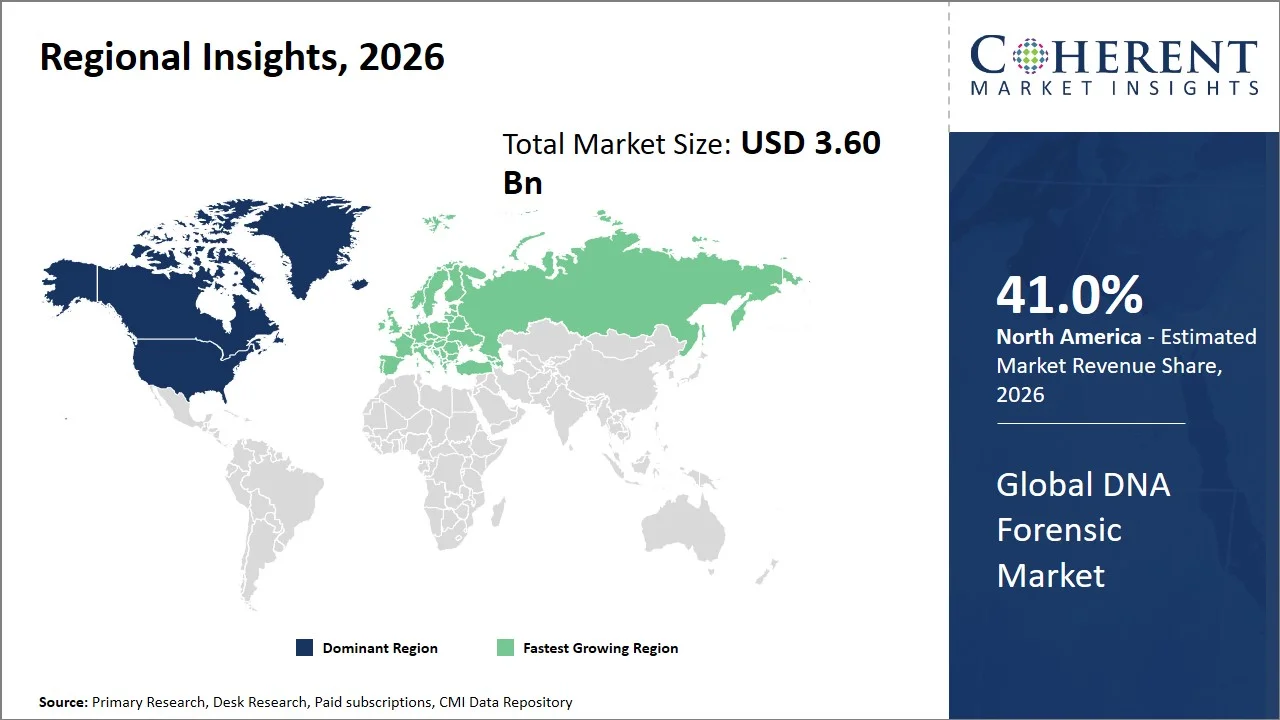
- North America is expected to dominate the DNA forensic market in 2026 with a market share of 41.0 %. Growth in next generation sequencing based forensic workflows in North America is driving the growth of the regional market. On April 17, 2026, Astrea Forensics achieved a major forensic milestone as New York courts accepted its whole genome sequencing methodology.
- Europe is expected to account for 23.0 % share in 2026. Increasing need of cloud based forensic data management in Europe is driving the growth of the regional market. On January 14, 2026, Amazon Web Services launched its European Sovereign Cloud in Germany. It is designed for sensitive European workloads requiring stronger data residency and sovereignty controls.
Segmental Insights
Why Does Consumables Dominate the Global DNA Forensic Market?
The consumables segment is expected to account for 41.0% of the global DNA forensic market share in 2026. Consumables are the predominant type since they are required regularly by forensic laboratories for normal DNA extraction and profiling procedures. Each inquiry involves reagents, amplification kits, collection materials, and other disposable laboratory supplies. These goods are in constant need among forensic laboratories as case volumes increase. Standardized DNA profiling procedures are increasingly common, supporting consistent consumables utilization. They are purchased more frequently than durable forensic tools since they need to be replaced often. On February 19, 2026, the National Institute of Standards and Technology issued RM 8043 of degraded DNA and DNA mixes. Laboratories employ reference materials for training of analysts and validation of forensic tests. This development increases demand for standardized materials supporting routine quality assurance.
- Current Industry Events of 2026
- Market Size Estimation
- Regional Breakdown
- Competitive Landscape
- Customer Intelligence
- Segmental Analysis
- Pricing Analysis
- Key Market Drivers, Challenges & Future Trends
- Customized Insights Section
Why is Polymerase Chain Reaction Amplification the Most Preferred Method?
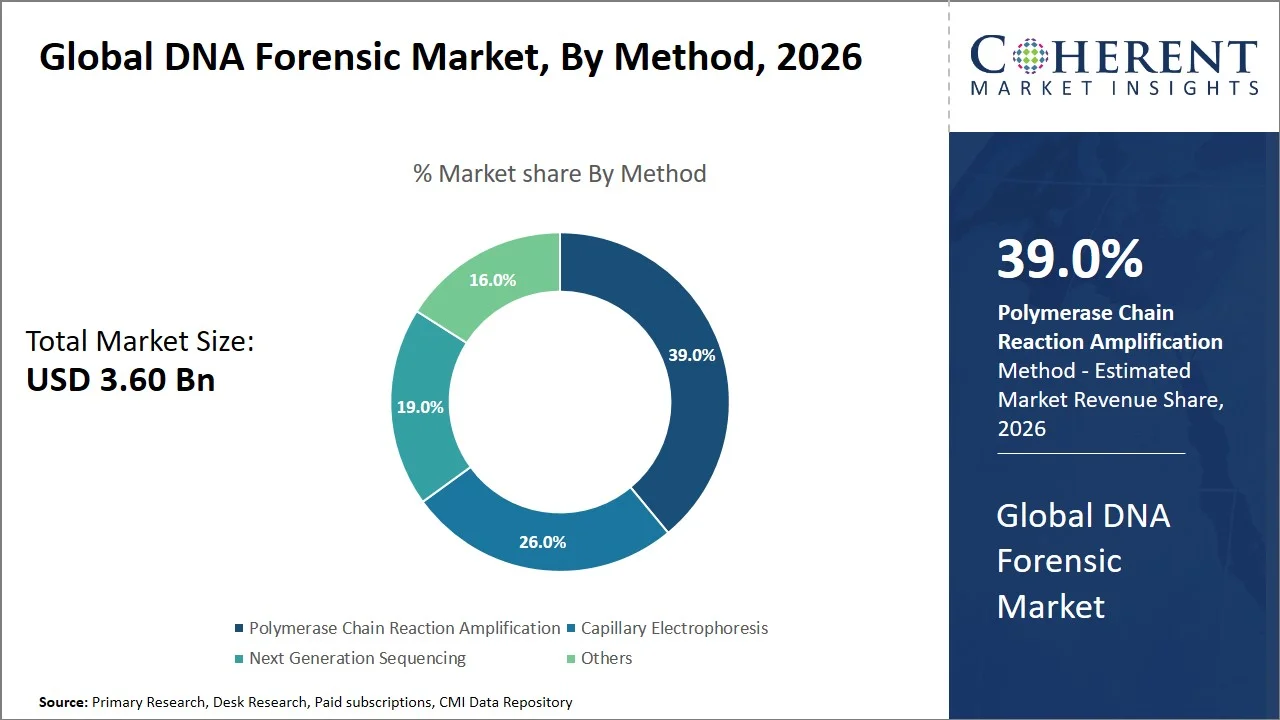
The Polymerase chain reaction amplification segment is expected to account for 39.0% of the global DNA forensic market share in 2026. The polymerase chain reaction amplification provides highly sensitive investigation of relatively small biological samples. It can amplify selected sections of DNA sufficiently to allow for reliable genetic profiling. This is useful when the evidence is inadequate, deteriorated, or contains mixed biological material. Established forensic protocols also support its repeated use between laboratories. Its broad compatibility with forensic DNA kits further supports its widespread usage in casework. In January 2025, QIAGEN shined a light on digital Polymerase Chain Reaction for mitochondrial DNA quantification and body-fluid identification. Its QIAcuity platform is suitable for multiplex tests and short DNA targets. These features improve sample triage prior to downstream profiling and sequencing.
Criminal Testing Dominates the Global DNA Forensic Market
The criminal testing segment is expected to account for 44.0% of the global DNA forensic market share in 2026. Crime investigation's growing workload necessitates the reliable examination of biological evidence. DNA profiling allows detectives associate biological samples to persons and crime scenes. It also aids in suspect identification, victim identification and evidence verification during investigations. With the increased size of forensic databases, it is possible to compare freshly acquired samples with existing profiles. The increasing adoption of standardized DNA techniques by law enforcement agencies is further boosting demand for criminal testing services. In September 2025, Parabon NanoLabs helped a U.S. inquiry into identical twins and a 1987 sex assault. Somatic mutation analysis separated the twins and aided in culprit identification. The resulting conviction demonstrated expanding demand for specialized DNA analysis in difficult criminal investigations.
Current Events and their Impact
Current Events | Description and its Impact |
European Union Regulation 2024/982 - Prüm II Regulation |
|
India Criminal Procedure Identification Act |
|
DNA Forensic Market Dynamics
Market Drivers
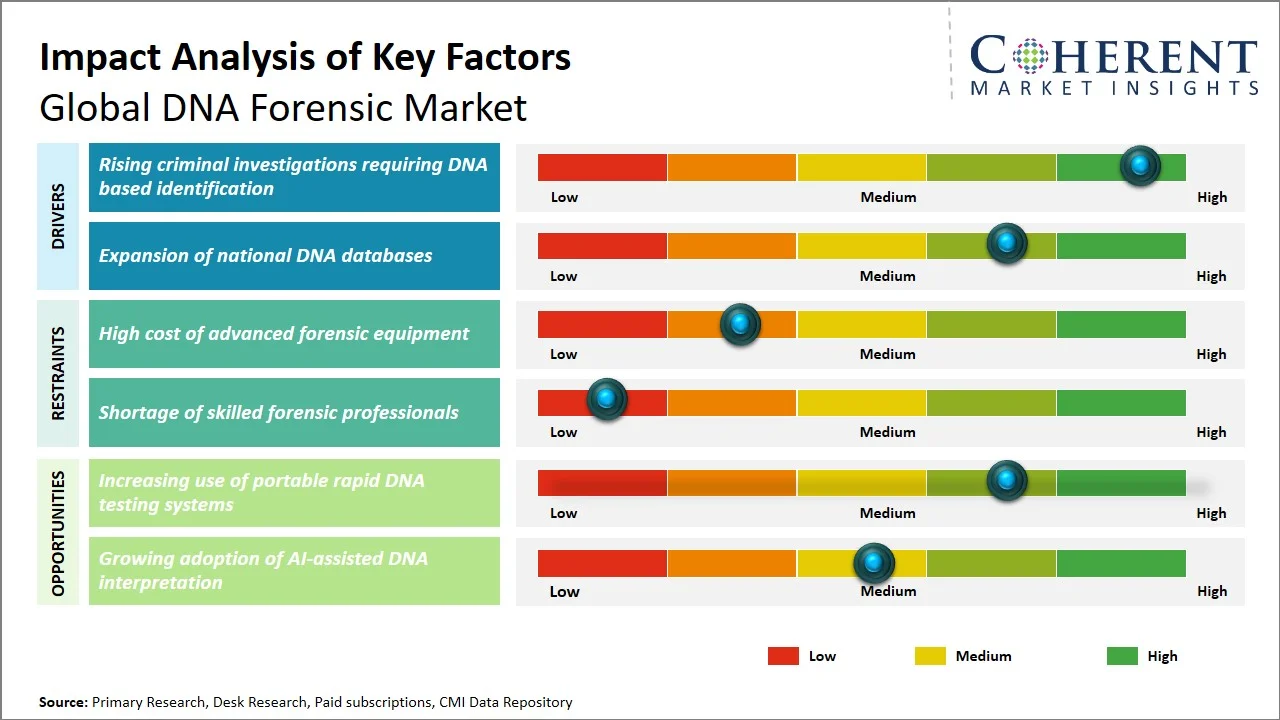
- Rising criminal investigations requiring DNA based identification: Increasing criminal investigations are producing growing demand for DNA based identification technology. Biological evidence is playing an increasingly important role for law enforcement authorities in identifying individuals and linking them to crime scenes. Reliable genetic evidence is also needed when traditional identification approaches do not suffice for complex investigations. This is leading to more dependence on forensic laboratories and thereby boosting demand for DNA extraction, amplification, profiling and interpretation solutions. On May 6, 2026, Parabon NanoLabs created a Single Nucleotide Polymorphism profile from a bone sample. Genealogical analysis linked the profile to relatives, enabling an identification after classic DNA testing failed to generate a match.
- Expansion of national DNA databases: The expansion of national DNA databases is strengthening the ability to compare new profiles obtained with existing records. Governments are beefing up database infrastructure to aid investigations, to identify repeat offenders and to close unsolved cases. The bigger the database, the more likely is to find a relevant genetic match in forensic searches. Cross-border identification and investigative cooperation are also being enhanced by international data-sharing programs. Since May 31, 2025, U.S. Customs and Border Protection increased DNA collection from detained migrants and uploaded profiles into the Federal Bureau of Investigation’s Combined DNA Index System. More than 1.5 million profiles have been purportedly uploaded since 2020.
Emerging Trends
- Rapid DNA Testing Expansion: Rapid DNA technologies are cutting processing timeframes for qualifying samples in investigations. Extra deployments at law enforcement sites are helping speed up suspect identification. Integration with automated workflows is also increasing operational efficiency in forensic technologies used by investigation agencies.
- Next Generation Sequencing Adoption: Beyond traditional short tandem repeat profiling, Next Generation Sequencing is broadening the scope of forensic analysis. It allows a more detailed analysis of complicated materials, degraded DNA and other genetic features. The increasing technology maturity is leading to adoption for demanding forensic investigations involving sophisticated genetic analysis.
- Forensic Genetic Genealogy Growth: Forensic genetic genealogy is gaining interest in identifying suspects in previously unresolved investigations. Investigators can integrate DNA evidence with genealogy information and publicly available genetic resources. Investigation applications are increasingly offering new prospects for specialized forensic analysis companies.
- Artificial Intelligence Integration: AI is being applied more and more into DNA interpretation and forensic data processing. Automated algorithms can help in complex mixes, pattern detection and statistical evaluation. More powerful computing is increasing lab productivity and helping with more consistent interpretation of complex evidence.
Regional Insights
Why is North America a Strong Market for DNA Forensic?
North America is expected to account for a market share of 41.0% in 2026. North America has a significant capability for forensic laboratories and integrated systems for DNA identification. The Federal Bureau of Investigation runs the Combined DNA Index System, which is used in more than 200 laboratories. The National DNA Index has more than 20 million profiles from offenders. It also has over 6 million arrestee profiles and nearly 1.5 million forensic profiles. Combined DNA Index System searches had returned more than 808,000 hits by June 2026. These matches helped with almost 784,000 investigations. Increasing federal sample processing requirements are another important growth factor. The Federal Bureau of Investigation received over 118,000 DNA samples monthly during an earlier reporting period.
Why Does Europe DNA Forensic Market Exhibit High Growth?
Europe is expected to register the fastest growth with a CAGR of 7.2% over the forecast period. Europe is projected to account for 23.0% of the global DNA forensic market in 2026. The region is experiencing stronger demand from cross-border DNA profile searching and forensic interoperability. The Prüm framework for automated searches of DNA profiles between authorities of the European Union was extended by Regulation 2024/982. The framework also has features for the detection of missing persons and unidentified human remains. This adds further requirements for suitable databases, laboratory systems and DNA analysis infrastructure. European countries can exchange core information following confirmed biometric matches. Germany, France, Spain, Italy, and other participating countries therefore benefit from greater investigative connectivity. The regulation specifically requires appropriate safeguards for personal data and fundamental rights. These requirements are encouraging standardized technical capabilities across national forensic systems.
Global DNA Forensic Market Outlook for Key Countries
Why is U.S. Emerging as a Major Hub in the DNA Forensic Market?
The U.S. has a particularly strong demand driver from continuously expanding forensic database utilization. The National DNA Index contained 20,317,558 offender profiles in June 2026. It also contained 6,448,070 arrestee profiles and 1,487,942 forensic profiles. Combined DNA Index System searches had generated 808,813 hits by that period. Those hits assisted more than 784,252 criminal investigations. California alone had more than 2.36 million offender profiles and 146,520 investigations aided. Federal collection requirements have also increased laboratory workloads considerably. The Federal Bureau of Investigation reported receiving approximately 118,000 DNA samples monthly during fiscal reporting.
Is China the Next Growth Engine for the DNA Forensic Market?
China’s rise is fueled by widespread forensic application in criminal investigations and large-scale evidence processing. The national police apparatus is increasingly using DNA analysis to identify suspects and link crimes together. The country also has extensive forensic laboratory capabilities in provincial and municipal public security entities. The high population density generates enormous investigative demand for the fast processing of biological evidence. China continues to invest in forensic science infrastructure, enabling sophisticated DNA extraction and profiling capabilities. Next generation sequencing research is also improving capacities for complex forensic materials. Further standardization of forensic science will encourage laboratories to employ contemporary instrumentation and consumables. These innovations maintain a steady demand from government forensic laboratories and police investigative units.
Germany DNA Forensic Market Analysis and Trends
Germany benefits from a highly structured forensic system centered around the Federal Criminal Police Office. Its DNA Analysis Database was established in 1998 following successful DNA investigations. The Federal Criminal Police Office states that almost every fourth trace can now be matched to its source. This high matching capability supports crime linkage and suspect identification. Germany also permits legally regulated mass screenings under Section 81h of its Code of Criminal Procedure. Such screenings can investigate serious crimes when investigators identify a geographic suspect profile. Strict rules govern voluntary samples and prohibit voluntary permanent database storage. These safeguards support continued forensic DNA use within defined legal boundaries.
U.K. DNA Forensic Market Analysis and Trends
The U.K. benefits from one of Europe's largest and longest-established forensic DNA databases. The National DNA Database was established in 1995 and supports crime-scene comparisons. By March 2025, it contained 7,404,888 subject profile records. It also contained 700,459 crime-scene profile records. During 2024–25, 335,933 new subject profiles entered the database. Another 22,997 crime-scene profiles were loaded during that period. Between 2001 and 2025, the database generated 843,494 matches to unsolved crimes. Burglary generated 8,764 routine matches during 2023-24. Vehicle crime generated another 3,669 matches. These applications sustain demand for laboratory processing and DNA profiling technologies.
Japan DNA Forensic Market Analysis and Trends
Japan's DNA forensic growth is supported by increasing police use across conventional and serious crime investigations. The National Police Agency reports rising DNA examination activity through 2024. Police databases contain both suspect-derived and crime-scene-derived DNA records. These records support unsolved case investigations and additional-offence identification. Japan also uses DNA databases for unidentified deceased persons and specific missing-person investigations. National Research Institute of Police Science conducts reference-sample analysis utilizing buccal swabs. Its Identification Center is also testing sophisticated analytical devices, including next generation sequencers. These capabilities increase demand for sophisticated DNA analysis equipment, consumables, and laboratory operations.
Global DNA Forensic Market - Average DNA Processing Time by Technology
Technology / Workflow | Average Processing Time | Typical Sample Capacity |
Rapid DNA | Approximately 90 minutes | 1 sample per run |
Polymerase Chain Reaction amplification | Approximately 40–80 minutes | Up to 48 samples |
Automated DNA extraction | Approximately 20 minutes | Up to 24 samples |
Automated high-throughput DNA purification | Less than 90 minutes | Up to 96 samples |
Conventional laboratory DNA profiling | Up to 48 hours | Batch dependent |
How is Increasing Use of Portable Rapid DNA Testing Systems Creating New Growth Opportunities in the DNA Forensic Market?
Increasing use of portable Rapid DNA systems is creating opportunities by moving DNA analysis closer to booking stations and crime scenes. The Federal Bureau of Investigation approved ANDE 6C Series G and RapidHIT ID systems for booking stations. Starting in July 2025, quality assurance criteria will now include qualifying forensic casework materials processed with Rapid DNA equipment. The ANDE systems can handle several samples and generate profiles in around two hours. That drives demand for portable instruments, specific consumables, booking station software, validation services, training and database integration. FBI information also points to severe processing backlogs, bolstering the rationale for decentralized DNA processing capacity. On July 18, 2025, Rapid DNA analysis by Telangana Forensic Science Laboratory identified 26 fatalities of Sigachi factory disaster. The first identification reports were delivered in 16 hours. The deployment reflects growing demand for quick DNA identification in mass-casualty disasters.
Market Players, Key Development, and Competitive Landscape
Key Developments
- On October 30, 2025, QIAGEN N.V. announced the launch of the EZ2 DNA Investigator Sep&Prep Kit, a fully automated solution for processing sexual assault samples. The EZ2 DNA Investigator Sep&Prep kit enhances the separation of sperm from non-sperm fractions and the preparation of sperm-derived DNA for direct downstream use in forensic DNA profiling.
- On September 25, 2024, Promega announced plans to integrate the new reduced stutter polymerase into future 8-color STR analysis kits. Promega is also the first manufacturer to launch 8-color STR chemistry, which enables analysts to generate more data from complex or degraded samples.
Competitive Landscape
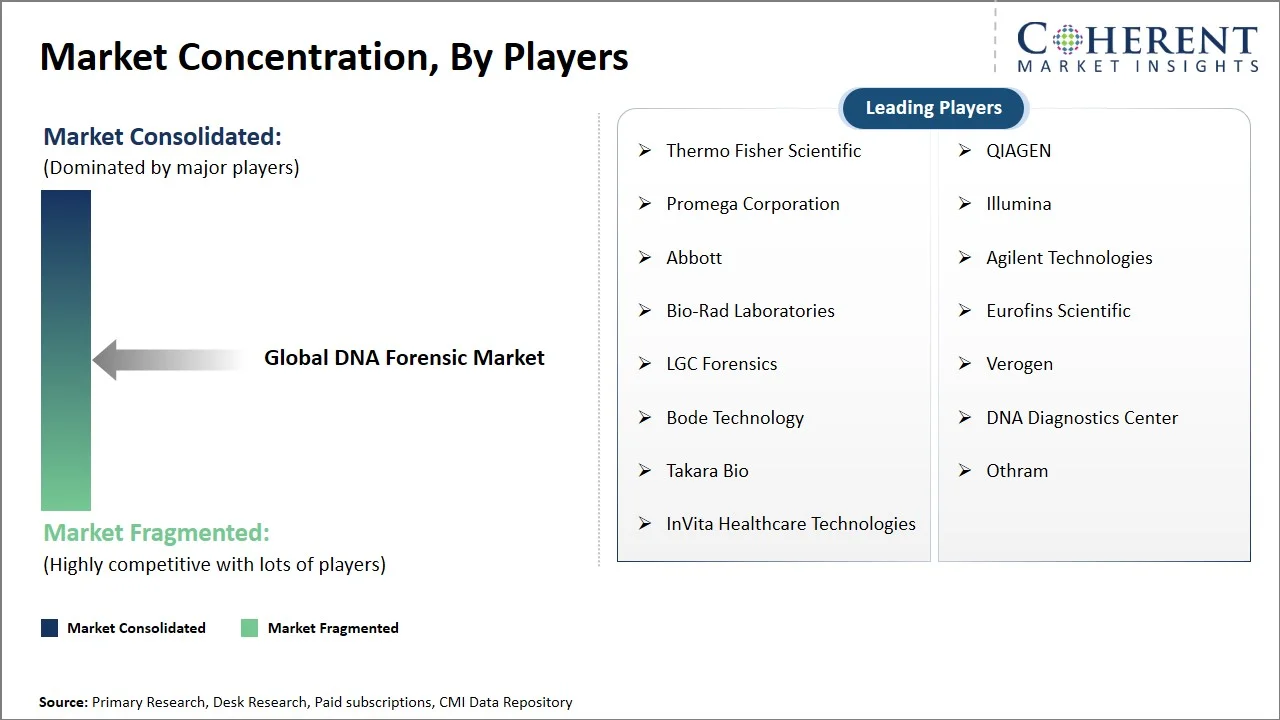
Thermo Fisher Scientific offers integrated forensic workflows using GlobalFiler kits, Applied Biosystems devices, RapidHIT ID and GeneMapper software. Its approach is founded on established workflows, database compatibility, automation and fast analysis. QIAGEN boosts rivalry with Investigator kits, automated extraction and sequencing capabilities from Verogen. PowerPlex 35GY eight-color STR chemistry is part of the PowerPlex systems from Promega. Specialist companies such as Othram focus on forensic genetic genealogy and complex identification cases. The competitive emphasis is shifting toward complete workflows rather than individual instruments.
Market Report Scope
DNA Forensic Market Report Coverage
| Report Coverage | Details | ||
|---|---|---|---|
| Base Year: | 2025 | Market Size in 2026: | USD 3.60 Bn |
| Historical Data for: | 2020 To 2024 | Forecast Period: | 2026 To 2033 |
| Forecast Period 2026 to 2033 CAGR: | 6.3% | 2033 Value Projection: | USD 6 Bn |
| Geographies covered: |
| ||
| Segments covered: |
| ||
| Companies covered: | Thermo Fisher Scientific, QIAGEN, Promega Corporation, Illumina, Abbott, Agilent Technologies, Bio-Rad Laboratories, Eurofins Scientific, LGC Forensics, Verogen, Bode Technology, DNA Diagnostics Center, Takara Bio, Othram, InVita Healthcare Technologies | ||
| Growth Drivers: |
| ||
| Restraints & Challenges: |
| ||
Analyst Opinion (Expert Opinion)
- The industry is expected to shift toward faster, integrated DNA workflows that reduce laboratory dependency. Rapid DNA systems will gain importance for booking stations and field investigations. Next generation sequencing will become more valuable for degraded samples and complex kinship investigations. Forensic genetic genealogy will remain an important specialist application for unresolved cases.
- The strongest opportunities are expected in rapid DNA systems, degraded-sample analysis, and forensic genetic genealogy. The U.S. should remain particularly attractive because of extensive database infrastructure and established laboratory networks. China and India offer substantial opportunities for portable systems and automated laboratory platforms. Also, sexual assault evidence processing is ripe for automated extraction and separation technology.
- Market players should concentrate on end-to-end workflows that integrate extraction, amplification, sequencing, interpretation and database integration. Products should be designed to fit within existing forensic laboratory infrastructure to ease validation challenges. Rapid DNA vendors should focus on FBI-compliant solutions and ease of deployment at booking facilities. Suppliers should also enhance their skills for complicated mixes, damaged samples, and kinship analysis. Working with forensic labs can help accelerate validation, train users and increase adoption.
Speak to the analyst
Want personalized insights?
Take the findings above to one of our principal consultants, or have the report rebuilt around the segments, geographies and competitors you actually track.
Market Segmentation
- Component Insights (Revenue, USD Billion, 2021 - 2033)
- Consumables
- Analyzers and Sequencers
- Software
- Services
- Method Insights (Revenue, USD Billion, 2021 - 2033)
- Polymerase Chain Reaction Amplification
- Capillary Electrophoresis
- Next Generation Sequencing
- Others
- Application Insights (Revenue, USD Billion, 2021 - 2033)
- Criminal Testing
- Paternity and Familial Testing
- Disaster Victim Identification
- Others
- End User Insights (Revenue, USD Billion, 2021 - 2033)
- Law Enforcement Agencies
- Forensic Laboratories
- Research Institutions
- Medical and Research Institutions
- Legal and Judicial Systems
- Others
- Regional Insights (Revenue, USD Billion, 2021 - 2033)
- North America
- U.S.
- Canada
- Latin America
- Brazil
- Argentina
- Mexico
- Rest of Latin America
- Europe
- Germany
- U.K.
- Spain
- France
- Italy
- Russia
- Rest of Europe
- Asia Pacific
- China
- India
- Japan
- Australia
- South Korea
- ASEAN
- Rest of Asia Pacific
- Middle East
- GCC Countries
- Israel
- Rest of Middle East
- Africa
- South Africa
- North Africa
- Central Africa
- North America
- Key Players Insights
- Thermo Fisher Scientific
- QIAGEN
- Promega Corporation
- Illumina
- Abbott
- Agilent Technologies
- Bio-Rad Laboratories
- Eurofins Scientific
- LGC Forensics
- Verogen
- Bode Technology
- DNA Diagnostics Center
- Takara Bio
- Othram
- InVita Healthcare Technologies
Sources
Primary Research Interviews
- Forensic Scientists & DNA Analysts
- Law Enforcement & Investigative Agencies Representatives
- Forensic Laboratory Directors & Technicians
- Legal & Regulatory Compliance Experts
Magazines
- Forensic Magazine
- Scientific American (Forensic Science Section)
- Forensic Science International Magazine
Journals
- Journal of Forensic Sciences
- International Journal of Legal Medicine
- Forensic Science International: Genetics
Associations
- American Academy of Forensic Sciences (AAFS)
- International Society for Forensic Genetics (ISFG)
- European Network of Forensic Science Institutes (ENFSI)
- National Forensic Science Technology Center (NFSTC)
Public Domain Sources
- U.S. Department of Justice (DOJ) – Forensic Science Reports
- National Institute of Standards and Technology (NIST) – DNA Forensics
- World Health Organization (WHO) – Biotechnology & Forensics Reports
Proprietary Elements
- CMI Data Analytics Tool
- Proprietary CMI Existing Repository of Information for the Last 10 Years
Get access to 250+ pages report
Every segment, forecast, competitor profile and data table behind the analysis above — available for instant download.
- ESOMAR Member
- ISO 9001:2015 Certified
- D-U-N-S Registered
- GDPR & CCPA Compliant
Missing comfort of reading report in your local language? Find your preferred language:
Transform your Strategy with Exclusive Trending Reports
Frequently Asked Questions
The global DNA Forensic market is expected to stand at USD 3.60 Bn in 2026 and is expected to reach USD 6 Bn by 2033.
The CAGR of the global DNA forensic market is projected to be 6.3% from 2026 to 2033.
DNA forensics uses genetic material to identify individuals and connect biological evidence with investigations.
They allow qualifying samples to be processed closer to booking facilities and investigative locations.
Next Generation Sequencing enables deeper analysis of complex, degraded, and challenging forensic samples.
Artificial Intelligence can assist interpretation of complex DNA mixtures and improve analytical workflow efficiency.
Forensic genetic genealogy combines DNA analysis with genealogical information to investigate unidentified individuals.