

Global Elderly Walker Market Size and Forecast – 2026 to 2033
The global elderly walker market is estimated to be valued at USD 1.97 Bn in 2026 and is expected to reach USD 3.39 Bn by 2033, exhibiting a compound annual growth rate (CAGR) of 8.1% from 2026 to 2033. This steady growth reflects the increasing demand for elderly disabled assistive device driven by a rising aging population and heightened awareness of eldercare products worldwide.
Key Takeaways of the Global Elderly Walker Market
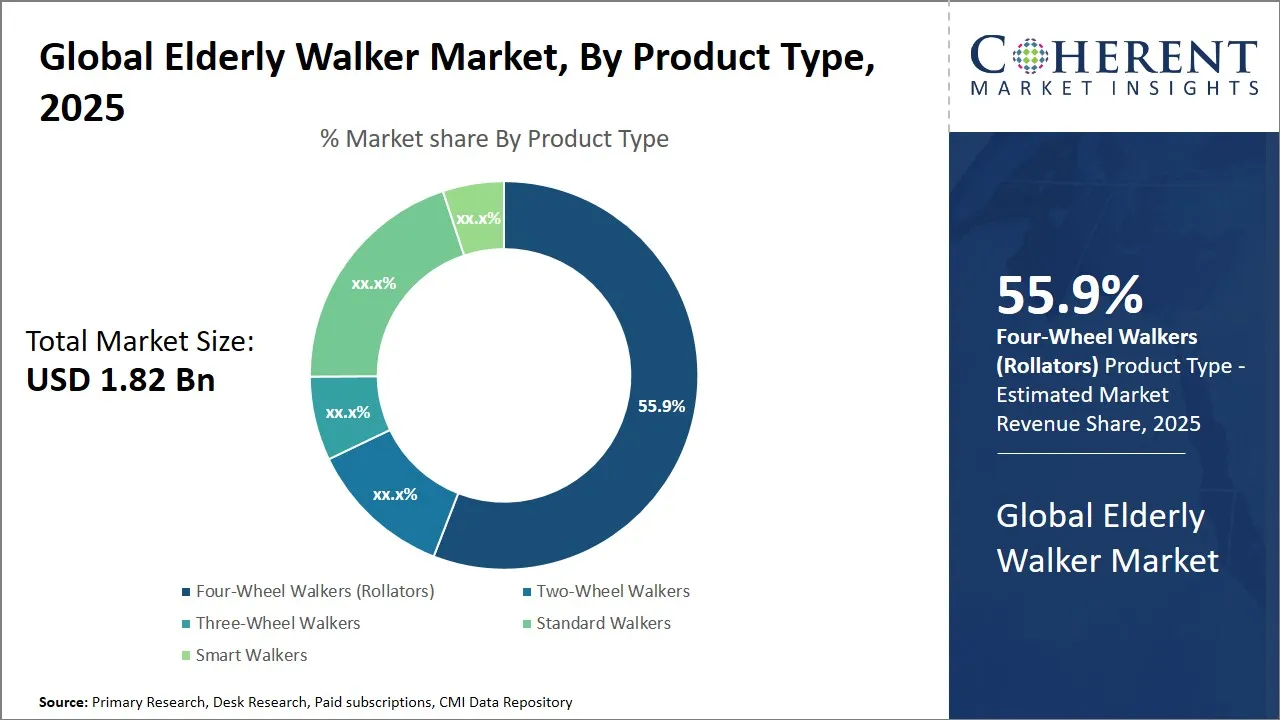
- In 2026, the four-wheel walkers (rollators) segment is projected to account for 56.9 % share in 2026.
- By material, the aluminum walkers segment is expected to lead with a 43.5 % share in 2026.
- By feature, the folding walkers segment is projected to hold 33.2 % share in 2026.
- North America is expected to lead the market, holding a share of 39.3 % in 2026. Asia Pacific is anticipated to be the fastest-growing region, with an estimated market share of 24.2% in 2026.
Market Overview
Market trends indicate a shift towards technologically advanced elderly walkers equipped with features such as enhanced stability, ergonomic designs, and smart sensors for fall detection. Additionally, growing preference for lightweight and foldable walkers is influencing product development. Increased healthcare infrastructure investments and supportive government policies further propel the market expansion, catering to a wider demographic seeking better mobility solutions and improved quality of life.
Current Events and Its Impact
Current Events | Description and its Impact |
Increase in Chronic Diseases Affecting Mobility |
|
Technological Advancements in Smart Walkers |
|
Segmental Insights
- Current Industry Events of 2026
- Market Size Estimation
- Regional Breakdown
- Competitive Landscape
- Customer Intelligence
- Segmental Analysis
- Pricing Analysis
- Key Market Drivers, Challenges & Future Trends
- Customized Insights Section
Elderly Walker Market Insights, by Product Type - Four-Wheel Walkers (Rollators) are Leading the Market with Unmatched Stability and Convenience
The four-wheel walkers (rollators) segment is expected to capture 56.9% share in 2026, due to their superior stability, enhanced mobility, and user-friendly features. The critical driving factor behind the popularity of rollators is their four-wheel design, which offers enhanced balance and support compared to other walker types. This design allows elderly users to maintain steady movement without the risk of frequent trips or falls, a paramount concern for aging individuals seeking safe ambulation aids.
Additionally, rollators typically come equipped with brakes on the rear wheels, allowing users to control their walking pace and pause securely when needed. This feature is especially vital for elderly users who may experience sudden fatigue or require moments of rest while walking indoors or outdoors.
For example, Mikirad, a family-owned company with over 35 years of expertise in orthopedic and rehabilitation equipment, is well recognized across Europe and international markets for its high-quality, EU-certified mobility aids. Among its portfolio of crutches, canes, and pediatric support devices, the 4-Wheel Mobility Walker 20/MR.4k stands out as a lightweight, foldable, and height-adjustable solution designed for elderly users.
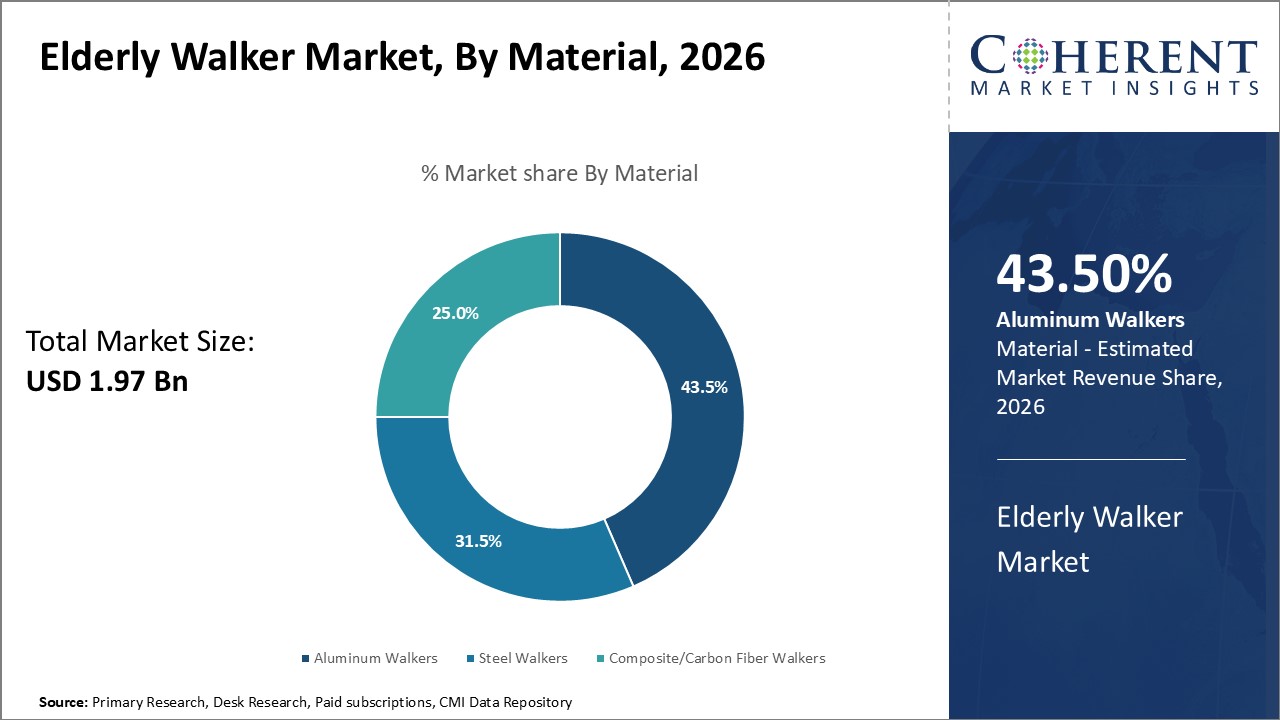
Elderly Walker Market Insights, by Material - Aluminum Walkers Segment Leads the Market due to Preferred Material Choice for Lightweight and Durable Mobility Solutions
The aluminum walkers segment is projected to hold 43.5% in 2026, driven by the material’s excellent balance of weight, strength, and corrosion resistance. Aluminum’s lightweight nature is critical for elderly users who may have limited upper body strength or endurance. A lighter walker is easier to lift, maneuver, and transport, which encourages consistent use and greater mobility independence.
In addition to weight, aluminum’s durability plays a significant role in its widespread adoption. The material withstands regular wear and tear, including exposure to weather elements such as moisture, without rusting. This characteristic is particularly advantageous for elderly individuals who frequently use their walkers outdoors or in humid environments. The long-lasting quality of aluminum reduces the need for frequent replacements and maintenance costs, offering a practical and economical choice for end users.
Elderly Walker Market Insights, by Feature - Folding Walkers Segment is Driving Convenience and Portability for Elderly Mobility
The folding walkers segment is expected to lead with a share of 33.2% in 2026, owing to their exceptional convenience with portability and space-saving design. The appeal of foldable walkers stems from the growing lifestyle demands of elderly users who require mobility solutions that integrate seamlessly with their daily routines, including travel, storage, and ease of transport.
Folding walkers are engineered to collapse into a compact form, enabling users and caregivers to easily store them in car trunks, closets, or small living areas without hassle. This portability supports active aging episodes where seniors wish to maintain social and recreational engagements outside the home, as they can conveniently carry their walker to social outings, medical appointments, or vacations.
Regional Insights
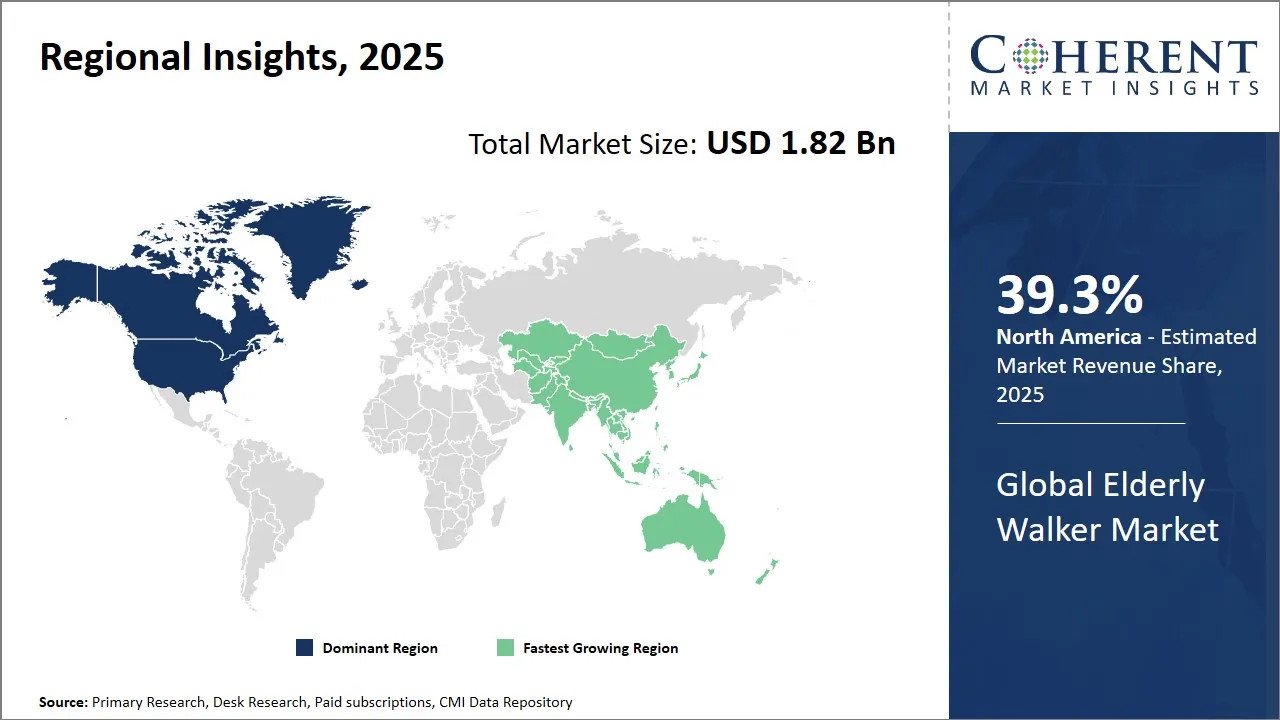
North America Elderly Walker Market Analysis and Trends
The North America region is projected to lead the market with a 39.3% share in 2026. The region benefits from a mature healthcare infrastructure and strong presence of medical device manufacturers who emphasize innovation and quality. Government policies, such as Medicare and Medicaid reimbursement programs, enhance affordability and access to mobility aids for the elderly population. Furthermore, North America's established distribution channels, including specialized medical equipment retailers and e-commerce platforms, facilitate widespread product availability.
For example, GF Health Products, through its Lumex brand, offers standard walkers, rollators, and specialty mobility aids. The company’s primary market is North America, with a focus on hospital-grade and bariatric mobility equipment. Similarly, Compass Health Brands, through Carex, provides mobility walkers, folding walkers, and rollators designed for homecare use. Their products are widely available across the U.S. and Canada, focusing on affordable and practical designs.
Asia Pacific Elderly Walker Market Analysis and Trends
The Asia Pacific region is expected to exhibit the fastest growth in the elderly walker market with a share of 24.2% in 2026, fueled by rapidly aging populations in countries like Japan, China, and India. Expanding healthcare infrastructure, rising middle-class incomes, and increasing governmental focus on elderly care promote market expansion. Regional governments are introducing policies to support senior citizens, including subsidies and public health initiatives aimed at enhancing mobility and independence. The industry ecosystem here is evolving, with both international corporations and emerging local manufacturers, such as Ossenberg and Fuji Medical Instruments, establishing strong footholds.
For example, Rehasense is a Luxembourg-based company with a strong presence across Europe and Asia Pacific. It manufactures lightweight walkers and rollators with modern Scandinavian-inspired designs, focusing on comfort, stability, and style.
Elderly Walker Market Outlook for Key Countries
U.S. Elderly Walker Market Analysis and Trends
The U.S. leads the North America elderly walker market, driven by an advanced healthcare system and extensive insurance coverage for mobility aids. Major companies like Drive DeVilbiss and Invacare continuously introduce product innovations including ergonomic designs and lightweight materials that address patient mobility challenges. Strong retail networks and home healthcare services expand product reach. Government programs supporting the elderly empower consumer purchasing decisions, sustaining the consistent demand.
For example, Drive DeVilbiss Healthcare, a leading global manufacturer of durable medical equipment, Drive DeVilbiss offers a wide range of walkers, rollators, and mobility aids. The company operates extensively across North America, Europe, and Asia Pacific, focusing on ergonomic and lightweight aluminum rollators designed for both homecare and institutional use.
Japan Elderly Walker Market Analysis and Trends
Japan elderly walker market is fueled by one of the world’s highest proportions of older adults. The country’s healthcare policies emphasize elder independence, fostering innovation in mobility aids such as compact, multifunctional walkers designed for urban lifestyles. Local manufacturers like Fuji Medical Instruments, alongside international brands, collaborate to produce technologically advanced, easy-to-use walkers. Government subsidies and robotics integration further propel the market growth and product sophistication.
In March 2023, Toyota Motor Corporation, a leading Japanese automaker, launched the C+walk S in Japan, a walking-assistance mobility vehicle designed to support elderly walker users and others who face difficulty covering longer distances. At the same time, Toyota updated its standing-type C+walk T to comply with new Road Traffic Act rules and enhanced the compact electric C+pod with improved braking, reflecting its broader “Mobility for All” initiative to expand independence and daily mobility for Japan’s aging population.
China Elderly Walker Market Analysis and Trends
China growing elderly population and rapid urbanization create vast opportunities within the elderly walker market. Increasing awareness of elder care and expanding health insurance schemes improve product accessibility. Both domestic manufacturers, such as Yuyue Medical Equipment & Supply, and global companies are rapidly expanding distribution. E-commerce platforms play a pivotal role in the market outreach, while government initiatives promote aging-in-place solutions, encouraging mobility aid adoption.
Germany Elderly Walker Market Analysis and Trends
Germany elderly walker market benefits from a robust medical device industry backed by stringent regulatory frameworks ensuring product quality and safety. Healthcare reimbursement policies support consumer access, and a strong network of orthopedic and rehabilitation centers enhances the demand. Notable companies, including Ottobock, contribute with high-precision and customizable walking aids. The aging population coupled with government-led aging-at-home strategies sustains the market stability and growth.
Sunrise Medical, headquartered in Germany, markets its rollators under the Gemino brand. The company operates globally, especially in Europe and North America, offering premium lightweight rollators with ergonomic grips, foldable frames, and design customization.
End User Feedback and Unmet Needs - Elderly Walker Market
- Feedback from elderly walker users and stakeholders in the healthcare ecosystem consistently reflects a blend of appreciation for enhanced mobility and frustration over persisting limitations. On the positive side, many users value the lightweight aluminum frames and foldable designs that make storage and travel easier. For example, hospital administrators in North America report strong satisfaction with walkers that feature integrated seats and storage compartments, since these reduce patient fatigue during rehabilitation sessions and improve independence. Similarly, caregivers highlight the role of ergonomic grips and adjustable height settings in reducing strain and making devices adaptable to users of varying builds. These practical features have significantly improved acceptance of walkers in both institutional and homecare settings, reinforcing their importance as essential mobility aids for aging populations.
- Yet recurring concerns also surface in end user feedback. Government-supported rehabilitation programs in Europe often cite affordability challenges, noting that advanced walkers with smart sensors or braking systems remain out of reach for lower-income groups. Industrial care facilities in Asia Pacific have raised issues around durability, pointing out that frequent wear on wheels and brake mechanisms increases replacement costs and disrupts continuity of care. These limitations point to unmet needs around affordability, customization for different terrains, and integration of digital features such as fall detection without inflating product costs. Addressing these concerns could open new growth opportunities for manufacturers by expanding access in emerging economies, while also inspiring innovation in design and materials. For policymakers, supporting subsidies or public-private partnerships could improve adoption rates, and for developers, refining technology to balance safety with affordability may prove key to long-term market growth and user satisfaction.
Market Players, Key Developments, and Competitive Intelligence
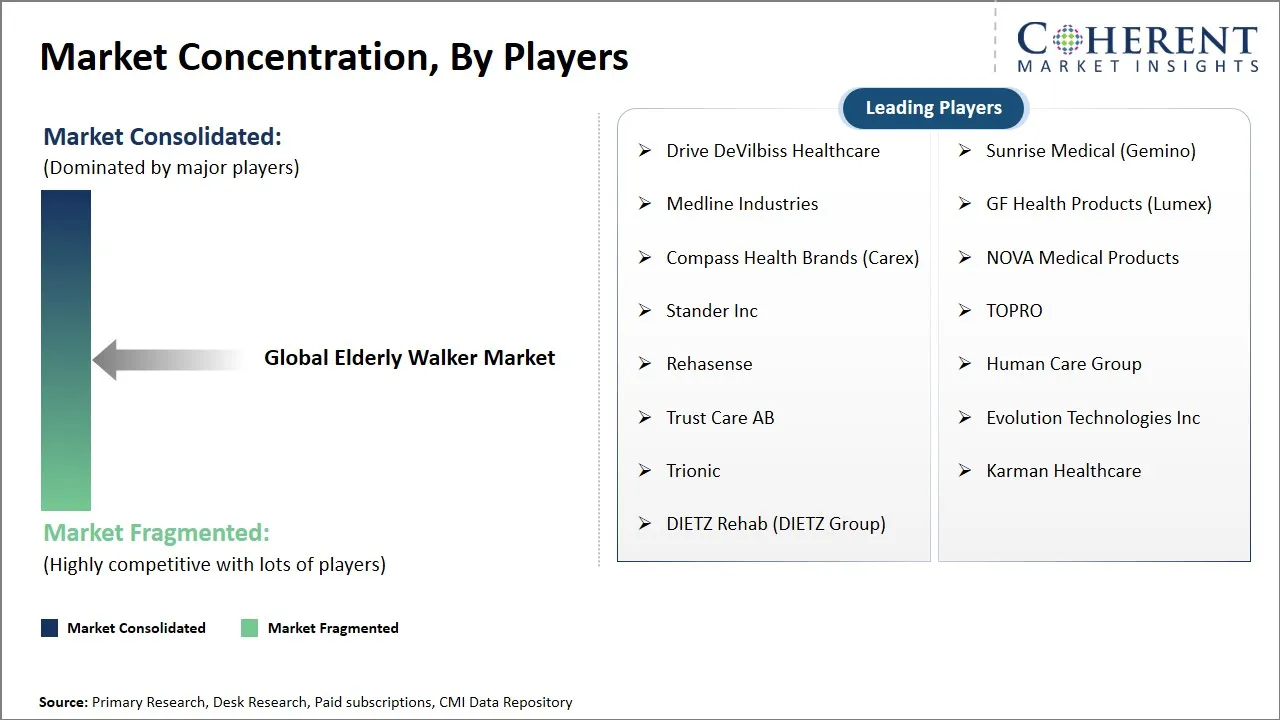
Key Developments
- In November 2024, WalkSafe, a student-led project by Mr. Shubham Shreshth and Mr. Jaswanth Buddha under the guidance of Prof. Amaresh Chakrabarti and Dr. Abhijit Biswas at the Indian Institute of Science, Bangalore, India introduced a smart assistive retrofit device for elderly walkers. Designed to address the high rate of fall injuries linked to walkers estimated at over 47,000 annually in the U.S. the device detects abnormal angular velocity and angle changes, then triggers an actuator that deploys spring-loaded support legs to stabilize the walker and prevent falls. This novel system, which combines fall detection with active balance recovery, represents a first-of-its-kind innovation in assistive mobility technology aimed at improving elderly safety and confidence in daily movement.
- In August 2024, GreenPioneer Mobility India, a healthcare and rehabilitation solutions provider, launched ‘NonStop,’ its first retail experience store offering a wide range of mobility aids from elderly walkers and wheelchairs to advanced rehabilitation and assistive devices. The company plans to expand NonStop across major metros including Hyderabad, Kochi, Bengaluru, Mumbai, and Delhi, combining international brands like WHILL from Japan, MEXPLE and iWalk from the U.S., and AiroMEDIC with interactive showrooms and online platforms to improve accessibility and quality of life for the elderly, people with disabilities, and patients in recovery.
- In July 2024, healthcare professionals, including therapists, nurses, and senior care specialists, recognized Drive Medical, a U.S.-based mobility and healthcare products company, among the top performers in the elderly walker segment. The Drive Medical Hugo Elite Rollator Walker was named the best overall choice for its padded seat, convenient storage, and foldable design. Meanwhile, the Drive Medical 10210-1 2-Button Folding Walker earned recognition as the most budget-friendly option, and the Drive Medical 10257RD-1 4-Wheel Rollator Walker was highlighted as the best walker with a seat.
Top Strategies Followed by Global Elderly Walker Market Players
- Established players dominate the landscape by heavily investing in research and development (R&D) to create high-performance products that cater to the evolving needs of elderly users. These companies prioritize enhancing product ergonomics, durability, and incorporating smart features, such as adjustable frames and integrated sensors, to improve mobility and safety. Furthermore, they form strategic partnerships with major industry players and Original Equipment Manufacturers (OEMs) to bolster their market presence and leverage shared expertise.
- For instance, Drive Devilbiss International, consistently invested in ergonomic and lightweight rollators with integrated storage solutions, while Invacare Corporation partners with rehabilitation centers worldwide to expand its distribution footprint. Similarly, TOPRO (Norway) has introduced smart rollators with adjustable frames and mobility-monitoring sensors, reflecting the trend of embedding digital technologies.
- Mid-level players in the elderly walker market typically focus on offering cost-effective solutions that strike a balance between quality and affordability, aiming to attract price-sensitive consumers without compromising on reliability or safety features. These companies emphasize practical and user-friendly designs with adequate support and lightweight materials, making their products accessible to a broader demographic. To enhance their production capability and technology adoption, mid-level players increasingly engage in collaborative ventures with manufacturing firms or technology partners.
- For example, Medline Industries offers budget-friendly aluminum walkers widely used in hospitals and care homes across North America and Europe. Similarly, Karma Medical (Taiwan) manufactures affordable yet durable walkers that are exported to Southeast Asia and Middle Eastern markets, ensuring affordability without compromising safety. Partnerships, like Karma’s tie-ups with rehabilitation equipment distributors, highlight how mid-tier players enhance regional accessibility.
- Small-scale players in the global elderly walker market focus on carving out specialized niches by developing unique features or highly innovative products tailored to specific customer segments. These companies often adopt cutting-edge technologies such as lightweight carbon fiber materials, smart navigation systems, or compact foldable designs that cater to niche requirements. By concentrating on innovation, they differentiate themselves from larger competitors and appeal to consumers looking for bespoke or highly specialized mobility solutions.
- For example, ByACRE (Denmark), carved a niche in the luxury mobility aid segment with its carbon fiber rollators, marketed as the lightest in the world. Another example is Zeal Lifestyle (U.K.), which recently launched its stylish “Zeal Walker” that combines modern aesthetics with foldability and customization, targeting elderly consumers seeking both function and fashion. Small players also collaborate with healthcare providers and startups to penetrate the local markets.
Market Report Scope
Elderly Walker Market Report Coverage
| Report Coverage | Details | ||
|---|---|---|---|
| Base Year: | 2025 | Market Size in 2026: | USD 1.97 Bn |
| Historical Data for: | 2020 To 2024 | Forecast Period: | 2026 To 2033 |
| Forecast Period 2026 to 2033 CAGR: | 8.1% | 2033 Value Projection: | USD 3.39 Bn |
| Geographies covered: |
| ||
| Segments covered: |
| ||
| Companies covered: | Drive DeVilbiss Healthcare, Sunrise Medical (Gemino), Medline Industries, GF Health Products (Lumex), Compass Health Brands (Carex), NOVA Medical Products, Stander Inc, TOPRO, Rehasense, Human Care Group, Trust Care AB, Evolution Technologies Inc, Trionic, Karman Healthcare, and DIETZ Rehab (DIETZ Group) | ||
| Growth Drivers: |
| ||
| Restraints & Challenges: |
| ||
Elderly Walker Market Dynamics
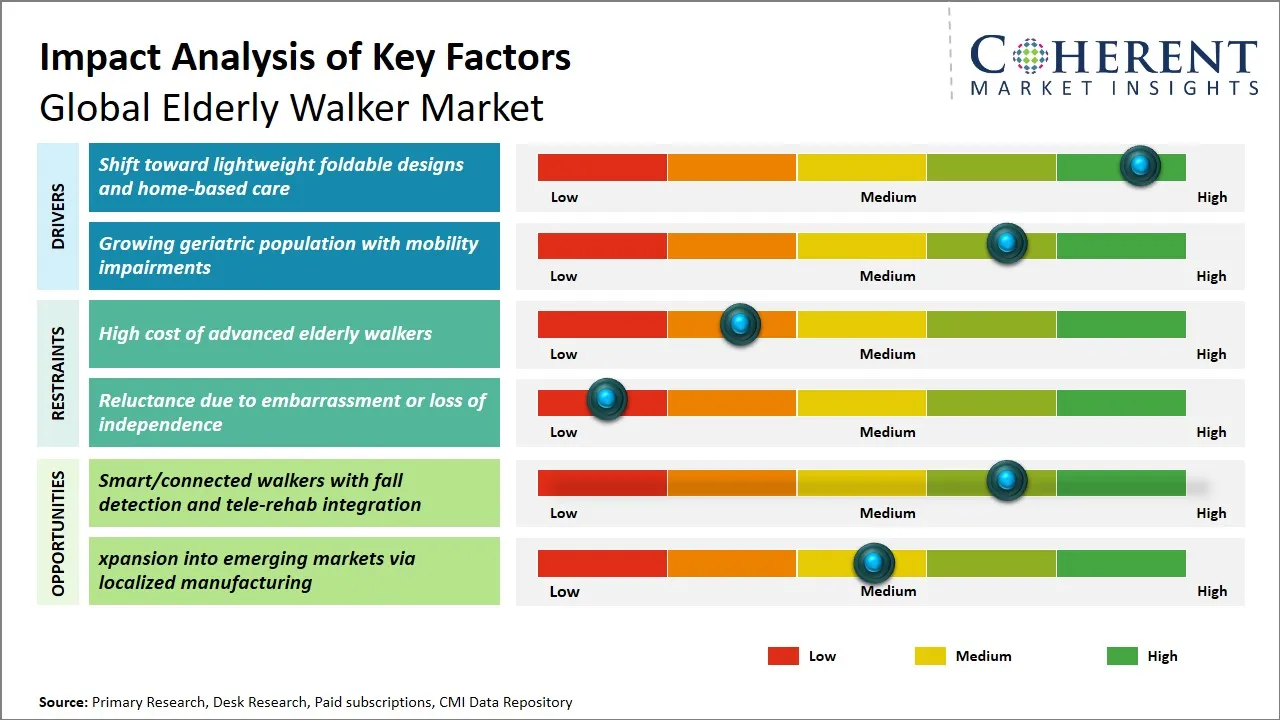
Elderly Walker Market Driver - Shift Toward Lightweight Foldable Designs and Home-Based Care
The growing preference for lightweight, foldable elderly walkers is significantly influencing the design and development trends within the global market. As mobility solutions increasingly target ease of use and convenience, manufacturers are focusing on creating walkers that are easier to carry, store, and maneuver, particularly for seniors who live independently or require assistance primarily within home environments. This shift aligns closely with the broader trend of home-based care, where the demand for mobility aids that seamlessly integrate into domestic settings is rising. Lightweight materials such as aluminum and carbon fiber, combined with innovative folding mechanisms, allow users to effortlessly transport and store walkers without compromising durability or stability.
In July 2025, Zeal Lifestyle, a young British brand founded by retail designer Ms. Georgia Williams and industrial designer Mr. Joshua King, unveiled its first luxury mobility aid, the Zeal walker. Designed after four years of collaboration with users, the smart, lightweight, and colourful rollator aims to redefine mobility support by blending independence with style. Each unit is handcrafted in the company’s Surrey workshop, fully customizable in shades from minimalist white to bold pastels, with matching vegan leather seats, wheels, and accessories.
Elderly Walker Market Opportunity - Smart/Connected Walkers with Fall Detection and Tele-Rehab Integration
The advent of smart and connected walkers presents a significant growth opportunity within the global elderly walker market, driven by the increasing the demand for advanced mobility aids that enhance safety and healthcare outcomes for aging populations. These next-generation walkers, equipped with fall detection sensors and real-time connectivity features, enable immediate alerts to caregivers or emergency services, thereby reducing the risk and severity of injuries resulting from falls. The integration of tele-rehabilitation technology further augments the value proposition by facilitating remote monitoring and personalized therapy sessions, allowing healthcare providers to track patient progress and adjust treatment plans without requiring frequent in-person visits.
For example, Camino, a health-tech company developing advanced mobility aids, announced the launch of its smart electric-powered walker, Camino One, available through an exclusive first mover waitlist. The device promises intelligent support features including boost, braking, and obstacle detection, designed to keep users active and independent. The company is offering guaranteed early access, a USD 500 discount on the list price of USD 2,999, subscription plans starting at USD 50 per month, and support through State Assistive Technology Program low-interest loans.
Analyst Opinion (Expert Opinion)
- The global elderly walker market is expanding steadily as aging populations worldwide seek safer, more reliable mobility solutions. The demand is being fueled by ongoing technological improvements, such as smart walkers with fall detection and GPS navigation, along with strong regulatory support for medical device safety standards. At the same time, opportunities are opening up in emerging economies where awareness of elderly mobility care is rising, though cost and reimbursement gaps remain a challenge. Conferences like Medica in Germany, Arab Health in Dubai, and Rehacare International have, over the past few years, provided crucial platforms for introducing advanced mobility aids and sparking conversations among manufacturers, healthcare providers, and policymakers about accessibility and affordability.
- On the ground, several notable initiatives are shaping market momentum. For instance, governments in Europe and North America continue to extend insurance coverage for assistive devices, while Asian markets are rolling out community-based elder care programs that encourage adoption of walkers and rollators. Companies such as Drive DeVilbiss and Invacare have also piloted lightweight foldable models designed for home use and travel, improving both comfort and convenience for users. These instances highlight how collaboration between manufacturers, regulators, and healthcare systems is not only driving innovation but also ensuring that elderly walkers are more widely available and better aligned with the real needs of older adults.
Speak to the analyst
Want personalized insights?
Take the findings above to one of our principal consultants, or have the report rebuilt around the segments, geographies and competitors you actually track.
Market Segmentation
- Product Type Insights (Revenue, USD Bn, 2021 - 2033)
- Four-Wheel Walkers (Rollators)
- Two-Wheel Walkers
- Three-Wheel Walkers
- Standard Walkers
- Smart Walkers
- Material Insights (Revenue, USD Bn, 2021 - 2033)
- Aluminum Walkers
- Steel Walkers
- Composite/Carbon Fiber Walkers
- Feature Insights (Revenue, USD Bn, 2021 - 2033)
- Folding Walkers
- Non-Folding Walkers
- Lightweight Walkers
- Heavy-Duty/Bariatric Walkers
- Walkers with Seats/Storage Attachments
- Fixed Height Walkers
- Adjustable Height Walkers
- Weight Capacity Insights (Revenue, USD Bn, 2021 - 2033)
- Standard Capacity (up to 300 lbs)
- Bariatric/Heavy-duty (over 300 lbs)
- Application Insights (Revenue, USD Bn, 2021 - 2033)
- Geriatric Population (age-related mobility issues)
- Post-Surgery Patients (e.g., hip or knee replacement)
- Disabled Individuals (chronic mobility impairment)
- Others (temporary injuries, neurological conditions)
- Gender Insights (Revenue, USD Bn, 2021 - 2033)
- Female
- Male
- End User Insights (Revenue, USD Bn, 2021 - 2033)
- Hospitals and Clinics
- Rehabilitation Centers
- Nursing Homes and Assisted Living Facilities
- Homecare Settings
- Specialty Clinics (Orthopedic, Geriatric)
- Regional Insights (Revenue, USD Bn, 2021 - 2033)
- North America
- U.S.
- Canada
- Latin America
- Brazil
- Argentina
- Mexico
- Rest of Latin America
- Europe
- Germany
- U.K.
- Spain
- France
- Italy
- Russia
- Rest of Europe
- Asia Pacific
- China
- India
- Japan
- Australia
- South Korea
- ASEAN
- Rest of Asia Pacific
- Middle East
- GCC Countries
- Israel
- Rest of Middle East
- Africa
- South Africa
- North Africa
- Central Africa
- North America
- Key Players Insights
- Drive DeVilbiss Healthcare
- Sunrise Medical (Gemino)
- Medline Industries
- GF Health Products (Lumex)
- Compass Health Brands (Carex)
- NOVA Medical Products
- Stander Inc
- TOPRO
- Rehasense
- Human Care Group
- Trust Care AB
- Evolution Technologies Inc
- Trionic
- Karman Healthcare
- DIETZ Rehab (DIETZ Group)
Sources
Primary Research Interviews
Industry Stakeholders list
- R&D heads at mobility-aid manufacturers
- Product managers for walkers/rollators
- Regulatory affairs specialists (FDA/MHRA/CE)
- Hospital procurement managers (rehab & geriatrics)
- DME/HME distributors & service providers
- Rehabilitation engineers/clinicians (e.g., RESNA members)
End Users list
- Geriatric patients using standard walkers
- Older adults using rollators/four-wheel walkers
- Caregivers and family members
- Physiotherapists and occupational therapists
- Nursing home and assisted-living administrators
- Home health nurses and visiting therapists
Government and International Databases
- WHO Global Health Observatory (GHO)
- World Bank Open Data
- UN DESA World Population Prospects
- UN Comtrade Database
- Eurostat (Health & Ageing)
- U.S. FDA MAUDE Adverse Event Database
Trade Publications
- Medical Device & Diagnostic Industry (MDDI)
- MedTech Dive
- HME Business
- Mobility Management
- HomeCare Magazine
- Rehab Management
Academic Journals
- Assistive Technology
- Disability and Rehabilitation: Assistive Technology
- Archives of Physical Medicine and Rehabilitation
- Gait & Posture
- Age and Ageing
- Journal of Aging and Health
Reputable Newspapers
- The New York Times
- The Guardian
- Financial Times
- The Wall Street Journal
- The Times (U.K.)
- The Hindu
Industry Associations
- RESNA (Rehabilitation Engineering and Assistive Technology Society of North America)
- BHTA (British Healthcare Trades Association)
- MedTech Europe
- AdvaMed (Advanced Medical Technology Association)
Public Domain Resources
- WHO IRIS
- NCBI Bookshelf
- OpenStreetMap
- Internet Archive
Proprietary Elements
- CMI Data Analytics Tool: Proprietary analytics tool to analyze real-time market trends, consumer behavior, and technology adoption in market
- Proprietary CMI Existing Repository of Information for Last 8 Years
Get access to 250+ pages report
Every segment, forecast, competitor profile and data table behind the analysis above — available for instant download.
- ESOMAR Member
- ISO 9001:2015 Certified
- D-U-N-S Registered
- GDPR & CCPA Compliant
Missing comfort of reading report in your local language? Find your preferred language:
Transform your Strategy with Exclusive Trending Reports
Frequently Asked Questions
The global elderly walker market is estimated to be valued at USD 1.97 Bn in 2026 and is expected to reach USD 3.39 Bn by 2033.
The CAGR of the global elderly walker market is projected to be 8.1% from 2026 to 2033.
Shift toward lightweight foldable designs and home-based care and growing geriatric population with mobility impairments are the major factors driving the growth of the global elderly walker market.
High cost of advanced elderly walkers and reluctance due to embarrassment or loss of independence are the major factors hampering the growth of the global elderly walker market.
In terms of product type, the four-wheel walkers (rollators) segment is estimated to dominate the market revenue share in 2026.
The market is expected to grow steadily, supported by technological innovation and an expanding elderly base.
Physiotherapists often recommend walkers as part of rehabilitation and mobility improvement plans.