

Global Electric Fuse Market Size and Forecast – 2026-2033
The global electric fuse market is estimated to be valued at USD 8.46 Bn in 2026 and is expected to reach USD 13.24 Bn by 2033, exhibiting a compound annual growth rate (CAGR) of 6.6% from 2026 to 2033.
Key Takeaways of the Global Electric Fuse Market
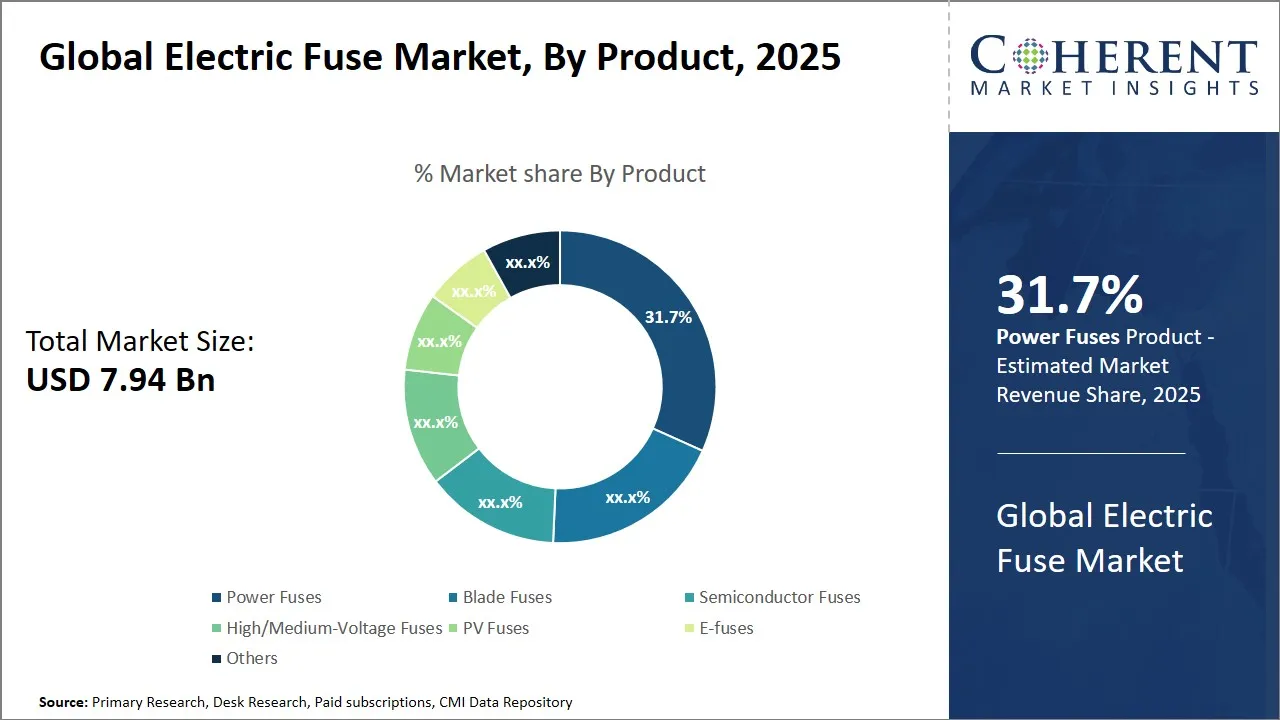
- The power fuses segment is expected to lead the market holding a share of 32.7% in 2026.
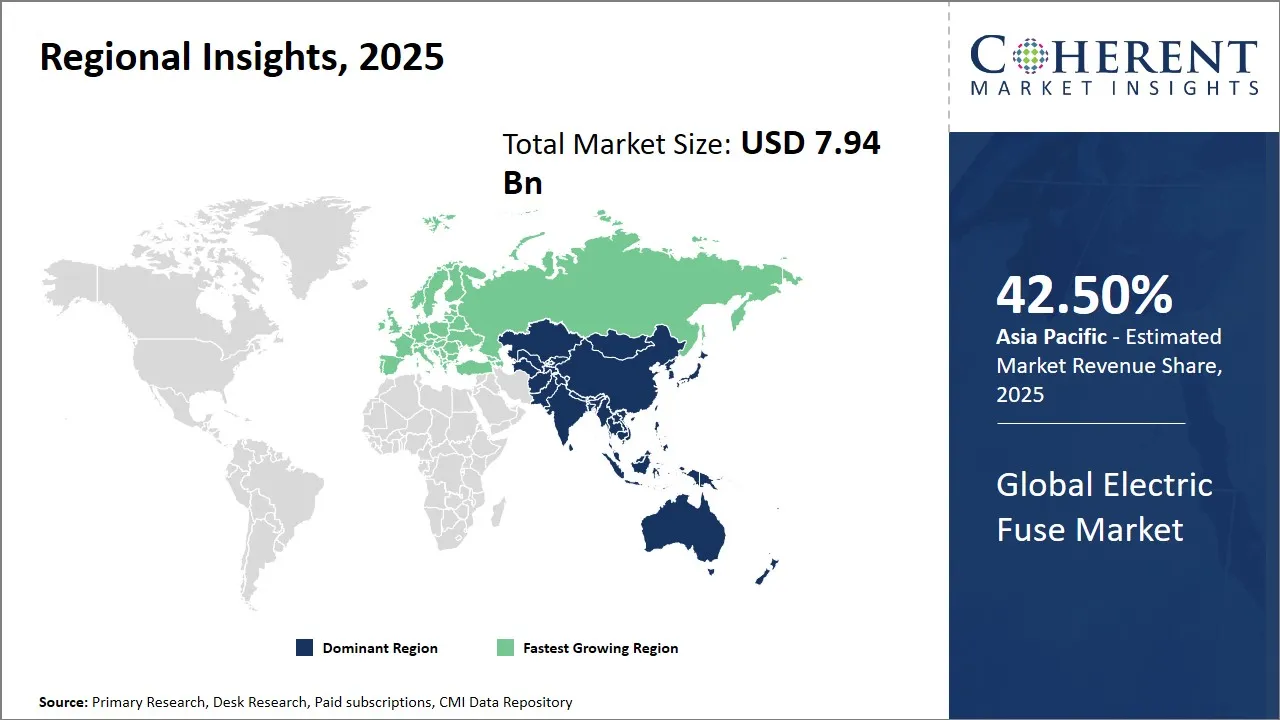
- Asia Pacific, holding an estimated share of 42.5% in 2026, and projected to dominate the market.
- Europe, holding a projected share of 20. 7% in 2026, and shows the fastest growth in the market.
Market Overview
The market sees a growing preference for smart and eco-friendly fuses that offer improved performance and sustainability. Use of IoT and digital monitoring capabilities in electric fuses is gaining traction, enabling real-time diagnostics and predictive maintenance. Also, the move toward miniaturization and improved safety standards is influencing product innovation, while emerging economies present new growth opportunities due to rapid industrialization and electrification efforts.
Current Events and Its Impact
Current Events | Description and its Impact |
U.S. Inflation Reduction Act (IRA)/EV policy shifts |
|
Bipartisan Infrastructure Law & U.S. grid modernization funding |
|
EU Battery Regulation (Reg. (EU) 2023/1542) and tighter battery safety/traceability rules |
|
Segmental Insights
- Current Industry Events of 2026
- Market Size Estimation
- Regional Breakdown
- Competitive Landscape
- Customer Intelligence
- Segmental Analysis
- Pricing Analysis
- Key Market Drivers, Challenges & Future Trends
- Customized Insights Section
Global Electric Fuse Market Insights, By Product – Robust Industrial and Utility Demand Drives Power Fuses Segment Growth
Power fuses are expected to hold the largest share of 32.7% in the global electric fuse market in 2026, because of their vital role in protecting high-voltage electrical systems across industrial, commercial, and utility sectors. Their ability to interrupt fault currents allows for reliable operation in power distribution networks where uptime and safety are critical.
A big growth driver is the global focus on grid reliability and safety. With rising electricity demand and renewable energy integration, utilities require dependable overcurrent protection to prevent transformer and switchgear failures. For instance, Eaton’s Bussmann series power fuses have been used a lot in U.S. and European grid-modernization projects to enhance network safety and fault isolation.
Fast industrialization and urbanization in emerging economies are also pushing large-scale electrical infrastructure development. Power fuses are preferred in power plants, substations, and heavy manufacturing because of their high fault-current tolerance and durability. Smart grid expansion further accelerates replacement of legacy fuses with modern, high-performance designs.
Technological advancements, such as compact, faster-acting fuses with improved coordination alongside circuit breakers, are boosting efficiency and safety. Combined with strict regulatory standards, these innovations add to the continued dominance of the power fuse segment in the global electric fuse market.
Pricing Analysis of the Global Electric Fuse Market
Product/Fuse Type | Representative Product | Actual/Typical Price (USD) |
Low-voltage industrial fuse (~16 A/500 V class gG) – e.g., Eaton Bussmann C10G25 Fuse | C10G25 class gG 25 A, 500 V | USD 18.06 each (1-unit) |
Mid-voltage industrial power fuse (~60 A/600 V) – e.g., Eaton CubeFuse TCF60 60 A/600 V | TCF60 series | USD 186.48 each (1-unit) |
High-voltage/utility grade fuse (~250 A/690 V) – e.g., BAZJHH /GL 250A 690V Fuse | 250 A, 690 V fuse | USD ~300 |
Very high-capacity fuse (e.g., 2000 A/600 V) – auction listing | Bussmann KRP-C-2000SP Low-Peak 2000A 600V | ~ USD 499.99 for one unit |
Estimated market-average price for the “power fuse & fuse link” segment | — | Estimated USD 250-600 typical for heavy industrial/utility power fuses |
Regional Market Focus on the Electric Fuse Market
Region | Key developments/current focus | Impact on electric fuse market (what it means for demand/product mix/suppliers) |
India — Smart-metering & distribution modernization | Large national smart-meter rollouts under RDSS/SMNP (targets for hundreds of millions of meters, feeder/DT metering & DISCOM modernization). EESL/RDSS targets and state dashboards show accelerated deployments (2024–2026). | - Shift from passive distribution to digitized grids makes demand for meter boxes, feeder/DT protection, and coordinated protection devices (medium/low-voltage fuses, fuse-holders). |
China — Fast EV adoption & domestic EV industry scale | China continues to lead global EV sales and manufacturing (very large annual EV volumes; 2024–Q1 2025 growth strong). EV penetration and local OEM scale accelerate demand for EV components and high-voltage protection. | - Large and growing requirement for high-voltage/EV fuses (battery disconnect fuses, pyro-fuses, HV DC links). |
Middle East — Transmission & grid expansion (generation + interconnects) | Major transmission expansion, interconnect projects and grid modernization across GCC (GCCIA capacity upgrades, Saudi planned HV substations & investment in cleaner generation). Large utility capex announced 2024–2030. | - A lot of demand for medium/high-voltage fuses, HV fuse links, and substation protection equipment to support new transmission lines, substations and inter-country interconnects. |
Regulatory & Safety Standards Landscape Table for the Global Electric Fuse Market
Standard/Regulation | Scope & Certification Requirements | Implications for Manufacturers |
IEC Standards (International Electrotechnical Commission) | - Governs global safety and performance of electrical and fuse devices. | - Ensures global marketability and cross-border acceptance of fuse products. |
UL Standards (Underwriters Laboratories – USA) | - Applicable mainly to products sold in North America. | - Mandatory for U.S. and Canadian markets. |
RoHS (Restriction of Hazardous Substances – EU Directive 2011/65/EU) | - Restricts hazardous materials such as lead, cadmium, mercury, hexavalent chromium, PBB, PBDE. | - Forces use of eco-friendly, compliant materials in fuse components (contacts, solder, encapsulants). |
CE Marking (Conformité Européenne) | - Indicates conformity with EU safety, health, and environmental protection requirements. | - Required for sale in the European Economic Area (EEA). |
CSA Certification (Canadian Standards Association) | - Similar to UL, covers electrical safety for products in Canada. | - Allows dual North American certification (UL + CSA) to broaden distribution. |
ISO 9001/ISO 14001 (Quality & Environmental Management) | - ISO 9001: Quality management system certification. | - Enhances credibility for OEM partnerships and large project tenders. |
Automotive Standards (AEC-Q200, ISO 26262) | - AEC-Q200: Qualification for passive components (including fuses) in automotive applications. | - Mandatory for EV and automotive fuse suppliers. |
Regional Energy & Utility Standards (e.g., BIS – India, CCC – China, GCC Conformity) | - BIS (IS 13703) — Indian equivalent of IEC 60269 for low-voltage fuses. | - Enables participation in local public tenders. |
Regional Insights
Asia Pacific Electric Fuse Market Analysis and Trends
Asia Pacific, holding an estimated share of 42.5% in 2026, dominates the global electric fuse market, because of the region’s expansive industrial base and rapidly growing infrastructure projects. Countries like China, India, and Japan see a mature ecosystem because of high electricity consumption and increasing urbanization, which makes demand for reliable electrical safety components such as electric fuses. Government initiatives focused on upgrading power grids and pushing renewable energy integration have also added to market growth.
Strong manufacturing capabilities, added with the presence of global and regional industry leaders like Mitsubishi Electric, Schneider Electric, and Siemens, facilitate rapid product development and distribution. Trade dynamics support ease of importing high-quality components and exporting finished products across the region, adding to Asia Pacific’s leadership in the market.
Europe Electric Fuse Market Analysis and Trends
Europe, holding an estimated share of 20.7% in 2026, shows the fastest growth in the global electric fuse market, because of stringent regulatory frameworks, rapid renewable energy integration, and modernization of legacy power infrastructure. Countries such as Germany, the U.K., France, and the Netherlands are leading large-scale grid digitalization and electrification projects, making a lot of demand for advanced fuse solutions across industrial, residential, and utility sectors.
The European Union’s focus on carbon neutrality under the Green Deal, added with strict targets for renewable power generation, is adding to installations of wind, solar, and energy storage systems. These systems need reliable circuit protection components like electric fuses. Big market players such as Siemens AG, Schneider Electric, and Littelfuse Inc. are investing a lot in R&D and strategic partnerships to comply with IEC and RoHS directives, ensuring safety and environmental performance.
Electric Fuse Market Outlook for Key Countries
China Electric Fuse Market Analysis and Trends
China electric fuse market remains a cornerstone in the electric fuse sector built upon its massive electricity generation and consumption volumes. The country’s strategic push towards smart grid development and renewable energy integration makes a lot of demand for advanced protective components, including electric fuses. Big domestic players such as CHINT Group complement global enterprises like Siemens and Schneider Electric, ensuring diversified product offerings that cater to both industrial and residential sectors. Government-backed infrastructure projects and favorable trade policies add to collaboration and increase investment in the electric fuse supply chain.
India Electric Fuse Market Analysis and Trends
India electric fuse market is propelled by expanding infrastructure and rural electrification initiatives, driven by governmental programs aimed at increasing electricity access and reliability. The presence of multinational corporations, including ABB and Schneider Electric, working alongside local manufacturers such as Larsen & Toubro, adds to competitive innovation. India’s regulatory focus on electrical safety and energy efficiency further adds to the adoption of sophisticated fuse designs. Despite challenges related to supply chain logistics and regional disparities, growing industrialization and urbanization signal strong prospective demand.
U.S. Electric Fuse Market Analysis and Trends
The U.S. electric fuse market is seeing mature infrastructure and stringent safety standards that push demand for high-performance and technologically advanced fuses. Big companies such as Eaton Corporation, Littelfuse, and Cooper Industries dominate the landscape, offering a wide array of products tailored to industrial, commercial, and residential applications. Supportive regulatory frameworks and ongoing grid modernization projects, including enhanced renewable integration efforts, maintain steady market activity. Also, research and development efforts in the region focus on smart fuses and IoT-enabled protective devices that cater to growing safety and efficiency requirements.
Germany Electric Fuse Market Analysis and Trends
Germany continues to lead in Europe electric fuse market, because of high industrialization and its role as a technological innovator within the region. The country’s strong focus on energy transition (Energiewende) makes a dynamic environment pushing investment in safe and efficient electrical components. Big players such as Siemens and Phoenix Contact operate expansive manufacturing and R&D facilities, offering a steady supply of cutting-edge fuses. Germany’s efficient trade policies and integration within the European Union give seamless market access and encourage technological advancements aligned with stringent EU standards.
U.A.E. Electric Fuse Market Analysis and Trends
The U.A.E. electric fuse market is growing fast with extensive government-driven projects aimed at smart city developments and renewable energy adoption. The country is a regional hub for importing and distributing electric fuse products across the Middle East and Africa, because of efficient logistics and business-friendly trade policies. Global companies like ABB, Schneider Electric, and Eaton have a strong presence, often collaborating with local firms to cater to tailored market requirements. The fast pace of infrastructure expansion and diversification of energy sources underpin notable growth prospects for electric fuse demand across residential, commercial, and industrial sectors.
Market Players, Key Development, and Competitive Intelligence
Key Developments
- In October 2025, Littelfuse, Inc., a leader in making smart solutions that enable safe and efficient electrical energy transfer, announced a definitive agreement to acquire Basler Electric Company for a cash consideration of approximately USD 350 Mn, subject to customary adjustments.
- In April 2025, Eaton introduced advanced pyro fuses, including a dual-trigger version that provides a significant safety and reliability advantage for electrified vehicles (EVs).
- In May 2024, Eaton announced that it is now offering a portfolio of fuses for commercial electrified vehicles (EVs).
- In February 2024, Eaton opened a new assembly plant in Santiago de los Caballeros, the company’s fifth manufacturing site in the Dominican Republic, to meet growing customer demand for its fuses. The project will increase supplies of Eaton’s Bussmann series fuses, which provide critical safety functionality in electric vehicles (EVs), renewable and energy storage projects, data center as well as other industrial applications.
Top Strategies Followed by Electric Fuse Market Players
- Established players dominate the landscape by investing a lot in research and development (R&D) to drive innovation and develop high-performance products that meet evolving industry standards.
- In 2024, ABB expanded its R&D facility in Ladenburg, Germany, to accelerate innovation in smart protection devices, including advanced fuse technologies designed for renewable energy and smart grid applications.
- Mid-level players in the competitive electric fuse market use a different approach by concentrating on delivering cost-effective solutions that strike a balance between quality and affordability.
- In 2023, Havells launched a new line of low-cost LV fuses for distribution networks and residential applications, targeting emerging markets. The move aligns with the company’s focus on affordability and scalability while maintaining IEC compliance.
- Small-scale players in the electric fuse market differentiate themselves by focusing on specialized features or highly innovative products that cater to niche demands.
- In 2024, Bel Fuse introduced miniature surface-mount fuses optimized for EV battery management systems and high-frequency electronics.
Market Report Scope
Electric Fuse Market Report Coverage
| Report Coverage | Details | ||
|---|---|---|---|
| Base Year: | 2025 | Market Size in 2026: | USD 8.46 Bn |
| Historical Data for: | 2020 To 2024 | Forecast Period: | 2026 To 2033 |
| Forecast Period 2026 to 2033 CAGR: | 6.6% | 2033 Value Projection: | USD 13.24 Bn |
| Geographies covered: |
| ||
| Segments covered: |
| ||
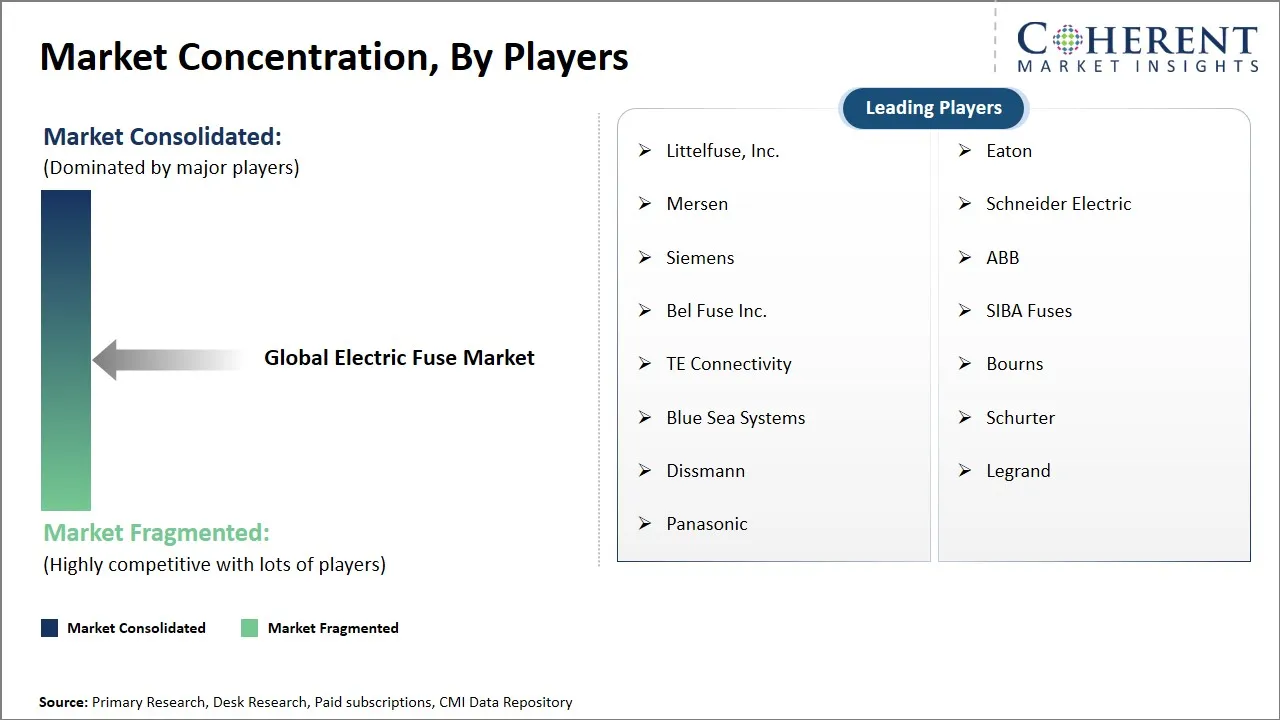
| Companies covered: | Littelfuse, Inc., Eaton, Mersen, Schneider Electric, Siemens, ABB, Bel Fuse Inc., SIBA Fuses, TE Connectivity, Bourns, Blue Sea Systems, Schurter, Dissmann, Legrand, and Panasonic | ||
| Growth Drivers: |
| ||
| Restraints & Challenges: |
| ||
Market Dynamics
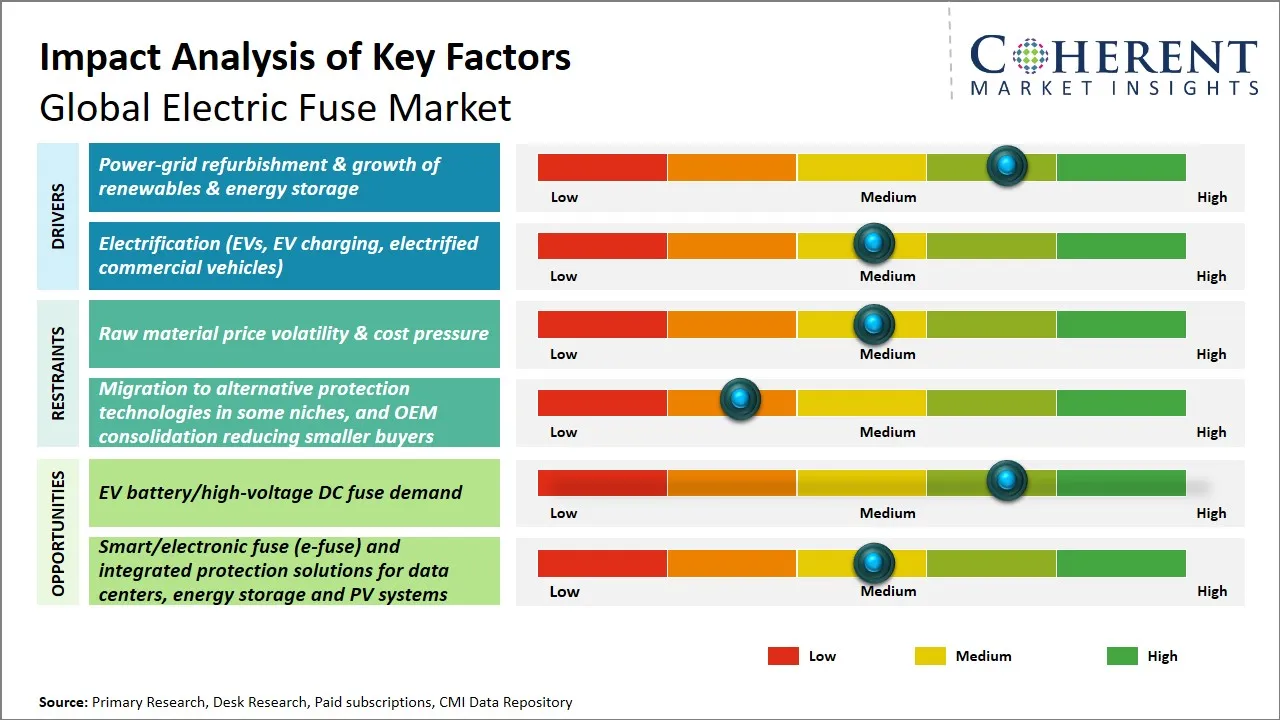
Global Electric Fuse Market Driver – Power-Grid Refurbishment & Growth of Renewables & Energy Storage
Modernizing aging power grids and integrating renewable energy systems are driving strong demand for advanced electric fuses. As utilities upgrade networks to handle fluctuating power flows from solar, wind, and energy storage, reliable overcurrent protection becomes important. Smart-grid and distributed generation projects need fuses that can withstand dynamic loads and bidirectional energy transfer.
In 2024, Siemens Energy and E.ON launched a USD 289.3 million (€250 million) grid modernization initiative across Germany, using advanced protective devices, including high-capacity fuses, to support renewable integration and grid stability.
Global Electric Fuse Market Opportunity – Growing Demand for EV Battery and High-Voltage DC Fuses
The fast global shift toward electric vehicles (EVs) is creating major opportunities for high-voltage DC fuses that protect battery systems from short circuits and overloads. As EV charging speeds and energy density increase, automakers need compact fuses with faster interruption times and higher breaking capacity.
In 2025, Littelfuse grew its EV Series High-Voltage DC Fuse Line to serve new electric truck and bus platforms, aligning with the rise in fast-charging infrastructure and large-capacity EV fleets in North America and Europe.
Analyst Opinion (Expert Opinion)
- The electric fuse market is increasingly challenged by the rise of smart circuit breakers and electronic protection systems, which offer reusability, remote monitoring, and integration with digital grids. While fuses remain cost-effective and reliable for basic applications, manufacturers risk falling behind if they fail to innovate or embed smart sensing features to stay relevant in modern power ecosystems.
- The market sees a lot of price competition, especially in Asia Pacific and African regions where low-cost imports dominate. Coupled with fluctuating prices of metals such as copper, silver, and zinc, manufacturers are squeezed between maintaining quality standards and preserving profitability.
- The patchwork of regional safety, environmental, and energy compliance standards (IEC, UL, RoHS, CCC, BIS, etc.) creates a cumbersome barrier to market entry and expansion. Mid-sized and emerging manufacturers, in particular, struggle to navigate overlapping certification processes, incurring high compliance costs and delays.
Speak to the analyst
Want personalized insights?
Take the findings above to one of our principal consultants, or have the report rebuilt around the segments, geographies and competitors you actually track.
Market Segmentation
- Product Insights (Revenue, USD Bn, 2021 - 2033)
- Power Fuses
- Blade Fuses
- Semiconductor Fuses
- High/Medium-Voltage Fuses
- PV Fuses
- E-fuses
- Others
- Regional Insights (Revenue, USD Bn, 2021 - 2033)
- North America
- U.S.
- Canada
- Latin America
- Brazil
- Argentina
- Mexico
- Rest of Latin America
- Europe
- Germany
- U.K.
- Spain
- France
- Italy
- Russia
- Rest of Europe
- Asia Pacific
- China
- India
- Japan
- Australia
- South Korea
- ASEAN
- Rest of Asia Pacific
- Middle East
- GCC Countries
- Israel
- Rest of Middle East
- Africa
- South Africa
- North Africa
- Central Africa
- North America
- Key Players Insights
- Littelfuse, Inc.
- Eaton
- Mersen
- Schneider Electric
- Siemens
- ABB
- Bel Fuse Inc.
- SIBA Fuses
- TE Connectivity
- Bourns
- Blue Sea Systems
- Schurter
- Dissmann
- Legrand
- Panasonic
Sources
Primary Research Interviews
Stakeholders
- Electrical Equipment Manufacturers and Distributors
- Utility and Power Grid Operators
- Renewable Energy Developers (Solar and Wind Farm EPC Contractors)
- Automotive OEMs and EV Charging Infrastructure Providers
- Industrial Automation Integrators and Electrical Panel Builders
- Regulatory and Certification Experts (IEC, UL, BIS)
- Procurement Managers and Electrical Safety Inspectors
Databases
- Eurostat
- U.S. Energy Information Administration (EIA)
- OECD Energy Database
- IEA Energy Efficiency Indicators
- Construction Global
- World Electric Power Industry Database (fictional)
- Global Energy Transmission Projects Tracker (fictional)
Magazines
- Electrical Engineering Today
- Power & Energy Solutions Magazine
- Electrical Times
- Automation & Control Review
- Smart Energy International
Journals
- IEEE Transactions on Power Delivery
- Journal of Electrical Engineering & Technology
- Energy Systems Research Journal
- Power Electronics and Drives Journal
- Renewable Energy Integration Review
Newspapers
- The Guardian (U.K.)
- The Economic Times (India)
- Energy Digital News
- Power Transmission & Distribution World
- Gulf News Energy Section
Associations
- International Electrotechnical Commission (IEC)
- National Electrical Manufacturers Association (NEMA)
- European Committee for Electrotechnical Standardization (CENELEC)
- Electrical Contractors’ Association (ECA)
- Institute of Electrical and Electronics Engineers (IEEE)
- Bureau of Indian Standards (BIS)
- Middle East Electricity Association (fictional)
Public Domain Sources
- U.S. Department of Energy (DOE)
- EUROSTAT
- World Bank – Global Electrification Database
- International Renewable Energy Agency (IRENA)
- United Nations Economic Commission for Europe (UNECE)
- ResearchGate
- World Energy Council Reports
Proprietary Elements
- CMI Data Analytics Tool, Proprietary CMI Existing Repository of Information for the Last 8 Years
Get access to 250+ pages report
Every segment, forecast, competitor profile and data table behind the analysis above — available for instant download.
- ESOMAR Member
- ISO 9001:2015 Certified
- D-U-N-S Registered
- GDPR & CCPA Compliant
Missing comfort of reading report in your local language? Find your preferred language:
Transform your Strategy with Exclusive Trending Reports
Frequently Asked Questions
The global electric fuse market is estimated to be valued at USD 8.46 billion in 2026 and is expected to reach USD 13.24 billion by 2033.
The CAGR of the global electric fuse market is projected to be 6.6% from 2026 to 2033.
Power-grid refurbishment & growth of renewables & energy storage and electrification (EVs, EV charging, electrified commercial vehicles) are the major factors driving the growth of the global electric fuse market.
Raw material price volatility & cost pressure and migration to alternative protection technologies in some niches, and OEM consolidation reducing smaller buyers are the major factors hampering the growth of the global electric fuse market.
In terms of product, the power fuses are estimated to dominate the market revenue share in 2026.
Integration of smart sensing and resettable fuse technologies is transforming product design and efficiency.
It significantly boosts demand for high-voltage DC fuses used in EV batteries and charging infrastructure.