

Global Electric Mountain Bike Market Size and Forecast – 2026-2033
The global electric mountain bike market is estimated to be valued at USD 7.21 Bn in 2026 and is expected to reach USD 16.24 Bn by 2033, exhibiting a compound annual growth rate (CAGR) of 12.3% from 2026 to 2033.
Key Takeaways of the Global Electric Mountain Bike Market
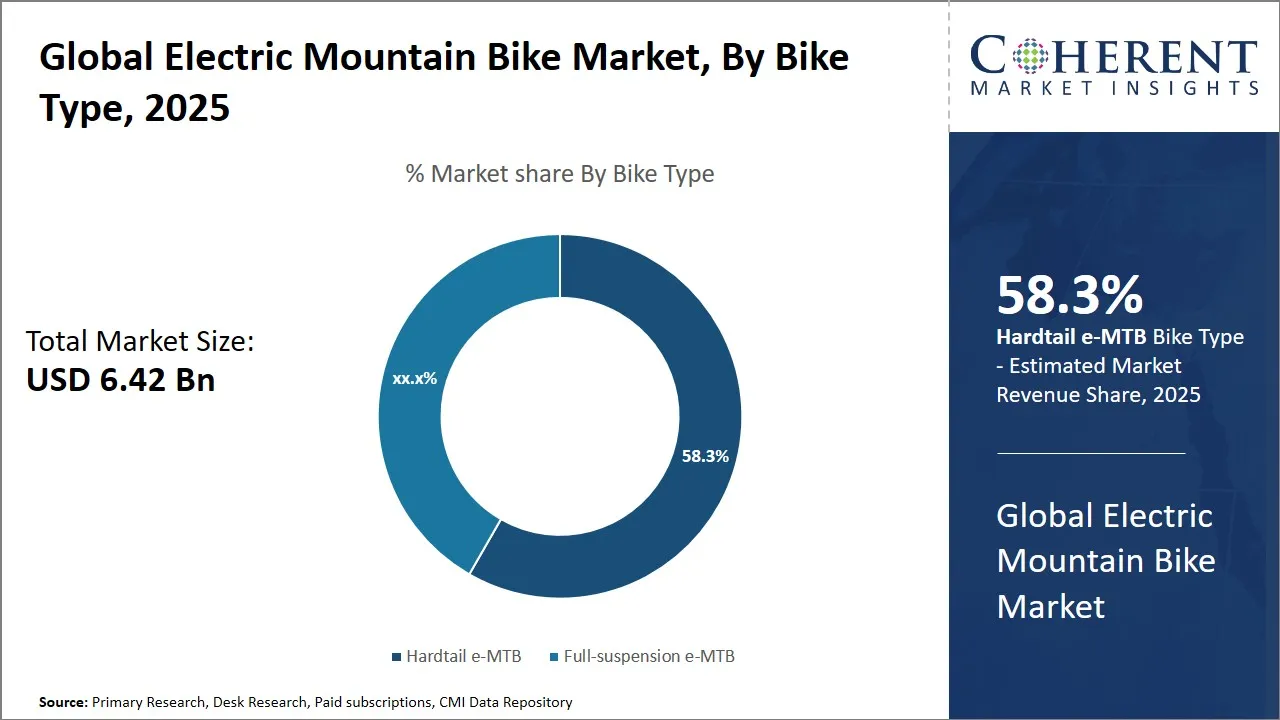
- The hardtail e-MTB segment leads the market holding an estimated share of 59.3 % in 2026.
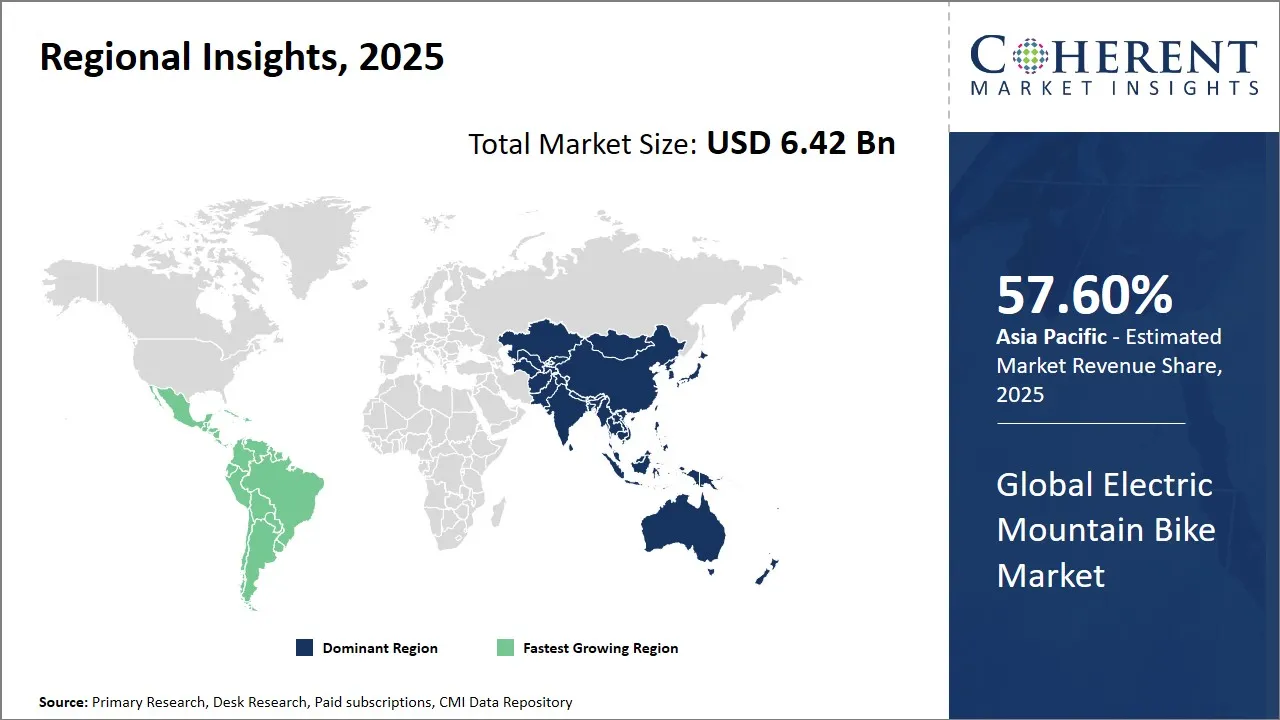
- Asia Pacific is estimated to lead the market with a share of 57.6 % in 2026.
- Latin America, holding an estimated share of 4.1 % in 2026, and it is projected to be the fastest growing region.
Market Overview
Market trends indicate a strong shift towards integrating smart technologies and connectivity features in electric mountain bikes, such as GPS tracking, mobile app integration, and customized ride settings. Additionally, manufacturers are focusing on lightweight materials and improved battery efficiency to boost user experience and bike versatility. Growing awareness about environmental sustainability and government incentives promoting electric vehicles are also propelling market growth. The adoption of e-mountain bikes among millennials and adventure enthusiasts is transforming the landscape, making the market highly dynamic and competitive.
Current Events and Its Impact
Current Events | Description and its Impact |
Geopolitical and Trade Developments |
|
Economic and Infrastructure Trends |
|
Segmental Insights
- Current Industry Events of 2026
- Market Size Estimation
- Regional Breakdown
- Competitive Landscape
- Customer Intelligence
- Segmental Analysis
- Pricing Analysis
- Key Market Drivers, Challenges & Future Trends
- Customized Insights Section
Global Electric Mountain Bike Market Insights, by Bike Type – Hardtail e-MTB Segment Leads Owing to its Affordability and Versatility
The hardtail e-MTB segment is projected to account for 59.3% share in 2026. Hardtail e-MTBs, characterized by their front suspension only, offer riders a lighter frame compared to full-suspension bikes, which translates into easier handling and improved efficiency on less aggressive terrains. Another vital driver for the hardtail segment’s growth is its adaptability across various user groups. Beginners and intermediate riders gravitate towards hardtails due to their simplified mechanics, which require less maintenance and are more forgiving in rough environments.
Additionally, the hardtail e-MTB segment benefits from increasing consumer awareness regarding sustainable and active lifestyles. Their relatively lighter weight also enhances battery efficiency, which is crucial for riders aiming for longer rides without frequent recharging. Manufacturers are also investing in technological improvements in front suspension systems and lightweight frames, further enhancing the appeal of hardtail e-MTBs. Innovations such as advanced motor integration and improved battery management systems are making hardtail models increasingly competitive, particularly in emerging markets where price sensitivity is a major consideration.
Decathlon’s Rockrider E-EXPL 520 Hardtail e-MTB (2024 launch) is a prime example of this trend. Designed for entry-level and intermediate riders, it combines an aluminum hardtail frame with a mid-drive motor at an affordable price point under USD 2,000.
Pricing Analysis for the Global Electric Mountain Bike Market
Segment | Representative Models / Range | Typical Price Range (USD) |
Entry-level Hardtail | Budget hardtail e-MTBs (e.g., Aventon Ramblas) | USD 2,900 (MSRP) |
Entry-level Full-suspension | Beginner full-suspension models | USD 3,300 – USD 3,500 (Estimated) |
Mid-Range Models | Mid-range e-MTBs (hardtail/full-suspension) | USD 3,500–USD 6,000 (Estimated) |
Premium Full-Suspension | Competitive high-end e-MTBs (e.g., Specialized Levo 4) | ~USD 14,000 (MSRP) |
Ultra-Premium Carbon e-MTBs | DJI Amflow PL Carbon & Pro models | USD 7,499 – USD 10,199 |
Regional Insights
Asia Pacific Electric Mountain Bike Market Analysis and Trends
Asia Pacific region is projected to lead the market with a 57.6% share in 2026, due to rising disposable incomes, increased urbanization, and growing interest in outdoor recreational activities. Countries like China, Japan, and South Korea have witnessed a surge in the demand fueled by expanding consumer awareness of health and environmental benefits. Government policies across various APAC nations are increasingly supportive of electric vehicle adoption, including infrastructure development such as bike lanes and charging stations. The presence of several domestic manufacturers like Giant and Merida, along with the entry of global players, has intensified competition and innovation within the region. Moreover, the expanding e-commerce and retail distribution channels have made electric mountain bikes more accessible to a broader consumer base. The region’s trade dynamics are shaped by significant export capabilities, particularly from China, which serves as a global manufacturing hub for both Original Design Manufacturer (ODM) and Original Equipment Manufacturer (OEM) electric bike production.
Latin America Electric Mountain Bike Market Analysis and Trends
Latin America is projected to be the fastest-growing region in the electric mountain bike market with an estimated 4.1% share in 2026. Growth is fueled by rising urban congestion, increasing fuel costs, and a growing shift toward affordable, sustainable transportation alternatives. Countries such as Brazil, Mexico, and Chile are witnessing increased adoption of e-MTBs, supported by expanding recreational cycling communities and rising consumer interest in outdoor sports.
Government initiatives in Brazil and Mexico promoting sustainable mobility, alongside gradual infrastructure improvements such as new cycling lanes in urban areas, are contributing to market momentum. The region is also seeing increased popularity of bike-sharing and rental services, where e-MTBs are being introduced for adventure tourism and leisure riders. The competitive landscape is shaped by the entry of global brands such as Trek, Specialized, and Giant, coupled with the emergence of regional players and assemblers that cater to price-sensitive consumers.
Global Electric Mountain Bike Market Outlook for Key Countries
Germany Electric Mountain Bike Market Analysis and Trends
Germany’s leadership is fueled by its strong manufacturing base and technological innovation in e-bike components. Major players such as Bosch lead in drive system technology, powering many European and global brands. German companies like Haibike and Canyon have been instrumental in product development and maintaining high-quality standards. Government incentives supporting eco-friendly transportation and a well-established cycling culture further boost the demand, alongside comprehensive urban cycling infrastructure encouraging e-MTB usage for both commuting and recreation.
U.S. Electric Mountain Bike Market Analysis and Trends
The U.S. has seen robust expansion driven by growing outdoor adventure trends and an increasing focus on health and fitness. Companies such as Specialized, Trek, and Cannondale offer a wide range of e-MTB products tailored to diverse terrains and user preferences. Supportive policies at state levels, especially in California and Colorado, promote sustainable transportation and introduce incentives that aid consumer adoption. Retail and specialty bike shops play a vital role in the market penetration, while digital platforms facilitate brand presence and customer engagement across vast geographic areas.
China Electric Mountain Bike Market Analysis and Trends
China stands as a key manufacturing powerhouse and rapidly expanding consumer market in the electric mountain bike segment. Domestic giants like Giant and Yadea dominate production and distribution, supported by advanced manufacturing capabilities and cost efficiencies. Government push toward electrification of urban mobility, combined with growing middle-class affordability, drives domestic consumption. Moreover, China’s role as a major exporter influences global supply chains, enabling international brands to source components and finished products competitively from this region.
France Electric Mountain Bike Market Analysis and Trends
France boasts a vibrant electric mountain bike market influenced by widespread outdoor leisure culture and government support for sustainable mobility. Local brands such as Lapierre and Moustache Bikes focus on innovation and performance, appealing to both casual riders and enthusiasts. Initiatives to develop green spaces and bike-friendly urban environments have facilitated increased e-bike adoption. Strong distribution networks through bike retailers and specialized shops contribute to product accessibility across the country.
Japan Electric Mountain Bike Market Analysis and Trends
Japan electric mountain bike market is characterized by a combination of technological sophistication and an emerging interest in outdoor sporting activities. Companies like Yamaha and Panasonic, known for their battery and motor technologies, significantly contribute to the market growth by supplying advanced components and developing integrated e-bike models. Government policies aimed at reducing urban pollution and promoting active lifestyles complement these efforts. The market sees steady growth supported by compact urban centers and well-maintained cycling infrastructure, making e-MTBs a practical choice for commuting and weekend excursions.
Market Players, Key Development, and Competitive Intelligence
Key Developments
- In July 2025, Canyon developed the Neuron:ON CLLCTV edition. An all-new rocker linkage facilitates a mullet setup on the M through XL sizes of the new bike (and dedicated 27.5” wheels at both ends on the XS and S sizes), deviating from the double 29” wheels of the existing Neuron:ON.
- In June 2025, Polygon made its return to Eurobike 2025, one of the world’s largest bicycle exhibitions, held in Frankfurt, Germany. This time, Polygon showcased a wide range of flagship models, including the Helios A road bike, the trusted Collosus DH downhill bike, the Collosus TLE, Tambora AE gravel bike, and even several unreleased models.
- In September 2024, as part of the “AAA Believe” campaign, Haibike unveiled their latest eMTB models for 2025. The new AllMtn, AllTrail, and ADVENTR models come equipped with the brand-new Bosch Performance Line CX Smart System.
- In September 2024, Trek present two new eMTBs for the 2025 season, which both come equipped with the latest Bosch Performance Line CX motor. The Trek Rail+ and Trek Powerfly+ are designed to cover a wide range of applications, from trekking to trail riding.
Top Strategies Followed by Electric Mountain Bike Market
- Established market leaders predominantly invest heavily in research and development (R&D) to innovate high-performance e-MTBs that combine durability, enhanced battery life, lightweight materials, and smart technology integration.
- Specialized launched the 2025 Turbo Levo 4/S-Works Levo with a newly designed 3.1 motor system, offering up to 720W peak power and improved battery integration — a result of in-house R&D for performance differentiation.
- Mid-level players in the e-MTB sector adopt a different set of strategies aimed at targeting price-sensitive consumers without compromising on essential quality and performance.
- Decathlon (Riverside/Rockrider e-MTB lines) continues to push aggressively in the USD 2,500 – USD 4,000 range, appealing to budget-conscious riders while offering reliable specs.
- Small-scale players in the global electric mountain bike market carve out competitive niches by focusing on specialized features or pioneering products that appeal to targeted regional or enthusiast segments.
- Orbea (Spain) developed the Rise e-MTB, a lightweight carbon model with reduced battery size for riders who want a natural, trail-bike feel — carving out a niche in “lightweight e-MTBs.”
Market Report Scope
Electric Mountain Bike Market Report Coverage
| Report Coverage | Details | ||
|---|---|---|---|
| Base Year: | 2025 | Market Size in 2026: | USD 7.21 Bn |
| Historical Data for: | 2020 To 2024 | Forecast Period: | 2026 To 2033 |
| Forecast Period 2026 to 2033 CAGR: | 12.3% | 2033 Value Projection: | USD 16.24 Bn |
| Geographies covered: |
| ||
| Segments covered: |
| ||
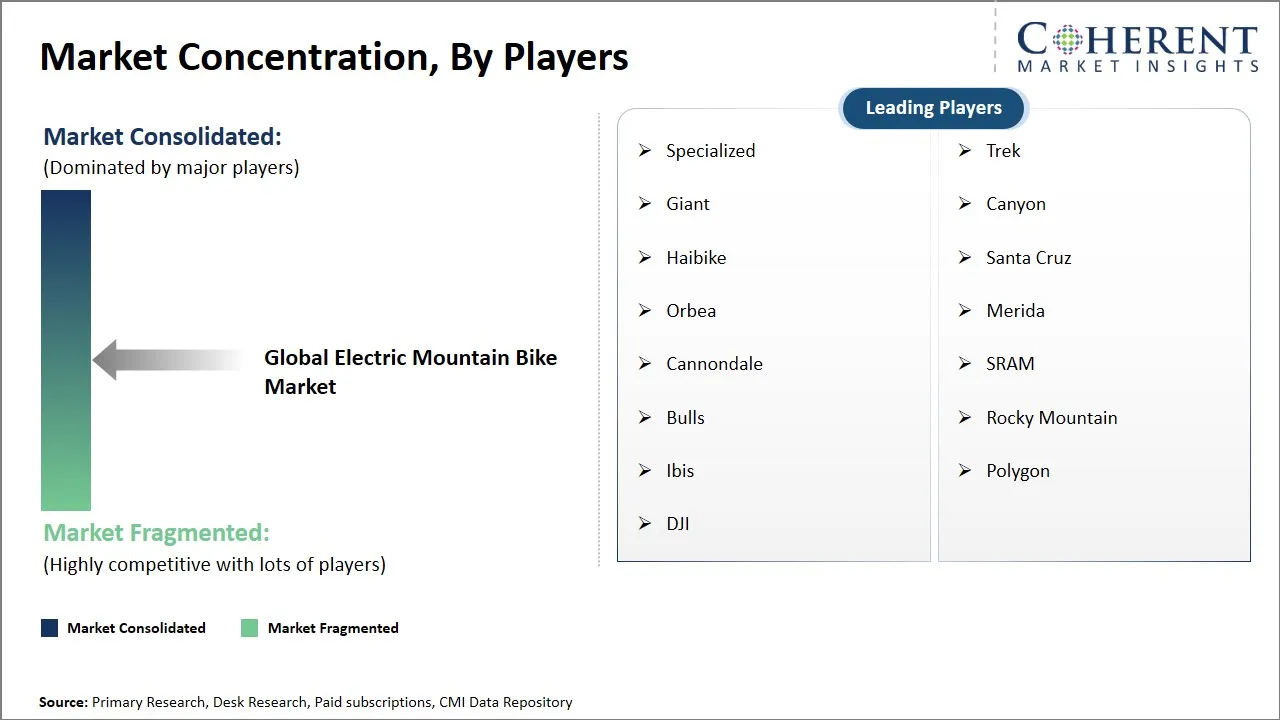
| Companies covered: | Specialized, Trek, Giant, Canyon, Haibike, Santa Cruz, Orbea, Merida, Cannondale, SRAM, Bulls, Rocky Mountain, Ibis, Polygon, and DJI | ||
| Growth Drivers: |
| ||
| Restraints & Challenges: |
| ||
Market Dynamics
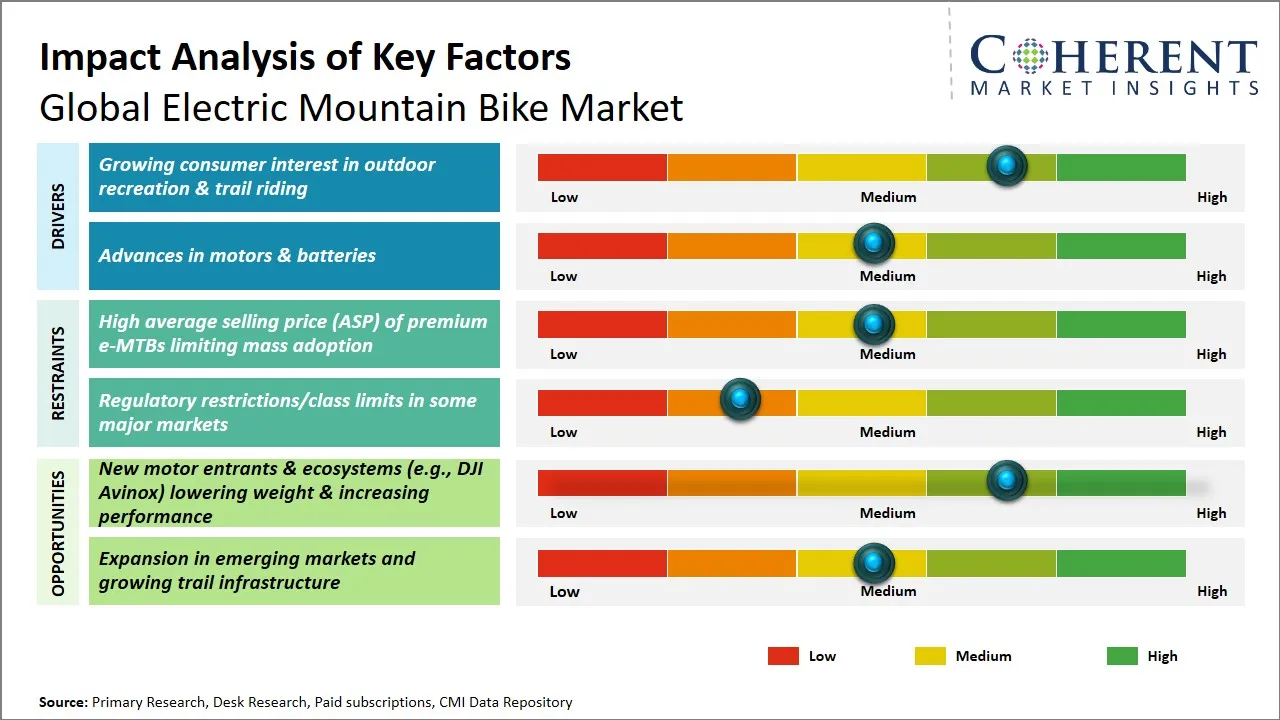
Global Electric Mountain Bike Market Driver – Growing Consumer Interest In Outdoor Recreation & Trail Riding
An increasing number of consumers are seeking active lifestyles that blend fitness with adventure, propelling their interest in outdoor recreational activities such as trail riding. This shift is largely driven by growing awareness of health and wellness benefits associated with spending time in nature, coupled with the desire to explore challenging terrains while minimizing physical strain. According to the U.S. National Park Service and the Outdoor Industry Association, trail use and mountain biking participation surged post-pandemic, with record ridership on MTB trails in the U.S. and Europe. Electric Mountain Bikes (e-MTBs) perfectly cater to this demand by providing pedal-assist technology that extends the range and accessibility of trail riding to a broader audience, including older riders and those with varying fitness levels.
Furthermore, the appeal of e-MTBs is amplified by their ability to navigate steep and rugged landscapes more efficiently than traditional bikes, making off-road exploration more attainable and enjoyable. This evolving consumer preference for outdoor experiences that combine excitement, sustainability, and physical activity directly fuels the adoption of electric mountain bikes, driving growth and innovation within the market segment.
Global Electric Mountain Bike Market Opportunity – New Motor Entrants and Ecosystems (e.g. DJI Avinox) Lowering Weight and Increasing Performance
The global electric mountain bike market stands to benefit significantly from the influx of new motor manufacturers and the development of sophisticated ecosystems that enhance both performance and user experience. Notably, companies like DJI Avinox are pioneering lightweight, high-efficiency motor technologies that are reshaping the fundamentals of e-MTB design. These new entrants bring innovative engineering approaches, such as compact brushless motors and integrated power management systems, which contribute to reducing the overall weight of electric mountain bikes without compromising torque or battery efficiency. Lighter motors enhance maneuverability and ride comfort, addressing long-standing challenges for consumers who sought powerful yet agile off-road electric bikes. In 2024, DJI introduced the Avinox mid-drive motor system (up to 850W peak, 120Nm torque, with integrated smart battery management).
Moreover, emerging ecosystems encompass intelligent software integration, offering features such as adaptive power delivery, real-time diagnostics, and seamless connectivity with mobile devices. This integration enables riders to customize their riding modes, monitor battery health remotely, and gain access to firmware updates that continuously improve motor responsiveness. The synergy of lightweight hardware and smart digital ecosystems allows manufacturers to deliver enhanced range, improved hill-climbing capabilities, and more intuitive control dynamics, making e-MTBs accessible to a broader demographic, from casual riders to hardcore enthusiasts.
Analyst Opinion (Expert Opinion)
- The majority of global e-MTB demand stems from recreational riders and trail enthusiasts, particularly in Europe and North America, where cycling culture and mountain trail infrastructure are well established. Increasing consumer focus on outdoor fitness and nature exploration continues to drive strong replacement and upgrade cycles in this segment.
- The tourism sector is emerging as a strong application driver, with rental operators in destinations like the Alps, Rockies, and Japan increasingly offering e-MTB fleets. This trend caters to casual riders and travelers seeking a premium yet accessible adventure experience, expanding e-MTB adoption beyond core enthusiasts.
- While not traditionally designed for commuting, e-MTBs are increasingly used in urban and peri-urban settings, especially in Asia-Pacific, where rugged roads and mixed terrains make them practical alternatives to scooters and standard e-bikes. This dual-purpose usage (recreation + commuting) is expected to widen the consumer base in fast-growing markets.
Speak to the analyst
Want personalized insights?
Take the findings above to one of our principal consultants, or have the report rebuilt around the segments, geographies and competitors you actually track.
Sources
Primary Research Interviews
Stakeholders
- Bicycle Manufacturers and OEMs
- Electric Motor & Battery Suppliers
- Retailers & Distributors of Bicycles and Sporting Goods
- Adventure Tourism Operators & Bike Rental Companies
- Cycling Associations & Trail Management Organizations
- Sustainability Experts and E-Mobility Consultants
Databases
- Eurostat
- U.S. Census
- Cycling Industry Global
- OECD
Magazines
- Cycling Today
- Electric Bike Action Magazine
- Mountain Bike International
- Outdoor & Adventure Cycling Review
Journals
- Journal of Sports Engineering and Technology
- Transportation Research Part D: Transport and Environment
- Journal of Cleaner Production
- International Journal of Sustainable Transportation
Newspapers
- Bike Europe
- Cycling Industry News
- The Guardian (UK)
- The Economic Times (India)
Associations
- European Cyclists’ Federation (ECF)
- PeopleForBikes (U.S.)
- International Mountain Bicycling Association (IMBA)
- Confederation of the European Bicycle Industry (CONEBI)
- World Cycling Alliance
Public Domain Sources
- U.S. Census Bureau
- EUROSTAT
- United Nations Economic Commission for Europe (UNECE)
- World Bank
- ResearchGate
Proprietary Elements
- CMI Data Analytics Tool
- Proprietary CMI Existing Repository of information for last 8 years
Get access to 250+ pages report
Every segment, forecast, competitor profile and data table behind the analysis above — available for instant download.
- ESOMAR Member
- ISO 9001:2015 Certified
- D-U-N-S Registered
- GDPR & CCPA Compliant
Missing comfort of reading report in your local language? Find your preferred language:
Transform your Strategy with Exclusive Trending Reports
Frequently Asked Questions
The global electric mountain bike market is estimated to be valued at USD 7.21 billion in 2026 and is expected to reach USD 16.24 billion by 2033.
The CAGR of the global electric mountain bike market is projected to be 12.3% from 2026 to 2033.
Growing consumer interest in outdoor recreation & trail riding and advances in motors & batteries are the major factors driving the growth of the global electric mountain bike market.
High average selling price (ASP) of premium e-MTBs limiting mass adoption and regulatory restrictions/class limits in some major markets are the major factors hampering the growth of the global electric mountain bike market.
In terms of bike type, the hardtail e-MTB segment is estimated to dominate the market revenue share in 2026.
A mountain bike equipped with an electric motor for pedal assistance, designed for off-road and trail riding.
Primarily, mid-drive motors and hub-drive motors are used in e-MTBs, with mid-drive dominating in performance models.