

Europe and U.S. Creator Economy Market Size and Forecast – 2026-2033
The Europe and U.S. creator economy market is estimated to be valued at USD 117.37 Bn in 2026 and is expected to reach USD 529.05 Bn by 2033, exhibiting a compound annual growth rate (CAGR) of 24.0% from 2026 to 2033.
Key Takeaways of the Europe and U.S. Creator Economy Market
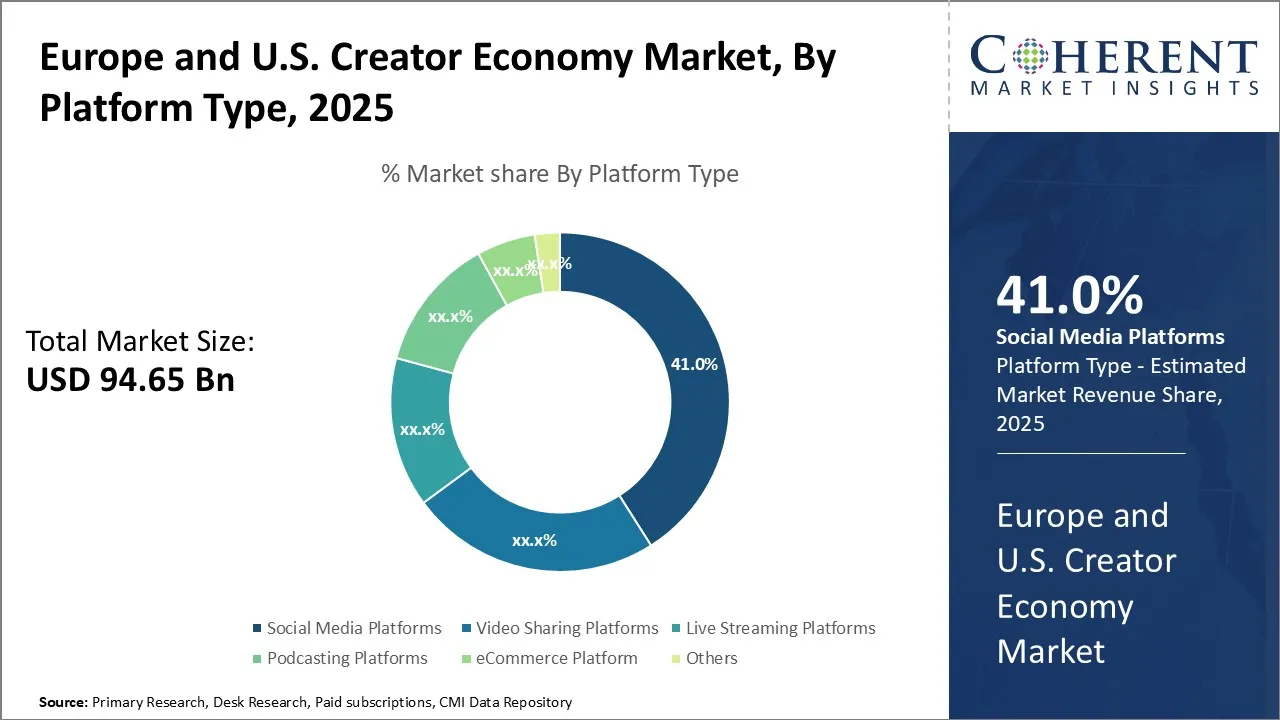
- The social media platforms segment leads the market holding an estimated share of 42% in 2026.
- The sponsorships and partnerships segment is projected to dominate with a share of 47.4% in 2026.
- The amateur creator segment leads the market holding a projected share of 75.1% in 2026.
Market Overview
The market is seeing the rising adoption of content monetization tools like subscriptions, digital tipping, and exclusive content platforms. Also, the popularity of social media and media streaming services is helping a big range of creators to engage niche audiences, while brands increasingly collaborate with influencers for targeted marketing. This trend, added with advancements in artificial intelligence and Blockchain for content protection and fan engagement, is reshaping the creator economy landscape in Europe and the U.S.
Current Events and their Impact
Current Events | Description and its Impact |
Regulatory & Policy Developments |
|
Commerce & Payments Integration |
|
Segmental Insights
- Current Industry Events of 2026
- Market Size Estimation
- Regional Breakdown
- Competitive Landscape
- Customer Intelligence
- Segmental Analysis
- Pricing Analysis
- Key Market Drivers, Challenges & Future Trends
- Customized Insights Section
Europe and U.S. Creator Economy Market Insights, by Platform Type – Dominance of Social Media Platforms in the Market Driven by Enhanced User Engagement and Versatile Content Formats
The social media platforms segment is projected to account for 42.0% of the Europe and U.S. creator economy market share in 2026, because of their high reach and the versatility they give creators for content dissemination. These platforms have become multi-functional ecosystems that allow creators to engage with audiences in different content forms like short-form videos, stories, images, reels and longer, interactive posts. These cater to differing consumer preferences, adding to consumer base. TikTok’s dominance in short-form video content has changed creator engagement in both the U.S. and Europe. The platform can amplify content virally through its algorithm, which has helped creators like Mr. Khaby Lame and Ms. Addison Rae achieve global fame.
Another big factor adding to social media platforms' growth is the use of community-building tools, such as comments, live chats, and groups. This allows creators to make a sense of belonging in their audiences, which is a key motivator for repeat visits and content consumption. The virality potential inherent in social media also amplifies creators’ reach, as trending content can rapidly attract followers and increase visibility without proportional increases in marketing expenditure.
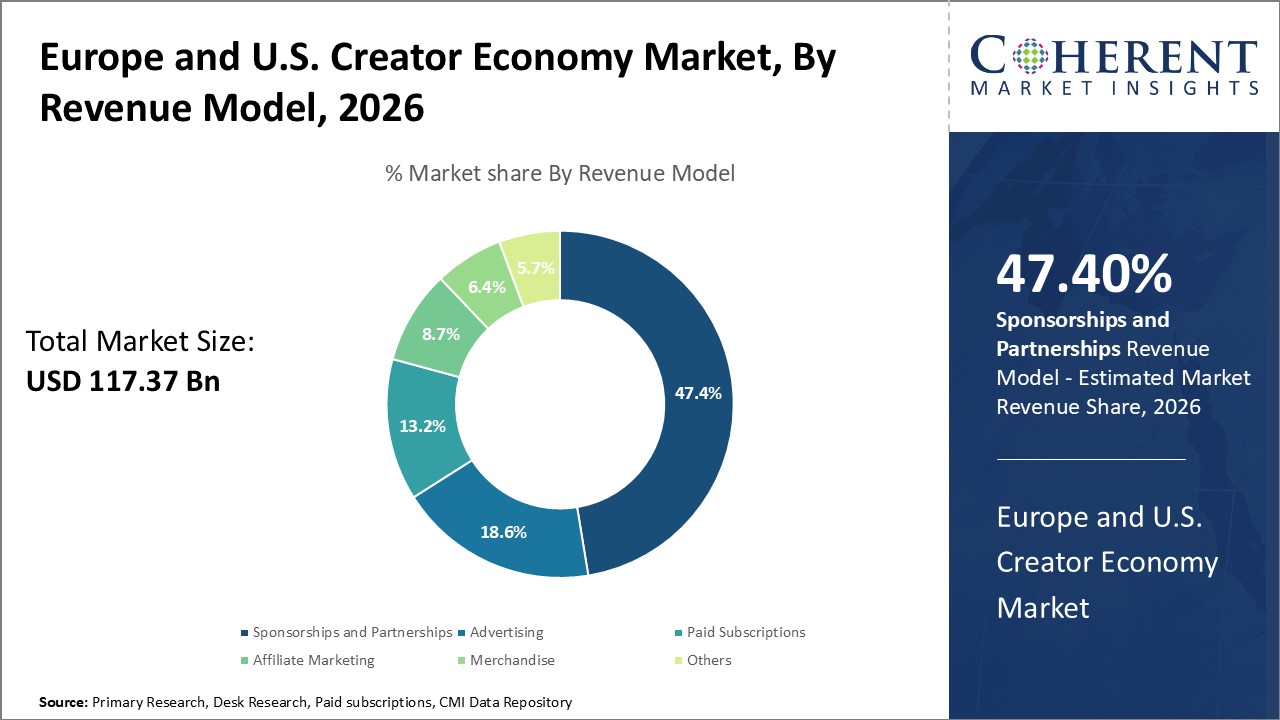
Europe and U.S. Creator Economy Market Insights, by Revenue Model – Sponsorships and Partnerships Lead Revenue Models Because of Brand Alignment and Authentic Audience Reach
The sponsorships and partnerships segment is expected to capture 47.4% share in 2026. This is because of brands increasingly recognizing the value of authentic engagement created through influencer-led content, which often resonates more effectively with consumers than traditional advertising. Sponsors seek collaborations that align with their values and target demographics, seeing creators as trusted intermediaries who can humanize products and services.
Furthermore, the diversification of partnership types—from exclusive endorsements and product placements to co-branded merchandise and experiential marketing campaigns—provides creators with multiple monetization options, which can be tailored to their audience size and niche. The emergence of creator-led brands, funded or supported through partnerships, exemplifies this synergy between creators and sponsors.
Brands’ increasing investment in micro and nano-influencers also plays a significant role in elevating sponsorships. These smaller-scale creators often boast highly engaged, niche communities, translating to higher authenticity and impact per campaign dollar spent. L’Oréal Paris’ “Beauty for All” campaign in 2024 partnered with micro-influencers in France and the U.K., choosing creators with highly engaged niche audiences to promote diversity and inclusivity. This dynamic not only expands opportunities for amateur creators but also encourages a proliferation of partnerships across market verticals, sustaining the segment’s dominant position.
Europe and U.S. Creator Economy Market Insights, by End User – Amateur Creators Capture the Largest Share Owing to Accessibility and Growing Digital Literacy
The amateur creators segment is projected to hold 76.1% share in 2026. This prominence is largely attributable to the removal of traditional barriers to content creation and distribution, which has empowered individuals outside conventional media and entertainment industries to participate actively in the economy. The proliferation of user-friendly digital tools and platforms has transformed content creation from a specialized profession to a mass-accessible hobbyist pursuit.
Amateur creators are motivated by multiple factors including creative expression, community building, and potential monetization opportunities. They often start with limited resources but benefit from platforms that provide free or affordable access to content creation and promotion assets. The rise in remote working, increased leisure time for certain groups, and the broad cultural acceptance of social media as a venue for sharing passion projects also contribute significantly to this surge.
Moreover, the social and psychological aspects tied to being an amateur creator add to this segment’s growth. Many users find fulfillment and validation through their creative outputs, which nudges more individuals to produce content consistently. The availability of educational resources, mentoring by more experienced creators, and peer-to-peer support networks further lower the skill threshold, encouraging sustained participation.
Importantly, amateur creators often become the fertile ground for platform innovation, as their experimentation with new content styles and formats pushes platforms to evolve features catering to diverse creator needs. TikTok’s Creator Fund in Europe has inspired everyday users like small-town artists in Spain and hobby chefs in Germany to pursue content creation as both a pastime and a potential income source. This feedback loop enhances platform stickiness and broadens the creator base, perpetuating growth in this segment. The accessibility and empowerment inherent in the amateur creator ecosystem thus fundamentally drive its dominant market share in the creator economy across Europe and the U.S.
Impact of AI on the Europe and U.S. Creator Economy Market
Artificial Intelligence is becoming a true creative partner. Platforms like TikTok and YouTube are using AI-driven editing assistants, automated captioning, and recommendation systems that personalize both the creative process and audience reach. For instance, TikTok’s “Creative Assistant” uses OpenAI-powered tools to help creators generate ad scripts, suggest music, and optimize captions. This reduces the time and cost of production, allowing even small or part-time creators to produce professional-quality content and compete on the same stage as established influencers.
However, the AI revolution has also brought complexities. As algorithms largely decide what audiences see, creators face new challenges around authenticity and visibility. Also, AI-generated or enhanced content risks saturating platforms with repetitive or impersonal material, forcing creators to find fresh ways to maintain a human touch and emotional connection with their followers.
Market Players, Key Development, and Competitive Intelligence
Key Developments
- On October 6, 2025, Asos launched Asos Live, entering the live shopping field with real-time video shopping experiences.
- On October 2, 2025, Heylist, a SaaS platform that connects global brands with creators, made its official launch in the U.S. It aims to make influencer marketing more accessible and help creators earn.
- On October 1, 2025, People Inc. acquired Feedfeed, a 12-year-old food publisher and creator network with more than 7 million followers on social media and roughly 1,000 influencer partners.
- In March 2025, Jellysmack spun off its "Jellysmack Originals" division into a new independent company called Blue Foxes. Blue Foxes will manage the 150+ owned-and-operated channels and shows, such as Oh My Goal and Beauty Studio, that were formerly part of Jellysmack Originals.
Top Strategies Followed by the Europe and U.S. Creator Economy Market
- Established players dominate the market because of huge investments in research and development, innovating high-performance, feature-rich products.
- Leading platforms like Meta and YouTube are making huge investments in artificial intelligence and machine-learning R&D to make creator engagement and personalization better.
- Mid-level market participants use a different approach, focusing on delivering cost-effective solutions that give a balance between quality and affordability.
- Patreon’s “Patreon Lite” and simplified analytics dashboard allow smaller creators to monetize directly through subscriptions at lower commission rates.
- Small-scale players in the Europe and U.S. creator economy market depend on niche differentiation and technological flexibility to gain competitive advantage.
- Heylist, a U.S.-based startup, offers AI-powered discovery and matchmaking tools made for micro- and nano-influencers, allowing brands to connect with creators who have highly engaged audiences.
Market Report Scope
Europe and U.S. Creator Economy Market Report Coverage
| Report Coverage | Details | ||
|---|---|---|---|
| Base Year: | 2025 | Market Size in 2026: | USD 117.37 Bn |
| Historical Data for: | 2020 To 2024 | Forecast Period: | 2026 To 2033 |
| Forecast Period 2026 to 2033 CAGR: | 24.0% | 2033 Value Projection: | USD 529.05 Bn |
| Segments covered: |
| ||
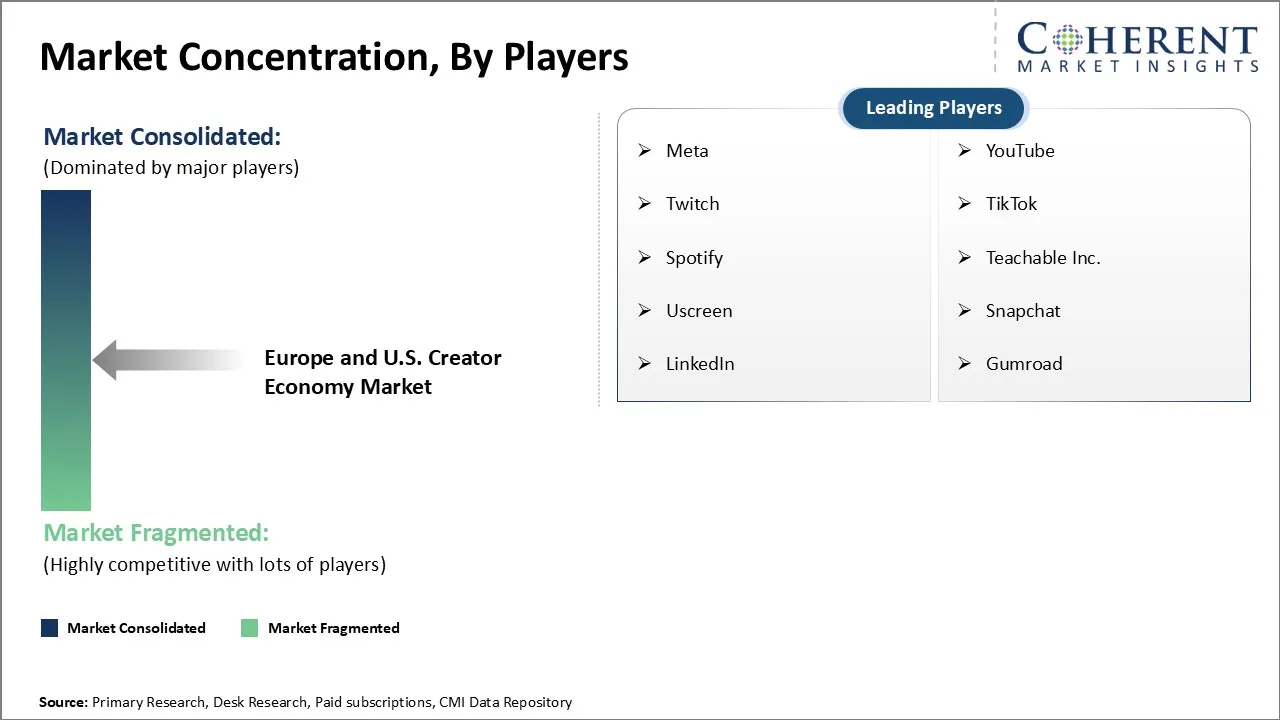
| Companies covered: | Meta, YouTube, Twitch, TikTok, Spotify, Teachable Inc., Uscreen, Snapchat, LinkedIn, and Gumroad | ||
| Growth Drivers: |
| ||
| Restraints & Challenges: |
| ||
Market Dynamics
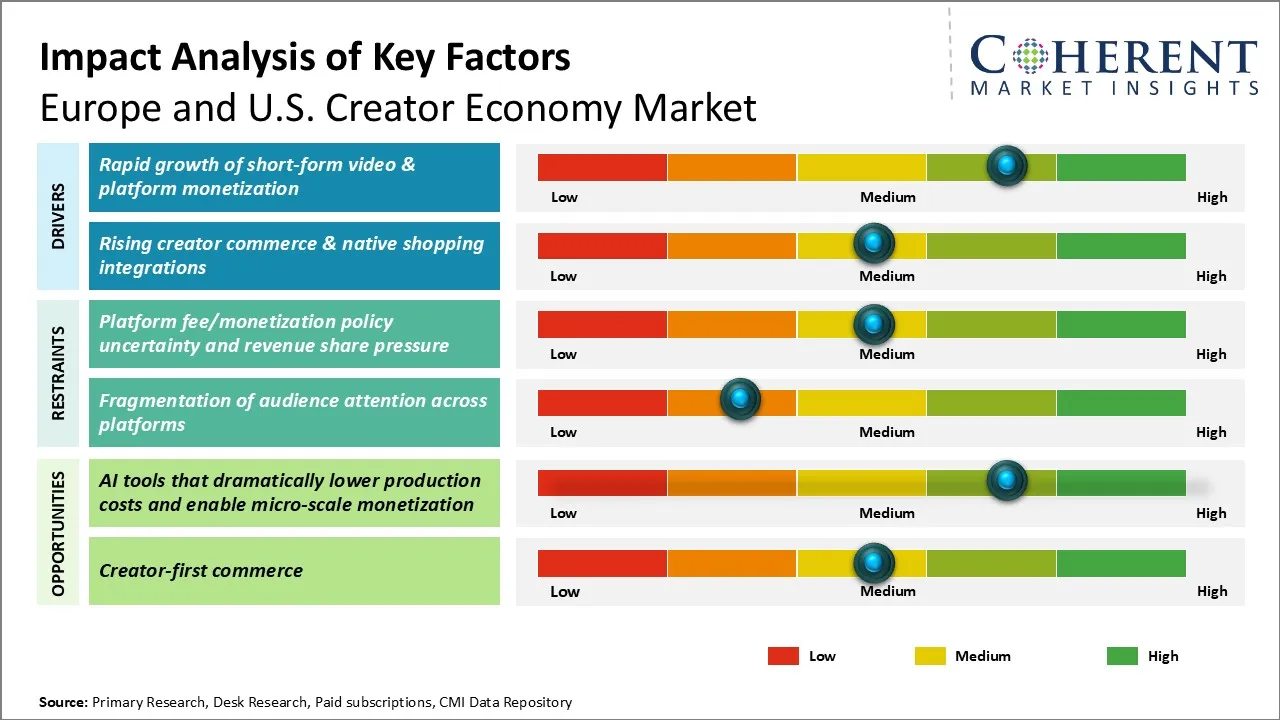
Europe and U.S. Creator Economy Market Driver – Rapid Growth of Short-Form Video & Platform Monetization
The surge in popularity of short-form video content has become a significant catalyst for the expansion of the creator economy across Europe and the U.S. Platforms like TikTok, Instagram Reels, and YouTube Shorts offer bite-sized, highly engaging content that attract younger demographics. This move adds to greater content consumption and opens new areas for creators to monetize their work. Improved monetization features like direct fan contributions, brand partnerships, and e-commerce options, help creators make diversified revenue streams.
Also, platforms continuously change their algorithms and monetization policies to attract creator participation, making a vibrant ecosystem. YouTube expanded its Partner Program in 2023 and began sharing ad revenue with Shorts creators, a move that pushed a lot of adoption in both regions. This relationship between content format popularity and monetization capabilities is making sustained creator engagement and attracting a big pool of individuals to pursue content creation professionally.
Europe and U.S. Creator Economy Market Opportunity – AI-Driven Tools Lowering Production Costs and Enabling Micro-Scale Monetization
The rise of advanced AI tools makes a big opportunity for the Europe and U.S. creator economy as these tools reduce content production costs and allow creators to capitalize on micro-scale monetization models. They automate time-intensive processes like video editing, graphic design, content curation, and copywriting, helping creators produce high-quality content with less resources and technical knowledge. This accessibility of content creation allows a bigger and more diverse pool of creators to participate and compete. Patreon’s rollout of AI-powered audience analytics tools in 2024 has helped creators personalize subscriber rewards and micro-tier offerings, making fan retention and income generation better.
Also, AI tools make possible personalized content recommendations and audience targeting, enhancing engagement and unlocking new revenue streams through microtransactions, subscriptions, and tipping on platforms tailored to niche communities. The ability to efficiently produce and monetize content at scale addresses the growing demand for unique, authentic creator output, especially among Gen Z and Millennial consumers in these regions. Also, AI-driven analytics give creators actionable insights into audience preferences and consumption patterns.
Analyst Opinion (Expert Opinion)
- The U.S. continues to lead the creator economy because of a strong digital advertising market, high influencer marketing budgets, and advanced monetization tools in platforms like YouTube, TikTok, and Instagram. American creators see early platform adoption and more brand partnerships.
- Countries like the U.K., Germany, and France are seeing fast growth in mid-tier and professional creators, fueled by expanding brand collaborations, EU digital policies promoting transparency, and local startups offering creator commerce tools. U.K.-based influencer agencies and German SaaS content platforms are helping creators monetize through diversified income streams beyond ads, such as live shopping and paid communities.
- Regions like Italy, Spain, and the Nordics are showing increasing participation from lifestyle, gaming, and travel creators. Improved digital infrastructure, cross-border sponsorship opportunities, and local-language content platforms are boosting regional creator engagement. Although these markets are smaller in absolute terms, their double-digit growth rates highlight rising demand for creator tools, analytics platforms, and localized monetization solutions across Europe.
Speak to the analyst
Want personalized insights?
Take the findings above to one of our principal consultants, or have the report rebuilt around the segments, geographies and competitors you actually track.
Market Segmentation
- Platform Type Insights (Revenue, USD Bn, 2021 - 2033)
- Social Media Platforms
- Video Sharing Platforms
- Live Streaming Platforms
- Podcasting Platforms
- eCommerce Platform
- Others
- Revenue Model Insights (Revenue, USD Bn, 2021 - 2033)
- Sponsorships and Partnerships
- Advertising
- Paid Subscriptions
- Affiliate Marketing
- Merchandise
- Others
- End User Insights (Revenue, USD Bn, 2021 - 2033)
- Amateur Creator
- Professional Creator
- Key Players Insights
- Meta
- YouTube
- Twitch
- TikTok
- Spotify
- Teachable Inc.
- Uscreen
- Snapchat
- Gumroad
Sources
Primary Research Interviews
Stakeholders
- Digital Content Platforms and Social Media Companies
- Influencer Marketing Agencies
- Creator Monetization Platforms
- E-commerce and Affiliate Network Operators
- Analytics and AI Tool Providers
- Independent Content Creators, Influencers, and Podcasters across Europe and the U.S.
- Venture Capital Firms investing in creator-tech startups
- Policy Analysts and Digital Economy Experts (EU and U.S. regulatory advisers)
Databases
- EuroDigital Observatory
- U.S. Bureau of Digital Commerce (USBDC)
- Global Influencer Network Database (GIND)
- Digital Economy Statistical Portal (DESP)
- OECD Creative Industries Dataset
Magazines
- Creator Insight Weekly
- Digital Media Today
- Influencer Economy Review (IER)
- TechCulture Europe Magazine
- Content Business Monthly (CBM)
Journals
- Journal of Digital Media and Innovation
- Social Commerce Research Journal (SCRJ)
- Journal of Creative Economy and Entrepreneurship
- International Journal of Influencer Marketing (IJIM)
- New Media and Digital Culture Studies
Newspapers
- The Digital Times (U.S.)
- EU Media Observer (Brussels)
- The London Tech Chronicle (U.K.)
- Berlin Business Gazette (Germany)
- New York Innovation Daily (U.S.)
Associations
- European Digital Creators Association (EDCA)
- American Creator Economy Council (ACEC)
- Global Alliance for Influencer Marketing (GAIM)
- Federation of Online Content Professionals (FOCP)
- European Media Innovation Network (EMIN)
Public Domain Sources
- EUROSTAT – Digital Economy Division
- U.S. Department of Commerce – Digital Trade Section
- United Nations Conference on Digital Development (UNCDD)
- World Bank – Global Digital Entrepreneurship Data
- ResearchGate – Open Access Creator Economy Papers
Proprietary Elements
- CMI Data Analytics Tool, Proprietary CMI Existing Repository of information for last 8 years
Get access to 250+ pages report
Every segment, forecast, competitor profile and data table behind the analysis above — available for instant download.
- ESOMAR Member
- ISO 9001:2015 Certified
- D-U-N-S Registered
- GDPR & CCPA Compliant
Missing comfort of reading report in your local language? Find your preferred language:
Transform your Strategy with Exclusive Trending Reports
Frequently Asked Questions
The Europe and U.S. creator economy market is estimated to be valued at USD 117.37 Bn in 2026 and is expected to reach USD 529.05 Bn by 2033.
The CAGR of the Europe and U.S. creator economy market is projected to be 24.0% from 2026 to 2033.
Rapid growth of short-form video & platform monetization and rising creator commerce & native shopping integrations are the major factors driving the growth of the Europe and U.S. creator economy market.
Platform fee/monetization policy uncertainty and revenue share pressure and fragmentation of audience attention across platforms are the major factors hampering the growth of the Europe and U.S. creator economy market.
In terms of platform type, the social media platforms segment is estimated to dominate the market revenue share in 2026.
Meta, YouTube, Twitch, TikTok, Spotify, Teachable Inc., Uscreen, Snapchat, LinkedIn, and Gumroad are the major players.
The creator economy refers to the ecosystem of individuals, platforms, and tools that enable creators to monetize their content, skills, and influence online.