

Global Federated Cloud Storage Market and Forecast – 2026-2033
The global federated cloud storage market is estimated to be valued at USD 3.29 Bn in 2026 and is expected to reach USD 10.10 Bn by 2033, exhibiting a compound annual growth rate (CAGR) of 17.4% from 2026 to 2033.
Key Takeaways of the Federated Cloud Storage Market
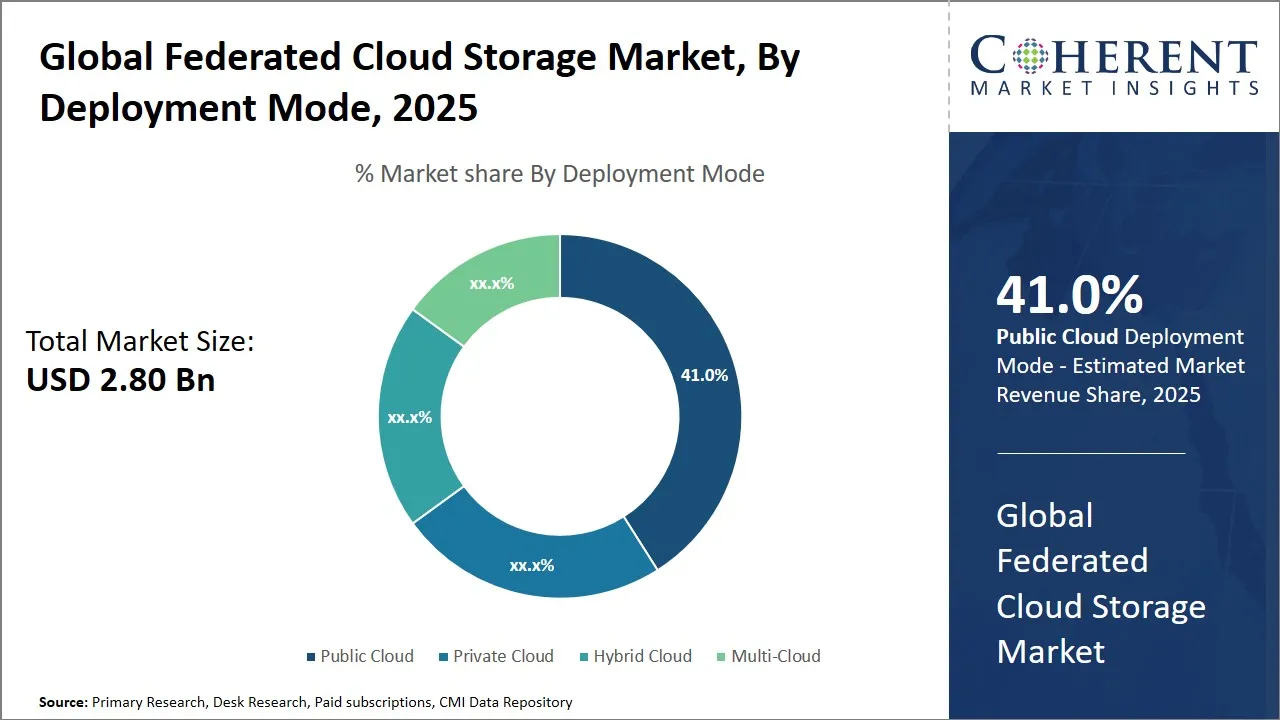
- The public cloud segment is expected to account for 42% of the federated cloud storage market share in 2026.
- The Infrastructure-as-a-Service (IaaS) segment is projected to capture 44% of the market share in 2026.
- The object storage segment is expected to command 47% share in 2026.
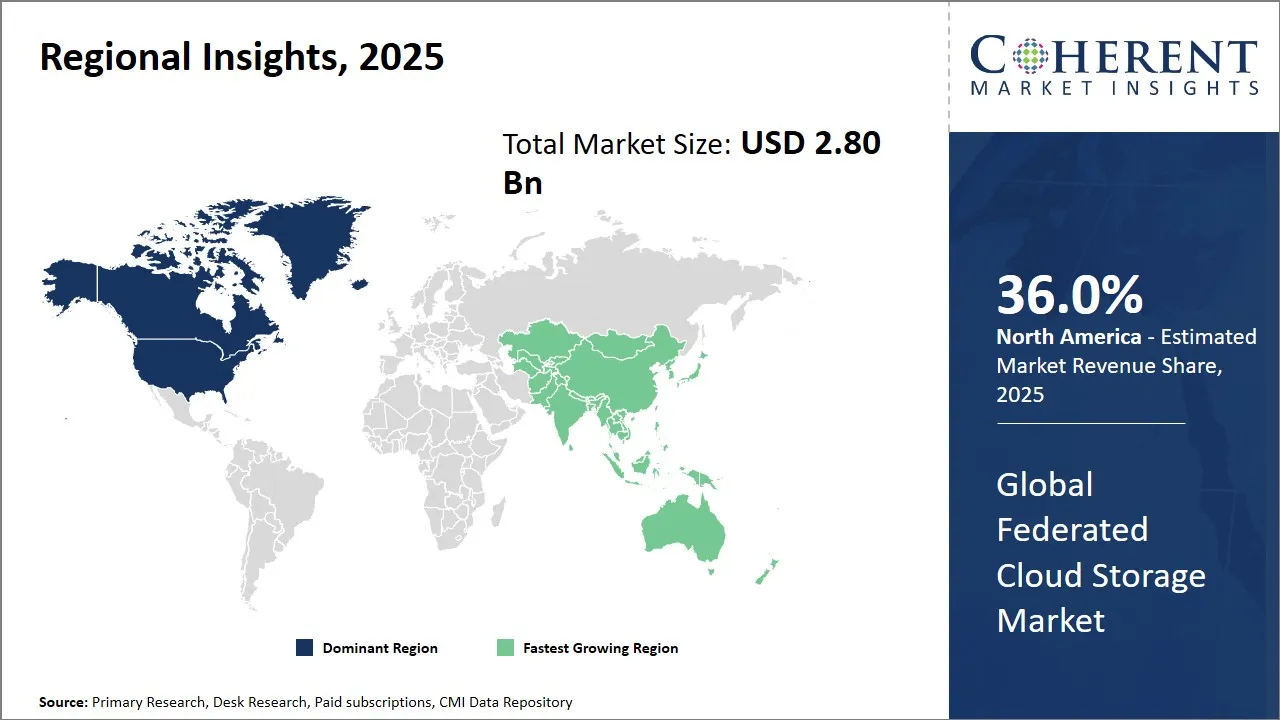
- North America will dominate the federated cloud storage market in 2026 with an estimated 36%
- Asia Pacific will hold 29% share in 2026 and record the fastest growth.
Current Events and Its Impact
Current Events | Description and its Impact |
Cisco Platform Launch |
|
Segmental Insights
- Current Industry Events of 2026
- Market Size Estimation
- Regional Breakdown
- Competitive Landscape
- Customer Intelligence
- Segmental Analysis
- Pricing Analysis
- Key Market Drivers, Challenges & Future Trends
- Customized Insights Section
Why Does Public Cloud Segment Dominate the Global Federated Cloud Storage Market in 2026?
The public cloud segment is expected to hold 42.0% of the global federated cloud storage market share in 2026. The rise comes from strong scalability, along with adaptability and lower costs. Firms are leaning more toward public cloud setups, mainly since they allow instant use of broad computing power and storage space while avoiding large initial investments tied to local hardware. Such flexible scaling helps companies manage shifting storage needs smoothly, which matters especially for connected systems pulling data from various clouds and locations.
Furthermore, simple setup in public cloud systems helps companies launch faster when adding shared storage solutions. Since major providers already have vast networks, businesses can quickly assign and handle data space, ideal for sectors like entertainment, banking, or medicine working with widespread information. Although security once slowed down use, improved safeguards, user permissions, and verified standards now reduce risks, making this option more appealing.
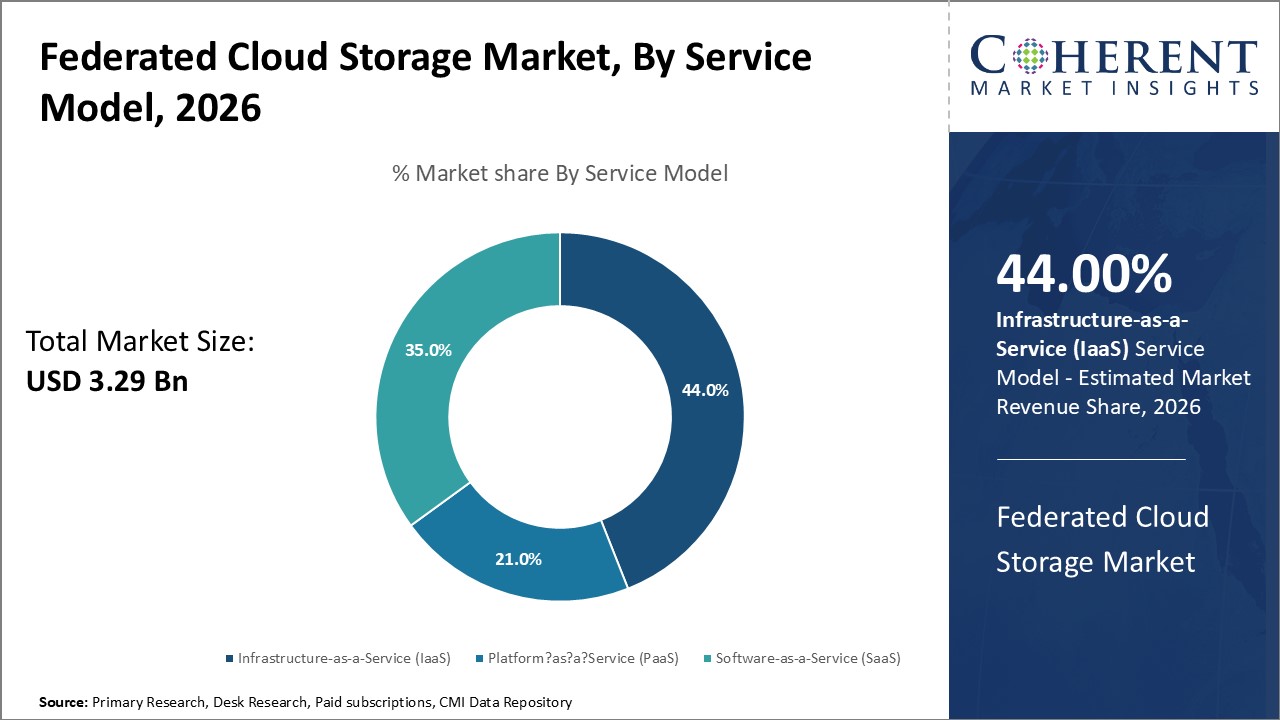
Infrastructure-as-a-Service (IaaS) Segment Dominates the Federated Cloud Storage Market
The infrastructure-as-a-service (IaaS) segment is expected to hold 44.0% of the global federated cloud storage market share in 2026. The expansion comes as IaaS delivers basic infrastructure tools adjustable exactly to company needs, allowing them to skip handling actual equipment yet still manage software environments and programs. Such flexibility matters greatly in decentralized cloud storage scenarios, when organizations frequently adjust their setup on the fly depending on app demands, regulatory rules, or regional presence.
One major reason companies like Amazon Web Services choose IaaS is how well it handles different tasks and developer setups which lets them create, grow, or test distributed storage systems freely across providers. Since IaaS gives basic computing and storage components, tech teams are able to set up various data tools and rules that fit their multi-cloud plans. Such adaptability proves essential for firms aiming to improve where data lives, backup levels, and response speed in hybrid clouds.
Why is Object Storage the Most Preferred Storage Type in the Federated Cloud Storage Market?
The object storage segment is expected to hold 47.0% of the global federated cloud storage market share in 2026. The growth of the segment stems from natural scalability, adaptability and advanced metadata handling. Unlike others, object storage uses an architecture that holds data in separate blocks known as objects and a distinct ID which fits well with scattered setups found in federated cloud systems.
Object storage manages huge volumes of irregular data like videos, backups, or sensor outputs, that now flood modern digital setups. Instead of using rigid folder trees, this system expands smoothly across servers and regions through flat structures. That flexibility matters greatly for connected cloud networks trying to merge separate storage zones without losing reliability or ease of access.
Data Sovereignty & Compliance Readiness Index
Region | Regulatory Maturity (0–100) | Cloud Compliance Framework Strength (0–100) | Federated Cloud Adoption Level (0–100) |
North America | 85 | 88 | 86 |
Europe | 92 | 90 | 82 |
Asia Pacific | 78 | 75 | 72 |
Middle East | 70 | 68 | 65 |
Latin America | 66 | 64 | 60 |
Regional Insights
North America Federated Cloud Storage Market Analysis and Trends
North America is projected to lead the market with a 36% share in 2026. The market expansion stems from a developed tech environment alongside solid IT frameworks, while numerous leading cloud firms adopt hybrid plus multi-cloud models. This area gains advantage through clear data protection rules combined with focus on local data control, pushing the use of connected cloud systems supporting regional storage needs.
Government efforts boosting digital upgrades also help spread cloud usage across sectors. Key providers like AWS, Azure, and Google Cloud operate widely in North America, advancing distributed cloud features through alliances and broad portfolios. Close cooperation among big companies, emerging firms, and public bodies strengthens North America’s top position in this space.
Asia Pacific Federated Cloud Storage Market Analysis and Trends
Asia Pacific is expected to exhibit the fastest growth in the market contributing 29% share in 2026. The growth is linked to faster digitization, growing data output, alongside major spending on cloud systems from government and business alike. In emerging markets, new privacy rules are rolling out while hybrid or decentralized cloud setups gain preference due to worries about international data flow and local authority.
Public strategies around intelligent urban development, digital administration, notably Industry 4.0 uptake are helping broaden market opportunities. Nations including China, India, Japan, and South Korea now host active networks of cloud vendors and integration firms emphasizing distributed models for better regional data oversight. Key names like Huawei Cloud, Alibaba Cloud are leading progress in shared cloud frameworks, pushing solutions aligned with area-specific regulations and company needs.
Federated Cloud Storage Market Outlook for Key Countries
Why is the U.S. Emerging as a Major Hub of Federated Cloud Storage?
The U.S. federated cloud storage market thrives as a technology driven region, home to major cloud providers such as AWS, Microsoft, or Google. Because firms face strict rules on data protection, they quickly adopt federated storage solutions. Firms across the country focus on improving compatibility and safeguards through new tools, supporting smooth operations in mixed or multiple cloud systems. These advancements serve sectors including health care, banking, or public agencies.
Is China the Next Growth Engine for the Federated Cloud Storage Market?
China's federated cloud storage market grows quickly due to state rules on data control and security priorities. Providers like Alibaba Cloud, alongside Huawei Cloud, design systems compliant with tight regulations. A push for independent tech foundations strengthens collaboration among telecom firms and cloud operators. This environment encourages advancements in decentralized storage setups built for massive datasets.
Germany Federated Cloud Storage Market Analysis and Trends
Germany follows EU rules on data privacy, especially GDPR which pushes businesses toward federated cloud setups to stay compliant without losing flexibility. As industries like car-making, production, and banking are so big there, they need safe storage that works smoothly across different locations. Major players including Deutsche Telekom and SAP boost growth by providing cloud networks focused on control over data, protection, and compatibility with current corporate tools.
India Federated Cloud Storage Market Analysis and Trends
India's growth in federated cloud storage stems from fast digital changes across public agencies and businesses, driven by programs such as Digital India along with broader use of cloud systems in small firms. Firms like Tata Communications, alongside newer entrants, are partnering with international companies to offer decentralized storage that emphasizes affordability while meeting local rules. A thriving network of startups, combined with stronger focus on personal data protection, is pushing more organizations toward distributed models for flexible, safe information handling.
Japan Federated Cloud Storage Market Analysis and Trends
Japan keeps moving ahead in building modern IT systems that value user privacy while ensuring smooth connections between platforms, helping grow a strong market for linked cloud storage. Instead of standalone solutions, firms such as NTT Communications and Fujitsu are blending decentralized storage with wider digital services, including edge computing, to improve operations in areas like factory automation, medical services, or government functions. By prioritizing local control over data along with international cloud partnerships, the country plays a key role in shaping how distributed networks evolve. Joint efforts between regulators and private enterprises also encourage responsible tech development, making sure new tools meet strict rules without slowing progress.
Market Players, Key Development, and Competitive Intelligence
Key Developments
- On April 9, 2025, DDN, the global leader in AI and data intelligence solutions, and Google Cloud collaborated to advance AI initiatives with Google Cloud Management Luster and Infinia at Google Cloud Next 2025. This collaboration aims to transform AI-driven infrastructure with Google Cloud Management Luster, based on DDN EXAScaler.
Top Strategies Followed by Global Federated Cloud Storage Market Players
Player Type | Strategic Focus | Example |
Established Market Leaders | Business Collaboration | In September 2024, NetApp, the intelligent data infrastructure company, announced the expansion of its decade-long relationship with Amazon Web Services (AWS) to help joint customers continuously fuel business growth and innovation in the artificial intelligence (AI) era. |
Mid-Level Players | Investment for Expansion | In July 2025, Alibaba Cloud, the digital technology and intelligence backbone of Alibaba Group, announced it will invest over USD 60 Million for 2026 to empower its partner ecosystem and accelerate AI innovation. |
Small-Scale Players | Business Collaboration | In March 2025, Rakuten Symphony extended its strategic alliance with Google Cloud by making Rakuten Cloud-Native Storage available on the Google Cloud Marketplace. Rakuten Symphony’s software-defined storage (SDS) solution and Rakuten Cloud-Native Storage have helped Rakuten Symphony reach new customers and provide a persistent storage solution for Google Distributed Cloud offerings. |
Market Report Scope
Federated Cloud Storage Market Report Coverage
| Report Coverage | Details | ||
|---|---|---|---|
| Base Year: | 2025 | Market Size in 2026: | USD 3.29 Bn |
| Historical Data for: | 2020 To 2024 | Forecast Period: | 2026 To 2033 |
| Forecast Period 2026 to 2033 CAGR: | 17.4% | 2033 Value Projection: | USD 10.10 Bn |
| Geographies covered: |
| ||
| Segments covered: |
| ||
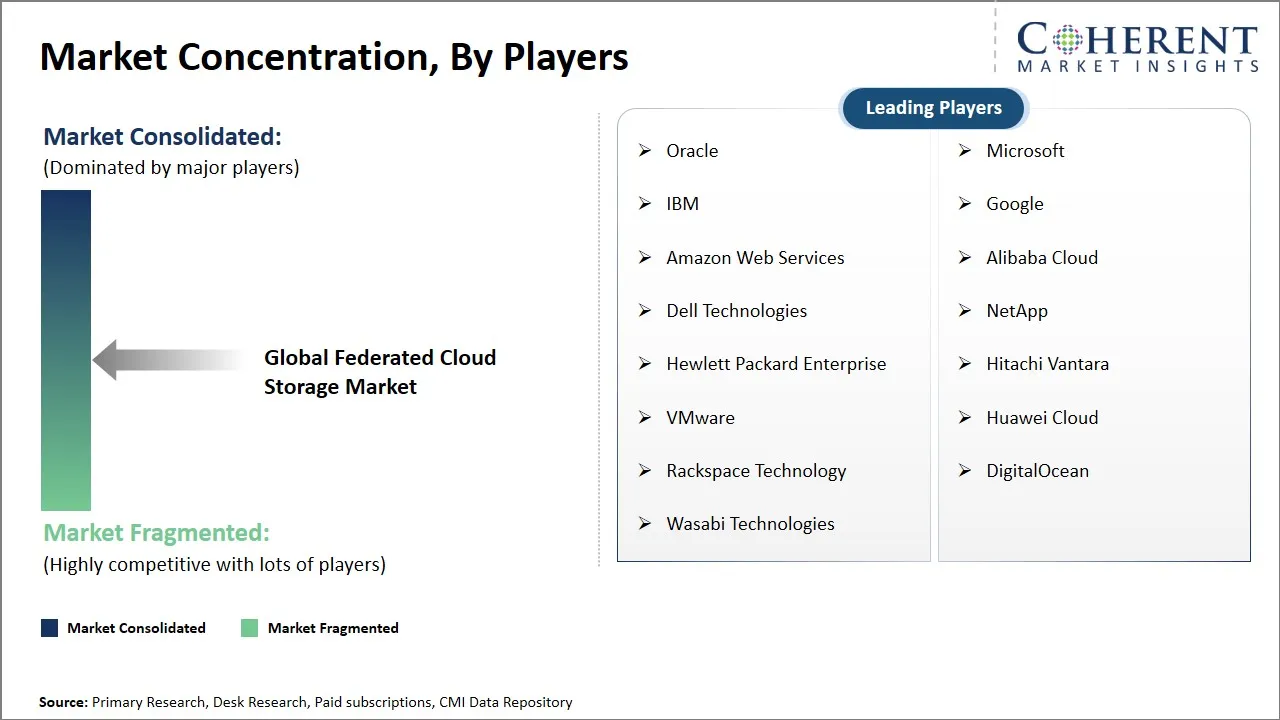
| Companies covered: | Oracle, Microsoft, IBM, Google, Amazon Web Services, Alibaba Cloud, Dell Technologies, NetApp, Hewlett Packard Enterprise, Hitachi Vantara, VMware, Huawei Cloud, Rackspace Technology, DigitalOcean, and Wasabi Technologies | ||
| Growth Drivers: |
| ||
| Restraints & Challenges: |
| ||
Global Federated Cloud Storage Market Dynamics
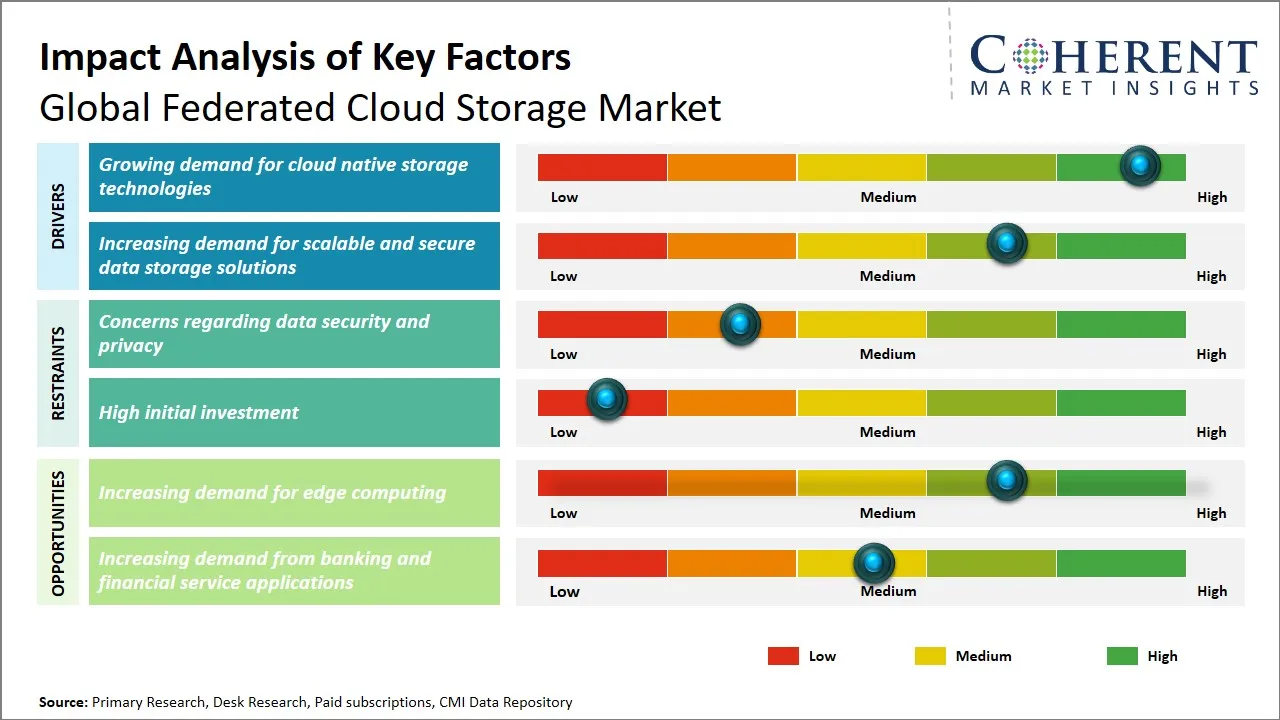
Global Federated Cloud Storage Market Driver - Growing Demand for Cloud Native Storage Technologies
The rise in using cloud-native software and storage is boosting the worldwide federated cloud storage market. As companies are moving apps and tasks to the cloud, demand grows for storage built specifically for these settings. Instead of old-style systems, cloud-native options allow better scaling, adaptability, and connection across platforms, helping firms handle vast data across clouds more smoothly.
Also, growing use of containers and microservices calls for flexible, always-available storage, and federated models help by combining separate cloud storages into one connected network. This shift fits enterprise aims to cut delays, boost access to data, yet strengthen backup systems across dispersed networks. As a result, rising use of cloud-based storage models drives the need for connected storage options capable of smoothly integrating while streamlining operations over mixed and multiple cloud platforms.
For instance, in June 2025, IONOS and Nextcloud introduced the fully featured office suite “Nextcloud Workspace”, a powerful Microsoft 365 alternative. As long-standing partners, the companies have merged their expertise to enable large organizations with an all-round office suite as European answer to U.S. products.
(Source: nextcloud.com)
Global Federated Cloud Storage Market Opportunity - Increasing Demand for Edge Computing
The growing use of edge computing opens strong potential for the worldwide federated cloud storage market. Because businesses now depend more on instant data flow and fast-response apps, processing happens nearer to where data is created, instead of only using central cloud systems. That change cuts delays, boosts performance, while making data management smoother; this matters greatly in fields like health services, vehicle tech, production units, or communication networks. With federated storage linking several cloud setups across varied sites efficiently, it fits naturally into how edge computing operates. They provide strong data sync, protection, and control, without slowing down or breaking rules.
As more IoT security gadgets appear, and ever-growing edge-generated information, there is greater pressure for flexible, safe, widely placed storage setups which pushes interest in connected cloud networks even higher. Firms choose linked frameworks that fit edge-based designs so they keep local data control, use assets better, while improving backup readiness. With edge processing evolving into standard practice, combined cloud storage is ready to grow by offering tools built for the fast-moving, complex needs of spread-out edge operations.
Analyst Opinion (Expert Opinion)
- The global federated cloud storage market is shifting from idea to real-world need, fueled by growing use of mixed cloud setups. Since businesses no longer want vital data tied to one vendor, connected storage offers consistent access and oversight across scattered locations. Rules on where data must stay, along with surging volumes of raw information and AI tasks, are pushing demand even higher. Because of this, shared cloud storage is now seen as essential infrastructure for current data systems - no longer just an optional extra.
- Going forward, the market’s direction will come from working across ecosystems along with smart software advances instead of just bigger infrastructures. Big cloud providers will keep adding federation features directly into their systems, whereas medium-sized firms will stand out using data insights, added security layers, or industry-focused tools. Small companies together with open-source groups should lead trials in distributed, edge-based, and low-cost shared setups. In general, steady expansion is likely as businesses focus on smooth connections, reliability, and meeting regulations, making connected cloud storage a lasting priority instead of a passing phase.
Speak to the analyst
Want personalized insights?
Take the findings above to one of our principal consultants, or have the report rebuilt around the segments, geographies and competitors you actually track.
Market Segmentation
- Deployment Mode Insights (Revenue, USD Billion, 2021 - 2033)
- Public Cloud
- Private Cloud
- Hybrid Cloud
- Multi-Cloud
- Service Model Insights (Revenue, USD Billion, 2021 - 2033)
- Infrastructure-as-a-Service (IaaS)
- Platform-as-a-Service (PaaS)
- Software-as-a-Service (SaaS)
- Storage Type Insights (Revenue, USD Billion, 2021 - 2033)
- Object Storage
- Block Storage
- File Storage
- Regional Insights (Revenue, USD Billion, 2021 - 2033)
- North America
- U.S.
- Canada
- Latin America
- Brazil
- Argentina
- Mexico
- Rest of Latin America
- Europe
- Germany
- U.K.
- Spain
- France
- Italy
- Russia
- Rest of Europe
- Asia Pacific
- China
- India
- Japan
- Australia
- South Korea
- ASEAN
- Rest of Asia Pacific
- Middle East
- GCC Countries
- Israel
- Rest of Middle East
- Africa
- South Africa
- North Africa
- Central Africa
- North America
- Key Players Insights
- Oracle
- Microsoft
- IBM
- Amazon Web Services
- Alibaba Cloud
- Dell Technologies
- NetApp
- Hewlett Packard Enterprise
- Hitachi Vantara
- VMware
- Huawei Cloud
- Rackspace Technology
- DigitalOcean
- Wasabi Technologies
Sources
Primary Research Interviews
- Cloud Storage Service Providers
- Enterprise IT Decision Makers
- Cloud Infrastructure Architects
- Data Management Consultants
Databases
- IDC Technology Database
- Bloomberg Terminal
Magazines
- Cloud Computing Magazine
- Data Center Knowledge
- Enterprise Storage Magazine
- CIO Magazine
Journals
- IEEE Cloud Computing Journal
- Journal of Cloud Computing
- International Journal of Information Technology
Newspapers
- The Wall Street Journal
- Financial Times
- Reuters Technology News
- Bloomberg Technology
- TechCrunch
Associations
- Cloud Security Alliance (CSA)
- Storage Networking Industry Association (SNIA)
- Cloud Native Computing Foundation (CNCF)
- Open Data Center Alliance (ODCA)
Public Domain Sources
- U.S. Securities and Exchange Commission (SEC) Filings
- Government Cloud Strategy Publications
- National Institute of Standards and Technology (NIST) Guidelines
Proprietary Elements
- CMI Data Analytics Tool
- Proprietary CMI Existing Repository of information for last 8 years
Get access to 250+ pages report
Every segment, forecast, competitor profile and data table behind the analysis above — available for instant download.
- ESOMAR Member
- ISO 9001:2015 Certified
- D-U-N-S Registered
- GDPR & CCPA Compliant
Missing comfort of reading report in your local language? Find your preferred language:
Transform your Strategy with Exclusive Trending Reports
Frequently Asked Questions
The global federated cloud storage market is estimated to be valued at USD 3.29 Bn in 2026 and is expected to reach USD 10.10 Bn by 2033.
The CAGR of the global federated cloud storage market is projected to be 17.4% from 2026 to 2033.
Growing demand for cloud native storage technologies and increasing demand for scalable and secure data storage solutions are the major factors driving the growth of the global federated cloud storage market.
Concerns regarding data security and privacy and high initial investment are the major factors hampering the growth of the global federated cloud storage market.
In terms of deployment mode, public cloud is estimated to dominate the market revenue share in 2026.
Unlike traditional cloud storage, federated cloud storage connects multiple independent storage systems under a single logical framework rather than relying on one centralized provider.
It allows enterprises to seamlessly operate across multiple cloud providers by abstracting storage layers and standardizing data access policies.