

Global Firm Tofu Market Size and Forecast – 2026 To 2033
The global firm tofu market is estimated to be valued at USD 3,875.2 Mn in 2026 and is expected to reach USD 6,061.7 Mn by 2033, growing at a compound annual growth rate (CAGR) of 6.6% from 2026 to 2033. This steady growth trajectory reflects increasing consumer interest in plant-based protein, greater incorporation of tofu into everyday meals, and expanding availability through mainstream retail channels.
Product innovation around convenient, ready-to-cook formats is also helping manufacturers address consumers seeking easier meal preparation. In April 2025, Cauldron introduced its Naked Tofu Pieces in the U.K., with retail availability across Tesco, Waitrose, and Sainsbury’s, providing a pre-prepared tofu format designed for quick cooking and multiple meal applications. This development highlights how tofu manufacturers are broadening product convenience and supermarket accessibility to support consumption beyond traditional vegetarian and Asian-food occasions.
Key Takeaways of the Global Firm Tofu Market
- Firm Tofu is estimated to expand at a 6.4% CAGR during 2026–2033 and is expected to hold 67.4% of the global firm tofu market in 2026. Its balanced density, shape retention, and ability to absorb sauces make it suitable for stir-frying, braising, grilling, and household meal preparation. In May 2025, Pulmuone launched a domestic-soy cooking tofu designed up to 30% firmer than its pan-frying tofu.
- Conventional Tofu is estimated to record a 6.2% CAGR during 2026–2033 and is expected to command 76.8% of the market in 2026. Its advantage comes from broad retail availability, established soybean sourcing, familiar taste profiles, and generally lower certification-related costs than organic alternatives. In August 2026, House Foods America continued to merchandise its standard Premium Tofu range separately from its certified Organic Tofu portfolio.
- Vacuum Packs and Pouches are estimated to grow at a 7.1% CAGR during 2026–2033 and account for 41.6% of the market in 2026. The format supports compact cold-chain handling, reduced oxygen exposure, longer usable freshness, and easier merchandising of dense tofu blocks. In August 2026, EVERSOON continued offering vacuum sealing equipment specifically suitable for regular firm tofu, emphasizing preservation and microbial-control benefits.
- Asia Pacific is estimated to expand at a 6.3% CAGR during 2026–2033 and is expected to represent 54.6% of the global market in 2026. Tofu’s established role in everyday Asian diets, extensive soybean-processing capacity, mature retail penetration, and large domestic producer base sustain high baseline consumption. In February 2026, Sagamiya and JA Zen-Noh announced a new domestic-soy logistics scheme to stabilize supply for tofu manufacturing in Japan.
- North America is estimated to post an 8.4% CAGR during 2026–2033 and is expected to hold 19.7% of the global market in 2026. Growth is supported by broader mainstream acceptance of minimally processed plant proteins, stronger supermarket placement, product innovation, and foodservice adoption beyond specialist vegan channels. In January 2025, Hodo expanded U.S. distribution into Meijer, Harris Teeter, and Giant Martin’s stores.
Segmental Insights
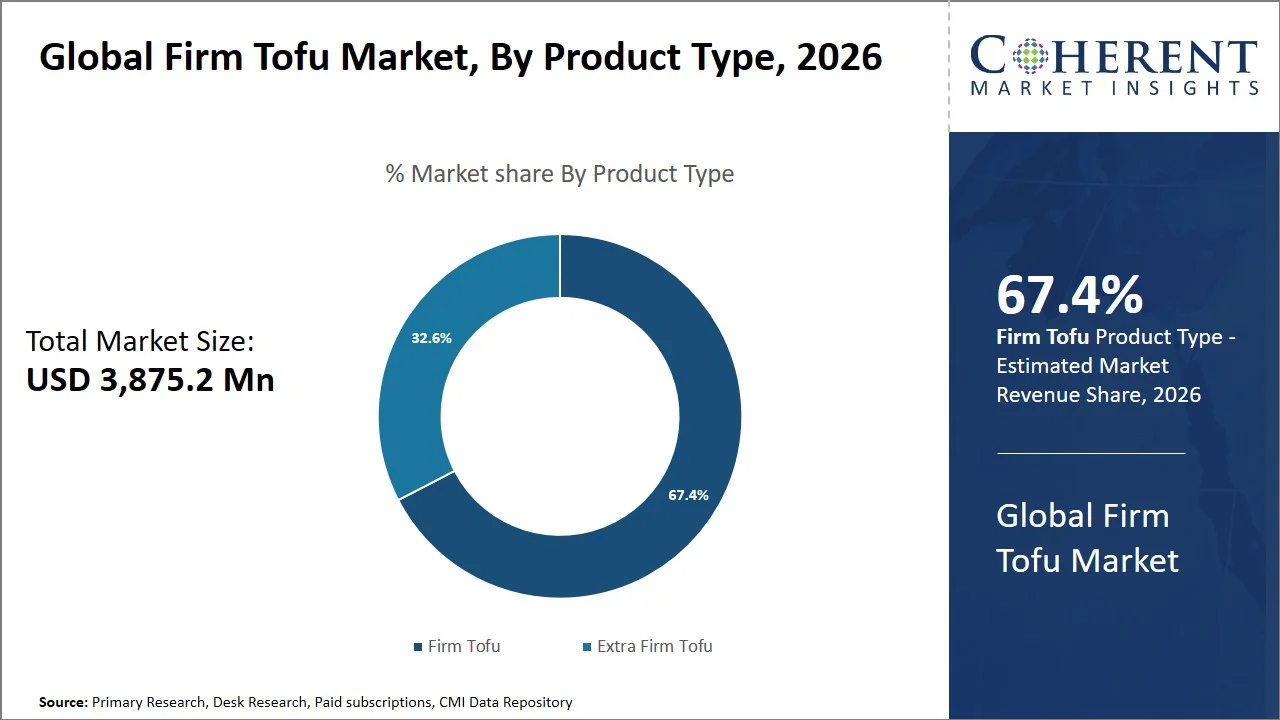
Why Does Firm Tofu Dominate the Product Type Category of the Global Firm Tofu Market?
Firm Tofu is expected to account for 67.4% of the global firm tofu market in 2026 because its intermediate moisture and curd density provide a practical balance between structural strength and seasoning uptake. Households can pan-fry, braise, crumble, bake, or add the same product to soups without purchasing multiple texture grades, while restaurants gain a block that tolerates portioning and batch preparation. On the supply side, standardized pressing and cutting equipment makes firm tofu comparatively straightforward to manufacture at scale, supporting broad supermarket and foodservice availability. This combination gives manufacturers a high-volume core SKU and lets distributors simplify chilled inventory. In June 2025, Vivera introduced Quick Marinating Firm Tofu in the U.K., using a pre-freezing process intended to accelerate marinade absorption while retaining firm-tofu functionality, illustrating continued innovation around the segment’s cooking performance.
- Current Industry Events of 2026
- Market Size Estimation
- Regional Breakdown
- Competitive Landscape
- Customer Intelligence
- Segmental Analysis
- Pricing Analysis
- Key Market Drivers, Challenges & Future Trends
- Customized Insights Section
Why Does Conventional Tofu Represent the Largest Nature Segment in the Global Firm Tofu Market?
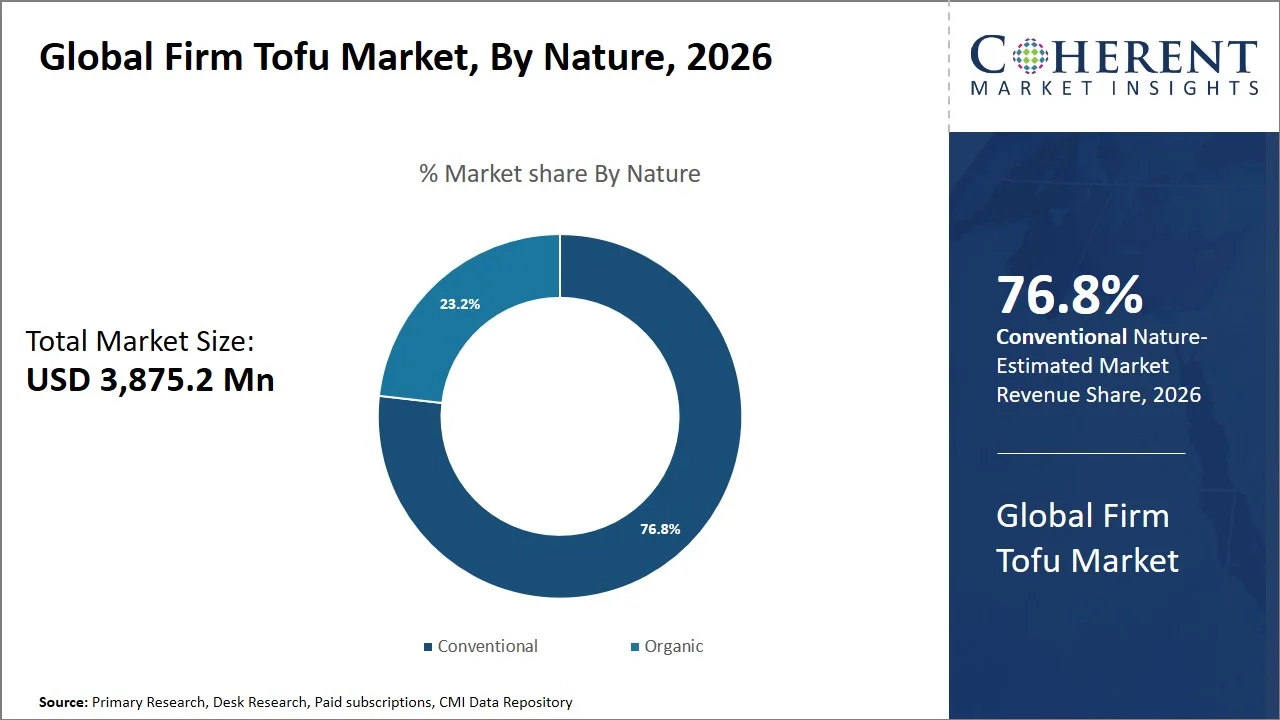
Conventional tofu is expected to represent 76.8% of the global firm tofu market in 2026 because it supports mass-market pricing and more flexible soybean procurement than certified-organic production. Large retailers, foodservice buyers, and value-oriented households require dependable texture, continuous supply, and competitive unit economics, making conventional products suitable for everyday purchasing and private-label programs. Manufacturers also avoid some certification, segregation, and documentation requirements associated with organic supply chains, enabling broader sourcing options and production utilization. The segment therefore provides the volume base for mainstream shelf presence while organic tofu addresses premium positioning. In December 2025, Sunrise Soya Foods reaffirmed continued investment in its products and operations; the company maintains its core Sunrise tofu portfolio separately from its certified-organic Soyganic range, illustrating a clear commercial distinction between mainstream and premium certified offerings.
Why Do Vacuum Packs and Pouches Dominate the Packaging Type Category of the Global Firm Tofu Market?
Vacuum Packs and Pouches are expected to hold 41.6% of the global firm tofu market in 2026 because flexible packaging aligns closely with the physical and logistical requirements of dense tofu blocks. Tight package contact can limit free headspace, contain moisture, reduce leakage exposure, and require less storage volume than many rigid alternatives, supporting refrigerated transportation and shelf handling. For manufacturers, pouch formats can integrate with sealing, pasteurization, and cooling systems and accommodate retail blocks alongside larger foodservice portions. Buyers gain practical storage and pack integrity, while suppliers can improve line efficiency and cold-chain utilization. In April 2026, Shokufo Limited Company documented a Canadian tofu producer using a steam pasteurizer on a third production line for tofu packed in vacuum bags, improving sterilization and cooling while limiting package deformation.
Current Events and their Impact
Current Event | Description and Its Impact |
December 2024 – U.S. FDA updates the “Healthy” nutrient content claim |
|
December 2025 – EU revises implementation timeline for the EUDR covering soy |
|
January 2026 – Canada makes front-of-package nutrition-label compliance mandatory |
|
Global Firm Tofu Market Dynamics
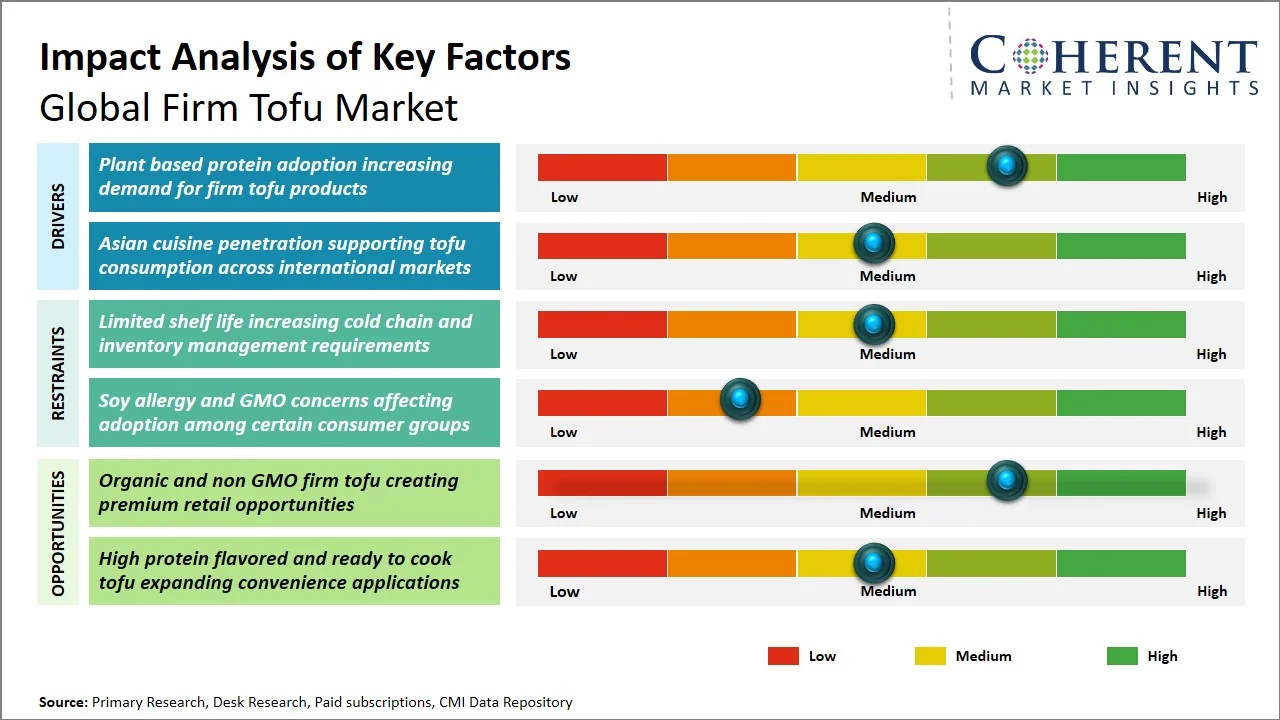
Key Market Drivers
- Plant based protein adoption increasing demand for firm tofu products: Plant-based protein adoption is increasingly converting firm tofu from a specialist vegetarian item into a repeat-purchase protein for institutional dining, meal preparation, and mainstream foodservice. Firm tofu is commercially attractive because it can be portioned, baked, crumbled, marinated, or incorporated into batch-cooked dishes while retaining enough structure for operational consistency. This gives caterers a recognizable whole-food alternative to more engineered meat substitutes and creates recurring volume opportunities for tofu processors, soybean suppliers, chilled distributors, and foodservice wholesalers. The strategic benefit is broader demand across consumers who may not identify as vegan but still rotate plant proteins into meals. In February 2026, Aramark Collegiate Hospitality convened chefs at the University of North Carolina Wilmington to develop plant-forward dishes, including a house-made tofu application, with broader campus-menu rollout planned after further testing.
- Asian cuisine penetration supporting tofu consumption across international markets: Asian cuisine penetration is supporting firm tofu consumption by introducing the product through familiar culinary formats rather than positioning it only as a substitute for meat. Korean barbecue bowls, Japanese ramen, Chinese stir-fries, Thai curries, and other sauce-led dishes give firm tofu a clear cooking role because its texture can carry marinades and withstand frying, baking, and mixing. As these cuisines become more accessible through restaurants, grocery ranges, recipe platforms, and prepared meals outside Asia, retailers gain a reason to maintain tofu alongside noodles, sauces, kimchi, and other Asian pantry products. This benefits tofu manufacturers, Asian-food distributors, supermarkets, and restaurant operators while reducing the education required for first-time buyers. In April 2025, UK-based Asian food brand itsu featured crispy tofu coated in Korean BBQ sauce and served with rice and kimchi within its vegetarian meal content.
Emerging Market Trends
- Cooking-Ready Formats Are Moving Firm Tofu Beyond the Basic Block: Cooking-ready firm tofu formats are moving the category beyond the traditional water-packed block toward products designed around specific meal occasions and preparation constraints. Pre-pressed, pre-cut, marinated, seasoned, baked, and portion-controlled formats reduce draining, cutting, seasoning, and cleanup, making tofu easier to integrate into weekday meals and professional kitchens. The commercial shift changes the basis of differentiation: manufacturers can compete on convenience, culinary performance, flavor architecture, and portion design instead of relying mainly on soybean origin or basic firmness. Retailers benefit from higher-value shelf options, while foodservice distributors can offer standardized formats that reduce kitchen labor and waste. During the forecast period, this trend is likely to create a wider gap between commodity block tofu and application-led products, rewarding processors with flexible lines, reliable flavor systems, and packaging capabilities that preserve texture without undermining tofu’s minimally processed positioning.
- Soybean-to-Block Production Is Becoming More Specification-Controlled: Firm tofu manufacturing is becoming more supply-chain engineered as processors seek tighter control over soybean functionality, product consistency, and resource efficiency. Protein content, bean variety, storage conditions, water quality, coagulation behavior, and pressing parameters all influence yield and finished texture, making upstream specification increasingly important for brands that promise repeatable cooking performance. This encourages closer relationships with growers, identity-preserved sourcing, better lot segregation, and more disciplined incoming-material testing. At the factory level, manufacturers are also likely to place greater emphasis on water reuse, energy-efficient heating, automated cleaning, and valorization of okara rather than treating production efficiency as a secondary sustainability exercise. The trend favors vertically coordinated processors and specialist suppliers that can document raw-material performance from crop to finished block. Companies dependent on opportunistic soybean purchasing may face greater variability, while disciplined sourcing can support premium positioning, fewer rejects, and more predictable production economics.
Regional Insights
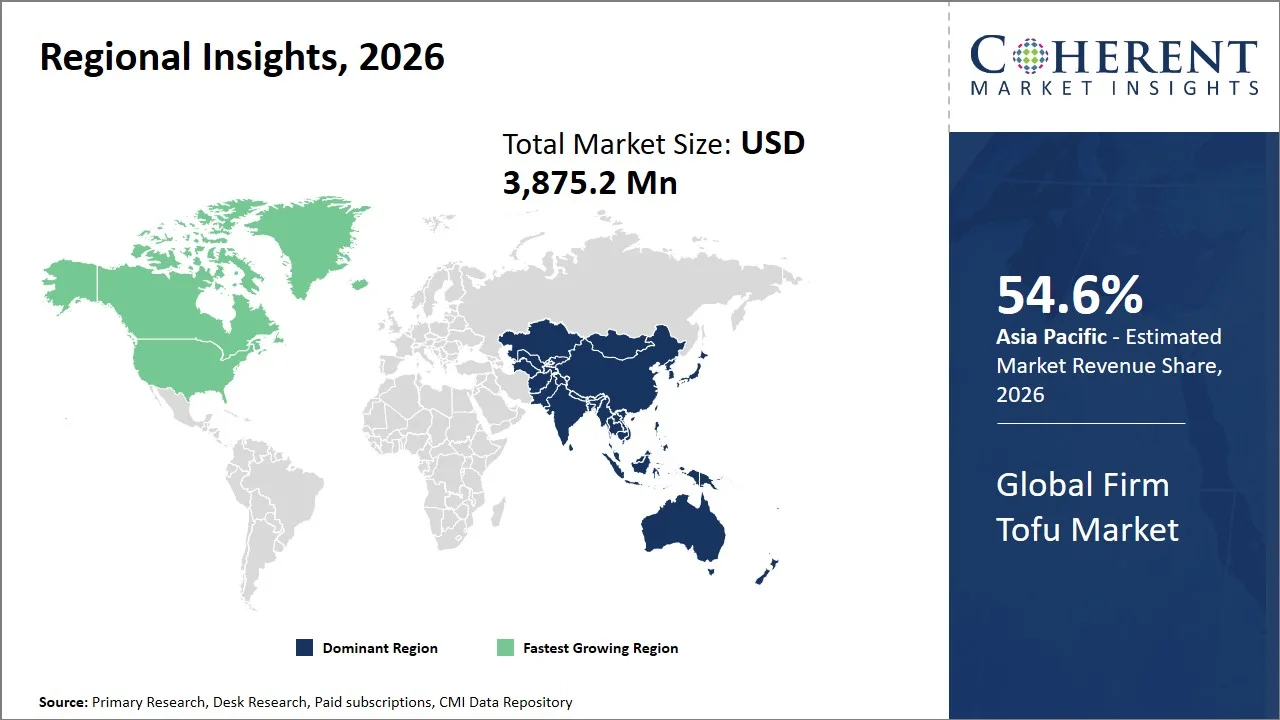
Why Does Asia Pacific Dominate the Global Firm Tofu Market?
Asia Pacific is expected to account for 54.6% of the global firm tofu market in 2026 because tofu is embedded in everyday meal patterns across China, Japan, South Korea, and several Southeast Asian markets rather than consumed mainly as an alternative protein. Dense retail networks, established soybean-processing industries, fresh-food distribution, and broad familiarity with pressed tofu support frequent household and foodservice purchasing. The region also benefits from a deep base of specialist manufacturers able to serve multiple texture, pack-size, and cuisine requirements at scale. This makes market leadership structurally consumption-led as well as production-led. In May 2025, National Public service platform for standard information China published GB/T 22106-2025, a new national quality standard for non-fermented soybean products that replaces earlier standards covering non-fermented soy products and dried tofu, reinforcing formalized quality requirements in one of the region’s largest tofu-producing economies.
Why Is North America Emerging as the Fastest-Growing Region in the Global Firm Tofu Market?
North America is expected to hold 19.7% of the global firm tofu market in 2026 and emerge as the fastest-growing region as tofu moves further into mainstream grocery, meal-preparation, institutional, and flexitarian consumption. Growth is supported by strong refrigerated retail infrastructure, greater familiarity with Asian cuisines, demand for minimally processed protein options, and a food-manufacturing base capable of scaling convenient firm and extra-firm formats. The region also offers room for manufacturers to expand beyond natural-food channels into conventional supermarkets and foodservice procurement. In December 2024, Canada Economic Development for Quebec Regions approved a US$ 129620.59 contribution to Soya Distinction Inc. for production equipment intended to increase the capacity and productivity of its tofu manufacturing operation, providing direct evidence of investment in North American tofu-processing capability.
Global Firm Tofu Market Outlook for Key Countries
Why Is the U.S. a Key Market for the Global Firm Tofu Market?
The U.S. is a key country in the global firm tofu market because its demand base combines mainstream supermarket access, Asian-American food consumption, flexitarian eating, institutional nutrition programs, and a large chilled-food logistics network. Firm tofu is well suited to this environment because it can be retailed as a simple protein ingredient while also fitting school, foodservice, meal-kit, and prepared-food applications. Domestic processors benefit from broad soybean availability and the ability to distribute nationally through produce and refrigerated sections. Public nutrition rules can also widen familiarity with tofu beyond specialist consumers. In April 2024, the U.S. Department of Agriculture finalized revisions to WIC food packages that allow state agencies to authorize tofu as a substitute for eggs, creating an additional pathway for qualifying tofu products to enter nutrition-assistance purchasing.
Why Is China Important in the Global Firm Tofu Market?
China is important to the Global Firm Tofu Market because tofu is deeply integrated into household cooking, restaurant menus, regional cuisines, and the country’s wider non-fermented soybean-products industry. Its importance is reinforced by a large domestic soybean-processing base, extensive wet-market and modern-retail distribution, and manufacturing capabilities ranging from fresh local tofu to packaged products for urban consumers. China also offers suppliers a broad raw-material and processing ecosystem that supports high-volume production and product specialization. In February 2026, the National Bureau of Statistics reported that China produced 20.91 million tons of soybeans in 2025, up 1.3% year over year. The scale of this upstream soybean economy provides an important foundation for food-grade soybean processors, tofu manufacturers, ingredient suppliers, and regional distribution networks serving the domestic market.
Why Does India Support Growth in the Global Firm Tofu Market?
India supports growth in the Global Firm Tofu Market through a combination of a large vegetarian consumer base, established soybean cultivation, expanding modern grocery access, and the familiarity of consumers with paneer-style cooking formats. Firm tofu can enter Indian meals through stir-fries, curries, wraps, salads, institutional menus, and protein-focused diets while using preparation methods already familiar to paneer users. The commercial opportunity is strongest where soybean production and food processing are geographically connected, helping reduce raw-material and logistics constraints for regional manufacturers and specialized foodservice suppliers. In July 2026, India’s National Portal identified Washim, Maharashtra, as a hub for soybean-based products including tofu, soy milk, soy sauce, and soybean oil, noting that widespread local soybean cultivation supports the area’s soybean-product manufacturing base.
Why Is Japan a Strategic Country in the Global Firm Tofu Market?
Japan is a strategic country in the global firm tofu market because tofu is a routine food category with established manufacturing know-how, specialized processors, mature quality expectations, and widespread grocery penetration. Firm and pressed tofu formats are supported by domestic culinary uses that require structure for simmering, grilling, frying, and regional preparations, giving producers a stable base of repeat consumption. Japan’s mature market also encourages manufacturers to compete through soybean provenance, texture control, packaging efficiency, premium positioning, and export development rather than relying only on volume. In May 2026, the Japan Tofu Association’s export division attended THAIFEX 2026 in Bangkok to collect information on Southeast Asian industry conditions and prospective buyers, showing that Japanese tofu suppliers are actively assessing overseas commercial opportunities from an established domestic production base.
Why Is South Korea an Important Growth Market for the Global Firm Tofu Market?
South Korea is an important growth market in the global firm tofu market because tofu remains closely linked with everyday Korean cooking, including stews, pan-fried dishes, side dishes, and institutional meals. This creates recurring demand for products that can hold shape during cooking while fitting fresh refrigerated distribution. The country also has a developed soybean-food manufacturing base and active government involvement in domestic soybean supply, which can influence processor costs and sourcing strategies. In June 2026, South Korea’s Ministry of Agriculture, Food and Rural Affairs convened major tofu and soy-milk manufacturers to support wider use of government-stocked domestic soybeans; 16 companies had been allocated 21,000 tons for raw-material use. The initiative directly supports ingredient availability for tofu processors while strengthening the domestic soybean consumption base.
Technology Adoption Landscape in the Global Firm Tofu Market
Technology | Adoption Level | Key Application Area | Business Impact |
Automated Soybean Soaking, Grinding and Extraction Control | High | Soymilk preparation | Standardizes solids extraction, improves batch consistency, reduces manual intervention, and supports higher line throughput. |
Precision Coagulant Dosing and Temperature Control | High | Curd formation | Improves firmness consistency, reduces coagulation variability, and allows processors to maintain tighter product specifications. |
Servo-Controlled Pressing and Block-Cutting Systems | High | Firm and extra-firm tofu production | Delivers repeatable moisture removal, block dimensions, and texture while lowering labor requirements and product breakage. |
Vacuum Sealing and Controlled-Atmosphere Packaging | High | Chilled firm tofu packaging | Limits oxygen exposure and leakage, protects product integrity, and improves handling through retail and foodservice cold chains. |
Aseptic Filling and Long-Life Packaging Systems | Medium | Shelf-stable tofu formats | Extends distribution reach beyond refrigerated channels but requires greater processing, packaging-validation, and capital capabilities. |
Inline Moisture, Protein and Process Quality Monitoring | Medium | Quality assurance and process control | Enables quicker batch adjustments, tighter specification control, lower reject rates, and more consistent cooking performance. |
How Are Foodservice-Specific Firm Tofu Formats Creating New Growth Opportunities in the Global Firm Tofu Market?
Foodservice-specific firm tofu is an underdeveloped opportunity because many commercial kitchens still receive retail-style blocks that require draining, cutting, portioning, and recipe adjustment before service. Manufacturers can create a more valuable B2B proposition through pre-drained high-solids blocks, standardized cubes or slabs, bulk packs, grill-ready portions, and specifications designed for batch cooking, holding, and sauce absorption. Priority customers include universities, workplace caterers, hotel groups, Asian and fusion restaurant chains, meal-preparation businesses, and institutional kitchens seeking flexible plant-protein options without complex handling. Capturing this opportunity requires chef-led product testing, documented cooking yields, foodservice-sized packaging, dependable refrigerated distribution, allergen controls, and consistent soybean and coagulation specifications. Established tofu producers have an advantage in scale and food-safety systems, while specialists can compete through customization and faster product development. Companies should also build distributor relationships and sampling programs because adoption will depend on kitchen performance and operator confidence, not retail brand awareness alone during peak service periods.
Market Players, Key Development, and Competitive Landscape
Key Developments
- In February 2025, Asahico introduced its Craft Tofu concept in Japan, emphasizing selected domestic soybeans, individual product identification of soybean origin and variety, QR-enabled product information, specialized tofu craftsmanship, and proprietary processing. This is important for the global firm tofu market because it demonstrates how manufacturers can move conventional tofu away from undifferentiated price competition toward provenance, process transparency, texture differentiation, and premium positioning.
- In August 2024, The Tofoo Co announced new investment following its acquisition by Comitis Capital, with existing management remaining invested and plans to accelerate growth across existing customers, new channels, foodservice, and international markets. This is important for the global firm tofu market because dedicated investment capital can support branded tofu manufacturers in scaling distribution, building foodservice penetration, and moving tofu further into mainstream plant-protein purchasing occasions
- In March 2024, Morinaga Milk Industry announced that its long-life Morinaga Tofu series, including the firmer “Kinu Tofu Shikkari” format, had obtained Phase Free Certification and would progressively adopt the certification mark on packaging. The products use aseptic filling and multilayer cartons for extended ambient storage. This is important because longer-life tofu can broaden inventory, emergency-stock, e-commerce, and distribution options beyond conventional refrigerated merchandising.
Competitive Landscape
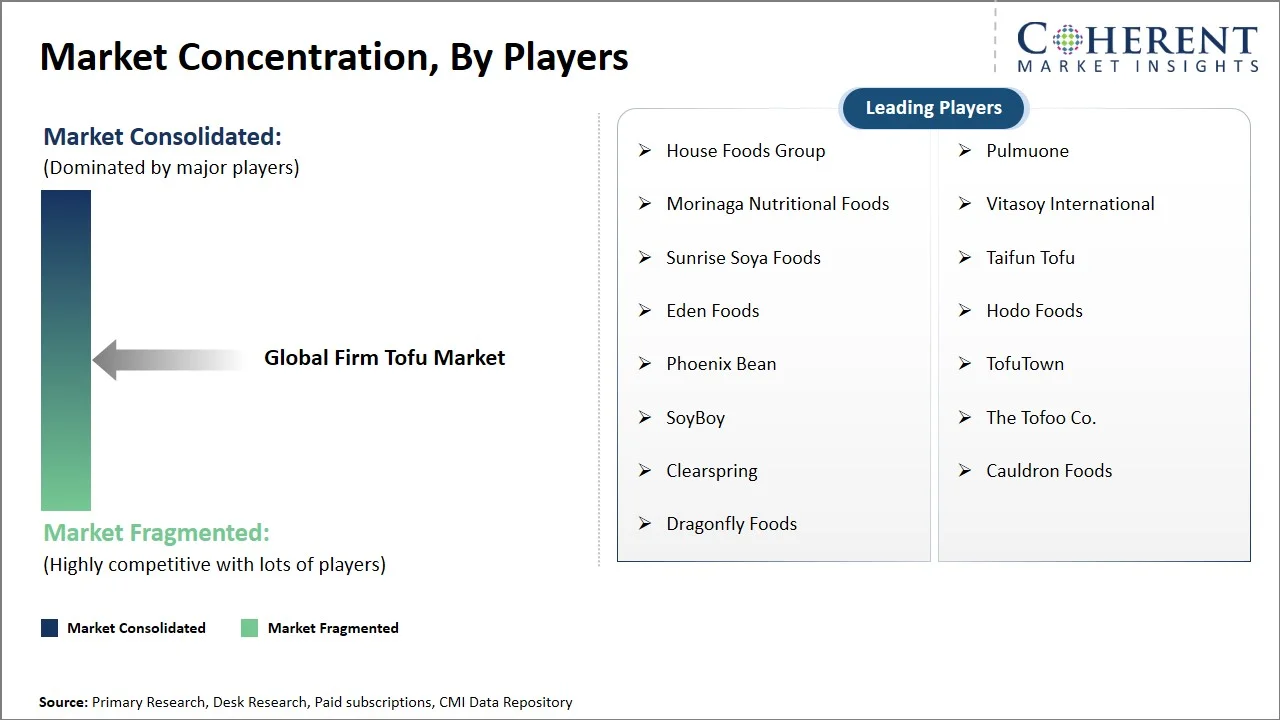
The global firm tofu market remains fragmented, with competition spanning established Asian tofu manufacturers, regional fresh-tofu specialists, branded plant-protein companies, organic producers, foodservice processors, and supermarket private labels. Competitive strength depends less on technological novelty alone and more on combining repeatable texture, soybean quality, manufacturing discipline, appropriate shelf life, cost control, and reliable refrigerated distribution. Regional manufacturers retain an advantage where freshness and local retail relationships matter, while larger processors can compete through automation, wider channel coverage, procurement scale, and standardized supply to multi-location buyers.
Key focus areas include
- Texture and cooking consistency: Maintaining predictable moisture, firmness, slicing strength, and cooking behavior across batches is fundamental to repeat purchasing.
- Soybean sourcing and traceability: Controlled bean specifications, reliable origin documentation, and supplier relationships increasingly support both quality and compliance.
- Manufacturing efficiency: High extraction yield, controlled coagulation, reduced breakage, and efficient line utilization protect margins in price-sensitive conventional tofu.
- Packaging and shelf-life performance: Leakage control, seal integrity, cold-chain compatibility, and appropriate pack sizing influence retailer acceptance and product losses.
- Channel coverage: Access to supermarkets, Asian food stores, foodservice distributors, institutional buyers, and online grocery channels broadens revenue resilience.
- Specialty positioning: Organic, non-GMO, clean-label, locally sourced, premium-soy, and culinary-specific propositions allow suppliers to move beyond price-only competition.
- Foodservice and private-label flexibility: Bulk formats, customized firmness, portion specifications, and contract-manufacturing capabilities can strengthen long-term customer relationships.
Market Report Scope
Firm Tofu Market Report Coverage
| Report Coverage | Details | ||
|---|---|---|---|
| Base Year: | 2025 | Market Size in 2026: | USD 3,875.2 Mn |
| Historical Data for: | 2020 To 2024 | Forecast Period: | 2026 To 2033 |
| Forecast Period 2026 to 2033 CAGR: | 6.6% | 2033 Value Projection: | USD 6,061.7 Mn |
| Geographies covered: |
| ||
| Segments covered: |
| ||
| Companies covered: | House Foods Group, Pulmuone, Morinaga Nutritional Foods, Vitasoy International, Sunrise Soya Foods, Taifun Tofu, Eden Foods, Hodo Foods, Phoenix Bean, TofuTown, SoyBoy, The Tofoo Co., Clearspring, Cauldron Foods, Dragonfly Foods | ||
| Growth Drivers: |
| ||
| Restraints & Challenges: |
| ||
Analyst Opinion (Expert Opinion)
- Market leadership is likely to shift from standard tofu blocks toward application-specific formats tailored for cooking performance, portioning, packaging, and foodservice requirements. Suppliers offering consistent texture and preparation performance will be better positioned to build stronger retailer and foodservice relationships.
- Shelf-stable and alternative packaging formats could reduce refrigeration dependence, improve distribution flexibility, and expand tofu access across e-commerce, export, and markets with limited cold-chain infrastructure. This shift could also lower inventory losses and improve commercial viability in geographically dispersed markets.
- Producers should prioritize consistent soybean quality, flexible processing, food safety, and channel-specific products while managing soybean, energy, refrigeration, and retailer-related cost pressures. Investment should focus on efficiency and scalable demand rather than capacity expansion without clear customer commitments.
Speak to the analyst
Want personalized insights?
Take the findings above to one of our principal consultants, or have the report rebuilt around the segments, geographies and competitors you actually track.
Market Segmentation
- Product Type Insights (Revenue, USD Mn, 2021 - 2033)
- Firm Tofu
- Extra Firm Tofu
- Nature Insights (Revenue, USD Mn, 2021 - 2033)
- Conventional
- Organic
- Packaging Type Insights (Revenue, USD Mn, 2021 - 2033)
- Vacuum Packs and Pouches
- Trays and Tubs
- Aseptic Cartons
- Others
- End User Insights (Revenue, USD Mn, 2021 - 2033)
- Household
- Foodservice
- Food Processing
- Institutional
- Distribution Channel Insights (Revenue, USD Mn, 2021 - 2033)
- Supermarkets and Hypermarkets
- Specialty and Asian Food Stores
- Convenience Stores
- Online Retail
- Direct Foodservice Sales
- Others
- Regional Insights (Revenue, USD Mn, 2021 - 2033)
- North America
- U.S.
- Canada
- Latin America
- Brazil
- Argentina
- Mexico
- Rest of Latin America
- Europe
- Germany
- U.K.
- Spain
- France
- Italy
- Russia
- Rest of Europe
- Asia Pacific
- China
- India
- Japan
- Australia
- South Korea
- ASEAN
- Rest of Asia Pacific
- Middle East
- GCC Countries
- Israel
- Rest of Middle East
- Africa
- South Africa
- North Africa
- Central Africa
- North America
- Key Players Insights
- House Foods Group
- Pulmuone
- Morinaga Nutritional Foods
- Vitasoy International
- Sunrise Soya Foods
- Taifun Tofu
- Eden Foods
- Hodo Foods
- Phoenix Bean
- TofuTown
- SoyBoy
- The Tofoo Co.
- Clearspring
- Cauldron Foods
- Dragonfly Foods
Sources
Primary Research Interviews
- Firm and extra-firm tofu manufacturers, soybean processors, private-label producers, and contract food manufacturers
- Food-grade soybean, coagulant, seasoning, packaging-film, carton, and processing-equipment suppliers
- Supermarkets, Asian food stores, distributors, foodservice wholesalers, institutional buyers, and online retailers
- R&D, production, procurement, quality, food safety, packaging, supply-chain, marketing, and sales executives
Stakeholders
- Conventional, organic, non-GMO, refrigerated, and shelf-stable tofu manufacturers
- Soybean growers/processors; calcium sulfate, magnesium chloride/nigari, and GDL suppliers
- Soaking, grinding, filtration, coagulation, pressing, cutting, pasteurization, aseptic-filling, and packaging-equipment providers
- Retailers, foodservice distributors, restaurants, institutional caterers, laboratories, certification bodies, and cold-chain operators
End-use Sectors
- Household consumption through supermarkets, Asian food stores, convenience stores, and online grocery
- Foodservice: restaurants, cafés, hotels, catering, meal-preparation, and Asian cuisine operators
- Food processing: ready meals, plant-based foods, prepared dishes, sauces, fillings, and frozen foods
- Institutional: schools, universities, hospitals, workplace dining, and public catering
Regulatory and Government Bodies
- U.S. FDA, USDA, and U.S. Customs and Border Protection
- European Commission, EFSA, and national EU food-safety authorities
- China SAMR, National Health Commission, and General Administration of Customs
- Japan MHLW, Consumer Affairs Agency, and MAFF
- India FSSAI; South Korea MFDS and MAFRA
- Health Canada, CFIA, and Food Standards Australia New Zealand
Databases
- FAOSTAT, UN Comtrade, ITC Trade Map, Eurostat, and national customs databases
- USDA Foreign Agricultural Service and soybean production/trade databases
- China National Bureau of Statistics, Japan MAFF statistics, and South Korea KOSIS
- Company annual reports, product catalogues, distributor databases, and retail assortment databases
- Supermarket pricing, e-commerce SKU, foodservice menu, promotional, packaging, and product-launch tracking
Magazines and Journals
- Journal of Food Science
- Food Chemistry
- LWT – Food Science and Technology
- Food Hydrocolloids
- Foods
- International Journal of Food Science & Technology
- Journal of Food Processing and Preservation
Associations
- Japanese Tofu Association, covering tofu manufacturing, quality, distribution, packaging, and industry development.
- American Soybean Association and U.S. Soybean Export Council
- Japan Soymilk Association and other national soybean/soy-food industry bodies
- Organic Trade Association and relevant plant-based food and food-manufacturing associations
Public Domain Sources
- Firmness, moisture, protein content, ingredients, soybean origin, pack size, shelf life, and storage specifications
- Soybean soaking, grinding, soymilk extraction, coagulation, pressing, cutting, pasteurization, cooling, and aseptic-processing information
- Retail prices, promotional activity, foodservice menus, distribution coverage, and online product availability
- Soybean production, food-grade soybean supply, imports/exports, cold-chain infrastructure, and packaging information
- Company launches, capacity investments, distribution agreements, manufacturing upgrades, and geographic expansion
Key Standards and Regulations
- U.S. FD&C Act/FALCPA allergen-labeling requirements: soybeans are treated as a major food allergen for applicable packaged foods.
- EU Regulation (EU) No 1169/2011: governs food information and requires clear declaration of soy allergens in applicable foods.
- China GB/T 22106-2025 – General Quality for Non-Fermented Soybean Products: relevant to tofu and related non-fermented soy foods; scheduled to take effect on December 1, 2026.
- Japan MHLW Standards for Foods and Additives: include specific tofu manufacturing, sterilization, water-use, packaging, and storage requirements.
- India FSSAI Food Safety and Standards Regulations: classify tofu under soybean products, including Tofu – Food Category 6.8.3.
- Australia New Zealand Food Standards Code: requires declaration of soy/soya/soybean under prescribed allergen-labeling requirements.
- Country-specific requirements covering food additives/coagulants, microbiological safety, GMO labeling, organic certification, nutrition labeling, packaging materials, cold-chain storage, traceability, and import compliance
Proprietary Elements
- CMI Data Analytics Tool, Proprietary CMI Existing Repository of information for last 10 years.
Get access to 250+ pages report
Every segment, forecast, competitor profile and data table behind the analysis above — available for instant download.
- ESOMAR Member
- ISO 9001:2015 Certified
- D-U-N-S Registered
- GDPR & CCPA Compliant
Missing comfort of reading report in your local language? Find your preferred language:
Transform your Strategy with Exclusive Trending Reports
Frequently Asked Questions
The CAGR of global firm tofu market is projected to be 6.6% from 2026 to 2033.
The global firm tofu market is estimated to be valued at USD 3,875.2 million in 2026 and is expected to reach USD 6,061.7 million by 2033.
Convenient ready-to-cook tofu formats, clean-label products, organic and non-GMO offerings, improved packaging, and wider adoption of tofu in plant-based and Asian-inspired meals are key trends influencing the global firm tofu market.
Firm tofu products are primarily distributed through supermarkets and hypermarkets, specialty and Asian food stores, convenience stores, online retail platforms, and direct foodservice channels.
Households represent the primary end-user group, while foodservice operators, food processing companies, restaurants, institutional kitchens, and catering businesses also contribute to demand in the global firm tofu market.
Plant based protein adoption increasing demand for firm tofu products and Asian cuisine penetration supporting tofu consumption across international markets are the major factor driving the growth of global firm tofu market.
Limited shelf life increasing cold chain and inventory management requirements and Soy allergy and GMO concerns affecting adoption among certain consumer groups are the major factor hampering the growth of global firm tofu market.