

Global Fishing Line Market Size and Forecast – 2026 to 2033
The Global Fishing Line Market is estimated to be valued at USD 1.96 Bn in 2026 and is expected to reach USD 3.00 Bn by 2033, reflecting a compound annual growth rate (CAGR) of 6.3% from 2026 to 2033.
Key Takeaways of the Fishing Line Market
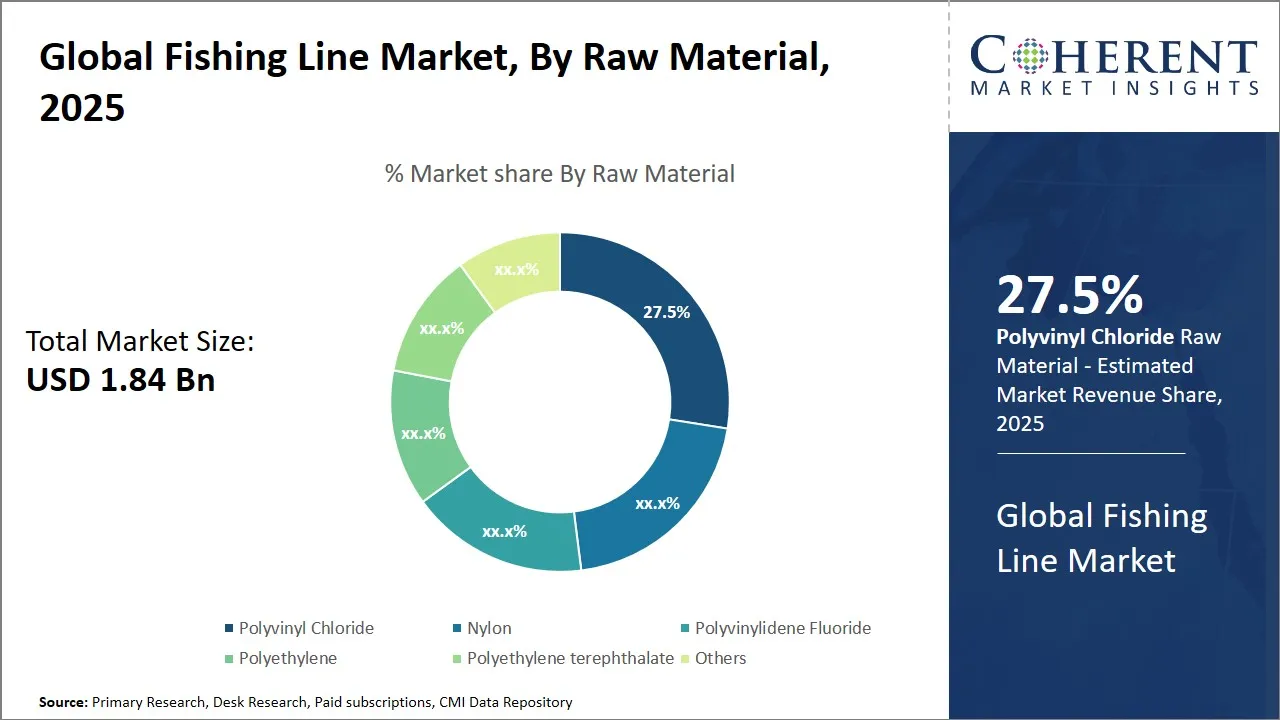
- Polyvinyl chloride segment is expected to account for 28.5% of the global fishing line market share in 2026.
- Monofilament lines segment is estimated to capture 44.7% of the market share in 2026.
- Freshwater fishing segment is projected to hold 39.6% of the fishing line market share in 2026.
- Asia Pacific will lead the global fishing line market in 2026 with an estimated 37.2% share.
- North America will hold a 19.3% share in 2026 and record the fastest growth.
Currents Events and Its Impacts
Current Events | Description and its Impact |
Retail push for eco-friendly and recycled monofilament lines in Europe |
|
Development of biodegradable fishing materials and gear |
|
Segmental Insights
- Current Industry Events of 2026
- Market Size Estimation
- Regional Breakdown
- Competitive Landscape
- Customer Intelligence
- Segmental Analysis
- Pricing Analysis
- Key Market Drivers, Challenges & Future Trends
- Customized Insights Section
Why Does Polyvinyl Chloride Dominate the Fishing Line Market in 2026?
Polyvinyl chloride segment is expected to hold 28.5% of the fishing line market share in 2026. PVC fishing lines are very valuable to the manufacturer as well as the end-users because they are durable and resistant to environmental forces including UV exposure, abrasion and water degradation. This toughness is converted into a dependable product that is capable of being used in various fishing situations without losing its strength or flexibility.
The other critical issue that contributes to the dominant share of PVC is its ability to be easily processed and customized. Improvement in polymer technology enables manufacturers to customize the characteristics of PVC lines and this enables adjustment of properties of PVC lines such as elasticity, tensile strength and diameter to suit the particular needs of different fishing applications. This flexibility provides PVC with a competitive advantage over other raw materials which can possess performance attributes that are fixed or can be processed more expensively.
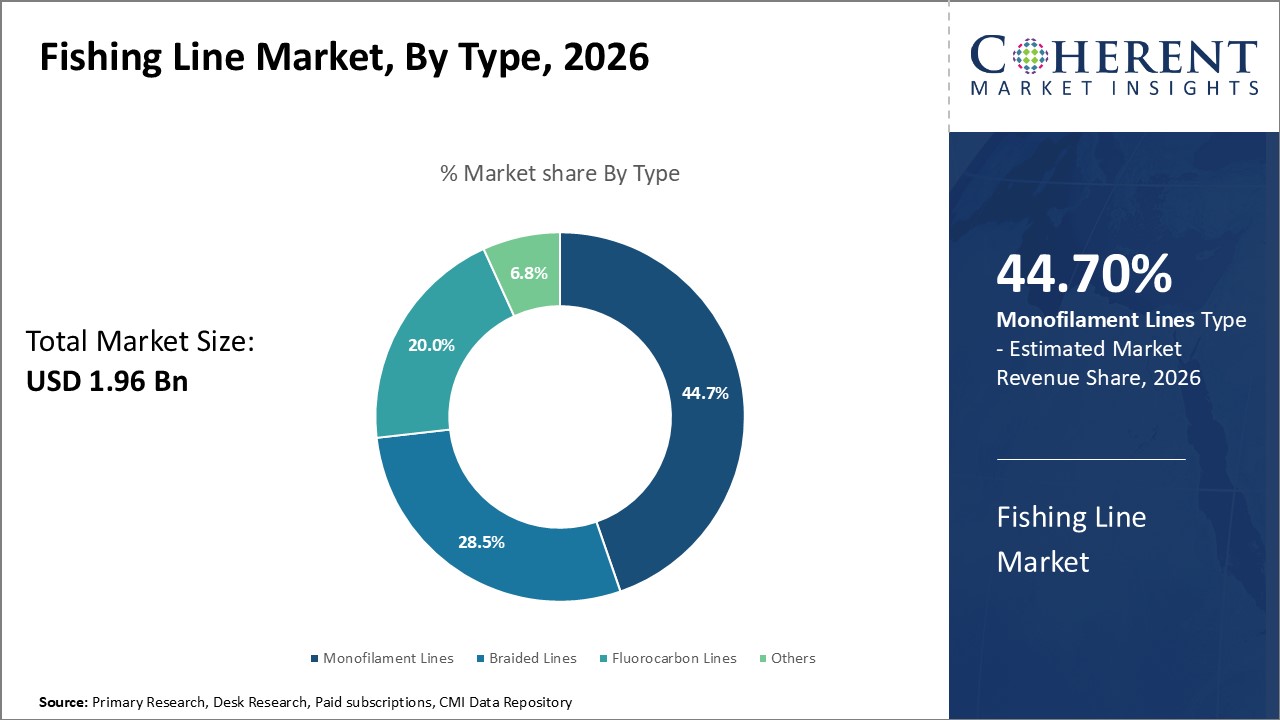
Monofilament Lines Dominate the Fishing Line Market
Monofilament lines segment is set to hold 44.7% of the market share in 2026. Monofilament lines are a single strand of lines and are usually of nylon or derivatives of plastic which are valued due to their elasticity, smooth texture and affordability. Such features can be especially appealing to a wide range of anglers, both amateurs and professional ones.
Elasticity of the monofilament lines serves as a shock absorber during fish strike decreasing the likelihood of it breaking and enhancing fish retention. This feature is important in the fishing fields of freshwater and saltwater where abrupt pulls or violent fish actions cause serious strain to the line. Monofilament lines are able to be forgiving and therefore controlled in a manner that reduces snagging resulting in the overall improvement of the fishing experience.
Why is Freshwater Fishing the Largest Application of Fishing Line in 2026?
Freshwater fishing segment is projected to command 39.6% of the global fishing line market share in 2026, due to its large level of participation and number of fish species and habitat that it serves. Freshwater fishing is attractive to a large group of potential customers who may be casual recreational fishing fans and even professional fishers, a factor that supports the need of specialized fishing lines that can meet the various freshwater requirements.
Fishing is also possible at all times and on freshwater bodies like lakes, rivers and reservoirs due to their availability. This supply makes the fishing equipment, such as fishing lines, more frequently used, which provokes the steady demand. Fishing of freshwater is also a highly entrenched practice in terms of culture and social-economic aspects in most parts, as it is a popular leisure or means of earning a living.
Regional Insights
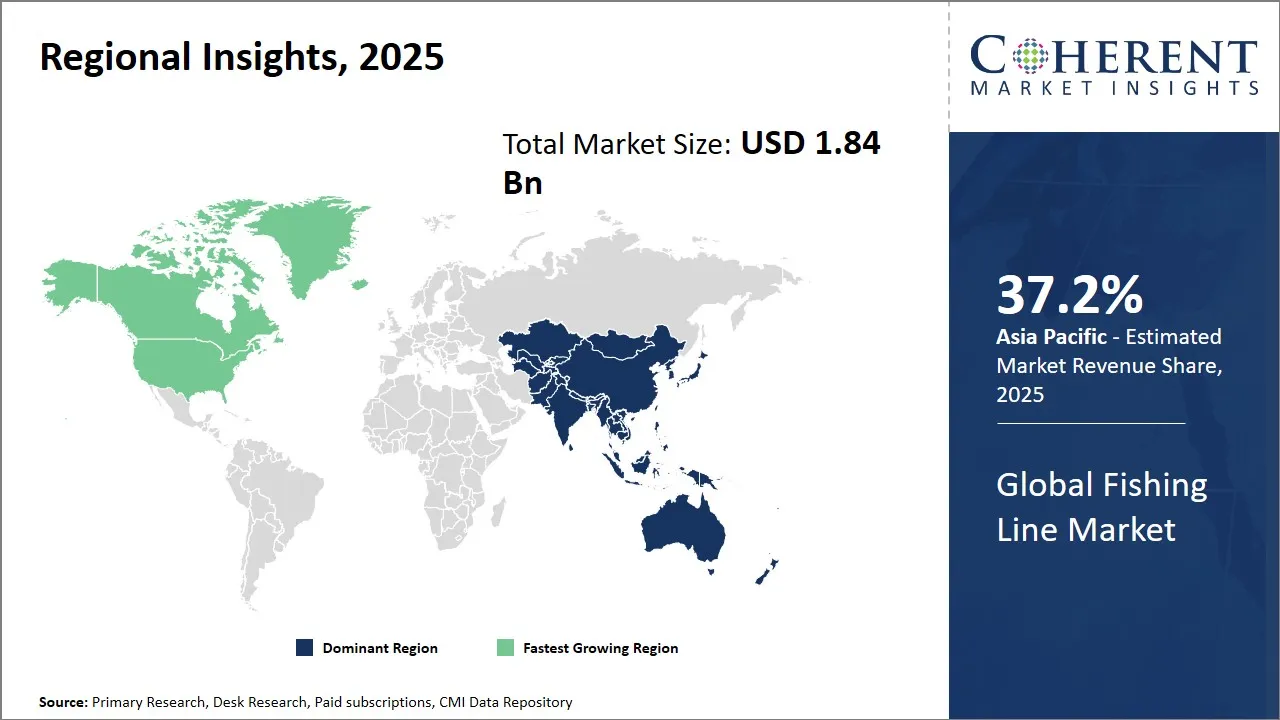
Asia Pacific Fishing Line Market Analysis and Trends
The Asia Pacific region is projected to lead the market with a 37.2% share in 2026, because of the growing recreational fishing activities, growing coastal strip, and growing disposable incomes by the emerging economies in the Asia Pacific like China, India, and Southeast Asia. Demand has also been triggered by government efforts to increase aquaculture and sustainable fishing techniques that have increased the need of high-performance fishing equipment such as fishing lines. The availability of a wide coastline and high concentration of fishing communities make commercial and subsistence fishing easy, hence expanding the market.
There are also local manufacturers such as YGK (Japan), Hi-Sea Fishing Tackle (China) and Laguna (Indonesia) who have played a major role in the market with their low-price and innovative products to meet the needs of the region. The retailing infrastructure that is on the rise and the better logistical networks further boosts the availability of the products in both the urban and rural regions of this region.
North America Fishing Line Market Analysis and Trends
The North America region is expected to exhibit the fastest growth in the market contributing 19.3% share in 2026, due to an established and matured fishing ecosystem in the region through a combination of good government policy, a good presence in the industry and good trade dynamics. America and Canada have a well-established recreational and commercial fishing industry, and therefore there is a high demand of innovative and well-developed fishing lines. The governmental bodies are also advancing sustainable fishing methods with an encouragement to establish and use on environmentally friendly and sustainable fishing lines.
Also, some of the leading manufacturers of fishing lines are located in North America including Berkley (subsidiary of Pure Fishing), Seaguar (owned by Momoi), and Rapala VMC Corporation. These firms dedicate large sums in research and development in improving the performance of their products through growth in material science such as fluorocarbon and braided lines. This network of retail stores and integration of e-commerce also underlines the availability and use of fishing lines in this area.
Fishing Line Market Outlook for Key Countries
Why is the U.S. Fishing Line Market Dominating the Global Recreational Angling Landscape?
Market competition in the U.S. is still very high and the main contenders, which include Berkley, Seaguar, and SpiderWire, control the market by continuously innovating and brand following. The broad-based fresh water and salt water fishing culture in the country ensures high level of demand on an extensive range of fishing line products such as monofilament, fluorocarbon and braided lines. Conservation is a core concept in regulatory bodies, and the demand of environmentally friendly and durable fishing lines arises. The rising popularity of sport fishing and tournaments also drives the demand of the high-quality and performance-oriented lines.
Japan Fishing Line Market Trends
The fishing line market in Japan is defined as one with keen engineering and cutting-edge material technology and companies such as YGK and Daiwa have been at the forefront of supplying fishing lines of high quality in terms of their braided and fluorocarbon lines. The country has a very good fishing background, and high consumer demand for high-quality products promote innovations that emphasize on durability and castability. The government regulations that surround marine sustainability and conservation also promote the production of products that are eco-friendly. The supply chain is well-structured to benefit the domestic and export markets due to the consumer confidence in the Japanese fishing tackle brands.
Why is China Becoming a Fast-Growing Force in the Global Fishing Line Market?
The market in China is growing very fast owing to the extensive fishing sector and increasing angling population in the country. The local manufacturers like the Hi-Sea Fishing Tackle and other emerging players play a key role in ensuring that the market grows well due to the fact that they are offering competitively priced products that are improving in quality standards. Government focus on aquaculture development and coastal economic zones supports the expansion of fishing infrastructure, thus increasing line consumption. Enhanced trade routes and rising e-commerce usage also promote wider product accessibility across urban and rural areas.
Germany Fishing Line Market Trends
Germany maintains a steady market presence with emphasis on quality and EU-compliant products. Companies like DAM and Balzer have a strong foothold, supplying advanced monofilament and fluorocarbon lines to both recreational and professional anglers. The region’s extensive freshwater fishing ecosystem, supported by strict environmental regulations, encourages manufacturers to develop biodegradable and long-lasting fishing lines. There is also a notable presence of distributors and specialty stores catering to fishing enthusiasts, facilitating market penetration.
Brazil Fishing Line Market Trends
The Brazilian market is on the rise due to the presence of the bountiful freshwater fishing grounds and growing popularity of sport fishing. The domestic brands and foreign competitors SpiderWire and Berkley have been increasing their presence by collaborating with local retailers. Government programs to enhance sustainable fishing and aquaculture industry have a beneficial effect on the demand of the products. Another factor is the varying aquatic habitat of Brazil that requires the use of a variety of types of fishing lines, and this encourages the development of lines that are resistant and strong enough to fit the area fishing requirements.
Saltwater vs Freshwater Performance
This segment flags environmental stress and degradation effects
- Environment type (freshwater, inshore salt, offshore bluewater)
- Salinity, temperature, UV exposure, duration of soak
- Post‑exposure tensile and knot strength vs baseline (retention percentage)
- Abrasion test results (cycles to failure vs standard rough surface or sand/shell proxy).
Tensile & Knot Strength Benchmarking
The “Tensile Strength & Knot Strength Benchmarking” portion usually captures
- Line ID (brand, model, material, diameter, rated pound test)
- Measured tensile strength (ultimate breaking load, often in N or lb)
- Elongation at break / stretch percentage
- Knot type used and measured knot strength (breaking load with knot)
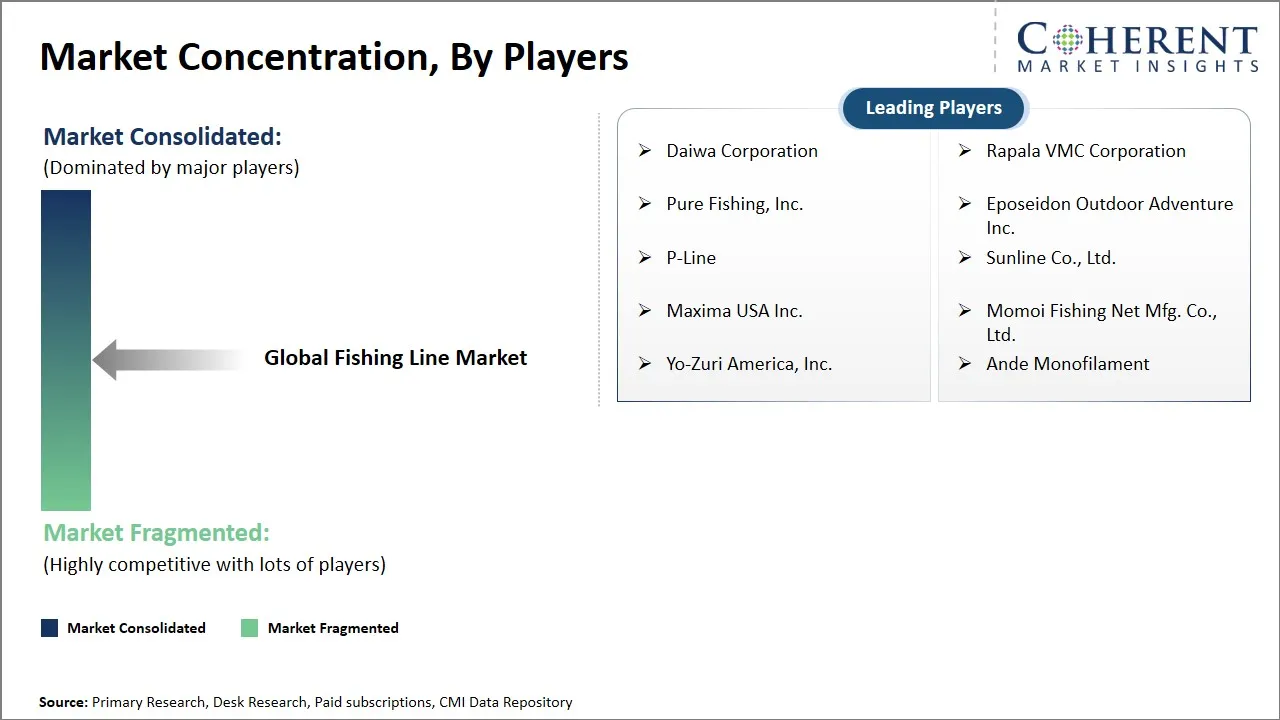
Market Players, Key Development, and Competitive Intelligence
Key Developments
- In October 2024, Pure Fishing Inc. obtained a five-year, USD 750 million credit facility from a group of lenders led by Monarch Alternative Capital LP and Silver Point Finance. The funding will be used to repay existing term and asset-backed loans fully, providing the company with additional long-term capital for growth.
- In August 2024, DAIWA collaborated with Japan’s XBRAID to introduce the highest-quality braided fishing lines to the North American market. XBRAID is now accessible to anglers in both North and South America through DAIWA, providing exciting opportunities for freshwater and saltwater fishermen.
- In May 2024, KastKing launched the iReel One IFC Smart Fishing Reel. The iReel One features Intelligent Frequency Control (IFC) that assesses casting factors, such as spool speed, inertia, and line tension to enhance performance in real-time.
Top Strategies Followed by Global Fishing Line Market Players
- The well-established markets are spending so much on research and development (R&D) to innovate and develop high-performance fishing lines that meet the changing demands of professional fishermen and serious recreationalist. Such companies are constantly developing the product characteristics of strength, abrasion resistance, flexibility, and environment friendliness. They also focus on product innovation, establishment of strategic alliances with key industry players, original equipment manufacturers (OEMs) and distributors, which assist them in monopolizing their dominance through merging their lines with a broad spectrum of fishing equipment and accessories.
- For example, Berkley (Pure Fishing) spends much on the material science as evidenced by the Trilene as well as its FireLine advanced braided line, which has been engineered to be more tensile and more sensitive.
- The middle players of the world fishing line market assume an alternative yet no less important course of action. They mainly specialize in selling affordable fishing line products that are priced at the right balance between quality and price. Appealing to price sensitive customers, such as amateur and low end consumers, these companies draw significant portions of the market that require quality products at affordable prices.
- For example, SuperPower Braided Line shows, its competitive strength and sensitivity is at an extremely lower cost when compared to the high-level brands. Using the same tactic, Piscifun is selling its Sword Fluorocarbon Line, which is very durable but not high-end, thereby appealing to recreational fishermen.
- The small players in the fishing line market are also able to create niches in the market by specializing in specifications or highly innovative products that suit the individual needs of the customers. On the example, some can create ultra-lightweight lines to fit a particular fishing method, biodegradable lines to please eco-friendly fishermen, or unique colors and textures to meet the needs of niche aesthetics.
- For example, Bioline produces a series of fully biodegradable fishing lines that are oriented to sustainability-friendly fishermen who want to avoid using conventional nylon monofilament. Specialist brands such as RIZOV or Avani (micro-segments in Varivas Japan) create ultra-light and micro-diameter lines and are specifically designed to be used in a specific technique, which may include trout area games or finesse lure fishing.
Market Report Scope
Fishing Line Market Report Coverage
| Report Coverage | Details | ||
|---|---|---|---|
| Base Year: | 2025 | Market Size in 2026: | USD 1.96 Bn |
| Historical Data for: | 2020 To 2024 | Forecast Period: | 2026 To 2033 |
| Forecast Period 2026 to 2033 CAGR: | 6.3% | 2033 Value Projection: | USD 3.00 Bn |
| Geographies covered: |
| ||
| Segments covered: |
| ||
| Companies covered: | Daiwa Corporation, Rapala VMC Corporation, Pure Fishing, Inc., Eposeidon Outdoor Adventure Inc., P-Line, Sunline Co., Ltd., Maxima USA Inc., Momoi Fishing Net Mfg. Co., Ltd., Yo-Zuri America, Inc., and Ande Monofilament | ||
| Growth Drivers: |
| ||
| Restraints & Challenges: |
| ||
Fishing Line Market Dynamics
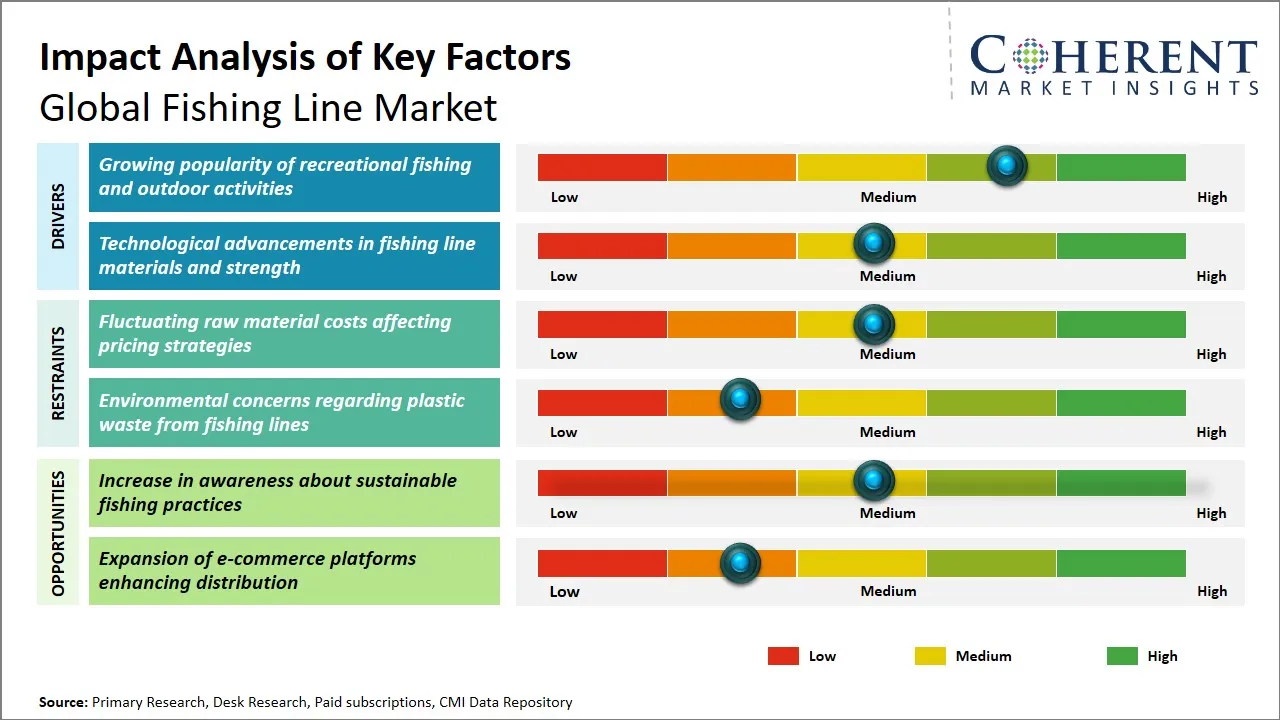
Fishing Line Market Driver - Growing Popularity of Recreational Fishing and Outdoor Activities
The growing interest in leisure fishing and outdoor activities among the different groups of people has heavily fuelled the need to buy the best fishing lines in the world. With the increased number of people in search of more leisure activities which can provide relaxation, communion with nature as well as, avenues of social interaction, recreational fishing app has come to be a popular pastime in most areas. This demand is also backed by increased consciousness regarding sustainable and environmentally friendly fishing methods and the desire to purchase high-quality and long-lasting fishing equipment by fans.
For example, The case of Europa’s Recreational Fishing Boom, Germany, France, and the U.K. had reported increased angling license registrations after 2020, which directly translated into increased sales of monofilament and specialty lines.
Fishing Line Market Opportunity - Increase in Awareness About Sustainable Fishing Practices
The increasing nature of the sustainability and environmental protection movement around the world is also a great opportunity to the global fishing line market. Following the heightened campaign on sustainable fishing methods by governments, regulatory bodies, and environmental organizations, the need to have eco-friendly and biodegradable fishing lines that have minimal adverse effects on the marine ecosystems is increasing. Anglers and commercial fishermen, fish processing are increasingly aware of the necessity to minimize pollutions and prevent the risks of entanglements as traditional synthetic fishing lines may lead to marine debris and damage aquatic animals.
As an example, Government & NGO Initiatives, such as the programs such as the NOAAs Marine Debris Program (U.S.) and campaigns in European Union to clean up the coastlines are encouraging responsible fishing equipment use, which in turn drives the market towards low-impact fishing equipment.
Analyst Opinion (Expert Opinion)
- Fishing line market is experiencing a significant growth, due to the rising interest in the recreational fishing and the development of the line technology. As presented by the International Fishing Tackle Trade Show (2023) and the Angling Trust Conference (2022), new innovations were quite evident, with such companies as Berkley and PowerPro in the vanguard of innovations in braided and fluorocarbon lines.
- The recent entry by Berkleys into a superline with improved sensitivity and strength is a proactive reaction to the market to meet the demands of the angler to have high performance equipments to suit different fishing conditions.
- These conferences focused on the issue of sustainability, and the trend of discussing eco-friendly materials and recycling programs to solve the environmental issue increased. Nevertheless, the issues of threats of cheaper substitutes and unstable material prices were often mentioned as possible obstacles to the market development.
- Products based on innovations in their features like Extremophile (UV resistance) and visibility improvement will probably gain more market share. Finally, the fishing line market development will be based on the opportunity to be innovative in solving the needs of competitive and non-competitive fishers and pursuing the goal of sustainability in the fishing industry.
Speak to the analyst
Want personalized insights?
Take the findings above to one of our principal consultants, or have the report rebuilt around the segments, geographies and competitors you actually track.
Market Segmentation
- Raw Material Insights (Revenue, USD Bn, 2021 - 2033)
- Polyvinyl Chloride
- Nylon
- Polyvinylidene Fluoride
- Polyethylene
- Polyethylene terephthalate
- Others
- Type Insights (Revenue, USD Bn, 2021 - 2033)
- Monofilament Lines
- Braided Lines
- Fluorocarbon Lines
- Others
- Application Insights (Revenue, USD Bn, 2021 - 2033)
- Freshwater Fishing
- Saltwater Fishing
- Ice Fishing
- Regional Insights (Revenue, USD Bn, 2021 - 2033)
- North America
- U.S.
- Canada
- Latin America
- Brazil
- Argentina
- Mexico
- Rest of Latin America
- Europe
- Germany
- U.K.
- Spain
- France
- Italy
- Russia
- Rest of Europe
- Asia Pacific
- China
- India
- Japan
- Australia
- South Korea
- ASEAN
- Rest of Asia Pacific
- Middle East
- GCC Countries
- Israel
- Rest of Middle East
- Africa
- South Africa
- North Africa
- Central Africa
- North America
- Key Players Insights
- Daiwa Corporation
- Rapala VMC Corporation
- Pure Fishing, Inc.
- Eposeidon Outdoor Adventure Inc.
- P-Line
- Sunline Co., Ltd.
- Maxima USA Inc.
- Momoi Fishing Net Mfg. Co., Ltd.
- Yo-Zuri America, Inc.
- Ande Monofilament
Sources
Primary Research Interviews
- CEO – Leading Fishing Line Manufacturer (e.g., Sufix International or PureFishing equivalent)
- Supply Chain Director – Major Fishing Tackle Distributor
- Production Lead – Monofilament/Braided Line Producer
- Sustainability Officer – Fishing Gear Certification Authority
Stakeholders
- Manufacturers
- End-use Sectors
- Recreational Anglers & Sport Fishing
- Commercial Fishing Fleets
- E-commerce Retailers (Amazon, Bass Pro Shops)
- Regulatory & Certification Bodies (e.g., NOAA Fisheries, EU Common Fisheries Policy)
- E-commerce Platforms and Retailers (Alibaba, Tackle Warehouse, Shimano)
- Technology Integration Players: Advanced braided line and fluorocarbon innovators
Databases
- UN Comtrade Database (HS Code for Fishing Lines)
- India Import Export (EXIM) Database
- USITC Trade Data (Fishing Tackle Imports/Exports)
- Eurostat Trade Statistics for Fishing Gear
- Volza Global Trade Database (Fishing Line Shipments)
Magazines
- Sport Fishing Magazine – Trends in fishing line materials
- Field & Stream – Innovations in angling gear
- Practical Fishkeeping – Line strength and sustainability
- Tackle Trade World – Global fishing tackle market dynamics
- Angling Times – Consumer trends in fishing lines
Journals
- Fisheries Research – Fishing gear impacts on stocks
- Journal of Sustainable Fisheries – Environmental effects of line materials
- Marine Policy – Supply chain analysis for fishing tackle
- Polymer Engineering & Science – Material science in monofilament lines
- Ocean & Coastal Management – Gear technology advancements
News
- The Wall Street Journal – Global recreational fishing demand
- Reuters – Supply chain disruptions in fishing tackle
- Business Standard (India) – Fishing gear imports growth
- Outdoor Life News – Price volatility in angling products
- The Guardian – Sustainability in fishing equipment
Associations
- American Sportfishing Association (ASA)
- European Fishing Tackle Trade Association (EFTTA)
- International Game Fish Association (IGFA)
- National Fishing Industry Association
- World Fishing & Aquaculture Exhibition Organizers
Public Domain Sources
- NOAA Fisheries – Guidelines for fishing gear handling
- European Commission – Regulations on fishing tackle materials
- FAO – Safety standards for fishing equipment
- USGS – Mineral use in fishing line production (nylon precursors)
- OECD – Trade and sustainability reports for recreational gear
Proprietary Elements
- CMI Data Analytics Tool
- Proprietary CMI Existing Repository of information for last 8 years
Get access to 250+ pages report
Every segment, forecast, competitor profile and data table behind the analysis above — available for instant download.
- ESOMAR Member
- ISO 9001:2015 Certified
- D-U-N-S Registered
- GDPR & CCPA Compliant
Missing comfort of reading report in your local language? Find your preferred language:
Transform your Strategy with Exclusive Trending Reports
Frequently Asked Questions
The global fishing line market is estimated to be valued at USD 1.96 Bn in 2026 and is expected to reach USD 3.00 Bn by 2033.
The CAGR of global fishing line market is projected to be 6.3% from 2026 to 2033.
Growing popularity of recreational fishing and outdoor activities and technological advancements in fishing line materials and strength are the major factors driving the growth of the global fishing line market.
Fluorocarbon offers higher abrasion resistance, low visibility underwater, and better sensitivity, making it preferred for clear water and technical fishing.
A fishing line is the cord used to connect the angler’s reel to the hook or lure; it is critical for casting, sensitivity, hook-setting, and landing the fish safely.
Fluctuating raw material costs affecting pricing strategies and environmental concerns regarding plastic waste from fishing lines are the major factors hampering the growth of the global fishing line market.
In terms of raw material, the polyvinyl chloride is estimated to dominate the market revenue share in 2026.