

Global Food Waste Disposer Market Size and Forecast – 2026 to 2033
According to Coherent Market Insights, the Global Food Waste Disposer Market is estimated to be valued at USD 3.41 Bn in 2026 and is expected to reach USD 4.85 Bn by 2033, exhibiting a compound annual growth rate (CAGR) of 5.15% from 2026 to 2033.
Key Takeaways of the Food Waste Disposer Market
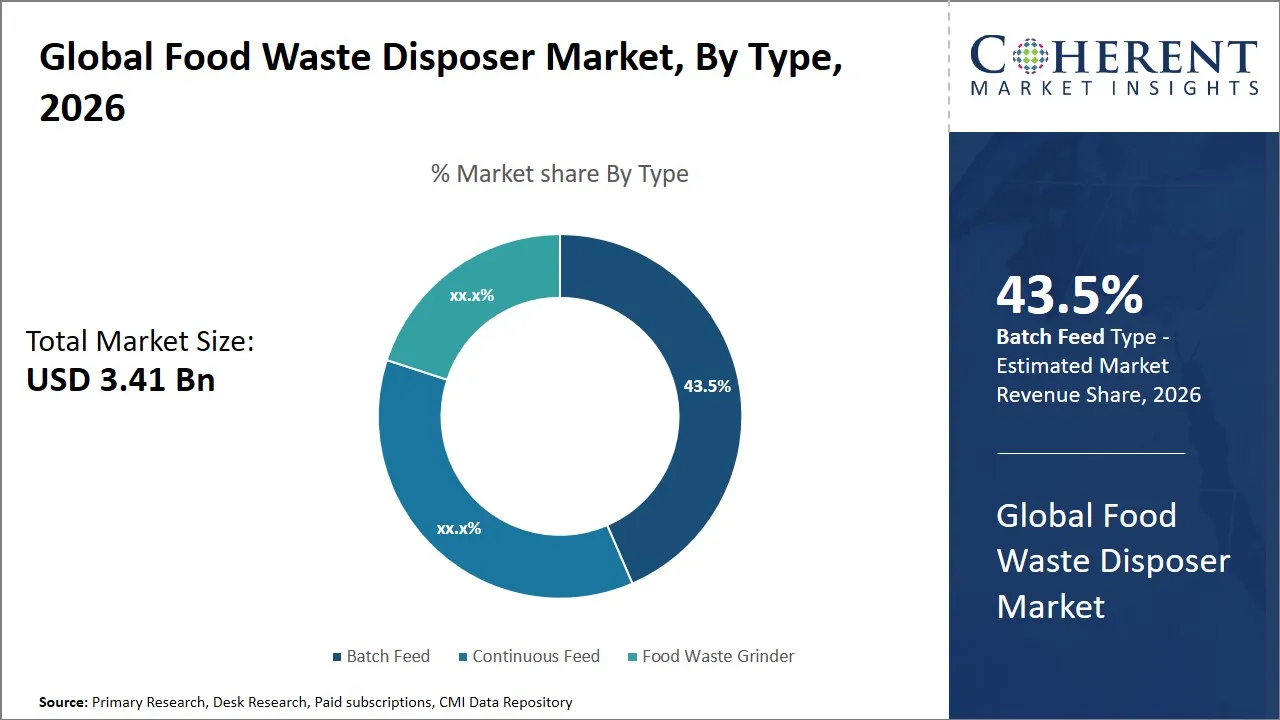
- The batch feed segment is expected to account for 43.5% share of the global food waste disposer market in 2026.
- Electric disposers are projected to account for 42.6% of the food waste disposer market in 2026, driven by their electric motor–based design that delivers steady, reliable grinding performance across varying food waste loads.
- The residential segment is expected to command 52.7% share of the global food waste disposer market in 2026, supported by rapid urbanization and rising adoption of environmentally responsible household waste management practices.
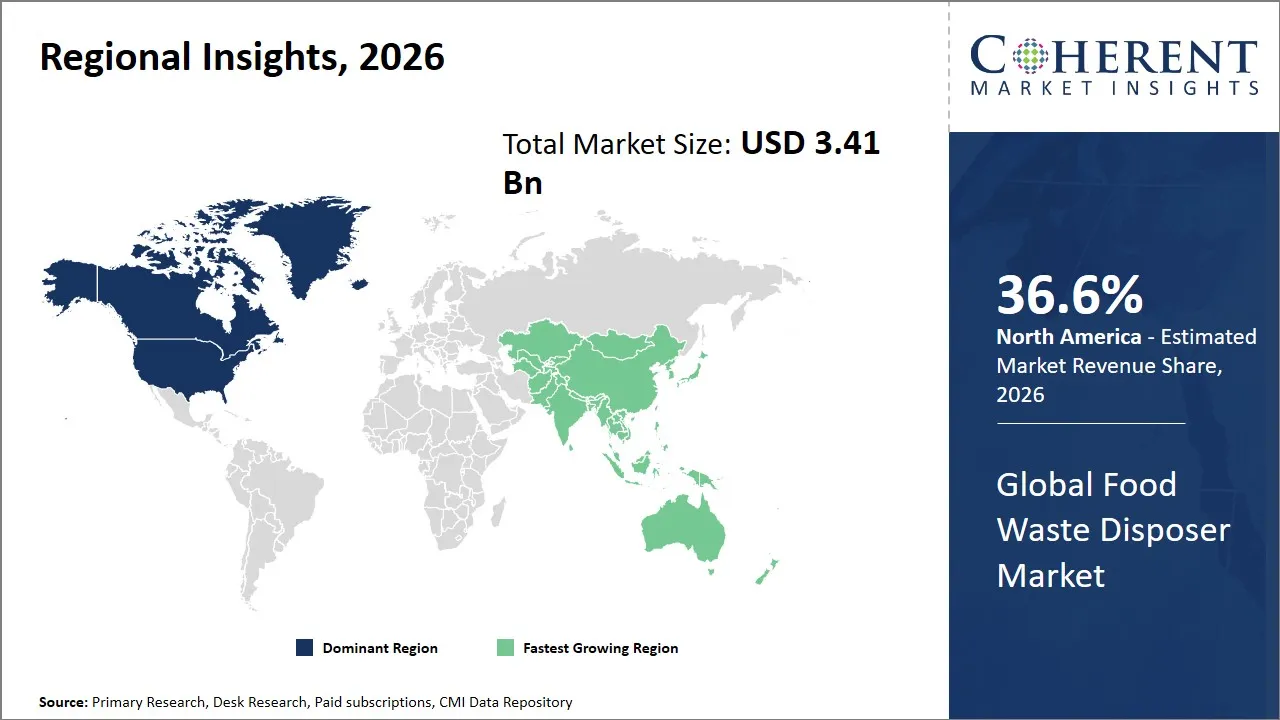
- North America is expected to lead with a 36.6% market share in 2026, driven by strong infrastructure and sustainability-focused regulations.
- Asia Pacific is the fastest-growing region, holding an estimated 22.3% share in 2026, driven by urbanization, rising incomes, and growing hygiene and convenience awareness.
Market Overview
- Market trends indicate a significant shift toward eco-friendly and energy-efficient food waste disposers, driven by stringent environmental regulations and growing urbanization.
- Integration of smart technologies for improved waste garbage disposals processing efficiency and convenience is gaining traction.
- Furthermore, the push towards circular economy models and waste-to-energy solutions is boosting the demand for innovative disposers that aid in reducing food waste and supporting sustainability initiatives globally.
Currents Events and Its Impacts
Current Events | Description and its impact |
England’s “Simpler Recycling” requires separate food-waste handling for businesses (from March 31, 2025) |
|
EU Parliament approves binding food-waste reduction targets toward 2030 (September 2025) |
|
Segmental Insights
- Current Industry Events of 2026
- Market Size Estimation
- Regional Breakdown
- Competitive Landscape
- Customer Intelligence
- Segmental Analysis
- Pricing Analysis
- Key Market Drivers, Challenges & Future Trends
- Customized Insights Section
Why Does the Batch Feed Dominate the Food Waste Disposer Market in 2026?
Batch feed segment is projected to hold 43.5% share of the global food waste disposer market in 2026, primarily due to their inherent safety features and operational convenience. Batch feed models have the added feature of the user closing a lid or a stopper and placing it before the disposer begins functioning which not only adds an extra safety measure against accidental use, but it also makes it quite attractive in the homes of children. This safety aspect will help gain the confidence of users and minimize chances of injury, thus this aspect is a lot more attractive to residential customers as well as a medium scale commercial consumer.
Batch-feed systems appeal to environmentally conscious consumers by enabling controlled, small-portion waste disposal, supporting food-waste reduction at the source. The batch processing enables users to load a chosen quantity of waste to be ground and minimize the energy usage and maximize this disposal. This aspect is attractive to individuals who have food to charge, but still energy conscious.
Why Do Electric Disposers Lead by Offering Enhanced Efficiency and User-Friendly Features?
Electric disposers segment is expected to hold 42.6% share of the food waste disposer market in 2026. Powered by electric motors, these disposers provide consistent grinding power. This dependability qualifies them to be essential both at home and in commercial environments where it is imperative to have smooth and continuous waste management.
The introduction of new technologies like insulated motors and the development of sophisticated impeller designs are also involved in reducing the amount of noise during an operation and at the same time ensure a maximum amount of grinding efficiency. This would improve the user experience as the disposal of waste is effective and less intrusive.
Residential Dominates the Food Waste Disposer Market
Residential segment is projected to hold 52.7% share of the global food waste disposer market in 2026, primarily fueled by increasing urbanization and a growing trend toward eco-friendly household practices. With increasing urban population and reduced space, especially in residential areas, efficient waste disposal methods such as food waste disposers have been very popular. These gadgets are a clean and effective alternative to the conventional ways of disposing waste, which removes the lingering odor of food and makes the kitchen less cluttered.
The residential market is advantaged as it experiences increased consumer concern over the sustainability and waste minimization. By incorporating food waste disposers into the home setting, consumers can take the initiative of disposing of organic waste materials and decrease the amount they take to landfills, as well as decrease the environmental impact of their daily lives.
For example, InSinkErator is widely recognized for its quiet, compact, and energy-efficient residential food waste disposers, designed specifically for urban kitchens with space constraints. Its residential models emphasize odor reduction, ease of maintenance, and compatibility with modern sustainability-focused households, making them popular among urban homeowners and environmentally conscious consumers.
Regional Insights
North America Food Waste Disposer Market Analysis and Trends
The North America region is projected to lead the market with a 36.6% share in 2026. The established market ecosystem characterized by advanced infrastructure, high consumer awareness about sustainability, and strong government initiatives promoting waste management and environmental . The U.S. is a pioneer in the region in terms of the extensive use of food waste disposers both in homes and business settings, with policies in favor of proper disposal of food waste.
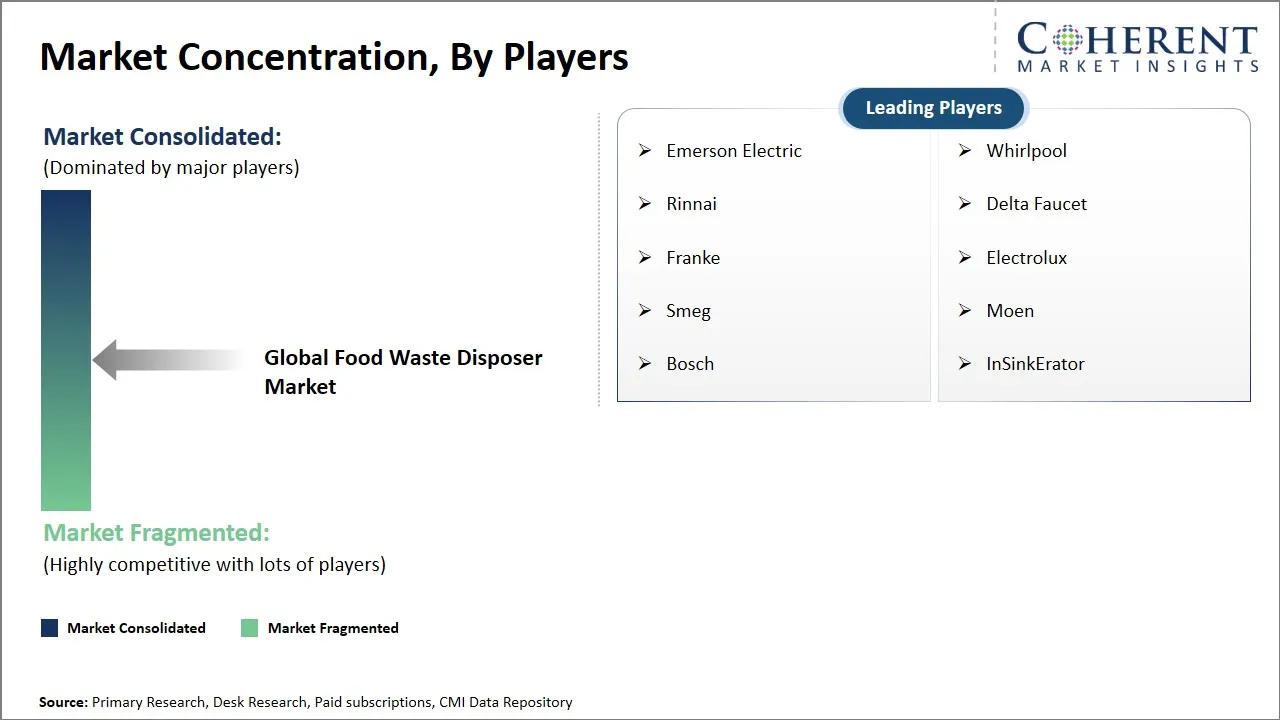
In addition, innovation and availability of products have been reinforced by the availability of leading manufacturers including InSinkErator (a subsidiary of Emerson Electric) and Whirlpool Corporation. Such firms spend a lot of money on the implementation of new technology to enhance the efficiency of the disposers, minimization of noise, and safe environment, thereby fueling consumer preference and market penetration. The dynamics of the trade are positive and North America is the place where high-profile devices are exported to other areas, which reinforces its dominating role further.
Asia Pacific Food Waste Disposer Market Analysis and Trends
The Asia Pacific region is expected to exhibit the fastest growth in the market contributing 22.3% share in 2026, due to rapid urbanization, increasing disposable incomes, and rising awareness about hygiene and convenience in daily kitchen practices. Countries like China, India, and Japan have seen accelerated adoption owing to expanding middle-class populations and infrastructure development.
Competition in the market is heightened by the growing availability of international brands such as InSinkErator and local players such as Zhejiang Supor Co., Ltd. (in China). Trade enhancement, such as the advancement of supply chains and e-commerce penetration, allows gaining broader access to the market, which adds to the dynamic growth trend of the region.
Global Food Waste Disposer Market Outlook for Key Countries
U.S. Food Waste Disposer Market Trends
The U.S. remains the epicenter of the food waste disposer market, heavily influenced by consumer preferences for eco-friendly kitchen solutions and stringent environmental regulations promoting waste reduction. The entry of Whirlpool Corporation into the provision of disposers as a part of the appliances will contribute to the momentum in the market. The U.S. food waste disposer market is very competitive and technologically developed as the adoption is further promoted by the public awareness campaigns and incentives on the state level to maintain sustainable waste management.
Is China Emerging as a High-Growth Market for Food Waste Disposers?
The food waste disposer market in China is rapidly developing under the influence of the growth of urban populations, the shift toward modern kitchen infrastructure, and municipal solid waste management regulations. Local companies like Zhejiang Supor Co., Ltd. have cropped up and they are providing competitively priced appliances to meet the rising demand. Also, international firms are increasing their presence by joint ventures and alliances with an emphasis placed on product innovation to suit local consumer requirements. E-commerce systems considerably contribute to the market penetration, and the disposers became available in tier 2 and 3 cities.
Japan Food Waste Disposer Market Trends
Japan leads in durable, eco-efficient food waste disposer adoption, supported by landfill-reduction policies and innovations in compact, quiet, smart-home-ready models from leading manufacturers. Such firms as Panasonic and Mitsubishi Electric have also launched state-of-the-art models of food waste disposers, which are more in line with the local taste of small, quiet and easy to maintain machines. The consistent demand is supported by government efforts to decrease the load of landfills. The innovative culture of the country will lead to a constant increase in the level of food waste disposer and integration with smart home technologies.
Is India Poised to Become a High-Growth Market for Food Waste Disposers?
The market of food waste disposers in India is growing with increasing urbanization and the growth of hygiene awareness among consumers. The market environment in the Swachh Bharat Mission through the governments focus on solid waste management reforms boosts the market environment.
While international players are gradually entering, local manufacturers are focusing on affordable, energy-efficient disposers suitable for Indian households. Key companies are enhancing awareness through marketing campaigns and collaborations with municipal bodies, gradually transforming traditional waste disposal habits.
Germany Food Waste Disposer Market Trends
The Germany food waste disposer market has advantages such as strong environmental laws and customer desire towards sustainable kitchen appliances. Germany is also a platform to the wider European market because of its strategic location and well-established logistics networks. Waste management innovation benefits and consumer preference towards green technology have helped maintain market vitality.
Lifecycle Carbon Abatement Cost Curve
Abatement Lever (Lifecycle Stage) | CO₂e Reduction (kg CO₂e/ton food waste) | Curve Position |
Avoided landfill methane emissions | 280–340 | Far left |
Reduced landfill transport & handling | 40–60 | Left |
Renewable biogas replacing fossil natural gas | 110–150 | Far left |
Cost-Per-Ton of Waste Diverted vs Alternatives
Waste Diversion Option | Capex Burden (System Level) | Opex (Collection/Energy/Labor) |
Food Waste Disposer + WWTP Biogas Capture | Minimal (uses existing sewer + AD) | Low/partially offset by biogas |
Food Waste Disposer (No Biogas Capture) | Minimal | Low |
Industrial Composting | Medium | Medium |
Market Players, Key Development, and Competitive Intelligence
Key Developments
- In December 2024, WELTEC BIOPOWER broke ground on a new biomethane plant for Eco Sustainable Solutions in Dorset U.K., marking a strategic expansion that will use household food waste as feedstock when it comes online in 2025.
- In October 2024, SCS Global Services released SCS-110 Zero Waste Standard v4.0, expanding the scope to facilities, events, and projects.
- In April 2024, Whirlpool and Arçelik finalized the formation of Beko Europe B.V., an expansion move that realigns Whirlpool’s European appliance portfolio while keeping InSinkErator under its direct ownership for global growth synergies.
Top Strategies Followed by Global Food Waste Disposer Market Players
Player Type | Strategic Focus | Example |
Established Market Leaders | Heavy investment in R&D and innovation | InSinkErator (owned by Emerson Electric) keeps improving motor efficiency, noise reduction and grind performance as well as keeping its products in line with plumbing and environmental standards. |
Mid-Level Players | Cost-effective solutions with balanced quality | Anaheim Manufacturing is specialized in durability and simplified designs which lower the failure rates and cost of service. |
Small-Scale Players | Niche specialization & innovative variants | Startups and regional producers target smart and environmentally conscious differentiation IoT-based load-sensing disposers, anti-jam diagnostics, or IoT-based water-saving optimization to target smart-home users. Such as brands such as Insinkerator Badger 1 Garbage Disposal based in Asia are testing disposers with small water footprint in apartments with limited plumbing systems. |
Market Report Scope
Food Waste Disposer Market Report Coverage
| Report Coverage | Details | ||
|---|---|---|---|
| Base Year: | 2025 | Market Size in 2026: | USD 3.41 Bn |
| Historical Data for: | 2020 To 2024 | Forecast Period: | 2026 To 2033 |
| Forecast Period 2026 to 2033 CAGR: | 5.15% | 2033 Value Projection: | USD 4.85 Bn |
| Geographies covered: |
| ||
| Segments covered: |
| ||
| Companies covered: | Emerson Electric, Whirlpool, Rinnai, Delta Faucet, Franke, Electrolux, Smeg, Moen, Bosch, and InSinkErator | ||
| Growth Drivers: |
| ||
| Restraints & Challenges: |
| ||
Food Waste Disposer Market Dynamics
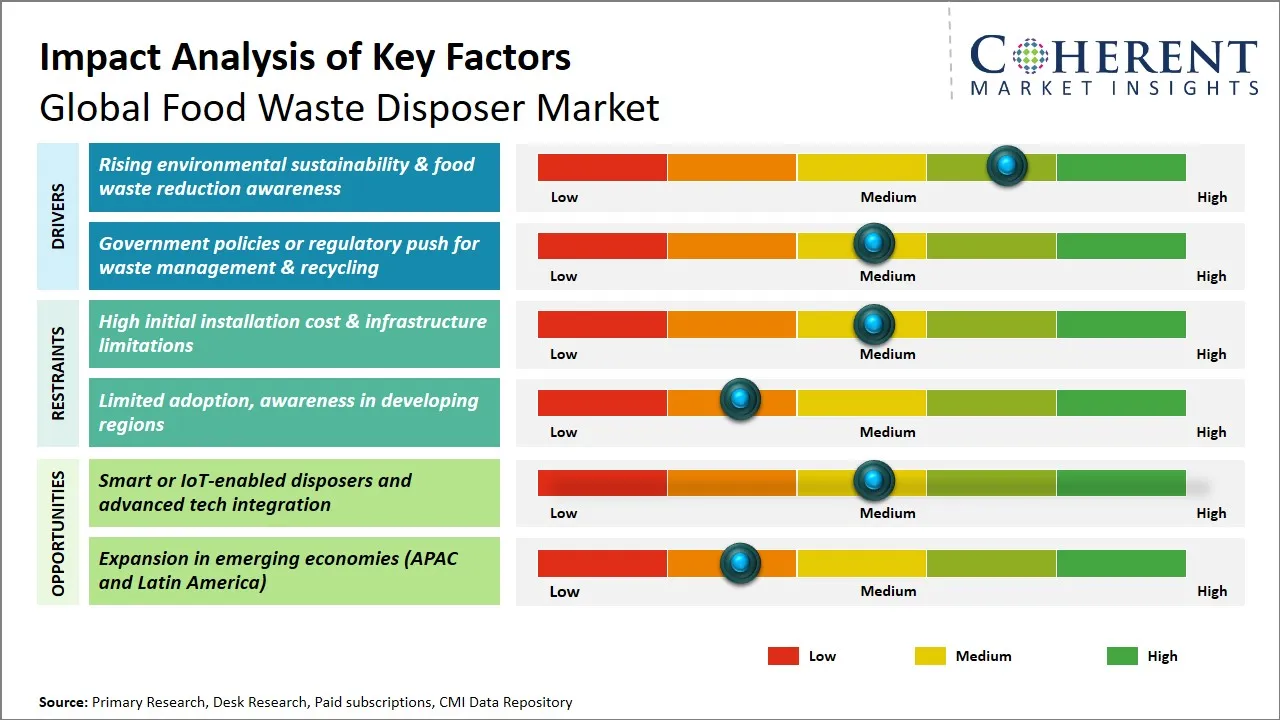
Food Waste Disposer Market Driver - Rising Environmental Sustainability & Food Waste Reduction Awareness
The growth of environmental sustainability awareness to minimize food waste is a major force that is driving the demand for food waste disposers worldwide. The increasing environmental awareness among consumers has created the urge to initiate practices that help to reduce the environmental impact of food waste disposal by reducing landfill wastes and greenhouse gas emissions. Food waste disposers are an efficient solution since they can cut organic waste into smaller particles, which can be easily absorbed into the wastewater treatment system, thus enabling easy waste disposal and recycling of nutrients.
European and North American cities are increasing landfill diversion requirements and organic waste requirements, which indirectly prefers in-sink food waste management solutions. As an example, a number of American cities encourage waste minimization at the household level to reduce the amount of landfill methane emissions and wastewater treatment plants are increasingly encouraging the use of disposer-compatible organic loads.
Food Waste Disposer Market Opportunity - Smart and IoT-Enabled Disposers Driving Market Growth
Smart and IoT-enabled features in food waste disposers can be used as a high-growth market opportunity in the international market. The demand for innovative and connected kitchen appliances is growing as consumers are increasingly electing smart home ecosystems. The IoT-based food waste management disposers also provide a higher level of convenience as it is possible to monitor and control the disposer remotely using smartphone applications which makes operating the disposer effective and ensures that the disposer performs optimally. These disposers have advanced sensors that can identify the nature and amount of food waste, which optimizes grinding senses to minimize energy usage and minimize chances of clogging, which eventually increases the life of the appliance.
Top appliance makers such as CNET have launched connected food waste later, which can be integrated with smart home systems so that the device can monitor motor health, send alerts when the device gets clogged, and schedules its use during low-energy times using mobile applications. This is in line with the development of intelligent kitchens in the U.S., China, and Western Europe.
Analyst Opinion (Expert Opinion)
- The food waste disposer market has been growing at a high rate due to an upsurge in the conscious levels among the population towards sustainable waste disposal and the growing popularity of the need to have green solution in the homes. The International Waste Management Conference (2023) and the Global Green Technology Forum (2022), shed light on the most important innovations, with such companies as InSinkErator and Waste King pioneering the development of the disposer technology, which contributes to efficiency and minimizes the environmental impact.
- The conferences also highlighted the increased trend of zero-waste lives with discussions stating the significance of incorporating food waste disposers in residential waste systems. But the difficulty of consumer misunderstanding of the use of energy and plumbing compatibility were commonly reported as obstacles to widespread adoption.
- Firms that make investment in consumer education and marketing strategies that emphasize on the environmental benefits and convenience of food waste disposers will probably secure a competitive advantage. Finally, the expansion of the food waste disposer market will depend on the capacity to keep innovating and meeting the changing customer preference on efficient and sustainable waste management systems.
Speak to the analyst
Want personalized insights?
Take the findings above to one of our principal consultants, or have the report rebuilt around the segments, geographies and competitors you actually track.
Market Segmentation
- Type Insights (Revenue, USD Bn, 2021 - 2033)
- Batch Feed
- Continuous Feed
- Food Waste Grinder
- Technology Insights (Revenue, USD Bn, 2021 - 2033)
- Electric Disposers
- Non-electric Disposers
- Biodegradable Disposers
- Application Insights (Revenue, USD Bn, 2021 - 2033)
- Residential
- Commercial
- Industrial
- Regional Insights (Revenue, USD Bn, 2021 - 2033)
- North America
- U.S.
- Canada
- Latin America
- Brazil
- Argentina
- Mexico
- Rest of Latin America
- Europe
- Germany
- U.K.
- Spain
- France
- Italy
- Russia
- Rest of Europe
- Asia Pacific
- China
- India
- Japan
- Australia
- South Korea
- ASEAN
- Rest of Asia Pacific
- Middle East
- GCC Countries
- Israel
- Rest of Middle East
- Africa
- South Africa
- North Africa
- Central Africa
- North America
- Key Players Insights
- Emerson Electric
- Whirlpool
- Rinnai
- Delta Faucet
- Franke
- Electrolux
- Smeg
- Moen
- Bosch
- InSinkErator
Sources
Primary Research Interviews
- CEO – Leading Food Waste Disposer Manufacturer (e.g., InSinkErator/Emerson Electric or Waste King equivalent)
- Supply Chain Director – Major Appliance Distributor
- Production Lead – Household Appliance Manufacturer Specializing in Disposers
- Sustainability Officer – Food Waste Management Certification Authority
Stakeholders
- Manufacturers
- End-use Sectors
- Residential Households
- Commercial Kitchens (Restaurants, Hotels)
- Institutional Facilities (Hospitals, Schools)
- Regulatory & Certification Bodies (e.g., BIS for India IS 302 standards, EPA wastewater guidelines, EU Waste Framework Directive)
- E-commerce Platforms and Retailers (Amazon, Home Depot, Alibaba, Lowe’s)
- Technology Integration Players: Smart kitchen appliance innovators and biogas integration firms
Databases
- UN Comtrade Database (HS codes for food waste disposers/appliances)
- India Import Export (EXIM) Database
- USITC/USA Trade Online (U.S. kitchen appliance trade)
- Eurostat Trade Statistics for Appliances
- Global Trade Atlas for Food Waste Equipment
Magazines
- Waste Dive – Trends in food waste disposal technology
- Waste Management World – Global waste management innovations
- Waste Business Journal – Disposal equipment market analysis
- Appliance Design Magazine – Kitchen appliance advancements
- Recycling Magazine – Food waste processing solutions
Journals
- Waste Management Journal – Food waste disposer policy impacts
- Resources, Conservation and Recycling – Environmental effects of disposers
- Journal of Cleaner Production – Sustainability in waste grinding tech
- Environmental Science & Technology – Wastewater implications
Newspapers
- The Wall Street Journal – Appliance market demand for disposers
- Business Standard (India) – Food waste management imports growth
- Reuters – Sustainability trends in kitchen waste solutions
Associations
- Association of Manufacturers of Domestic Electrical Appliances (AMDEA)
- International Solid Waste Association (ISWA)
- World Biogas Association – Food waste digestion integration
- ReFED (Rethink Food Waste Through Economics and Data)
- Industrial Waste Management Association (India)
Public Domain Sources
- EPA – Wastewater discharge guidelines for food waste disposers
- European Commission – Circular Economy Action Plan on biowaste
- World Health Organization – Hygiene standards in waste disposal
- USGS – No direct, but appliance trade via Census Bureau
- OECD – Waste management and sustainability reports
Proprietary Elements
- CMI Data Analytics Tool
- Proprietary CMI Existing Repository of information for last 8 years.
Get access to 250+ pages report
Every segment, forecast, competitor profile and data table behind the analysis above — available for instant download.
- ESOMAR Member
- ISO 9001:2015 Certified
- D-U-N-S Registered
- GDPR & CCPA Compliant
Missing comfort of reading report in your local language? Find your preferred language:
Transform your Strategy with Exclusive Trending Reports
Frequently Asked Questions
The global food waste disposer market is estimated to be valued at USD 3.41 Bn in 2026 and is expected to reach USD 4.85 Bn by 2033.
The CAGR of global food waste disposer market is projected to be 5.15% from 2026 to 2033.
Continuous-feed (most common) and batch-feed (more safety-focused), with variations by motor type (induction vs permanent magnet) and chamber size.
Large bones, corn husks, banana peels, onion skins, fibrous stems, coffee grounds in bulk, expandable starches (rice/pasta), grease/oil, and shells.
Rising environmental sustainability & food waste reduction awareness and Government policies or regulatory push for waste management & recycling are the major factor driving the growth of global food waste disposer market.
High initial installation cost & infrastructure limitations and Limited adoption, awareness in developing regions are the major factor hampering the growth of global food waste disposer market.
In terms of type, batch feed is estimated to dominate the market revenue share 2026.