

Global Forage Feed Market Size and Forecast – (2026-2033)
The Global Forage Feed Market is estimated to be valued at USD 19.43 Bn in 2026 and is expected to reach USD 26.80 Bn by 2033, reflecting a compound annual growth rate (CAGR) of 4.7% from 2026 to 2033.
Key Takeaways of the Forage Feed Market
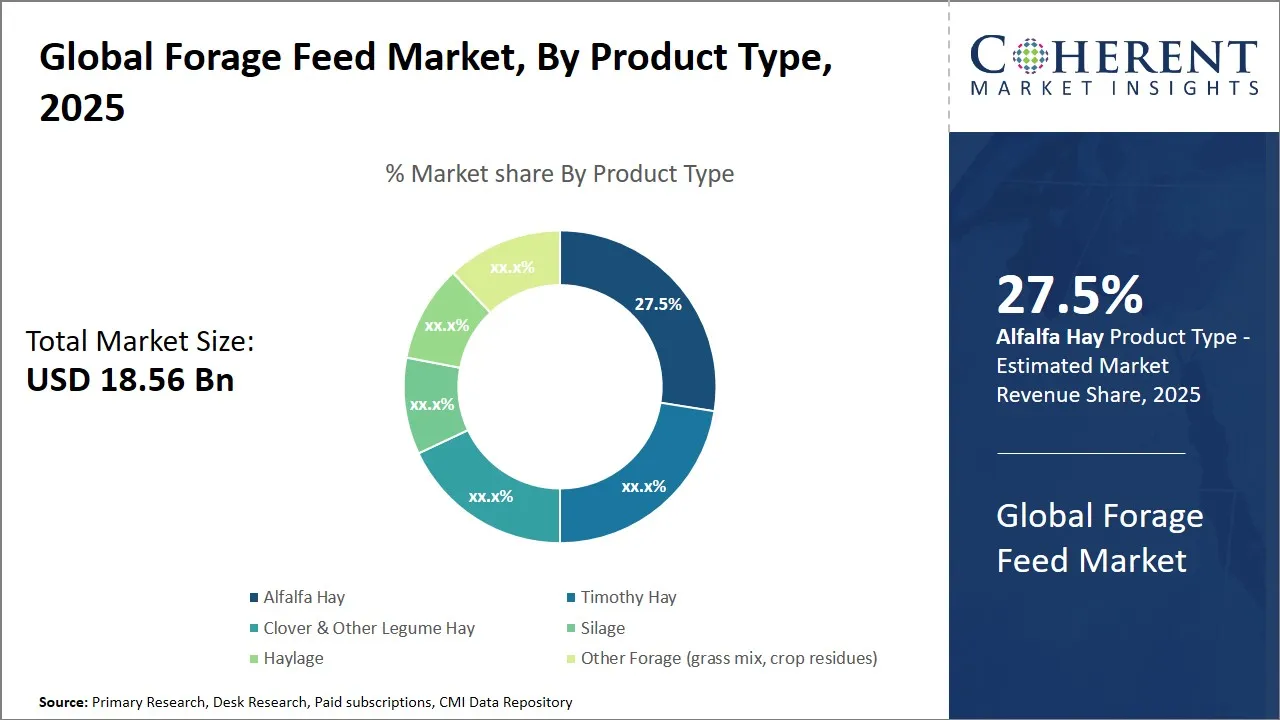
- Alfalfa hay segment is expected to hold a 28.5% of the market share in 2026.
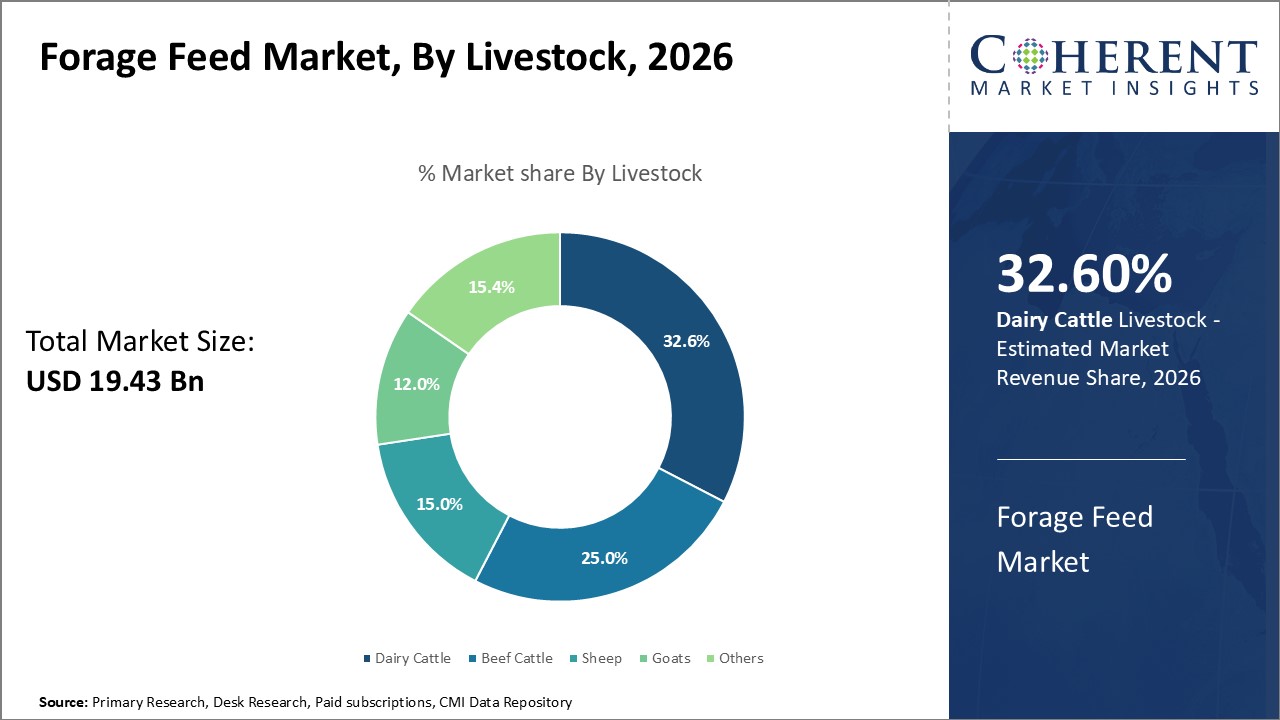
- The dairy cattle segment is estimated to hold a 32.6% of the global forage feed market share in 2026.
- Feed mills segment is projected to account for 46.8% share in 2026.
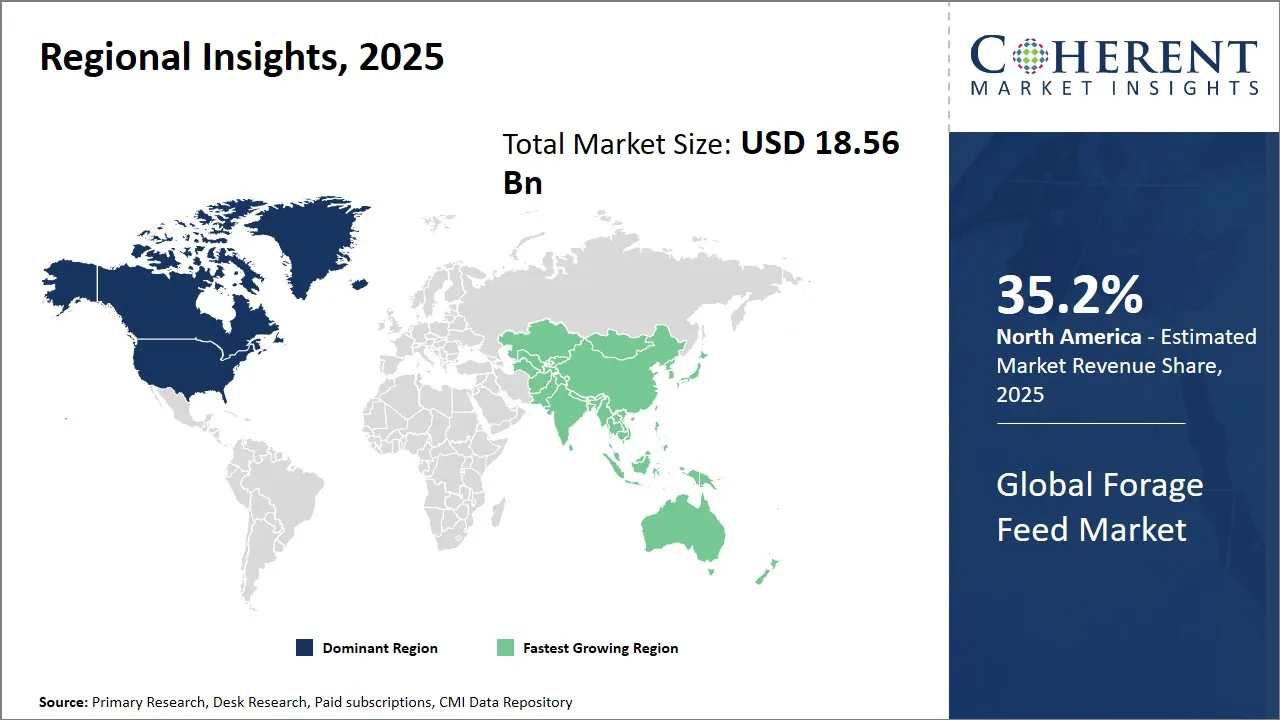
- North America will lead the forage feed market in 2026 with an estimated 35.2% share.
- Asia Pacific will be the fastest-growing region in 2026 with 18.3% share.
Market Overview
- A significant market trend is the rising adoption of organic and natural forage feed products, propelled by consumer preference for organic meat and dairy products.
- Additionally, there is increasing integration of technology in forage production, such as precision agriculture, to enhance yield and feed quality.
- Environmental concerns are pushing stakeholders toward eco-friendly forage options, while the growth of the dairy and meat industries across emerging economies continues to propel the market growth, making the forage feed sector a critical component of the global animal nutrition landscape.
Currents Events and Its Impact
Current Events | Description and its Impact |
Global Feed Production Resilience Post-Challenges |
|
Climate-Driven Pasture Stress and Resource Conflicts |
|
Segmental Insights
- Current Industry Events of 2026
- Market Size Estimation
- Regional Breakdown
- Competitive Landscape
- Customer Intelligence
- Segmental Analysis
- Pricing Analysis
- Key Market Drivers, Challenges & Future Trends
- Customized Insights Section
Why Does Alfalfa Hay Dominate Global Forage Feed Market in 2026?
Alfalfa Hay segment is expected to contribute 28.5% of the global forage feed market share in 2026, owing to its exceptional nutritional quality and wide range of applications across various livestock categories. Alfalfa is widely recognized for its rich protein content, digestible fiber, and high mineral concentration, making it a preferred feed ingredient especially in intensive dairy farming systems. Its ability to improve milk yield and overall animal health makes it a staple in the diets of dairy cattle, which drives sustained demand for alfalfa-based forage feeds. Compared to other forage types such as Timothy Hay, Clover, and Silage, alfalfa offers a well-balanced nutrient profile that supports optimal rumen function and growth rates in ruminants.
In the U.S. dairy industry, large-scale operations in California and Wisconsin routinely use premium alfalfa hay as the core forage for high-producing Holstein cows. These farms report higher milk output and better protein-fat ratios when alfalfa replaces grass hay or low-protein silage, reinforcing alfalfa’s dominance in commercial dairy rations.
Why Does the Dairy Cattle Segment Dominate the Global Forage Feed Market?
The dairy cattle segment is expected to hold 32.6% share in 2026, driven by escalating global demand for dairy products coupled with the need for optimizing milk production efficiency. The dairy operations largely focus on feed quality since this directly affects the milk yield, composition and the health of the animals. The forage feed is a basic element of dairy cattle diet being high in fiber and other essential nutrients which promotes the health of rumen and also ensures the cattle does not stop the feed consumption. The ever-increasing dairy farming practices and concerns of herd management have enhanced the interest in the provision of nutritional balanced feed, which has spearheaded the demand in the segment.
The increased demand of fresh milk, yogurt and cheese, and other dairy derivatives by the consumers has made producers invest more in the quality of the forage to help them produce as much as possible during the lactation cycle. The need to have forages that improve digestibility and energy level is the one that influences dairy farmers to obtain high quality types of forages like alfalfa hay and quality silage. Also, regulatory and industry-oriented welfare initiatives towards animal welfare and sustainable agriculture need the utilization of natural and nutrient rich feeds, which the forage segment achieves by responding well.
Feed Mills Dominate the Global Forage Feed Market
Feed mills segment is projected to hold 46.8% of the market share in 2026, driven by their capacity to provide consistent quality feed at scale and customized formulations tailored to diverse livestock needs. Feed mills combine raw forage crops like alfalfa hay, silage and haylage in consolidated feed blocks or pellets or mixed rations to guarantee consistent provision of nutrients and enhanced ratios of feed. Their standardization and feed management is critical in the commercial business namely in large scale dairy and beef cattle ranching.
Feed mills are centralized and can use the economies of scale to optimize their production costs, and comply with regulatory requirements regarding safety and hygiene of feed. This is what renders feed mills the channel of choice of the institutional purchaser who needs reliability, traceability as well as consistency in the supply of the feed. Moreover, feed mills have high-level processing technologies and quality control systems that increase the shelf life, palatability and digestibility of forage based feed, which is advantageous to livestock productivity and help farmers to stay profitable.
Regional Insights
North America Forage Feed Market Analysis and Trends
The North America region is projected to lead the market with a 35.2% share in 2026, due to its high nutritional value and its diverse sources of use in different types of livestock. The area has other favorable government policies, such as subsidies and research on sustainable livestock feed production. Good supply chains and well-established market presence of main forage feed companies support the market ecosystem, which promotes innovation and product diversification.
Archer Daniels Midland Company (ADM), Cargill Incorporated and Land OLakes are major companies that play an active role in contributing towards the development of forage crops and value-added feed formulations, improving the quality and efficiency of feed. Moreover, trade relations are more favorable to North America, which satisfies local demand and export markets taking advantage of the modern logistics and ensuring the preservation of the competitive edge.
Asia Pacific Forage Feed Market Analysis and Trends
The Asia Pacific region is expected to exhibit the fastest growth in the market contributing 18.3% share in 2026, fueled by rising livestock production driven by increasing meat and dairy consumption in emerging economies. Market is growing fast due to government programs on agritech adoption, rural development, and quality feed. The scale and the complexity of agricultural systems in such countries as China, India, and Southeast Asia form a dynamic market ecosystem where there is an increasing investment in forage seed technologies and feed processing sectors.
This is also facilitated by enhancing infrastructure and increased inflows of foreign direct investment. The presence of influential companies like the New Hope Group, COFCO Corporation, and Nutreco is continually spreading their presence by establishing production facilities locally and customizing their products to the requirements of livestock in their regions hence causing them to penetrate the market.
Global Forage Feed Market Outlook for Key Countries
U.S. Forage Feed Market Trends
The U.S. forage feed market remains a key driver in North America, supported by significant corn and alfalfa production which serve as primary forage crops. The well-developed research facilities of the country work in close partnership with the industry giants such as Cargill and ADM to develop sustainable feeds, such as improved pelletized forage foods and nutrient-enhanced feeds. Another method of enhancing market strengths is through the subsidies of forage crop insurance and precision agriculture investments by the U.S. governments. Vertical farming and feed companies reduce the supply chains optimization and enhance the stable growth of the market.
Is Brazil the Growth Engine Powering the Latin America Forage Feed Market?
The large arable land and livestock industry of Brazils puts it in a key role in the market of forage feed in Latin America. Growth starts with a powerful cattle ranching industry, as well as government incentives to enhance pasture management and feed efficiency. By including solutions to forage feed as part of their supply chains, companies such as BRF S.A. and JBS S.A. are making their contribution. The export-driven meat industry in Brazils is also a demand source of forage feeds since they aim at a consistent quality of feeds to ensure production levels remain at par, stimulating innovations in forage crop hybrids and feed supplements.
Is China Setting the Pace for Forage Feed Growth in the Asia Pacific Market?
The Asia Pacific region is dominated by China which has the highest volume of forage feed demand due to its growing livestock population and the increasing demand of animal protein by its people. The national policies that support the adoption of modernized farming systems and feed safety regulations are promoting the adoption of high-quality forage feed. New Hope Liuhe and Jinlu Group, which is leading in the domestic industry, are highly invested in production technology of forage seed and feed processing, and they cooperate with international forces to enhance yield and nutritional value of forage. The strategic development of the market is based on China’s emphasis on self-sufficiency of the feed imports and import substitution.
India Forage Feed Market Trends
The growth of India’s forage feed market is driven by the fact that India has a huge dairy industry and rising demand for animal protein. Government programs that encourage the use of fodder crop and better mechanization of farms increase the supply and quality of forage. The companies such as Godrej Agrovet and Suguna Foods are the key contributors to the development of forage feed products that are specific to the local livestock breeds and climatic conditions. Sustainable livestock production and efficient utilization of the feed resources push the governments to develop the ecosystem in terms of the novel forage seeds and feed compounding techniques.
Germany Forage Feed Market Trends
Germany being one of the major markets in forage feed in Europe enjoys the advantage of effective regulatory structures that focus on sustainability and animal welfare. Organic and precision farming is a promise that increases the quality of forage and feed efficiency in the country. Innovation of products is driven by the established European competitors in the sector, including K plus S Aktiengesellschaft and Deutsche Tiernahrung Cremer GmbH, according to which the main emphasis is made on optimization of nutrients and minimization of the negative impact on the environment. The export-based livestock sector in Germanys is relying on the high-quality forage feeds, and they are continually conducting research to help forage crops to withstand climate change
Impact of Precision Agriculture on Forage Yield
- Precision agriculture is transforming the economics of forage directly because it is increasing yield, consistency, and nutrient efficiency instead of merely increasing acreage. GPS-controlled seeding, variable-rate application of fertilizers, soil moisture sensors, satellite imagery, and yield mapping technologies enable the producer to place and time inputs at a micro-field. This decreases over-application and wastage and enhances forage quality measures including crude protein and digestibility.
- In the case of the forage feed market, this can be translated to greater output per hectare and reduced price per ton which can make the home-grown forage better than the purchased feed. Realistic increases in yield of 8-20 percent are now feasible, based on type of crop, and penetration of technology. Moreover, precision systems provide season-independent yield variation that is essential to large dairy farms that typically rely on consistent ration development.
Economics of Home-Grown vs. Purchased Forage
Parameter | Home-Grown Forage | Purchased Forage |
Average Cost per Ton (USD) | 90 – 140 | 120 – 190 |
Quality Control | High (producer-controlled) | Variable (supplier-dependent) |
Typical Usage | Core ration component | Seasonal gap, drought backup |
Market Players, Key Development, and Competitive Intelligence
Key Developments
- In October 2024, Millborn Seeds, a subsidiary of Renovo Seed, announced the addition of OptiHarv, a new forage mix, to its portfolio in 2024. The mix combines millets, peas, beans, barley, and brassicas to produce high tonnage for baleage, haylage, or grazing. The blend enables multiple harvests from a single field while yielding high-quality Total Mixed Ration (TMR) throughout the growing season.
- In August 2024, Charoen Pokphand Group and COFCO formed a strategic partnership to enhance collaboration in agriculture, food production, and global supply chains. This partnership strengthens CP Group's forage feed operations in China through improved access to raw materials and logistics networks, expanding its presence in the feed market.
- In September 2023, MAS Seeds launched a new range of forage mixtures and specialized blends, including MAS4 NUTRI forage, which is rich in legumes and would be used to increase animal diet.
Top Strategies Followed by Global Forage Feed Market Players
Player Type | Strategic Focus | Example |
Established Market Leaders | Global leaders focus on R&D-led differentiation and scale-driven partnerships. | Companies such as Cargill, ADM, and Bunge are companies, which spend much money to enhance digestibility of forages, protein efficiency, and fiber ratio by using enzyme-treated forage, fortified silage additives, and scientifically proven formulations. These players also have a regular partnership with OEMs in harvesting equipment and silage, seed companies and with large dairy integrators in securing long term supply deals. |
Mid-Level Players | Cost-effective solutions with balanced quality | Firms like De Heus, Alltech regional subsidiaries, and Nutrecos local operating units focus their attention on small and middle-sized dairy and beef farms offering cost optimized forage blends and silage enhancers. These competitors are dependent on joint ventures with local feed mills, the licensing of technologies in microbial inoculants and co-development with farmer cooperatives. |
Small-Scale Players | Niche specialization & innovative variants | There is a Minas Gerais based forage processor in Brazil that focuses on fiber-optimized corn silage and haylage as a specific product designed to serve small and mid-sized dairy farms to overcome regional forage deficiencies and fodder quality variation. |
Market Report Scope
Global Forage Feed Market Report Coverage
| Report Coverage | Details | ||
|---|---|---|---|
| Base Year: | 2025 | Market Size in 2026: | USD 19.43 Bn |
| Historical Data for: | 2020 To 2024 | Forecast Period: | 2026 To 2033 |
| Forecast Period 2026 to 2033 CAGR: | 4.7% | 2033 Value Projection: | USD 26.80 Bn |
| Geographies covered: |
| ||
| Segments covered: |
| ||
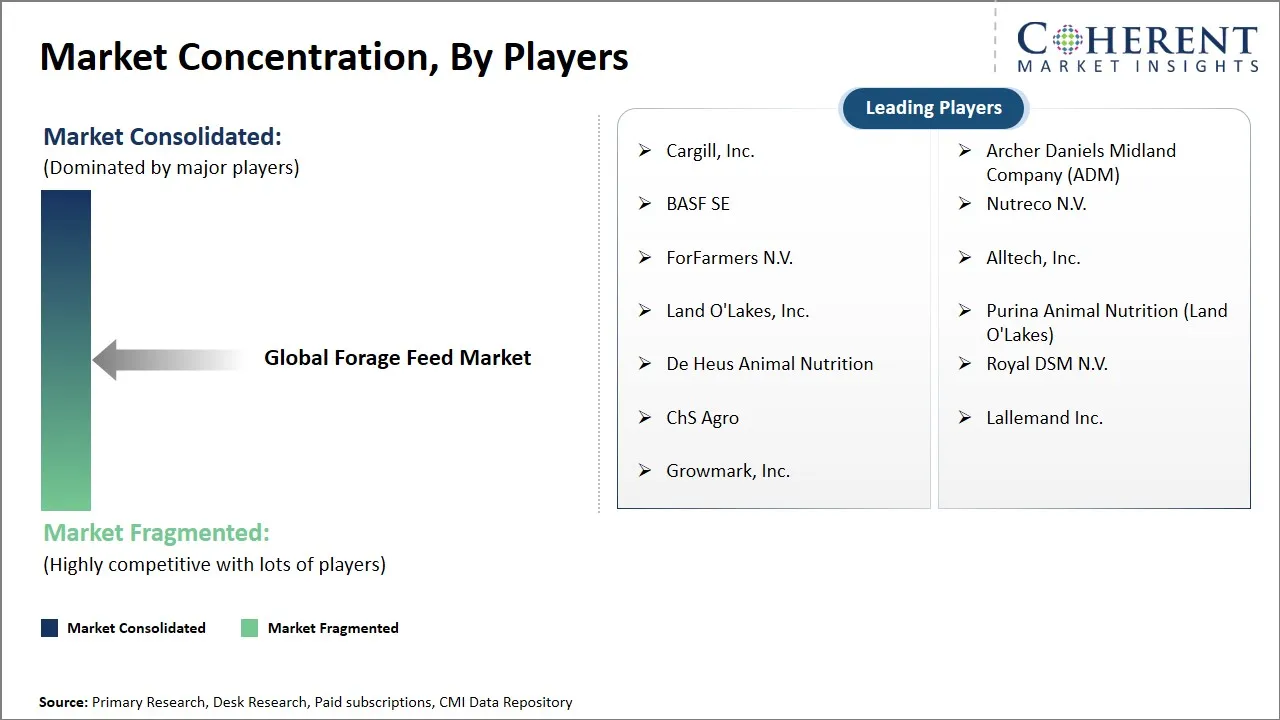
| Companies covered: | Cargill, Inc., Archer Daniels Midland Company (ADM), BASF SE, Nutreco N.V., ForFarmers N.V., Alltech, Inc., Land O'Lakes, Inc., Purina Animal Nutrition (Land O'Lakes), De Heus Animal Nutrition, Royal DSM N.V., ChS Agro, Lallemand Inc., and Growmark, Inc. | ||
| Growth Drivers: |
| ||
| Restraints & Challenges: |
| ||
Forage Feed Market Dynamics
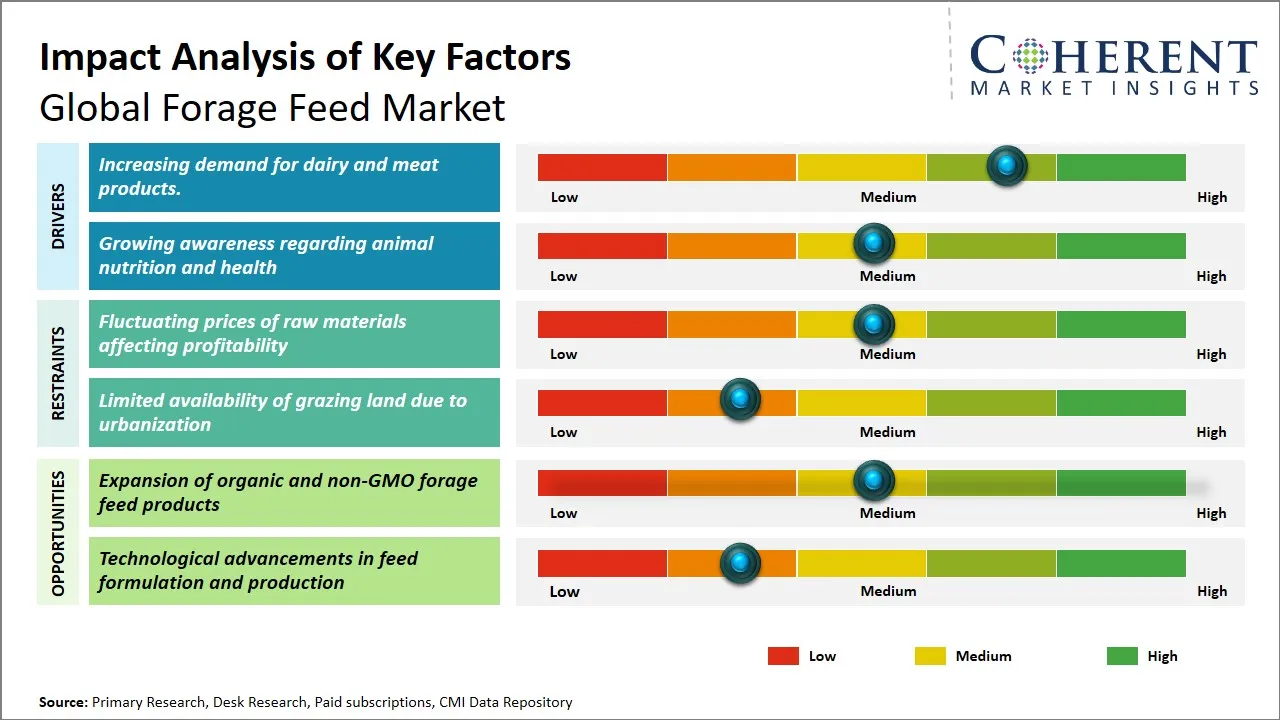
Forage Feed Market Driver - Increasing Demand for Dairy and Meat Products
Increasing demand for dairy and meat products in the world is a major force that is driving the forage feed market growth. With the increase in population and rise in living standards particularly in the developing economies, a shift in consumer preference is observed towards the consumption of protein rich foods and this has boosted consumption of milk, cheese, beef, and poultry. This increase in demand also requires high productivity levels in livestock and this directly increases the requirement in the quality of forage feed to be used to ensure healthy animal development and maximum production.
Large scale dairy farming in China has led to increasing milk yield and protein content through imported alfalfa hay especially in the north-western provinces of the country whose herd sizes are quickly escalating. In India, the practice of balanced feeding is being vigorously being propagated by the organized dairy players, urging farmers to switch to nutrient-dense green fodder and silage to increase productivity per-animal.
Forage Feed Market Opportunity - Expansion of Organic and Non-GMO Forage Feed Products
The forage feed market around the world is experiencing a massive opportunity due to the rising demand for organic and non-GMO forage feed products. This is due to increasing demand for organic forage feeds with increasing preference given to organic livestock products as consumers are becoming healthier and environmentally conscious. Farmers, agricultural producers, and livestock farmers are slowly adapting to sustainable farming methods, which involve the use of organic and non-GMO feeds to guarantee quality and safety of animal-based products including dairy products, meat, and egg processing.
In the European Union, and notably in Germany and Austria, non-GMO labeling is forcing livestock producers to obtain verified non-GMO forage crops, such as grass and maize silage. The international marketing of dairy and beef as grass-fed and naturally reared in Australia and New Zealand further boosts the demand for good quality pasture-based forage feeds, which supports the movement towards sustainable and traceable forage feed systems.
Analyst Opinion (Expert Opinion)
- The forage feed market is marked by a significant rise and growth attributed to the growing need of nutritionally good quality food to the animals and the growing interest of sustainable farming practices. The experience of the International Forage Symposium (2023) and the Animal Feed Forum (2022) showed that the country has achieved a lot, and such companies as Cargill and Nutreco are on the forefront of developing forage and nutrient optimization.
- The recent introduction of a new forage blend by Cargills, which is aimed at increasing the digestive activity of cattle and the general well-being of the animals, can be considered the example of the industry devotion to the further productivity improvement and animal welfare.
- Quality of forage was pointed out the most important factor of livestock performance and health during these conferences and discussions which is now more important as farmers are trying to cut down on feed costs and increase efficiency every way possible. Nonetheless, the issue of climate change that led to poor harvest was still a major obstacle as well as the constantly changing price of raw materials.
- The companies that are the most successful in the future are those that will be able to do the R&D to come up with resilient forage and those that will be doing R&D to come up with resilient forage and will be able to give farmers personalized nutrition advice. The forage feed market's growth will inevitably depend on its capacity to change along with the needs of livestock producers who are looking profitability and sustainability in their operations.
Speak to the analyst
Want personalized insights?
Take the findings above to one of our principal consultants, or have the report rebuilt around the segments, geographies and competitors you actually track.
Market Segmentation
- Product Type Insights (Revenue, USD Bn, 2021 - 2033)
- Alfalfa Hay
- Timothy Hay
- Clover & Other Legume Hay
- Silage
- Haylage
- Other Forage (grass mix, crop residues)
- Livestock Insights (Revenue, USD Bn, 2021 - 2033)
- Dairy Cattle
- Beef Cattle
- Sheep
- Goats
- Others
- Distribution Channel Insights (Revenue, USD Bn, 2021 - 2033)
- Feed Mills
- Direct Farm Supply
- Online Platforms
- Regional Insights (Revenue, USD Bn, 2021 - 2033)
- North America
- U.S.
- Canada
- Latin America
- Brazil
- Argentina
- Mexico
- Rest of Latin America
- Europe
- Germany
- U.K.
- Spain
- France
- Italy
- Russia
- Rest of Europe
- Asia Pacific
- China
- India
- Japan
- Australia
- South Korea
- ASEAN
- Rest of Asia Pacific
- Middle East
- GCC Countries
- Israel
- Rest of Middle East
- Africa
- South Africa
- North Africa
- Central Africa
- North America
- Key Players Insights
- Cargill, Inc.
- Archer Daniels Midland Company (ADM)
- BASF SE
- Nutreco N.V.
- ForFarmers N.V.
- Alltech, Inc.
- Land O'Lakes, Inc.
- Purina Animal Nutrition (Land O'Lakes)
- De Heus Animal Nutrition
- Royal DSM N.V.
- ChS Agro
- Lallemand Inc.
- Growmark, Inc.
Sources
Primary Research Interviews
- CEO – Leading Barium Carbonate Producer (e.g., Solvay or Chemical Products Corp equivalent)
- Supply Chain Director – Major Barium Chemicals Distributor
- Production Lead – Specialty Barium Compounds Manufacturer
- Sustainability Officer – Barium Mineral Certification Authority
Stakeholders
- Manufacturers
- End-use Sectors
- Glass Industry (Flat Glass, Container Glass)
- Ceramics & Tiles Producers
- Oil & Gas Drilling (Barite Derivatives)
- Regulatory & Certification Bodies (e.g., EPA for barium compounds, REACH compliance in EU)
- E-commerce Platforms and Retailers (Alibaba, Industrial Suppliers, Sigma-Aldrich)
- Technology Integration Players: Advanced ceramics and frit producers using barium carbonate
Databases
- UN Comtrade Database
- India Import Export (EXIM) Database
- USGS Mineral Commodity Summaries (Barium)
- Eurostat Trade Statistics for Chemicals
Magazines
- Chemical Processing Magazine – Trends in barium chemicals supply
- Glass International – Barium in glass manufacturing innovations
- Ceramics World Review – Applications in ceramic glazes
- Industrial Minerals – Market dynamics for barium carbonate
- Oil & Gas Journal – Barite and barium use in drilling fluids
Journals
- Journal of Materials Science – Barium carbonate in ceramics durability
- Resources Policy – Global barium supply chain analysis
- Journal of Hazardous Materials – Environmental impact of barium processing
- Chemical Engineering Journal – Synthesis and purification techniques
- Minerals Engineering – Extraction and refining of barium ores
Newspapers
- The Wall Street Journal – Global chemical demand for barium compounds
- The Guardian – Sustainability in mining barium carbonate
- Business Standard (India) – Barium chemical imports and Asia market growth
- Chemical Week – Supply disruptions in barium production
- Reuters – Price volatility in industrial minerals like barium
Associations
- International Barite Association
- Barium Chemicals Producers Group
- Glass Packaging Institute
- Tile Council of North America
- European Chemical Industry Council (Cefic)
- Green Chemistry Institute
Public Domain Sources
- EPA – Guidelines for barium compounds handling
- European Commission – REACH regulations on barium carbonate
- World Health Organization – Safety standards for barium exposure
- USGS – Barium statistics and trade assessments
- OECD – Chemical trade and sustainability reports for barium
Proprietary Elements
- CMI Data Analytics Tool
- Proprietary CMI Existing Repository of information for last 8 years.
Get access to 250+ pages report
Every segment, forecast, competitor profile and data table behind the analysis above — available for instant download.
- ESOMAR Member
- ISO 9001:2015 Certified
- D-U-N-S Registered
- GDPR & CCPA Compliant
Missing comfort of reading report in your local language? Find your preferred language:
Transform your Strategy with Exclusive Trending Reports
Frequently Asked Questions
The global forage feed market is estimated to be valued at USD 19.43 Bn in 2026 and is expected to reach USD 26.80 Bn by 2033.
The CAGR of global forage feed market is projected to be 4.7% from 2026 to 2033.
Increasing demand for dairy and meat products. and growing awareness regarding animal nutrition and health are the major factors driving the growth of the global forage feed market.
Fluctuating prices of raw materials affecting profitability and limited availability of grazing land due to urbanization are the major factors hampering the growth of the global forage feed market.
In terms of product type, alfalfa hay is estimated to dominate the market revenue share in 2026.
Cargill, Inc., Archer Daniels Midland Company (ADM), BASF SE, Nutreco N.V., ForFarmers N.V., Alltech, Inc., Land O'Lakes, Inc., Purina Animal Nutrition (Land O'Lakes), De Heus Animal Nutrition, Royal DSM N.V., ChS Agro, Lallemand Inc., and Growmark, Inc. are the major players.
North America is expected to lead the global forage feed market in 2026.