

Global Forestry Equipment Market Size and Forecast: 2026 to 2033
The global forestry equipment market is estimated to be valued at USD 11.46 Bn in 2026 and is expected to reach USD 14.78 Bn by 2033, exhibiting a compound annual growth rate (CAGR) of 3.7% from 2026 to 2033.
Key Takeaways of the Forestry Equipment Market
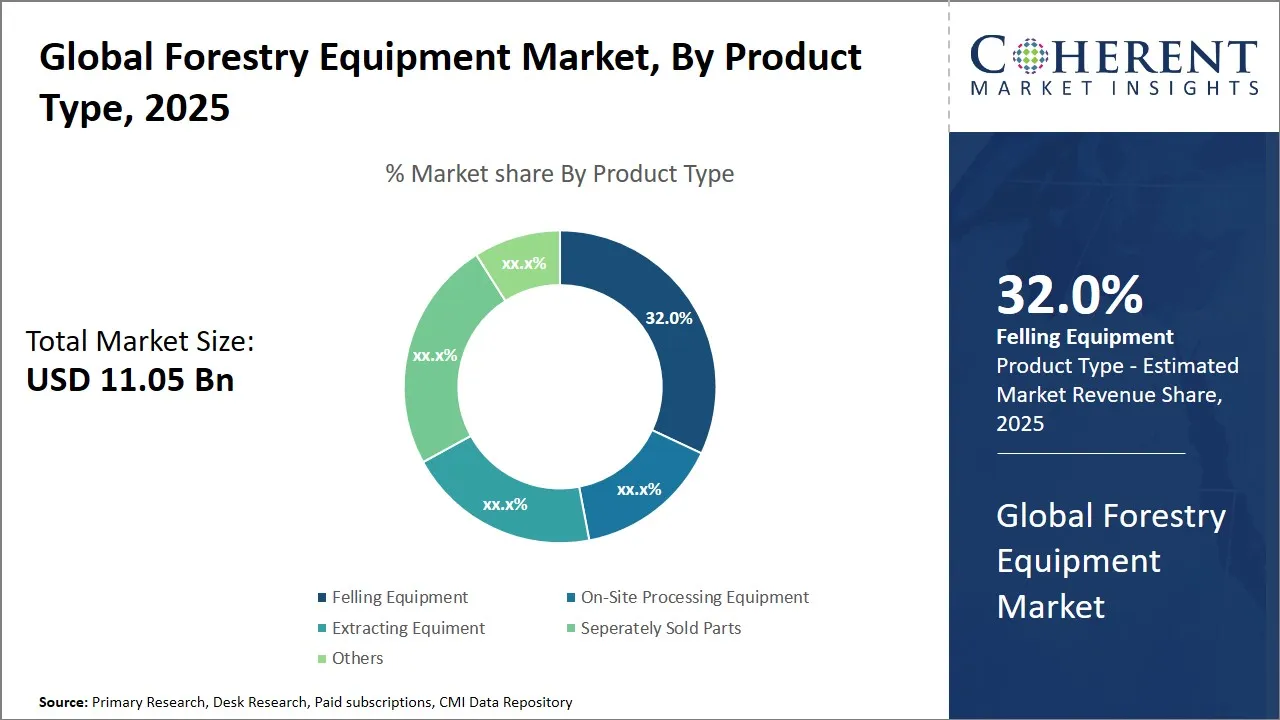
- The felling equipment segment is expected to account for 33% of the forestry equipment market share in 2026.
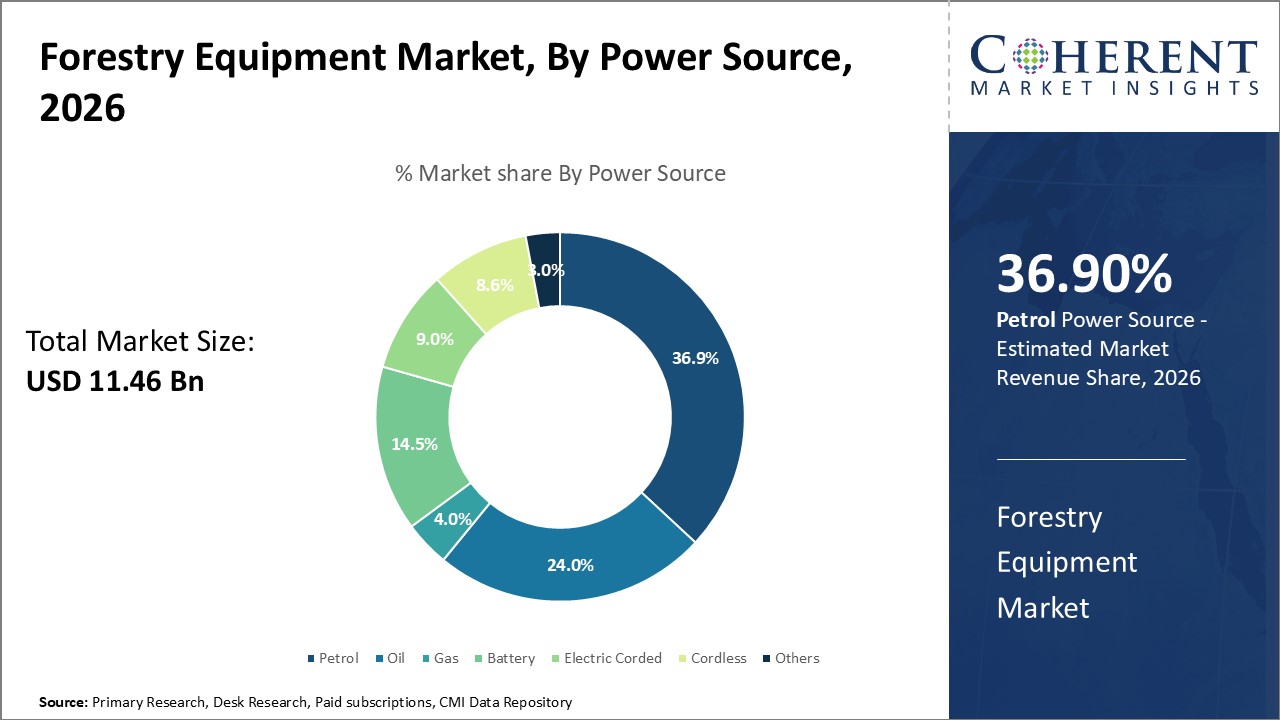
- The petrol segment is projected to capture 36.9% of the market share in 2026.
- The metal segment is expected to command 38.3% share in 2026.
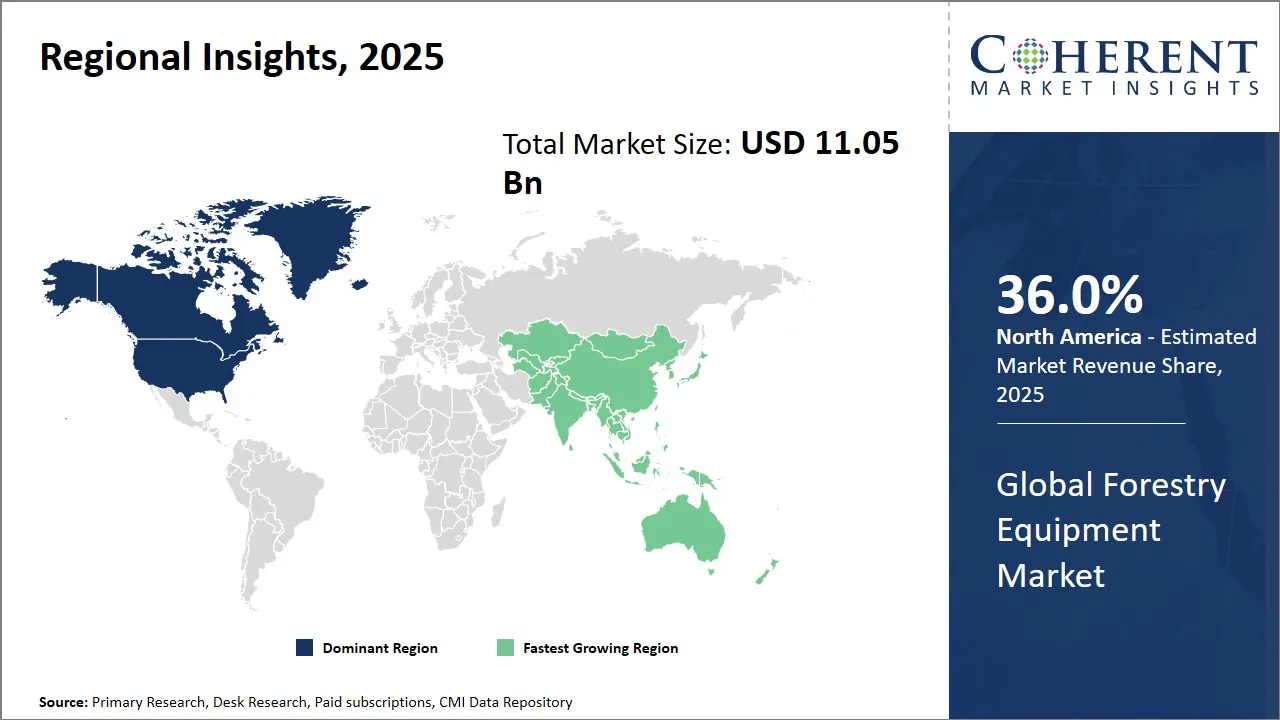
- North America will dominate the forestry equipment market in 2026 with an estimated 36%
- Asia Pacific will hold 25% share in 2026 and record the fastest growth.
Currents Events and Its Impact
Current Events | Description and its Impact |
Caterpillar Product Launch |
|
Tigercat Product Launch |
|
Segmental Insights
- Current Industry Events of 2026
- Market Size Estimation
- Regional Breakdown
- Competitive Landscape
- Customer Intelligence
- Segmental Analysis
- Pricing Analysis
- Key Market Drivers, Challenges & Future Trends
- Customized Insights Section
Why Does Felling Equipment Dominate the Forestry Equipment Market in 2026?
The felling equipment segment is expected to hold 33% of the forestry equipment market share in 2026, due to its broad utility in various applications. Felling tools like chainsaws or feller bunchers handle the first step of logging, bringing trees down quickly, without risk. Their large presence in the market shows steady spending on machines built to cut faster, with better accuracy.
Forestry work now focuses more on efficiency alongside safety, while modern felling tools help meet these goals well. Machines that cut trees automatically lower the need for handwork, letting workers manage big timber without heavy strain and this cuts down injury risks. Also, technological features like self-regulating systems or small satellite navigation improve precision when cutting, limit harm to nearby plants, yet aid responsible forestry methods.
For instance, on April 14, 2025, Tigercat launched the L857 feller buncher, built on a slanted rear chassis suited for uneven woodland terrain. The inclined structure boosts efficiency on steep gradients versus standard versions. Equalized weight distribution along with lower overturn chance improve stability - critical on declines. An exclusive rugged suspension eases motion while aiding handling and comfort in use.
Petrol Segment Dominates the Forestry Equipment Market
The petrol segment is predicted to dominate the market with a 36.9% share in 2026, due to its proven reliability, performance, and widespread applicability in challenging forestry environments.
Petrol engines power most forestry equipment, since their strength relative to weight makes them ideal for demanding jobs like felling trees or hauling logs - especially in uneven terrain far from infrastructure. While electric alternatives exist, they struggle with sustained output where refueling is difficult. Thus, despite environmental concerns, gasoline-driven machines remain common in rugged outdoor settings requiring dependable performance. More than 70% of worldwide timber operations take place in isolated, rough areas without practical access to power sources. Some locations run from 10 to 12 hours daily, so managing battery recharges becomes a costly challenge. Where this happens, gasoline-powered tools offer consistent performance and freedom.
Why is Metal the Preferred Material for Forestry Equipment?
The metal segment is projected to dominate the market with a 38.3% share in 2026, owing to its critical importance in ensuring equipment durability, strength, and reliability.
Forestry machinery faces intense pressure, rough climates, also ongoing friction, so choosing materials impacts durability plus function just as much. Metal, especially strong steel and alloys, gives support needed for tough parts like blades, links, frames, or removal systems. Because these materials withstand hits, rubbing, and high temperatures, forest machines keep working well even during intense wood collection and sorting tasks. Their durability means fewer repairs and longer use life, which cuts overall expenses for logging work.
Electrification & Hybrid Forestry Equipment Adoption
Region | Approx. % Electric / Hybrid (or Electric) Machinery, or % of New Purchases |
Europe — new equipment | 26% |
Europe — battery-electric forwarders | 42% |
Europe — electric forestry harvesters | 38% |
North America — new machinery | 22% |
North America — hybrid forestry equipment | 38% |
Asia Pacific — electric forestry machinery | 9% |
Asia Pacific — share of global electric forestry harvester | 22% |
Regional Insights
North America Forestry Equipment Market Analysis and Trends
The North America region is projected to lead the market with a 36% share in 2026. The leading role in the global forestry equipment market comes from strong industrial roots, boosted by modern tech and clear regulations. In North America, large forest areas make timber operations essential, relying on sustainability alongside machine-based logging. Rules here focus on responsible woodland use, protecting nature, and keeping workers safe, which increases need for smart, clean, high-performance tools. Key firms like John Deere, Tigercat, or Caterpillar help push progress in harvesters, processing units, and log carriers. Firms stay ahead due to strong logistics plus broad support services after purchase. Exchange patterns, large shipments of wood-processing equipment in and out, help spread technology and components, boosting North America’s edge through continuous flow.
Asia Pacific Forestry Equipment Market Analysis and Trends
The Asia Pacific region is expected to exhibit the fastest growth in the market contributing 25% share in 2026. Owing to broader forestry operations along with higher use of machines in developing nations, particularly China, India, and parts of Southeast Asia, the sector is shifting quickly. Industrial progress combined with stronger need for timber goods pushes more firms to adopt up-to-date tools. Supportive state programs focused on responsible forest management also help speed this change. Improved transport networks alongside growing local production capacity make machinery cheaper and easier to obtain. Firms such as Komatsu or Hyundai Forestry boost development via joint ventures and tech modifications suited to area demands. On top of that, rising overseas investments together with open-trade rules expand market reach by bringing in new technologies and wider equipment supply.
For instance, on September 4, 2026, Komatsu introduced the 951XC-1, its biggest harvester. Designed for tough forest work, it ensures better balance, output, and efficiency. This machine ranks among the largest harvesters available today. With eight powered wheels, it offers strong grip and control - ideal for uneven, slippery, or hilly terrain.
Forestry Equipment Market Outlook for Key Countries
U.S. Forestry Equipment Market Trends
The U.S. market gains advantages due to strict environmental rules pushing demand for modern, low-emission logging machines. Companies like John Deere and Tigercat play key roles here, spurring progress in automated systems and remote-controlled technology. Because industrial timber operations are extensive, rugged machinery is essential; this helps make North America a center for new developments. On top of that, national forest protection efforts shape how gear is built, emphasizing eco-friendly performance alongside productivity.
Why is Canada Emerging as a Competitive Producer of Forestry Equipment?
Canada’s forestry equipment market relies on extensive woodlands along with eco-friendly harvesting methods. Firms such as Husqvarna and TimberPro provide tools built for diverse weather, whether in cold northern woods or milder southern areas. Public funding together with modernization incentives helps woodland managers adopt advanced machinery. Close ties to the U.S., meanwhile, boost regional trade while enabling joint technological progress.
China Forestry Equipment Market Trends
China is quickly upgrading its forestry industry, shifting away from hand-based methods toward full automation. Instead of traditional techniques, it now uses machines more widely across operations. Government backing helps push replanting efforts along with responsible tree harvesting practices, which increases the need for better machinery. Local producers are growing their output and improving machine designs, sometimes working with global brands such as Komatsu. These adjustments suit regional landscapes and forest types well. As a result, China plays a central role in shaping how the Asia Pacific area develops in this field.
India Forestry Equipment Market Trends
India's forestry equipment market is changing due to stronger state-backed tree planting initiatives. As focus grows on ecological balance and job creation in rural forest areas, so does the need for effective tools. Foreign companies, together with new domestic producers, are developing cost-effective, adaptable machines fit for varied Indian woodlands. Changes in regulations that improve financing options or ease tech imports are also helping drive expansion.
Is Brazil the Next Growth Engine for the Forestry Equipment Market?
Brazil's forestry equipment market ties directly to vast forests and the role of wood products. As efforts grow to curb unlawful logging, automation rises across areas like the Amazon. Firms in Brazil work together with global makers such as Caterpillar, bringing in machines built for rough landscapes but gentler on nature. Rules that balance conservation with business push advancements in tools, shaping how quickly the industry grows.
Forest Area Restoration, Reforestation, and Timber Harvesting Statistics
Global | Forest Area / Cover / Change |
Net Forest Loss | Approx. 4.12 million ha/year |
Deforestation | Approx. 10.9 million ha/year |
Forest Expansion | Approx. 6.78 million ha/year |
Wood Removals | Approx. 3.9 billion m³ under-bark |
Market Players, Key Development, and Competitive Intelligence
Key Developments
- On November 21, 2025, Deere & Company launched the 1610G forwarder. The John Deere 1610G forwarder marks a new chapter in the well-known G Series journey. While fitting right into the G lineup, this machine shines through strength and practical design. Unlike the widely used 1510G version, the 1610G offers a loading area that's 15% bigger - meaning each trip carries more timber to road edges. As a result, daily productivity gets a clear boost.
- On June 9, 2025, Komatsu introduced the Komatsu 898, a new forwarder with 25 tons load capacity. Komatsu 898 improves upon the widely used Komatsu 895 final felling forwarder, designed for heavier payloads. While offered primarily as an 8-wheel model, a 6-wheel variant suits plantation work on level ground, providing lower operating costs.
Top Strategies Followed by Global Forestry Equipment Market Players
Player Type | Strategic Focus | Example |
Established Market Leaders | Heavy investments in new products | Deere & Company launched the updated H-Series 1270 and 1470 wheeled harvesters in April 2024. Benefit from 15% higher hydraulic output alongside better fuel efficiency. The new H7 and H9 booms provide stronger lift and swing performance. Productivity rises thanks to a redesigned cab offering clearer sightlines, reduced sound levels, upgraded lighting, plus additional room for storage. |
Mid-Level Players | Collaborations with major dealers | On October 24, 2025, Tigercat Industries stated Bosco Machinery will now handle its equipment sales in Germany. Starting with a dedicated partnership goal, the company operates under leaders who know forestry well. While built around teamwork, it draws strength from hands-on background in forest operations.
|
Small-Scale Players | Niche specialization & innovative variants | In April 2024, Oregon Tool introduced a fresh chainsaw chain, designed for accurate trimming of thin branches. This 24AP model offers a compact build with a ¼-inch pitch and slim profile, plus a 1.1 mm gauge. It uses a semi-chisel cutting edge - its curved tip keeps sharpness extended while maintaining solid performance. Instead of aggressive cuts, it balances durability with efficiency.
|
Market Report Scope
Global Forestry Equipment Market Report Coverage
| Report Coverage | Details | ||
|---|---|---|---|
| Base Year: | 2025 | Market Size in 2026: | USD 11.46 Bn |
| Historical Data for: | 2020 To 2024 | Forecast Period: | 2026 To 2033 |
| Forecast Period 2026 to 2033 CAGR: | 3.7% | 2033 Value Projection: | USD 14.78 Bn |
| Geographies covered: |
| ||
| Segments covered: |
| ||
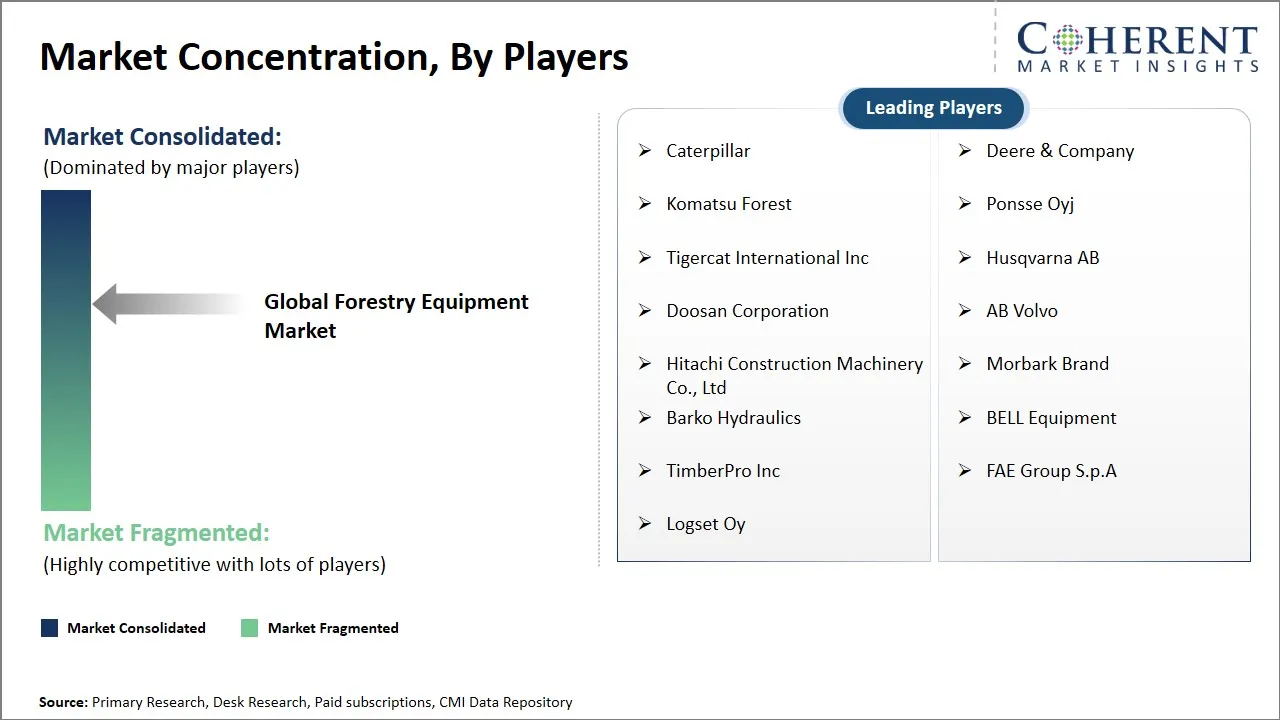
| Companies covered: | Caterpillar, Deere & Company, Komatsu Forest, Ponsse Oyj, Tigercat International Inc, Husqvarna AB, Doosan Corporation, AB Volvo, Hitachi Construction Machinery Co., Ltd, Morbark Brand, Barko Hydraulics, BELL Equipment, TimberPro Inc, FAE Group S.p.A, and Logset Oy | ||
| Growth Drivers: |
| ||
| Restraints & Challenges: |
| ||
Forestry Equipment Market Dynamics
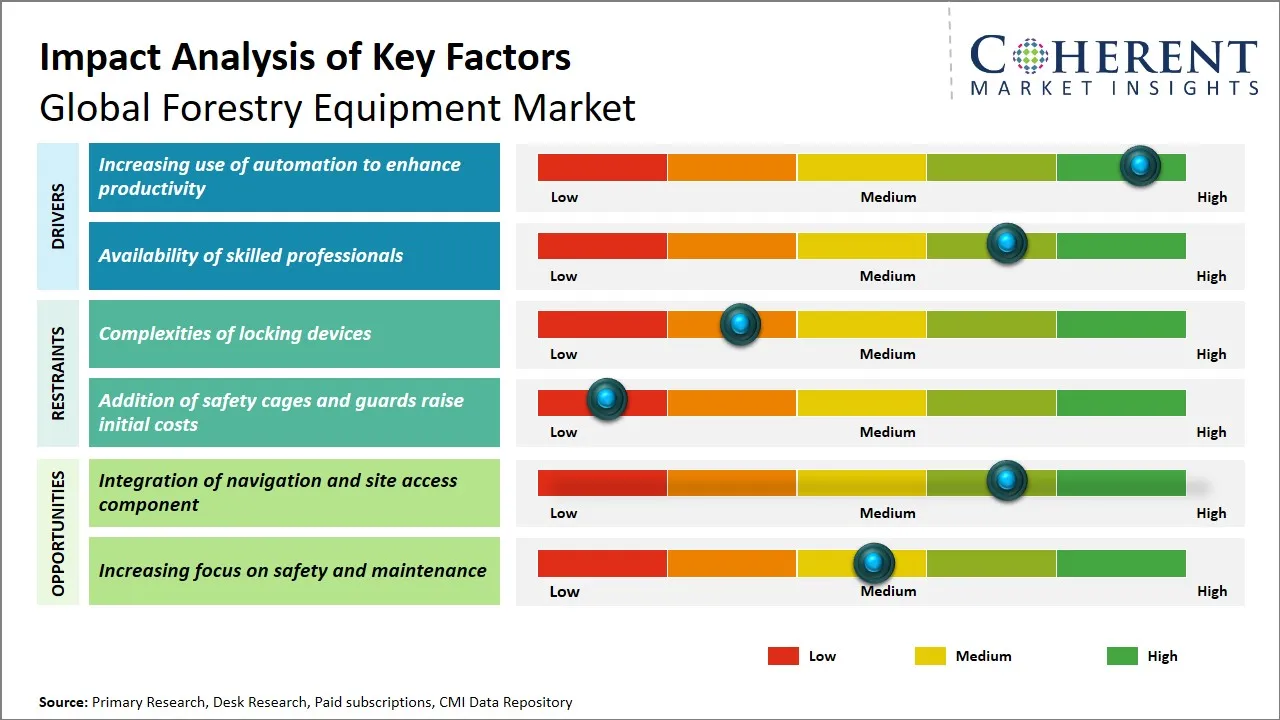
Forestry Equipment Market Driver - Increasing Use of Automation to Enhance Productivity
The forestry equipment field is changing fast as more firms use automated tech to boost output and cut inefficiencies. Machines like smart harvesters and forwarders - loaded with sensors, GPS, and live data tools help crews work faster and more accurately. Because of this, there’s less need for hands-on labor, fewer mistakes happen, and materials are used smarter, helping logging teams shorten harvest periods and limit idle time.
Owing to automation, workers can monitor machines from afar or run them without direct control, even in rough landscapes, which makes jobsites safer and helps cover gaps caused by worker shortages. The mix of robots and smart tech in forest machines helps predict repairs while improving choices using weather and terrain data. Because firms want better harvests without harming nature, automation spreads faster - showing how deeply it’s changing global logging tools and practices.
Forestry Equipment Market Opportunity - Integration of Navigation and Site Access Component
The use of modern navigation plus smart site access tools in forestry machines opens strong growth chances in the worldwide market. Because forest work now relies more on precise methods, machines fitted with GPS guidance together with instant access controls are seeing higher demand. With these systems, drivers can plan better routes, harvest wood more accurately, save fuel while also lowering damage to nature through less soil disruption.
Linking site entry parts like auto gates or coded locks helps speed up daily tasks because only allowed people get in, making field operations run smoother. This integration improves data gathering along with remote tracking, enabling early maintenance instead of waiting for failures, thus cutting idle time. Combining IoT links with modern navigation yields practical information aiding choices on both daily operations and long-term planning. With stricter eco-rules emerging alongside higher running expenses, timber firms must adopt intelligent, connected machinery to boost output while staying within legal environmental limits. Therefore, builders focusing on adding route guidance and location tools to their machines stand a stronger chance of gaining more customers and growing presence amid rising worldwide competition.
Analyst Opinion (Expert Opinion)
- The market confronts strong systemic challenges that may reduce growth speed or create unequal expansion. A primary barrier lies in steep capital demands - new harvesters or forwarders frequently carry prices far above basic or outdated models, limiting access for smaller firms, particularly across emerging economies.
- Although worldwide movement favors automated, intelligent, and eco-friendly logging, progress will probably differ across regions: major companies and big landholders will lead uptake due to stronger access to resources; meanwhile, independent loggers might stick with outdated or basic equipment - particularly in areas where loans, maintenance support, or roads are limited.
Speak to the analyst
Want personalized insights?
Take the findings above to one of our principal consultants, or have the report rebuilt around the segments, geographies and competitors you actually track.
Market Segmentation
- Product Type Insights (Revenue, USD Bn, 2021 - 2033)
- Felling Equipment
- On-Site Processing Equipment
- Extracting Equipment
- Separately Sold Parts
- Others
- Power Source Insights (Revenue, USD Bn, 2021 - 2033)
- Petrol
- Oil
- Gas
- Battery
- Electric Corded
- Cordless
- Others
- Material Insights (Revenue, USD Bn, 2021 - 2033)
- Metal
- Plastic
- Wood
- Recycled Plastics
- Synthetic Resin
- Others
- Regional Insights (Revenue, USD Bn, 2021 - 2033)
- North America
- U.S.
- Canada
- Latin America
- Brazil
- Argentina
- Mexico
- Rest of Latin America
- Europe
- Germany
- U.K.
- Spain
- France
- Italy
- Russia
- Rest of Europe
- Asia Pacific
- China
- India
- Japan
- Australia
- South Korea
- ASEAN
- Rest of Asia Pacific
- Middle East
- GCC Countries
- Israel
- Rest of Middle East
- Africa
- South Africa
- North Africa
- Central Africa
- North America
- Key Players Insights
- Caterpillar
- Deere & Company
- Komatsu Forest
- Ponsse Oyj
- Tigercat International Inc
- Husqvarna AB
- Doosan Corporation
- AB Volvo
- Hitachi Construction Machinery Co., Ltd
- Morbark Brand
- Barko Hydraulics
- BELL Equipment
- TimberPro Inc
- FAE Group S.p.A
- Logset Oy
Sources
Primary Research Interviews
- Forestry Equipment Manufacturers
- Equipment Dealers and Distributors
- Forest Management Companies
- Logging and Harvesting Contractors
Databases
- FAO Forestry Database
- IBISWorld Industry Reports
- Euromonitor International
Magazines
- Forestry Journal
- Timber & Forestry Magazine
- International Forestry Review
- Forest & Wood Products Australia Magazine
Journals
- Forest Products Journal
- International Journal of Forest Engineering
- European Journal of Forest Research
Newspapers
- The Financial Times
- Wall Street Journal
- Reuters Business News
- Bloomberg Industry News
Associations
- Forest Industries Association
- International Union of Forest Research Organizations (IUFRO)
- National Association of Forest Industries
- European Forestry Equipment Association
Public Domain Sources
- Government Forestry Department Reports
- UN Food and Agriculture Organization Publications
- World Bank Forestry Sector Reports
- OECD Environmental Reports
Proprietary Elements
- CMI Data Analytics Tool
- Proprietary CMI Existing Repository of information for last 8 years
Get access to 250+ pages report
Every segment, forecast, competitor profile and data table behind the analysis above — available for instant download.
- ESOMAR Member
- ISO 9001:2015 Certified
- D-U-N-S Registered
- GDPR & CCPA Compliant
Missing comfort of reading report in your local language? Find your preferred language:
Transform your Strategy with Exclusive Trending Reports
Frequently Asked Questions
The global forestry equipment market is estimated to be valued at USD 11.46 Bn in 2026 and is expected to reach USD 14.78 Bn by 2033.
The CAGR of the global forestry equipment market is projected to be 3.7% from 2026 to 2033.
Increasing use of automation to enhance productivity and availability of skilled professionals are the major factors driving the growth of the global forestry equipment market.
Complexities of locking devices and addition of safety cages and guards raise initial costs are the major factors hampering the growth of the global forestry equipment market
In terms of product type, the felling equipment is estimated to dominate the market revenue share in 2026.
Caterpillar, Deere & Company, Komatsu Forest, Ponsse Oyj, Tigercat International Inc, Husqvarna AB, Doosan Corporation, AB Volvo, Hitachi Construction Machinery Co., Ltd, Morbark Brand, Barko Hydraulics, BELL Equipment, TimberPro Inc, FAE Group S.p.A, and Logset Oy are the major players.
North America is expected to lead the global forestry equipment market in 2026.