

Global Four Legged Robots Market Size and Forecast – 2026-2033
The Global Four Legged Robots Market is estimated to be valued at USD 1.66 Bn in 2026 and is expected to reach USD 5.12 Bn by 2033, exhibiting a compound annual growth rate (CAGR) of 17.5% from 2026 to 2033.
Key Takeaways of the Global Four Legged Robots Market
- The commercial/industrial inspection & patrol robots segment leads the market holding an estimated share of 43.7% in 2026.
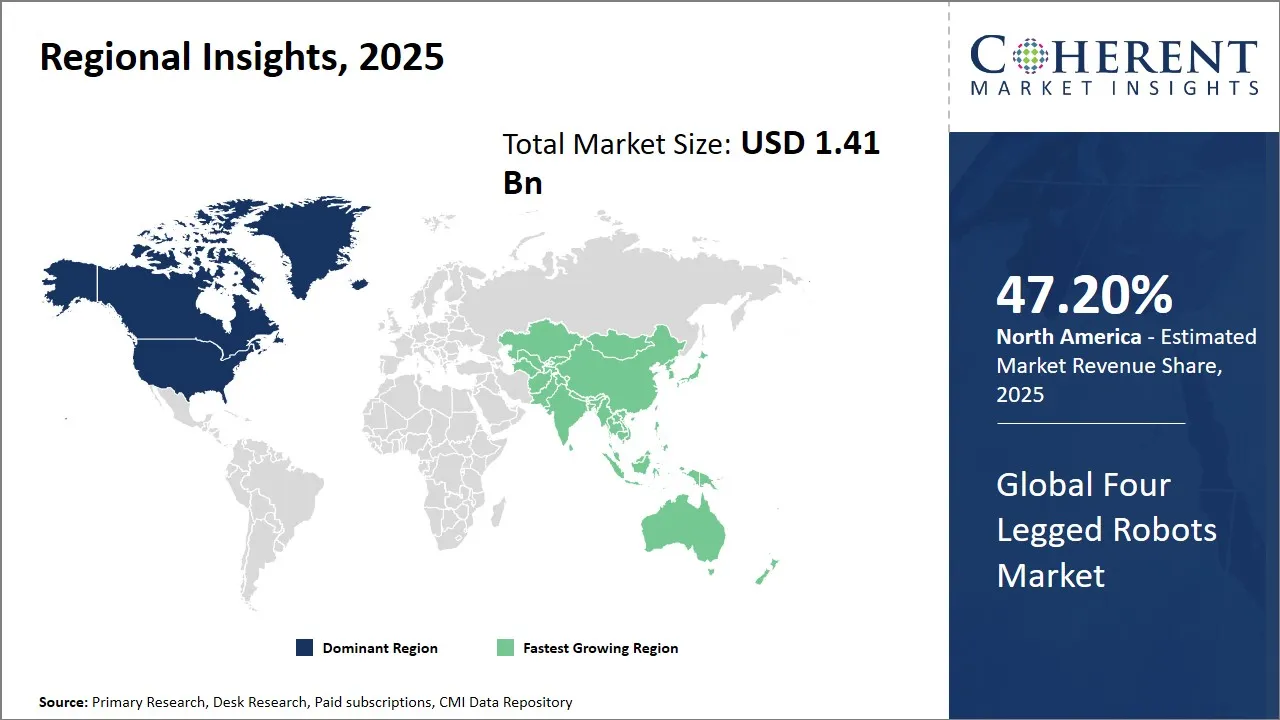
- North America, holding a share of 47.2% in 2026, is set to dominate the market.
- Asia Pacific, holding a projected share of 30.8% in 2026, shows the fastest growth in the market.
Market Overview
Current trends in the four legged robots market highlight a surge in innovation focused on improving mobility, agility, and AI-driven capabilities. Companies are integrating machine learning and computer vision to enable robots to perform complex tasks in unstructured environments. Additionally, the incorporation of lightweight materials and energy-efficient components is enhancing robot endurance, making these robots more viable for extended field operations. This evolving landscape is fostering broader applications and propelling the market expansion globally.
Current Events and Its Impact
Current Events | Description and its impact |
Geopolitical and Trade Developments |
|
Economic and Industrial Trends |
|
Segmental Insights
- Current Industry Events of 2026
- Market Size Estimation
- Regional Breakdown
- Competitive Landscape
- Customer Intelligence
- Segmental Analysis
- Pricing Analysis
- Key Market Drivers, Challenges & Future Trends
- Customized Insights Section
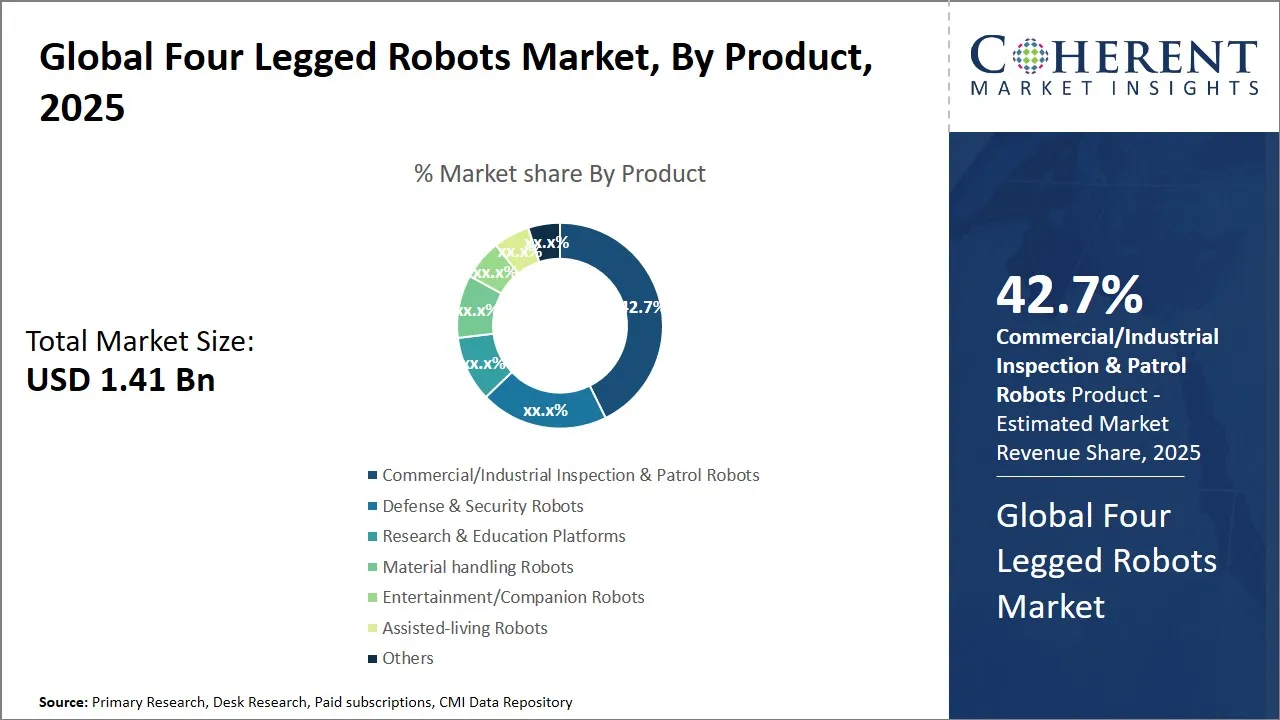
Global Four Legged Robots Market Insights, By Product – Commercial/Industrial Inspection & Patrol Robots Lead with Increasing Demand for Automation and Safety in Industrial Environments
The commercial and industrial inspection & patrol robots segment is expected to hold the largest share of 43.7% in 2026, driven by growing demand for automation, operational safety, and continuous monitoring in high-risk environments. These robots are increasingly used across manufacturing, oil & gas, energy, logistics, and construction sectors to conduct inspections and patrols that would otherwise expose human workers to hazardous conditions.
Their ability to move easily across uneven or confined areas gives them a major advantage over wheeled systems, allowing efficient inspection of sites like chemical plants, power stations, and warehouses. For example, Kawasaki’s Bex quadruped robot has been deployed for industrial site inspections in Japan, demonstrating how such machines can navigate rough terrain while carrying sensors and tools.
Advancements in LIDAR, thermal cameras, and AI-driven analytics now enable these robots to detect equipment faults, unauthorized access, or temperature anomalies in real time—supporting predictive maintenance and enhanced site security. With tightening workplace safety and environmental regulations, more organizations are turning to robotic patrol systems to minimize downtime, reduce liability, and maintain continuous operations efficiently.
Pricing Analysis of the Four Legged Robots Market
Robot Model | Manufacturer | Price (USD) |
Spot | Boston Dynamics | USD 74,500 – USD 99,500 |
Spot Enterprise | Boston Dynamics | USD 85,000 – USD 120,000 |
ANYmal C/X | ANYbotics | USD 150,000 – USD 200,000 |
Ghost Minitaur | Ghost Robotics | USD 40,000 – USD 60,000 |
Vision 60 | Ghost Robotics | USD 100,000 – USD 150,000 |
Unitree A1 | Unitree Robotics | USD 4,500 – USD 7,500 |
Unitree AlienGo | Unitree Robotics | USD 7,500 – USD 10,500 |
Unitree Go1 Pro | Unitree Robotics | USD 3,500 – USD 5,000 |
Xiaomi CyberDog | Xiaomi | USD 1,500 – USD 1,800 |
Laikago | Unitree/Research | USD 10,000 – USD 15,000 |
DEEP Robotics X30 | DEEP Robotics | USD 25,000 – USD 40,000 |
ANYmal B | ANYbotics | USD 120,000 – USD 160,000 |
OpenDog (DIY/Kits) | Open-source projects | USD 1,500 – USD 3,500 |
Ghost Vision Mini | Ghost Robotics | USD 60,000 – USD 80,000 |
Unitree Go2/R2 | Unitree Robotics | USD 5,000 – USD 7,000 |
Regional Insights
North America Four Legged Robots Market Analysis and Trends
North America, holding a projected share of 47.2% in 2026, dominates the global four legged robots market because of a mature technology ecosystem and strong industry presence. The region sees well-established robotics companies, extensive research institutions, and innovation hubs that add to continuous advancements. Government initiatives like federal funding for robotics research and defense contracts add to the development and deployment of four-legged robots for military, industrial inspection, and service applications.
The U.S. leads with companies like Boston Dynamics, which has made highly agile and capable quadruped robots like Spot. The presence of a strong startup culture and venture capital support makes sustained innovation possible. North America also grows because of a favorable trade environment that encourages technology exchange and collaboration across borders.
Asia Pacific Four Legged Robots Market Analysis and Trends
The Asia Pacific, holding an estimated share of 30.8% in 2026, exhibits the fastest growth in the four legged robots market. This is because of fast industrialization, increased automation adoption, and growing government support for robotics across key economies such as China, Japan, and South Korea. Investments in smart manufacturing, logistics automation, and defense modernization are big drivers.
Policies promoting advanced technology sectors, including robotics, underpin significant R&D and commercialization efforts. The region’s growing manufacturing base needs flexible robotic solutions that four-legged robots can provide in unstructured and rugged environments. Companies like Unitree Robotics in China and Boston Dynamics’ regional partners are adding to product range and affordability. The expanding nexus of suppliers, integrators, and end users in Asia Pacific creates a vibrant market ecosystem that feeds rapid uptake.
Global Four Legged Robots Market Outlook for Key Countries
U.S. Four Legged Robots Market Analysis and Trends
The U.S. is characterized by pioneering technology leadership, with Boston Dynamics as a flagship innovator delivering versatile and commercially viable quadruped robots. The country’s focus on defense applications, alongside industrial and research use cases, makes a lot of demand and development activity. Strong collaboration between government agencies, academic institutions, and private sector players add to technology maturity. U.S. policies supporting advanced robotics and AI integration help maintain its competitive edge globally.
China Four Legged Robots Market Analysis and Trends
China sees a lot of growth because of government-backed robotics initiatives and industrial automation programs. Domestic companies like Unitree Robotics focus on cost-effective, scalable four-legged robot solutions for inspection, logistics, and education sectors. Also, collaborations between state-owned enterprises and private firms make possible fast product development and deployment. The government’s strategic plans targeting smart manufacturing sectors make a strong demand framework. Deep integration into local supply chains and growing R&D spending boost China’s regional dominance.
Japan Four Legged Robots Market Analysis and Trends
Japan continues to lead in robotics technology excellence, using its strong industrial robotics base to expand four-legged robot applications in search and rescue, inspection, and entertainment. Companies such as Sony and other robotics startups focus on highly reliable and user-friendly quadruped robots. The country’s aging population also drives innovation toward robotic assistance in healthcare and domestic environments. Government support through subsidies and innovation grants add to steady market progression.
South Korea Four Legged Robots Market Analysis and Trends
South Korea four legged robots market sees an advanced manufacturing ecosystem and substantial government investment in robotics and AI. Big players like Hyundai Robotics and Samsung are focusing on research initiatives targeting next-generation robots with mobility and autonomy. The government’s ‘K-robot’ strategy supports the deployment of intelligent robots in manufacturing, logistics, and public safety, adding to the adoption of four-legged robots well-suited for uneven terrains and complex tasks. South Korea’s strong export orientation accelerates technology dissemination across the Asia Pacific.
Germany Four Legged Robots Market Analysis and Trends
Germany is shaped by its strong industrial engineering sector and strong emphasis on Industry 4.0 automation frameworks. Companies like ANYbotics and Roboception improve the four-legged robots’ utility in industrial inspection, maintenance, and hazardous environment operations. German government policies support sustainable automation, pushing the integration of intelligent robotic systems in manufacturing and infrastructure monitoring. The country’s use of cutting-edge sensors and AI technologies makes the market position of quadruped robots stronger.
Market Players, Key Development, and Competitive Intelligence
Key Developments
- In August 2025, Unitree Robotics launched new humanoid robot starting at USD 5,900.
- In April 2025, Boston Dynamics, the global leader in mobile robotics, and Hyundai Motor Group (the Group) entered a new chapter together to increase manufacturing capabilities, expand collaboration to produce more robots, and build a vibrant robotics ecosystem in the U.S.
- In January 2025, Boston Dynamics and Ghost Robotics made an agreement to resolve their patent litigation in U.S. District Court.
- In December 2024, ANYbotics raised an additional USD 60 million, making its total funding to over USD 130 million. The new funding is led by Qualcomm Ventures and Supernova Invest, with participation from TDK Ventures and other new investors.
Top Strategies Followed by the Four Legged Robots Market Players
- Established market leaders invest a lot in research and development (R&D) to add to innovation and improve product performance.
- Boston Dynamics continuously invests in R&D to improve Spot and Stretch robots, enhancing autonomy, payload handling, and sensor integration.
- Mid-level companies in the four legged robots market use a different approach, focusing on delivering cost-effective solutions without compromising significantly on quality.
- Unitree Robotics offers affordable quadruped robots like Unitree A1, Go1, and AlienGo for research and hobbyist applications, balancing features with lower price points.
- Small-scale players in the four-legged robots arena make their niches by focusing on specialized features or highly innovative products made for specific needs or applications.
- Ghost Robotics targets defense and security applications with rugged, tactical quadrupeds like Vision 60, optimized for outdoor patrol and reconnaissance rather than mass-market deployments.
Market Report Scope
Four Legged Robots Market Report Coverage
| Report Coverage | Details | ||
|---|---|---|---|
| Base Year: | 2025 | Market Size in 2026: | USD 1.66 Bn |
| Historical Data for: | 2020 To 2024 | Forecast Period: | 2026 To 2033 |
| Forecast Period 2026 to 2033 CAGR: | 17.5% | 2033 Value Projection: | USD 5.12 Bn |
| Geographies covered: |
| ||
| Segments covered: |
| ||
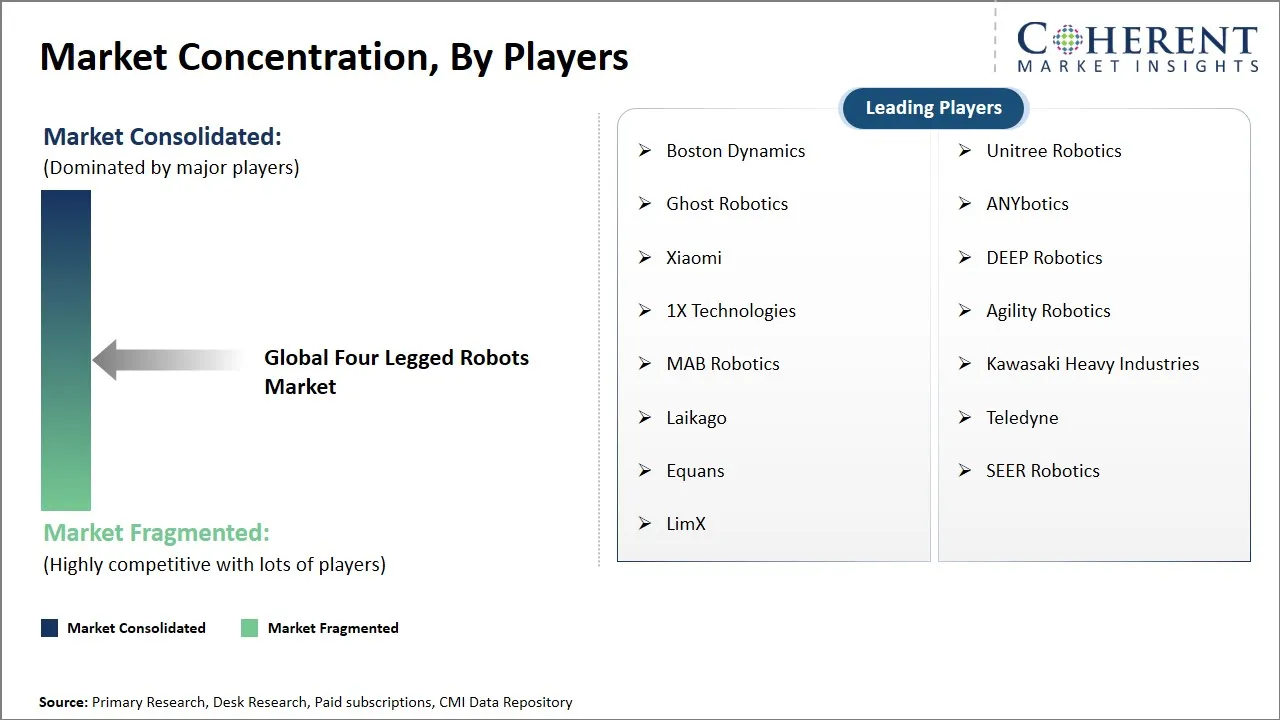
| Companies covered: | Boston Dynamics, Unitree Robotics, Ghost Robotics, ANYbotics, Xiaomi, DEEP Robotics, 1X Technologies, Agility Robotics, MAB Robotics, Kawasaki Heavy Industries, Laikago, Teledyne, Equans, SEER Robotics, and LimX | ||
| Growth Drivers: |
| ||
| Restraints & Challenges: |
| ||
Market Dynamics
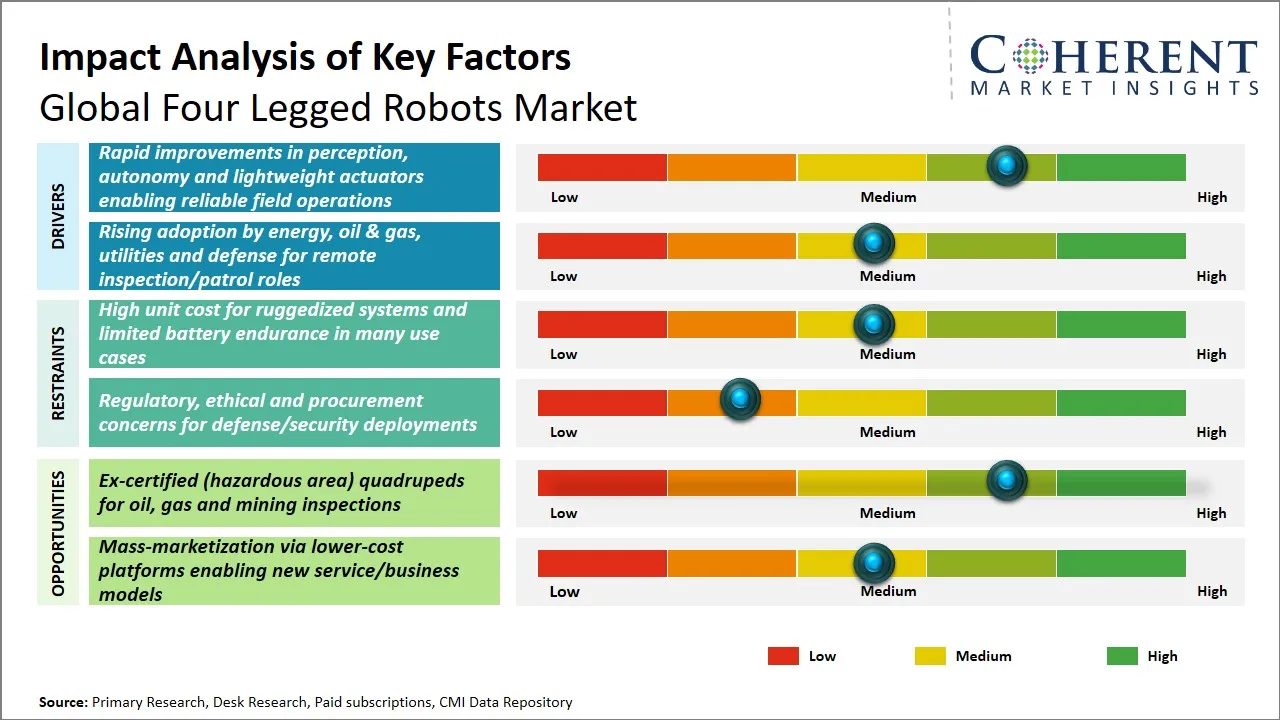
Global Four Legged Robots Market Driver – Rapid Improvements in Perception, Autonomy and Lightweight Actuators Enabling Reliable Field Operations
Four-legged robots are becoming far more capable thanks to fast progress in perception systems, autonomy software, and lightweight actuator technology. Modern sensor fusion, joining LiDAR, cameras, and ultrasonic data, lets these machines interpret surroundings with far greater precision and stability. Improved autonomy now allows them to adapt in real time, avoiding obstacles, handling rough terrain, and making independent navigation decisions.
At the same time, lighter and more energy-efficient actuators show improved balance, mobility, and battery life. This means robots can work longer in outdoor or industrial environments without overheating or power loss. For instance, ANYmal X by ANYbotics, made in collaboration with Petronas, shows strong autonomous inspection capabilities in offshore energy facilities. These technological improvements are making four-legged robots more practical for real-world operations in industries like logistics yards and construction.
Global Four Legged Robots Market Opportunity – Ex-Certified Quadruped Robots for Oil, Gas, and Mining Inspections
A big growth opportunity lies in developing Ex-certified quadruped robots, made to operate safely in explosive or hazardous environments like oil refineries, gas plants, and mines. These robots meet strict international safety standards to prevent sparks or ignition while conducting autonomous inspections.
A practical example is ANYmal X, which became the world’s first Ex-certified legged robot and is already being tested for offshore oil platform inspections by Equinor and Shell. Outfitted with sensors for gas leaks, thermal anomalies, and structural damage, it allows continuous remote monitoring of critical infrastructure. As industries face tighter safety and environmental regulations, and seek to cut maintenance costs, demand for Ex-rated robots like these is expected to rise sharply.
Analyst Opinion (Expert Opinion)
- Quadruped robots are increasingly being deployed in offshore platforms, power substations, chemical plants, and mining operations. Their ability to navigate rugged terrain and hazardous environments allows real-time inspection, data collection, and predictive maintenance, reducing human risk and downtime. Platforms like ANYmal X and Boston Dynamics Spot Enterprise are leading this trend.
- Military and law enforcement adoption is expanding beyond R&D pilots to active field operations, including perimeter patrol, reconnaissance, and unmanned cargo delivery. Ghost Robotics’ Vision 60 and Spot’s security integrations demonstrate growing confidence in autonomous, quadruped robots for mission-critical operations in complex terrains.
- Emerging applications include warehouse logistics, last-mile delivery, and healthcare assistance. Lower-cost, smaller quadrupeds like Unitree A1/Go1 and Xiaomi CyberDog are enabling autonomous package transport, supply delivery in hospitals, and research on assistive robotics for elderly care, signaling a shift toward scalable commercial deployments in urban environments.
Speak to the analyst
Want personalized insights?
Take the findings above to one of our principal consultants, or have the report rebuilt around the segments, geographies and competitors you actually track.
Market Segmentation
- Product Insights (Revenue, USD Bn, 2021 - 2033)
- Commercial/Industrial Inspection & Patrol Robots
- Defense & Security Robots
- Research & Education Platforms
- Material handling Robots
- Entertainment/Companion Robots
- Assisted-living Robots
- Others
- Regional Insights (Revenue, USD Bn, 2021 - 2033)
- North America
- U.S.
- Canada
- Latin America
- Brazil
- Argentina
- Mexico
- Rest of Latin America
- Europe
- Germany
- U.K.
- Spain
- France
- Italy
- Russia
- Rest of Europe
- Asia Pacific
- China
- India
- Japan
- Australia
- South Korea
- ASEAN
- Rest of Asia Pacific
- Middle East
- GCC Countries
- Israel
- Rest of Middle East
- Africa
- South Africa
- North Africa
- Central Africa
- North America
- Key Players Insights
- Boston Dynamics
- Unitree Robotics
- Ghost Robotics
- ANYbotics
- Xiaomi
- DEEP Robotics
- 1X Technologies
- Agility Robotics
- MAB Robotics
- Kawasaki Heavy Industries
- Laikago
- Teledyne
- Equans
- SEER Robotics
- LimX
Sources
Primary Research Interviews
Stakeholders
- Industrial Automation Companies and Robotics Integrators (e.g., Site Operations Managers, Robotics Engineers)
- Four-Legged Robot Manufacturers and Component Suppliers
- Defense and Security Agencies using robotic patrol solutions
- Research Labs and Universities developing legged robotics
- Logistics and Warehouse Operators implementing autonomous robotics
- AI and Robotics Consultants specializing in autonomous navigation and control
Databases
- Global Robotics Deployment Database (GRDD)
- International Autonomous Systems Registry (IASR)
- OECD Innovation & Robotics Indicators
- RoboTech Industry Insights Database
Magazines
- Robotics Today
- Industrial Automation & Robotics Magazine
- Building & Automation Technology (BAT)
- Quadruped Robotics Review
Journals
- Journal of Autonomous Systems & Robotics
- International Journal of Robotics Research (IJRR)
- Robotics and AI in Industry Journal
- Journal of Field Robotics
Newspapers
- The Robotics Times
- Industrial Automation Daily
- The Tech Observer (UK)
- Global Engineering News
Associations
- International Federation of Robotics (IFR)
- Autonomous Robotics Alliance (ARA)
- Association for Unmanned Systems & Robotics (AUSR)
- American Robotics Institute (ARI)
- European Robotics Network (EURON)
Public Domain Sources
- United Nations Office for Outer Space Affairs (UNOOSA) – Robotics Reports
- World Economic Forum – Future of Robotics Reports
- U.S. Department of Energy – Robotics Deployment Insights
- European Commission – Robotics & AI Research Data
- ResearchGate (Robotics & AI Studies)
Proprietary Elements
- CMI Data Analytics Tool, Proprietary CMI Existing Repository of information for last 8 years
Get access to 250+ pages report
Every segment, forecast, competitor profile and data table behind the analysis above — available for instant download.
- ESOMAR Member
- ISO 9001:2015 Certified
- D-U-N-S Registered
- GDPR & CCPA Compliant
Missing comfort of reading report in your local language? Find your preferred language:
Transform your Strategy with Exclusive Trending Reports
Frequently Asked Questions
The global four legged robots market is estimated to be valued at USD 1.66 billion in 2026 and is expected to reach USD 5.12 billion by 2033.
The CAGR of global four legged robots market is projected to be 17.5% from 2026 to 2033.
Rapid improvements in perception, autonomy and lightweight actuators enabling reliable field operations and rising adoption by energy, oil & gas, utilities and defense for remote inspection/patrol roles are the major factors driving the growth of the global four legged robots market.
High unit cost for ruggedized systems and limited battery endurance in many use cases and regulatory, ethical and procurement concerns for defense/security deployments are the major factors hampering the growth of the global four legged robots market.
In terms of Product, Commercial/Industrial Inspection & Patrol Robots segment is estimated to dominate the market revenue share in 2026.
Boston Dynamics, Unitree Robotics, Ghost Robotics, ANYbotics, Xiaomi, DEEP Robotics, 1X Technologies, Agility Robotics, MAB Robotics, Kawasaki Heavy Industries, Laikago, Teledyne, Equans, SEER Robotics, and LimX are the major players.
Quadruped robots are autonomous or semi-autonomous robots that use four legs for locomotion, designed to navigate complex terrains.