

GCC Blue Economy Market Size and Forecast – 2026-2033
The GCC Blue Economy Market is estimated to be valued at USD 191.19 Bn in 2026 and is expected to reach USD 289.39 Bn by 2033, exhibiting a compound annual growth rate (CAGR) of 6.1% from 2026 to 2033.
Key Takeaways of the GCC Blue Economy Market
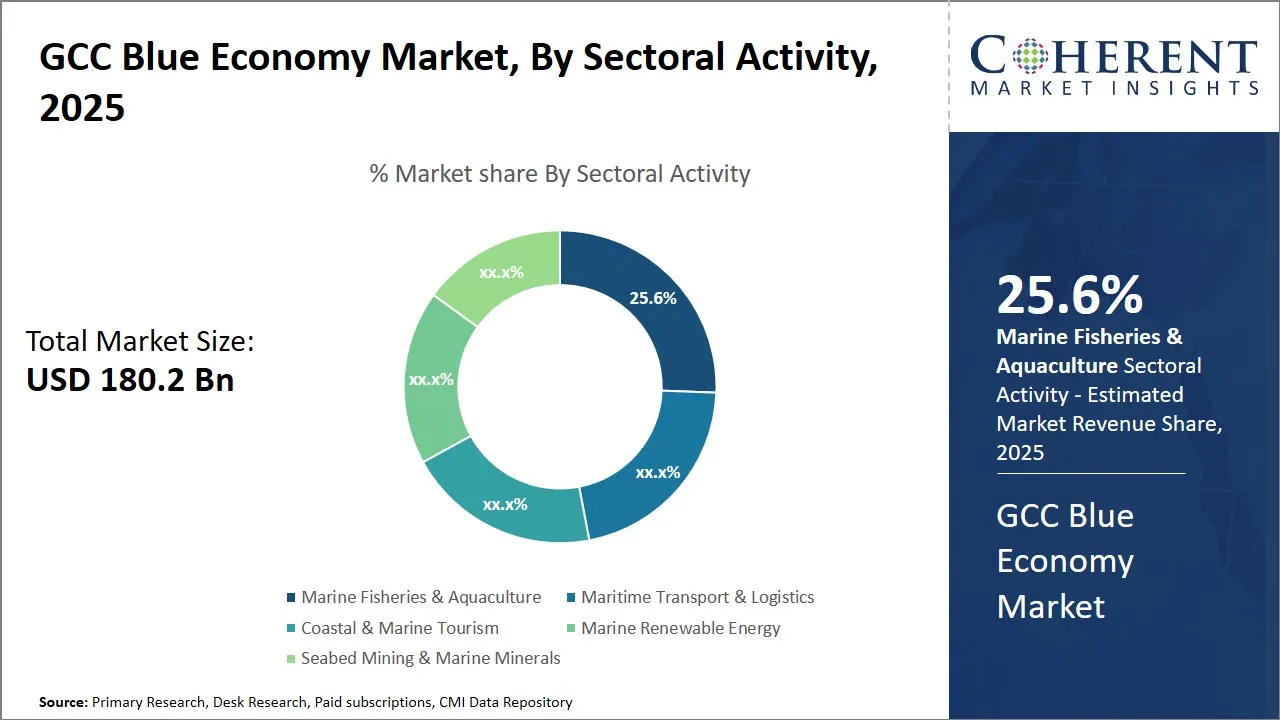
- The marine fisheries & aquaculture segment is projected to account for 26.6% of the GCC blue economy market share in 2026.
- The living resources segment is expected to account for 28.4% of the GCC blue economy market share in 2026.
- The food & nutrition segment is projected to capture 34.7% of the market share in 2026.
Market Overview
The market trend in the GCC blue economy is characterized by a strong emphasis on sustainability and technological innovation. Governments in the region are investing heavily in marine infrastructure, aquaculture, and offshore energy projects to diversify their economies away from oil dependency. Additionally, advancements in maritime technologies and increasing awareness about ocean conservation are fostering new opportunities within fisheries, tourism, and marine biotechnology, positioning the GCC as a strategic hub for blue economy initiatives globally.
Currents Events and their Impact
Current Events | Description and its Impact |
Gulf Blue Carbon Network/regional blue carbon initiatives |
|
Enhanced GCC maritime security posture & redefinition of maritime borders |
|
Segmental Insights
- Current Industry Events of 2026
- Market Size Estimation
- Regional Breakdown
- Competitive Landscape
- Customer Intelligence
- Segmental Analysis
- Pricing Analysis
- Key Market Drivers, Challenges & Future Trends
- Customized Insights Section
GCC Blue Economy Market Insights, By Sectoral Activity - Marine Fisheries & Aquaculture Segment Dominates the Market by Food Security and Sustainable Livelihoods
The marine fisheries & aquaculture segment is expected to contribute 26.6% of the GCC blue economy market share in 2026, owing to its pivotal role in ensuring regional food security and sustaining the livelihoods of coastal communities. GCC countries, which are mostly arid and have a small volume of arable land, extensively depend on marine resources to satisfy their protein and nutrition needs, and in this regard, marine fisheries and aquaculture became the central target of the blue economy. The development of technologies in aquaculture and sustainable fishing has enabled this industry to grow successfully in accordance with the current consumption trends and increase in population in the area.
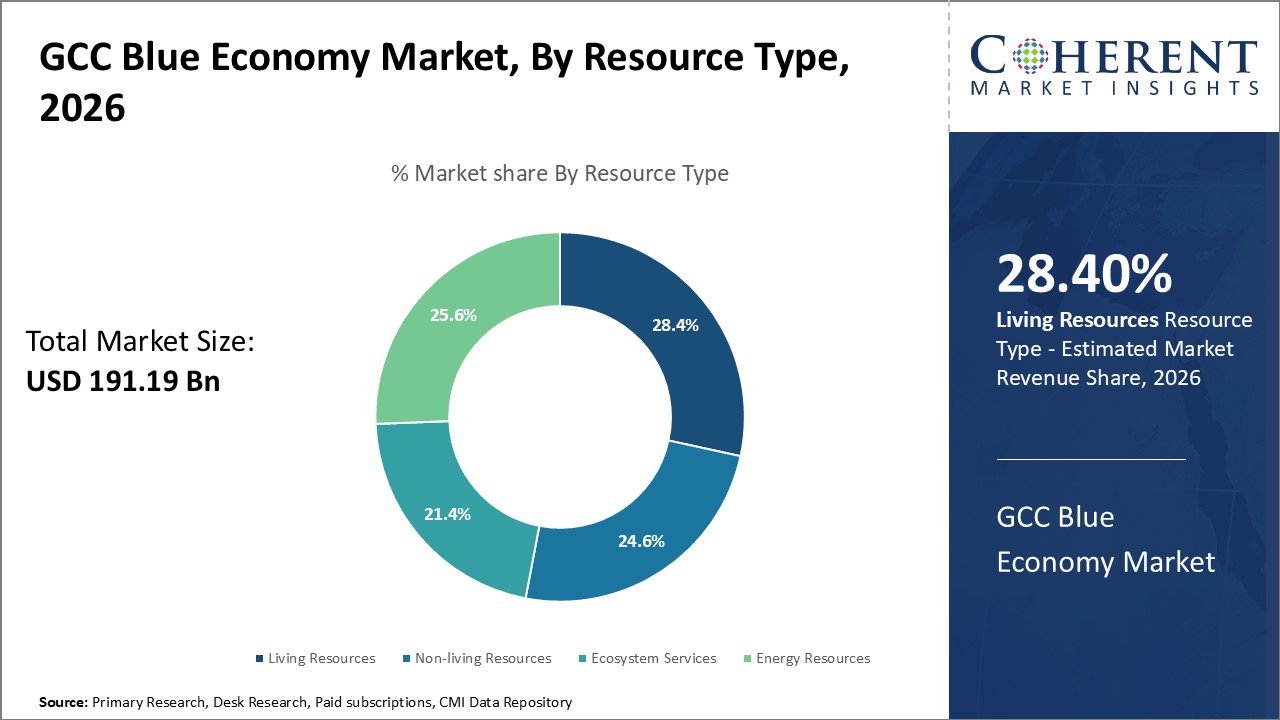
GCC Blue Economy Market Insights, By Resource Type - Living Resources Segment Dominates the Market Driven by Abundant and Renewable Biological Assets
The living resources segment is projected to hold 28.4% of the market share in 2026, attributed fundamentally to the abundance of renewable biological assets such as fish, crustaceans, mollusks, and aquatic plants that form the basis of multiple economic activities. The large coastline and comparatively fertile marine waters create a highly favorable habitat to a wide range of living marine organisms, which are very important not only to be extracted but also to maintain a balance of the ecosystem.
The focus on living resources is enhanced by the fact that they are versatile in supporting other industries other than the traditional fisheries such as aquaculture and pharmaceutical and biotechnological industries. Living marine organisms are the source of raw materials in nutrition, bioactive compounds and other high value products thus appealing to the investments that are geared towards exploiting the increasing world markets of natural and sustainable health products.
GCC Blue Economy Market Insights, By End-use Application - Food & Nutrition Segment Dominates the Market due to Growing Dietary Needs and Health Trends
The food & nutrition segment is expected to capture 35.7% share in 2026, owing to the critical role seafood plays in regional diets and the broader imperative of improving nutritional security. Food items derived in the sea are crucial sources of high-quality protein, omega-3 fatty acids, vitamins, and minerals that are increasingly being identified as vital to health such as support of the cardiovascular system and other consequences that improve cognitive functions.
The population increase by the GCCs and the increasing consumer awareness on healthy eating habits has led to a long-time demand of seafood products, both fresh and value-added products. Such a demand is supplemented by the policies of the government to diversify food sources and lessen the reliance on imports using the resources of the sea to provide a stable food chain.
Macro and Micro Economic Factors Impacting on GCC Blue Economy Market Growth
Macroeconomic Factors
- Economic Diversification: GCC countries are underway to transition away to a model of economic dependence on oil, and blue economy patterns of shipping, coastal tourism, fisheries, and renewable ocean energy are at the core of sustainable growth agendas.
- Government Programs and Vision Statements: National Visions (such as Saudi Vision 2030 and UAE Vision 2050) strategically help to support the blue economy investments, generating non-oil revenues, to provide jobs and enhance economic resilience in the event of oil price volatility.
- Global Trade and Maritime Positioning: The GCCs strategic geographic location along the key shipping routes and along major shipping routes increases its potential in the area of port operations, maritime transportation and logistics infrastructure, which form the basis of macroeconomic stability and international flow of trade.
- Climate Change and Environmental Policies: The increasing environmental awareness drives the region to invest in sustainable blue economy activities by balancing economic development with carbon reduction and environmental resilience particularly with the factors of resource shortages such as freshwater and arable lands.
Microeconomic Factors
- Sector-Specific Investments: A growth in aquaculture, effective port operations, maritime transport, and blue biotechnology have a direct correlation with the growth in the participation and investment of the sector by the private sector in the country of GCC membership.
- Workforce Development and Skill Creation: Capacity to upskill the people in the new industries maritime industries, coastal tourism, and ocean energy determine productivity and value addition at the microeconomic level.
- Fisheries and Aquaculture Performance: Although aquaculture and ports can positively influence growth, an overfishing or an unmanaged fishery may cause adverse effects to the overall contribution of blue economy.
Market Players, Company Insights, and Competitive Intelligence
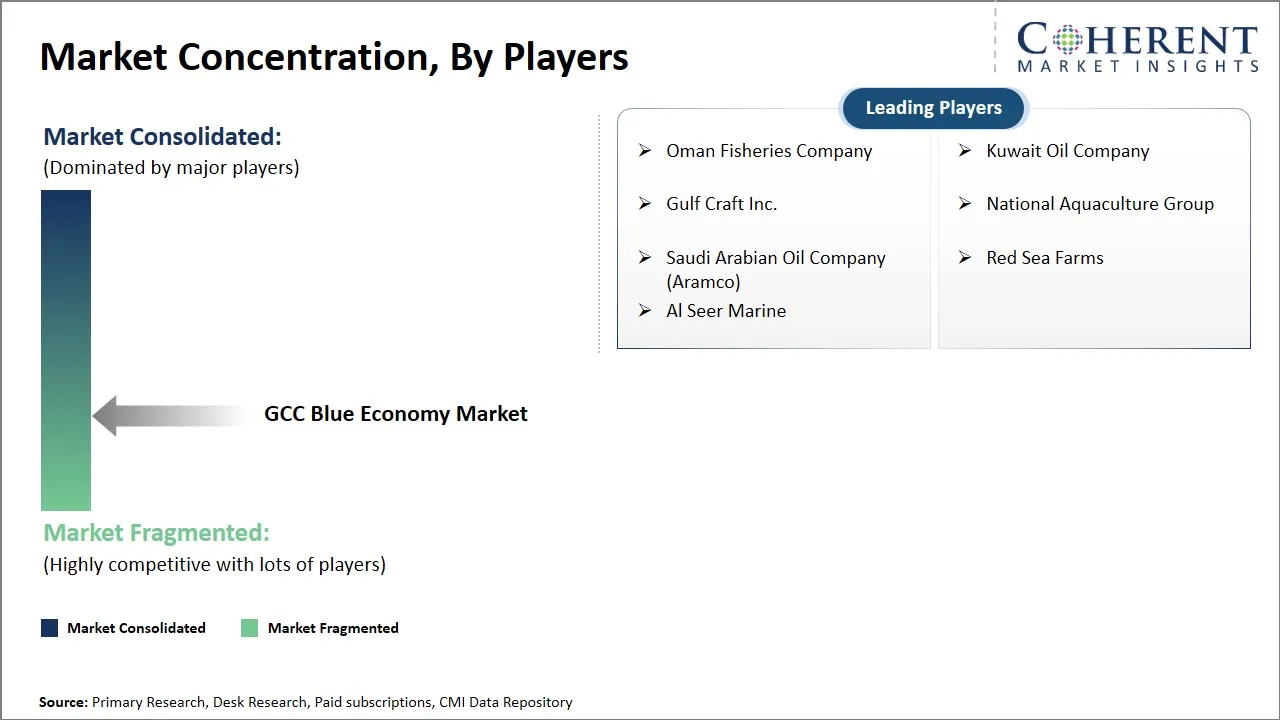
Company Insight
- Oman Fisheries Company (OFC) is an important player in the GCC blue economy market, as it provides value added products and high-quality seafood in the Gulf region. OFC has integrated value chains: the company procures wild-catch fish (demersal and pelagic species tuna, cephalopods, crustaceans) in Omani waters and sells it through both retail and export channels, using its ISO / HACCP/EU-approved plants.
Top Strategies Followed by GCC Blue Economy Market Players
- Established Players: One of the strategies these giants in the industry have embraced is to invest heavily in research and development (R&D) in a bid to develop high performance products that will satisfy the emerging needs of the marine and the maritime sector. Such innovations can be as simple as high-tech maritime devices and as eco-friendly aquaculture tools, which makes such players at the center of the blue economy revolution.
- As an example, DP World dedicates a lot of effort to smart port automation and AI-based logistics, decreasing vessel turnaround time and carbon emissions.
- The competitive strategy of mid-layers in the GCC blue economy market situation is different and aims at quality and affordability. Understanding that most market segments are highly price sensitive, such firms develop cost-effective solutions that do not interfere with the key performance and reliability parameters. This way, they serve a wide customer base comprising of commercial users and other smaller scale business that require efficient yet low-cost marine technologies and services.
- For example, NMDC providing eco-friendly dredging vessels to suit GCC port development ventures, at an affordable cost.
- Small players, which frequently can be described through their agility and innovative zeal, are a key element in the GCC blue economy market because they focus on small-market segments and applications. Such firms focus on coming up with specialized functionalities or novel products that meet particular challenges or new needs in the maritime industry.
- For example, Blue Gulf Aquatech, the company is implementing IoT Cages in aquaculture to check the real-time salinity and oxygen levels.
Market Report Scope
GCC Blue Economy Market Report Coverage
| Report Coverage | Details | ||
|---|---|---|---|
| Base Year: | 2025 | Market Size in 2026: | USD 191.19 Bn |
| Historical Data for: | 2020 To 2024 | Forecast Period: | 2026 To 2033 |
| Forecast Period 2026 to 2033 CAGR: | 6.1% | 2033 Value Projection: | USD 289.39 Bn |
| Segments covered: |
| ||
| Companies covered: | Oman Fisheries Company, Kuwait Oil Company, Gulf Craft Inc., National Aquaculture Group, Saudi Arabian Oil Company (Aramco), Red Sea Farms, and Al Seer Marine | ||
| Growth Drivers: |
| ||
| Restraints & Challenges: |
| ||
GCC Blue Economy Market Dynamics
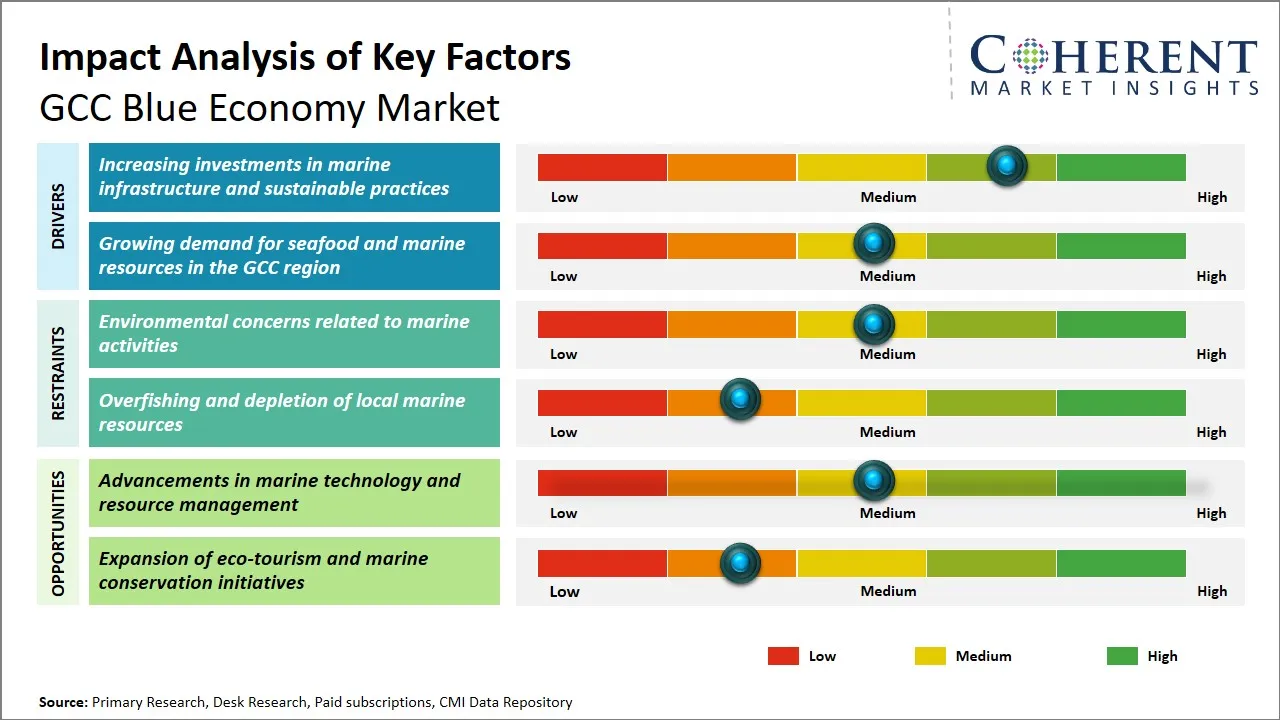
GCC Blue Economy Market Driver - Increasing Investments in Marine Infrastructure and Sustainable Practices
The GCC region is witnessing a significant surge in investments directed towards enhancing marine infrastructure, which is playing a pivotal role in driving the expansion of the blue economy. The governments and private stakeholders are also focusing on the development of ports, logistic centers and offshore centers to enhance the maritime connectivity and other economic activities that include shipping, fisheries and tourism. In conjunction with the development of infrastructure, the focus on the integration of sustainable practices, in order to maintain the marine ecosystems, yet to maximize the use of resources, is also increasing. As an example, U.A.E. strives to establish 30 percent of its national waters as an ocean zone by 2030.
GCC Blue Economy Market Opportunity - Advancements in Marine Technology and Resource Management
The blue economy industry in the Gulf Cooperation Council (GCC) region is a major opportunity presented by continuous improvement in marine technologies/marine engineering and management of the available resources. As more countries continue to invest in research and innovation, GCC countries are embracing the latest technologies like remote sensors, autonomous underwater vehicles (AUVs), and state of the art marine surveillance systems as a way of improving sustainable exploitation of marine resources. The technological advances allow the marine environment biodiversity to be more accurately mapped, fisheries tracked in real-time and maritime activities efficiently managed, which are important in ensuring that the maximum amount of resource is used without causing environmental harm.
Analyst Opinion (Expert Opinion)
- The blue economy market in the GCC is developing at an alarming rate, which is supported by the strategic orientation of the region towards the management of marine resources sustainably and diversification of the economy. The GCC Blue Economy Forum (2023) and the Arab Ocean Conference (2022) emphasized a notable progress, and such companies as ADNOC and Gulf Marine Services took the leading positions in relation to sustainable fishing practices and marine preservation.
- The recent investment ventures by ADNOC in floating solar technology offshore are the examples of innovative methods to improve the efficiency of energy supply and reduce the impact on the environment. Through meetings, it was evident that there is need to have a collaboration between Gulf states to have regulatory systems that ensure that there is a responsible marine practice and that biodiversity is preserved. In addition, the participation of local communities in blue economy projects is essential to promote stewardship and achieve success in the long run.
Speak to the analyst
Want personalized insights?
Take the findings above to one of our principal consultants, or have the report rebuilt around the segments, geographies and competitors you actually track.
Market Segmentation
- Sectoral Activity Insights (Revenue, USD Bn, 2021 - 2033)
- Marine Fisheries & Aquaculture
- Maritime Transport & Logistics
- Coastal & Marine Tourism
- Marine Renewable Energy
- Seabed Mining & Marine Minerals
- Resource Type Insights (Revenue, USD Bn, 2021 - 2033)
- Living Resources
- Non-living Resources
- Ecosystem Services
- Energy Resources
- End-use Application Insights (Revenue, USD Bn, 2021 - 2033)
- Food & Nutrition
- Energy & Power Generation
- Transportation & Trade
- Tourism & Recreation
- Pharmaceuticals & Biotechnology
- Key Players Insights
- Oman Fisheries Company
- Kuwait Oil Company
- Gulf Craft Inc.
- National Aquaculture Group
- Saudi Arabian Oil Company (Aramco)
- Red Sea Farms
- Al Seer Marine
Sources
Primary Research Interviews
- Blue Economy Policy Director – GCC Regional Authority
- Maritime Economy Specialist – Major Gulf Shipping Company
- Sustainability Manager – GCC Marine Conservation NGO
- Aquaculture Development Head – Leading Fishery Enterprise
Stakeholders
- Government and Regional Economic Bodies (GCC countries)
- Marine and Fisheries Industry Players
- Renewable Ocean Energy Companies (wave, tidal, offshore wind)
- Maritime Transportation and Logistics Firms
Databases
- GCC Statistical Center Marine and Economic Data
- UN Comtrade with GCC Regional Data Fisheries and Marine Products
- International Maritime Organization (IMO) Data Sets for GCC Ports and Shipping
Magazines
- Marine and Coastal Economy Review – Trends in GCC Blue Economy sectors
- Gulf Maritime Journal – Shipping and port developments in GCC
- Renewable Ocean Energy Monthly – Ocean energy projects in Gulf Region
- Aquaculture World – Aquaculture growth and regulation in GCC countries
Journals
- Journal of Marine Policy and Economics – GCC focused research on ocean economy
- Aquaculture Research – Studies on marine farming in the Gulf region
- Renewable Energy in Marine Environments – GCC renewable ocean energy studies
- Coastal Management Journal – GCC coastal development and sustainability
Newspapers
- The Gulf Times – Regional news focused on maritime economy and blue economy
- Arabian Business – Investments and corporate news on GCC Blue Economy
- Middle East Economic Digest – Analysis of marine and ocean economic sectors in GCC
- Khaleej Times – Coastal tourism and development news
Associations
- Gulf Cooperation Council (GCC) Secretariat – Blue Economy Task Force
- International Maritime Organization (IMO) Regional Office for Middle East
- Middle East Fisheries and Aquaculture Network
- Gulf Marine Sustainability Initiative
- Renewable Energy and Ocean Innovation Cluster – GCC
Public Domain Sources
- GCC Blue Economy Strategy Documents and Reports
- UN FAO Reports on Fisheries and Aquaculture in the GCC Region
- World Bank Blue Economy Initiatives and Reports with GCC focus
- International Renewable Energy Agency (IRENA) Reports on GCC ocean energy
- Regional Environmental Impact Assessment Reports for Coastal Projects
Proprietary Elements
- CMI Data Analytics Tool, Proprietary CMI Existing Repository of information for last 8 years.
Get access to 250+ pages report
Every segment, forecast, competitor profile and data table behind the analysis above — available for instant download.
- ESOMAR Member
- ISO 9001:2015 Certified
- D-U-N-S Registered
- GDPR & CCPA Compliant
Missing comfort of reading report in your local language? Find your preferred language:
Transform your Strategy with Exclusive Trending Reports
Frequently Asked Questions
The GCC blue economy market is estimated to be valued at USD 191.19 Bn in 2026 and is expected to reach USD 289.39 Bn by 2033.
The CAGR of the GCC blue economy market is projected to be 6.1% from 2026 to 2033.
Increasing investments in marine infrastructure and sustainable practices and growing demand for seafood and marine resources in the GCC region are the major factors driving the growth of the GCC blue economy market.
Environmental concerns related to marine activities and overfishing and depletion of local marine resources are the major factors hampering the growth of the GCC blue economy market.
In terms of sectoral activity, the marine fisheries & aquaculture segment is estimated to dominate the market revenue share in 2026.
Oman Fisheries Company, Kuwait Oil Company, Gulf Craft Inc., National Aquaculture Group, Saudi Arabian Oil Company (Aramco), Red Sea Farms, and Al Seer Marine are the major players.