

Germany Senior Living Market Size and Forecast – 2026-2033
The Germany senior living market is expected to grow from USD 28.15 Bn in 2026 to USD 47.67 Bn by 2033, registering a compound annual growth rate (CAGR) of 7.8%. The Germany senior living market is poised for significant expansion, fueled by the country’s rapidly aging population and increasing demand for long-term care services.
According to the Federal Statistical Office of Germany, one in four people in Germany is expected to be aged 67 or older by 2035, highlighting a significant structural shift. (Source: Statistisches Bundesamt (Destatis))
Key Takeaways of the Germany Senior Living Market
- Independent living is projected to hold 52.9% of the Germany senior living market share in 2026, making it the dominant type segment, as a result of an increasing inclination by relatively fit seniors in the 65–75-year age group to keep their independence while being provided with services on an optional basis due to cheaper prices than the cost of living in assisted/nursing homes. For instance, in Germany, nursing home costs range between USD 2,300 and USD 5,300 (€2,000 and €4,500) per month, making home care a comparatively cost-effective alternative in many cases. (Source: Agentur für Haushaltshilfe GmbH)
- Household and daily life support services are projected to hold 47.3% of the Germany senior living market share in 2026, making it the dominant service offered segment driven by the increasing demand for personal assistance like food preparation, mobility, and housekeeping services facilitated through the Pflegeversicherung reimbursement system in Germany.
- Growth of Premium and Lifestyle-Oriented Senior Living: Increased disposable incomes and altered tastes of the senior generation have fueled the need for luxury retirement centers providing health benefits, hospitality, and individual care services. There is, thus, potential for developers to create luxurious experience-based centers.
- Expansion of Home-Based and Hybrid Care Models: An emerging demand for in-home care solutions and blended living facilities combining independent living with access to medical help when required has opened up new business opportunities for service providers to leverage digital health technologies in their operations.
Segmental Insights
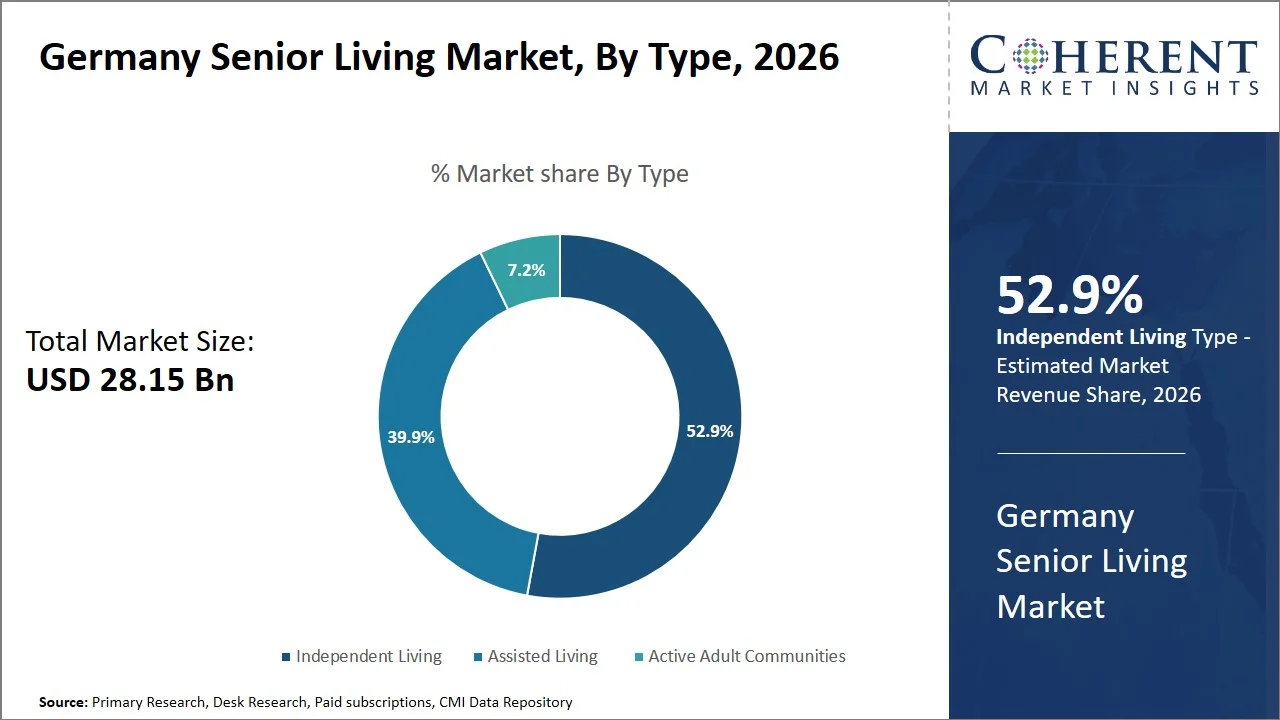
Why Does the Independent Living Segment Dominate the Germany Senior Living Market?
Independent living is projected to hold a market share of 52.9% in 2026, due to the presence of robust regulations and financing policies (including Germany’s statutory long-term care system under SGB XI, Pflegeversicherung funding structure, home-based care incentives, and housing adaptation grants) encouraging non-institutionalized care. Germany's Pflegeversicherung (statutory long-term care insurance) enables recipients to choose between Pflegegeld (cash benefit) and specially-designed in-kind benefits that help with caregiving within homes, which provides an economic incentive for staying independent. According to Federal Statistical Office of Germany, around 4.1 million people in need of care are supported at home, either by relatives or outpatient services, reflecting a structural preference embedded in policy. (Source: Statistisches Bundesamt (Destatis))
Additionally, the regulations under Social Code Book XI (SGB XI) subsidize up to USD 4,700 (€4,000) per home modification measure while promoting greater ambulatory healthcare services over inpatient care facilities (Source: Federal Ministry of Health). Overall, the independent living concept remains dominant in Germany's senior living sector with the assistance of policy-driven structure, cost benefits, and decentralization of care provision infrastructure.
- Current Industry Events of 2026
- Market Size Estimation
- Regional Breakdown
- Competitive Landscape
- Customer Intelligence
- Segmental Analysis
- Pricing Analysis
- Key Market Drivers, Challenges & Future Trends
- Customized Insights Section
Why are Household and Daily Life Support Services Most Preferred Service Offered in Germany Senior Living Market?
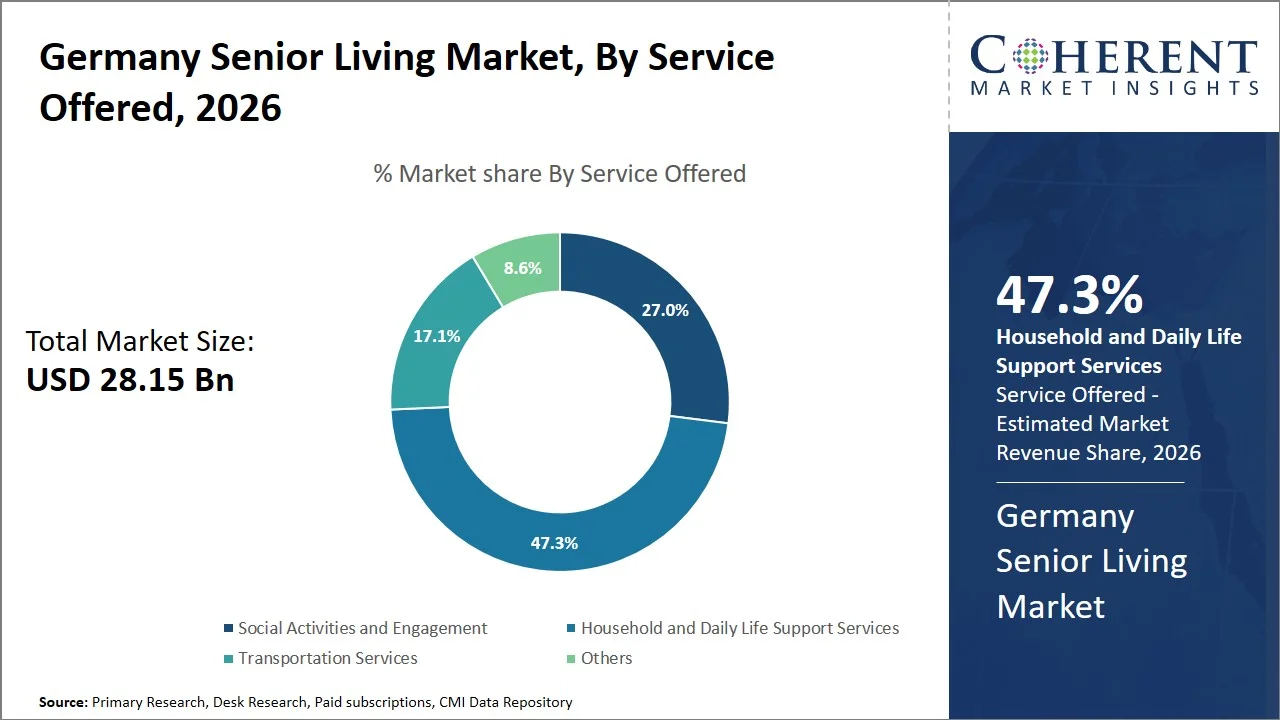
Household and daily life support services are projected to hold 47.3% of the market share in 2026. This is due to the strict home-based care policies existing in Germany under the statutory long-term care insurance scheme (SGB XI). In accordance with this legislation, patients have the right to obtain in-kind benefits (Pflegesachleistungen) and an extra benefit (Entlastungsbetrag of USD 153 (€131) per month) for specific services including housekeeping, cooking, and mobility. Thus, according to the Federal Ministry of Health Germany, the provision of these services is aimed at reducing the necessity of obtaining institutional services through improving outpatient services and other assistance services, which make it the most commonly used type of services. (Source: Federal Ministry of Health)
Currents Events and their Impact
Current Events | Description and its Impact |
Regulatory Shift: Expansion of Home-Based Care under SGB XI (2024–2025) |
|
Macro Shift: Accelerating Population Decline and Aging (2025–2026) |
|
Germany Senior Living Market Dynamics
Market Drivers
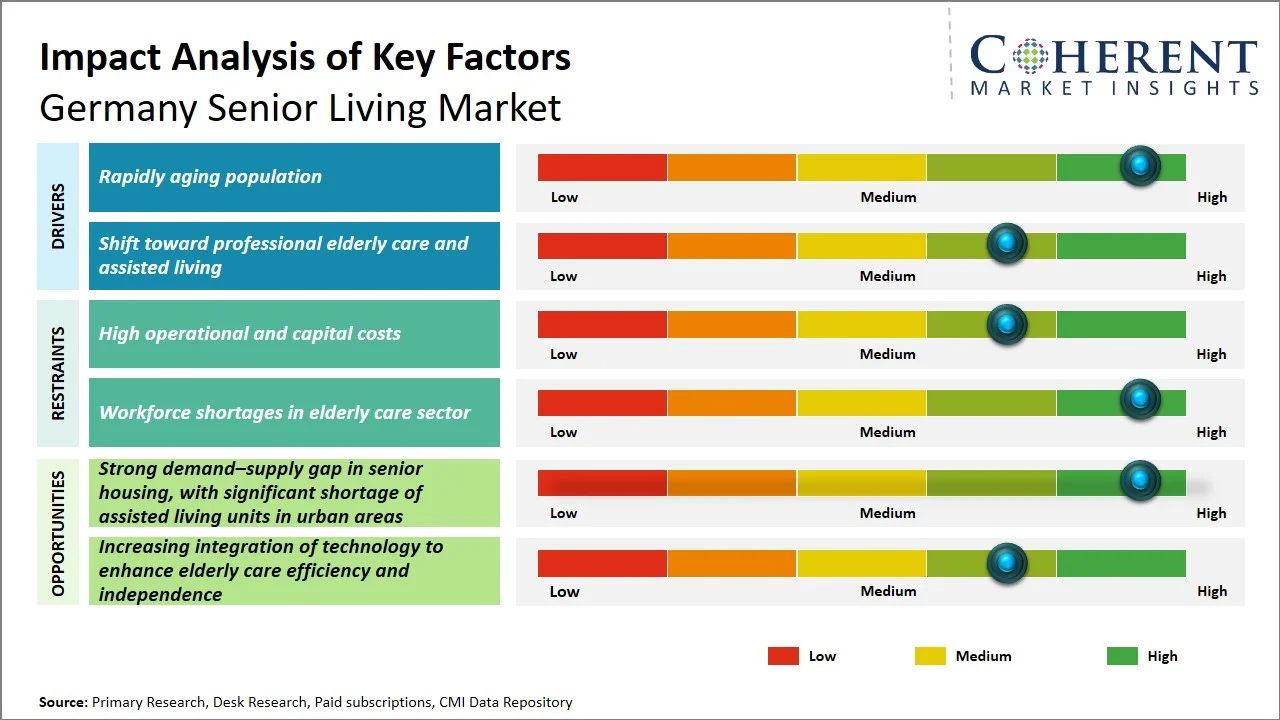
- Rapidly Aging Population: Germany's senior living sector is experiencing significant growth, fueled by an aging population. The Federal Statistical Office's figures show that the percentage of individuals aged 67 and older will climb from 20% in 2024 to somewhere between 25% and 27% by 2038. This translates to almost four million more retirees. The surge in the elderly population, especially those over 80 who often need more assistance, is creating a structural demand for senior housing, assisted living facilities, and long-term care across the nation. (Source: Statistisches Bundesamt (Destatis))
- Shift Toward Professional Elderly Care and Assisted Living: Germany is undeniably moving towards a more professional and formalized approach to care services. This shift is backed by the country's statutory long-term care insurance system (SGB XI), which provides access to in-kind care services (Pflegesachleistungen) and professional outpatient care providers. The Federal Statistical Office reports that roughly half of those aged 80 and older already need long-term care. This highlights the rising demand for structured, professional care settings, rather than relying solely on informal family support. The growing need for care among the oldest demographic is speeding up the transition to assisted living facilities and organized elderly care services. (Source: Statistisches Bundesamt (Destatis))
Emerging Trends
- Digitalization and Smart Senior Living Solutions: The senior care industry is moving towards adopting digital health solutions such as remote monitoring, telemedicine, and AI-based systems. Such a move will improve service delivery and promote aging in place initiatives.
- Shift Toward Community-Based and Independent Living: Increasingly, there is a tendency among seniors to prefer autonomous living or even living in a community compared to living in institutions. This is resulting in the emergence of hybrid living environments.
Reimbursement Framework in the Germany Senior Living Market
Aspect | Detail | Impact on Market |
Regulatory Framework | Governed under Social Code Book XI (SGB XI) | Establishes a structured and mandatory long-term care insurance system supporting elderly care services |
Coverage Type | Partial reimbursement for inpatient (nursing homes), outpatient, and home-based care services | Ensures steady demand across care settings while maintaining affordability |
Benefit Structure | Fixed benefits based on care levels (Pflegegrade), not full cost coverage | Encourages cost-sharing, increasing out-of-pocket spending |
Eligibility | Individuals assessed under defined care dependency levels qualify for benefits | Expands access to formal care services and drives utilization |
Private Pay Component | Accommodation, food, and additional services often paid privately | Drives growth of premium senior living and private care facilities |
Home Care Support | Strong reimbursement support for home and community-based care | Accelerates shift toward home-based and hybrid care models |
How is the strong demand–supply gap in senior housing, with significant shortage of assisted living units in urban areas creating new growth opportunities in the Germany senior living market?
The Germany senior living market offers a good opportunity based on the increasing demand-supply mismatch, especially in urban regions where the growth in aging population is surpassing the development of infrastructure.
Based on data published by the Federal Statistical Office of Germany, there will be an estimated increase in the number of people who need long-term care from ~5.0 million in 2021 to ~6.8 million in 2055 (~37%) (Source: Statistisches Bundesamt (Destatis)). However, supply increases are limited as the country has about ~583,000 senior living units and ~893,000 nursing care beds, which are inadequate in urban cities where imbalances occur (Source: RICS.org.). Accordingly, the unmet need for senior living services and assisted housing in urban areas presents a clear avenue for growth for developers and providers, especially in dense metropolitan environments.
Market Players, Key Development, and Competitive Intelligence
Key Developments
- In March 2026, Swiss Life Asset Managers expanded its footprint in Germany's senior living market by purchasing the Barkhausen retirement home in Porta Westfalica, North Rhine-Westphalia. This acquisition was made through its ESG healthcare real estate fund. The contemporary facility, finished in 2023, boasts more than 6,000 square meters of space. It features inpatient care beds and intensive care units, and is fully leased to a private care operator under a long-term contract.
- In January 2026, Periskop Living signaled its plans to expand its senior living investment platform. Having already committed roughly USD 233.6 million (€200 million) to the sector, the company declared its intention to move beyond Germany, targeting other European markets, such as the Netherlands. This expansion highlighted increasing investor confidence and a trend of cross-border activity within the senior housing sector.
Competitive Landscape
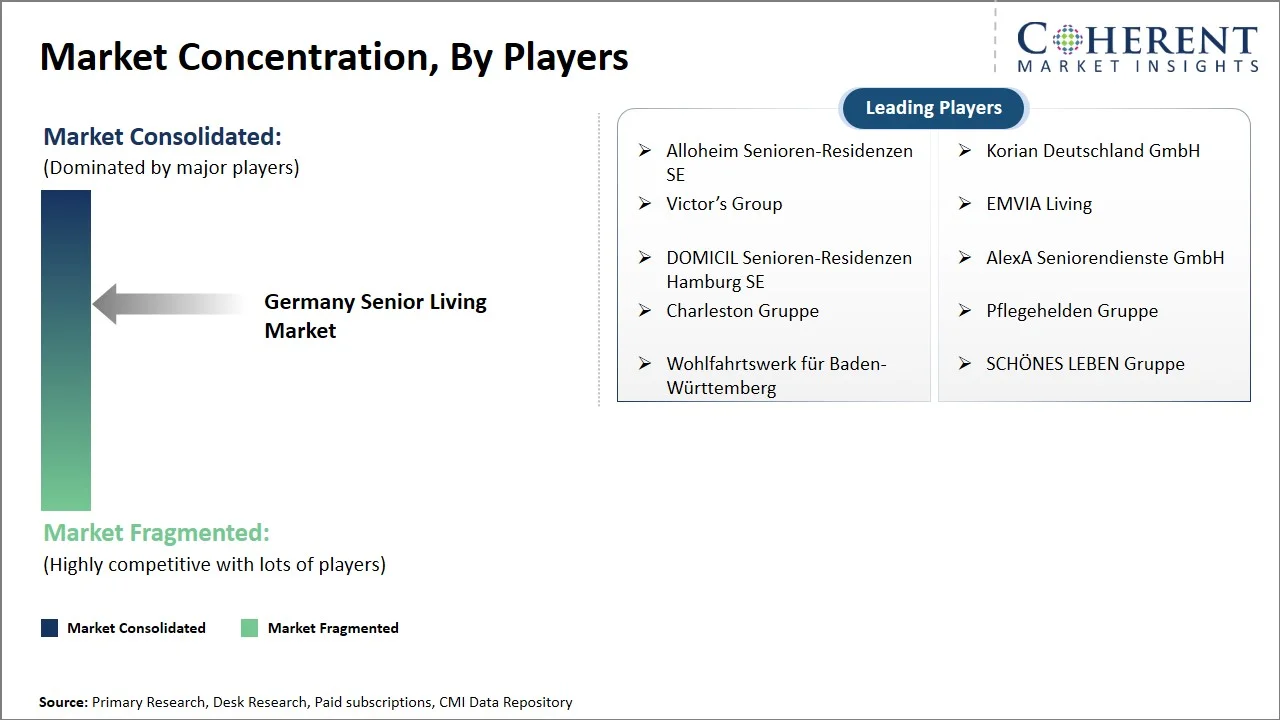
The Germany senior living market is somewhat fragmented and developing because of the rising interest of investors in establishing their businesses. They are investing heavily in elderly care due to the increasing number of elderly people in the country. The senior living companies have adopted an ambulatory approach for the treatment of patients as per the government strategy. Key focus areas include:
- Independent living communities
- Technology-enabled care solutions (remote monitoring, smart homes)
- Compliance with stringent regulatory standards under SGB XI
Market Report Scope
Germany Senior Living Market Report Coverage
| Report Coverage | Details | ||
|---|---|---|---|
| Base Year: | 2025 | Market Size in 2026: | USD 28.15 Bn |
| Historical Data for: | 2020 To 2024 | Forecast Period: | 2026 To 2033 |
| Forecast Period 2026 to 2033 CAGR: | 7.8% | 2033 Value Projection: | USD 47.67 Bn |
| Segments covered: |
| ||
| Companies covered: | Alloheim Senioren-Residenzen SE, Korian Deutschland GmbH, Victor’s Group, EMVIA Living, DOMICIL Senioren-Residenzen Hamburg SE, AlexA Seniorendienste GmbH, Charleston Gruppe, Pflegehelden Gruppe, Wohlfahrtswerk für Baden-Württemberg, and SCHÖNES LEBEN Gruppe | ||
| Growth Drivers: |
| ||
| Restraints & Challenges: |
| ||
Analyst Opinion (Expert Opinion)
- It is anticipated that the country's senior care sector will trend towards the decentralization of the industry and prioritizing the care within patients' homes, favoring independent living options and outpatient solutions. The continuous efforts by the government through the implementation of SGB XI and demographic changes will drive the adoption of the tech-enabled community care systems.
- The areas of maximum growth potential are projected to be the development of integrated independent living and assisted living solutions with daily living services provision in the territory of Germany, especially in the cities and semi-urban environment where there are aging populations combined with low care infrastructure. The fields of memory care and dementia are growing quickly, mainly because of the increasing number of age-related health issues.
- To gain a competitive edge, companies should focus on building partnerships with outpatient facilities, creating flexible and adaptable housing options, and using technologies like telemedicine and AI-driven care systems. Furthermore, aligning the service portfolio with regulatory frameworks (SGB XI), improving operational efficiency amidst labor shortages, and offering premium, yet flexible, service models can be advantageous.
Speak to the analyst
Want personalized insights?
Take the findings above to one of our principal consultants, or have the report rebuilt around the segments, geographies and competitors you actually track.
Market Segmentation
- Type Insights (Revenue, USD Bn, 2021 - 2033)
- Independent Living
- Assisted Living
- Active Adult Communities
- Service Offered Insights (Revenue, USD Bn, 2021 - 2033)
- Social Activities and Engagement
- Household and Daily Life Support Services
- Transportation Services
- Others
- Key Players Insights
- Alloheim Senioren-Residenzen SE
- Korian Deutschland GmbH
- Victor’s Group
- EMVIA Living
- DOMICIL Senioren-Residenzen Hamburg SE
- AlexA Seniorendienste GmbH
- Charleston Gruppe
- Pflegehelden Gruppe
- Wohlfahrtswerk für Baden-Württemberg
- SCHÖNES LEBEN Gruppe
Sources
Primary Research Interviews
- CEO / Managing Director – Senior Living Operators (Germany)
- Director – Nursing Homes / Assisted Living Facilities
- Head – Home Care & Community Care Services
- Real Estate Developers – Senior Housing Projects
- Policy Experts – Long-Term Care & Aging Population
Databases
- Federal Statistical Office of Germany (Destatis) – Aging population, long-term care statistics
- German Federal Ministry of Health (BMG) – Long-term care and insurance data
- OECD Health Statistics – Elderly population and healthcare spending
- Eurostat – Demographics and aging trends
Magazines
- Pflege Management Magazine – Elderly care trends in Germany
- Healthcare IT News – Digital health in elderly care
- Senior Housing News – Senior living investments and models
- Immobilien Zeitung – Senior housing real estate developments
- Healthcare Business Today – Long-term care and facility trends
Journals
- Journal of Aging & Social Policy – Elderly care models
- BMC Geriatrics – Aging population and care outcomes
- The Gerontologist – Senior living and long-term care research
- Journal of Housing for the Elderly – Senior housing infrastructure
- European Journal of Ageing – Demographic and care trends
Newspapers
- The Wall Street Journal – Senior housing investments
- Financial Times – European healthcare and aging trends
- Handelsblatt – German healthcare and senior care market
- Frankfurter Allgemeine Zeitung – Policy and demographic shifts
Associations
- German Federal Association of Private Providers of Social Services (BPA)
- German Nursing Council (Deutscher Pflegerat)
- German Association for Geriatrics
- European Ageing Network
Public Domain Sources
- Federal Statistical Office of Germany (Destatis) – Long-term care data
- German Federal Ministry of Health (BMG) – Policy and reimbursement
- European Commission – Aging population and healthcare policies
- OECD – Long-term care and elderly care statistics
Proprietary Elements
- CMI Data Analytics Tool, Proprietary CMI Existing Repository of information for last 10 years.
Get access to 250+ pages report
Every segment, forecast, competitor profile and data table behind the analysis above — available for instant download.
- ESOMAR Member
- ISO 9001:2015 Certified
- D-U-N-S Registered
- GDPR & CCPA Compliant
Missing comfort of reading report in your local language? Find your preferred language:
Transform your Strategy with Exclusive Trending Reports
Frequently Asked Questions
The Germany senior living market is estimated to be valued at USD 28.15 Bn in 2026 and is expected to reach USD 47.67 Bn by 2033.
Independent living dominates due to strong policy support for home-based care under the statutory long-term care system (SGB XI), which incentivizes seniors to remain independent through financial benefits and outpatient services.
The CAGR of Germany senior living market is projected to be 7.8% from 2026 to 2033.
Rapidly aging population and shift toward professional elderly care and assisted living are the major factors driving the growth of the Germany Senior Living market.
High operational and capital costs and workforce shortages in elderly care sector are the major factors hampering the growth of the Germany senior living market.
In terms of service offered, household and daily life support services are estimated to dominate the market revenue share in 2026.
SGB XI (Social Code Book XI) establishes the statutory long-term care insurance framework, providing financial support for home-based and outpatient care services, thereby promoting independent living and reducing reliance on institutional facilities.