

Global & Asia Pacific Sunscreen Efficacy Testing Market Size and Forecast – 2026-2033
The global & Asia Pacific sunscreen efficacy testing market is estimated to be valued at USD 567.7 Mn in 2026 and is expected to reach USD 798.9 Mn by 2033, exhibiting a compound annual growth rate (CAGR) of 5.0% from 2026 to 2033.
Key Takeaways of the Global & Asia Pacific Sunscreen Efficacy Testing Market
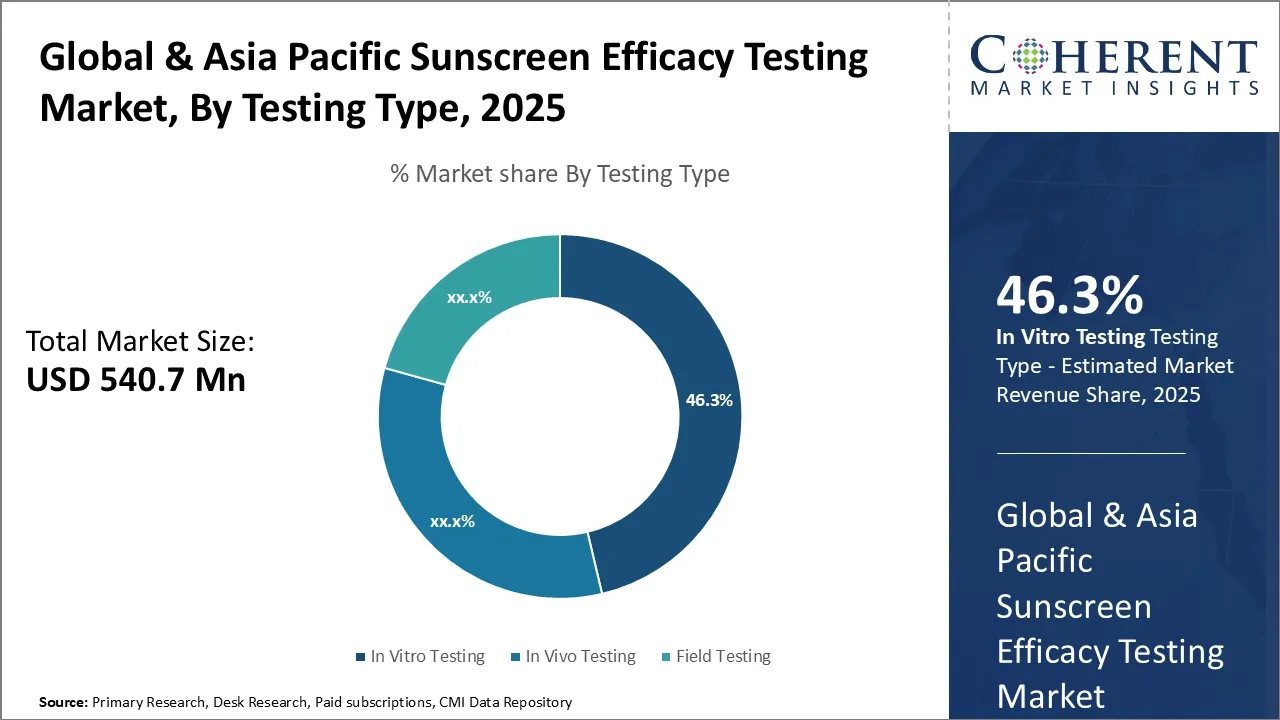
- The in vitro testing segment is expected to hold 47.3 % of the market share in 2026.
- The SPF efficacy segment is projected to account for 36.5 % of the market share in 2026.
- The chemical sunscreens segment is projected to capture 34.7 % share in 2026.
Market Overview
Market trends indicate a growing demand for advanced, scientifically validated sunscreen efficacy testing methods. Innovations such as in vitro and non-invasive testing techniques are gaining traction due to their ethical and practical advantages over traditional in vivo tests. Additionally, the rise of natural and organic sun care products drives the need for specialized efficacy assessments, boosting the market growth.
Current Events and Its Impact
Current Events | Description and its Impact |
Stricter Regulatory Guidelines in Asia Pacific (2024–2025) |
|
Increased Incidence of Skin Cancer Awareness Campaigns |
|
Segmental Insights
- Current Industry Events of 2026
- Market Size Estimation
- Regional Breakdown
- Competitive Landscape
- Customer Intelligence
- Segmental Analysis
- Pricing Analysis
- Key Market Drivers, Challenges & Future Trends
- Customized Insights Section
Global & Asia Pacific Sunscreen Efficacy Testing Market Insights, by Testing Type - In Vitro Testing Segment Dominates the Market due to its Efficiency and Technological Advancements
In vitro testing segment is anticipated to account for 47.3% of the market share in 2026, which is mainly attributed to the accuracy, cost-effectiveness, and correlation with the regulatory trends towards alternative testing methods. In contrast to In Vivo and Field-Testing, In Vitro Testing utilizes advanced laboratory methods based on the use of cultured cells or artificial skin models to model human skin reaction to UV exposure. The ease with which sunscreen efficacy can be quickly and repeatedly evaluated in this controlled environment, in testing UV absorption and penetration properties, without the use of human or outdoor subjects.
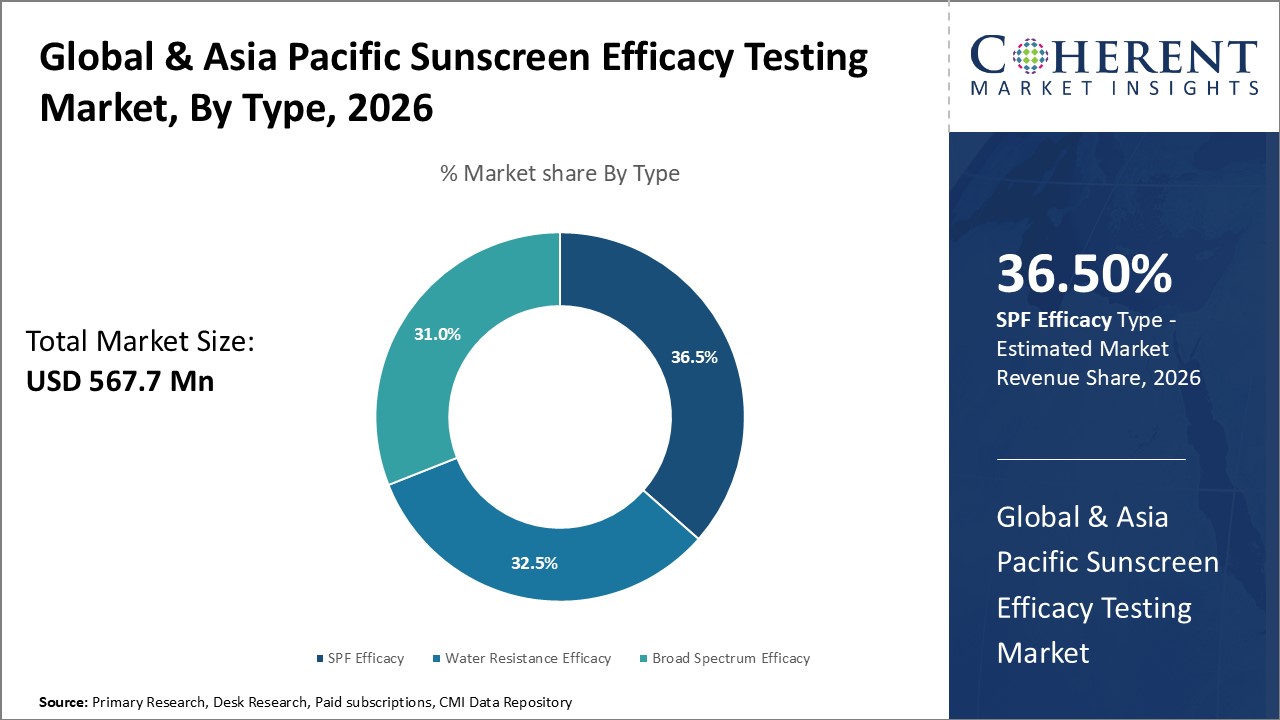
Global & Asia Pacific Sunscreen Efficacy Testing Market Insights, by Type - SPF Efficacy Segment Dominates the Market Driven by Consumer Demand for Reliable Sun Protection and Regulatory Emphasis on Accurate SPF Measurement
The SPF efficacy segment is projected to hold 36.5% of the market share in 2026. To a large extent, such dominance is occasioned by the increased consumer awareness regarding the unfavorable effect of UV radiation and the central role that SPF plays in the definition of the protective efficacy of sunscreen products.
SPF is a common and standardized variable that is used to explain the capacity of a sunscreen to prevent the destruction of UVB rays, which are the primary cause of sunburn and the formation of skin cancer. The uniformity of SPF values and understanding of its efficacy also give it a vital role in its testing which is necessary to brands to prove product claims and earn consumer confidence. Due to the high growth rate of skincare and cosmetic industries both in the mature and emerging markets, proper determination of SPF provides transparency and credibility in the labelling of sunscreens.
Global & Asia Pacific Sunscreen Efficacy Testing Market Insights, by Product Type - Chemical Sunscreen Segment Dominates the Market Propelled by Formulation Flexibility and Consumer Preference for Cosmetically Elegant Options
The chemical sunscreens segment is expected to capture 35.7% of the market share in 2026, pegged on their extensive use and excellent formulation strengths. These sunscreens work by absorbing the harmful UV rays using organic substances like oxybenzone, avobenzone, octisalate and homosalate to transform the harmful radiation into less harmful energy.
The cosmetic property of chemical sunscreens to be prepared in light, transparent, and cosmetic products is also one of the main development drivers of the product. These features are close to the consumer, especially in Asian Pacific where skincare that is non greasy and easily absorbable is usually inclined towards preference. Chemical sunscreens have a smooth texture with no white coloration often seen in mineral ones and therefore, this increases compliance with the products and daily use.
Macro and Micro Economic Factors Impacting the Global & Asia Pacific Sunscreen Efficacy Testing Market Growth
Macro-Economic Factors
- Rising Public Awareness and Health Expenditure: Increased consumer awareness of UV-related risks, such as skin cancer and premature aging, is spurring demand for effective sunscreen products and their reliable efficacy testing.
- Changing Regulatory Landscape: Stricter guidelines from global entities like FDA (U.S.), EU, and ASEAN require rigorous testing and quality benchmarks, which is accelerating the adoption of advanced efficacy testing methodologies and shaping market dynamics.
- Economic Growth and Disposable Income: Rising disposable incomes in emerging markets—particularly in Asia Pacific countries like China, India, and Southeast Asia—boost purchasing power and support sector expansion for sunscreen and efficacy services.
- Environmental and Sustainability Trends: Growing environmental concerns about sunscreen ingredients (e.g. oxybenzone bans in specific markets) lead to reformulation and the need for amended efficacy testing, particularly for organic/natural products.
Micro Economic Factors
- Technological Advancements in Testing: Sophisticated protocols such as spectrophotometry, in vitro models, and image analysis have increased the reliability and accessibility of testing, fostering innovation and competitive differentiation.
- R&D and Innovation Pressure: Continuous introduction of new sunscreen formulations and active ingredients requires agility and ongoing investments from service providers in R&D, especially to update or replace traditional testing methods.
- Consumer Trends and Transparency: Demand for transparent product claims and third-party validation has made efficacy testing services a key part of brand-building and market positioning, increasing the engagement of consumers and competitive brands.
- Segmented Regulatory Demands: Regional variations in standards, testing methodologies, and ingredient approvals mean service providers must adapt segment-specific approaches for multinational and local brands in Asia Pacific.
Market Players, Key Development, and Competitive Intelligence
Key Developments
- Beautiful Solutions Ltd situated in New Zealand and Australia offers a full range of services in the sunscreen efficacy testing market with a great emphasis on the safety, regulatory and product performance. The company focuses on in vivo and in vitro SPF testing, and it is based on the international standards of ISO, to measure the effectiveness of the sunscreen accurately. Beautiful Solutions Ltd carry out a multitude of tolerability and safety tests including patch tests, photo-patch tests, repeated insult patch tests (RIPT), and hypoallergenic tests and they are undertaken to ensure that the sunscreen products are safe and skin-safe.
- Future Cosmetics is located in South Africa and offers a wide scope of services in the market of testing the efficacy of sunscreens where the company concerns product performance and safety validation. The company focuses on the in vivo SPF testing that uses a solar simulator to mimic UV exposure where sunscreens are put on human subjects and the results compare them to reference products. These are tests that are carried out in full adherence to ISO 24444 international standards and SANS1557 South African national standards that will provide a reliable and regulatory approved SPF determination.
Top Strategies Followed by Global & Asia Pacific Sunscreen Efficacy Testing Market Players
- The existing market leaders have invested a lot in research and development (R&D), to develop high performance, scientifically advanced products and market them. The concern of these players is the development of testing methodologies with guaranteed high effectiveness of products, safety, and adherence to high standards of regulation in the world. Through these alliances, the mature companies are able to access larger customer markets and innovative technical skills.
- For instance, Eurofins comes up with progressive in vitro UV protection testing procedures that assists manufacturers in meeting the U.S. FDA and EU standards with minimized use of animal testing. Intertek, with the help of its labs in China and Singapore, offers SPF validation and water-resistance testing in real time services to multinationals-based sunscreen brands in Asia Pacific in search of regulatory compliance.
- Mid-level players in the global & Asia Pacific sunscreen efficacy testing market have a different-set of strategies to employ so as to be able to compete successfully in a rather price-sensitive market. They focus more on providing low-cost testing solutions that balance the quality and cost that are affordable and attractive to the smaller manufacturers and regional brands that are exploring quality assurance services that are reliable, but not expensive. These players often enter into collaborations or joint ventures to increase their operational and market reach as well as access to advanced technologies and increased production capacity.
- Indicatively, the environment of Helioscreen and Dermatest GmbH is very competitive and price sensitive. They stand out with the provision of low-cost but quality SPF measurement equipment, such as Helioscreen’s HD-SPRAY and HD-THERMASTER, which is common in the average cosmetic companies.
- The small-scale players, in their turn, place themselves strategically with an emphasis on specialization and creativity of specific products and needs in the particular region. These firms frequently incorporate the latest technologies, e.g., AI-based data analytics or new methods of biomarkers detection, to make their offerings stand out of the larger competitors. Their flexibility enables them to adapt easily to the dynamic needs of the market and compliance to the regulation requirements to facilitate swift product developmental cycles.
Market Report Scope
Global & Asia Pacific Sunscreen Efficacy Testing Market Report Coverage
| Report Coverage | Details | ||
|---|---|---|---|
| Base Year: | 2025 | Market Size in 2026: | USD 567.7 Mn |
| Historical Data for: | 2020 To 2024 | Forecast Period: | 2026 To 2033 |
| Forecast Period 2026 to 2033 CAGR: | 5.0% | 2033 Value Projection: | USD 798.9 Mn |
| Segments covered: |
| ||
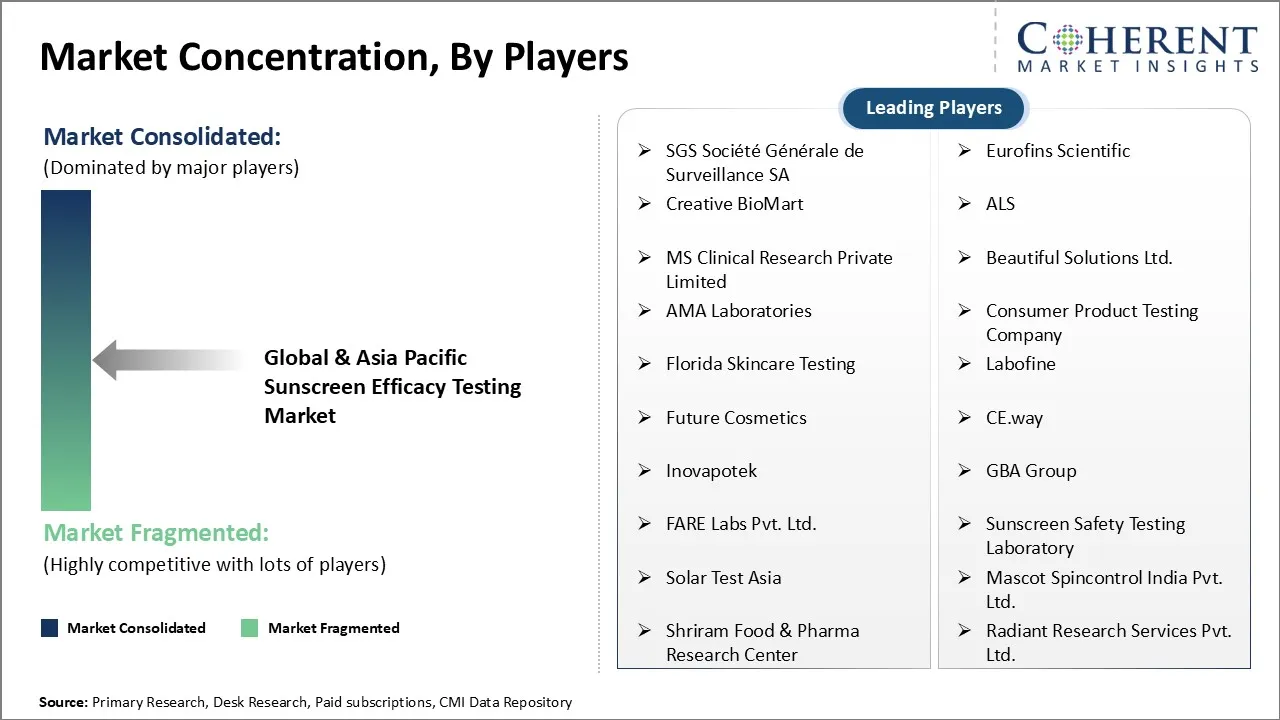
| Companies covered: | SGS Société Générale de Surveillance SA, Eurofins Scientific, Creative BioMart, ALS, MS Clinical Research Private Limited, Beautiful Solutions Ltd., AMA Laboratories, Consumer Product Testing Company, Florida Skincare Testing, Labofine, Future Cosmetics, CE.way, Inovapotek, GBA Group, FARE Labs Pvt. Ltd., Sunscreen Safety Testing Laboratory, Solar Test Asia, Mascot Spincontrol India Pvt. Ltd., Shriram Food & Pharma Research Center, and Radiant Research Services Pvt. Ltd. | ||
| Growth Drivers: |
| ||
| Restraints & Challenges: |
| ||
Global & Asia Pacific Sunscreen Efficacy Testing Market Dynamics
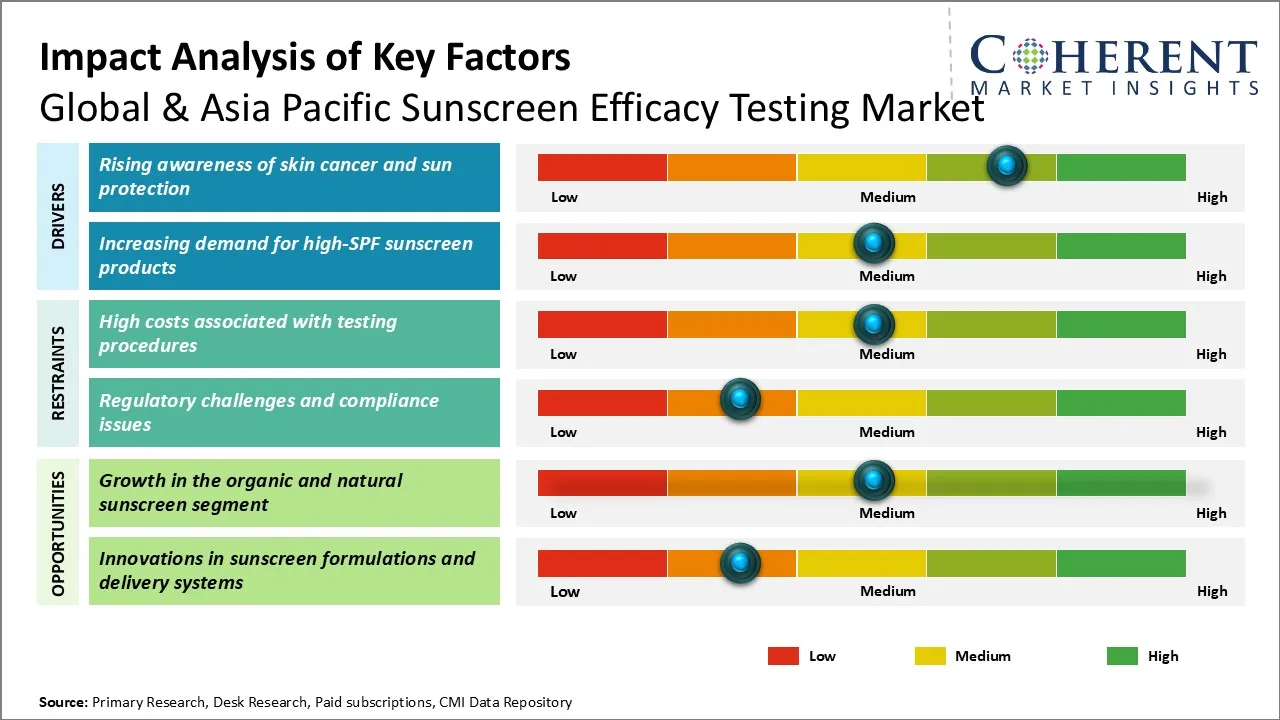
Global & Asia Pacific Sunscreen Efficacy Testing Market Driver - Rising Awareness of Skin Cancer and Sun Protection
The development of more awareness about the negative impact of Ultraviolet (UV) radiation and the growing rates of skin cancer are the important reasons why effective sunscreen efficacy testing may be demanded. The emphasis on the safety and efficacy of sunscreen products has also increased with the increase in the amount of the education that consumers have about the dangers of prolonged sun exposure, including melanoma and other skin related ailments. This change of consumer attitude has led to enforcement of strict guidelines and standards on formulations of sunscreens by regulatory bodies in different parts of the world especially in the Asia Pacific region.
This increase in consumer awareness has put the regulators under pressure to increase the requirements of sunscreen products. Regulators in Japan and South Korea have stringent SPF and PA rating tests to pass any product to the market, as the culture of both countries’ places beauty and skin protection close to each other. Similarly, the FDA of the U.S. requires manufacturers to demonstrate clear evidence of broad-spectrum protection in labeling. These practical cases assert the increased awareness and harmonization of regulations that are driving the need of standardized and consistent sunscreen efficacy testing protocols in the world.
Global & Asia Pacific Sunscreen Efficacy Testing Market Opportunity - Growth in the Organic and Natural Sunscreen Segment
The growing consumer demand in the global & Asia Pacific sunscreen efficacy testing market is that of organic and natural skin care products. The growing demand of organic and natural formulations of sunscreens is explained by the growing awareness about the possible negative impact of chemical-based sunscreens, as well as the growing interest in environmentally-friendly and sustainable solutions. The segmentation is especially high in Asia Pacific, where traditional herbal and plant products are widely appreciated, and the consumers are starting to follow the trends of clean beauty.
To illustrate, Indian companies like Forest Essentials and Mama earth have introduced ayurvedic and natural sunscreens, as the combination of traditional herbs and modern recipes.
Analyst Opinion (Expert Opinion)
- The global & Asia Pacific sunscreen efficacy testing market is fairly dynamic due to increased consumer sensitivity of the sun protection issue, regulatory attention to claims on the products. The findings of the Cosmetics & Toiletries Conference (2023) and the Asia Pacific Skin Health Summit (2022) became very illuminating on the critical trends, and companies such as Eurofins and Intertek have surged ahead in the expressions of testing methods.
- The recent introduction of Eurofins of sophisticated in vitro testing methods is an exemplary move in taking the initiative of providing true SPF claims that appeal to the growingly informed consumers. The debates alongside these gatherings emphasized the need to have strong testing procedures considering that the regulatory requirements are on the rise especially in areas such as Australia and Japan where consumer safety is taken seriously. Nevertheless, the problem with expensive nature of the extensive testing and the necessity to unify the standards in various markets was reported as a serious hindrance.
- A competitive edge will likely be realized by the companies that are able to automate their testing procedures and offer open reporting. Also, it will be essential to cooperate successfully with brands to improve consumer awareness regarding product effectiveness. Finally, the development of the sunscreen efficacy testing market will rely on its capacity to accommodate regulatory environments and guarantee a sense of credibility among the consumers due to scientific validation.
Speak to the analyst
Want personalized insights?
Take the findings above to one of our principal consultants, or have the report rebuilt around the segments, geographies and competitors you actually track.
Market Segmentation
- Testing Type Insights (Revenue, USD Mn, 2021 - 2033)
- In Vitro Testing
- In Vivo Testing
- Field Testing
- Type Insights (Revenue, USD Mn, 2021 - 2033)
- SPF Efficacy
- Water Resistance Efficacy
- Broad Spectrum Efficacy
- Product Type Insights (Revenue, USD Mn, 2021 - 2033)
- Chemical Sunscreen
- Minerals Sunscreen
- Hybrid Sunscreens
- Application Insights (Revenue, USD Mn, 2021 - 2033)
- Children’s Sunscreen
- Adult Sunscreen
- End User Insights (Revenue, USD Mn, 2021 - 2033)
- Cosmetic Manufacturers
- Pharmaceutical Companies
- Research Institutions
- Regulatory Agencies
- Key Players Insights
- SGS Societe Generale de Surveillance SA
- Eurofins Scientific
- Creative BioMart
- ALS
- MS Clinical Research Private Limited
- Beautiful Solutions Ltd.
- AMA Laboratories
- Consumer Product Testing Company
- Florida Skincare Testing
- Labofine
- Future Cosmetics
- CE.way
- Inovapotek
- GBA Group
- FARE Labs Pvt. Ltd.
- Sunscreen Safety Testing Laboratory
- Solar Test Asia
- Mascot Spincontrol India Pvt. Ltd.
- Shriram Food & Pharma Research Center
- Radiant Research Services Pvt. Ltd.
Sources
Primary Research Interviews
- R&D Director – Leading Dermatological Lab Specializing in Sunscreen Testing
- Procurement Manager – Major Personal Care Product Retailer
- Head of Product Development – Global Sunscreen Brand
- Quality Assurance Manager – Clinical Safety Testing Organization
- Regulatory Compliance Officer – Cosmetic Standards Board
Stakeholders
- Manufacturers (Cosmetics, Personal Care, Sun Protection Products)
- End Use Sectors:
- Consumer Sunscreen Brands
- Dermatology Clinics & Healthcare Facilities
- Outdoor and Sports Brands
- Contract Testing Laboratories
- Regulatory & Certification Bodies
- E-commerce Platforms and Retailers
- Technology Integration Players: AI-enabled efficacy analytics and digital SPF validation providers
Databases
- UN Comtrade Database (Import/Export statistics for sunscreen ingredients and formulations)
- Asia Pacific Regional Cosmetics Trade Data
- India Import Export (EXIM) Database
Magazines
- Cosmetics & Toiletries – Innovations in UV formulations and efficacy testing
- Global Personal Care Insights – Sunscreen efficacy standards and consumer trends
- Asia Beauty Business – Testing regulations and product launches in APAC sunscreen market
- Suncare Market Watch – Industry news, product efficacy comparisons
Journals
- International Journal of Cosmetic Science – Efficacy testing and safety of UV filters
- Journal of the Society of Cosmetic Chemists – New methodologies in sunscreen efficacy
- Photodermatology, Photoimmunology & Photomedicine – Clinical efficacy and photoprotection
- Journal of Clinical Dermatology – Methods for SPF and broad-spectrum testing
Newspapers
- The Financial Times – Market growth and investment in sunscreen efficacy labs
- The Guardian – Consumer shifts to efficacy-tested sun protection
- Asia Health Journal – APAC trends in sunscreen safety and regulatory changes
- European Cosmetics News – Regulatory updates for UV protection products
Associations
- International Federation of Societies of Cosmetic Chemists (IFSCC)
- Personal Care Products Council (PCPC)
- Asia Pacific Cosmetic Association
- European Commission: Scientific Committee on Consumer Safety (SCCS)
- Cosmetic, Toiletry and Fragrance Association (CTFA)
Public Domain Sources
- FDA – Regulations and SPF testing protocols for sunscreens
- European Commission – Cosmetics Regulation and Sunscreen Efficacy Guidelines
- World Health Organization – Health studies on sun protection effectiveness
Proprietary Elements
- CMI Data Analytics Tool, Proprietary CMI Existing Repository of information for last 8 years.
Get access to 250+ pages report
Every segment, forecast, competitor profile and data table behind the analysis above — available for instant download.
- ESOMAR Member
- ISO 9001:2015 Certified
- D-U-N-S Registered
- GDPR & CCPA Compliant
Missing comfort of reading report in your local language? Find your preferred language:
Transform your Strategy with Exclusive Trending Reports
Frequently Asked Questions
The global & Asia Pacific sunscreen efficacy testing market is estimated to be valued at USD 567.7 Mn in 2026 and is expected to reach USD 798.9 Mn by 2033.
The CAGR of the global & Asia Pacific sunscreen efficacy testing market is projected to be 5.0% from 2026 to 2033.
Rising awareness of skin cancer and sun protection and increasing demand for high-SPF sunscreen products are the major factors driving the growth of the global & Asia Pacific sunscreen efficacy testing market.
High costs associated with testing procedures and regulatory challenges and compliance issues are the major factors hampering the growth of the global & Asia Pacific sunscreen efficacy testing market.
In terms of testing type, the in vitro testing segment is estimated to dominate the market revenue share in 2026.
SGS Société Générale de Surveillance SA, Eurofins Scientific, Creative BioMart, ALS, MS Clinical Research Private Limited, Beautiful Solutions Ltd., AMA Laboratories, Consumer Product Testing Company, Florida Skincare Testing, Labofine, Future Cosmetics, CE.way, Inovapotek, GBA Group, FARE Labs Pvt. Ltd., Sunscreen Safety Testing Laboratory, Solar Test Asia, Mascot Spincontrol India Pvt. Ltd., Shriram Food & Pharma Research Center, and Radiant Research Services Pvt. Ltd. are the major players.