

Global GPS Fleet Tracking Market Size and Forecast – 2026-2033
The Global GPS Fleet Tracking Market is estimated to be valued at USD 4.61 Bn in 2026 and is expected to reach USD 9.34 Bn by 2033, exhibiting a compound annual growth rate (CAGR) of 10.6% from 2026 to 2033.
Key Takeaways of the Global GPS Fleet Tracking Market
- The hardware segment leads the market holding an estimated share of 45.8 % in 2026.
- North America is estimated to lead the market with a share of 37.5 % in 2026.
- Asia Pacific, holding a share of 22.1 % in 2026, is projected to be the fastest growing region.
Market Overview
Market trends indicate a significant shift towards cloud-based GPS fleet tracking systems that provide real-time data analytics, predictive maintenance, and route optimization capabilities. The integration of AI and machine learning with fleet tracking solutions is accelerating operational efficiency and decision-making. Additionally, environmental regulations are prompting companies to adopt tracking solutions to monitor fuel consumption and reduce carbon footprints, further reinforcing the industry's momentum in adopting advanced telematics and connectivity platforms.
Segmental Insights
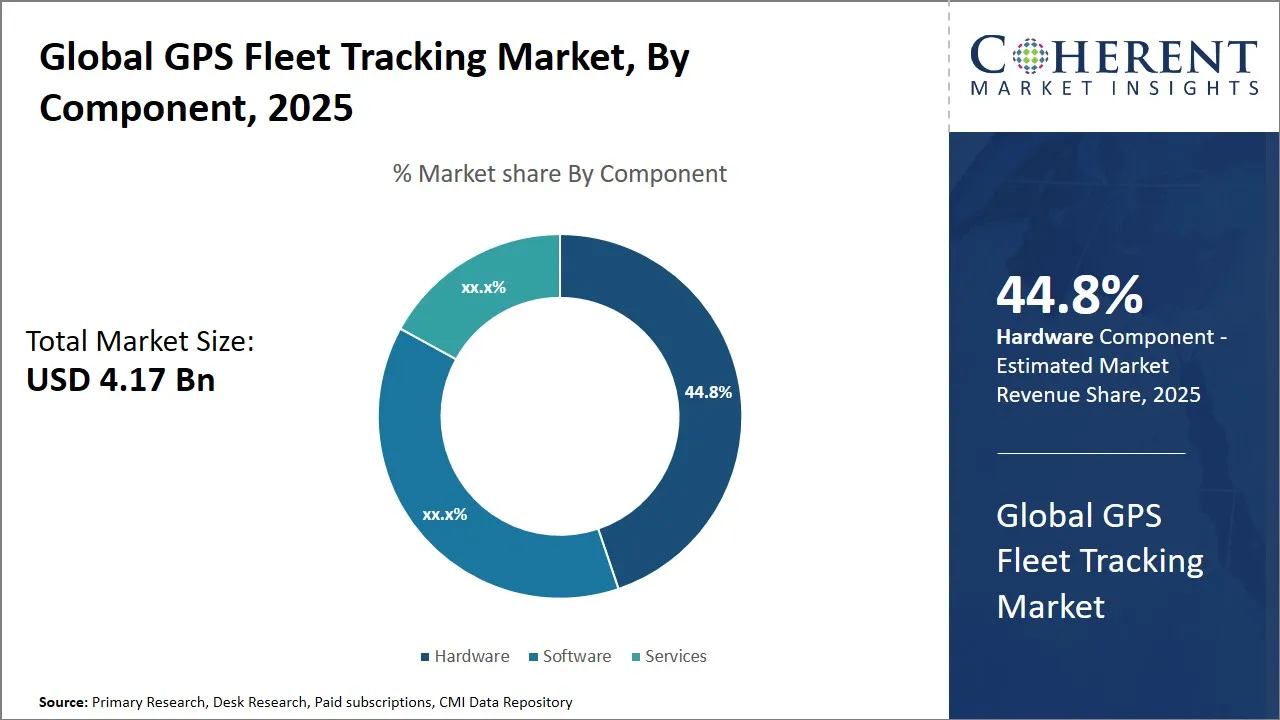
Global GPS Fleet Tracking Market Insights, by Component – Robust Demand for Advanced Vehicle Tracking Devices Drives the Hardware Segment Growth
Hardware segment is expected to contribute the highest share of 45.8% in the market in 2026. The hardware segment encompasses essential devices such as GPS trackers, sensors, on-board units (OBUs), and communication modules that are physically installed in vehicles to collect and relay real-time data. The increasing adoption of these advanced tracking devices is driven by the need for enhanced fleet visibility, driver safety, and regulatory compliance across various industries including transportation, logistics, and public services.
One of the primary factors fueling the growth of the hardware segment is the rapid technological advancements in GPS hardware components. Innovations such as improved GPS receivers, miniaturized devices, and enhanced connectivity options (e.g., integration with cellular networks and IoT technologies) have substantially increased the efficiency and reliability of fleet tracking systems. In 2024, CalAmp launched its next-generation iOn Tag asset tracking hardware, designed for trailers and non-powered assets. These advancements enable fleet operators to gather more precise location data, monitor vehicle diagnostics, and optimize route planning, thereby reducing operational costs.
Furthermore, rising concerns regarding vehicle security and theft prevention are compelling organizations to invest heavily in sophisticated hardware solutions. GPS tracking devices equipped with features like real-time alerts, geo-fencing, and anti-tampering mechanisms provide a strong deterrent against unauthorized use or theft, making hardware installation indispensable.
Another key growth driver is the expanding demand for the multifunctional hardware capable of integrating with other vehicle management systems. Devices that can simultaneously track fuel consumption, engine performance, and driver behavior provide fleet managers with comprehensive insights, which helps improve overall fleet performance and compliance with safety standards.
- Current Industry Events of 2026
- Market Size Estimation
- Regional Breakdown
- Competitive Landscape
- Customer Intelligence
- Segmental Analysis
- Pricing Analysis
- Key Market Drivers, Challenges & Future Trends
- Customized Insights Section
Impact of AI on the GPS Fleet Tracking Market
Artificial Intelligence (AI) is transforming GPS fleet tracking from basic location monitoring into an intelligent decision-support system. By combining GPS data with AI-driven analytics, fleet operators can predict vehicle maintenance needs, optimize routes in real time, and improve driver safety. Machine learning models analyze vast amounts of telematics data — such as fuel usage, idling patterns, and harsh braking events — to identify inefficiencies and reduce operational costs. AI-powered video telematics also enhances safety by detecting distracted driving, alerting drivers in real time, and providing actionable insights for fleet managers. This shift from reactive to predictive intelligence is enabling fleets to reduce downtime, save fuel, and meet stricter sustainability goals.
A real instance is Samsara’s AI-powered safety platform, launched in March 2025, which uses multi-camera feeds and computer vision to detect risky behaviors like phone use or tailgating. The system provides in-cab alerts and automatically generates coaching workflows for fleet managers.
Regional Insights
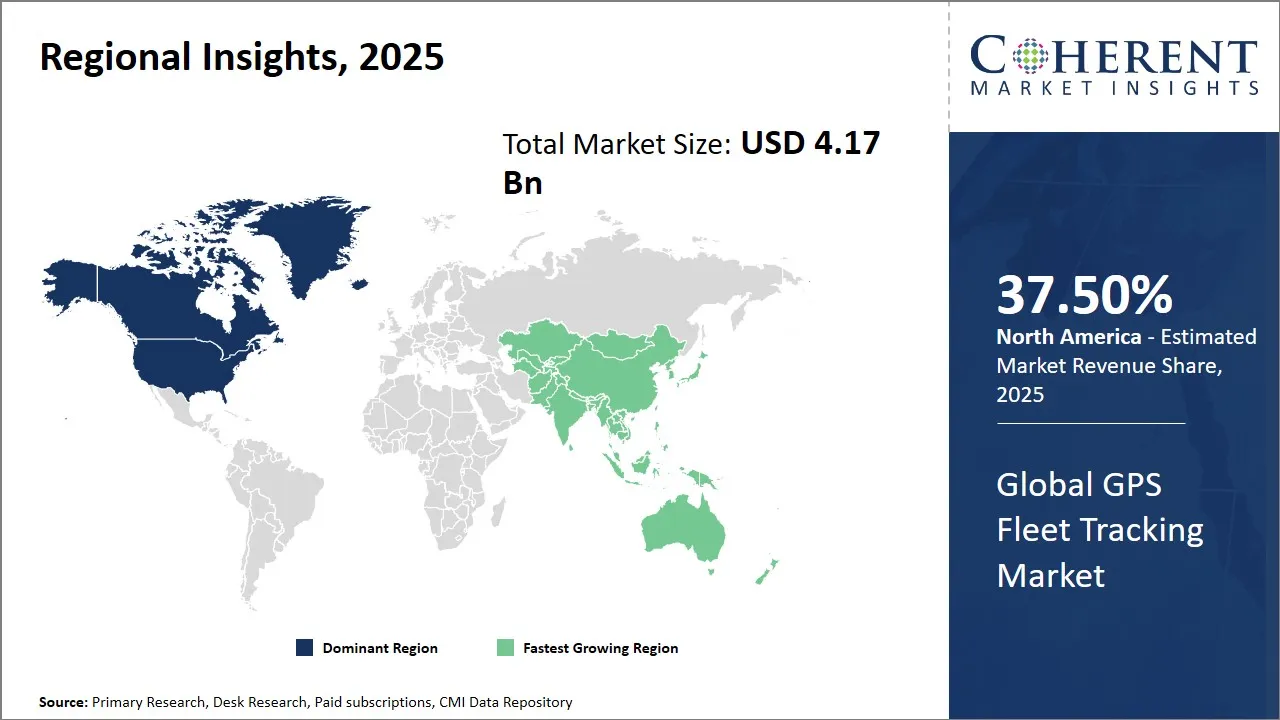
North America GPS Fleet Tracking Market Analysis and Trends
North America, holding an estimated share of 37.5% in 2026, dominates the GPS fleet tracking market driven by a well-established technological ecosystem and the strong presence of major telematics providers. The region benefits from advanced infrastructure, widespread adoption of IoT and smart logistics solutions, and supportive government initiatives promoting transportation efficiency and safety. U.S. federal and state regulations aimed at reducing carbon emissions and improving road safety have accelerated the deployment of GPS fleet tracking systems across commercial logistics, transportation, and utility sectors. Key players such as Verizon Connect, Geotab, and Trimble have substantial operations in the region, contributing advanced hardware and software solutions that cater to the diverse needs of North American fleets. The mature market environment is bolstered by integration with cloud computing services and robust after-sales support, enhancing overall customer retention.
Asia Pacific GPS Fleet Tracking Market Analysis and Trends
The Asia Pacific, holding a projected share of 22.1% in 2026, exhibits the fastest growth in the GPS fleet tracking market, propelled by rapid urbanization, expanding logistics and e-commerce industries, and increasing government focus on smart city initiatives. Emerging economies, particularly India and Southeast Asian countries, are aggressively investing in fleet digitization to improve operational efficiencies and address transportation bottlenecks.
National programs to modernize infrastructure combined with rising smartphone penetration facilitate the adoption of tracked fleet management solutions. Additionally, the expanding automotive and telematics manufacturing base in China and Korea supports scalable supply chains and technology innovation. Leading companies such as SinoTrack, Orbcomm, and Teletrac Navman have been strategically expanding their presence here through partnerships and tailored offerings suited to local telecommunication and regulatory environments.
GPS Fleet Tracking Market Outlook for Key Countries
U.S. GPS Fleet Tracking Market Analysis and Trends
The U.S. remains a critical market within North America due to widespread logistics activity and high vehicle fleet density. Advanced regulatory frameworks, such as the Federal Motor Carrier Safety Administration (FMCSA) mandates, drive compliance-related adoption of GPS tracking systems. Major corporations like Verizon Connect have innovated with AI-enabled fleet analytics and integrated mobile applications, facilitating enhanced fleet visibility and route optimization that benefit long-haul trucking and last-mile delivery services. The competitive landscape features a broad mix of startups and established players focusing on innovation, scalability, and seamless integration with other enterprise management systems.
Germany GPS Fleet Tracking Market Analysis and Trends
Germany reflects strong demand given its position as Europe’s logistics hub and automotive powerhouse. The integration of fleet tracking with Industry 4.0 solutions, supported by robust manufacturing and transportation sectors, accelerates the market. German government policies emphasize environmental sustainability, which encourages fleets to optimize fuel consumption and emissions through GPS tracking technologies. Companies such as Continental and Bosch offer sophisticated telematics solutions integrating vehicle diagnostics and fleet management software tailored for commercial fleets across Europe. The collaborative ecosystem between automotive OEMs and technology providers boosts localized innovation.
India GPS Fleet Tracking Market Analysis and Trends
India’s rapidly expanding commercial transportation sector provides a crucial growth base, fueled by government initiatives like the Digital India program and the push towards smart transportation systems. Fleet tracking has become essential for improving operational transparency, theft prevention, and compliance with regional transport regulations. Domestic players like Trak N Tell and international companies expanding into the Indian market are adapting their solutions to accommodate challenges such as variable terrain and network connectivity. The proliferation of affordable cellular data and increasing smartphone usage have also been instrumental in scaling adoption across logistics and construction industries.
U.K. GPS Fleet Tracking Market Analysis and Trends
The U.K. GPS fleet tracking market benefits from advanced logistics networks and a growing emphasis on sustainability and regulatory compliance post-Brexit. Government initiatives aimed at reducing road congestion and carbon footprints complement the adoption of GPS tracking systems for route optimization and predictive maintenance. Providers like Masternaut and Verizon Connect offer comprehensive telematics platforms, integrating real-time tracking with compliance reporting tools that help fleets navigate complex regulatory requirements. The strong presence of third-party logistics providers fosters a competitive environment encouraging technological enhancements and service reliability.
China GPS Fleet Tracking Market Analysis and Trends
China represents a critical market within Asia Pacific due to its massive transportation network and government-backed smart city and intelligent transportation system campaigns. The country’s increasing focus on autonomous vehicle research and large-scale infrastructure projects accelerates demand for high-precision GPS tracking and fleet management solutions. Chinese companies such as SinoTrack and Queclink lead in manufacturing GPS devices, contributing significantly to cost reduction and widespread deployment. Additionally, collaborations between technology firms and logistics operators enable comprehensive ecosystem development, enhancing last-mile delivery efficiency and helping to address urban congestion challenges.
Market Players, Key Development, and Competitive Intelligence
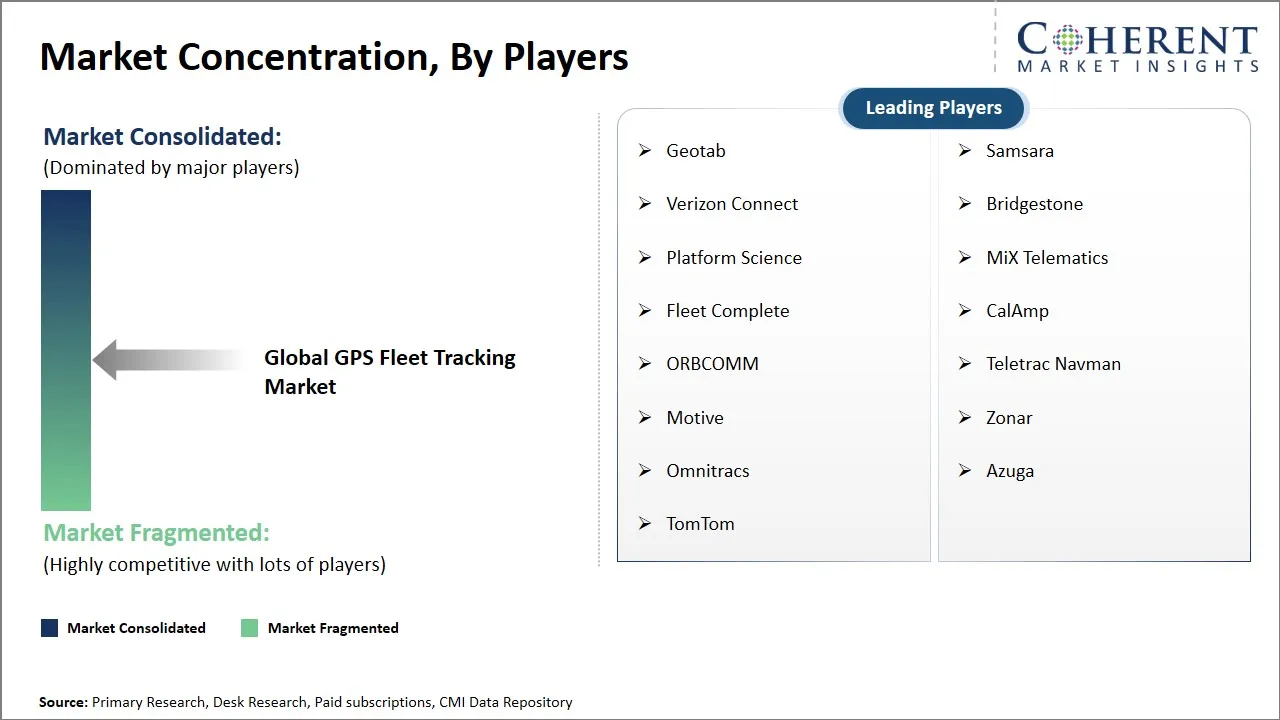
Key Developments
- In June 2025, Samsara Inc., the pioneer of the Connected Operations Platform, and Element Fleet Management Corp., the largest publicly traded, pure-play automotive fleet manager in the world, announced a holistic fleet and operations management offering. This joint offering streamlines procurement and onboarding for shared customers, delivering greater safety and efficiency through the combined power of product solutions—far beyond traditional telematics.
- In June 2025, Samsara Inc. unveiled more than a dozen transformative AI-powered solutions for physical operations. Fueled by Samsara’s open platform, these first-of-their-kind solutions empower organizations to operate smarter — and fundamentally alter the industry’s approach to the safety of frontline teams.
- In April 2025, Verizon Business launched vehicle-to-everything connected-driving platform with multiple customers. Edge Transportation Exchange is an integrated mobile-network vehicle-to-everything (V2X) communication platform that allows a vehicle to communicate with other connected vehicles, road users, and infrastructure around it.
- In February 2025, Trimble and Platform Science announced the completion of Platform Science's acquisition of Trimble's global transportation telematics business units.
Top Strategies Followed by GPS Fleet Tracking Market Players
- Established market leaders command significant investment in research and development to drive innovation, resulting in high-performance and technologically advanced fleet tracking products.
- Geotab has consistently expanded its R&D in AI-driven fleet intelligence. In April 2025, the company announced new OEM integrations and advanced data-harmonization capabilities, allowing fleets to seamlessly manage mixed-vehicle data.
- Mid-level players in the GPS fleet tracking market adopt a different approach, targeting segments that prioritize affordability without compromising on essential quality.
- Fleet Complete, a mid-tier player, focuses on offering affordable telematics solutions tailored for SMEs and regional logistics operators. Its subscription-based models and scalable platform make advanced fleet tracking accessible to small and medium-sized fleets, especially in emerging markets where cost sensitivity is high.
- Small-scale players in the GPS fleet tracking market carve out their niche by focusing on specialized product features and innovative technology applications to distinguish themselves in a crowded marketplace.
- Azuga carved out a niche in insurance telematics by developing driver-behavior monitoring tools integrated into usage-based insurance (UBI) programs.
Market Report Scope
GPS Fleet Tracking Market Report Coverage
| Report Coverage | Details | ||
|---|---|---|---|
| Base Year: | 2025 | Market Size in 2026: | USD 4.61 Bn |
| Historical Data for: | 2020 To 2024 | Forecast Period: | 2026 To 2033 |
| Forecast Period 2026 to 2033 CAGR: | 10.6% | 2033 Value Projection: | USD 9.34 Bn |
| Geographies covered: |
| ||
| Segments covered: |
| ||
| Companies covered: | Geotab, Samsara, Verizon Connect, Bridgestone, Platform Science, MiX Telematics, Fleet Complete, CalAmp, ORBCOMM, Teletrac Navman, Motive, Zonar, Omnitracs, Azuga, and TomTom | ||
| Growth Drivers: |
| ||
| Restraints & Challenges: |
| ||
Market Dynamics
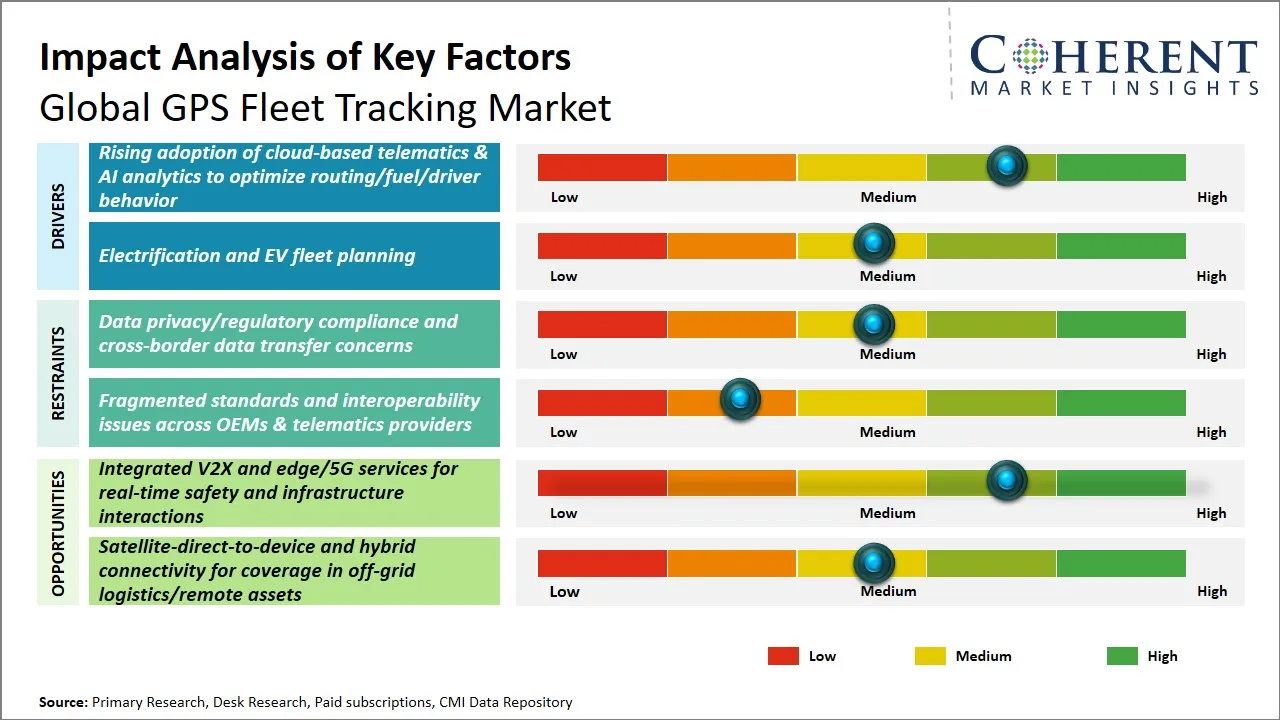
Global GPS Fleet Tracking Market Driver – Rising Adoption of Cloud-Based Telematics & AI Analytics to Optimize Routing/Fuel/Driver Behavior
Fleet operators are leveraging cloud platforms to access real-time data remotely, enabling seamless monitoring of vehicle location, route efficiency, and driver behavior. AI-powered analytics enhance this capability by providing predictive insights that help optimize routing, thereby reducing unnecessary mileage and fuel consumption. Beyond route optimization, these technologies facilitate comprehensive fuel management by identifying patterns of excessive idling or aggressive driving, which are key contributors to higher operational costs. Furthermore, AI-driven behavior analysis improves driver safety and performance, decreasing accident risks and associated liabilities. Samsara has developed a cloud-native fleet management platform that leverages AI analytics to optimize routing, fuel efficiency, and driver behavior.
Global GPS Fleet Tracking Market Opportunity – Integration of V2X and Edge/5G Technologies for Enhanced Real-Time Safety and Infrastructure Interaction
The global GPS fleet tracking market stands to benefit significantly from the integration of Vehicle-to-Everything (V2X) communication and cutting-edge edge computing combined with 5G network capabilities. This opportunity arises from the growing demand for real-time data exchange between vehicles, infrastructure, and fleet management systems to enhance safety, efficiency, and operational control. V2X technology enables vehicles within a fleet to communicate seamlessly not only with each other but also with traffic signals, road signs, and other elements of smart infrastructure.
Verizon Business launched its Edge Transportation Exchange in June 2025, a 5G-enabled vehicle-to-everything (V2X) platform. The system enables real-time communication between vehicles, infrastructure, and fleet operators, supporting advanced safety applications like collision avoidance and smart traffic coordination.
When coupled with edge computing, data processing occurs closer to the source, minimizing latency and delivering instant actionable insights critical for dynamic fleet operations. The proliferation of 5G networks further amplifies this by providing high-bandwidth, low-latency connectivity essential for managing large volumes of data generated by GPS trackers and sensors embedded in fleet vehicles. This synergy supports real-time hazard detection, collision avoidance, route optimization, and predictive maintenance, making fleet operations safer and more efficient.
Analyst Opinion (Expert Opinion)
- The largest share of demand comes from long-haul trucking, courier, and parcel services where real-time GPS tracking is critical for route optimization, on-time delivery, and compliance with safety regulations. As e-commerce continues to expand globally, logistics players will further intensify investments in advanced telematics.
- Demand from construction, mining, and utilities is rising steadily as companies seek to track heavy equipment, reduce theft, and improve asset utilization. With major infrastructure projects underway across North America, Europe, and Asia Pacific, fleet tracking in off-road and mixed-asset fleets is becoming a high-growth application area.
- Insurance-linked telematics solutions are gaining traction, particularly in North America and Europe. By monitoring driver behavior and accident patterns, insurers are offering usage-based insurance (UBI) to fleets, creating a new application-driven demand segment that smaller, specialized telematics providers are capitalizing on.
Speak to the analyst
Want personalized insights?
Take the findings above to one of our principal consultants, or have the report rebuilt around the segments, geographies and competitors you actually track.
Market Segmentation
- Component Insights (Revenue, USD Bn, 2021 - 2033)
- Hardware
- Software
- Services
- Regional Insights (Revenue, USD Bn, 2021 - 2033)
- North America
- U.S.
- Canada
- Latin America
- Brazil
- Argentina
- Mexico
- Rest of Latin America
- Europe
- Germany
- U.K.
- Spain
- France
- Italy
- Russia
- Rest of Europe
- Asia Pacific
- China
- India
- Japan
- Australia
- South Korea
- ASEAN
- Rest of Asia Pacific
- Middle East
- GCC Countries
- Israel
- Rest of Middle East
- Africa
- South Africa
- North Africa
- Central Africa
- North America
- Key Players Insights
- Geotab
- Samsara
- Verizon Connect
- Bridgestone
- Platform Science
- MiX Telematics
- Fleet Complete
- CalAmp
- ORBCOMM
- Teletrac Navman
- Motive
- Zonar
- Omnitracs
- Azuga
- TomTom
Sources
Primary Research Interviews
Stakeholders
- Fleet Operators and Logistics Companies (e.g., Operations Managers and Fleet Supervisors)
- Telematics Hardware Manufacturers and Device Suppliers
- Software and Cloud Platform Providers
- Insurance Companies and Risk Management Firms using telematics for UBI programs
- EV Fleet Operators and Charging Infrastructure Providers
- Transportation Safety Consultants and Regulatory Compliance Experts
Databases
- Global Transport Statistics Database (GTSD)
- International Vehicle Fleet Registry (IVFR)
- Telematics Market Insights Database (TMID)
- OECD Transport & Mobility Database
Magazines
- Fleet Management Today
- Transport Telematics Magazine
- Logistics & Mobility Review
- Connected Vehicles Insights
Journals
- Journal of Intelligent Transportation Systems
- Transportation Research Part C: Emerging Technologies
- IEEE Transactions on Vehicular Technology
- International Journal of Vehicle Telematics
Newspapers
- The Logistics Times
- Transport Weekly
- The Guardian (UK) – Mobility Section
- The Economic Times (India) – Transportation & Technology Section
Associations
- International Association of Fleet Management (IAFM)
- Telematics Industry Association (TIA)
- Global Smart Mobility Alliance (GSMA)
- American Trucking Association (ATA)
- European Telematics Society (ETS)
Public Domain Sources
- U.S. Department of Transportation (USDOT)
- EUROSTAT – Transport & Vehicle Statistics
- United Nations Economic Commission for Europe (UNECE) – Transport Division
- World Bank – Global Transport Indicators
- ResearchGate – Transportation & Telematics Publications
Proprietary Elements
- CMI Data Analytics Tool, Proprietary CMI Existing Repository of Information for Last 8 Years
Get access to 250+ pages report
Every segment, forecast, competitor profile and data table behind the analysis above — available for instant download.
- ESOMAR Member
- ISO 9001:2015 Certified
- D-U-N-S Registered
- GDPR & CCPA Compliant
Missing comfort of reading report in your local language? Find your preferred language:
Transform your Strategy with Exclusive Trending Reports
Frequently Asked Questions
The global GPS fleet tracking market is estimated to be valued at USD 4.61 billion in 2026 and is expected to reach USD 9.34 billion by 2033.
The CAGR of global GPS fleet tracking market is projected to be 10.6% from 2026 to 2033.
Rising adoption of cloud-based telematics & AI analytics to optimize routing/fuel/driver behavior and electrification and EV fleet planning are the major factors driving the growth of the global GPS fleet tracking market.
Data privacy/regulatory compliance and cross-border data transfer concerns and fragmented standards and interoperability issues across OEMs & telematics providers are the major factors hampering the growth of the global GPS fleet tracking market.
In terms of Component, Hardware is estimated to dominate the market revenue share in 2026.
GPS fleet tracking uses satellite signals to determine a vehicle’s real-time location. The device transmits this data via cellular, satellite, or hybrid networks to a cloud-based platform, where fleet managers can monitor routes, driver behavior, and vehicle performance.
GPS tracking devices have virtually unlimited range for satellite signal reception, but the effective reporting range depends on the communication method—cellular devices work within network coverage, while satellite-enabled devices can transmit from virtually anywhere globally.