

Global Green Facade Market Size and Forecast – 2026-2033
The global green facade market is estimated to be valued at USD 688.7 Mn in 2026 and is expected to reach USD 1,084.5 Mn by 2033, exhibiting a compound annual growth rate (CAGR) of 6.7% from 2026 to 2033.
Key Takeaways of the Green Facade Market
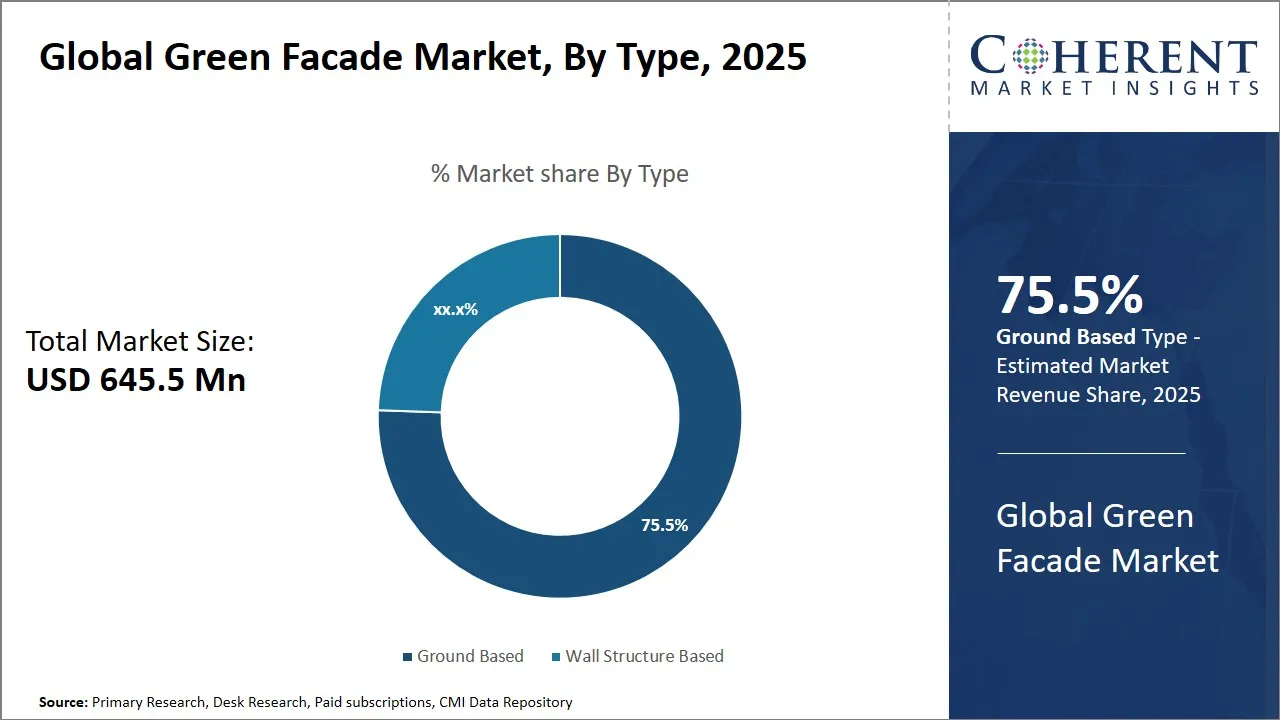
- Ground based segment is projected to command 76.5% of the global green facade market share in 2026.
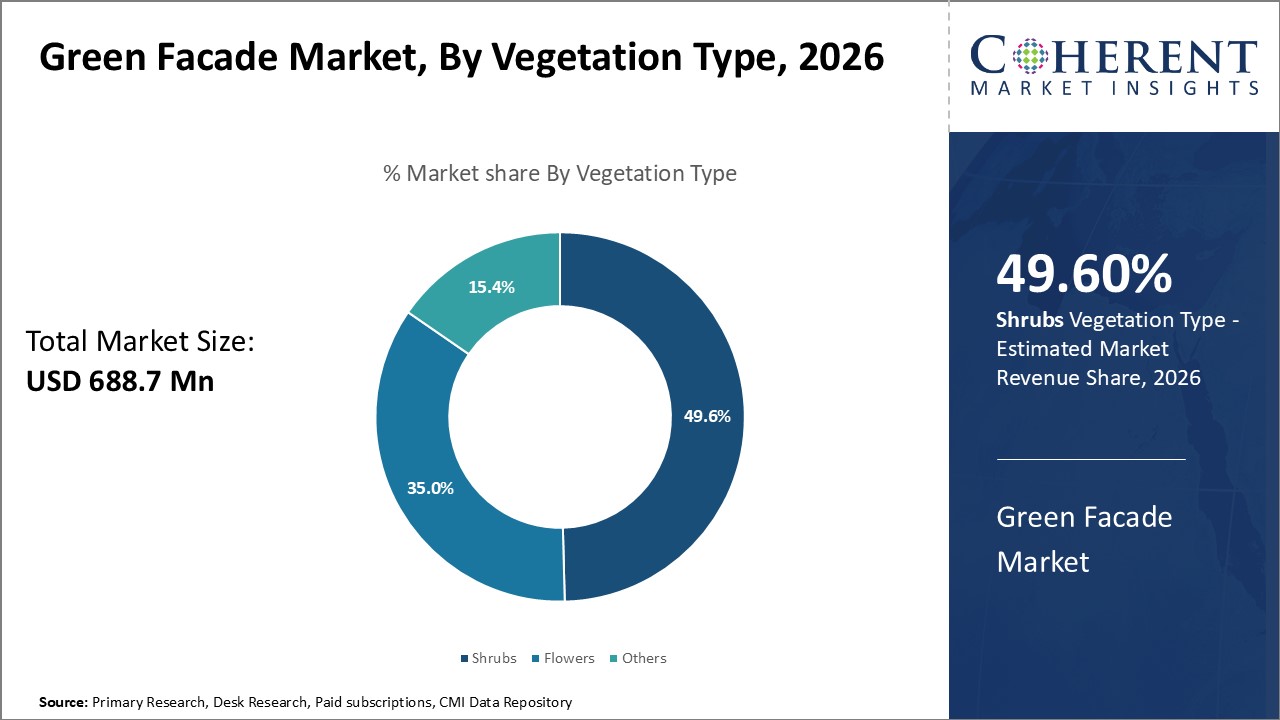
- The shrubs segment is expected to account for 49.6% of the market share in 2026.
- The residential segment is estimated to hold 54.7% of the green facade market share in 2026.
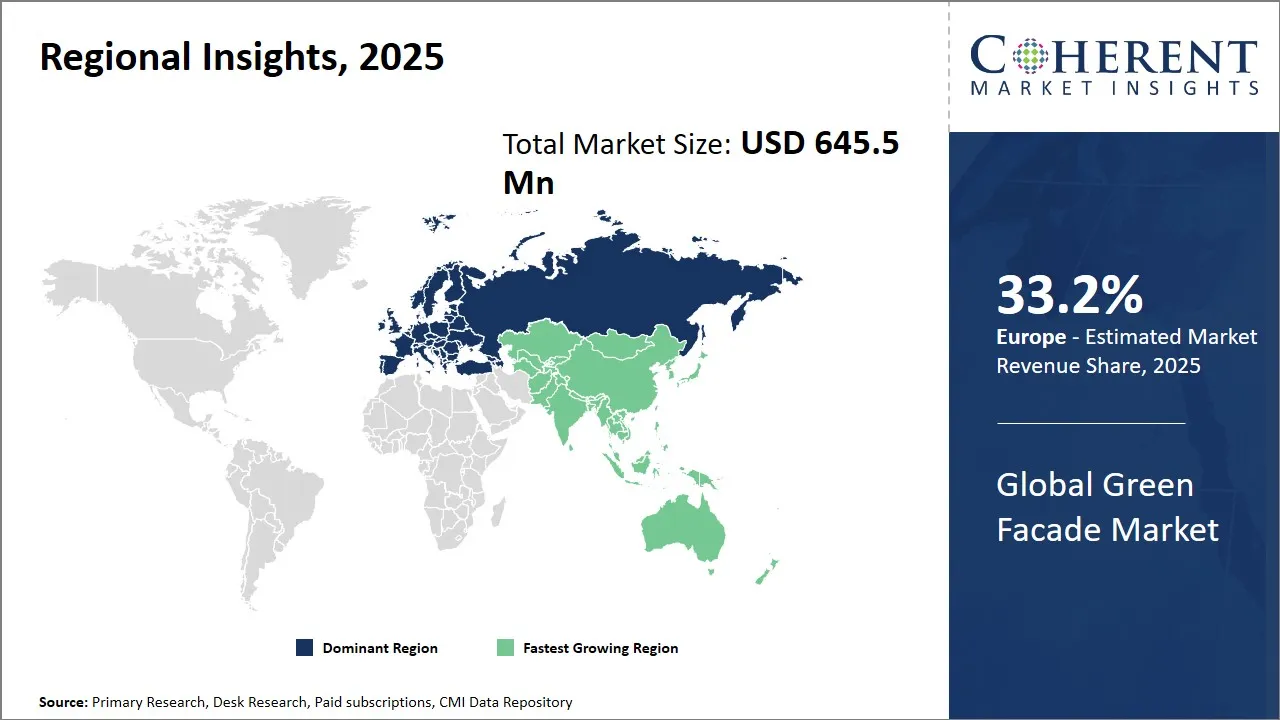
- Europe is expected to lead the market in 2026 with a 33.2% share. Asia Pacific is anticipated to be the fastest-growing region, with a projected market share of 19.5% in 2026.
Market Overview
The single significant market trend that enabled the green facade market is the global transition to green building and urbanization towards the green construction projects. The trend has also been greening of the cities and governments and other organizations are integrating green infrastructure as a way of addressing the urban heat islands and low carbon footprints. Moreover, with the aid of utilization of green building certification, technologies and support are hastening the adoption in both commercial and residential market concerning vertical farming and gardening. The green facade business is set on a long-term growth trajectory by such sustainability trend in the coming years.
Currents Events and Its Impact
Current Events | Description and its Impact |
EU “Renovation Wave” and updated Energy Performance of Buildings Directive (EPBD), EU, ongoing to 2030 |
|
Expansion of state-level incentives and FSI/FAR bonuses for green buildings, India, 2024 |
|
Segmental Insights
- Current Industry Events of 2026
- Market Size Estimation
- Regional Breakdown
- Competitive Landscape
- Customer Intelligence
- Segmental Analysis
- Pricing Analysis
- Key Market Drivers, Challenges & Future Trends
- Customized Insights Section
Green Facade Market Insights, By Type - Ground Based Segment Dominates the Market due to its Versatility and Ease of Implementation
Ground based segment has the highest share of the green facade market in the world in 2026 with a market share of 76.5% of the total due to their flexibility to numerous environments as well as the ease of installation and maintenance. Supposedly, as opposed to the wall structure-based facades, the ground-based systems make use of the natural planting growth planted in the ground, or planted in ground planter boxes at the ground level. This will allow an augmented growth in the root system which will contribute to a healthy and robust growth of plants and ultimately makes the green facades more stable and beautiful like beauty.
In the city of Melbourne, Australia the city has used ground-based green facades as part of the rejuvenation of their urban areas, retrofitting some of their older buildings with modular planter boxes at the ground level. The method enabled the incorporation of green walls without having to make significant structural changes that would improve the aesthetics of the building in addition to the sustainability aspect.
Green Facade Market Insights, By Vegetation Type – Shrubs Segment Dominates the Market due to their Year-Round Greenery and Maintenance Efficiency
Shrubs segment is expected to hold 49.6% of the green facade market share in 2026, because of their ability to provide dense, year-round coverage combined with relative ease of maintenance. Unlike herbaceous plants or annual flowers, shrubs are woody in stem as well as sturdy in foliage that persists to multi seasons. This renders it an annual greenery as the buildings that boast of shrub-based facade do not need to be replanted or refurbished every so often since the greenery maintains the building look and functionality.
The significance of such plants in terms of their structural integrity of shrubs is one of the most crucial advantages. The woody stems attached to the plants hence clinging the plants firmly to the supporting structures and this heightens the resistance of the plants to heavy winds and other weather-related stresses. This stability is a requirement of vertical green installations that have to be capable of enduring extreme weather conditions in the long run. In addition, the capacity of shrubs to adapt to different levels of light in the full sun and partial shade conditions predisposes the shrubs to diverse building exposures, and this enhances the opportunities of creating a facade.
Green Facade Market Insights, By Application – Residential Segment Dominates the Market due to Rising Environmental Consciousness and Urban Living Needs
The residential segment is set to command 54.7% share in 2026, fueled by increasing environmental awareness and the growing trend toward sustainable urban living spaces. Customers living in their own homes are also giving more attention to the application of green features in their homes in an effort to improve the quality of air, beauty and wellbeing. The greenery facades offer more convenient and visually pleasing answer to the closeness to the house with the nature to these evolving preferences.
Among the primary reasons to implement water green facades in residential building, one should state that they lead to the enhancement of indoor air and natural thermal conditions. The circulation of air and the rise of temperature in the residential buildings particularly in the densely populated urban centers is always an issue due to the concrete thick environment. Green facades is a natural filtering system which traps dusts, pollutants and CO2 rendering make the environment habitable. Moreover, the shading of the vegetation will reduce the indoor temperature, thus lowering the usage of air conditioning that will reduce the level of energy consumption.
CO₂ Offset Quantification
- Direct Sequestration: Plants absorb 1.79 kg CO₂/m²/year (e.g., Buddha grass); vertical green walls (VGWs) reduce indoor CO₂ by 5-50% via assimilation.
- Indirect via Energy Savings: 13-24% lower heating/cooling loads cut emissions 11.3-18%; annual electricity bill drops 29-39%, equating to 20% ventilation savings (1400 kWh/year/office).
- Net Lifecycle Offset: West-facing facades yield 12.6-18% CO₂ reduction; overall urban decarbonization via air purification (PM10 15-23%, PM2.5 45-71%).
UHI Reduction Quantification
- Facade Cooling: Evapotranspiration lowers surface temps 7-15°C, acting as sunscreen/insulator.
- Indoor/Ambient Effects: Reduces indoor temps 10°C; net VGW cooling 1.2-4.5°C (vent on/off); minimizes UHI via shading/evapotranspiration.
- Energy Tie-In: 9-30% consumption savings in warm-dry climates, amplifying UHI mitigation city-scale.
Regional Insights
Europe Green Facade Market Analysis and Trends
The Europe region is projected to lead the market with a 33.2% share in 2026, owing to the steady market ecosystem, evident in prevalence of environmental sensibleness, superior urban development, and favorable state policies. In a number of European countries, there is a set of stringent green building policies and incentives supporting sustainable architecture that has a tremendous impact in supporting the demand of the green facade. The area enjoys the good industry growth with several developed firms dealing in green wall and facades technologies which include Green City Solutions (Germany), ZinCo GmbH (Germany), and Sempergreen (Netherlands).
The trade relationships in Europaes are also oriented to border cooperation and knowledge exchange which enhances adoption and innovation. Even more, such major cities as Berlin, Amsterdam, or Paris are vigorous in green infrastructure initiatives, which promote the inclusion of vertical green space within business and residential property.
Asia Pacific Green Facade Market Analysis and Trends
The Asia Pacific region is expected to exhibit the fastest growth in the market contributing 19.5% share in 2026, driven by rapid urbanization, increased awareness of environmental issues, and expanding infrastructure investment. The green technologies are being actively embraced by emerging economies like China, India, Japan, and the Southeast Asian nations to fight urban pollution and the heat island effects.
The green facade market is driven by government incentives on sustainable urban development and reduction of emissions, and the increasing demand of middle-income consumers to live in green spaces. The local and foreign firms, such as Greenworks (China), SG Sustainable Design (Singapore), and Isover Saint-Gobain (India) are increasing their operations to meet this increasing demand. Asia Pacific trade openness helps in transfer of technology and strategic alliances, which improves market penetrations.
Global Green Facade Market Outlook for Key Countries
Germany Green Facade Market Trends
Strictness of the environmental policies such as incentives on the green building certifications like DGNB and LEED characterize the Germanys market. The sustainability trend has seen the emergence of a robust green facade industry in the country through the assistance of companies such as ZinCo GmbH and Green City Solutions that have pioneered on the application of modular green wall systems and green intelligent irrigation systems. The great emphasis on research, urban sustainability projects, corporate social responsibility exercised by Germans has since then continued to be a catalyst to its implementation in large cities like Berlin, and Munich.
China Green Facade Market Trends
China’s market for green facade is thriving under the government renewal plans of the cities with a prospect of improving the air quality and city look. The five-year plans of the nation are aimed at environmentally friendly infrastructure which is established in all the rapidly growing cities like Shanghai and Beijing. Green buildings units at Greenworks and other local corporations and larger conglomerates are spending and investing massively on the development of affordable scalable green facades. The policy driven orientation in Chinas and the further development of the construction activity leads to the development of the market.
U.S. Green Facade Market Trends
The U.S. market is highly innovative, and there is the presence of the private sector. Green Walls America and Green Living Technologies are not left behind in a row of companies that have different products representing businesses, institutions and residential markets. The market is growing due to the well-developed interest of the companies and cities in the LEED certification and sustainability purposes. Moreover, university-industry collaboration uplifts the green facade technologies development on the research and development front, but such cities as New York and San Francisco are already proceeding with pilot projects.
India Green Facade Market Trends
India’s market is evolving against the backdrop of growing environmental requirements and smart cities eruption. Governmental initiatives such as the Smart Cities Mission are pushing us to integrate the element of green buildings such as green facades to improve the quality of life and energy saving. These local companies as Isover Saint-Gobain and Eco Wall System focus on adapting the products to the local weather conditions but are not even expensive. The market momentum is in high urbanization and increased environmental consciousness of the builders.
Netherlands Green Facade Market Trends
The Netherlands is also termed as the pioneer as far as sustainable urban design is concerned where the use of green facade is a common practice in city planning. The market is dominated by such companies as Sempergreen having the quality vegetation systems and personalized services. The Dutch policies are very positive towards the tenets of the circular economy as well as the biodiversity, which is the complement of the green facade adoption. Amsterdam and Rotterdam are also evasive places that urban greening programs on both the individual and government level are flourishing and are indicative of market maturity.
Lifecycle Cost-Benefit Analysis
- Installation Costs: Initial outlay covers structure, plants, and irrigation (e.g., USD100-300/m²); higher upfront but offset by incentives for green building certifications.
- Maintenance Costs: Annual expenses ~5-10% of installation (pruning, watering, repairs); totals like USD 18,951 replacement over lifecycle in sample analyses.
- Energy Savings: 20-50% HVAC reduction via insulation/shading, yielding USD95,000+ annually in mid-sized buildings; NPV often USD1.8M+ at 8% discount.
Market Players, Key Development, and Competitive Intelligence
Key Development
- In February 2025, Tracer (ArcelorMittal) , the French green facade manufacturer, has adopted low-carbon XCarb recycled and renewably produced Magnelis steel for its ventilated facade substructures, offering a sustainable alternative to traditional galvanized steel, aluminum, and stainless steel.
Top Strategies Followed by Global Green Facade Market Players
- The global green facade market is characterized by a great variety of approaches to competition that are utilized at various levels, making the way of established companies, who invest considerable money in research and development. These industry giants are keen on innovation in order to come up with high performance green facade products that address the changing standards and customer needs in the current environment.
- For example, Sempergreen (Netherlands) rolled out its upgraded Façade System 2.0 in April 2024, strengthening its leadership in EU public-infrastructure retrofits. GSky Plant Systems (U.S.) deployed its patented VPC system at Amazon HQ2 in August 2023, integrating automated moisture-sensing irrigation to improve plant survival rates.
- The green facade market players are in the middle and are more cost-conscious by offering solutions that offer a compromise between quality and cost in order to reach out the price-sensitive customers. These firms have realized the increased pressure on green facade systems in the mid income residential and commercial market and have designed their products to suit the market so as to provide viable but effective choices.
- For example, they use standardized modules, local fabrication alliances and outsourced irrigation technology to keep the development costs low. In February 2024, Green over Grey (Canada) collaborated with the regional horticulture suppliers to reduce the procurement expenses of the municipal green-facade projects.
- The small-scale play focuses on niche segments, specialization, and specific features or novel product variants in the market of green facades. The companies utilize the latest technologies, such as modular apparatus, low-weight materials, or intelligent monitoring devices, to create the special offerings that meet the particular demands of the customers. They can be flexible and can easily adapt to the trends and can even trial new ideas that can be adopted by the mainstream.
- As an example, in January 2024 Foshan MexyTech Co., Ltd. anufacturer engaging in WPC materials, facade panels that, owing to weight constraints, were previously unimaginable to install on older buildings.
Market Report Scope
Green Facade Market Report Coverage
| Report Coverage | Details | ||
|---|---|---|---|
| Base Year: | 2025 | Market Size in 2026: | USD 688.7 Mn |
| Historical Data for: | 2020 To 2024 | Forecast Period: | 2026 To 2033 |
| Forecast Period 2026 to 2033 CAGR: | 6.7% | 2033 Value Projection: | USD 1,084.5 Mn |
| Geographies covered: |
| ||
| Segments covered: |
| ||
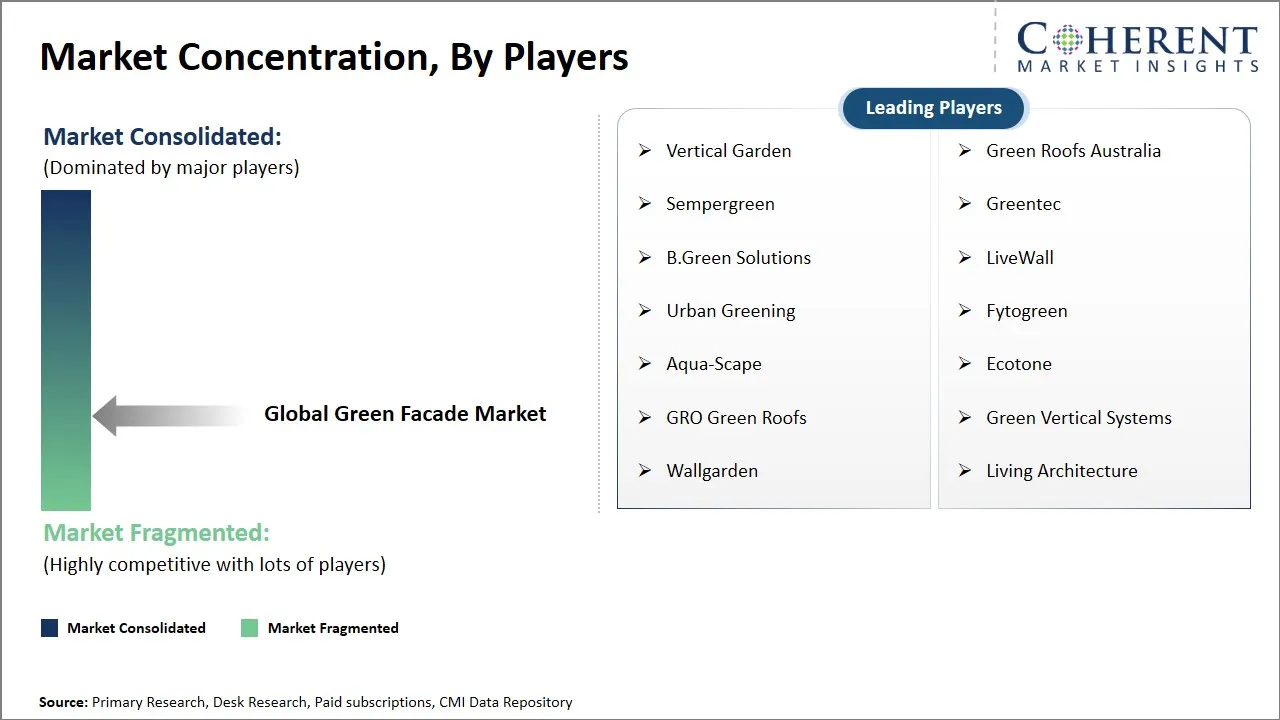
| Companies covered: | Vertical Garden, Green Roofs Australia, Sempergreen, Greentec, B.Green Solutions, LiveWall, Urban Greening, Fytogreen, Aqua-Scape, Ecotone, GRO Green Roofs, Green Vertical Systems, Wallgarden, and Living Architecture | ||
| Growth Drivers: |
| ||
| Restraints & Challenges: |
| ||
Green Facade Market Dynamics
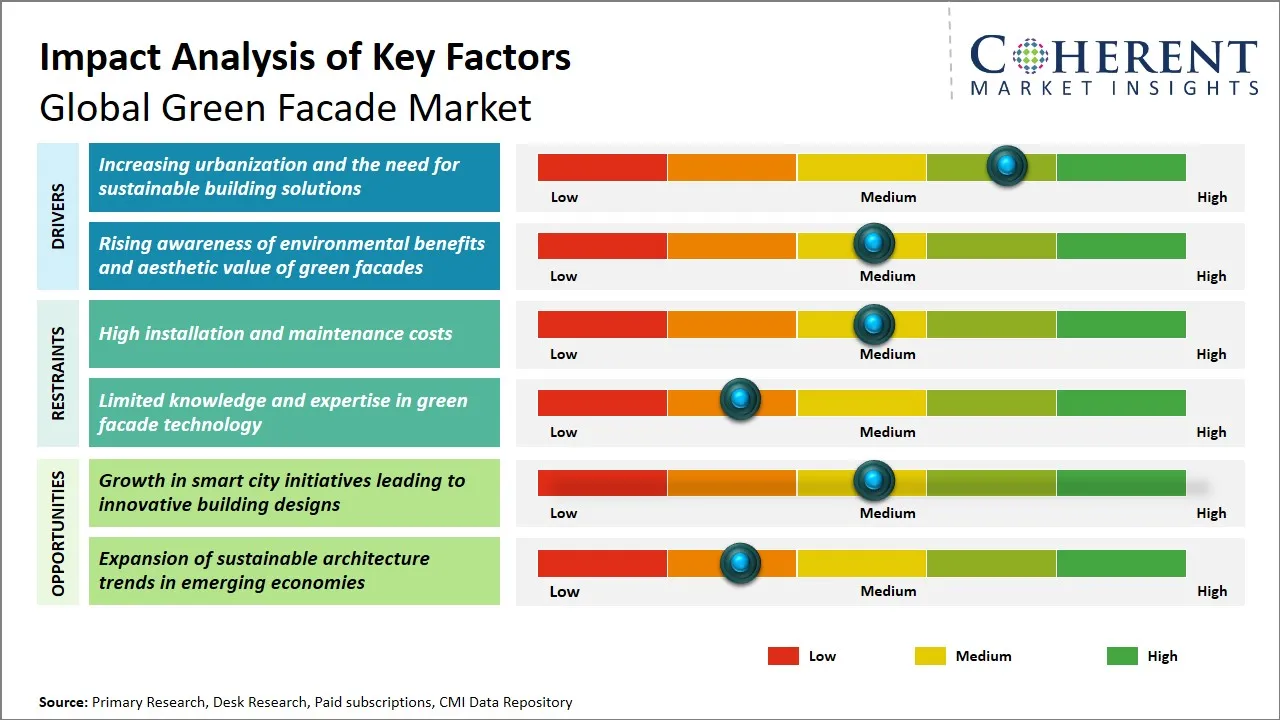
Green Facade Market Driver - Increasing Urbanization and the Need for Sustainable Building Solutions
The high urbanization rate experienced in the world has increased the demand on sustainable and ecologically friendly building strategies leaving green facade solution the more appealing in urban regions. As the urbanization intensifies, the air quality, heat islands in cities, and biodiversity are deteriorated by the increase of the number of concrete buildings and the absence of a green space. A natural solution to this is green facades since, it encompasses use of plants on the outer surfaces of the structure thereby providing greater insulation, reducing the use of energy and at the same time making urban areas more appealing.
In January 2025, Paris turned on the second phase of its Plan Climate, which involves subsidies to cultivate-in green vegetation to combat its growing levels of heat. The buildings within the city and in residential complexes are given priority on green facades due to the documented temperature reducing benefits.
Green Facade Market Opportunity - Growth in Smart City Initiatives Driving Innovative Building Designs
The tremendous development rate of smart city projects across the globe is a significant growth opportunity of the world green facade market. As the focus on sustainability, energy consumption and comfortable living in the cities increases, the use of green facades in building design has been the preferred trend in development of the smart cities. The projects of smart cities focus on the implementation of the latest technologies and the environmentally saving infrastructure that enables the emergence of new architectural trends and the integration of green facades to improve the quality of air, reduce urban heat islands, and promote biodiversity. Municipalities and governments are emptying their coffers in the development of smart cities, the emergence of efficient building codes such as the LEED and the WEL certification that focus on use of natural vegetation on exterior of the buildings.
The NEOMs building standards, which were published in August 2024, were used as an example of imposing a high dependence on vertical green systems to facilitate cooling in hyper-arid regions. Green facades became an essential architectural aspect in this project because one of the biggest smart city projects in the world.
Analyst Opinion (Expert Opinion)
- The green facade market will experience a massive growth due to the growing focus on the sustainability issue and urban greening programs in architecture. The Green Building Expo (2023) and the International Conference on Sustainable Building (2022) were important events that outlined the key trends, with such companies as Gartner or Verdant Aesthetics being at the forefront of green facade innovations and living walls.
- A case in point is the recent introduction of a modular green facade system by Gartner that incorporates smart irrigation technology, to provide proactive response by the market to improve the environmental benefits, including better air quality and energy conservation. The theme of discussions during such conferences is the value of regulatory frameworks and incentives to promote green building practices indicating a more industry-driven towards sustainability goals.
- Nonetheless, obstacles like original installation expenses and a requirement to maintain them were often mentioned as the impediments to a wider adoption. As will those companies that take the time to inform architects and developers about the benefits of using a green facade over time, and provide solutions that are of a scale. Finally, the development of the green facade market will rely on the possibility to be innovative and respond to the economic and environmental demands of the city in the context of the quickly evolving building environment.
- The green facade market players in the middle area are more concerned with cost-efficiency and are willing to provide products that offer quality and a reasonable price to attract consumers with a constrained income. These companies realize the increasing need of green facade systems in the mid-income residential and commercial markets and modifies their products to provide effective and very practical ones. Middle-range companies do not need to focus on the innovative advanced technology but usually enter into enterprises with technology suppliers, manufacturers, or local distributors in order to boost their output and commercial effectiveness.
Speak to the analyst
Want personalized insights?
Take the findings above to one of our principal consultants, or have the report rebuilt around the segments, geographies and competitors you actually track.
Market Segmentation
- Type Insights (Revenue, USD Mn, 2021 - 2033)
- Ground Based
- Wall Structure Based
- Vegetation Type Insights (Revenue, USD Mn, 2021 - 2033)
- Shrubs
- Flowers
- Others
- Application Insights (Revenue, USD Mn, 2021 - 2033)
- Residential
- Commercial
- Regional Insights (Revenue, USD Mn, 2021 - 2033)
- North America
- U.S.
- Canada
- Latin America
- Brazil
- Argentina
- Mexico
- Rest of Latin America
- Europe
- Germany
- U.K.
- Spain
- France
- Italy
- Russia
- Rest of Europe
- Asia Pacific
- China
- India
- Japan
- Australia
- South Korea
- ASEAN
- Rest of Asia Pacific
- Middle East
- GCC Countries
- Israel
- Rest of Middle East
- Africa
- South Africa
- North Africa
- Central Africa
- North America
- Key Players Insights
- Vertical Garden
- Green Roofs Australia
- Sempergreen
- Greentec
- Green Solutions
- LiveWall
- Urban Greening
- Fytogreen
- Aqua-Scape
- Ecotone
- GRO Green Roofs
- Green Vertical Systems
- Wallgarden
- Living Architecture
Sources
Primary Research Interviews
- R&D Director – Leading Green Facade Systems Manufacturer
- Procurement Manager – Major Sustainable Architecture Firm
- Product Development Head – Prominent Green Wall Technology Provider
- Sustainability Manager – Green Building Certification Organization
Stakeholders
- Manufacturers
- End-use Sectors
- Commercial Buildings and Urban Developments
- Residential High-Rise Projects focusing on biophilic design
- Regulatory & Certification Bodies
- Architects and Urban Planners
- Technology Integration Players: Modular irrigation and hydroponic system providers
Databases
- UN Comtrade Database
- India Import Export (EXIM) Database
Magazines
- Green Building + Architecture Magazine – Trends in sustainable facades and green walls
- Gb&d Magazine – Innovations in green building envelopes
- Living Architecture Monitor – Industry updates on green roofs and facades
- Green Roofs for Healthy Cities Publications – Market insights for living architecture
- Global Green Building Magazine – Sustainability trends in vertical greening
Journals
- Smart Cities and Society – Green facades in sustainable smart buildings
- Journal of Sustainable Structures – Applicability of green facades in high-rises
- Science of the Total Environment – Efficiency and sustainability of green facades
- Building and Environment – Thermal performance and energy efficiency research
- Landscape and Urban Planning – Urban heat mitigation via green facades
Newspapers
- The Financial Times – Growth in sustainable architecture markets
- The Guardian – Urban greening trends and climate adaptation
- Asia Health Journal – Asia-Pacific adoption of green building technologies
- European Nutrition News – EU green building policies (adapted for facades)
- The New York Times – Shifts toward biophilic urban design
Associations
- Green Roofs for Healthy Cities (GRHC)
- European Federation of Green Roof and Living Wall Associations (EFB)
- Indian Green Building Council (IGBC)
- World Green Building Council
- U.S. Green Building Council (USGBC)
- Clean Label Project equivalents for green infrastructure
Public Domain Sources
- U.S. Green Building Council (USGBC) – LEED guidelines for green facades
- European Commission – Green building and facade regulations
- World Health Organization – Urban health benefits of green infrastructure
- OECD – Sustainability assessments for living architecture
Proprietary Elements
- CMI Data Analytics Tool
- Proprietary CMI Existing Repository of information for last 8 years.
Get access to 250+ pages report
Every segment, forecast, competitor profile and data table behind the analysis above — available for instant download.
- ESOMAR Member
- ISO 9001:2015 Certified
- D-U-N-S Registered
- GDPR & CCPA Compliant
Missing comfort of reading report in your local language? Find your preferred language:
Transform your Strategy with Exclusive Trending Reports
Frequently Asked Questions
The global green facade market is estimated to be valued at USD 688.7 Mn in 2026 and is expected to reach USD 1,084.5 Mn by 2033.
The CAGR of the global green facade market is projected to be 6.7% from 2026 to 2033.
Increasing urbanization and the need for sustainable building solutions and rising awareness of environmental benefits and aesthetic value of green facades are the major factors driving the growth of the global green facade market.
High installation and maintenance costs and limited knowledge and expertise in green facade technology are the major factors hampering the growth of the global green facade market.
In terms of type, the ground based is estimated to dominate the market revenue share in 2026.
Vertical Garden, Green Roofs Australia, Sempergreen, Greentec, B.Green Solutions, LiveWall, Urban Greening, Fytogreen, Aqua-Scape, Ecotone, GRO Green Roofs, Green Vertical Systems, Wallgarden, and Living Architecture are the major players.
Europe is expected to lead the global green facade market in 2026.