

Global Construction Drone Market Size and Forecast 2026-2033
Global construction drone market is estimated to be valued at USD 21.9 Mn in 2026 and is expected to reach USD 57.6 Mn by 2033, exhibiting a compound annual growth rate (CAGR) of 14.8% from 2026 to 2033.
Key Takeaways of the Global Construction Drone Market
- In terms of system, missile defence systems segment is estimated to hold the highest market share of 43.3% in 2026.
- In terms of end user, hybrid EV (PHEV & HEV) segment is estimated to hold the highest market share of 52.8% in 2026.
- In terms of platform, air-based segment is estimated to hold the highest market share of 39.9% in 2026.
- North America is expected to dominate the construction drone market with an estimated market share of 33. 7% in 2026.
Market Overview
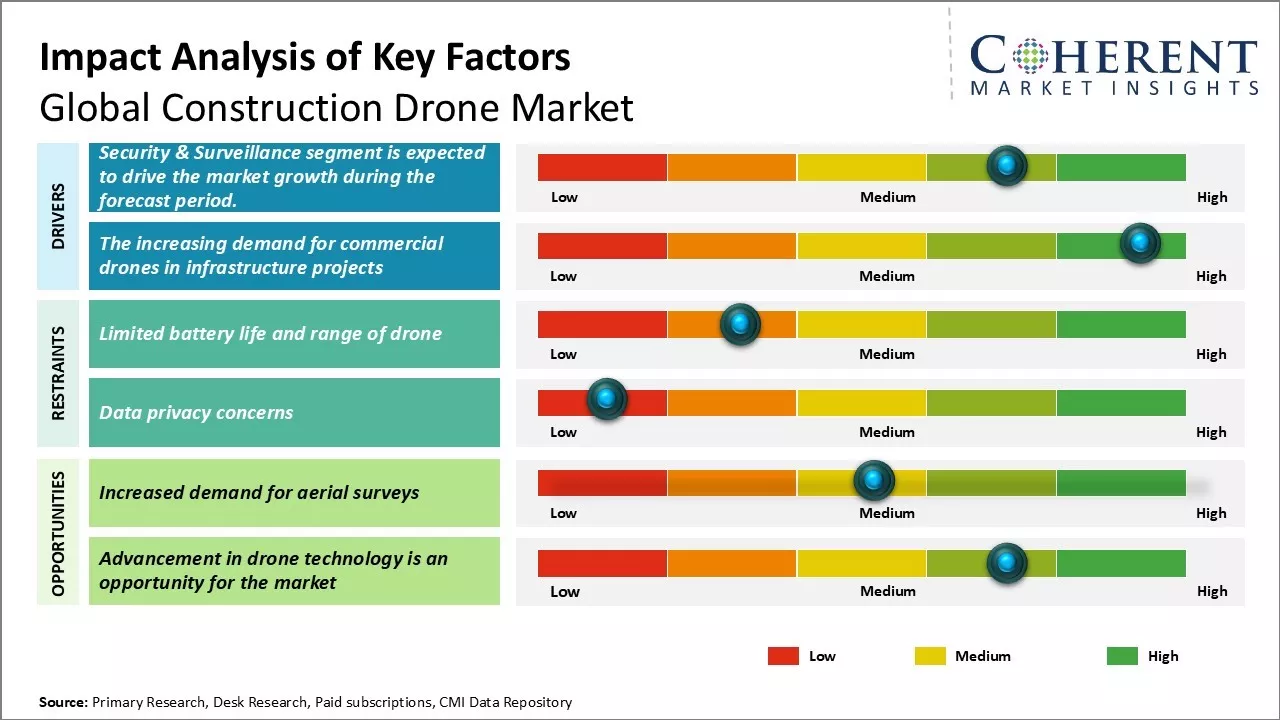
Construction drones are increasingly used for monitoring construction sites, assessing progress, inspecting structures, and documenting projects. Their usage improves project efficiency through better documentation, project tracking, and risk assessment.
Drones enable real-time data capturing and sharing to facilitate communication between field crews and project managers. This help identify flaws or defects early and reduce rework. There has been huge adoption of these drones due to increasing awareness of the technology's applications and benefits among construction companies looking to improve productivity, project planning, and risk management.
Pricing Analysis in the Construction Drone Market
Segment / System (Manufacturer) | Estimated Upfront Cost (USD) | Recurring / Operational Costs |
Rotary-Wing Enterprise Drone (e.g., DJI Matrice 350 RTK) | 10,600 – 13,000 (base drone only) | Payloads (LiDAR, thermal, multispectral): USD 5,000 – USD 15,000 per sensor. Annual software, training, and regulatory compliance: USD 1,000 – USD 3,000 |
Autonomous AI-enabled Drone (e.g., Skydio X10/X2) | 15,000 – 20,000 | Software subscriptions: 1,000+ USD/year. Battery replacements: ~ USD 500 each. Maintenance and spare parts additional |
High-End LiDAR/RTK Drone (e.g., Freefly Astro Max) | 26,000+ with RTK/mapping payloads | Calibration, spare parts, and software licenses: USD 2,000 – USD 5,000 annually. Field operator training costs extra |
Lower-Tier Mapping Drone (general use) | 10,000 – 50,000 depending on configuration | Maintenance, basic software, and regulatory compliance: typically several hundred to a few thousand USD per year |
Impact of Artificial Intelligence (AI) on Construction Drone Market
AI is transforming the construction drone market by improving data processing, predictive analysis, and autonomous flight.
- Companies like Trimble use AI in their software for automated site inspections, progress tracking, and risk detection.
- Construction drones with AI are applied in areas such as site surveying, structural integrity monitoring, and inventory management. DJI's AI-driven drones, for instance, can autonomously scan sites and identify defects early, improving safety and reducing rework.
- Companies like Kespry offer fully AI-enabled drone systems that automate site mapping, stockpile tracking, and reporting, leading to significant reductions in surveying time and improved operational accuracy for construction and mining industries.
- Current Industry Events of 2026
- Market Size Estimation
- Regional Breakdown
- Competitive Landscape
- Customer Intelligence
- Segmental Analysis
- Pricing Analysis
- Key Market Drivers, Challenges & Future Trends
- Customized Insights Section
Current Events and their Impact on the Global Construction Drone Market
Current Events | Description and its impact |
Geopolitical Tensions and Supply Chain Disruptions |
|
Global Chip Shortage and Manufacturing Pressures |
|
Market Trends
- Emerging Startups in the Global Construction Drone Market
Anthropic has developed AI-based aerial robotics including software allowing drones to navigate obstacle courses autonomously. Its innovations could support automated data collection on job sites. Sky Specs uses machine learning to analyze drone-captured visuals and generate reports on building details. This streamlines post-flight workflows.
Terra Drone, an Israel-based startup, manufactures drones that lift heavier payloads for tasks like installations. Its drones use fewer batteries than oil-powered lift trucks, offering sustainable solutions. BioCarbon Engineering develops drones embedded with devices to capture and store carbon directly from the air. Their technology could aid the industry's decarbonization efforts.
Some startups address niche industry needs like Insitu that developed solutions for risky scenarios like bridge inspections, reducing safety risks for workers. Bardygrub collaborates with contractors and architects to 3D-print construction components using drone-based robotics.
- Security & Surveillance segment
There has been an increase in usage of drones for security and surveillance purposes. Construction sites are massively spread outdoor areas making surveillance a challenge using traditional means. However, drones provide an effective solution by allowing real-time monitoring from bird's eye view. These can rapidly scan large premises to detect any security threats, trespassers, or unauthorized activities. For instance, in April 2020, DJI, a leader in aerial photography systems, launched Mavic Air 2, which has 8GB on-board memory storage and 3,500 mAh battery for aerial photography and video surveillance of residential construction sites.
Market Opportunity - Increased demand for aerial surveys for construction monitoring and planning
Global construction drone market can witness growth opportunities due to increased demand for aerial surveys and infrared inspections of construction sites. Drones equipped with HD cameras and thermal imaging sensors provide an inexpensive and timely method to monitor progress, inspect structures, and detect issues remotely. This helps construction companies to plan work, track milestones, and ensure quality standards are being followed throughout the project duration. Aerial surveys using drones can save significant time and labour costs compared to traditional manned surveys using cranes or elevated platforms.
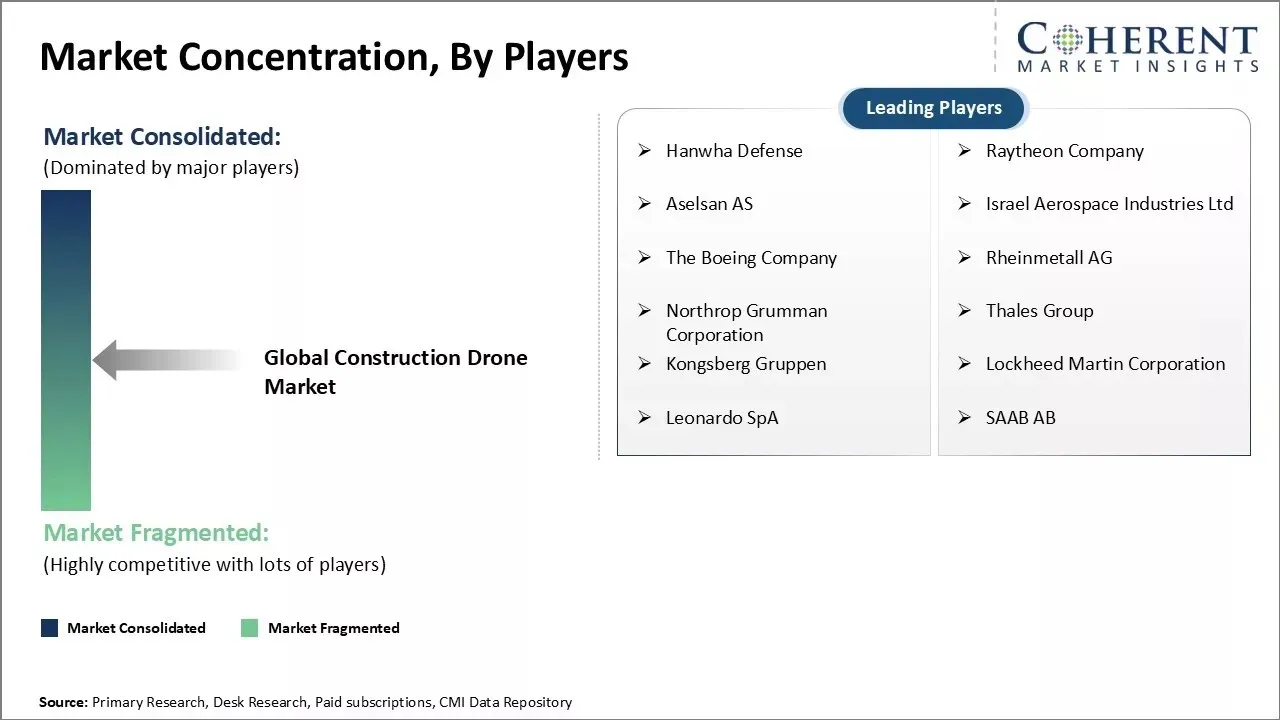
Market Concentration and Competitive Landscape
Segmental Insights
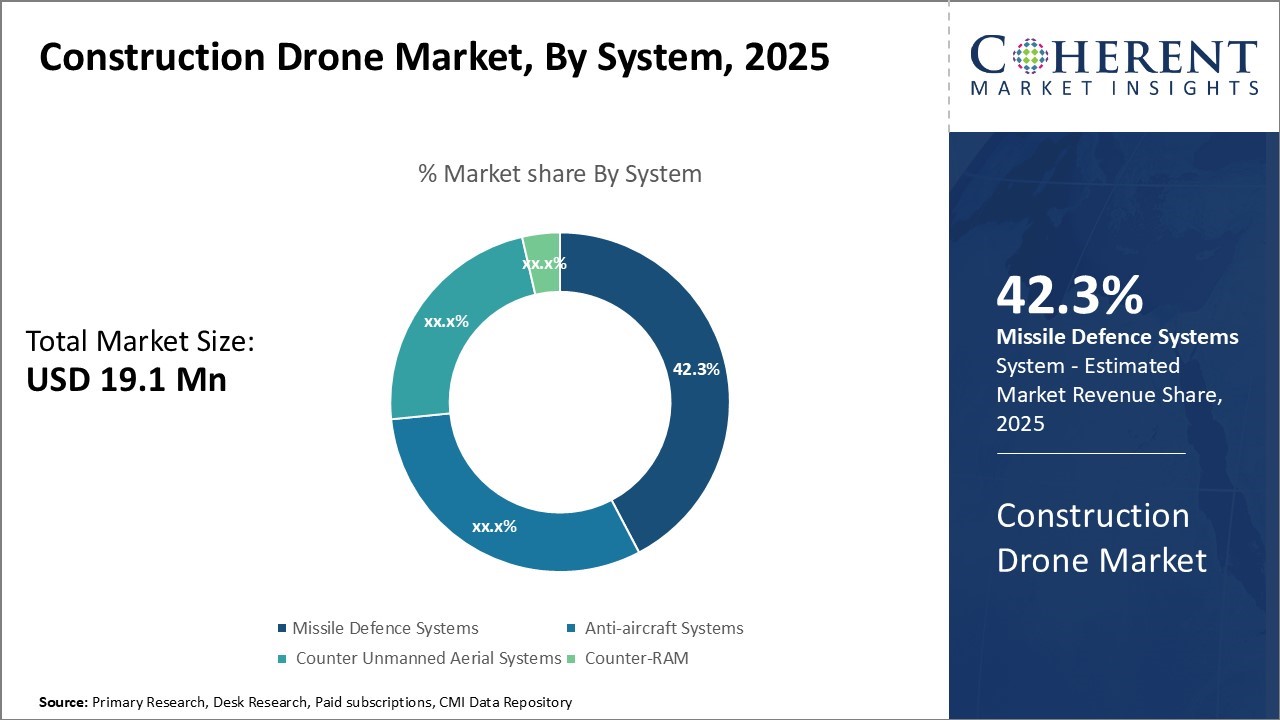
Global Construction Drone Market Insights, By System- Ensuring security amid evolving threats
In terms of system, missile defence systems segment is estimated to hold the highest market share of 43.3% in 2026, owing to growing need for security against missile attacks. Missile defence systems provide protection from various short- and long-range missiles. With advancement in missile technology and their increasing proliferation, especially among certain rival nations, there has been increase in threat from missile strikes.
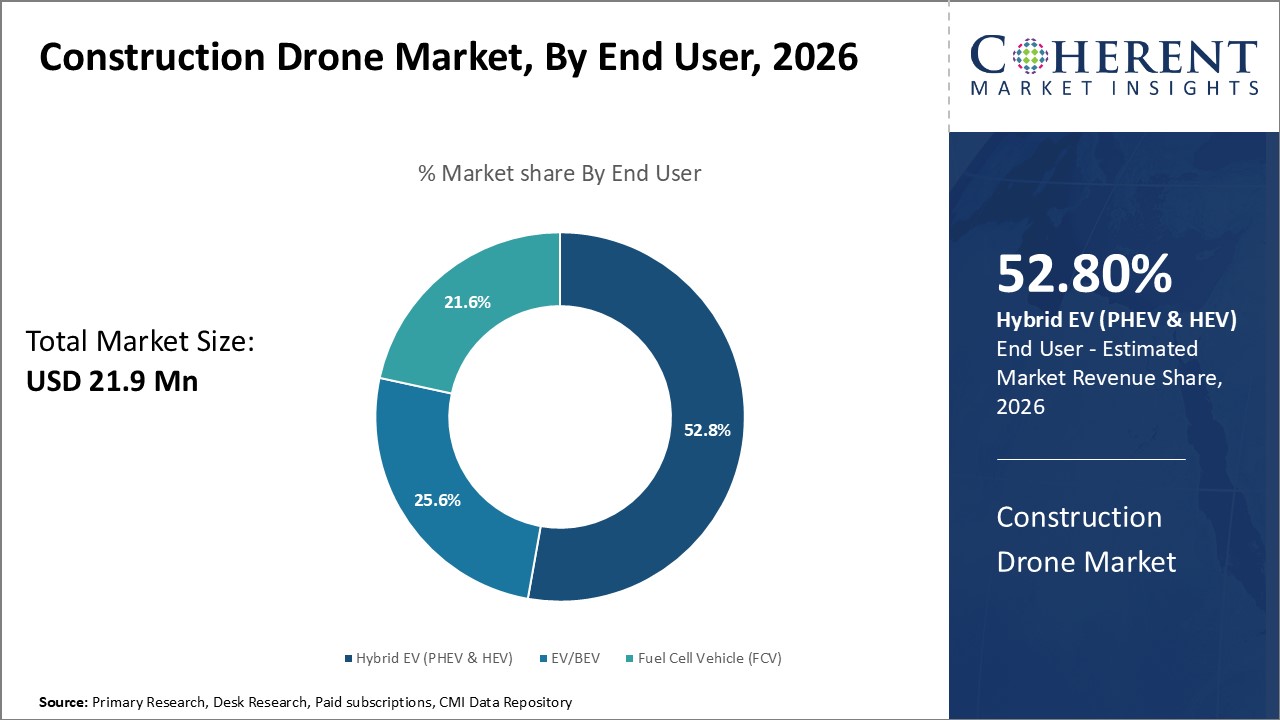
Global Construction Drone Market Insights, By End User- Stepping stone to sustainable transportation
In terms of end user, hybrid EV (PHEV & HEV) segment is estimated to hold the highest market share of 52.8% in 2026, as it serves as an important intermediate technology. With world moving towards E-mobility and renewable energy sources, there has been shift to electric vehicles. However, full electric vehicles still have certain limitations in terms of driving range and charging infrastructure which limit their mass adoption.
Global Construction Drone Market Insights, By Platform- Strengthening strategic and operational capabilities
In terms of platform, air-based segment is estimated to hold the highest market share of 39.9% in 2026, as land remains the most viable route for deployment of major military hardware. Land forces constitute the mainstay of a nation's military might and serve varied strategic, operational and tactical purposes. From protecting borders to conducting offensive/defensive maneuvers, land platforms play a vital role. These provide strength and deterrent at ground level along with reach and muscle in combat situations. Terrain flexibility makes them best suited for regional defence requirements.
Regional Insights
North America Construction Drone Market Trends and Analysis
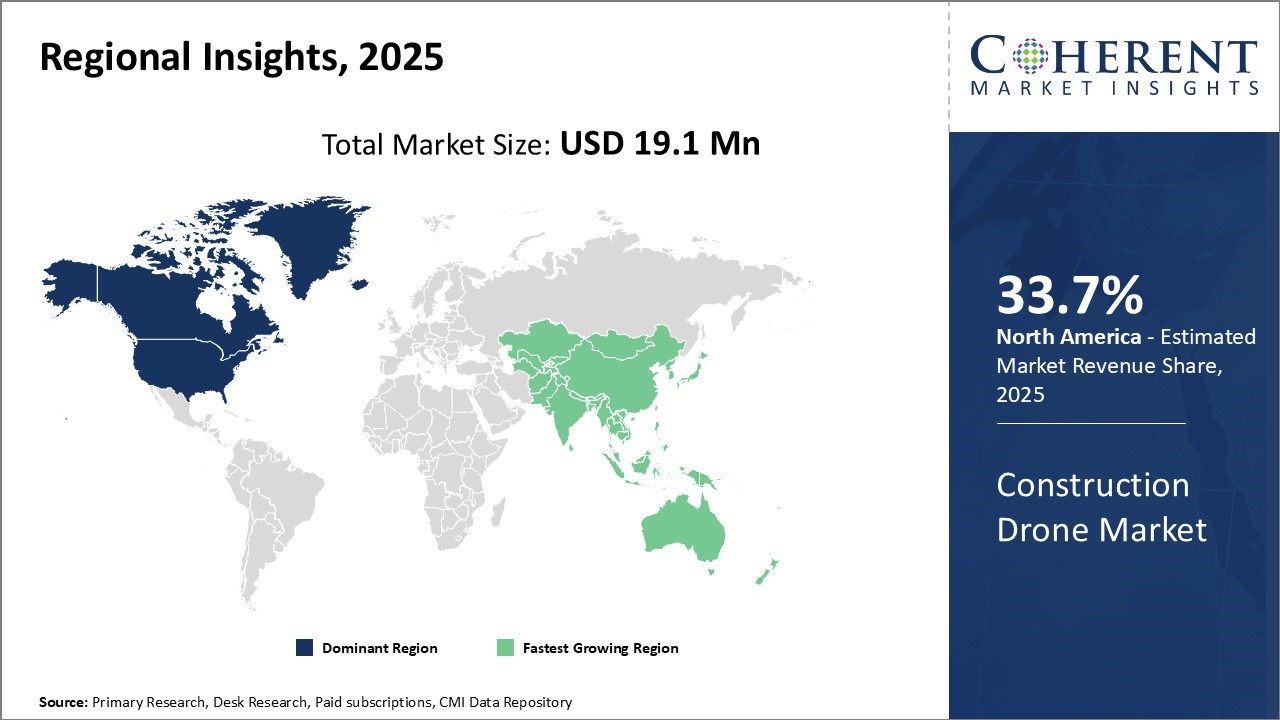
North America is expected to dominate the construction drone market with an estimated market share of 33.7% in 2026, due to factors such as high adoption of advanced technologies across industries and a well-established construction sector. Major drone manufacturers such as DJI have a strong presence in the region.
The region is also seeing a rise in "Drone-as-a-Service (DaaS)" models, which make drone technology more accessible to small and medium-sized enterprises by providing equipment, skilled operators, and data analytics on a service basis. This helps overcome the high initial investment and maintenance costs associated with acquiring and operating drones.
Companies like Skanska and Bechtel in the U.S. actively deploy drones for surveying, monitoring sites, and tracking construction progress, especially for large infrastructure projects, leading to better planning and reduced fieldwork costs. On January 28, 2026, DroneDeploy received a nationwide FAA BVLOS (beyond visual line-of‑sight) waiver for critical infrastructure drone operations empowering fully autonomous aerial monitoring of data center and infrastructure construction sites across North America.
Asia Pacific Construction Drone Market Trends and Analysis
Asia Pacific region exhibits the fastest growth due to booming construction industries, especially in emerging economies like China and India. Rapid urbanization and investment in infrastructure development projects create significant opportunities for drone usage.
Governments across the region are increasingly supporting drone integration through favorable policies and regulatory approvals for commercial drone usage. This is crucial as drones can significantly reduce project costs and accelerate timelines by providing real-time data for progress tracking, topographic mapping, and automated surveying.
For example, the U.S. Department of Transportation (DOT) estimates that drones can reduce construction project costs by up to 15% through minimized manual labor and enhanced accuracy, a benefit being increasingly realized in Asia Pacific projects. For instance, in early 2026, Skydio partnered with India’s Aerоarc under the INDUS‑X initiative to co-develop and locally manufacture AI-powered, autonomous drones tailored for industrial and construction inspections in the Indo‑Pacific region.
Construction Drone Market Outlook for Key Countries
U.S. Construction Drone Market Trends
The U.S. construction drone market is driven by advanced drone service providers offering solutions for inspection, surveying, mapping, and real-time progress tracking. Companies like DroneDeploy and Skycatch are revolutionizing job site visibility with AI-powered platforms that automate data capture and analysis.
Turner Construction employs DroneDeploy alongside Boston Dynamics’ Spot robots to perform nightly drone-based inspections and progress documentation cutting inspection times and reducing labor costs significantly. The company also makes use of weekly drone flights at the Sacramento Kings’ Golden 1 Center project to create 3D models, improving schedule tracking and reducing rework. These examples underscore how leading U.S. builders are embedding drones into their project lifecycles to boost efficiency and safety.
China Construction Drone Market Trends
China’s construction drone market is expanding dynamically due to robust government policies supporting drone adoption and industrial digitalization. The Civil Aviation Administration of China (CAAC) has eased low-altitude airspace regulations, enabling widespread drone deployment in urban construction. Leading firms like DJI supply drones equipped with multispectral and LiDAR sensors used by developers such as China State Construction Engineering Corporation (CSCEC) to enhance surveying precision in high-rise and infrastructure projects. Moreover, state-funded smart city initiatives are integrating drones for real-time monitoring of urban development.
Japan Construction Drone Market Trends
Japan-based construction firms are at the forefront of integrating drones for advanced applications including thermal imaging, GIS data collection, and structural integrity monitoring. Companies like Komatsu have pioneered the use of drones in their Smart Construction platform, which integrates drone-captured 3D terrain models with automated machinery to enhance productivity. Obayashi Corporation, a major Japanese builder, uses drones to inspect dam and tunnel sites, significantly reducing human risk in hazardous areas. The government’s push for automation in response to labor shortages has further fueled drone integration in public infrastructure projects.
Germany Construction Drone Market Trends
The Germany’s construction drone market is growing rapidly, supported by smart infrastructure projects and favorable regulations. With over 56,000 commercial drones in use, firms like TS Engineering and DB Schenker are leveraging UAVs for highway mapping and warehouse inventory tracking. Others, like hhpberlin and FairFleet, use drones for emergency planning and damage assessment. These real-world applications highlight the rising adoption of drones for precision surveying, monitoring, and safety in Germany’s construction sector.
Top Manufacturers and Facilities
- Skydio
Location: San Mateo, California, U.S.
Products: Skydio 2, Skydio 2+, and enterprise drone systems
Core Capabilities: AI-powered autonomous flight, advanced obstacle avoidance, and 3D modeling—ideal for infrastructure inspection and construction site monitoring.
Competitive Advantage: A leader in U.S.-manufactured drones, Skydio’s systems are security-compliant and widely used in government and defense sectors.
- American Robotics
Location: Massachusetts, U.S.
Products: Scout System and Optimus System
Core Capabilities: Fully autonomous “drone-in-a-box” solutions for industrial applications, featuring automated launch, charging, and FAA-approved operations.
- AgEagle Aerial Systems
Location: Kansas, U.S.
Products: eBee X, eBee TAC fixed-wing drones, MicaSense sensors, and analytics platforms
Core Capabilities: Complete surveying and mapping solutions for construction and agricultural projects, offering high-resolution thermal and multispectral imaging.
- Orqa International
Location: Osijek, Croatia
Products: Custom FPV drones and enterprise drone platforms
Core Capabilities: Specializes in full in-house manufacturing of FPV systems, optics, radios, and electronics.
- AeroVironment
Location: Virginia, U.S.
Products: Raven, Wasp, Puma UAS, and Switchblade loitering munitions
Core Capabilities: Originally designed for military reconnaissance, these drones are now being adapted for construction site surveillance and tactical inspections under extreme conditions.
- Skypersonic
Location: Michigan, U.S.
Products: Skycopter (spherical drones)
Core Capabilities: Designed for indoor and confined-space inspections—ideal for construction sites with restricted access. Compact, collision-resistant designs enhance worker safety and efficiency.
Global Construction Drone Industry News
- In November 2024, Garuda Aerospace partnered with CYOL to launch operations in Sri Lanka, expanding its presence in South Asia and beyond. The company offers advanced drone solutions for agriculture, surveillance, mapping, and defense.
- In April 2024, Virtual Surveyor extended its popular smart drone surveying software with an exciting new package of planimetric survey capabilities. Amongst numerous performance enhancements, Virtual Surveyor version 9.5 will enable users to check and compile 2D features quickly and easily, directly from orthophotos captured by drones, and integrate them into the 3D topographic model developed using the same data set.
- In June 2024, Datumate and BEAD, LLC partnership will redefine aerial surveying for engineering firms. This cooperation blends in the strength of the analytical powers of Datumate with the operational excellence of BEAD, promising to change the techniques associated with surveying. Construction and engineering companies can outsource their surveying jobs without compromising on data quality and depth, which may be required for intricate projects.
- In July 2024, DTDC, in partnership with Skye Air Mobility, introduced drone-based deliveries, completing its first delivery from Bilaspur to Gurugram (Sector 92) in 3–4 minutes, significantly reducing transit time. This initiative aims to enhance delivery efficiency while supporting eco-friendly logistics by minimizing carbon emissions and traffic congestion.
- In August 2022, The U.S. State Department approved the resupply of Patriot missile interceptors to Saudi Arabia and THAAD missile interceptors to the United Arab Emirates
- In April 2022, for the U.S. and its allies, Lockheed Martin signed a deal for USD 4.7 billion to provide radar and THAAD air defense systems, giving them a vital capability to counter short- and medium-range ballistic missiles
Analyst View
- The construction drone market is shifting from experimental deployment to operational indispensability, driven by the growing need for real-time, high-resolution data in large-scale infrastructure projects. The use of LiDAR-equipped drones, such as DJI’s Matrice 300 RTK with Zenmuse L1, has reduced topographic survey times by up to 80% compared to traditional methods. This is no longer a futuristic add-on—it’s a competitive imperative. In sectors like road and rail construction, drones now serve as a critical layer of digital verification, reducing errors that cost millions downstream.
- The global skills gap in drone operation and data processing is being rapidly closed through AI automation and modular interfaces. With platforms like DroneDeploy offering automated flight paths and real-time 3D modeling, the barrier to entry is no longer technical—it’s strategic. Companies not adapting to drone-enabled workflows will find themselves outpaced on both cost and timelines. A report by McKinsey noted that drone-enabled projects saw a 32% reduction in rework due to improved site visibility.
- Policy liberalization in airspace usage is acting as a growth accelerant. India's 2021 drone rules and the U.S. FAA’s expanded waivers for beyond visual line of sight (BVLOS) operations are de-risking drone adoption at scale. As regulatory frameworks catch up with technological capabilities, first-mover firms are gaining a structural advantage.
Market Report Scope
Construction Drone Market Report Coverage
| Report Coverage | Details | ||
|---|---|---|---|
| Base Year: | 2025 | Market Size in 2026: | USD 21.9 Mn |
| Historical Data for: | 2020 To 2024 | Forecast Period: | 2026 To 2033 |
| Forecast Period 2026 to 2033 CAGR: | 14.8%2033 Value Projection: | USD 57.6 Mn | |
| Geographies covered: |
| ||
| Segments covered: |
| ||
| Companies covered: | Hanwha Defence, Raytheon Company, Aselsan AS, Israel Aerospace Industries Ltd, The Boeing Company, Rheinmetall AG, Northrop Grumman Corporation, Thales Group, Kongsberg Gruppen, Lockheed Martin Corporation, Leonardo SpA, and SAAB AB | ||
| Growth Drivers: |
| ||
| Restraints & Challenges: |
| ||
Market Segmentation
- System Insights (Revenue, USD Mn, 2021 2033)
- Missile Defence Systems
- Anti-aircraft Systems
- Counter Unmanned Aerial Systems (C-UAS)
- Counter-RAM
- End User Insights (Revenue, USD Mn, 2021 2033)
- Hybrid EV (PHEV & HEV)
- EV/BEV
- Fuel Cell Vehicle (FCV)
- Platform Insights (Revenue, USD Mn, 2021 2033)
- Land-based
- Air-based
- Sea-based
- Type Insights (Revenue, USD Mn, 2021 2033)
- Threat Detection
- Countermeasures
- Regional Insights (Revenue, USD Mn, 2021 2033)
- North America
- U.S.
- Canada
- Latin America
- Brazil
- Argentina
- Mexico
- Rest of Latin America
- Europe
- Germany
- U.K.
- Spain
- France
- Italy
- Russia
- Rest of Europe
- Asia Pacific
- China
- India
- Japan
- Australia
- South Korea
- ASEAN
- Rest of Asia Pacific
- Middle East
- GCC Countries
- Israel
- Rest of Middle East
- Africa
- South Africa
- North Africa
- Central Africa
- Key Players Insights (Revenue, USD Mn, 2021 - 2033)
- Hanwha Defence
- Raytheon Company
- Aselsan AS
- Israel Aerospace Industries Ltd.
- The Boeing Company
- Rheinmetall AG
- Northrop Grumman Corporation
- Thales Group
- Kongsberg Gruppen
- Lockheed Martin Corporation
- Leonardo SpA
- SAAB AB
Sources
Stakeholders
- Construction Equipment Manufacturers
- Drone Technology Providers
- Construction Project Managers
- Regulatory Authorities
- Others
Magazines
- Construction Executive
- Drone Life
- Commercial UAV News
- Construction Today
- Others
Journals’
- Journal of Construction Engineering and Management,
- Remote Sensing, Automation in Construction,
- Others
Newspapers
- The Construction Index
- Engineering News-Record
- The Wall Street Journal
- The Economic Times
- Others
Associations
- Association for Unmanned Vehicle Systems International (AUVSI)
- Construction Industry Institute (CII)
- American Society of Civil Engineers (ASCE)
- International Drone Federation (IDF)
- Others
Public Domain Sources
- U.S. Federal Aviation Administration (FAA) Reports
- International Civil Aviation Organization (ICAO)
- European Union Aviation Safety Agency (EASA)
- National Aeronautics and Space Administration (NASA)
- Others
Proprietary Elements
- CMI Data Analytics Tool
- Proprietary CMI Existing Repository of information for the last 8 years
Get access to 250+ pages report
Every segment, forecast, competitor profile and data table behind the analysis above — available for instant download.
- ESOMAR Member
- ISO 9001:2015 Certified
- D-U-N-S Registered
- GDPR & CCPA Compliant
Missing comfort of reading report in your local language? Find your preferred language:
Transform your Strategy with Exclusive Trending Reports
Frequently Asked Questions
The Construction Drone Market is estimated to be valued at USD 21.9 Mn in 2026, and is expected to reach USD 57.6 Mn by 2033.
The CAGR of the Construction Drone Market is projected to be 14.8% from 2026 to 2033.
Security & surveillance segment and increasing demand for commercial drones in infrastructure projects are the major factors driving the growth of the global construction drone market.
Limited battery life and range of drone and data privacy concerns are the major factors hampering the growth of the global construction drone market.
In terms of system, missile defence systems segment is estimated to dominate the market in 2026.
Hanwha Defence, Raytheon Company, Aselsan AS, Israel Aerospace Industries Ltd, The Boeing Company, Rheinmetall AG, Northrop Grumman Corporation, Thales Group, Kongsberg Gruppen, Lockheed Martin Corporation, Leonardo SpA, and SAAB AB are the major players in the construction drone market.
North America is expected to lead the global construction drone market.