

Global Hall Current Sensor Market Size and Forecast – 2026 To 2033
The global hall current sensor market is expected to grow from USD 1.15 Bn in 2026 to USD 2.20 Bn by 2033, registering a compound annual growth rate (CAGR) of 4.7% from 2026 to 2033. The global hall current sensor market is driven by growing advancements in industrial automation and robotics. On March 9, 2026, ABB Robotics announced that it is integrating NVIDIA Omniverse libraries into ABB Robotics’ RobotStudio to help manufacturers deploy physical AI in real world robotics applications. (Source: ABB)
Key Takeaways of the Global Hall Current Sensor Market
- The Open-Loop segment is expected to account for 57.0 % of the global hall current sensor market share in 2026. Higher demand for galvanically isolated current measurement is driving the growth of the segment. On June 25, 2026, Melexis unveiled the MLX91229, a conventional-Hall current sensor featuring a sigma-delta digital output to improve signal integrity in electrically noisy environments. (Source: Melexis)
- The Analog Output segment is estimated to capture 51.0 % of the market share in 2026. Expansion of renewable energy and energy storage installations is driving the growth of the segment. On June 24, 2026, NatPower and Tesla signed a multi-year supply and execution agreement covering more than 25GWh of battery energy storage systems (BESS) across Italy and the U.K.
- The AC Current Sensors segment is estimated to capture 47.0 % of the market share in 2026. Increasing advancements in compact, high-accuracy Hall-effect ICs is majorly driving the growth of the segment. On March 6, 2025, SK keyfoundry announced its offering of a new 3D Hall-effect sensor technology that can measure speed and direction through three-dimensional magnetic field detection for its foundry customers.
- Asia Pacific is expected to dominate the hall current sensor market in 2026 with a market share of 41.0 %. Growth in smart grid and power distribution monitoring in Asia Pacific is driving the growth of the regional market. On June 26, 2025, Hitachi Energy India Limited received an order from Power Grid Corporation of India Limited to supply 30 units of 765-kilovolt (kV) 500 megavolt-ampere (MVA) single-phase transformers. (Source: Hitachi Energy)
- North America is expected to account for 32.0 % share in 2026 and is projected to record the fastest growth over the forecast period. Rising demand for IoT-enabled industrial equipment in North America is driving the growth of the regional market. On June 17, 2025, Rockwell Automation, Inc. announced the release of PointMax I/O, a flexible remote input/output (I/O) system designed to help manufacturers tackle the growing complexity of modern industrial operations. (Source: Rockwell Automation)
- Rapid Adoption of Hall Current Sensors in Electric Vehicles and Battery Management Systems (BMS): The proliferation of electric vehicles and hybrid vehicles is driving a surge in the use of Hall current sensors to enable accurate current measurements in traction inverters, onboard chargers, DC-DC converters and battery management systems. Automakers are demanding smaller, more precise and electrically separated sensors capable of dependably working in high-voltage environments – and Hall-effect technology is the chosen solution.
- Growing Integration with Renewable Energy and Energy Storage Systems: The proliferation of solar photovoltaic plants, wind farms, and battery energy storage systems (BESS) is driving a major increase in demand for Hall current sensors. These sensors are crucial for monitoring current flow in inverters, power converters, and grid-connected storage systems to allow efficient energy conversion, better system protection, and compliance with new smart grid regulations.
Segmental Insights
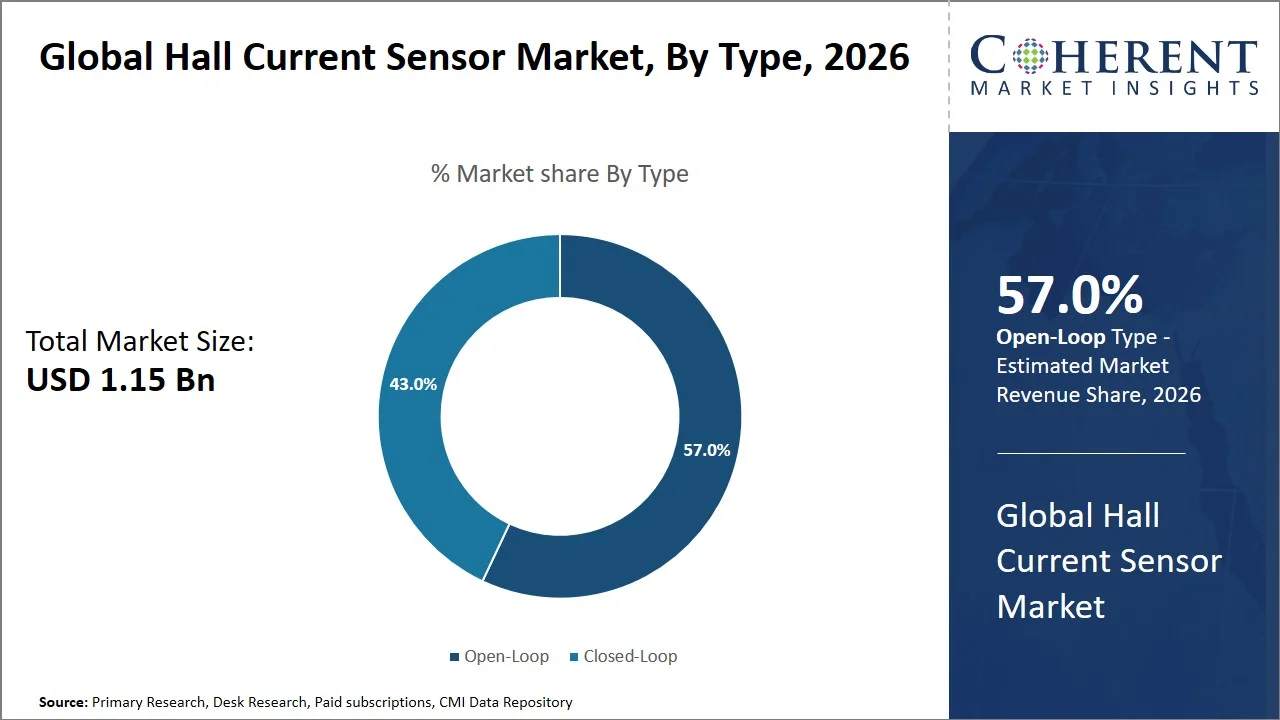
Why Does Open-Loop Dominate the Global Hall Current Sensor Market?
The open-loop segment is expected to account for 57.0% of the global hall current sensor market share in 2026. Open-loop Hall current sensors are widely used because of their cost-effectiveness and simplicity of their design. They require fewer components than closed-loop sensors, which makes them easier to manufacture, integrate and maintain in high-volume applications such as electric vehicles, industrial motor drives, consumer electronics, renewable energy inverters and power supplies. They provide reliable current measurement with enough accuracy for most commercial and industrial applications, while taking up little space and using little power. This makes them a good choice for manufacturers wanting to improve performance and reduce production costs. On October 20, 2025, Infineon Technologies AG announced expansion of its XENSIV magnetic current sensor family with the new TLE4971/TLI4971 sensors, housed in a 300-mil package. These new products offer the highest accuracy in magnetic coreless current sensors on the market, with a total error of only 0.7 percent over temperature and lifetime.
- Current Industry Events of 2026
- Market Size Estimation
- Regional Breakdown
- Competitive Landscape
- Customer Intelligence
- Segmental Analysis
- Pricing Analysis
- Key Market Drivers, Challenges & Future Trends
- Customized Insights Section
Why is Analog Output the Most Preferred Output Type?
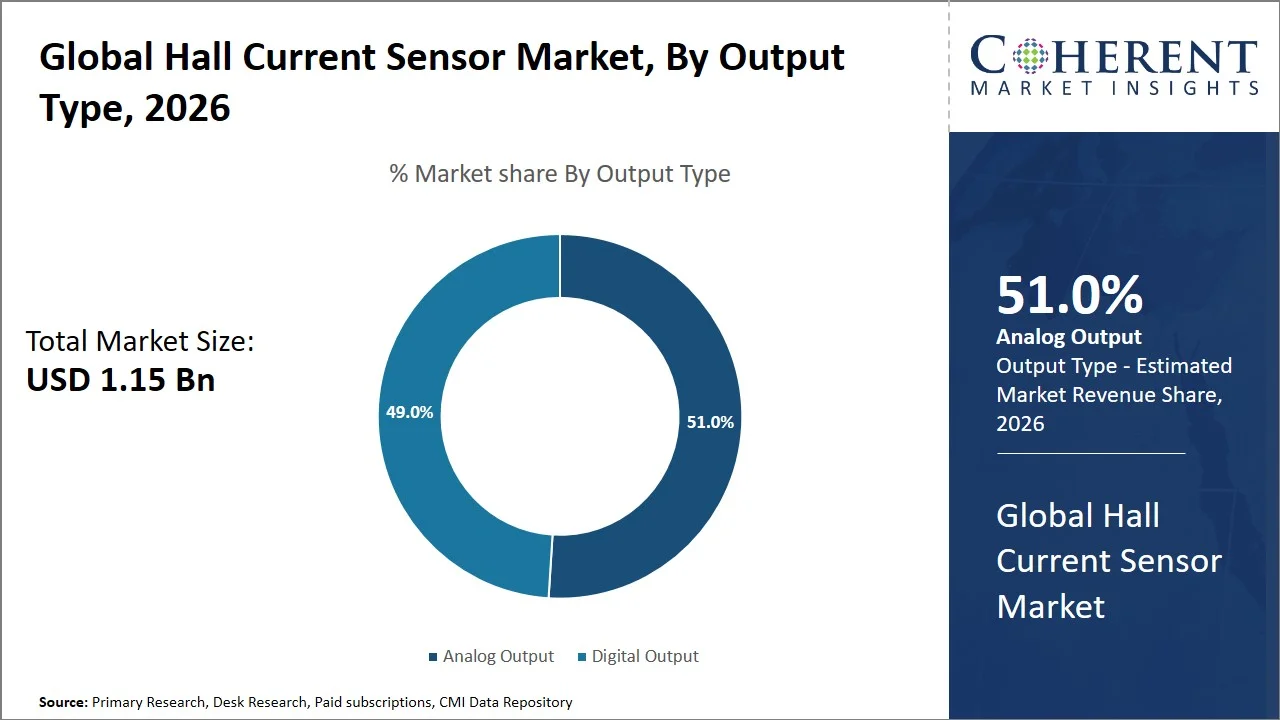
The analog output segment is expected to account for 51.0% of the global hall current sensor market share in 2026. One of the main reasons for the popularity of analog output Hall current sensors is the wide-ranging compatibility of the existing power electronics and industrial control systems. Analog sensors may continuously monitor current in real-time and can be interfaced directly to analog-to-digital converters, microcontrollers, programmable logic controllers, and motor control units without the need for sophisticated digital communication protocols. This facilitates system integration, saves implementation costs and enables fast response times in applications such as motor drives, power supply, renewable energy inverters and automotive electronics where constant and accurate current monitoring is critical. On September 24, 2025, ROHM Semiconductor added small magnetic sensor solutions to its Hall IC series for consumer electronics and industrial automation systems.
AC Current Sensors Dominate the Global Hall Current Sensor Market
The AC current sensors segment is expected to account for 47.0% of the global hall current sensor market share in 2026. AC current sensors find extensive use in industrial power distribution and motor control applications. Alternating current is essential for power transmission and equipment operation in manufacturing facilities, commercial buildings, renewable energy systems, and utility infrastructure, resulting in a continuous need for reliable AC current monitoring. The non-contact, electrically isolated measurement of hall current sensors increases system safety, energy efficiency and equipment protection, making them the preferred choice for monitoring motors, transformers, variable frequency drives and power distribution networks in a wide array of industries like automotive and manufacturing.
Currents Events and their Impact
Current Events | Description and its Impact |
European Union Battery Regulation (EU) 2023/1542 |
|
European Union Ecodesign for Sustainable Products Regulation (ESPR) |
|
Hall Current Sensor Market Dynamics
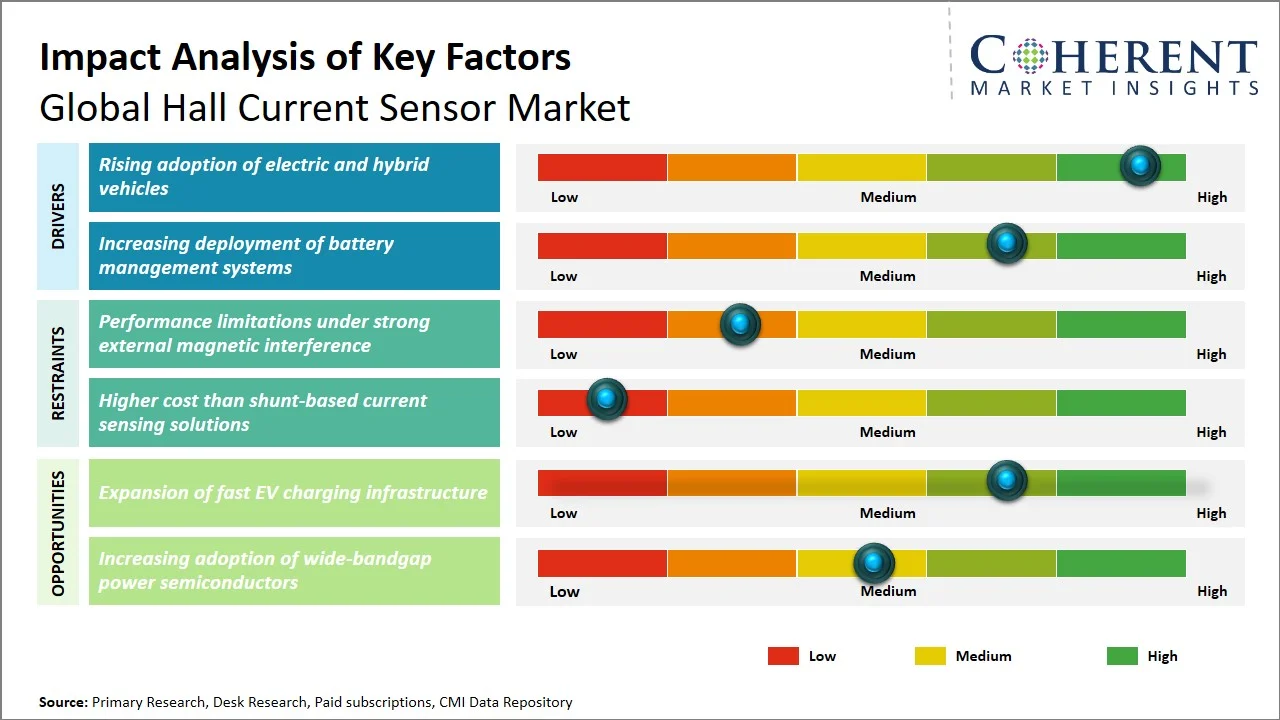
Market Drivers
- Rising adoption of electric and hybrid vehicles: The increasing adoption of electric and hybrid vehicles is a major driver of the global Hall current sensor market, as these vehicles demand precise and reliable current measurement for efficient power management and safety. Hall current sensors are commonly employed in battery management systems, traction inverters, onboard chargers, DC-DC converters and electric motor control for electrically isolated, real-time current monitoring. Governments are pushing for the electrification of vehicles with stricter emission standards and incentive schemes. Automotive manufacturers are incorporating more and more sophisticated Hall current sensors to improve battery performance, energy efficiency, and overall electric powertrain reliability. On March 17, 2025, BYD launched the Super e-Platform, featuring flash-charging batteries, a 30,000 RPM motor, and new silicon carbide (SiC) power chips. The platform upgrades the core electric components, achieving a charging power of 1 megawatt (1000 kW) and a peak charging speed of 2 kilometers per second, making it the fastest for mass-produced vehicles - 5 minutes of charging for 400 kilometers of range. (Source: BYD)
- Increasing deployment of battery management systems: The rising adoption of battery management systems is a key driver for Hall current sensors, as accurate current monitoring is crucial to ensure battery safety, performance and longevity. Hall current sensors can detect charge and discharge currents in real time, while at the same time providing electrical isolation. This allows battery management systems to precisely predict state of charge, state of health, and fault states. With the increasing use of electric vehicles, renewable energy storage systems and industrial battery applications, manufacturers are driven to adopt high-precision Hall current sensors to improve battery efficiency, prevent overcurrent occurrences, and boost overall system reliability. On March 19, 2025, PULSETRAIN raised approximately USD 6 million seed financing to drive a paradigm shift in electromobility through innovation. PULSETRAIN’s technology delivers up to 80% longer lifespan for EV batteries, the equivalent of lasting 18 years instead of 10, while reducing thermal risks.
Emerging Trends
- Miniaturization and High-Precision Sensor Development: Manufacturers are concentrating on producing smaller, highly integrated Hall current sensors with better sensitivity, lower power consumption and greater thermal stability. Higher precision and smaller PCB footprint sensors enabled by advanced semiconductor techniques and integrated signal conditioning enhance next generation industrial automation, consumer electronics and compact power electronic systems.
- Increasing Deployment in Smart Industrial Automation and Predictive Maintenance: Industry 4.0 initiatives are responsible for the implementation of intelligent Hall current sensors that can monitor current in real time and diagnostics. These sensors are embedded in motor drives, robotics, factory automation equipment and industrial IoT platforms, providing continuous operating data that enables predictive maintenance, improves equipment dependability, decreases downtime and increases overall manufacturing efficiency.
Regional Insights
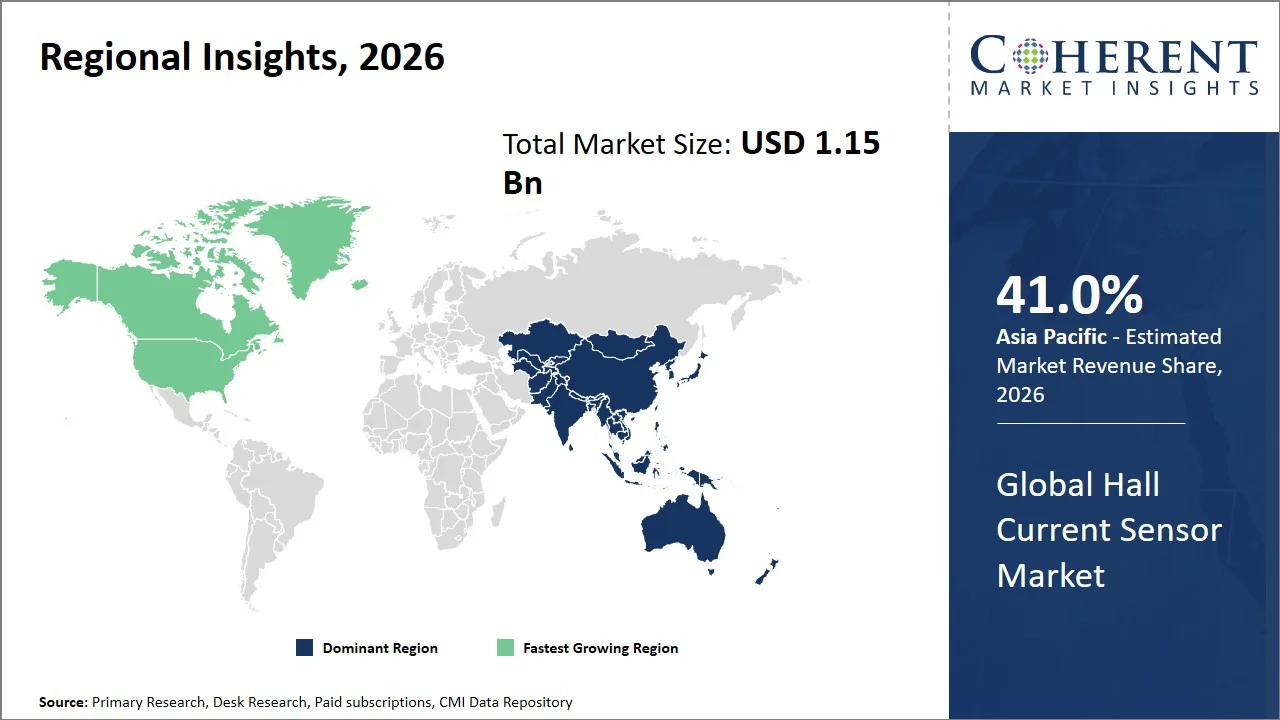
Why is Asia Pacific a Strong Market for Hall Current Sensor?
Asia Pacific is expected to account for a market share of 41.0% in 2026. The Asia Pacific region is the greatest manufacturing hub for Hall current sensors due to the concentration of electric vehicle production, battery manufacture, consumer electronics, and industrial automation. China, Japan, and South Korea are large contributors to worldwide demand, with businesses such as BYD, CATL, Panasonic Energy, and Mitsubishi Electric using Hall current sensors in battery management systems, traction inverters and industrial motor drives. The region is also experiencing widespread deployment of renewable energy and battery energy storage projects, and Hall current sensors are increasingly used in photovoltaic inverters and power conversion equipment. On February 28, 2024, Asahi Kasei Microdevices Corporation (AKM) started mass production of the CZ39 series of coreless current sensors. The CZ39 device family is particularly well-suited to electric vehicle (EV) applications due to its 100 ns response time, low heat generation, and noise immunity.
Why Does North America Hall Current Sensor Market Exhibit High Growth?
North America is projected to account for 32.0% of the global hall current sensor market and expected to register the fastest growth. Electric mobility, aerospace, industrial automation, and the upgrade of energy infrastructure all drive high demand in North America. In U.S., Hall current sensing technologies are used in electric powertrains, charging systems, energy storage solutions and grid equipment by corporations like Tesla, Rivian, and GE Vernova. The region is also home to prominent sensor vendors such as Allegro MicroSystems, Honeywell, and Texas Instruments that continue to develop high accuracy Hall current sensing integrated circuits for automotive and industrial applications. Moreover, growing developments in in industrial automation in the region are also driving the growth of the hall current sensor market. On October 21, 2024, Honeywell and Google Cloud announced a unique collaboration connecting artificial intelligence (AI) agents with assets, people and processes to accelerate safer, autonomous operations for the industrial sector.
Global Hall Current Sensor Market Outlook for Key Countries
Why is China Emerging as a Major Hub in the Hall Current Sensor Market?
Hall current sensors are particularly important to China because of its leadership in electric car production, lithium-ion battery manufacture and renewable energy deployment. Hall current sensors are widely used in domestic manufacturers such as BYD, NIO, XPeng, and battery maker CATL in battery management systems, onboard chargers and motor controllers. The fast development of utility-scale solar and battery energy storage facilities in the country has further expedited the use of Hall current sensors in power conversion systems by businesses such as Sungrow and Huawei Digital Power.
Is U.S. the Next Growth Engine for the Hall Current Sensor Market?
The U.S. boasts of a technologically advanced hall current sensor industry led by electric mobility, smart grid investments and industrial automation. Tesla uses Hall current sensors in all of its electric vehicle platforms and energy storage products, and GE Vernova uses current sensing technologies in grid modernization and renewable energy equipment. Semiconductor makers such as Allegro MicroSystems, Texas Instruments and Honeywell continue to launch automotive-grade Hall current sensing solutions for high-voltage EV platforms, industrial motor control and smart power management.
Germany Hall Current Sensor Market Analysis and Trends
Germany is a key European market, with its large automotive manufacturing base and advanced industrial automation. Car manufacturers like BMW, Mercedes-Benz and Volkswagen Group use Hall current sensors in the electric drive systems, battery management units and charging electronics that make up their growing electric car portfolios. In factory automation systems, Hall current sensors are increasingly integrated into variable frequency drives, intelligent power distribution equipment, and advanced motion control solutions deployed by industrial technology providers such as Siemens and Bosch as part of their Industry 4.0 and smart manufacturing initiatives.
Japan Hall Current Sensor Market Analysis and Trends
The Japanese Hall current sensor market is backed by its globally competitive automotive, robotics and power electronics industry. Hall current sensors are used in hybrid and battery electric vehicles, especially for inverter control and battery monitoring. Toyota, Honda, and Nissan use them. Electronics makers such as Panasonic, Mitsubishi Electric, TDK, and Asahi Kasei Microdevices are still designing small, high-precision solutions for industrial automation, renewable energy systems and sophisticated consumer electronics.
South Korea Hall Current Sensor Market Analysis and Trends
South Korea is seeing strong increase in the deployment of Hall current sensors due to its expertise in battery technology, semiconductor manufacturing, and electric mobility. Hyundai Motor and Kia are using Hall current sensors in their electric car drive systems, and battery makers LG Energy Solution and Samsung SDI are widely using Hall current sensors in their battery management systems for automotive and stationary energy storage applications. Demand for compact and high-performance current sensing technologies found in sophisticated electronic and industrial equipment is also driven by the country’s robust semiconductor ecosystem spearheaded by Samsung Electronics and SK hynix.
Global Hall Current Sensor Market - Renewable Energy Inverters with Hall Current Sensors
Region | Renewable Energy Inverters Equipped with Hall Current Sensors (Million Units) |
Asia Pacific | 18.8 |
Europe | 9.2 |
North America | 7.1 |
Latin America | 3.2 |
Middle East & Africa | 2.4 |
How is Expansion of Fast EV Charging Infrastructure Creating New Growth Opportunities in the Hall Current Sensor Market?
The expansion of fast electric vehicle charging infrastructure is creating considerable potential prospects for the Hall current sensor industry as the demand for precise, real-time current measurement in high-power charging systems grows. DC fast chargers and ultra-fast charging stations need Hall current sensors to offer electrically isolated current monitoring for power conversion, overload protection, thermal management, and billing accuracy because they run at high voltages and currents. As governments and private companies build out public and commercial charging infrastructure to support the expanding fleet of electric vehicles, charger manufacturers are increasingly incorporating high-accuracy Hall current sensors in charging modules, power converters and grid interface equipment to enhance charging efficiency, operational safety and system reliability. On February 5, 2025, Ionna, the North American fast-charging joint venture of BMW, General Motors, Honda, Hyundai, Kia, Mercedes-Benz, Stellantis and Toyota, unveiled its first charging hub and its headquarters in North Carolina.
Market Players, Key Development, and Competitive Intelligence
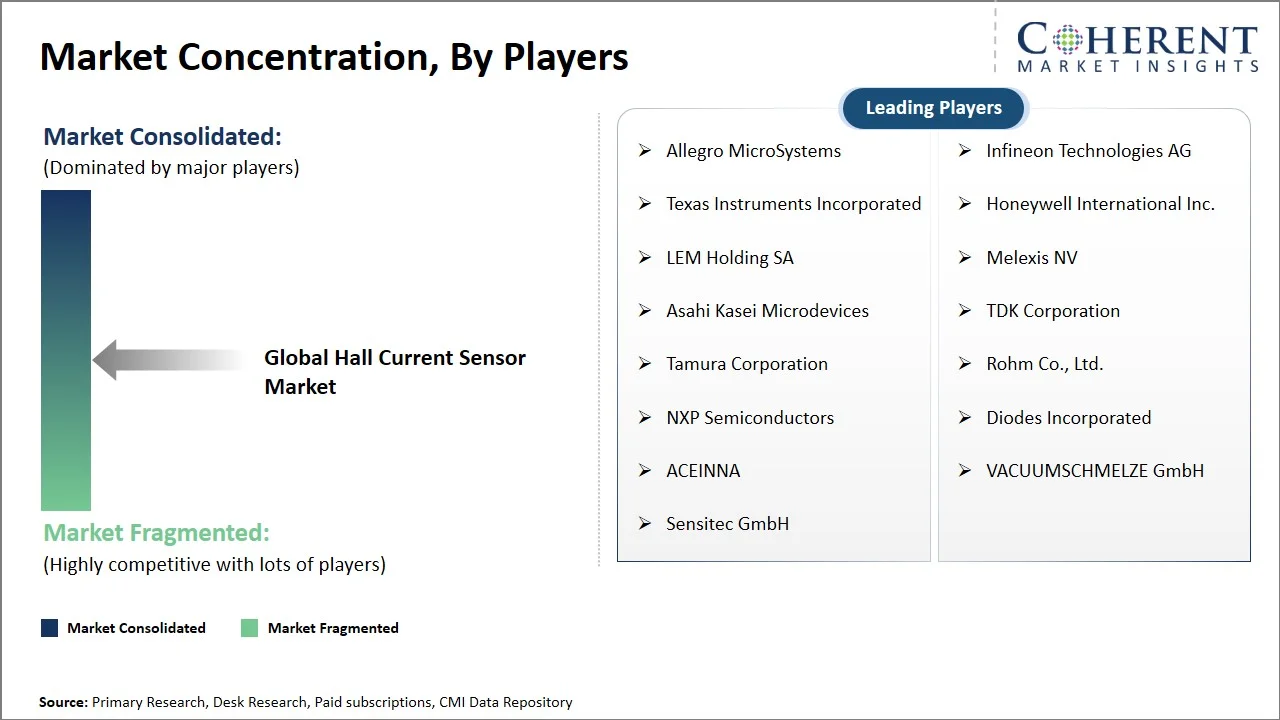
Key Developments
- On April 29, 2025, Asahi Kasei Microdevices Corporation and Silicon Austria Labs GmbH successfully completed a joint proof of concept for integrating a current sensor into a power module to be used in automotive applications such as traction inverters and DC-DC converters. This technology enables energy efficiency, as well as compact and lightweight design for ultra-high current applications using next-generation SiC power devices.
- On January 8, 2025, Allegro MicroSystems, Inc. announced the launch of two new current sensor Ics, the ACS37030MY and the ACS37220MZ. Leveraging Allegro’s cutting-edge sensing technology, these ICs provide low internal conductor resistance, high operating bandwidth, and reliable performance across a wide range of automotive, industrial, and consumer applications.
Competitive Landscape
The global Hall current sensor market is highly competitive with a number of semiconductor manufacturers and specialized sensing technology providers focusing on enhancing accuracy, miniaturization, and electrical isolation. Companies such as Allegro MicroSystems, Infineon Technologies, Texas Instruments, Honeywell, LEM Holding, Melexis, TDK, and Asahi Kasei Microdevices are expanding their product portfolio with automotive-grade and industrial-grade Hall current sensors designed for electric vehicles, renewable energy systems, and industrial automation.
Market Report Scope
Hall Current Sensor Market Report Coverage
| Report Coverage | Details | ||
|---|---|---|---|
| Base Year: | 2025 | Market Size in 2026: | USD 1.15 Bn |
| Historical Data for: | 2020 To 2024 | Forecast Period: | 2026 To 2033 |
| Forecast Period 2026 to 2033 CAGR: | 4.7% | 2033 Value Projection: | USD 2.20 Bn |
| Geographies covered: |
| ||
| Segments covered: |
| ||
| Companies covered: | Allegro MicroSystems, Infineon Technologies AG, Texas Instruments Incorporated, Honeywell International Inc., LEM Holding SA, Melexis NV, Asahi Kasei Microdevices, TDK Corporation, Tamura Corporation, Rohm Co., Ltd., NXP Semiconductors, Diodes Incorporated, ACEINNA, VACUUMSCHMELZE GmbH, Sensitec GmbH | ||
| Growth Drivers: |
| ||
| Restraints & Challenges: |
| ||
Analyst Opinion (Expert Opinion)
- The global Hall current sensor market is being assessed through critical performance metrics including measurement accuracy, linearity, response time, bandwidth, temperature stability, isolation voltage, power consumption, and long-term reliability. Manufacturers are increasingly focusing on reducing offset drift and measurement errors while improving sensitivity across wide current ranges to meet the stringent requirements of automotive, industrial, renewable energy, and power electronics applications. Continuous advancements in semiconductor processes and magnetic sensing technologies are also enabling more compact sensor designs with higher precision and improved electromagnetic compatibility.
- Another important set of market metrics includes package miniaturization, integration capability, functional safety compliance, production yield, and cost efficiency. Greater emphasis is being placed on sensors that support higher current ratings, lower insertion losses, and simplified system integration without compromising electrical isolation or operational stability. Product differentiation is increasingly being measured by lifetime performance, calibration accuracy, thermal robustness, and compatibility with high-voltage power systems, while manufacturing scalability and consistent quality across high-volume production remain essential benchmarks for maintaining competitiveness in the global Hall current sensor market.
- The global Hall current sensor market is being assessed through critical performance metrics including measurement accuracy, linearity, response time, bandwidth, temperature stability, isolation voltage, power consumption, and long-term reliability. Manufacturers are increasingly focusing on reducing offset drift and measurement errors while improving sensitivity across wide current ranges to meet the stringent requirements of automotive, industrial, renewable energy, and power electronics applications. Continuous advancements in semiconductor processes and magnetic sensing technologies are also enabling more compact sensor designs with higher precision and improved electromagnetic compatibility.
- Growth prospects include package miniaturization, integration capability, functional safety compliance, production yield, and cost efficiency. Greater emphasis is being placed on sensors that support higher current ratings, lower insertion losses, and simplified system integration without compromising electrical isolation or operational stability. Product differentiation is increasingly being measured by lifetime performance, calibration accuracy, thermal robustness, and compatibility with high-voltage power systems, while manufacturing scalability and consistent quality across high-volume production remain essential benchmarks for maintaining competitiveness in the global Hall current sensor market.
Speak to the analyst
Want personalized insights?
Take the findings above to one of our principal consultants, or have the report rebuilt around the segments, geographies and competitors you actually track.
Market Segmentation
- Type Insights (Revenue, USD Billion, 2021 - 2033)
- Open-Loop
- Closed-Loop
- Output Type Insights (Revenue, USD Billion, 2021 - 2033)
- Analog Output
- Digital Output
- Current Type Insights (Revenue, USD Billion, 2021 - 2033)
- AC Current Sensors
- DC Current Sensors
- AC/DC Current Sensors
- Mounting Type Insights (Revenue, USD Billion, 2021 - 2033)
- PCB Mount
- Busbar Mount
- Panel Mount
- End User Insights (Revenue, USD Billion, 2021 - 2033)
- Automotive
- Industrial Automation
- Consumer Electronics
- Renewable Energy
- Power and Energy
- Telecommunications
- Medical Devices
- Aerospace and Defense
- Regional Insights (Revenue, USD Billion, 2021 - 2033)
- North America
- U.S.
- Canada
- Latin America
- Brazil
- Argentina
- Mexico
- Rest of Latin America
- Europe
- Germany
- U.K.
- Spain
- France
- Italy
- Russia
- Rest of Europe
- Asia Pacific
- China
- India
- Japan
- Australia
- South Korea
- ASEAN
- Rest of Asia Pacific
- Middle East
- GCC Countries
- Israel
- Rest of Middle East
- Africa
- South Africa
- North Africa
- Central Africa
- North America
- Key Players Insights
- Allegro MicroSystems
- Infineon Technologies AG
- Texas Instruments Incorporated
- Honeywell International Inc.
- LEM Holding SA
- Melexis NV
- Asahi Kasei Microdevices
- TDK Corporation
- Tamura Corporation
- Rohm Co., Ltd.
- NXP Semiconductors
- Diodes Incorporated
- ACEINNA
- VACUUMSCHMELZE GmbH
- Sensitec GmbH
Sources
Primary Research Interviews
- Current Sensor Manufacturers & Product Engineers
- Automotive & EV System Integrators
- Industrial Automation & Power Electronics Specialists
- Energy & Smart Grid Infrastructure Experts
Magazines
- Electronic Design Magazine
- Power Electronics News
- IEEE Spectrum Magazine
- Sensors Magazine
Journals
- IEEE Transactions on Industrial Electronics
- Journal of Magnetism and Magnetic Materials
- Sensors and Actuators A: Physical
Associations
- International Electrotechnical Commission (IEC)
- Institute of Electrical and Electronics Engineers (IEEE)
- Sensor Manufacturers and Users Association (SMUA)
- Electric Drive Transportation Association (EDTA)
Public Domain Sources
- U.S. Department of Energy (DOE) – energy.gov
- European Commission – ec.europa.eu
- International Energy Agency (IEA) – iea.org
- World Bank Open Data – data.worldbank.org
Proprietary Elements
- CMI Data Analytics Tool
- Proprietary CMI Existing Repository of Information for the Last 10 Years
Get access to 250+ pages report
Every segment, forecast, competitor profile and data table behind the analysis above — available for instant download.
- ESOMAR Member
- ISO 9001:2015 Certified
- D-U-N-S Registered
- GDPR & CCPA Compliant
Missing comfort of reading report in your local language? Find your preferred language:
Transform your Strategy with Exclusive Trending Reports
Frequently Asked Questions
The global hall current sensor market is expected to stand at USD 1.15 Bn in 2026 and is expected to reach USD 2.20 Bn by 2033.
The CAGR of the global hall current sensor market is projected to be 4.7% from 2026 to 2033.
In terms of type, open-loop segment is estimated to dominate the market revenue share in 2026.
They monitor charging and discharging currents to improve battery safety, efficiency, and lifespan.
Yes, they are widely used in solar inverters, wind power converters, and battery energy storage systems.
Rising adoption of electric and hybrid vehicles and increasing deployment of battery management systems are the major factors driving the growth of the global hall current sensor market.
Performance limitations under strong external magnetic interference and higher cost than shunt-based current sensing solutions are the major factors hampering the growth of the global hall current sensor market.