

Global Healthtech Market Size and Forecast – 2026 to 2033
The Global Healthtech Market is estimated to be valued at USD 1.25 Tn in 2026 and is expected to reach USD 3.07 Tn by 2033, exhibiting a compound annual growth rate (CAGR) of 13.7% from 2026 to 2033. This substantial growth is driven by advancements in digital health solutions, increasing adoption of telemedicine, and enhanced healthcare infrastructure worldwide. The market’s expansion reflects rising demand for innovative technologies to improve patient outcomes and streamline healthcare delivery.
Key Takeaways of the Global Healthtech Market
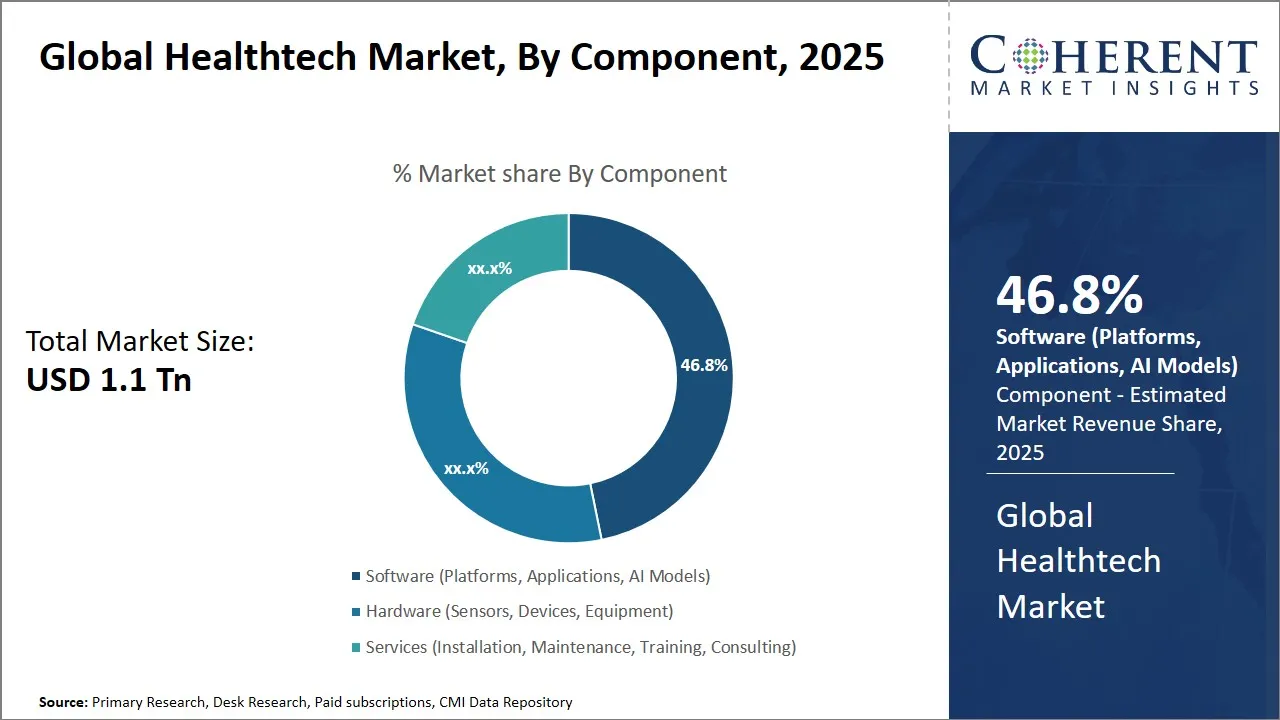
- In the global healthtech market, the software segment comprising platforms, applications, and AI models is expected to account for the largest share at 47.8% in 2026.
- Based on deployment mode, cloud-based platforms are projected to dominate with a 68.5 % share in 2026.
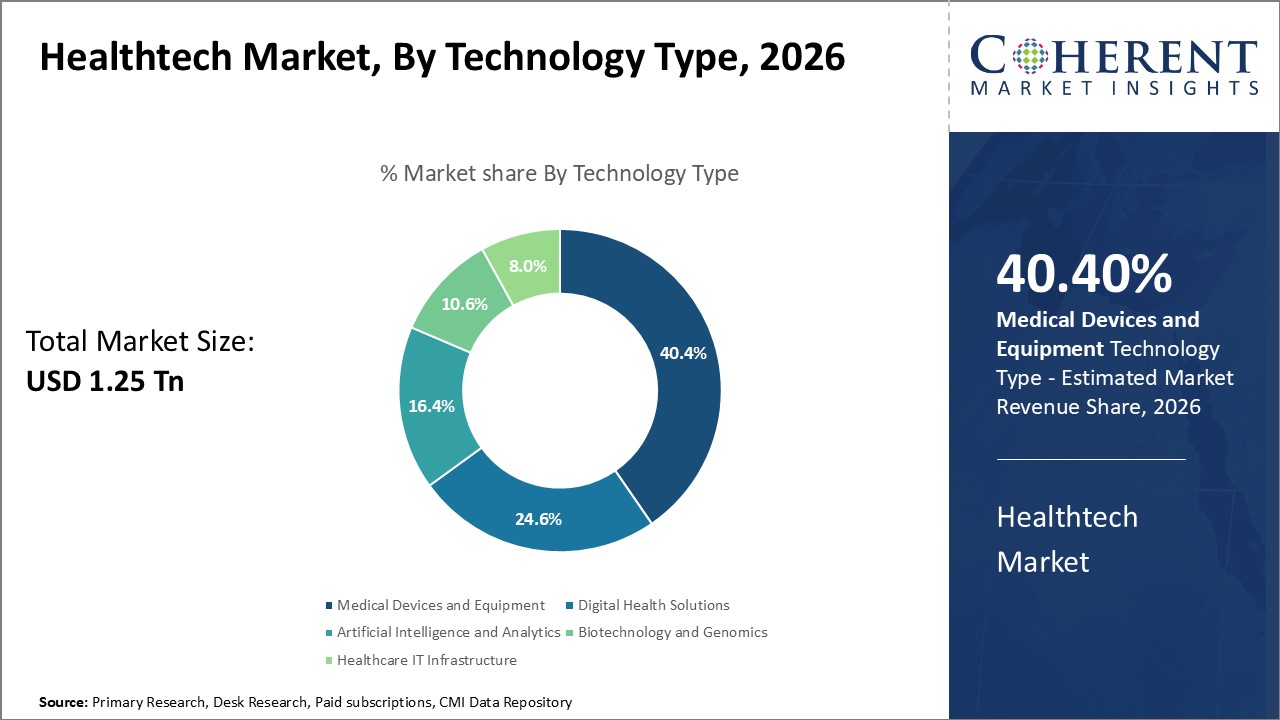
- By technology type, medical devices and equipment is anticipated to lead the market with a 40.4 % share in 2026.
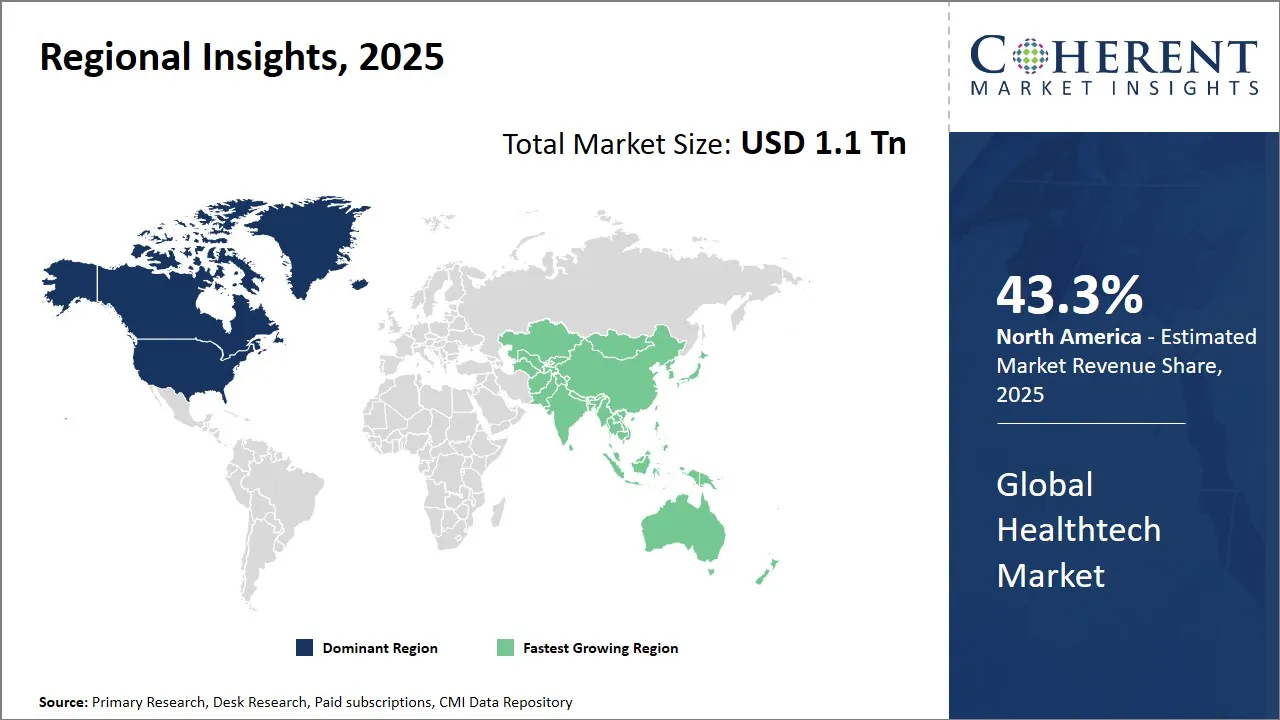
- North America is expected to lead the market, holding a share of 43.3 % in 2026. Asia Pacific is anticipated to be the fastest-growing region, with a market share of 24.5% in 2026.
Market Overview
Key market trends include the integration of artificial intelligence and machine learning in diagnostics and treatment, which are revolutionizing personalized medicine. Additionally, the surge in wearable health devices and remote monitoring tools are enabling continuous patient care outside traditional settings. Growing investments in Healthtech startups and rising awareness about digital health solutions among consumers are further shaping the industry landscape, driving innovation and increasing accessibility to healthcare services globally.
Current Events and Its Impact
Current Events | Description and its Impact |
Surge in AI-driven diagnostics adoption |
|
Expansion of telehealth reimbursement frameworks |
|
Segmental Insights
- Current Industry Events of 2026
- Market Size Estimation
- Regional Breakdown
- Competitive Landscape
- Customer Intelligence
- Segmental Analysis
- Pricing Analysis
- Key Market Drivers, Challenges & Future Trends
- Customized Insights Section
Healthtech Market Insights, By Component - Software segment is dominant due to the rising integration of AI, machine learning, and data analytics
By component, the software (platforms, applications, AI models) segment is expected to hold the largest portion of the global healthtech market share of 47.8% in 2026 due to its transformative ability to improve healthcare delivery, operational efficiency, and patient outcomes. The increasing use of interoperable software platforms and the increasing need of telehealth, remote monitoring, and personalized care are some of the reasons that have contributed to the growth of this segment.
On October 08, 2025, Microsoft, a global technology and healthtech solutions provider, launched a new AI-powered claims denial tool to support rural hospitals under its Rural Health Resilience Program. Available for free on GitHub, the tool helps streamline resolution of denied Medicare, Medicaid, and private insurance claims, improving efficiency in revenue cycle management.
Healthtech Market Insights, By Technology Type - Medical devices and equipment segment is dominant due to expanding adoption of digital health platforms and AI integration
By technology type, the medical devices and equipment segment is projected to have the largest market share at 40.4% in 2026 due to the constant innovation and the growing need to find precise health care solutions. These equipment cut across a wide range, with diagnostic equipment, like imaging equipment, point-of-care equipment, and therapeutic equipment like implantables and surgical equipment.
With the combination of advanced technology like miniaturization, wireless communication, and increased accuracy of sensors, the diagnosis and treatment of various diseases are changing and the medical devices are becoming an inseparable part of the medical environment.
Healthtech Market Insights, By Deployment Mode - Dominance of cloud-based platforms driven by interoperability and real-time access
Cloud-based platforms are expected to hold the largest deployment mode of 68.5% in the market in 2026 due to their scalability, affordability, and capacity to accommodate the fast-changing healthcare demands.
The cloud technology provides health organizations with scalable accessibility to applications, databases, and computing resources without being limited by the physical infrastructure. The flexibility is essential in the new health ecosystem, where data size and complexity constantly grow because of the development of diagnostics, personalized medicine, and digital tools.
Role of Artificial Intelligence (AI) in the Global Healthtech Market
- The global healthtech market is changing Artificial Intelligence (AI) that promotes automation, personalization, and data-driven decision-making in the fields of diagnostics, treatment, and patient management. AI has the potential to offer predictive analytics to detect diseases early, precision medicine based on the analysis of genomic and imaging data, and hospital operational efficiency through the automation of administrative online processes.
- Artificial intelligence-based radiology tools, virtual nurse assistants, and clinical decision support systems will improve the quality of care and reduce costs and human error. Other companies like IBM Watson Health, Philips Healthcare and Tempus use AI to streamline clinical insights, improve care delivery, and improve patient engagement using intelligent platforms.
- AI is enabling new scalable business models in HealthTech, including subscription-based analytics, AI-driven telemedicine, and predictive equipment maintenance. However, challenges like data privacy, algorithmic bias, and regulatory uncertainty remain. Companies can capitalize by adopting secure cloud analytics, cross-industry collaborations, and transparent AI frameworks.
Regional Insights
North America Healthtech Market Analysis and Trends
North America’ dominance in the global healthtech market, with an estimated 43.3% share in 2026, is driven by a developed ecosystem of the healthcare sector and developed technological base and substantial investment in research and development. The powerful industry representation of best-known organizations, such as Cerner Corporation, Teladoc Health, and Medtronic, continues to reinforce the leading role of North America by constantly driving innovative healthtech solutions into the market and increasing access to care via technology.
In September 2026, Australian healthtech company, PainChek, known for its AI-assisted pain assessment solutions, set up its Canadian headquarters in the Edmonton Metropolitan Region to launch its North American operations. PainChek developed the world’s first regulatory-cleared medical device that uses AI-driven facial recognition to evaluate pain levels in non-verbal patients, including those with dementia.
Asia Pacific Healthtech Market Analysis and Trends
The healthtech market growth has been the fastest in the Asia Pacific region, which is expected to hold 24.5% share in 2026. This is because of the high growth rate in digitization, increasing awareness in healthcare, the growing penetration of the internet, and friendly government policies encouraging the development of smart healthcare programs. China, India, and Southeast Asian countries are some of the countries that are opting to use healthtech solutions to deal with issues like high population of patients, absence of equitable access to healthcare, and shortage of healthcare workers.
In June 2026, tech giant, Google, opened its first Asia Pacific Safety Engineering Center in Hyderabad, India, marking its fourth global facility after Munich, Dublin, and Malaga. The new center will focus on tackling AI-driven fraud, strengthening cybersecurity infrastructure, and promoting responsible AI practices.
Global Healthtech Market Outlook for Key Countries
U.S. Healthtech Market Trends
The healthtech market in the U.S. is based on the massive cooperation of both the private and public sectors, and some of the companies that are leading the telemedicine platforms and electronic health records include Teladoc Health and Cerner Corporation. Innovation has been encouraged by the fact that the U.S. government has been concentrating on the digitization of healthcare, value-based healthcare models, and interoperability standards.
Also, the high levels of investor enthusiasm in startups and established corporations spur AI diagnostics breakthrough, remote patient monitoring, and personalized medicine, which means that the U.S. is among the first to come up with scalable and cutting-edge healthtech.
Germany Healthtech Market Trends
The healthtech market in Germany is favorable due to a high quality of the healthcare infrastructure, governmental policies that stimulate the use of digital health, and the active biopharmaceutical sector. Digital Healthcare Act (Digitale-Versorgung-Gesetz) is a policy which allows health insurers to reimburse digital health apps, which will accelerate the adoption of digital therapeutics. Siemens Healthineers, BioNTech and other companies are major stakeholders and they are involved in the development of advanced diagnostic equipment and biotechnological innovations.
In July 2026, Germany’s healthtech startup, Skleo Health, raised USD 3 million in seed funding to expand its AI-powered eye screening network nationwide and fight preventable blindness. Backed by Sanoptis and Antler, the Düsseldorf-based company uses AI and medical review for quick six-minute eye screenings at pharmacies, opticians, and workplaces, already serving over 11,000 people and identifying more than 3,000 cases needing specialist care.
China Healthtech Market Trends
China is an emerging market in healthtech, driven by the long-term governmental support, such as the strategic plans aimed at the development of AI in the medical industry and telemedicine. Ping An Good Doctor and WeDoctor companies are the first to introduce digital healthcare systems to meet the demands of a large and diverse population. The advantages of smart hospital infrastructure and the push by the government to achieve health data interoperability offer fertile ground to have a quick uptake of healthtech
In September 2026, Shanghai launched the Global Health Innovation Institute to boost healthtech research and develop affordable medicines for diseases like tuberculosis and malaria, strengthening China’s role in global healthcare innovation.
India Healthtech Market Trends
The healthtech market in India is developing at an extremely fast rate because of the growing smartphone rates, the positive government initiatives such as Ayushman Bharat Digital Mission and more awareness about the benefits of digital health. The major competitors like Practo, 1mg, and MedGenome are using technology to deliver cost-effective and convenient healthcare services like teleconsultations, e-pharmacy services, and genomics-related diagnostics to both urban and rural communities.
In September 2026, IITI Drishti CPS Foundation at IIT Indore and DHN launched the HealthTech Innovation Challenge 2026 to accelerate digital healthcare innovation in India. The initiative aims to identify and support promising healthtech startups with mentorship, incubation, funding, and market access.
Market Players, Key Developments, and Competitive Intelligence
Key Developments
- In August 2025, the Ireland-based healthtech startup, Phyxiom, a digital healthcare company spun out of RCSI University of Medicine and Health Sciences, was officially launched to transform asthma and COPD management.
- In August 2025, the U.S. Department of Health and Human Services’ Office for Civil Rights (OCR) updated its HIPAA Privacy Rule FAQs to align with the Centers for Medicare & Medicaid Services’ new healthtech initiative. The revisions clarify how protected health information (PHI) can be disclosed under the Privacy Rule, supporting healthcare providers and technology developers in responsibly advancing digital health solutions while maintaining patient data security and compliance.
- In August 2025, New Mexico-based healthtech consortium, HealthInno, received a USD 145,000 grant from the Encantado Foundation to launch a new health technology workforce program in partnership with CNM Ingenuity and New Mexico Community Trust. The initiative aims to train and connect local talent for high-demand roles in health data, informatics, and digital health, helping strengthen the state’s growing healthtech ecosystem.
- In May 2025, London-based venture capital firm Meridian Health Ventures, formerly KHP Ventures, launched the world’s first transatlantic healthtech fund with USD 44.7 million in commitments to help UK innovations scale across the NHS and into the U.S. healthcare market.
Top Strategies Followed by Global Healthtech Market Players
- Established players in the industry spend a lot of money in research and development (R&D) to introduce high performance, innovative products that are industry leaders. To stay on the technological edge, such companies invest significant resources in the development of advanced medical equipment, telehealth applications, and AI-based diagnostic systems. In addition, they enter into strategic collaboration with industry stakeholders, including original equipment manufacturers (OEMs) and healthcare providers, to increase product integration and distribution.
- In August 2025, India’s healthtech firm, Ultrahuman, acquired viO HealthTech to launch “Cycle and Ovulation Pro” for its Ring AIR device, offering advanced cycle tracking and fertility insights using viO’s AI-driven temperature-sensing technology based on over 260,000 recorded cycles.
- The position of the middle-level healthtech players is slightly different as they mostly deal with the offerings related to providing cost-effective solutions that remain a balance between quality and cost. These firms are targeting the consumer segments which are sensitive to price hence designing products and services which are affordable but maintain quality hence serving the hospitals, clinics and patients who are constrained in their finances.
- In September 2025, Karnataka Health Minister Mr. Dinesh Gundu Rao inaugurated Docbrella, a next-generation healthtech platform, in Bengaluru, India to promote transparent, affordable, and digitally accessible healthcare. Developed as an AI-driven “umbrella” system for consultations and patient data security, Docbrella aims to empower informed medical decisions and reduce unnecessary healthcare costs.
- Small players in the global healthtech market stand out by targeting niche segments and offering innovative or highly customized product features. Numerous startups and smaller companies implement new technologies, including artificial intelligence, wearable sensors, blockchain, or more sophisticated data analytics to come up with unique solutions that would solve a particular medical issue or unmet demand.
- In August 2025, India’s healthtech firm, Ultrahuman, acquired viO HealthTech to launch “Cycle and Ovulation Pro” for its Ring AIR, offering cost-effective, AI-powered cycle, and fertility tracking based on data from over 260,000 recorded cycles.
Market Report Scope
Healthtech Market Report Coverage
| Report Coverage | Details | ||
|---|---|---|---|
| Base Year: | 2025 | Market Size in 2026: | USD 1.25 Tn |
| Historical Data for: | 2020 To 2024 | Forecast Period: | 2026 To 2033 |
| Forecast Period 2026 to 2033 CAGR: | 13.7% | 2033 Value Projection: | USD 3.07 Tn |
| Geographies covered: |
| ||
| Segments covered: |
| ||
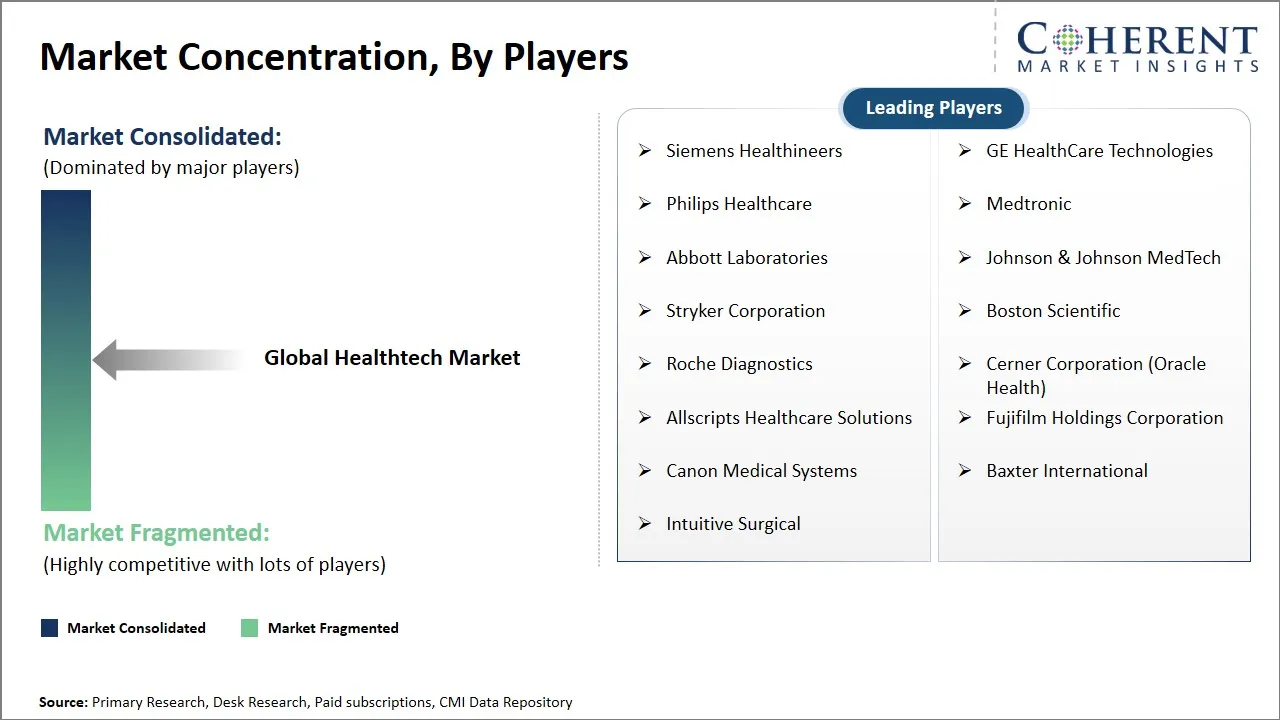
| Companies covered: | Siemens Healthineers, GE HealthCare Technologies, Philips Healthcare, Medtronic, Abbott Laboratories, Johnson & Johnson MedTech, Stryker Corporation, Boston Scientific, Roche Diagnostics, Cerner Corporation (Oracle Health), Allscripts Healthcare Solutions, Fujifilm Holdings Corporation, Canon Medical Systems, Baxter International, and Intuitive Surgical | ||
| Growth Drivers: |
| ||
| Restraints & Challenges: |
| ||
Healthtech Market Dynamics
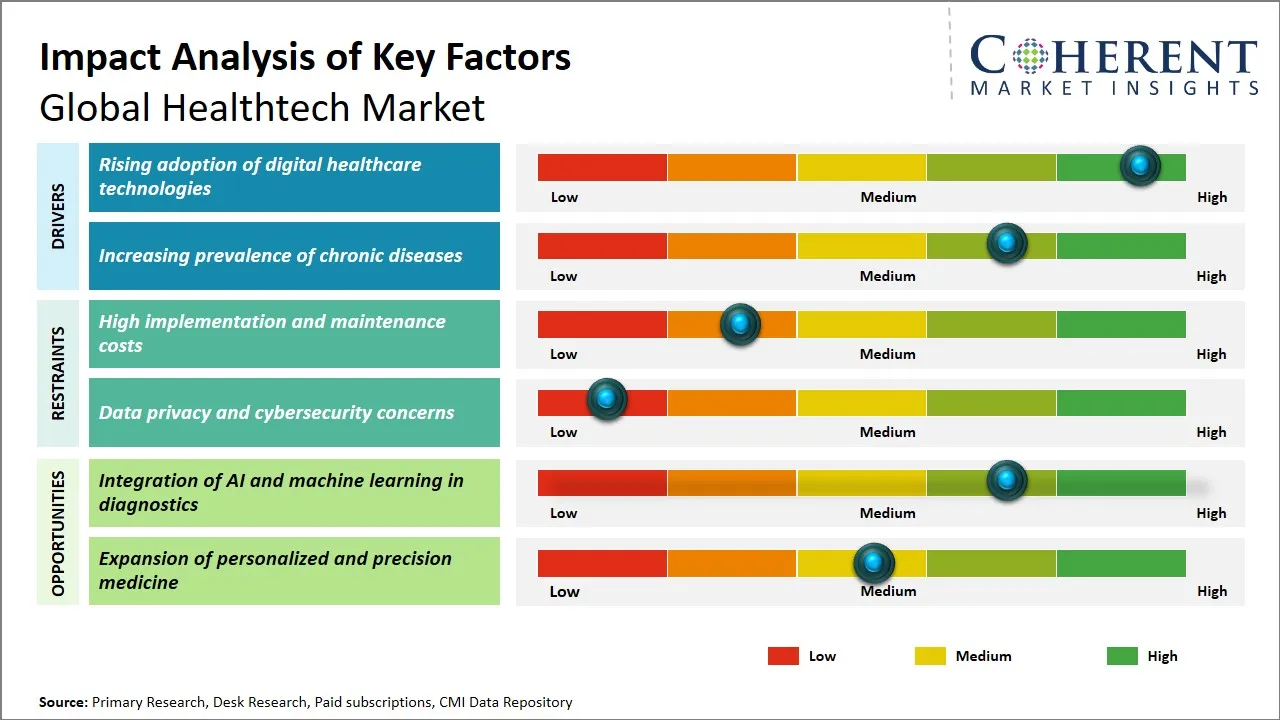
Healthtech Market Driver - Rising Adoption of Digital Healthcare Technologies
The increasing pace of digital healthcare integration is a key factor that is transforming the healthtech market in the global arena. The growing need of consumers to find more convenient, easily available, and personalized healthcare solutions is driving providers to pursue tools and solutions like telemedicine platforms, wearables, remote monitoring, and AI-supported diagnostic applications. Such technologies do not only increase patient interaction and care management but also allow the collection and analytics in real-time, which enhance the accuracy of treatment and efficiency of operations. Furthermore, the development of cloud computing and mobile connectivity reduced the guard to digital usage and enabled healthcare organizations of different sizes to introduce new solutions within a short period of time.
In May 2025, Indian healthtech firm, Practo, expanded its services to the U.A.E, enabling users in Abu Dhabi, Dubai, and Sharjah to book appointments with verified doctors and read patient reviews. With over 17 years in healthcare technology, Practo has onboarded more than 31,000 doctors and 3,000 healthcare facilities, attracting around 50,000 monthly active users in the region.
Healthtech Market Opportunity - Integration of AI and Machine Learning in Diagnostics
Integration of machine learning (ML) and artificial intelligence (AI) into diagnostics is a major developmental prospect of the healthtech market in the world. The future of healthcare is perceived to be in AI-powered diagnostic solutions that will increase the precision, speed, and efficiency of disease detection and prognosis. The algorithms of machine learning can process large volumes of medical information, including images, genetic data, and records of patients, to discern patterns that may not be noticeable by human health experts. The ability does not only enhance the early detection of the intricate conditions like cancer, heart conditions, and neurological conditions, but it is also useful in the personalized treatment planning.
In April 2025, Lytus Technologies, a global platform services and technology company listed on OTCMKTS: LYTHF, expanded its healthtech footprint by acquiring Blod.in, India’s first AI-powered on-demand blood logistics platform for hospitals and blood banks. Operating through its subsidiary, Lytus HealthTech, the company aims to enhance healthcare logistics and ensure timely access to blood products.
Analyst Opinion (Expert Opinion)
- The healthtech market is on a steady increase due to the complicated healthcare system, increased patient education, and the need to provide them with personal care. The use of AI-driven case management and digital navigation solutions is enhancing the level of coordination between patients, providers, and insurers and the regulatory support increases transparency. Telehealth-based advocacy and employer-sponsored health navigation programs are available even though there are challenges such as low awareness in the emerging market and the lack of trained professionals.
- The digital advocacy and data ethics are being advocated through world initiatives like the World Health Summit and Global Health Congress. The navigation platform of Personify Health in the U.S. and NHS patient liaison modernization in the U.K. among others and AI-based advocacy pilots in Canada and Singapore are examples of the industry trend toward data-driven, accessible, and equitable healthcare solutions.
Speak to the analyst
Want personalized insights?
Take the findings above to one of our principal consultants, or have the report rebuilt around the segments, geographies and competitors you actually track.
Market Segmentation
- Component Insights (Revenue, USD Tn, 2021 - 2033)
- Software (Platforms, Applications, AI Models)
- Hardware (Sensors, Devices, Equipment)
- Services (Installation, Maintenance, Training, Consulting)
- Technology Type Insights (Revenue, USD Tn, 2021 - 2033)
- Medical Devices and Equipment
- Diagnostic Devices (Imaging, Monitoring, Point-of-Care)
- Therapeutic Devices (Implantable, Surgical, Rehabilitation)
- Wearables (Fitness, Medical-Grade, Smart Textiles, etc.)
- Others
- Digital Health Solutions
- Telehealth/Telemedicine Platforms
- mHealth Applications
- Electronic Health Records (EHR/EMR)
- Remote Patient Monitoring Systems
- Others (Digital Therapeutics)
- Artificial Intelligence and Analytics
- Clinical Decision Support Systems
- Predictive Analytics Platforms
- Medical Imaging AI
- Others (Drug Discovery and Genomics AI)
- Robotics and Automation
- Surgical Robots
- Rehabilitation Robots
- Others (Hospital Service Robots)
- Biotechnology and Genomics
- Gene Sequencing and Editing Tools
- Regenerative Medicine Solutions
- Others (Bioinformatics Platforms)
- Healthcare IT Infrastructure
- Cloud Computing and Data Storage
- Cybersecurity Solutions
- Others (Interoperability and Integration Platforms)
- Medical Devices and Equipment
- Deployment Mode Insights (Revenue, USD Tn, 2021 - 2033)
- Cloud-based Platforms
- On-premise Systems
- Hybrid Models
- Application Insights (Revenue, USD Tn, 2021 - 2033)
- Diagnostics and Screening
- Treatment and Therapy
- Patient Monitoring
- Clinical Workflow Management
- Preventive and Wellness Care
- Drug Discovery and Development
- Hospital Operations and Administration
- End User Insights (Revenue, USD Tn, 2021 - 2033)
- Hospitals and Clinics
- Diagnostic Centers
- Research and Academic Institutes
- Pharmaceutical and Biotechnology Companies
- Home Healthcare Providers
- Insurance Companies and Payers
- Government and Public Health Agencies
- Regional Insights (Revenue, USD Tn, 2021 - 2033)
- North America
- U.S.
- Canada
- Latin America
- Brazil
- Argentina
- Mexico
- Rest of Latin America
- Europe
- Germany
- U.K.
- Spain
- France
- Italy
- Russia
- Rest of Europe
- Asia Pacific
- China
- India
- Japan
- Australia
- South Korea
- ASEAN
- Rest of Asia Pacific
- Middle East
- GCC Countries
- Israel
- Rest of Middle East
- Africa
- South Africa
- North Africa
- Central Africa
- North America
- Key Players Insights
- Siemens Healthineers
- GE HealthCare Technologies
- Philips Healthcare
- Medtronic
- Abbott Laboratories
- Johnson & Johnson MedTech
- Stryker Corporation
- Boston Scientific
- Roche Diagnostics
- Cerner Corporation (Oracle Health)
- Allscripts Healthcare Solutions
- Fujifilm Holdings Corporation
- Canon Medical Systems
- Baxter International
- Intuitive Surgical
Sources
Primary Research Interviews
- Industry Stakeholders List
- World Health Organization (WHO) Regional Health Innovation Officers
- Chief Technology Officers (CTOs) of Medical Device Manufacturers
- End Users List
- Hospital IT Directors and Telehealth Program Managers
- Healthcare Practitioners and Clinical Administrators
Government and International Databases
- World Health Organization (WHO)
- Organisation for Economic Co-operation and Development (OECD) Health Data
- World Bank Health Statistics
- U.S. Food and Drug Administration (FDA)
- European Medicines Agency (EMA)
- National Health Service (NHS) Digital
Trade Publications
- Healthcare IT News
- MedTech Dive
- Medical Device Network
- Fierce Healthcare
- BioWorld
- PharmaVoice
Academic Journals
- The Lancet Digital Health
- Journal of Medical Internet Research (JMIR)
- Nature Digital Medicine
- IEEE Journal of Biomedical and Health Informatics
- Health Affairs Journal
- International Journal of Medical Informatics
Reputable Newspapers
- The Wall Street Journal (Health & Tech Section)
- The Guardian (Health Innovation)
- The New York Times (Health)
- Financial Times (Healthcare & Life Sciences)
- Reuters Health
- Bloomberg Healthcare
Industry Associations
- Medical Device Manufacturers Association (MDMA)
- Advanced Medical Technology Association (AdvaMed)
- Digital Therapeutics Alliance (DTA)
- Healthcare Information and Management Systems Society (HIMSS)
- American Telemedicine Association (ATA)
- European Federation of Pharmaceutical Industries and Associations (EFPIA)
Public Domain Resources
- World Health Organization Global Observatory for eHealth
- U.S. National Center for Biotechnology Information (NCBI)
- European Commission Health Technology Assessment Reports
- Centers for Medicare & Medicaid Services (CMS)
- National Institute for Health and Care Excellence (NICE)
Proprietary Elements
- CMI Data Analytics Tool: Proprietary analytics tool to analyze real-time market trends, consumer behavior, and technology adoption in market
- Proprietary CMI Existing Repository of Information for Last 8 Years
Get access to 250+ pages report
Every segment, forecast, competitor profile and data table behind the analysis above — available for instant download.
- ESOMAR Member
- ISO 9001:2015 Certified
- D-U-N-S Registered
- GDPR & CCPA Compliant
Missing comfort of reading report in your local language? Find your preferred language:
Transform your Strategy with Exclusive Trending Reports
Frequently Asked Questions
The global healthtech market is estimated to be valued at USD 1.25 Tn in 2026 and is expected to reach USD 3.07 Tn by 2033.
The CAGR of global healthtech market is projected to be 13.7% from 2026 to 2033.
Rising adoption of digital healthcare technologies and increasing prevalence of chronic diseases are the major factors driving the growth of the global healthtech market.
High implementation and maintenance costs and data privacy and cybersecurity concerns are the major factors hampering the growth of the global healthtech market.
In terms of component, software (platforms, applications, AI models) is estimated to dominate the market revenue share in 2026.
Siemens Healthineers, GE HealthCare Technologies, Philips Healthcare, Medtronic, Abbott Laboratories, Johnson & Johnson MedTech, Stryker Corporation, Boston Scientific, Roche Diagnostics, Cerner Corporation (Oracle Health), Allscripts Healthcare Solutions, Fujifilm Holdings Corporation, Canon Medical Systems, Baxter International, and Intuitive Surgical are the major players.
North America is expected to lead the global healthtech market in 2026.