

Global High Altitude Platforms Market Size and Forecast: 2026-2033
The global high altitude platforms market is estimated to be valued at USD 1.87 Bn in 2026 and is expected to reach USD 3.20 Bn by 2033, exhibiting a compound annual growth rate (CAGR) of 8.0% from 2026 to 2033.
Key Takeaways of the Global High Altitude Platforms Market
- The airships segment leads the market holding an estimated share of 40.2% in 2026.
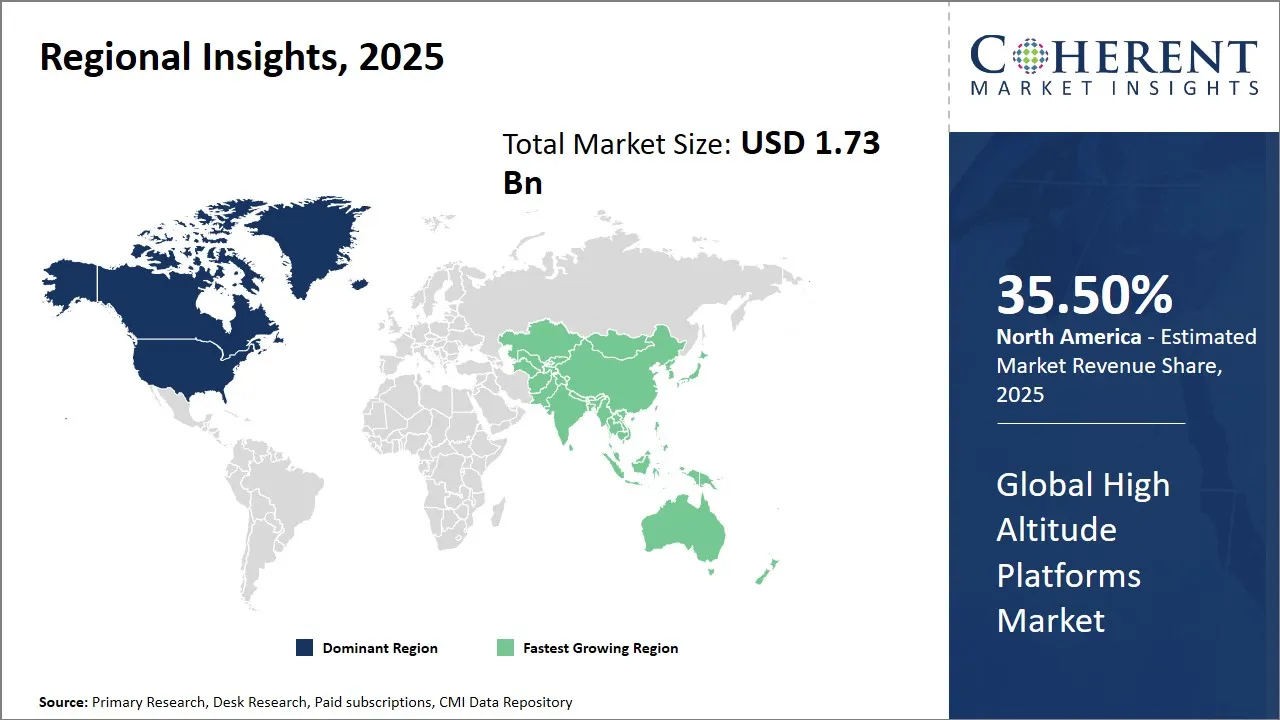
- North America is estimated to lead the market with a share of 35.5% in 2026.
- Asia Pacific, holding an estimated share of 29.8% in 2026 is projected to be the fastest growing region.
Market Overview
The market is seeing a big shift towards integrating artificial intelligence and machine learning technologies within high altitude platforms to improve data analytics and operational efficiency. Also, there is a lot of focus on sustainability, with companies exploring solar-powered platforms to reduce environmental impact. Collaboration between private companies and government agencies is also accelerating innovation, while expanding applications in defense, telecommunications, and disaster management continue to fuel the market expansion.
Current Events and their Impact
Current Events | Description and its Impact |
Geopolitical and Trade Developments |
|
Economic and Infrastructure Trends |
|
Segmental Insights
- Current Industry Events of 2026
- Market Size Estimation
- Regional Breakdown
- Competitive Landscape
- Customer Intelligence
- Segmental Analysis
- Pricing Analysis
- Key Market Drivers, Challenges & Future Trends
- Customized Insights Section
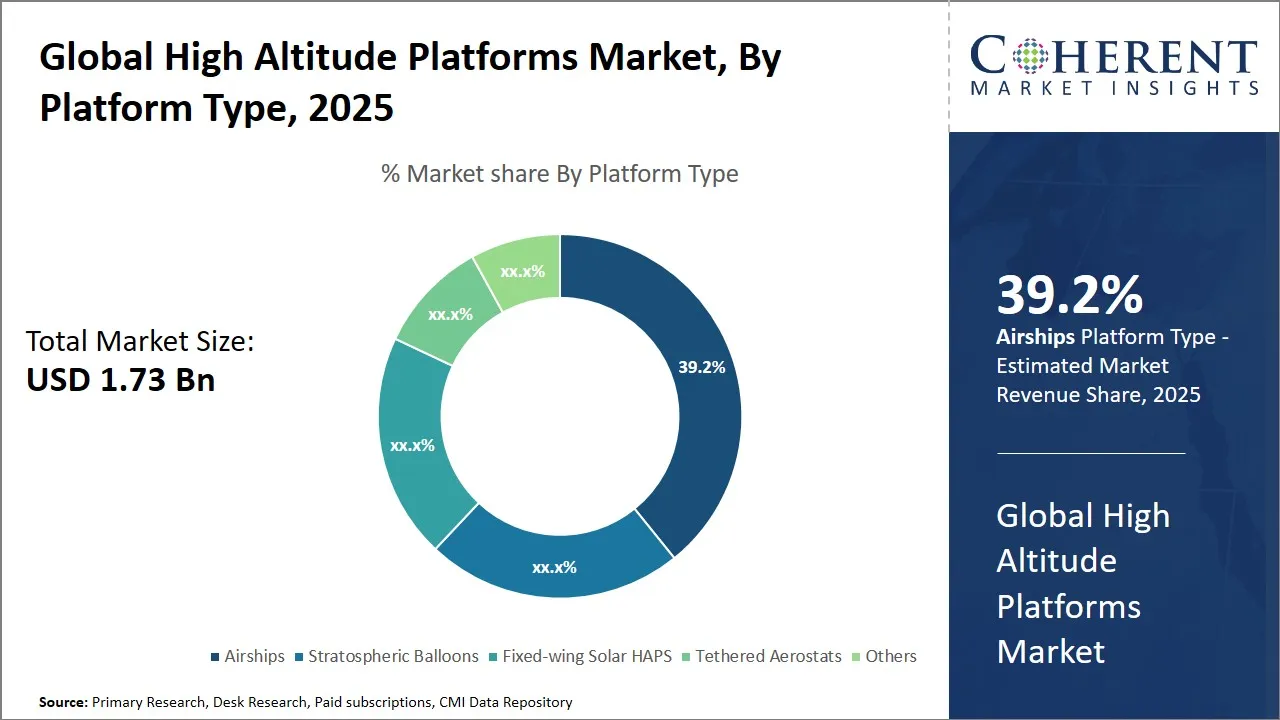
Global High Altitude Platforms Market Insights, By Platform Type – Airships Segment Dominates due to the Rising Demand for Versatile and Cost-Effective Connectivity Solutions
The airships segment is projected to account for 40.2% share in 2026. Airships offer persistent and wide-area coverage, making them very useful for telecommunications, surveillance, earth observation, and environmental monitoring applications. They can hover over a targeted area for weeks or even months, providing continuous service and reliable connectivity. For instance, in 2023, Sceye, a U.S.-based HAPS developer, successfully launched its stratospheric airship from New Mexico, showing the ability to hover at an altitude of around 65,000 feet for extended periods.
Also, airships need lower operational costs compared to traditional airborne platforms and satellites. Their fuel efficiency, combined with lower launch and retrieval expenses, makes airships an economical option for service providers and governments aiming to enhance broadband access or conduct prolonged surveillance missions. Another crucial growth driver is the advancement in lightweight materials and improved propulsion technologies, which have enhanced the performance, safety, and payload capacity of modern airships.
Impact of Artificial Intelligence ( AI) on the High Altitude Platforms Market
Artificial Intelligence (AI) is becoming a critical enabler in high-altitude platforms, enhancing their ability to operate autonomously in the stratosphere for extended periods. AI-powered algorithms are used for real-time navigation, adaptive flight control, and payload management, allowing platforms like solar-powered UAVs and stratospheric balloons to maintain station-keeping despite unpredictable stratospheric winds. In addition, AI-driven analytics help process vast amounts of data captured by HAPs, such as high-resolution imagery, surveillance footage, and telecom traffic, enabling faster decision-making for defense, disaster response, and environmental monitoring.
A real instance of AI integration is seen in Airbus’s Zephyr UAV, operated by its subsidiary AALTO. The Zephyr uses AI-based flight management systems to optimize energy use from solar panels and batteries, ensuring record-breaking endurance of over 67 continuous days in flight.
Regional Insights
North America High Altitude Platforms Market Analysis and Trends
North America, holding an estimated share of 35.50% in 2026, dominates the global high altitude platforms market, driven by a combination of advanced technological infrastructure, strong government support, and a well-established aerospace and defense ecosystem. The U.S., in particular, plays a pivotal role due to extensive investments in research and development related to High Altitude Platform Stations (HAPS) for both commercial and military applications. Regulatory frameworks facilitated by agencies such as the Federal Aviation Administration (FAA) and the Federal Communications Commission (FCC) encourage innovation while ensuring airspace safety.
Furthermore, North America houses several key industry players such as AeroVironment, Loon LLC (a subsidiary of Alphabet), and Lockheed Martin, who contribute significantly with diverse offerings ranging from solar-powered drones to autonomous airships and fixed-wing platforms. The presence of leading technology companies and startups fosters a robust ecosystem that supports sustained market leadership. The trade dynamics also favor rapid collaboration and integration with global supply chains, further consolidating North America’s market dominance.
Asia Pacific High Altitude Platforms Market Analysis and Trends
The Asia Pacific region is expected to exhibit the fastest growth in the market contributing 29.8% in 2026, fueled by rapid digitalization, rising demand for improved communications infrastructure, and increasing government initiatives toward smart city developments and broadband connectivity. Countries like India, China, and Japan have been aggressively ramping up their investments in high altitude platform technologies to bridge rural and remote connectivity gaps. Supportive regulatory policies from governments that emphasize indigenous innovation and public-private partnerships are enhancing market penetration.
The expanding aerospace manufacturing base in the region and rising local industry participation by companies such as Strat Aero (India), China Aerospace Science and Technology Corporation (CASC), and SoftBank-backed HAP firm HAPSMobile demonstrate the emerging prominence of Asia Pacific in this sector. Regional trade policies encouraging technology transfer and cross-border collaborations further accelerate growth, making Asia Pacific a hotbed for innovation and expansion in high altitude platform solutions.
Global High Altitude Platforms Market Outlook for Key Countries
U.S. High Altitude Platforms Market Analysis and Trends
The U.S. remains the strongest globally due to its advanced aerospace research facilities, significant defense budget allocations, and presence of innovators like Lockheed Martin and AeroVironment, which focus on high-altitude drones and solar-powered aircraft. The government’s strategic endorsements through DARPA and NASA focus heavily on integrating HAPS with satellite and 5G networks, which consolidates the U.S. position. Additionally, collaborations between private companies and research institutions enable rapid prototype developments and trials, resonating with commercial and strategic demand.
China High Altitude Platforms Market Analysis and Trends
China leads the Asia Pacific high altitude platforms market because of strong government-backed initiatives that look to achieve global leadership in aerospace and communications technologies. State-owned enterprises like China Aerospace Science and Technology Corporation (CASC) invest a lot in high altitude platforms, focusing on both civilian and defense applications. Strong domestic manufacturing capabilities and a comprehensive supply chain improve the country’s ability to innovate and scale solutions. Regulatory policies that support local R&D alongside growing demand for rural connectivity and disaster management applications add to the adoption of the high altitude platforms.
India High Altitude Platforms Market Analysis and Trends
India has seen growth because of ambitious national programs to improve internet penetration in rural areas and improve disaster surveillance systems. The government supports indigenous development through agencies like DRDO and partnerships with startups such as Strat Aero, focusing on cost-effective and environment-friendly HAPS solutions. India’s diverse geography and huge population add to the use of high altitude platforms for telecommunications, agriculture monitoring, and emergency response. Ongoing reforms toward easing airspace regulations encourage commercial viability and market entry by private players.
U.K. High Altitude Platforms Market Analysis and Trends
The U.K. holds a leading position because of the presence of leading aerospace companies like BAE Systems and Thales that are actively involved in developing high altitude platform technology. The government's “Future Combat Air System” program and investment in Next Generation Air Transportation Systems (NGATS) provide a conducive environment for innovative deployment of unmanned aerial platforms. The UK also sees strong research collaboration between academic institutions and industry.
Japan High Altitude Platforms Market Analysis and Trends
Japan high altitude platforms market, while smaller in size compared to China and the U.S., shows focus on technological precision and use of HAPS in smart infrastructure frameworks. Companies like NEC Corporation and SoftBank-backed initiatives add to developments in solar-powered and hydrogen-fueled high altitude platforms. The Japanese government supports sustainable technologies that align with its digital transformation goals. It focuses on applications in disaster resilience and improved communications in mountainous and island regions.
Market Players, Key Development, and Competitive Intelligence
Key Developments
- In April 2025, AALTO HAPS Ltd., an Airbus subsidiary based in Farnborough, U.K., set a world-record for global aviation with its Zephyr High Altitude Platform Station (HAPS). Designed, manufactured and operated by AALTO, Zephyr concluded 67 days, 6 hours and 52 minutes of continuous flight in the stratosphere. This surpassed Zephyr’s previous flight record of 64 days in 2022, and breaks the world-record for longest flight duration that has stood for half a century.
- In April 2025, Near Space Labs announced USD 20 million in Series B funding to accelerate delivery of its ultra-high-resolution, frequent aerial imagery across the continental U.S.
- In October 2024, an Aerostar Thunderhead Balloon achieved 200 days of stratospheric flight. The balloon, identified as HBAL 676, manufactured by Aerostar International LLC in South Dakota, U.S. was launched from New Mexico on March 28, 2024 to conduct research and development activities associated with navigation.
- In October 2024, AeroVironment (AV) flight-tested an upgraded Sunglider, enhancing its High-Altitude Platform-Station (HAPS) capabilities for commercial and government markets. The result was Horus A, the new version of Sunglider for government applications. Horus A is a solar-powered UAS capable of carrying up to 150 lb of payload with 1.5 kW of available power, offering industry-leading stratospheric performance.
Top Strategies Followed by High Altitude Platforms Market Players
- Established market leaders consistently invest heavily in research and development to innovate and refine high-performance products that meet the evolving demands of various applications, such as telecommunications, surveillance, and environmental monitoring.
- Airbus (AALTO HAPS) continues to invest in its Zephyr solar-powered Unmanned Aerial Vehicle (UAV).
- Mid-level players in the high altitude platforms market, while operating with relatively modest resources compared to industry giants, carve out a significant share by focusing on cost-effective solutions that strike an optimal balance between quality and affordability.
- Aerostar (U.S.), through its Thunderhead Balloon System, offers long-endurance balloon HAPs capable of over 300 days of stratospheric flight at a fraction of the cost of UAV-based systems.
- Small-scale enterprises in the high altitude platforms market differentiate themselves by developing unique features or addressing specific application needs—such as ultra-lightweight platforms, highly modular designs, or customized software capabilities—that larger firms may overlook.
- Near Space Labs (U.S.), developed “Swifty” stratospheric balloons that capture very-high-resolution imagery for urban planning, insurance, and climate analysis.
Market Report Scope
High Altitude Platforms Market Report Coverage
| Report Coverage | Details | ||
|---|---|---|---|
| Base Year: | 2025 | Market Size in 2026: | USD 1.87 Bn |
| Historical Data for: | 2020 To 2024 | Forecast Period: | 2026 To 2033 |
| Forecast Period 2026 to 2033 CAGR: | 8.0% | 2033 Value Projection: | USD 3.20 Bn |
| Geographies covered: |
| ||
| Segments covered: |
| ||
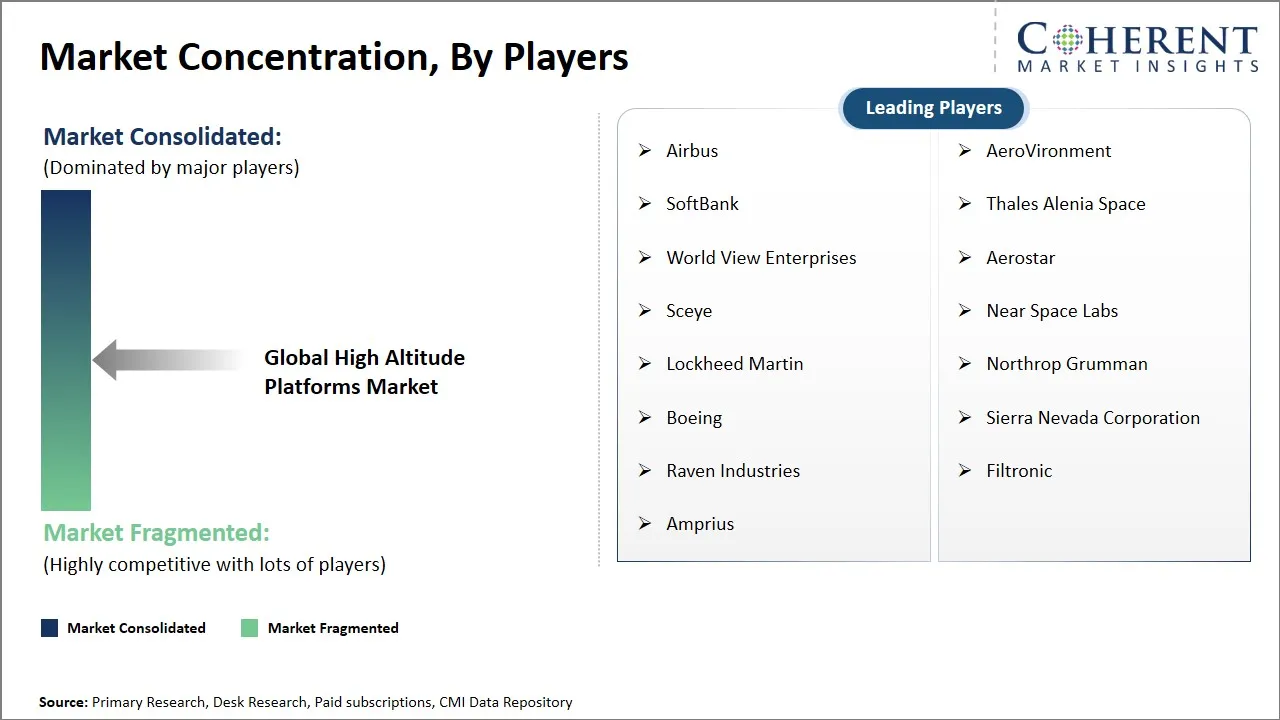
| Companies covered: | Airbus, AeroVironment, SoftBank, Thales Alenia Space, World View Enterprises, Aerostar, Sceye, Near Space Labs, Lockheed Martin, Northrop Grumman, Boeing, Sierra Nevada Corporation, Raven Industries, Filtronic, and Amprius | ||
| Growth Drivers: |
| ||
| Restraints & Challenges: |
| ||
Market Dynamics
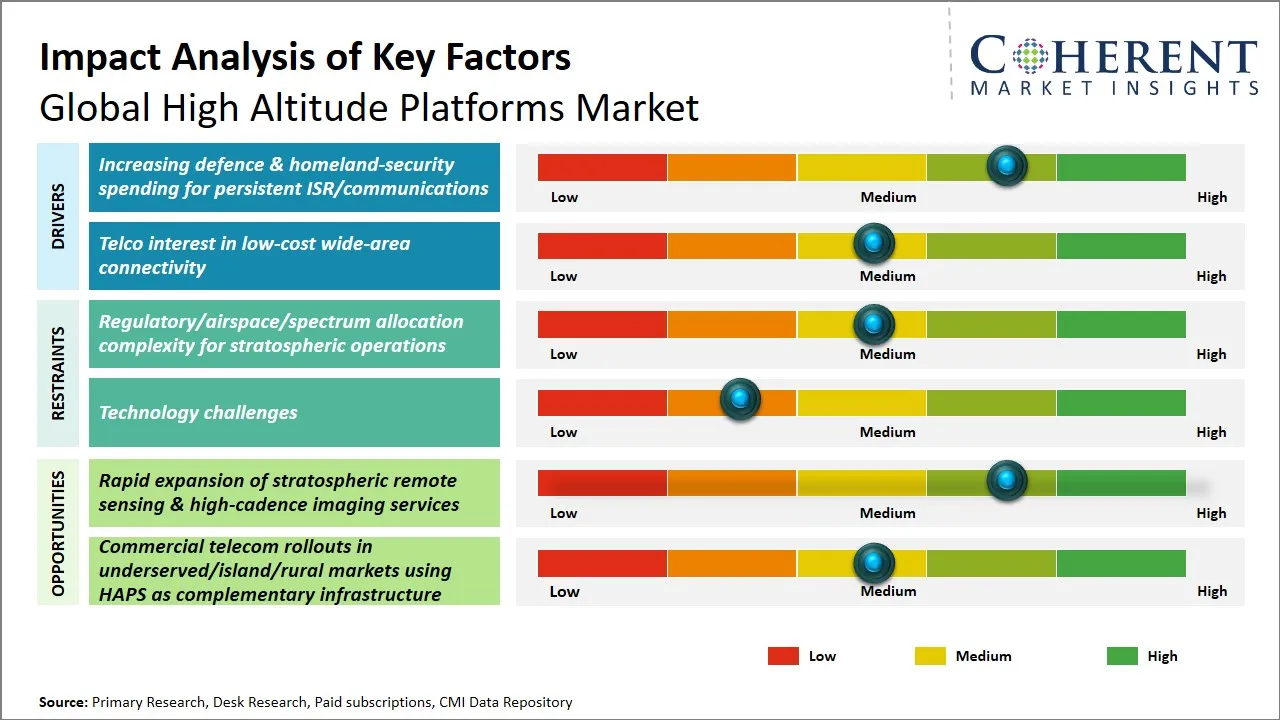
Global High Altitude Platforms Market Driver - Increasing Defense & Homeland-Security Spending for Persistent ISR/Communications
The escalating geopolitical tensions and evolving nature of global security threats have driven nations to significantly enhance their defense and homeland security budgets, which in turn is propelling the demand for High Altitude Platforms (HAPs). These platforms provide persistent Intelligence, Surveillance, and Reconnaissance (ISR) capabilities that are crucial for continuous monitoring over vast, inaccessible, or hostile areas without the limitations faced by traditional satellites and manned aircraft. High altitude platforms are increasingly favored for their ability to deliver real-time communications and situational awareness with enhanced flexibility and reduced deployment costs.
Governments and defense agencies see HAPs as vital assets for border security, disaster management, and rapid response operations. The ability of HAPs to maintain prolonged presence at stratospheric altitudes supports seamless data transmission and network connectivity, which is essential for modern security frameworks. In 2023, the U.S. Department of Defense awarded contracts to Aerostar for its Thunderhead Balloon System, leveraging long-endurance stratospheric balloons for persistent ISR (Intelligence, Surveillance, and Reconnaissance) missions. Consequently, the strategic importance of persistent ISR and communication solutions is driving robust investments in high altitude platform technologies by defense and homeland security sectors worldwide.
Global High Altitude Platforms Market Opportunity – Rapid Expansion of Stratospheric Remote Sensing and High-Cadence Imaging Services
High altitude platforms operating in the stratosphere provide an advantageous vantage point for continuous, high-resolution data acquisition, offering critical support to sectors such as environmental monitoring, agriculture, disaster management, and defense intelligence. The ability of HAPs to deliver persistent surveillance and real-time imaging with minimal latency is increasingly essential for applications requiring frequent and detailed observation over wide geographic areas. Near Space Labs (U.S.) raised $20 million in Series B funding in April 2025 to expand its fleet of “Swifty” balloon platforms. These stratospheric systems deliver ultra-high-resolution, high-cadence imagery for applications in urban planning, climate monitoring, and insurance assessments.
Furthermore, advancements in sensor technology, data processing algorithms, and communication systems have enhanced the capabilities of HAPs to capture multispectral, hyperspectral, and synthetic aperture radar (SAR) data, thereby enriching the quality and utility of remote sensing outputs. With growing demand for enhanced earth observation data to address climate change impacts, optimize crop yields, and monitor natural disasters more effectively, the market for stratospheric remote sensing platforms is poised for rapid expansion.
Analyst Opinion (Expert Opinion)
- Integration of AI for flight path optimization, energy management, and autonomous station-keeping is transforming HAPs from experimental systems into reliable pseudo-satellites. This will reduce operating costs and open broader adoption in both defense and commercial sectors.
- Telcos in Asia Pacific and Africa are piloting HAPS for 4G/5G extension in rural and underserved regions, offering a cost-effective complement to terrestrial towers and LEO satellites. This segment is poised to be one of the fastest-growing applications.
- Stratospheric balloons equipped with advanced imaging payloads are enabling high-cadence, ultra-high-resolution data services for urban planning, agriculture, and disaster management. This niche could create a new competitive frontier against traditional satellite imaging.
Speak to the analyst
Want personalized insights?
Take the findings above to one of our principal consultants, or have the report rebuilt around the segments, geographies and competitors you actually track.
Market Segmentation
- Platform Type Insights (Revenue, USD Bn, 2021 - 2033)
- Airships
- Stratospheric Balloons
- Fixed-wing Solar HAPS
- Tethered Aerostats
- Others
- Regional Insights (Revenue, USD Bn, 2021 - 2033)
- North America
- U.S.
- Canada
- Latin America
- Brazil
- Argentina
- Mexico
- Rest of Latin America
- Europe
- Germany
- U.K.
- Spain
- France
- Italy
- Russia
- Rest of Europe
- Asia Pacific
- China
- India
- Japan
- Australia
- South Korea
- ASEAN
- Rest of Asia Pacific
- Middle East
- GCC Countries
- Israel
- Rest of Middle East
- Africa
- South Africa
- North Africa
- Central Africa
- North America
- Key Players Insights
- Airbus
- AeroVironment
- SoftBank
- Thales Alenia Space
- World View Enterprises
- Aerostar
- Sceye
- Near Space Labs
- Lockheed Martin
- Northrop Grumman
- Boeing
- Sierra Nevada Corporation
- Raven Industries
- Filtronic
- Amprius
Sources
Primary Research Interviews
Stakeholders
- Aerospace OEMs
- Stratospheric Balloon Manufacturers
- Telecom Operators engaged in HAPS pilots
- Defense Agencies and Procurement Officers (ISR program managers)
- Satellite & Remote Sensing Companies exploring HAPS partnerships
- Civil Aviation Regulators and Spectrum Authorities
- Environmental Monitoring Agencies and Climate Research Institutions
Databases
- International Telecommunication Union (ITU)
- U.S. Federal Aviation Administration (FAA) Data Hub
- Eurocontrol Aviation Database
- OECD
- NASA Earth Science Data Systems
Magazines
- Aerospace & Defense Technology
- Aviation Week & Space Technology
- Satellite Evolution Global
- Unmanned Systems Technology
Journals
- Journal of Aerospace Information Systems
- Remote Sensing Journal
- IEEE Transactions on Aerospace and Electronic Systems
- International Journal of Satellite Communications and Networking
- Journal of Atmospheric and Solar-Terrestrial Physics
Newspapers
- The Wall Street Journal (U.S.)
- Nikkei Asia (Japan)
- The Guardian (UK)
- The Economic Times (India)
- Defense News
Associations
- International Telecommunication Union (ITU)
- European Aviation Safety Agency (EASA)
- U.S. National Defense Industrial Association (NDIA)
- Asia Pacific Telecommunity (APT)
- International Society for Photogrammetry and Remote Sensing (ISPRS)
Public Domain Sources
- World Bank
- United Nations Office for Outer Space Affairs (UNOOSA)
- European Space Agency (ESA)
- U.S. National Aeronautics and Space Administration (NASA)
- ResearchGate
Proprietary Elements
- CMI Data Analytics Tool
- Proprietary CMI Existing Repository of information for last 8 years
Get access to 250+ pages report
Every segment, forecast, competitor profile and data table behind the analysis above — available for instant download.
- ESOMAR Member
- ISO 9001:2015 Certified
- D-U-N-S Registered
- GDPR & CCPA Compliant
Missing comfort of reading report in your local language? Find your preferred language:
Transform your Strategy with Exclusive Trending Reports
Frequently Asked Questions
The global high altitude platforms market is estimated to be valued at USD 1.87 Bn in 2026 and is expected to reach USD 3.20 Bn by 2033.
The CAGR of the global high altitude platforms market is projected to be 8.0% from 2026 to 2033.
Increasing defense & homeland-security spending for persistent ISR/communications and telco interest in low-cost wide-area connectivity are the major factors driving the growth of the global high altitude platforms market.
Regulatory/airspace/spectrum allocation complexity for stratospheric operations and technology challenges are the major factors hampering the growth of the global high altitude platforms market.
In terms of platform type, the airships segment is estimated to dominate the market revenue share in 2026.
Airbus, AeroVironment, SoftBank, Thales Alenia Space, World View Enterprises, Aerostar, Sceye, Near Space Labs, Lockheed Martin, Northrop Grumman, Boeing, Sierra Nevada Corporation, Raven Industries, Filtronic, and Amprius are the major players.
North America is expected to lead the global high altitude platforms market in 2026.