

Global Home Theater Market Size and Forecast – 2026-2033
The global home theater market is estimated to be valued at USD 15.06 Bn in 2026 and is expected to reach USD 27.17 Bn by 2033, exhibiting a compound annual growth rate (CAGR) of 8.8% from 2026 to 2033.
Key Takeaways of the Global Home Theater Market
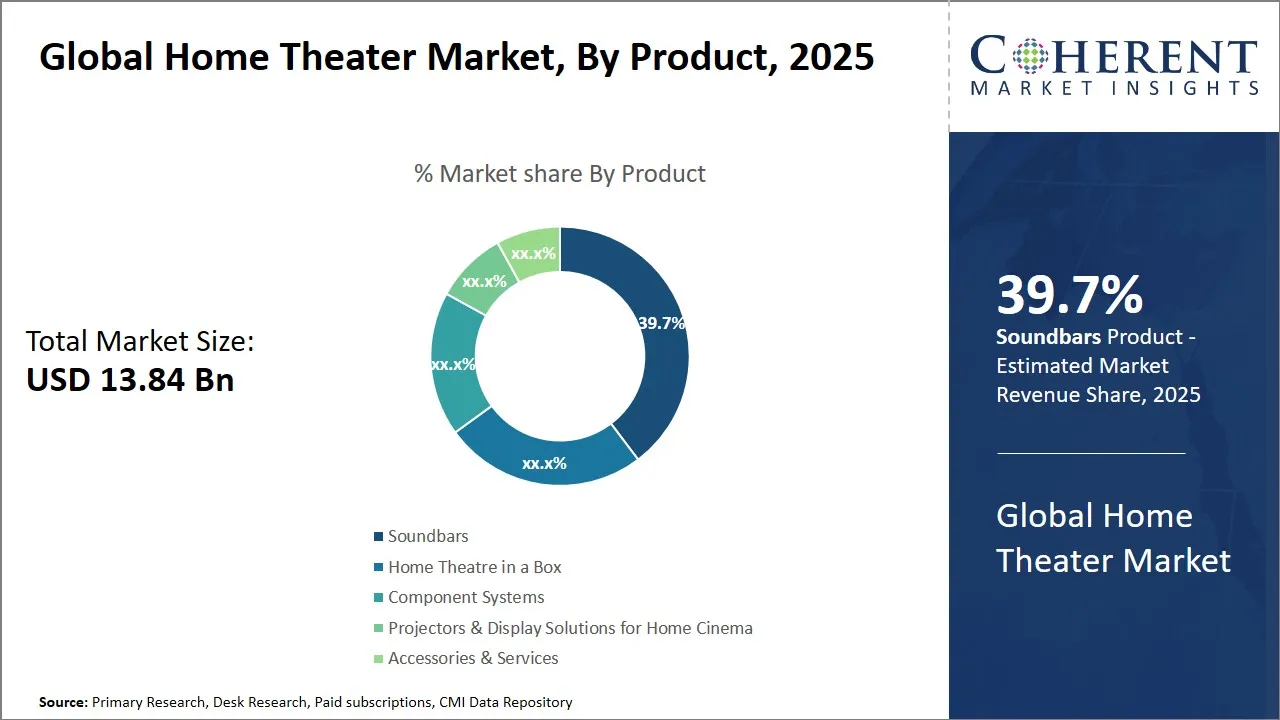
- The soundbars segment is expected to lead the market holding a share of 40.7% in 2026.
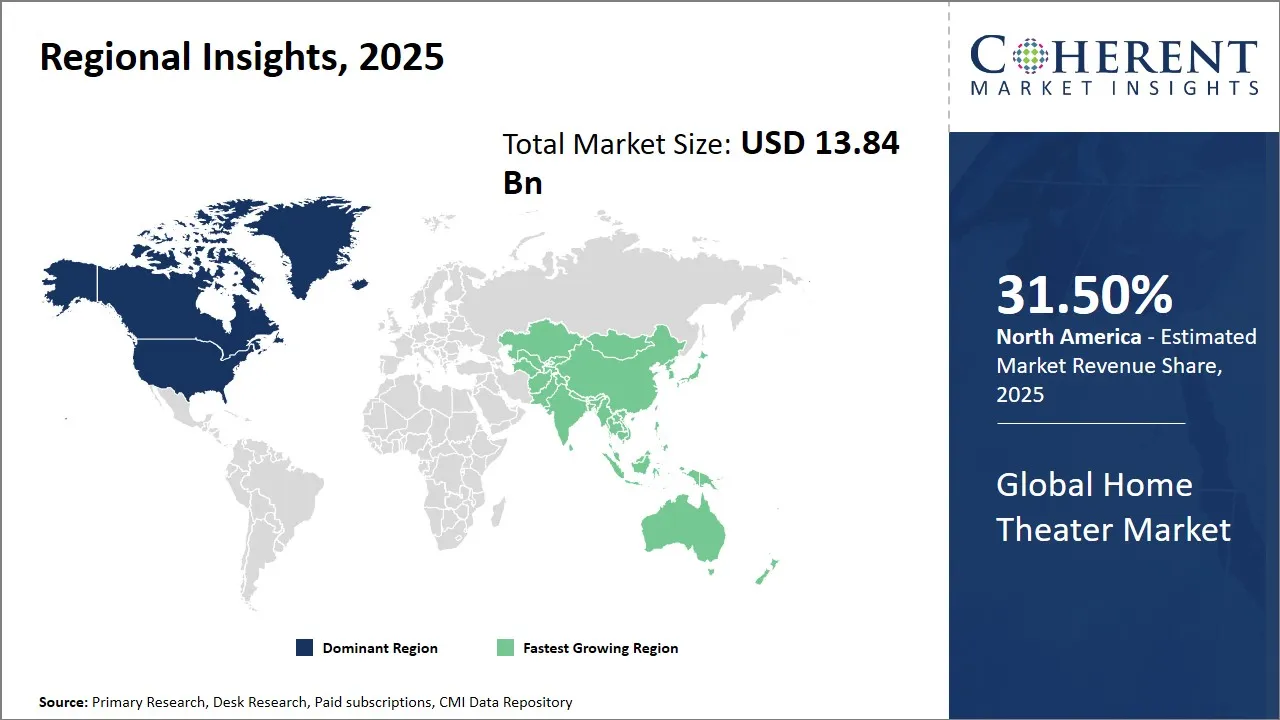
- North America, holding an estimated share of 31.5% in 2026, is projected to dominate the market.
- Asia Pacific, holding an expected share of 29.3% in 2026, shows the fastest growth in the market.
Market Overview
The market is seeing a strong move towards wireless and smart home theater systems that give added convenience and seamless connectivity. Also, the rise of streaming services and high-definition content is prompting consumers to upgrade home theater setups for superior viewing experiences. Innovations such as 4K and 8K resolution displays, Dolby Atmos sound technology, and AI-driven customization are affecting the market landscape.
Current Events and their Impact
Current Events | Description and its Impact |
Geopolitical and Trade Developments |
|
Asia Pacific Infrastructure Expansion
|
|
Segmental Insights
- Current Industry Events of 2026
- Market Size Estimation
- Regional Breakdown
- Competitive Landscape
- Customer Intelligence
- Segmental Analysis
- Pricing Analysis
- Key Market Drivers, Challenges & Future Trends
- Customized Insights Section
Global Home Theater Market Insights, By Product – Rising Consumer Preference for Compact and High-Quality Audio Solutions Make Demand for Soundbars
Soundbars lead the market with an estimated 40.7% share in 2026, because of demand for compact, powerful audio solutions that fit small urban living spaces. Samsung’s HW-Q990C became one of the top-selling premium soundbars in 2024 because of its slim design and room-friendly setup. Use of Dolby Atmos and DTS:X is adding to soundbar uptake by delivering surround sound without complex installations. LG’s S95QR soundbar, featuring up-firing drivers and Atmos/DTS:X, received strong sales traction in North America and Europe in 2024.
Built-in Bluetooth/Wi-Fi and support for Alexa, Google Assistant, and AirPlay improve convenience and ecosystem compatibility, raising adoption. Sonos Arc gained popularity globally for seamless integration with smart home systems and multi-room audio. Availability of entry, mid, and premium soundbars allows consumers to upgrade at any budget level, adding to penetration. JBL’s Bar 2.1 Deep Bass, priced affordably, became a high-volume seller in emerging markets during 2023–2024.
Pricing Analysis of the Global Home Theater Market
Product Category | Typical Price Range (USD) |
Soundbars — Entry/Budget | ~ USD 90 – USD 250 |
Soundbars — Mid/Premium | ~ USD 300 – USD 1,000+ |
Home Theater In a Box (HTIB)/5.1 Complete Kits | ~ USD 500 – USD 2,000 |
AV Receivers | ~ USD 200 – USD 3,000+ |
High-End/Luxury Home Theater (Speakers, Projectors, Receivers) | ~ USD 5,000 – USD 50,000+ |
Audio Technology Evolution
Topic | Metric/Estimate (2024–2025) | Impact (short) |
Dolby Atmos — penetration (home audio/consumer devices) | Estimate: 30–40% of new soundbars shipped in 2024–2025; ~20–25% of all home-audio device shipments (by value-share of immersive devices). | Strong buyer pull for Atmos adds to average selling prices (ASP) and pushes OEM roadmaps toward object-based decoding and up-firing drivers. |
DTS:X — penetration (home audio/consumer devices) | Estimate: 8–15% penetration across soundbars & receivers (2024–2025) — niche vs Atmos; used mainly in certain legacy AV receivers, PCs/gaming, and some soundbars. | Lower OEM emphasis vs Dolby; devices with DTS:X may be marketed to audiophile/legacy format users but have less mainstream pull than Atmos. |
Hi-Res Audio (lossless/>16-bit streaming) — penetration (consumer listening/home setups) | Estimate: 12–25% of active music-streaming users access Hi-Res/lossless tiers (2024–2025); Hi-Res hardware (streamers, DACs, hi-res players) ≈ small premium share of speaker/streamer market. | Growth in Hi-Res availability pushes premium audio purchases (streamers, DACs, better speakers) but penetration depends on user awareness and device capability. |
Atmos-enabled speaker adoption — soundbars (share of models shipped that are Atmos-capable) | Estimate: 35–45% of soundbar revenue/shipments in 2024–25 are Atmos-enabled models. | Rapid substitution of non-Atmos soundbars; manufacturers prioritize Atmos in mid+ segments—entry models still mostly stereo/virtual. |
Atmos-enabled speaker adoption — multi-component systems/speakers (share) | Estimate: 18–28% of sold speakers/AV receiver combos aimed at home theater are Atmos-ready (2024-25). | Encourages aftermarket add-ons (height modules, upward drivers) and increases demand for AVRs with Atmos processing. |
Virtual surround (software/processing) — market role | Prevalence: ~50–70% of entry & mid soundbars use virtual surround algorithms (2024). | Lowers cost and complexity for consumers; good perceived improvement for casual users but less convincing for audiophiles. |
True surround (discrete multiple speakers) | Prevalence: dominant in custom/home-cinema and mid-to-high component installs; ~30–40% of home-theater installs (value-weighted). | Best spatial accuracy and immersion, but higher cost and installation complexity—keeps a premium market niche. |
Virtual vs True — subjective quality gap (summary) | True surround: high spatial accuracy/localization; Virtual: good dialog clarity & perceived width but less accurate localization. | For studio-accurate playback (cinephiles/gamers), true surround remains superior; virtual solutions are chosen for convenience and cost. |
Codec licensing economics — Dolby (model & order-of-magnitude per-unit royalties/revenue) | Model: two-tier (initial implementation fee + per-unit royalty); royalties depend on product type, tech mix, and volumes. Publicly reported licensing revenue: Dolby licensing revenue (example: Q2 2024: licensing revenue lines shown in Dolby financial filings). Estimated per-unit royalty range (public industry reporting/leaks): ≈ USD 0.50–USD 3.00 per device for combined Dolby features | Licensing increases BOM for low-margin devices (cheap streaming sticks/TVs); for mid/high price soundbars the incremental royalty is a small % of ASP but influences OEM pricing and feature bundling. |
Codec licensing economics — DTS (model & pricing visibility) | Model: per-unit royalty and/or decoder licensing; some decoders available as paid software (e.g., DTS Sound Unbound decoder purchasable). | OEMs weigh codec support vs cost and marketing value; inclusion sometimes limited to premium tiers or optional firmware licenses. |
Regulatory/competitive pressure on codec fees (note) | Trend: push for royalty-free alternatives (e.g., Google interest) and patent-pool models can pressure pricing long term; patent pools/pooling may create more transparent per-unit terms. | Potential downward pressure on per-unit fees if strong royalty-free alternatives and broader industry coalitions emerge; OEMs may pressure licensors during procurement. |
Smart & Connected Home Integration
Smart and connected home integration is becoming a big driver of home theater adoption, as consumers prefer entertainment systems that seamlessly interact with broader smart ecosystems. Modern home theater devices, especially soundbars and speakers, come with Wi-Fi, Bluetooth, and proprietary multi-room platforms (e.g., Sonos, Samsung SmartThings, Apple AirPlay 2). Voice control via Alexa, Google Assistant, and Siri has shifted user expectations toward hands-free operation for playback, volume control, and device switching.
The trend supports unified control through smart home hubs, allowing home theaters to add with lighting, displays, streaming devices, and automation routines. For example, users can trigger “Movie Mode” scenes that dim lights, activate surround speakers, and launch streaming apps simultaneously. This adds to convenience, personalization, and immersive experience, adding to premium device purchases while encouraging ecosystem lock-in across brands.
Regional Insights
North America Home Theater Market Analysis and Trends
North America, holding a share of 31.5% in 2026, is expected to dominate the global home theater market, because of a mature technology ecosystem, high consumer disposable incomes, and a lot of adoption of advanced audiovisual technologies. The region sees strong industry presence, including key manufacturers, integrators, and content providers, which adds to innovation in home theater systems from 4K HDR displays to immersive sound solutions. Government policies supporting technology adoption and infrastructure development also add to market strength.
The U.S. houses big players such as Sony Corporation, Bose Corporation, and Harman International, whose continuous product advancements and extensive distribution networks set high market standards. Also, trade dynamics favor North America because of stable import-export regulations and a well-established electronic goods supply chain, supporting quick product availability and after-sales services.
Asia Pacific Home Theater Market Analysis and Trends
The Asia Pacific region, holding an estimated share of 29.3% in 2026, exhibits the fastest growth in the home theater market, driven by rising urbanization, increasing consumer awareness of home entertainment, and expanding middle-class populations with growing disposable incomes. Countries like China, India, and South Korea are seeing a lot of infrastructure development and fast digital transformation, making demand for smart home theaters with AI integration and IoT compatibility.
Also, supportive government initiatives aimed at boosting domestic electronics manufacturing (e.g., “Make in India” or China’s manufacturing incentives) and favorable trade policies enable OEMs and distributors to scale operations rapidly. Big companies such as Samsung Electronics, LG Electronics, and TCL have a lot of operations in Asia Pacific, catering to both premium and budget consumer segments and increasing market penetration through strategic partnerships and growing retail presence.
Global Home Theater Market Outlook for Key Countries
U.S. Home Theater Market Analysis and Trends
The U.S. remains the largest and most technologically advanced, with a well-established consumer base seeking cutting-edge audiovisual experiences. Leading companies like Sony, Bose, and Denon continue to innovate in immersive sound and smart home theater integration, adding to consumer interest. The country’s strong distribution infrastructure and high adoption of streaming services further encourage home theater system upgrades and customization, adding to its leadership role in the market.
China Home Theater Market Analysis and Trends
China is at the forefront of the Asia Pacific home theater market’s fast growth, because of expansive urban population centers and strong electronics manufacturing capabilities. Local brands such as TCL and Hisense are becoming popular alongside global giants like Samsung, offering competitively priced, high-quality home theater products. The government’s support for technological self-reliance and infrastructure modernization adds to the market’s dynamic growth. Also, increasing consumer preference for home entertainment solutions makes demand.
India Home Theater Market Analysis and Trends
India presents a lot of growth potential with increasing consumer spending on lifestyle products and rising awareness of home entertainment technologies. Government policies pushing domestic manufacturing have attracted investments by international players such as Sony and LG, who are making products to local preferences and price points. Growth of online retail platforms and improvement in electricity infrastructure also add to market accessibility, making India an emerging market.
South Korea Home Theater Market Analysis and Trends
South Korea home theater market thrives on early adoption of advanced technology and a culture favoring cutting-edge consumer electronics. Companies such as Samsung and LG, which are global leaders in display and sound technologies, add to innovation in home theater offerings. Government incentives promoting smart homes and IoT integration boost demand for connected home theater systems. The competitive electronics industry landscape makes continuous product upgrades, making South Korea a big influencer in the market.
Market Players, Key Development, and Competitive Intelligence
Key Developments
- In September 2025, HARMAN International, a wholly-owned subsidiary of Samsung Electronics Co., Ltd., focused on connected technologies for automotive, consumer, and enterprise markets, completed the acquisition of Sound United, the former consumer audio business of Masimo Corporation. Sound United’s portfolio of iconic audio brands includes Bowers & Wilkins, Denon, Marantz, Definitive Technology, Polk Audio, HEOS, Classé, and Boston Acoustics.
- In August 2025, Samsung, India’s largest consumer electronics brand, launched its 2025 soundbar line-up, introducing next-generation innovations in audio intelligence, adaptive design, and smart home integration. The new lineup consists of flagship HW-Q990F and the convertible HW-QS700F models.
- In June 2025, Sonos rolled out a batch of new features, including AI speech enhancement, TrueCinema, and Personal Home Theater for Two (with Ace).
- In October 2024, Sonos announced the introduction of Sonos Arc Ultra, a new premium soundbar that also debuts the brand’s revolutionary transducer technology called Sound Motion. Sound Motion drastically reduces the size of the transducer while supercharging the bass, opening a new chapter in sound innovation where bigger, better sound can be delivered from smaller products.
Top Strategies Followed by Home Theater Market Players
- Established market leaders invest a lot in research and development (R&D) to continually innovate and deliver high-performance, feature-rich home theater systems that cater to the evolving preferences of discerning consumers.
- Samsung expanded its Audio Lab in California and invested heavily in AI-powered sound optimization, resulting in premium models like the HW-Q990C with enhanced Q-Symphony features.
- Mid-level players in the home theater market use a different set of competitive tactics, focusing primarily on delivering cost-effective solutions that strike a balance between quality and affordability.
- Vizio offers budget-friendly Dolby Atmos soundbars such as the M-Series 5.1.2, providing high-end features at lower prices.
- Small-scale players in the global home theater market make their niche by emphasizing specialized features or innovation-driven products that cater to unique consumer segments.
- Vizio offers budget-friendly Dolby Atmos soundbars such as the M-Series 5.1.2, providing high-end features at lower prices.
Market Report Scope
Global Home Theater Market Report Coverage
| Report Coverage | Details | ||
|---|---|---|---|
| Base Year: | 2025 | Market Size in 2026: | USD 15.06 Bn |
| Historical Data for: | 2020 To 2024 | Forecast Period: | 2026 To 2033 |
| Forecast Period 2026 to 2033 CAGR: | 8.8% | 2033 Value Projection: | USD 27.17 Bn |
| Geographies covered: |
| ||
| Segments covered: |
| ||
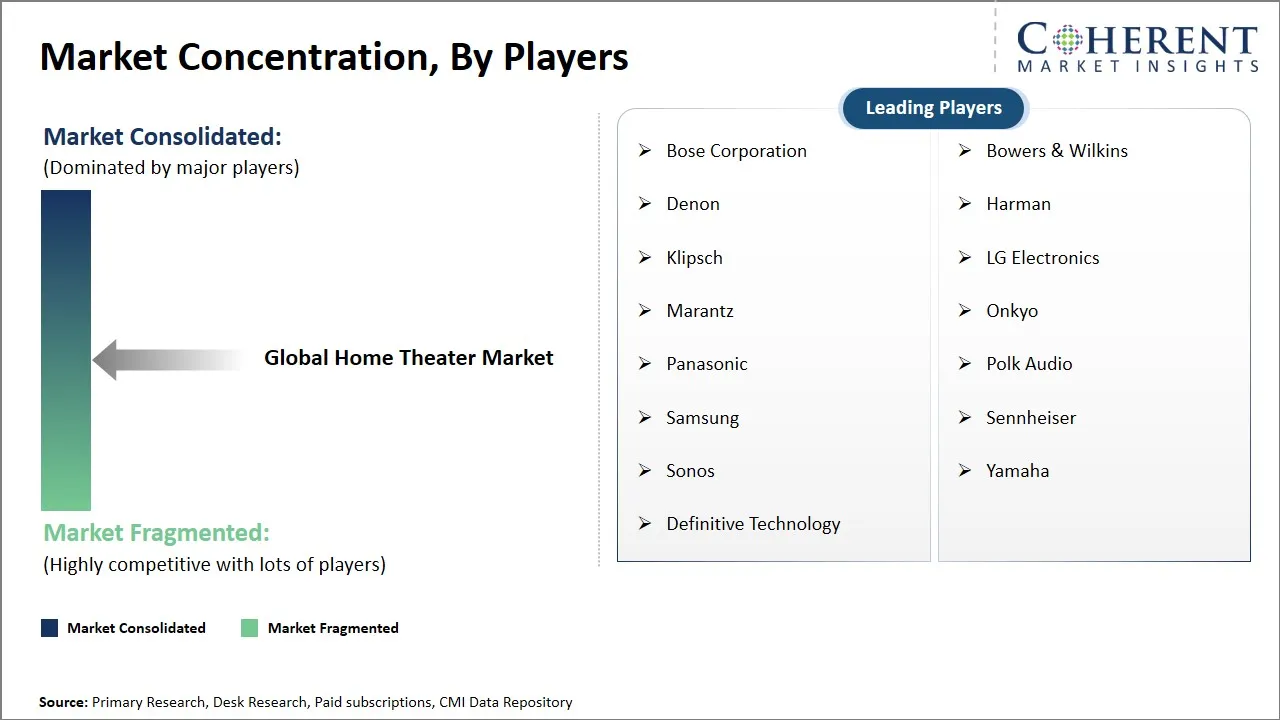
| Companies covered: | Bose Corporation, Bowers & Wilkins, Denon, Harman, Klipsch, LG Electronics, Marantz, Onkyo, Panasonic, Polk Audio, Samsung, Sennheiser, Sonos, Yamaha, and Definitive Technology | ||
| Growth Drivers: |
| ||
| Restraints & Challenges: |
| ||
Market Dynamics
Global Home Theater Market Driver – Rising Consumer Demand for Immersive Home Entertainment
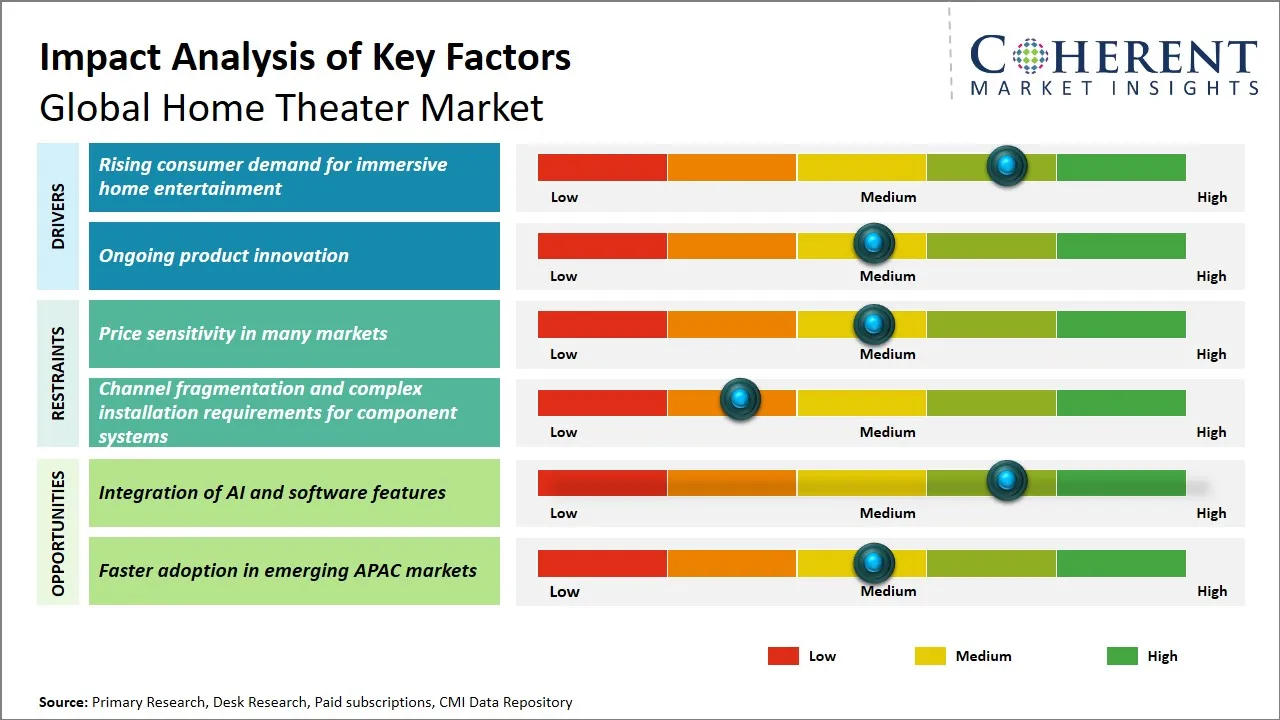
Growing consumer demand for immersive, high-quality home entertainment is boosting the home theater market. Advancements like UHD displays, Dolby Atmos sound, and smart connectivity enable users to get cinema-like experiences at home. Increased streaming content and lifestyle shifts—such as more time spent at home—are pushing consumers toward premium audio-visual setups integrated with smart devices. Sony and Samsung reported increased sales of premium TVs and soundbars in 2023–2024, driven by higher streaming consumption and demand for home-based entertainment upgrades.
Global Home Theater Market Opportunity – Integration of AI and Software Features
AI and advanced software features offer major growth opportunities by enabling personalized, intuitive, and adaptive entertainment experiences. AI-driven voice control, auto room calibration, content-aware sound adjustments, and predictive maintenance increase convenience and performance. Seamless integration with streaming apps and smart ecosystems strengthens adds to adoption and device value.
Sonos and Amazon partnered to integrate advanced AI-driven voice processing into premium speakers, making possible smarter sound tuning and seamless multi-device control.
Analyst Opinion (Expert Opinion)
- Mid- and low-tier brands flood the market with ultra-cheap soundbars and speaker systems, making established players slash margins or dilute product differentiation. This race to the bottom risks commoditizing core audio categories and affecting long-term brand value.
- Consumers are frustrated by devices that don’t sync seamlessly across brands or smart platforms. The lack of universal standards, especially in multi-room audio, voice assistants, and codec support makes friction that affects adoption of more advanced home theater setups.
- Fluctuating component prices and unpredictable logistics constraints make it increasingly difficult for manufacturers to maintain consistent production. As a result, brands struggle to keep high-demand models in stock, directly hindering revenue potential and slowing overall market growth.
Speak to the analyst
Want personalized insights?
Take the findings above to one of our principal consultants, or have the report rebuilt around the segments, geographies and competitors you actually track.
Market Segmentation
- Product Insights (Revenue, USD Bn, 2021 - 2033)
- Soundbars
- Home Theatre in a Box
- Component Systems
- Projectors & Display Solutions for Home Cinema
- Accessories & Services
- Regional Insights (Revenue, USD Bn, 2021 - 2033)
- North America
- U.S.
- Canada
- Latin America
- Brazil
- Argentina
- Mexico
- Rest of Latin America
- Europe
- Germany
- U.K.
- Spain
- France
- Italy
- Russia
- Rest of Europe
- Asia Pacific
- China
- India
- Japan
- Australia
- South Korea
- ASEAN
- Rest of Asia Pacific
- Middle East
- GCC Countries
- Israel
- Rest of Middle East
- Africa
- South Africa
- North Africa
- Central Africa
- North America
- Key Players Insights
- Bose Corporation
- Bowers & Wilkins
- Denon
- Harman
- Klipsch
- LG Electronics
- Marantz
- Onkyo
- Panasonic
- Polk Audio
- Samsung
- Sennheiser
- Sonos
- Yamaha
- Definitive Technology
Sources
Primary Research Interviews
Stakeholders
- Consumer Electronics Manufacturers
- Home Audio & Speaker System Suppliers
- Retailers & Distributors of Home Entertainment Products
- Smart Home Integration Specialists & Installers
- Audio Engineers and Acoustic Consultants specializing in Dolby Atmos and DTS:X systems
- E-commerce Platform Merchants involved in electronics category operations
- Streaming Platform Partnerships & Content Delivery Experts (for audio format compatibility insights)
Databases
- Eurostat
- U.S. Census
- Consumer Electronics Global Database (fictional)
- OECD
- Global Digital Entertainment Usage Repository (fictional)
Magazines
- Sound & Vision Magazine
- Home Theater Review Magazine
- AV Technology Magazine
- Smart Home World
- Home Entertainment Design Digest (fictional)
Journals
- Journal of Audio Engineering & Acoustics
- Consumer Electronics & Smart Devices Journal
- IEEE Transactions on Consumer Electronics
- Journal of Home Entertainment Systems (fictional)
- Digital Media and Immersive Sound Journal (fictional)
Newspapers
- The Verge (Tech Section)
- The Guardian (U.K. – Technology)
- The Economic Times (India – Electronics & Devices)
- Tech Chronicle Daily (fictional)
- Global Electronics Times (fictional)
Associations
- Consumer Technology Association (CTA)
- Audio Engineering Society (AES)
- Home Theater Industry Association (fictional)
- International Smart Home Alliance (ISHA – fictional)
- Wireless Speaker & Audio Association (WiSA)
Public Domain Sources
- U.S. Census Bureau
- EUROSTAT
- United Nations Statistics Division (UNSD)
- World Bank Open Data
- ResearchGate
- Digital Entertainment Public Database (fictional)
Proprietary Elements
- CMI Data Analytics Tool
- Proprietary CMI Existing Repository of information for last 8 years
Get access to 250+ pages report
Every segment, forecast, competitor profile and data table behind the analysis above — available for instant download.
- ESOMAR Member
- ISO 9001:2015 Certified
- D-U-N-S Registered
- GDPR & CCPA Compliant
Missing comfort of reading report in your local language? Find your preferred language:
Transform your Strategy with Exclusive Trending Reports
Frequently Asked Questions
The global home theater market is estimated to be valued at USD 15.06 billion in 2026 and is expected to reach USD 27.17 billion by 2033.
The CAGR of the global home theater market is projected to be 8.8% from 2026 to 2033.
Rising consumer demand for immersive home entertainment and ongoing product innovation are the major factors driving the growth of the global home theater market.
Price sensitivity in many markets and channel fragmentation and complex installation requirements for component systems are the major factors hampering the growth of the global home theater market.
In terms of product, soundbars are estimated to dominate the market revenue share in 2026.
Bose Corporation, Bowers & Wilkins, Denon, Harman, Klipsch, LG Electronics, Marantz, Onkyo, Panasonic, Polk Audio, Samsung, Sennheiser, Sonos, Yamaha, and Definitive Technology, are the major players.
North America is expected to lead the global home theater market in 2026.