

Global Hospitality Furniture Market Size and Forecast – 2026 To 2033
The Global Hospitality Furniture Market is estimated to be valued at USD 4.91 Bn in 2026 and is expected to reach USD 6.82 Bn by 2033, exhibiting a compound annual growth rate (CAGR) of 4.8% from 2026 to 2033. This steady growth in the hospitality furniture market reflects increasing investments in hotel construction, branded property expansion, renovation-led FF&E replacement, and demand for durable, customized, and design-led furniture across guestrooms, suites, lobbies, restaurants, bars, resorts, and serviced apartments. The hospitality furniture market is shifting towards a more strategic approach to cater to the shifting focus of hospitality operators on the guest experience, brand identity, space efficiency, sustainability, and rapid project completion.
For instance, IHG Hotels & Resorts has a new record for opening 443 hotels in 2025. The company signed 694 hotels to its pipeline and concluded the year with a total of 2,292 hotels in its pipeline, meeting future demand for guestroom furniture, public-area seating, restaurant furniture, and customized FF&E packages. (Source: IHG Annual Report)
Key Takeaways of the Global Hospitality Furniture Market
- Guestroom casegoods and storage furniture is expected to dominate the hospitality furniture market with 34.8 % share in 2026, supported by regular hotel room renovation cycles and the continued replacement of brand-standard wardrobes, media units, desks, and bedside storage furniture. Foliot Furniture’s hospitality program highlights approved/preferred supplier status across 14+ major hotel brands and casegoods manufacturing for Hilton, IHG, Marriott, and Choice projects. (Source: Foliot Furniture)
- Wood and engineered wood is expected to account for 41.3 % share in the hospitality furniture market in 2026, as hotel owners continue to prefer durable, warm, and brand-flexible finishes for guestrooms and public areas. Marriott Bonvoy Boutiques’ May 2026 Design Shop launch included wood nightstands, natural materials, headboards, beds, and layered hotel-inspired interiors, validating wood-led premium room aesthetics. (Source: PR Newswire)
- Guestrooms and suites are expected to hold 45.6 % share in 2026, as room-level FF&E absorbs the largest furniture allocation across new-builds, conversions, and renovations. Hilton’s 2025 annual review reported nearly 100,000 new rooms added, its 9,000th hotel milestone, and a record development pipeline, reinforcing large-scale room furniture procurement potential. (Source: Hilton)
- North America is expected to lead with 34.6 % share in 2026, supported by high hotel refurbishment intensity, larger FF&E budgets, and active U.S. construction and conversion pipelines. Lodging Econometrics reported 126 U.S. hotels opened in Q1 2026 and forecast 682 new hotels with 77,323 rooms for full-year 2026. (Source: Lodging Econometrics, Inc)
- Europe is expected to represent 25.4 % share in 2026 and show the fastest growth momentum, supported by upper-upscale, resort, and lifestyle hotel expansion. In March 2026, Radisson Hotel Group stated it closed 2025 with more than 272 hotel signings and openings, with European upper-upscale and resort segments central to its growth strategy. (Source: Radisson Hotel Group)
- Circular furniture specifications gain priority in the hospitality furniture market: Sustainability is becoming a core FF&E selection factor as hotels link furniture procurement with waste reduction, recycled materials, and visible ESG outcomes. In 2025, Potato Head and designer Mr. Max Lamb advanced the Wasted initiative, using recycled plastics, glass, textiles, and other waste streams to create functional design products, demonstrating how hospitality waste can become furniture and décor value. (Source: Future Publishing Limited Quay House)
- Custom procurement strengthens supplier relationships: Hotels increasingly work with furniture manufacturers for customized FF&E solutions that meet brand standards, design consistency, finish matching, delivery schedules, and multi-property renovation requirements. Kimball Hospitality’s custom process includes design concept development, manufacturing, shipping, installation, on-site service, 3D drawings, finish samples, and global quality control, reflecting the growing importance of turnkey custom furniture partnerships in the hospitality furniture market.
Segmental Insights
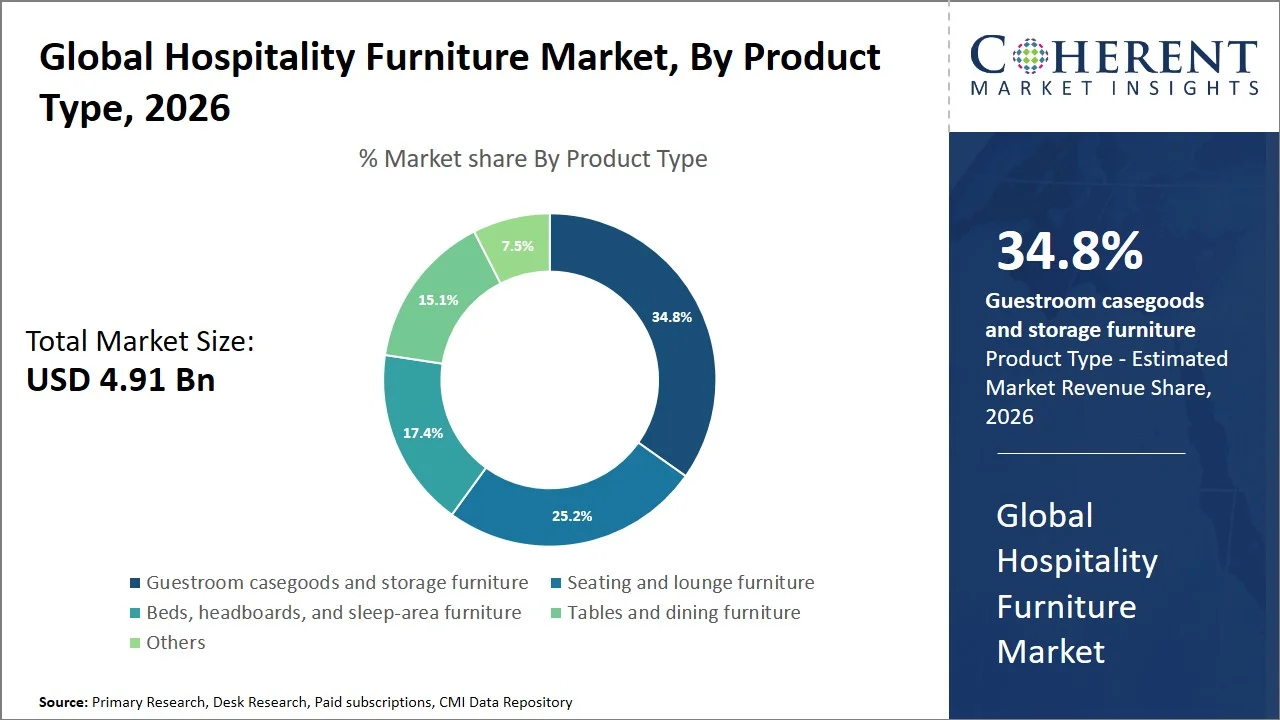
Why Do Guestroom Casegoods and Storage Furniture Dominate the Global Hospitality Furniture Market?
Guestroom case goods and storage furniture are projected to dominate the hospitality furniture market’s product type segment with a 34.8% share in 2026, as they represent the essential fixed furniture components of hotel rooms, including wardrobes, nightstands, TV units, luggage benches, desks, minibars, and storage consoles. Demand in the hospitality furniture market is supported by recurring room renovation cycles, brand-standard compliance, space optimization, and durability requirements across midscale, upscale, and luxury hotels. On the supply side, manufacturers are increasingly offering custom casegoods, finish matching, fire-safe materials, modular construction, and project-based installation support. This segment is highly relevant to guestrooms, suites, serviced apartments, and extended-stay properties where storage functionality directly affects guest comfort. For instance, Bernhardt Hospitality supplied custom casegoods, seating, outdoor furnishings, and vanities for the St. Regis Aruba’s 252 guestrooms and public spaces in 2025.
- Current Industry Events of 2026
- Market Size Estimation
- Regional Breakdown
- Competitive Landscape
- Customer Intelligence
- Segmental Analysis
- Pricing Analysis
- Key Market Drivers, Challenges & Future Trends
- Customized Insights Section
Why Does Wood and Engineered Wood Represent the Largest Material Segment in the Hospitality Furniture Market?
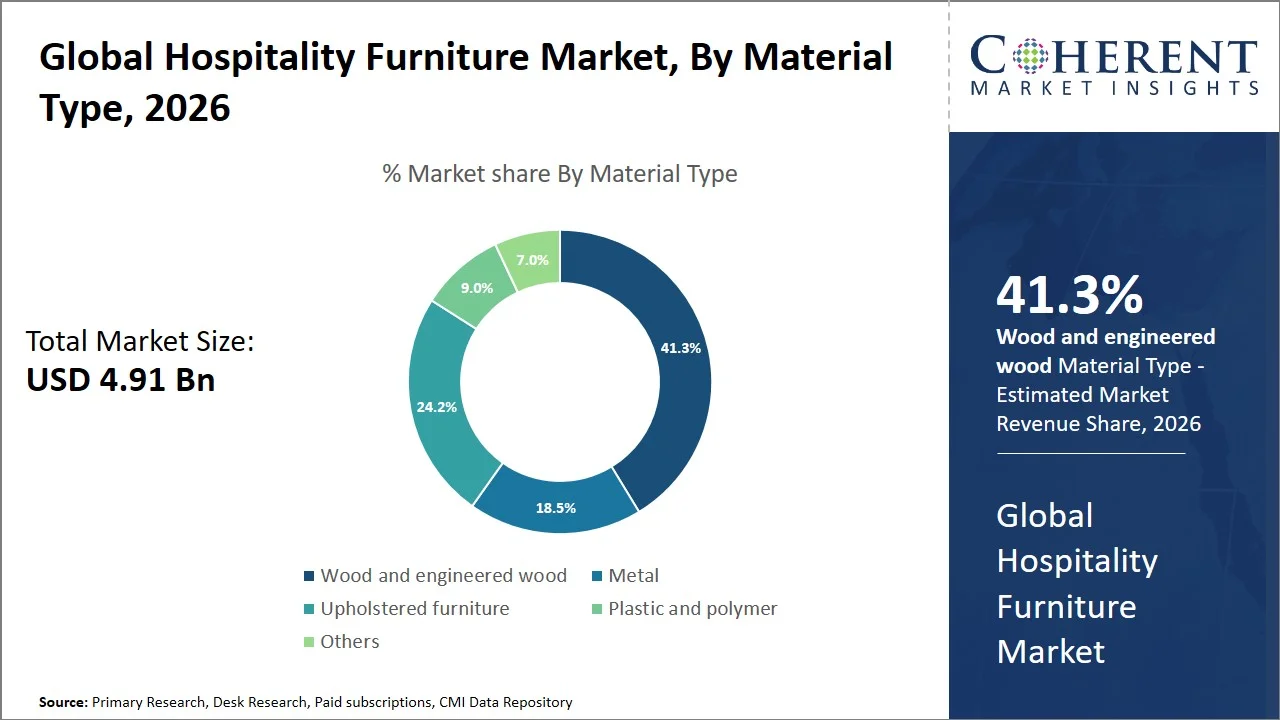
Wood and engineered wood is expected to lead the material type segment with 41.3% share in 2026, owing to its strong fit with hospitality design requirements such as warmth, premium appearance, structural strength, and wide finish flexibility. Hotels use wood-based materials extensively in casegoods, beds, wardrobes, wall panels, desks, dining tables, and lobby furniture because they can be customized across economy, lifestyle, and luxury brand standards. Engineered wood also supports cost control, repeatable manufacturing quality, lighter structures, and large-volume procurement compared with solid wood. Supply-side adoption is supported by certified wood sourcing and improved laminates, veneers, and moisture-resistant boards. Andreu World highlights its use of 100% sustainable wood with FSC certification, reinforcing the material’s relevance for hospitality buyers prioritizing sustainability and long lifecycle performance. (Source: Andreu World)
Why Do Guestrooms and Suites Dominate the Global Hospitality Furniture Market by Application?
Guestrooms and suites are expected to dominate the application segment with 45.6% share in 2026, as they represent the highest furniture density per hospitality property. Every room requires multiple coordinated furniture items, including beds, headboards, casegoods, seating, tables, desks, mirrors, and storage units, making room-level FF&E the largest procurement area during hotel openings and renovations. Demand is shaped by guest comfort, brand identity, room refresh cycles, and conversion projects where furniture upgrades are essential for repositioning assets. Supply-side relevance comes from standardized room packages, custom finishes, faster lead-time programs, and installation-ready furniture systems. In February 2026, Accor reported opening 303 hotels and nearly 51,000 rooms in 2025, along with a pipeline of over 257,000 rooms, indicating strong future room-level furniture demand for furniture hospitality market (Source: Accor)
Currents Events and their Impact
Current Events | Description and its Impact |
European Union Includes Furniture in ESPR Working Plan for Sustainable Products (April 2025) |
|
European Union Amends Deforestation Regulation Compliance Timeline for Wood-Based Products (December 2025) |
|
U.K. Advances Fire Safety Reform for Upholstered Furniture (March 2026) |
|
(Source: European Commission, GOV.UK.)
Global Hospitality Furniture Market Dynamics
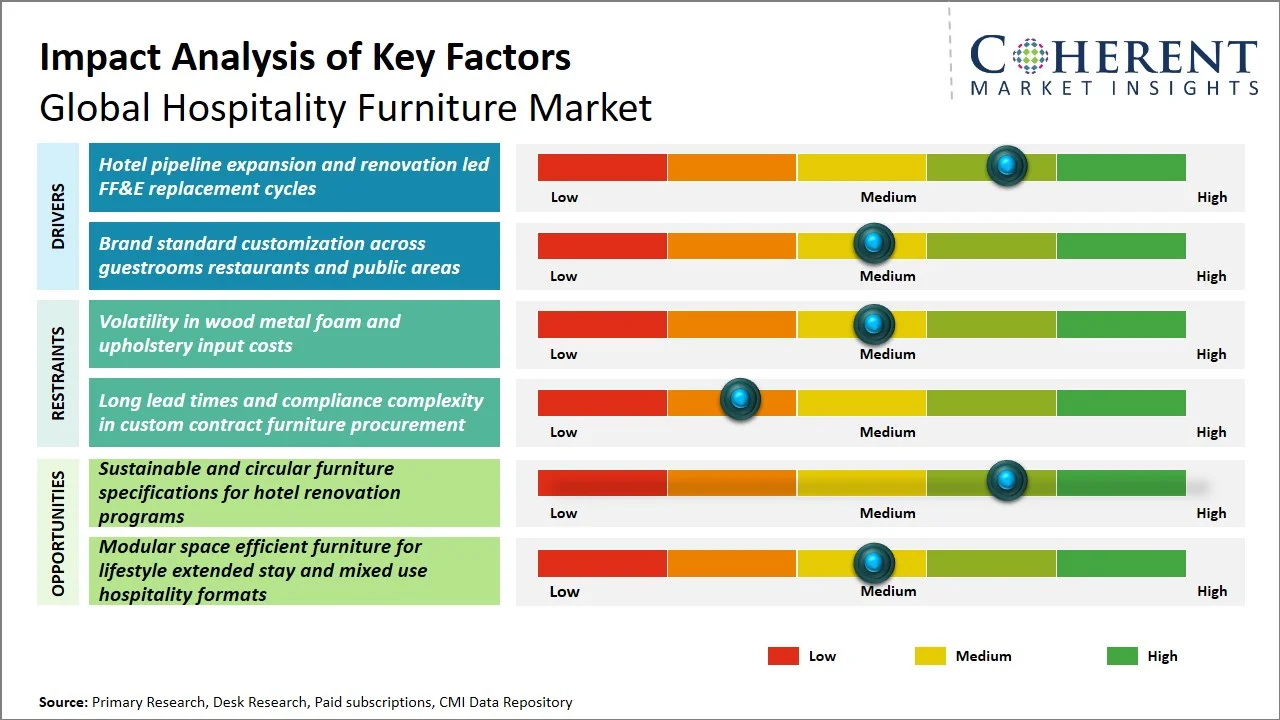
Market Drivers
- Hotel pipeline expansion and renovation-led FF&E replacement cycles: The hospitality furniture market is benefiting from a strong cycle of hotel openings, conversions, and renovation activity, as every new or upgraded property requires room furniture, lobby seating, restaurant furniture, outdoor furniture, and back-of-house fit-outs. Furniture procurement is closely linked to FF&E replacement cycles, where hotels refresh guestrooms and public spaces to maintain brand standards and pricing power. In Q4 2025, Lodging Econometrics reported record global conversion activity, with 2,815 projects/341,006 rooms, while combined renovations and conversions reached 3,777 projects/540,459 rooms. It also forecast 2,617 new hotels/389,175 rooms opening globally in 2026, creating a direct demand pipeline for hospitality furniture market. (Source: Lodging Econometrics, Inc)
- Brand-standard customization across guestrooms, restaurants, and public areas: Hospitality furniture demand is increasingly shaped by brand identity, guest experience, and property-level differentiation. Hotel chains require furniture that aligns with specific design codes, durability standards, wellness positioning, and destination-led concepts across guestrooms, restaurants, lobbies, bars, and outdoor spaces. This supports customized casegoods, headboards, seating, tables, finishes, and coordinated furniture packages rather than off-the-shelf procurement. In May 2026, Marriott Bonvoy Boutiques launched Design Shop, expanding beyond bedding and bath into furniture, décor, and art inspired by Marriott hotel brands. The initial collections were anchored by W Hotels and Westin Hotels & Resorts, including custom headboards, platform beds, benches, nightstands, and wellness-oriented room pieces. (Source: PR Newswire)
Emerging Market Trends
- Sustainability-led furniture specifications and circular product design: Sustainability is becoming a key procurement trend in the global hospitality furniture market as hotel owners, developers, and FF&E teams increasingly evaluate suppliers based on material traceability, durability, recyclability, repairability, and lifecycle performance. This trend is especially relevant for wood-based casegoods, upholstered seating, lounge furniture, outdoor furniture, and public-area furniture, which face high replacement frequency in hospitality environments. Hotels are shifting from short-lifecycle decorative furniture toward furniture that supports long-term asset value, lower waste generation, and stronger ESG positioning. Manufacturers that offer certified wood, recycled materials, low-emission finishes, modular parts, and repair-friendly designs are expected to gain stronger preference in hospitality procurement. This trend is also likely to influence pricing, supplier qualification, and product design standards across premium, lifestyle, and resort properties.
- Integrated multi-material manufacturing for faster project execution in the global hospitality furniture market: Hospitality furniture market suppliers are increasingly adopting integrated manufacturing models that combine woodworking, metal fabrication, upholstery, surface finishing, packaging, and project coordination within a single production ecosystem. This trend is important because hospitality projects usually require large-volume furniture packages with consistent finishes, strict opening schedules, and customized designs across guestrooms, restaurants, lobbies, and outdoor areas. Integrated production helps reduce vendor dependency, shorten lead times, improve quality control, and support better coordination between design, production, and installation teams. It also enables suppliers to handle mixed-material furniture such as wood-and-metal tables, upholstered headboards, lounge seating, and outdoor furniture more efficiently. As hotel brands continue to demand faster renovations and new property rollouts, vertically integrated furniture suppliers are expected to gain a competitive advantage.
Regional Insights
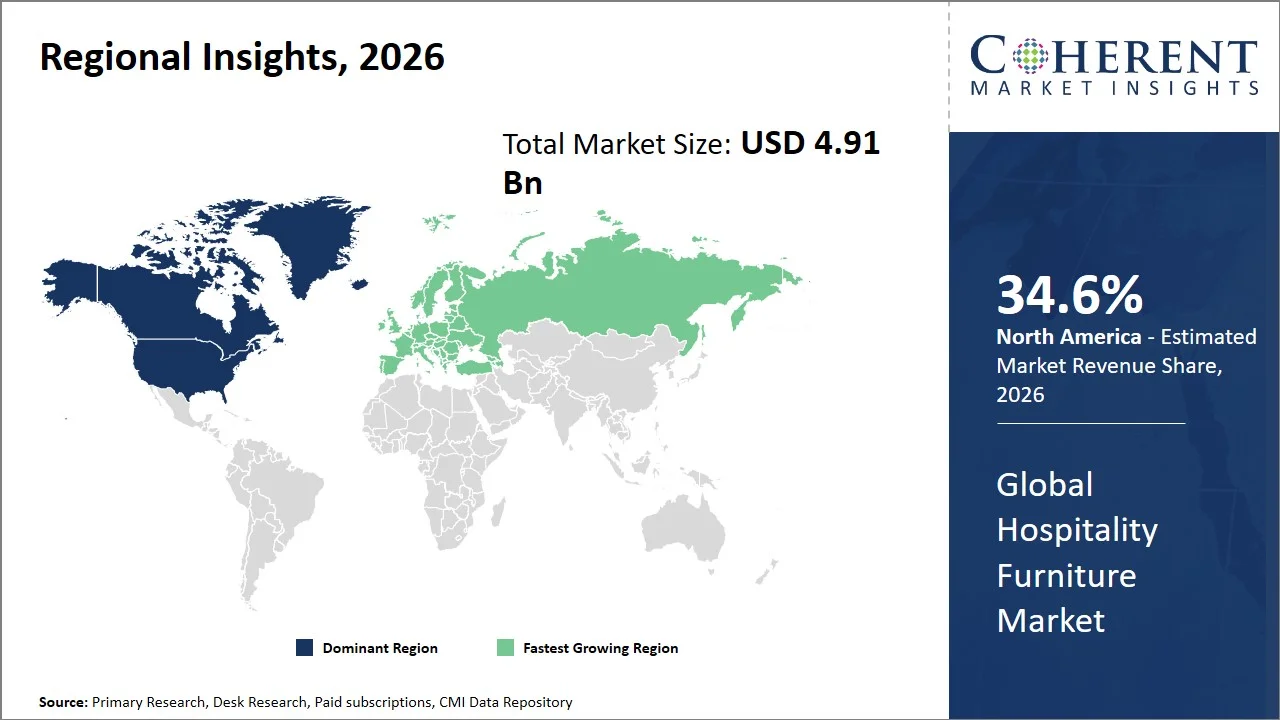
Why is North America a Strong Market for Hospitality Furniture?
North America is expected to dominate the global hospitality furniture market with 34.6% share in 2026, supported by high hotel refurbishment spending, large branded hotel penetration, strong FF&E replacement cycles, and mature procurement practices across the U.S. and Canada. The region has a strong base of contract furniture manufacturers, hospitality design firms, FF&E procurement specialists, and hotel ownership groups that regularly invest in guestroom casegoods, upholstered seating, lobby furniture, outdoor furniture, and restaurant furniture. Market leadership is further supported by premium room standards and renovation activity across luxury, upscale, and extended-stay properties. A recent indicator of this strength is the record global hotel pipeline at Q4 2025, where the U.S. remained the leading country-level contributor to hotel development activity. (Source: TechTarget, Inc)
Why Does Europe Hospitality Furniture Market Exhibit High Growth?
Europe is expected to be the fastest-growing region in the hospitality furniture market, with 25.4% share in 2026, supported by strong activity in luxury, upper-upscale, boutique, resort, and conversion-led hotel formats. The region’s growth is closely linked to the refurbishment of heritage hotels, lifestyle hotel development, sustainability-focused furniture specifications, and rising demand for locally designed, premium, and durable hospitality furniture market. European hotel owners are also placing greater emphasis on circularity, certified wood, repairability, and design-led public spaces, creating opportunities for furniture suppliers with sustainable and customized offerings. In Q1 2026, Europe’s hotel construction pipeline reached 1,731 projects and 255,354 rooms, with 319 hotels and 44,156 rooms forecast to open by year-end 2026. (Source: Lodging Econometrics)
Global Hospitality Furniture Market Outlook for Key Countries
Why is China a Key Demand Hub for Hospitality Furniture?
China is one of the most important country markets for hospitality furniture due to its large hotel construction pipeline, strong domestic tourism base, and rapid development of midscale, upscale, and lifestyle hotels. Furniture demand is supported by new guestrooms, restaurant areas, lobbies, serviced apartments, and public hospitality spaces across major cities and emerging travel destinations. The country is particularly relevant for standardized room furniture packages, engineered wood casegoods, metal-framed seating, and large-volume procurement by hotel chains. In Q1 2026, China’s hotel construction pipeline totaled 3,602 projects and 640,328 rooms, with upper midscale and upscale chain scales accounting for a major share of the pipeline. This indicates strong demand for commercially durable and cost-efficient hospitality furniture market. (Source: Lodging Econometrics)
Why are the U.S. Leading Hospitality Furniture Adoption and Procurement?
The U.S. remains the single most influential country in the hospitality furniture market because of its large installed hotel base, frequent renovation cycles, and strong presence of global hotel brands. Demand is supported by guestroom upgrades, conversion projects, extended-stay development, and event-linked travel demand. U.S. hotel owners typically procure furniture through direct manufacturers, FF&E firms, designers, and brand-approved vendor networks, making the country highly relevant for customized casegoods, beds, lounge seating, dining furniture, and outdoor furniture. In 2026, AHLA projected US$ 805 billion in hotel guest spending and more than 30,000 new jobs, indicating continued hotel operating activity and investment capacity despite cost pressures. (Source: Hospitality Net)
Why is India Emerging as a High-Growth Hospitality Furniture Market?
India is emerging as a high-potential country for hospitality furniture market, supported by domestic tourism, rising business travel, luxury hotel expansion, weddings, spiritual tourism, and growth in branded hotels across tier 1 and tier 2 cities. Furniture demand is particularly strong for guestrooms, banquet halls, restaurants, serviced apartments, and resort properties. The country also offers manufacturing advantages in woodwork, upholstery, and project-based furniture fabrication, supporting both domestic and export-oriented hospitality supply. In February 2026, Indian Hotels Company Limited reported a portfolio of 615 hotels, including 360 operating hotels and a 255-hotel pipeline, under its Accelerate 2030 strategy. This expanding branded-hotel base is expected to support long-term FF&E procurement. (Source: The Indian Hotels Company Limited IHCL)
Why is Germany Important for Premium and Sustainable Hospitality Furniture?
Germany is a key European hospitality furniture market due to its strong business travel base, trade fair cities, established hotel chains, and advanced furniture manufacturing ecosystem. The country is important for premium wood furniture, modular hotel room furniture, upholstered seating, and sustainable hospitality interiors. Demand is also supported by conversions and refurbishment of urban hotels, where furniture upgrades are used to reposition properties and improve guest experience. Germany’s relevance is reinforced by new hotel openings in major commercial locations. Accor listed Novotel Hamburg HafenCity among its anticipated 2026 openings, featuring 172 rooms in the Überseequartier district, with restaurant and fitness facilities. Such openings create demand for guestrooms, dining spaces, and public-area furniture. (Source: Accor)
Why is the U.A.E a Strong Market for Luxury Hospitality Furniture?
The U.A.E is a strategic for hospitality furniture market because of its luxury hotel concentration, resort development, branded residences, serviced apartments, and high-end tourism positioning. Furniture demand is concentrated in premium guestrooms, suites, restaurants, lounges, outdoor terraces, poolside areas, and public spaces where design quality, durability, and brand differentiation are critical. Dubai and Abu Dhabi also attract international hotel operators, designers, and FF&E suppliers, strengthening demand for imported and customized for hospitality furniture market. Dubai welcomed 19.59 million international overnight visitors in 2025, up 5% year-on-year, reflecting strong hotel utilization and continued investment in hospitality assets. This supports ongoing demand for renovation, replacement, and premium furniture procurement. Source: Dubai Department of Economy and Tourism. (Source: Dubai Department of Economy and Tourism)
Technology Adoption Landscape in the Global Hospitality Furniture Market
Technology | Key Features | Commercial / Operational Advantage | Market Relevance |
Modular Guestroom Furniture Systems | Pre-engineered beds, wardrobes, desks, luggage benches, and storage units designed in repeatable modules | Reduces installation time, supports brand-standard consistency, and simplifies room renovation programs | Highly relevant for hotels, serviced apartments, and extended-stay properties where large-volume room rollouts require speed and uniformity |
CNC and Automated Custom Furniture Manufacturing | Computer-controlled cutting, drilling, shaping, and finishing for wood, engineered wood, and panel-based furniture | Improves dimensional accuracy, reduces material wastage, and enables scalable customization for hotel projects | Increasingly adopted by hospitality furniture manufacturers producing casegoods, headboards, tables, wall panels, and storage furniture |
Sustainable and Circular Material Technologies | Certified wood, recycled materials, low-emission panels, recyclable components, repairable furniture systems, and lifecycle-oriented design | Supports ESG compliance, green building requirements, and hotel sustainability commitments | Becoming a key supplier-selection factor as furniture is listed among priority product groups under the EU’s 2025–2030 sustainable product working plan. (Green Forum) |
Performance Upholstery and Easy-Clean Fabric Technologies | Stain-resistant, splash-resistant, durable, cleanable, and hospitality-grade textile finishes | Extends furniture life, lowers maintenance cost, and improves hygiene in high-traffic hospitality spaces | Important for lobby seating, restaurant chairs, lounge furniture, banquet seating, guestrooms, and resort furniture; FibreGuard highlights hospitality-grade easy-clean and stain-resistant fabric use. |
Integrated Power and Smart-Ready Furniture | Furniture designed with USB charging, power sockets, cable management, lighting integration, and workspace-friendly configurations | Enhances guest convenience, supports business travelers, and upgrades the functionality of guestrooms and lobby areas | Gaining relevance in hotels, serviced apartments, co-working lounges, and extended-stay formats where connectivity and work-friendly furniture are part of guest experience |
Outdoor Weather-Resistant Furniture Materials | Powder-coated metals, synthetic wicker, treated wood, UV-resistant polymers, quick-dry foam, and marine-grade fabrics | Improves durability against sun, humidity, rain, salt exposure, and heavy outdoor use | Strongly relevant for resorts, poolside areas, terraces, rooftop bars, beachfront hotels, and outdoor dining spaces |
Digital Specification and 3D Visualization Tools | Digital product libraries, 3D drawings, renderings, finish sampling, and project coordination tools | Helps designers, FF&E buyers, and hotel owners validate furniture design before production, reducing rework and approval delays | Supports customized hospitality furniture procurement across guestrooms, suites, lobbies, restaurants, and public spaces, especially in premium and multi-property projects |
How are sustainable, modular, and smart-ready furniture solutions creating new growth opportunities in the global hospitality furniture market?
Technological advancement in hospitality furniture, especially modular guestroom systems, CNC-enabled customization, integrated power units, durable upholstery, and sustainable material engineering, is creating strong growth opportunities in the global hospitality furniture market. Hotels are increasingly shifting from standard furniture procurement to customized FF&E packages that support faster installation, brand consistency, space efficiency, and longer replacement cycles. Sustainable materials, certified wood, low-emission finishes, and repairable furniture designs are also becoming important as hotel groups strengthen ESG-linked procurement. For instance, in November 2025, Khanom Furniture inaugurated an integrated hospitality furniture factory in Vietnam, combining woodworking, metal fabrication, upholstery, and surface finishing to improve quality control, shorten lead times, and support large-scale hotel and resort projects. This reflects how advanced manufacturing and integrated production are improving supplier competitiveness and creating new growth opportunities for hospitality furniture providers. (Source: Khanom Furniture)
Market Players, Key Development, and Competitive Intelligence
Key Developments
- In May 2026, Marriott Bonvoy Boutiques launched Design Shop, introducing hotel-inspired furniture, décor, and art collections anchored by W Hotels and Westin Hotels & Resorts. The launch expanded Marriott’s retail offering beyond bedding and bath products into furniture, headboards, platform beds, benches, nightstands, rugs, lighting, and decorative pieces.
- In January 2026, Kettal and Nemo Group announced a new alliance to relaunch Driade, with Kettal, acquiring a majority stake in the Italian design furniture brand. The collaboration is aimed at strengthening Driade’s international positioning and combining Italian design heritage with Kettal’s industrial and commercial capabilities.
- In November 2025, Khanom Furniture inaugurated a new integrated hospitality furniture factory in Vietnam, consolidating woodworking, metal fabrication, upholstery, and surface finishing into one facility for large-scale B2B hospitality projects. The expansion is intended to improve production efficiency, quality control, lead times, and capacity for global hotel, resort, and restaurant furniture projects.
Competitive Landscape
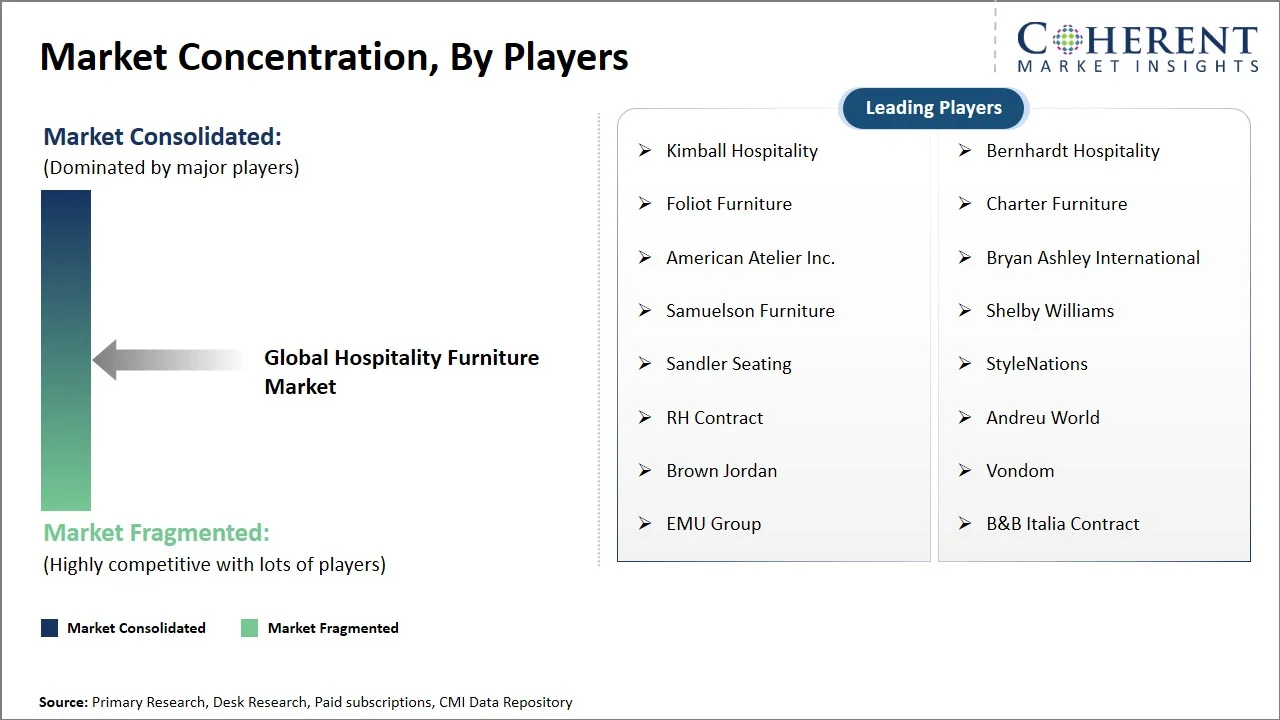
The global hospitality furniture market is moderately fragmented, with a mix of large contract furniture manufacturers, regional hospitality furniture specialists, design-led premium brands, and custom FF&E suppliers competing across hotels, resorts, restaurants, serviced apartments, and public hospitality spaces. Competition is primarily based on customization capability, material quality, design flexibility, durability, pricing, lead time, sustainability credentials, and ability to manage large-scale project execution. Key companies are increasingly focusing on integrated manufacturing, sustainable materials, modular furniture systems, outdoor durability, and direct collaboration with hotel brands, interior designers, and FF&E procurement firms. The market is also seeing stronger emphasis on brand-standard furniture packages, faster renovation support, and lifecycle value for hotel owners.
Key focus areas include
- Development of customized guestroom casegoods, seating, beds, tables, and storage furniture aligned with hotel brand standards
- Adoption of sustainable materials, certified wood, recyclable components, and low-emission finishes to meet ESG-focused procurement requirements
- Expansion of integrated manufacturing capabilities covering woodworking, metal fabrication, upholstery, finishing, and project installation support
- Strengthening of direct sales, FF&E procurement partnerships, and designer-led specification channels for large hospitality projects
- Innovation in modular, space-efficient, outdoor, and performance-upholstered furniture to support hotels, resorts, restaurants, and serviced apartments
- Geographic expansion through regional production hubs, distributor networks, and contract partnerships to reduce lead times and improve project delivery
Market Report Scope
Hospitality Furniture Market Report Coverage
| Report Coverage | Details | ||
|---|---|---|---|
| Base Year: | 2025 | Market Size in 2026: | USD 4.91 Bn |
| Historical Data for: | 2020 To 2024 | Forecast Period: | 2026 To 2033 |
| Forecast Period 2026 to 2033 CAGR: | 4.8% | 2033 Value Projection: | USD 6.82 Bn |
| Geographies covered: |
| ||
| Segments covered: |
| ||
| Companies covered: | Kimball Hospitality, Bernhardt Hospitality, Foliot Furniture, Charter Furniture, American Atelier Inc., Bryan Ashley International, Samuelson Furniture, Shelby Williams, Sandler Seating, StyleNations, RH Contract, Andreu World, Brown Jordan, Vondom, EMU Group, and B&B Italia Contract | ||
| Growth Drivers: |
| ||
| Restraints & Challenges: |
| ||
Analyst Opinion (Expert Opinion)
- The global hospitality furniture market is expected to witness steady long-term growth due to continued hotel pipeline expansion, renovation-led FF&E replacement cycles, and rising investment in branded hospitality interiors. Demand for durable, customized, and design-aligned furniture is projected to increase across guestrooms, suites, lobbies, restaurants, outdoor spaces, and serviced apartments, as hotel owners focus on guest experience, room monetization, and asset modernization.
- The highest market opportunities are expected to remain in North America, where strong hotel refurbishment activity, mature FF&E procurement networks, and high spending per room support consistent furniture replacement demand. Europe is expected to show strong growth momentum due to boutique hotel development, luxury resort expansion, sustainability-focused procurement, and rising preference for premium, locally designed, and circular furniture solutions. China, India, Germany, the U.S., and the UAE will remain key country-level growth markets.
- To gain a competitive advantage, hospitality furniture manufacturers should focus on customized guestroom casegoods, modular furniture systems, sustainable wood and engineered materials, performance upholstery, and integrated manufacturing capabilities. Strong partnerships with hotel brands, interior designers, FF&E procurement firms, and resort developers will be critical. Suppliers that can offer shorter lead times, consistent quality, sustainability documentation, and brand-standard customization are expected to strengthen their competitive position.
Speak to the analyst
Want personalized insights?
Take the findings above to one of our principal consultants, or have the report rebuilt around the segments, geographies and competitors you actually track.
Market Segmentation
- Product Type Insights (Revenue, USD Bn, 2021 - 2033)
- Guestroom casegoods and storage furniture
- Seating and lounge furniture
- Beds, headboards, and sleep-area furniture
- Tables and dining furniture
- Others
- Material Type Insights (Revenue, USD Bn, 2021 - 2033)
- Wood and engineered wood
- Metal
- Upholstered furniture
- Plastic and polymer
- Others
- Applications Insights (Revenue, USD Bn, 2021 - 2033)
- Guestrooms and suites
- Lobby and reception areas
- Restaurants, cafes, and bars
- Outdoor, poolside, and terrace areas
- Others
- End User Insights (Revenue, USD Bn, 2021 - 2033)
- Hotels
- Resorts
- Restaurants and cafes
- Serviced apartments and extended stay properties
- Others
- Sales Channel Insights (Revenue, USD Bn, 2021 - 2033)
- Direct Sales
- Indirect Sales
- Regional Insights (Revenue, USD Bn, 2021 - 2033)
- North America
- U.S.
- Canada
- Latin America
- Brazil
- Argentina
- Mexico
- Rest of Latin America
- Europe
- Germany
- U.K.
- Spain
- France
- Italy
- Russia
- Rest of Europe
- Asia Pacific
- China
- India
- Japan
- Australia
- South Korea
- ASEAN
- Rest of Asia Pacific
- Middle East
- GCC Countries
- Israel
- Rest of Middle East
- Africa
- South Africa
- North Africa
- Central Africa
- North America
- Key Players Insights
- Kimball Hospitality
- Bernhardt Hospitality
- Foliot Furniture
- Charter Furniture
- American Atelier Inc.
- Bryan Ashley International
- Samuelson Furniture
- Shelby Williams
- Sandler Seating
- StyleNations
- RH Contract
- Andreu World
- Brown Jordan
- Vondom
- EMU Group
- B&B Italia Contract
Sources
Primary Research Interviews
- Hospitality furniture manufacturers and contract furniture suppliers
- FF&E procurement consultants and project management firms
- Hotel owners, hotel asset managers, and hospitality developers
- Interior designers, architects, and hospitality space planners
- Procurement heads from hotels, resorts, serviced apartments, and restaurant chains
- Distributors, dealers, and importers of contract-grade hospitality furniture
- Raw material suppliers including wood, engineered wood, metal, upholstery, foam, and fabric suppliers
- Sustainability and certification consultants involved in hospitality furniture procurement
Stakeholders
- Hospitality furniture manufacturers
- Contract furniture and custom casegoods manufacturers
- Upholstered seating, outdoor furniture, and dining furniture suppliers
- FF&E procurement firms and hotel project management companies
- Interior design and architectural firms serving hospitality projects
- Hotel chains, resort operators, serviced apartment operators, and restaurant groups
- Furniture distributors, dealers, exporters, and importers
- Raw material and component suppliers serving hospitality furniture production
End-use Sectors
- Hotels and branded hotel chains
- Resorts and luxury hospitality properties
- Restaurants, cafés, and bars
- Serviced apartments and extended-stay properties
- Casinos, cruise lines, clubs, and entertainment venues
- Boutique hotels, lifestyle hotels, and mixed-use hospitality developments
- Banquet halls, conference centers, and event hospitality spaces
Regulatory & Standards Bodies
- European Commission – Ecodesign for Sustainable Products Regulation and EU Deforestation Regulation
- U.S. Consumer Product Safety Commission (CPSC)
- U.S. Environmental Protection Agency (EPA)
- U.K. Office for Product Safety and Standards
- International Organization for Standardization (ISO)
- ASTM International
- ANSI/BIFMA
- Forest Stewardship Council (FSC)
- Programme for the Endorsement of Forest Certification (PEFC)
- National Fire Protection Association (NFPA)
Databases
- UN Comtrade Database
- International Trade Centre (ITC) Trade Map
- Eurostat PRODCOM Database
- U.S. Census Bureau – Furniture and Related Product Manufacturing Data
- World Bank DataBank
- OECD Tourism Statistics
- UN Tourism Data Dashboard
- WTO Trade Statistics
- U.S. International Trade Commission DataWeb
- National statistical databases for hotel construction, tourism, and furniture trade
Magazines
- Hospitality Design
- Hotel Management
- Boutique Design
- Sleeper Magazine
- Furniture Today
- Contract Design
- Interior Design Magazine
- Dezeen
- Hospitality Interiors
- Hotelier Magazine
Journals
- International Journal of Hospitality Management
- Journal of Hospitality and Tourism Management
- Journal of Cleaner Production
- Forest Products Journal
- Journal of Interior Design
- Sustainability
- Buildings
- International Journal of Furniture Technology and Research
Publications
- Dezeen
- Furniture Today
- Designboom
- Architectural Digest PRO
Industry News Sources
- Hospitality Net
- Hotel News Now
- Hotel Business
- Skift
- Business Wire
- PR Newswire
Associations
- American Hotel & Lodging Association (AHLA)
- International Society of Hospitality Consultants (ISHC)
- Hospitality Industry Network (NEWH)
- International Council on Hotel, Restaurant, and Institutional Education (ICHRIE)
- Business and Institutional Furniture Manufacturers Association (BIFMA)
- European Furniture Industries Confederation (EFIC)
- British Furniture Confederation (BFC)
- International Furnishings and Design Association (IFDA)
- World Travel & Tourism Council (WTTC)
- UN Tourism
Public Domain Sources
- UN Tourism – International tourism and hotel demand indicators
- World Bank – Tourism, trade, and macroeconomic indicators
- OECD – Tourism trends and policy data
- Eurostat – Furniture production, trade, and hospitality statistics
- U.S. Census Bureau – Furniture manufacturing and trade data
- U.S. International Trade Commission – Furniture import and export statistics
- European Commission – Sustainability, ecodesign, and deforestation-free product regulations
- National tourism boards and hotel development authorities
- Government construction, tourism, and manufacturing statistics portals
Proprietary Elements
- CMI Data Analytics Tool, Proprietary CMI Existing Repository of information for last 10 years.
Get access to 250+ pages report
Every segment, forecast, competitor profile and data table behind the analysis above — available for instant download.
- ESOMAR Member
- ISO 9001:2015 Certified
- D-U-N-S Registered
- GDPR & CCPA Compliant
Missing comfort of reading report in your local language? Find your preferred language:
Transform your Strategy with Exclusive Trending Reports
Frequently Asked Questions
The CAGR of Global Hospitality Furniture Market is projected to be 4.8% from 2026 to 2033.
The Global Hospitality Furniture Market is estimated to be valued at USD 4.91 billion in 2026 and is expected to reach USD 6.82 billion by 2033.
In terms of product type, guestroom casegoods and storage furniture is estimated to dominate the market revenue share in 2026.
Hotel pipeline expansion and renovation led FF&E replacement cycles and brand standard customization across guestrooms restaurants and public areas are the major factors driving the growth of the Global Hospitality Furniture Market.
Volatility in wood metal foam and upholstery input costs and long lead times and compliance complexity in custom contract furniture procurement are the major factors hampering the growth of the Global Hospitality Furniture Market.
Kimball Hospitality, Bernhardt Hospitality, Foliot Furniture, Charter Furniture, American Atelier Inc., Bryan Ashley International, Samuelson Furniture, Shelby Williams, Sandler Seating, StyleNations, RH Contract, Andreu World, Brown Jordan, Vondom, EMU Group, and B&B Italia Contract are the major players.
North America is expected to lead the Global Hospitality Furniture Market in 2026.