

India Carbon Credit Market Size and Forecast – 2026-2033
The India carbon credit market is estimated to be valued at USD 5.90 Bn in 2026 and is expected to reach USD 66.79 Bn by 2033, exhibiting a compound annual growth rate (CAGR) of 41.4% from 2026 to 2033.
Key Takeaways of the India Carbon Credit Market
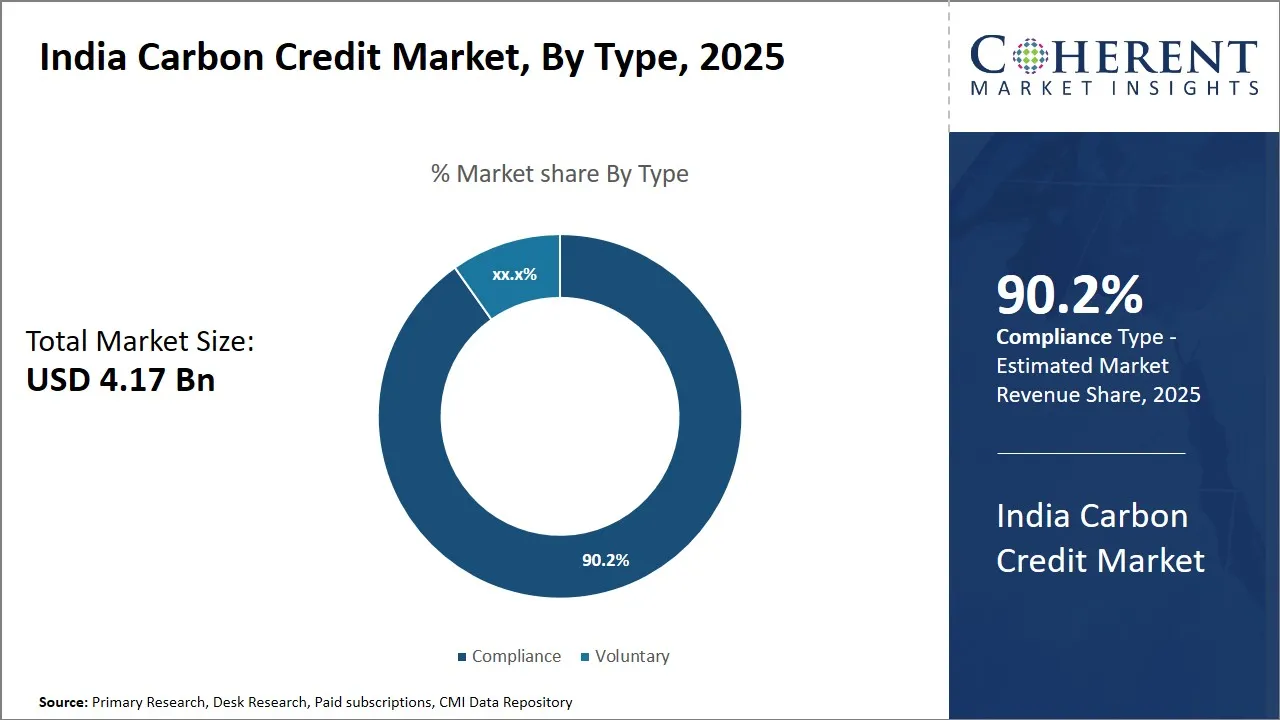
- The compliance segment is expected to capture 91.2 % of the market share in 2026.
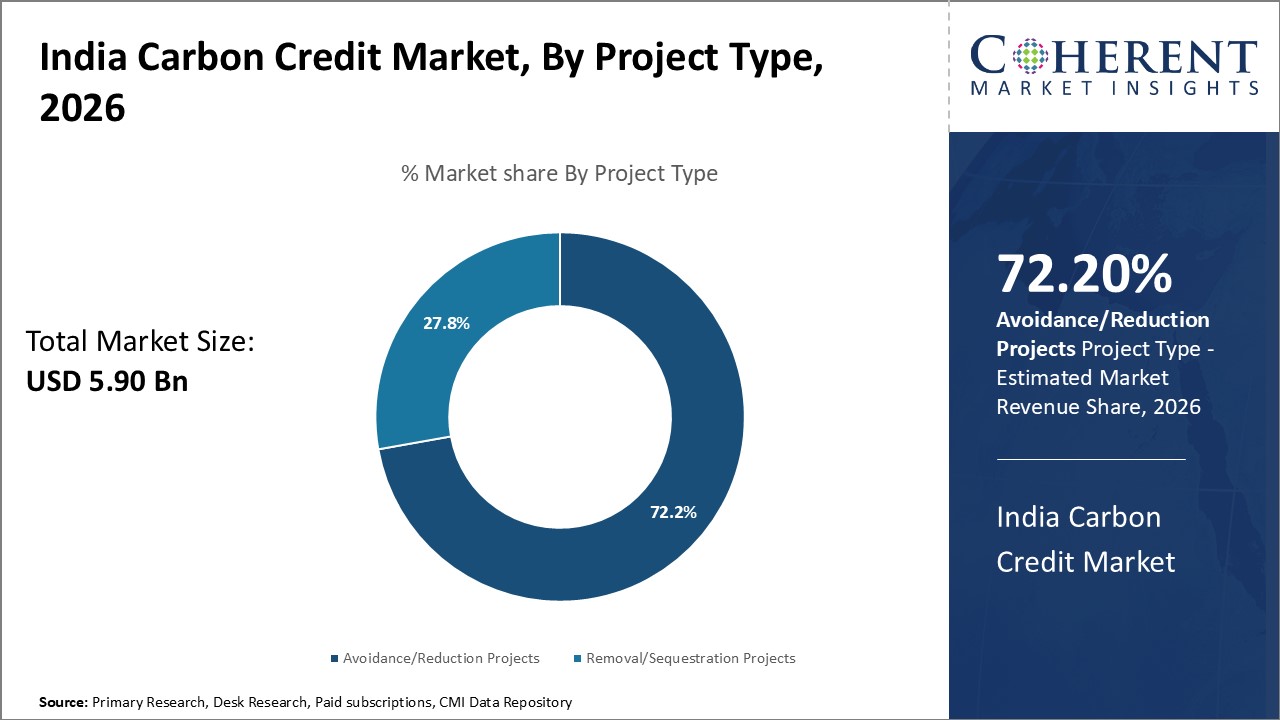
- The removal/sequestration projects segment is projected to account for 72.2% of the India carbon credit market share in 2026.
- The power segment is expected to hold a 30.8% of the India carbon credit market share in 2026.
Market Overview
A significant market trend is the rising focus on renewable energy projects and carbon offset initiatives driven by both public and private sectors. Advanced technologies for carbon capture and storage, awareness among companies about their environmental responsibility, and demand for carbon credits are on the rise. International collaborations and regulatory frameworks further advance this market. Carbon credits are therefore becoming pivotal in helping India achieve its climate goals.
Current Events and Its Impact
Current Events | Description and its Impact |
Launch of fiscal regulations for the Carbon Credit Trading Scheme (CCTS) (July 2024 / formalized 2025) |
|
Technological push via carbon capture, utilization & storage (CCUS) incentives |
|
Segmental Insights
- Current Industry Events of 2026
- Market Size Estimation
- Regional Breakdown
- Competitive Landscape
- Customer Intelligence
- Segmental Analysis
- Pricing Analysis
- Key Market Drivers, Challenges & Future Trends
- Customized Insights Section
India Carbon Credit Market Insights, By Type - Compliance Segment Dominates the Market Driven by Regulatory Mandates and Policy Support
Compliance segment is expected to hold 91.2% of the carbon credit market share in 2026. The growth has been large due to the rising importance of regulatory frameworks and government policies toward climate change mitigation. With international accords like the Paris Agreement, India has promised to pursue ambitious goals on the climate. With these requirements, various industries are compelled to fulfill the stipulated emission reductions or face penalties for not being able to meet those requirements.
The institutional support for the Compliance segment has taken the form of establishing mechanisms such as the Perform, Achieve and Trade scheme under the NMEEE. That program requires energy-intensive industries to reduce their emissions in exchange for tradable carbon credits. Initiatives like these establish a reliable and warm demand for compliance carbon credits since companies want to balance out their carbon footprint at the lowest possible cost. In addition, increasing regulatory scrutiny and a rise in environmental awareness is leading firms to participate in compliance as a means of demonstrating their sustainability commitments.
India Carbon Credit Market Insights, By Project Type - Avoidance/Reduction Projects Lead by Cost-Effectiveness and Immediate Impact Potential
Avoidance/reduction Projects segment will represent around 72.2% of the India carbon credit market share in 2026. The attractiveness of avoidance/reduction approaches is their practicality and their ability to elevate environmental and social outcomes quickly. Avoidance and/or reduction projects aim to prevent the emission of greenhouse gases before they occur, making them highly attractive for industries that want to engage in a rapid transition towards carbon mitigation, without the longer-term complexities of a sequestration approach.
Avoidance/reduction projects can include some or all of the activities: energy efficiency improvements, fuel switching, waste management methane recovery, and renewable energy projects. The significant demand for an energy transition away from dependency on fossil fuels will similarly catalyze investment in energy-related technologies associated with energy savings that generate avoidance credits.
India Carbon Credit Market Insights, By End-Use Industry - Power Sector Leads Demand Due to Energy Transition and Emission Reduction Mandates
The power segment is expected to comprise a noteworthy 30.8% share in 2026, to reflect the significance of the power sector as a large-scale greenhouse gas emitter and a critical sector of India's energy services infrastructure for carbon credit consumption. Due to the existence of the emission reduction mandates from the energy transition, the power segment must be more proactive in the carbon credit market in a sector considered to be the foundation of cleaner and sustainable energy generation.
To that end, the ambitious goals set in India to scale renewable energy capacity from sources such as solar and wind, and transition away from fossil fuels, have a direct impact on the carbon credit flows associated with improvements to the power segment.
Ambitious targets set by India to increase its renewable energy capacity from solar, wind, and other non-fossil fuels have a direct consequence on the dynamics of carbon credits for the power sector. Complementing the power generation from renewables, conventional coal-based power plants offset residual emissions through strategies that create robust demand for carbon credits. Apart from this, regulatory actions like emission intensity benchmarks compel power producers to either invest in cleaner technologies or purchase carbon credits to remain compliant.
Cross-Sector Emission Reduction Potential
- India’s Carbon Credit Trading Scheme covers major industrial sectors responsible for a bulk of India’s emissions, such as steel, cement, chemicals, aluminum, and power sectors.
- The scheme sets baseline and reduction targets on emission intensities for these sectors, monitored through robust reporting, verification, and compliance mechanisms.
- Cross-sectoral reduction potential is high because these sectors form the backbone of India's industrial emissions, and coordinated efforts avoid duplication of credit claims.
- Integration with renewable energy certificates and green hydrogen initiatives enhances emission reductions across sectors by encouraging renewable investments alongside carbon reductions.
Market Players, Key Development, and Competitive Intelligence
Key Development
- In January 2025, Google will buy 100,000 tons of carbon credits from the Indian Biochar Initiative by 2030. Biochar is made from agricultural waste and sequesters CO2 for hundreds of years while improving soil health.
Top Strategies Followed by India Carbon Credit Market Players
- Market leaders are well established and reasonably capitalized, so they are investing heavily in research and development (R&D) to develop advanced carbon credit products and solutions. Through continuous improvements in quality, efficiency, and sustainability of their carbon solutions, market leaders are establishing themselves as differentiated players in an increasingly crowded space.
- For example, ReNew Power developed a carbon credit program associated with its renewable energy projects, which has involved the company generating carbon credits from the vast solar and wind energy operations it owns and sells to the open market.
- Mid-tier players in the India carbon credit market are organizations that focus on delivering solutions that are cost-effective and have quality, somewhat different than established players in the same market. Mid-tier players typically also target price-sensitive clients such as small and medium enterprises and localized industries that are looking for realistic carbon credit offerings and will sacrifice performance over deliverables. Mid-tier companies also often develop partnerships with technology companies, financing institutions, and government entities with the intention of scaling up production and to gain access to innovative technologies.
- For example, Sterlite Power, taken a combined angle with low-cost, scalable carbon credit generation through wind energy and improvements to grid infrastructure targeting regional businesses that need low-cost programs.
- Small-scale entrants to the India carbon credit market take specialized vantages as they establish themselves in regional/business segments. They take the added value of product attributes/features or unique methods to serve customer needs. An example includes developing specific carbon offset projects, or renewable energy projects in coordination with a local energy producer, or developing sustainability solutions that are tailored to one or two niche industries. To be able to compete, and to be sufficiently nimble, small-scale teams are partaking in innovative new technologies like blockchain for tracking credits or AI-driven analytics to optimize carbon reduction strategies.
- For example, Eco India Carbon collaborates with agricultural businesses in rural India developing carbon offset projects customized around sustainable land management practices to procure credits for carbon offsets, while creating carbon credits through afforestation.
Market Report Scope
India Carbon Credit Market Report Coverage
| Report Coverage | Details | ||
|---|---|---|---|
| Base Year: | 2025 | Market Size in 2026: | USD 5.90 Bn |
| Historical Data for: | 2020 To 2024 | Forecast Period: | 2026 To 2033 |
| Forecast Period 2026 to 2033 CAGR: | 41.4% | 2033 Value Projection: | USD 66.79 Bn |
| Segments covered: |
| ||
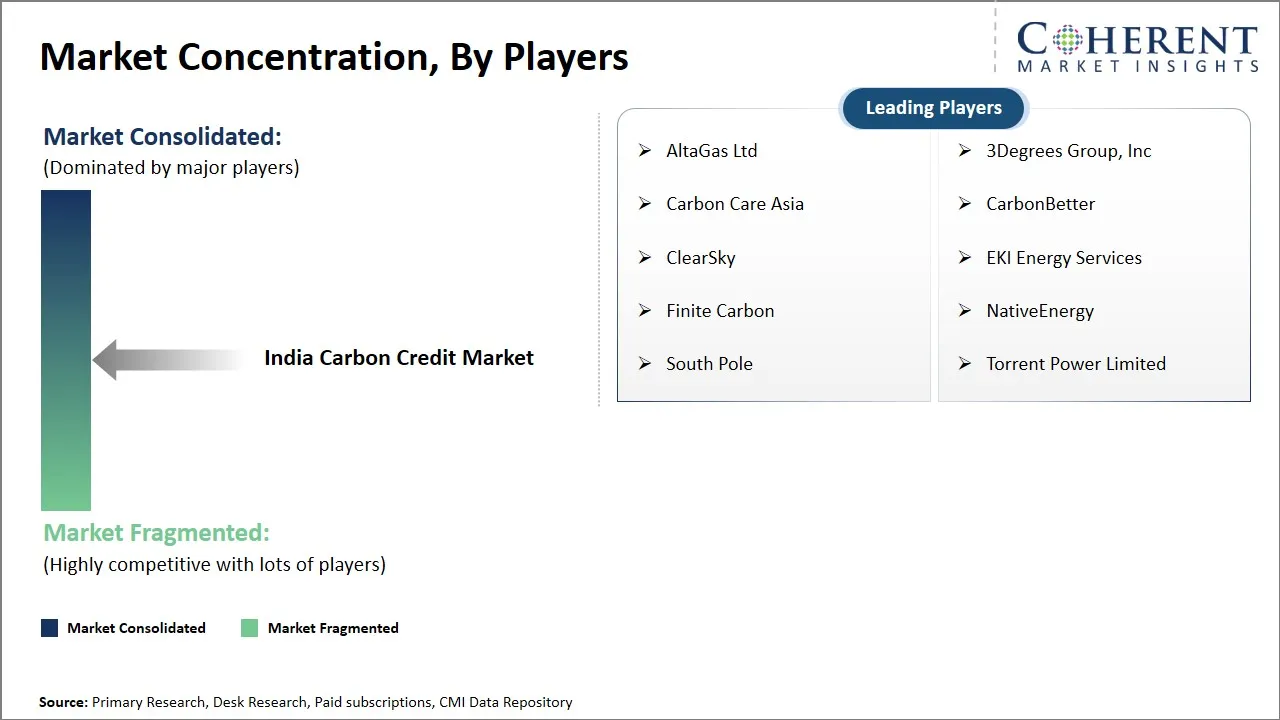
| Companies covered: | AltaGas Ltd, 3Degrees Group, Inc, Carbon Care Asia, CarbonBetter, ClearSky, EKI Energy Services, Finite Carbon, NativeEnergy, South Pole, and Torrent Power Limited | ||
| Growth Drivers: |
| ||
| Restraints & Challenges: |
| ||
India Carbon Credit Market Dynamics
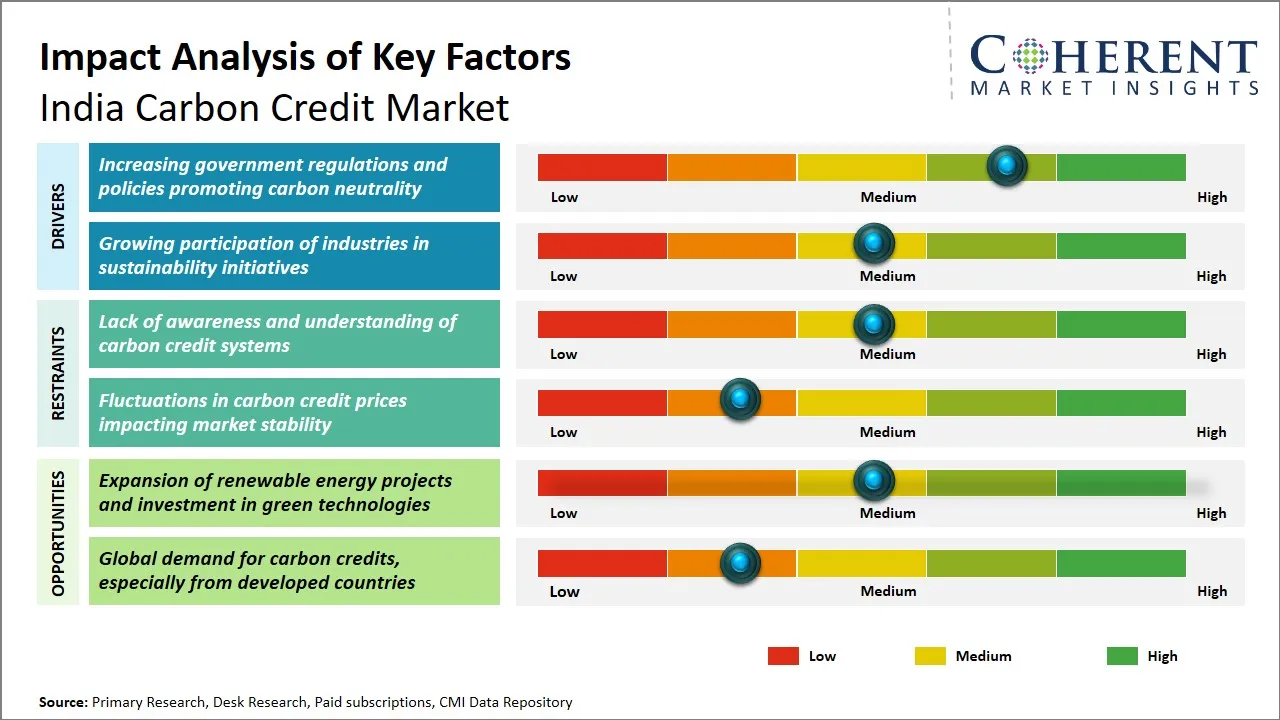
India Carbon Credit Market Driver - Increasing Government Regulations and Policies Promoting Carbon Neutrality
The push for stronger government regulations and policies supporting carbon neutrality is a major contributor to the carbon credit market in India. In keeping with its obligations under the Paris Agreement and its own Nationally Determined Contributions (NDCs), the government has begun the process of creating regulations and incentives to motivate companies to measure their carbon footprint reduction, report it, and eventually reduce it. Initiatives such as the Perform, Achieve and Trade (PAT) scheme under the National Action Plan on Climate Change (NAPCC) create a compliance mechanism in which the industry receives carbon credits for exceeding its energy performance target, and can profit by trading those credits to offset emissions.
As an example, JSW Steel, one of the largest steel producers in India, is a participant in the PAT scheme and successfully reduced its energy consumption over and above its PAT target. It subsequently received carbon credits, which it traded on the market to offset its operational emissions. This not only allowed the company to improve its energy performance, but it also provided a mechanism by which the company could operate within the Regulations while contributing to India's carbon neutrality commitment under the Paris Agreement.
India Carbon Credit Market Opportunity - Expansion of Renewable Energy Projects and Investment in Green Technologies
The carbon credit market in India will have considerable benefits from the rapid growth of renewable energy projects in conjunction with increased investment in green technologies. India has pledged to achieve net-zero greenhouse gas (GHG) emissions by 2070, creating a rapid acceleration of renewable energy-generating capacity - solar, wind, and bioenergy - to meet national grid power demand. This expansion creates opportunities for firms and investors to generate and sell carbon offset due to reductions in GHG emissions towards international climate targets. National government policies, including the National Solar Mission and regulatory frameworks, such as, the Perform, Achieve, and Trade (PAT) scheme also incentivize firms to switch to cleaner technologies therefore increasing demand for carbon credits in both compliance and voluntary carbon markets.
Adani Green Energy is a large renewable energy company based in India, significantly investing in large-scale solar farms across India, that create carbon credits due to cleaner energy displacing fossil-fuel based energy generation and GHG emissions reductions.
Analyst Opinion (Expert Opinion)
- The carbon credit market is changing rapidly, influenced by increasing regulatory pressures and the urgent need for businesses to meet sustainability requirements. Takeaways from the 2023 Global Carbon Market Conference and the COP27 Climate Summit (2022) provided key insights as organizations like Verra and Gold Standard are developing new carbon credit certification and trading platforms. Verra's recent announcement of a new streamlined verification process for carbon offset projects demonstrates how the market is responding to calls for greater transparency and faster approvals.
- Opportunities around voluntary carbon markets emerged in discussions among attendees of the conferences, where companies were driving to offset emissions beyond legally battery requirements. This trend illustrates a shift in assessments from reactive approaches focused on regulatory compliance to proactive assessments focused on climate action.
- However, barriers to wider adoption such as market volatility and the need for a standard set of tools and methodologies for project reviews were consistent topics in discussion at these forums. Companies breaking through the clutter with cohesive trading platforms and stakeholder engagement will win a bigger share of the market. Companies should also consider partnerships with environmental NGO's to build credibility and increase visibility for their projects. Overall, the carbon credit market will grow based on how well organizations can impact carbon mitigation strategies, while innovating around the complexities surrounding climate change and business responsibility.
Speak to the analyst
Want personalized insights?
Take the findings above to one of our principal consultants, or have the report rebuilt around the segments, geographies and competitors you actually track.
Market Segmentation
- Type Insights (Revenue, USD Bn, 2021 - 2033)
- Compliance
- Voluntary
- Project Type Insights (Revenue, USD Bn, 2021 - 2033)
- Avoidance/Reduction Projects
- Removal/Sequestration Projects
- Nature-based
- Technology-based
- End-use Industry Insights (Revenue, USD Bn, 2021 - 2033)
- Power
- Energy
- Aviation
- Transportation
- Buildings
- Industrial
- Others
- Key Players Insights
- AltaGas Ltd
- 3Degrees Group, Inc
- Carbon Care Asia
- CarbonBetter
- ClearSky
- EKI Energy Services
- Finite Carbon
- NativeEnergy
- South Pole
- Torrent Power Limited
Sources
Primary Research Interviews
- Director – Bureau of Energy Efficiency (BEE)
- Head of Carbon Market Operations – Central Electricity Regulatory Commission (CERC)
- Policy Advisor – Ministry of Power, India
- Sustainability Manager – Carbon Markets Association of India (CMAI)
Stakeholders
- Carbon Credit Certificate (CCC) Issuers and Verifiers
- Industrial Sectors under Emission Trading Scheme
- Regulatory Bodies and Compliance Agencies
- Voluntary Carbon Market Participants
- Environmental NGOs and Local Communities
Databases
- UN Comtrade Database (for carbon credit export/import data)
- India Ministry of Power Carbon Market Data Portal
- India EXIM Database (trade in carbon credits and related commodities)
Magazines
- Carbon Markets Association of India Bulletin
- Energy and Environment Review (India)
- Economic Times Energy & Environment Supplement
- Climate Policy Journal India edition
Journals
- International Journal of Environmental Sciences – Studies on India's Carbon Market
- Journal of Sustainable Development – Carbon Credits and Economic Growth in India
- Energy Policy Journal – Emission Trading and Regulatory Framework in India
- Environmental Economics and Policy Research – Market Mechanisms for Carbon Trading
Newspapers
- The Economic Times – Regulatory Updates on India’s Carbon Market
- The Hindu Business Line – Carbon Trading and Market Dynamics in India
- Financial Express – Market Trends and Policy News on Carbon Credits
- Mint – India's Carbon Market Growth and International Collaborations
Associations
- Carbon Markets Association of India (CMAI)
- Bureau of Energy Efficiency (BEE)
- Central Electricity Regulatory Commission (CERC)
- Ministry of Power, Government of India
- Voluntary Carbon Markets Integrity Initiative (VCMI)
Public Domain Sources
- Energy Conservation (Amendment) Act, 2022 – Legal framework for Carbon Credit Trading Scheme (CCTS)
- Ministry of Power – Guidelines and Regulatory Notifications on Indian Carbon Market
- Central Electricity Regulatory Commission (CERC) – Carbon Market Trading Regulations
- UNFCCC – India’s Carbon Market Participation and NDC Compliance
Proprietary Elements
- CMI Data Analytics Tool, Proprietary CMI Existing Repository of information for last 8 years.
Get access to 250+ pages report
Every segment, forecast, competitor profile and data table behind the analysis above — available for instant download.
- ESOMAR Member
- ISO 9001:2015 Certified
- D-U-N-S Registered
- GDPR & CCPA Compliant
Missing comfort of reading report in your local language? Find your preferred language:
Transform your Strategy with Exclusive Trending Reports
Frequently Asked Questions
The India carbon credit market is estimated to be valued at USD 5.90 Bn in 2026 and is expected to reach USD 66.79 Bn by 2033.
The CAGR of the India carbon credit market is projected to be 41.4% from 2026 to 2033.
Increasing government regulations and policies promoting carbon neutrality and growing participation of industries in sustainability initiatives are the major factors driving the growth of the India carbon credit market.
Lack of awareness and understanding of carbon credit systems and fluctuations in carbon credit prices impacting market stability are the major factors hampering the growth of the India carbon credit market.
In terms of type, the compliance is estimated to dominate the market revenue share in 2026.
AltaGas Ltd, 3Degrees Group, Inc, Carbon Care Asia, CarbonBetter, ClearSky, EKI Energy Services, Finite Carbon, NativeEnergy, South Pole, and Torrent Power Limited are the major players.