

India Infertility Gonadotropins Market Size and Forecast – 2026 To 2033
The India infertility gonadotropins market is expected to grow from USD 273.0 Mn in 2026 to USD 512.9 Mn by 2033, registering a compound annual growth rate (CAGR) of 13.3%. The India infertility gonadotropins market growth is fueled by the growing prevalence of infertility. According to the estimates of Indian Council of Medical Research, about 10 to 15% of the married couples in India suffer from infertility, resulting in a large number of patients who require treatment.
(Source: Indian Council of Medical Research)
Key Takeaways of the India Infertility Gonadotropins Market
- Follicle Stimulating Hormone (FSH) is projected to hold 56.0 % of the India infertility gonadotropins market share in 2026, making it the dominant type segment. FSH is compulsory during controlled ovarian stimulation treatment for all cycles in accordance with assisted reproductive technology (ART) treatment protocols from the Indian Council of Medical Research. In comparison with hCG and hMG, FSH treatment spans through the entire stimulation period (8-12 days per cycle), resulting in substantially greater volume and market share per cycle. (Source: Indian Council of Medical Research)
- Branded is projected to hold 82.5% of the India infertility gonadotropins market share in 2026, making it the dominant product type segment. Products in branded form predominate in view of the rigorous regulatory control (including approval and quality standards by the Central Drugs Standard Control Organization and compliance under the Drugs and Cosmetics Act 1940) exercised over biologics by the Central Drugs Standard Control Organization (CDSCO), which stipulates the necessity of proving comparability between similar biologics regarding quality, safety, and efficacy. Due to the great sensitivity of IVF procedure to drug consistency, preference is given to the established brand with batch reliability over an unbranded product, supported by evidence that recombinant gonadotropins are preferred due to improved purity and batch-to-batch consistency compared to older preparations, as highlighted in a review published in Endocrine Reviews. (Source: Endocrine Reviews)
- Subcutaneous is projected to hold 67.9% of the India infertility gonadotropins market share in 2026, making it the dominant route of administration segment. The subcutaneous route prevails in view of the growing trend among ART protocols towards outpatient self-administration of multiple doses during a number of treatment cycles. This is supported by scientific studies on human chorionic gonadotropin (hCG), that prove equal pharmacokinetics compared to the intramuscular route.
- Fertility Preservation (Egg Freezing) in Urban Working Women: Increased labor force participation and deferred parenthood have resulted in an increased demand for elective egg banking. This will open up a niche market for gonadotropins, as controlled ovarian hyperstimulation forms the basis of egg retrieval, thereby increasing its usage from merely being limited to infertility treatment.
- Expansion of Government-Regulated ART Clinics in Tier 2/3 Cities: Under the ART act introduced by the Ministry of Health and Family Welfare, registration of fertility centers has become easier, thereby opening up a patient pool that was earlier untouched. Increased penetration of ART has further led to a rise in demand for gonadotropins.
Segmental Insights
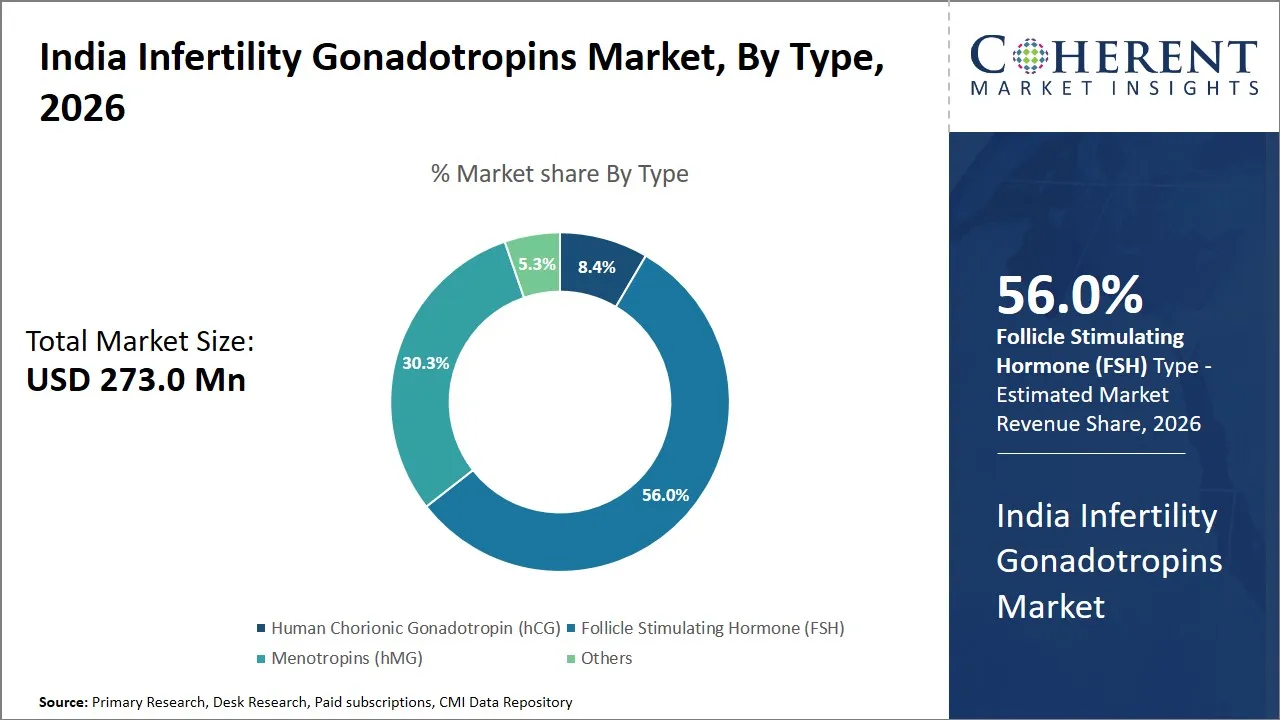
Why Do Follicle Stimulating Hormone (FSH) Dominate the India Infertility Gonadotropins Market?
Follicle Stimulating Hormone (FSH) is projected to hold a market share of 56.0% in 2026, owing to their main use in stimulating the ovaries during ART cycles that are becoming more widespread in India. Based on the report published by the National Assisted Reproductive Technology (ART) Registry, ICMR, ovarian stimulation using FSH constitutes the initial process during IVF treatments used in all registered clinics, ensuring continued high clinical use of FSH. In addition, the passing of the ART Act by the Ministry of Health and Family Welfare provides for uniform treatment guidelines across all ART clinics that are required to conduct controlled ovarian stimulation. The increase in ART clinic numbers and registered ART treatment procedures ensures sustained demand for FSH as the drug of choice. (Source: National Assisted Reproductive Technology (ART))
- Current Industry Events of 2026
- Market Size Estimation
- Regional Breakdown
- Competitive Landscape
- Customer Intelligence
- Segmental Analysis
- Pricing Analysis
- Key Market Drivers, Challenges & Future Trends
- Customized Insights Section
Why is Branded Most Preferred Product Type in India Infertility Gonadotropins Market?
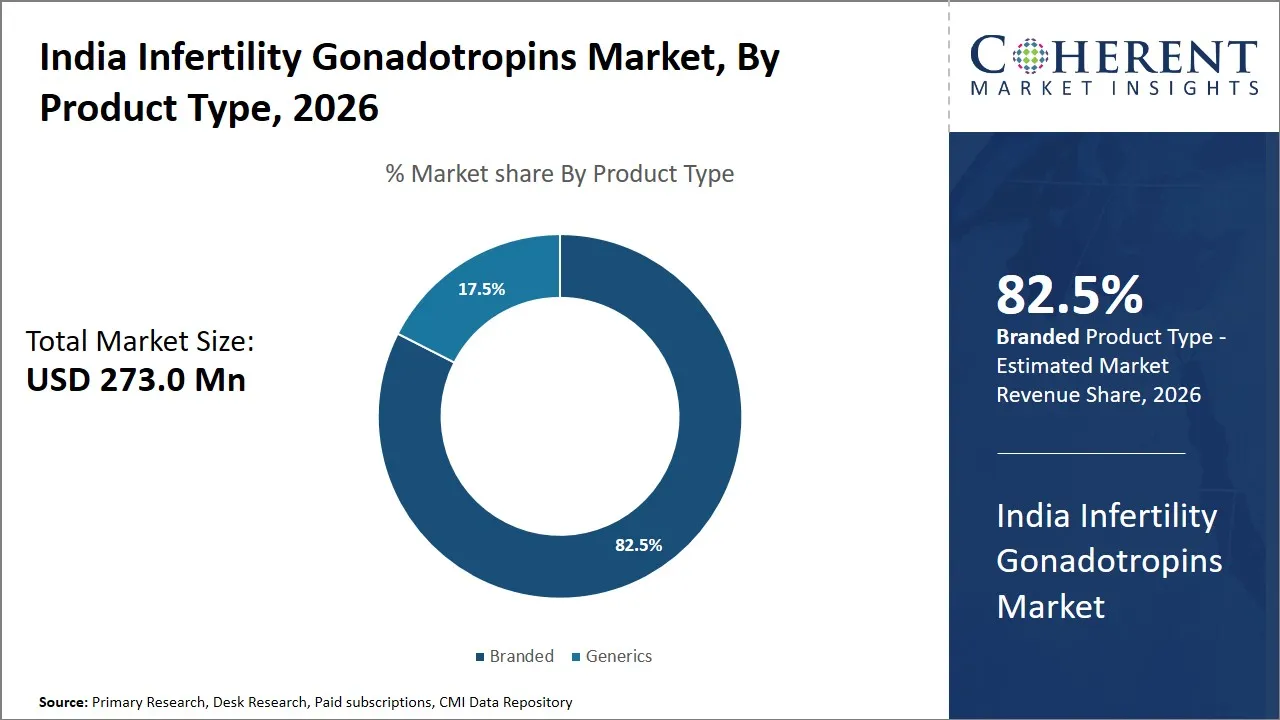
Branded is projected to hold 82.5% of the market share in 2026, owing to strict government policies (Central Drugs Standard Control Organization regulations on drug quality and approval, Drugs and Cosmetics Act 1940 compliance requirements, and price control under the National Pharmaceutical Pricing Authority through the Drug Price Control Order (DPCO)), clinical sensitivity related to infertility treatment, and guaranteed effectiveness in assisted reproduction technology (ART) cycles. Under the guidelines laid down in the ART Act enacted by the Ministry of Health & Family Welfare, all ART centers need to abide by certain treatment guidelines and maintain drug traceability in treatment procedures. (Source: Ministry of Health & Family Welfare)
Furthermore, the Central Drugs Standard Control Organization (CDSCO) has established stringent quality control standards for biological products, including gonadotropins, because even small changes in the drug's composition can affect how well the treatment works. For example, according to India's "Guidelines on Similar Biologics" (2016 amendment), manufacturers must demonstrate that their product is comparable to the original drug through thorough analysis and clinical testing, focusing on quality, safety, and effectiveness, to ensure there are no important differences in how the two drugs work (Source: Central Drugs Standard Control Organization (CDSCO). Given the significance of ovarian stimulation in achieving a successful IVF cycle rate, doctors usually choose branded drugs after thorough testing because of their batch-to-batch consistency, clinical efficacy, and negligible immunogenicity as compared to generic drugs.
Subcutaneous Segment Dominates the India Infertility Gonadotropins Market
The subcutaneous segment is expected to hold 67.9% of the India infertility gonadotropins market share in 2026, because of better patient convenience, easier self-injection, and clinical efficacy similar to or superior to that of the other methods of drug administration. Subcutaneous injection of gonadotropins is more convenient from a clinical perspective because this route of administration imposes less physical and mental stress on patients owing to self-injection without the need for clinic visits. Empirical evidence from the Indian Fertility Society supports the patient’s preference for self-injection as well as patient compliance with pen-based gonadotropins, whereby most patients prefer self-administration because of its simplicity and lack of pain. (Source: Indian Fertility Society)
Furthermore, scientific studies indicate that giving hormones under the skin leads to similar, or even higher, hormone levels in the blood and follicles compared to injecting them into the muscle. This confirms that gonadotropins work well in in-vitro fertilization (IVF) procedures. For example, a PubMed study on recombinant follicle-stimulating hormone (FSH) showed that the subcutaneous method was just as effective as the intramuscular method in achieving similar serum concentrations and promoting follicular development during an IVF cycle. (Source: PubMed)
Currents Events and their Impact
Current Events | Description and its Impact |
Regulatory Shift: Implementation of ART Act & National Registry (2024–2025) |
|
Industry Expansion: Rapid Growth of ART Clinics Across India (2024–2025) |
|
(Source: Ministry of Health & Family Welfare, National ART & Surrogacy Registry)
India Infertility Gonadotropins Market Dynamics
Market Drivers
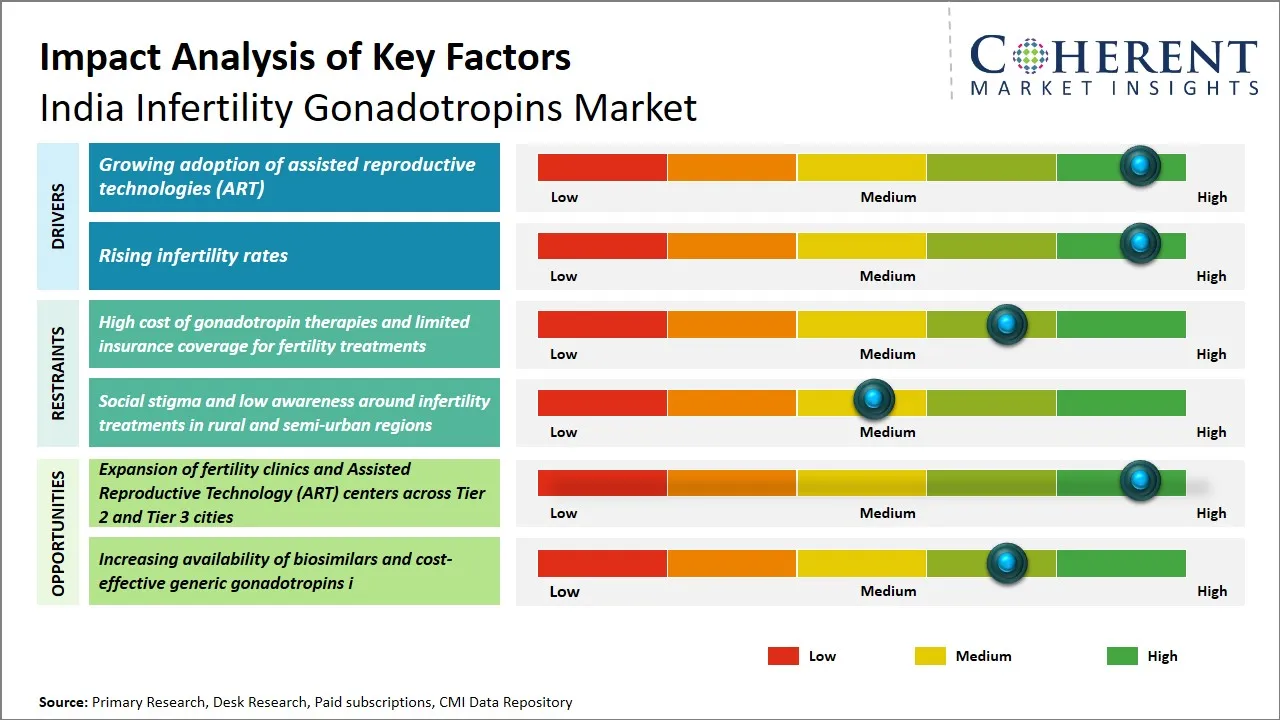
- Growing Adoption of Assisted Reproductive Technologies (ART): The ARTs techniques have been widely used in India because of the rise in cases of infertility issues and better availability of ARTs in both metro and non-metro cities. As indicated in a study published in BMJ Open journal in September 2025, 200,000 to 250,000 IVF procedures are done in India annually, with the aim of achieving a target number of 500,000-600,000 procedures annually by 2030 (Source: BMJ Open journal). Moreover, a research article in the Indian Journal of Community Medicine from 2024 indicated an increasing trend towards employing ART procedures as the primary treatment option for infertility. The implementation of the ART Act, as well as the establishment of registries, has made ART services more transparent and uniform, thus increasing patients’ trust in such procedures.
- Rising Infertility Rates: Infertility rates in India are climbing, fueled by delayed parenthood, shifting lifestyles, and a rise in reproductive health issues. In October 2024, study in the Indian Journal of Community Medicine found that roughly 15–20 million couples in India are grappling with infertility. The prevalence varies considerably, from 3.9% to 16.8%, depending on the region (Source: Indian Journal of Community Medicine). Furthermore, a 2023 study available on PubMed Central reports a notable rise in secondary infertility, reaching approximately 28.6%, indicating worsening reproductive health trends (Source: PubMed Central). An expansion in the patient base indicate that more people require medical attention, leading to an increase in the number of gonadotropins required for both ART and ovulation induction treatments.
Emerging Trends
- Rising Adoption of Recombinant and Biosimilar Gonadotropins: There is an increasing inclination toward recombinant gonadotropins due to their higher efficiency and efficacy compared with the urine-derived products. Meanwhile, biosimilar drugs are being used more frequently in countries like India where cost considerations play a significant role, resulting in higher volumes of gonadotropins usage.
- Integration of Personalized Fertility Treatments and Digital Monitoring: Data-driven practices, treatment planning based on artificial intelligence, and digital monitoring techniques have been gaining popularity among fertility clinics for ovarian stimulation therapy. This helps to improve success rates as well as patient compliance, leading to higher volumes for gonadotropin therapy through assisted reproduction technologies (ART).
Key Regulatory Framework Governing the India Infertility Gonadotropins Market
Regulatory Area
| Governing Authority | Key Regulation | Impact on Market |
Drug Approval & Licensing | Central Drugs Standard Control Organization (CDSCO) | Drugs and Cosmetics Act, 1940 & Rules, 1945 | Mandatory approval for recombinant and urinary gonadotropins before commercialization; ensures safety, efficacy, and quality |
Biologics & Biosimilars Regulation | Central Drugs Standard Control Organization + Department of Biotechnology | Guidelines on Similar Biologics (2016, revised) | Governs approval of recombinant FSH/LH biosimilars; promotes cost-effective alternatives while ensuring comparability |
Pricing Control | National Pharmaceutical Pricing Authority | Drug Price Control Order (DPCO), 2013 | Regulates ceiling prices of essential infertility drugs (if listed), impacting affordability and margins |
Import & Manufacturing Compliance | Central Drugs Standard Control Organization | Import licensing & GMP norms | Ensures quality standards for imported gonadotropins and domestic production facilities |
Clinical Trials & Safety | Central Drugs Standard Control Organization | New Drugs and Clinical Trials Rules, 2019 | Regulates clinical evaluation of new gonadotropin formulations and indications |
ART Practice Regulation | Ministry of Health and Family Welfare | Assisted Reproductive Technology (Regulation) Act, 2021 | Standardizes fertility clinics and treatment protocols, indirectly boosting demand for gonadotropins |
Ethical & Clinic Accreditation | Indian Council of Medical Research | National Guidelines for ART Clinics | Ensures ethical use of hormonal therapies and standardized infertility treatment practices |
How is the expansion of fertility clinics and assisted reproductive technology (ART) centers across Tier 2 and Tier 3 cities creating new growth opportunities in the India infertility gonadotropins market?
The surge of fertility clinics and assisted reproductive technology (ART) centers into Tier 2 and Tier 3 regions, away from just the big cities, is really boosting the demand for gonadotropins in India's infertility gonadotropins market by making advanced reproductive treatments much more accessible. As per the Government of India’s National ART & Surrogacy Registry, there are over 3,138 registered ART clinics in India, reflecting the rapid expansion of fertility infrastructure across the country (Source: National ART & Surrogacy Registry). Furthermore, a report provided by National Library of Medicine highlights that the number of assisted reproductive technology centers (ART) jumped from 500 in 2010 to over 1,500 by 2019 showing an upward trajectory. (Source: National Library of Medicine)
This decentralization, backed by regulations like the ART Act and national registry systems, is allowing patients in less populated areas to get IVF services closer to home. Additionally, Novel Medicare Solutions Pvt Ltd's data, citing the Economic Times Health Report 2024, reveals that India now sees over 350,000 IVF cycles each year, with demand climbing at a rate approaching 15% annually (Source: Novel Medicare Solutions Pvt Ltd). This surge in IVF procedures translates into considerable expansion prospects for pharmaceutical firms nationwide, particularly in the realm of gonadotropins used for ovarian stimulation.
Market Players, Key Development, and Competitive Intelligence
Key Developments
- In May 2025, Ferring Pharmaceuticals shared findings from its IRIS clinical study conducted in India. The study assessed the use of personalized dosing of recombinant FSH (follitropin delta) in IVF. The results showed better ovarian response and pregnancy rates, bolstering the case for personalized gonadotropin therapies. This news further solidifies the place of advanced fertility treatments within the India infertility gonadotropins market.
- In July 2024, Mankind Pharma revealed its plans to buy Bharat Serums and Vaccines Limited. The deal, valued at roughly USD 1.6 billion, was aimed at broadening Mankind's reach in women's health and fertility care, specifically in the area of gonadotropins. This move significantly bolsters Mankind's offerings in infertility treatments, setting the stage for expansion within the fertility sector.
Competitive Landscape
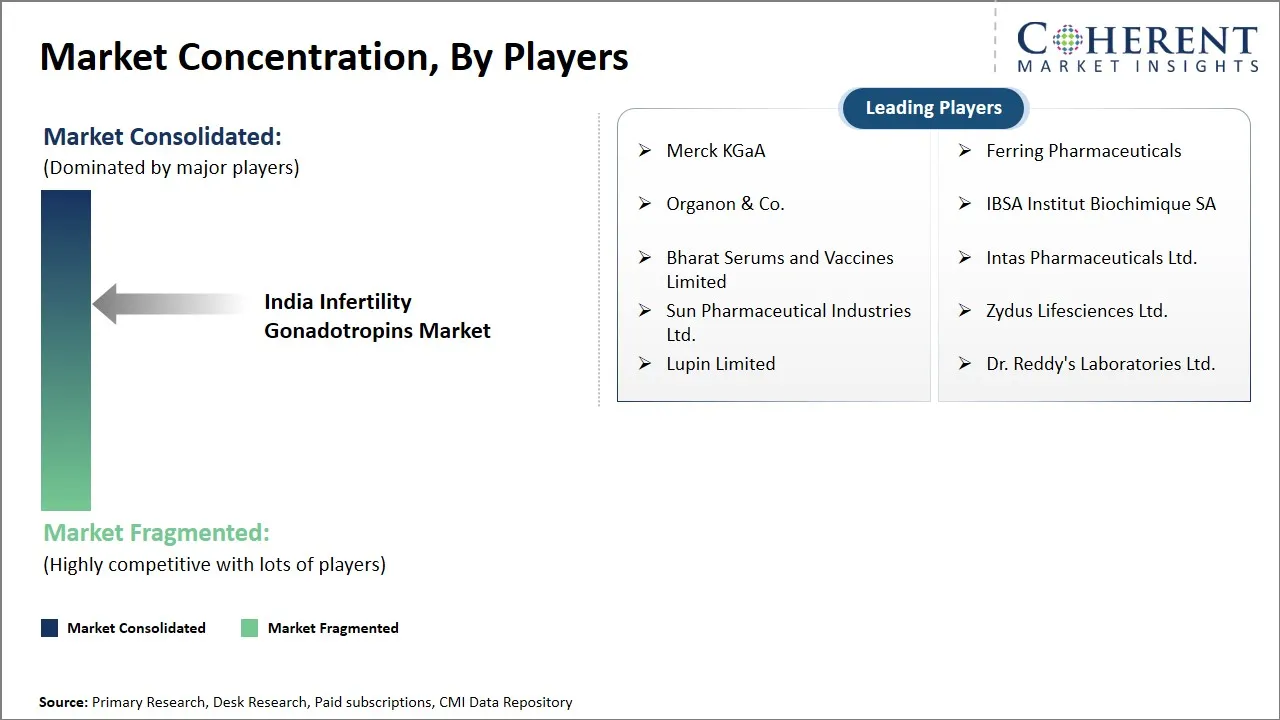
The India infertility gonadotropins market is highly competitive and evolving owing to the presence of multinational pharmaceutical firms, Indian biosimilar makers, and firms that specialize in fertility products. Product innovation, cost-effective biosimilars, and effective marketing have become key strategies among other aspects in the market environment. Key focus areas include:
- Recombinant Gonadotropins & Biosimilar Development
- Strategic Partnerships with IVF Clinics & ART Centers
- Regulatory Compliance & Quality Differentiation
Market Report Scope
India Infertility Gonadotropins Market Report Coverage
| Report Coverage | Details | ||
|---|---|---|---|
| Base Year: | 2025 | Market Size in 2026: | USD 273.0 Mn |
| Historical Data for: | 2020 To 2024 | Forecast Period: | 2026 To 2033 |
| Forecast Period 2026 to 2033 CAGR: | 13.3% | 2033 Value Projection: | USD 512.9 Mn |
| Segments covered: |
| ||
| Companies covered: | Merck KGaA, Ferring Pharmaceuticals, Organon & Co., IBSA Institut Biochimique SA, Bharat Serums and Vaccines Limited, Intas Pharmaceuticals Ltd., Sun Pharmaceutical Industries Ltd., Zydus Lifesciences Ltd., Lupin Limited, and Dr. Reddy's Laboratories Ltd. | ||
| Growth Drivers: |
| ||
| Restraints & Challenges: |
| ||
Analyst Opinion (Expert Opinion)
- The India infertility gonadotropins market forecast will see substantial growth owing to the rapid increase in the utilization of assisted reproductive technology (ARTs), an increasing number of infertility cases, and consumer acceptance of fertility services in metropolitans as well as tier-II and III cities. Thanks to the introduction of regulations such as ARTs act, it can be safely assumed that there would be a shift towards recombinant gonadotropins and advanced fertility services. Additionally, the participation of both local and international companies within the market would help facilitate this transition.
- In terms of opportunities, the most promising area of growth can be seen in recombinant gonadotropins used for IVF treatments in India, especially among organized fertility clinics and ART clinics in the region. With high success rates and increased numbers of procedures performed, the IVF category shall remain dominant, while increased adoption rates in small towns represents an untapped area of growth. In addition, the delayed childbearing trend along with better diagnoses and increased awareness shall fuel demand for ovarian stimulation, which in turn will boost gonadotropin usage.
- It is essential for market players to take into consideration cost optimization, engaging in localized manufacturing, and developing relationships with fertility clinics and hospitals. It will be essential to develop biosimilars at lower costs, expanding their sales networks to include underdeveloped regions, as well as organizing training for physicians. It is also crucial for firms to focus on patient-oriented strategies including payment solutions, communication platforms, and stigma-reduction activities. By employing evidence-based drug regimens and developing connections with ART clinics, firms can create value in a fiercely competitive market setting.
Speak to the analyst
Want personalized insights?
Take the findings above to one of our principal consultants, or have the report rebuilt around the segments, geographies and competitors you actually track.
Market Segmentation
- Type Insights (Revenue, USD Mn, 2021 - 2033)
- Human Chorionic Gonadotropin (hCG)
- Follicle Stimulating Hormone (FSH)
- Menotropins (hMG)
- Others
- Product Type Insights (Revenue, USD Mn, 2021 - 2033)
- Branded
- Generics
- Route of Administration Insights (Revenue, USD Mn, 2021 - 2033)
- Intramuscular
- Subcutaneous
- Application Insights (Revenue, USD Mn, 2021 - 2033)
- Female Infertility
- Male Infertility
- Type of Infertility Insights (Revenue, USD Mn, 2021 - 2033)
- Primary Infertility
- Secondary Infertility
- Age Group Insights (Revenue, USD Mn, 2021 - 2033)
- 18–25
- 26–30
- 31–35
- 36 and Above
- Distribution Channel Insights (Revenue, USD Mn, 2021 - 2033)
- Hospital Pharmacies
- Retail Pharmacies
- Online Pharmacies
- Government Supply / Public Health Programs
- Key Players Insights
- Merck KGaA
- Ferring Pharmaceuticals
- Organon & Co.
- IBSA Institut Biochimique SA
- Bharat Serums and Vaccines Limited
- Intas Pharmaceuticals Ltd.
- Sun Pharmaceutical Industries Ltd.
- Zydus Lifesciences Ltd.
- Lupin Limited
- Reddy's Laboratories Ltd.
Sources
Primary Research Interviews
- Fertility specialists (IVF clinicians) – ART clinics across India
- Head of Embryology Labs – IVF centers
- Medical Directors – Fertility hospital chains
- Gynecologists & Endocrinologists (reproductive health)
- Pharma distributors handling hormonal therapies (gonadotropins)
Databases
- Indian Council of Medical Research (ICMR – NARI)
- National Family Health Survey (NFHS)
- World Health Organization (GHO Database)
- Central Drugs Standard Control Organization (CDSCO)
- Ministry of Health and Family Welfare (MoHFW)
- Open Government Data Platform India
- Press Information Bureau (PIB)
Magazines
- BioSpectrum India
- Express Healthcare
- Pharmabiz
- ET HealthWorld
- Fierce Pharma
- Clinical Trials Arena
- Healthcare Radius
- Modern Healthcare
- PharmaTimes
- The Pharma Letter
Journals
- Journal of Human Reproductive Sciences
- Indian Journal of Community Medicine
- Journal of Obstetrics and Gynaecology of India
Newspapers
- The Economic Times
- Business Standard
- The Hindu BusinessLine
- Financial Express
Associations
- Indian Society for Assisted Reproduction (ISAR)
- Federation of Obstetric and Gynaecological Societies of India (FOGSI)
- ICMR – National ART Registry of India (NARI)
- World Health Organization (WHO) – infertility definitions & benchmarks
Public Domain Sources
- Indian Council of Medical Research (ICMR)
- Ministry of Health and Family Welfare (MoHFW)
- National Health Mission (NHM)
- Open Government Data Platform India
- Press Information Bureau (PIB)
- Central Drugs Standard Control Organization (CDSCO)
- National Pharmaceutical Pricing Authority (NPPA)
- World Health Organization
- World Bank
- United Nations Population Fund
Proprietary Elements
- CMI Data Analytics Tool, Proprietary CMI Existing Repository of information for last 10 years.
Get access to 250+ pages report
Every segment, forecast, competitor profile and data table behind the analysis above — available for instant download.
- ESOMAR Member
- ISO 9001:2015 Certified
- D-U-N-S Registered
- GDPR & CCPA Compliant
Missing comfort of reading report in your local language? Find your preferred language:
Transform your Strategy with Exclusive Trending Reports
Frequently Asked Questions
The India infertility gonadotropins market is estimated to be valued at USD 273.0 Mn in 2026 and is expected to reach USD 512.9 Mn by 2033.
Follicle Stimulating Hormone (FSH) dominate due to its central and indispensable role in both diagnosis and treatment of infertility.
Infertility gonadotropins are hormonal medications (like FSH, LH, and hCG) used to stimulate ovulation in women and sperm production in men to treat infertility.
The CAGR of India infertility gonadotropins market is projected to be 13.3% from 2026 to 2033.
Growing adoption of assisted reproductive technologies (ART) and rising infertility rates are the major factors driving the growth of the India infertility gonadotropins market.
High cost of gonadotropin therapies and limited insurance coverage for fertility treatments and social stigma and low awareness around infertility treatments in rural and semi-urban regions are the major factors hampering the growth of the India infertility gonadotropins market.
In terms of product type, branded is estimated to dominate the market revenue share in 2026.