

India Secure Access Service Edge (SASE) Market Size and Forecast – 2026-2033
The India Secure Access Service Edge (SASE) market is estimated to be valued at USD 645.9 Mn in 2026 and is expected to reach USD 2,643.2 Mn by 2033, exhibiting a compound annual growth rate (CAGR) of 22.3% from 2026 to 2033.
Key Takeaways of the India Secure Access Service Edge (SASE) Market
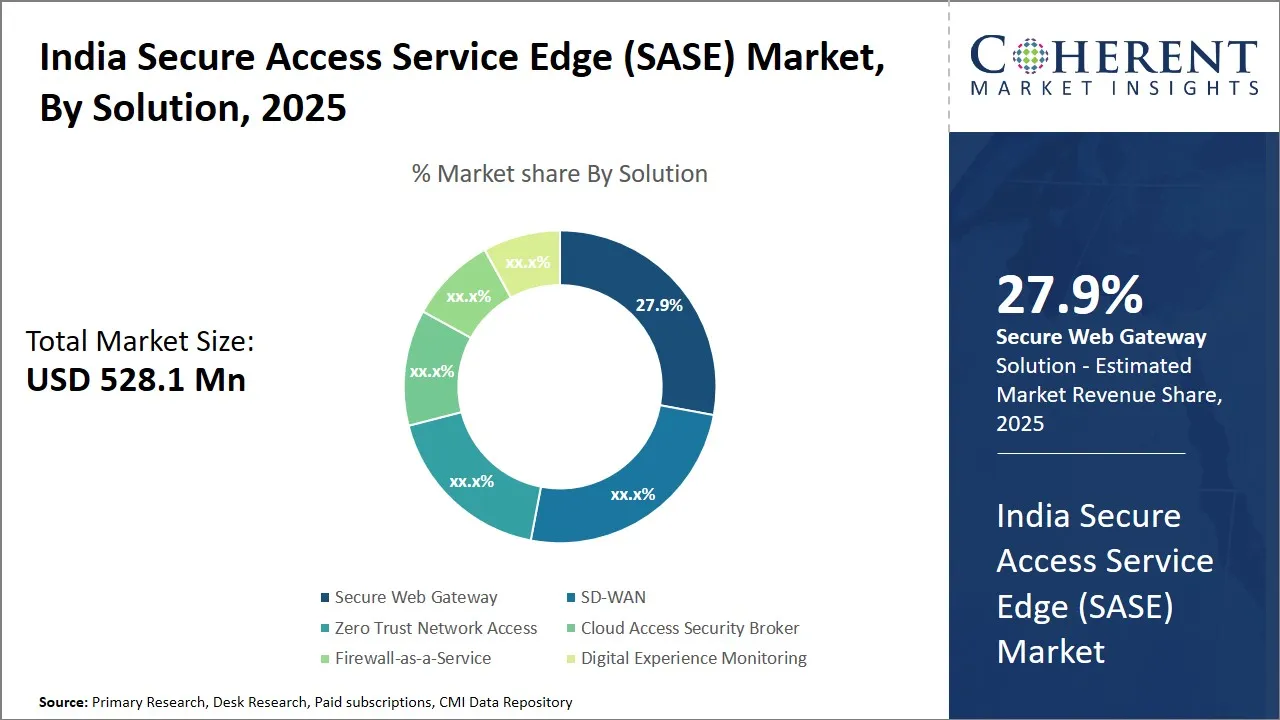
- The secure web gateway segment leads the market holding an estimated share of 28.9 % in 2026.
Market Overview
A key market trend in the India SASE space is the growing emphasis on zero-trust security frameworks combined with edge computing capabilities. Organizations are prioritizing unified solutions that consolidate networking and security functions such as SD-WAN, secure web gateways, and firewall-as-a-service to reduce complexity and operational costs. Additionally, rising cybersecurity threats and regulatory compliance requirements are accelerating the adoption of SASE platforms that provide real-time visibility, automated threat response, and improved access control, fueling continued the market expansion.
Current Events and Its Impact
Current Events | Description and Its Impact |
Geopolitical and Trade Developments |
|
Economic and Infrastructure Trends |
|
Segmental Insights
- Current Industry Events of 2026
- Market Size Estimation
- Regional Breakdown
- Competitive Landscape
- Customer Intelligence
- Segmental Analysis
- Pricing Analysis
- Key Market Drivers, Challenges & Future Trends
- Customized Insights Section
India Secure Access Service Edge (SASE) Market Insights, by Solution – Secure Web Gateway Leads Owing to its Critical Role in Securing Web Traffic and Ensuring Safe Internet Access
The secure web gateway segment, holding an estimated share of 28.9% in 2026, dominates the India Secure Access Service Edge (SASE) market, due to the rising need for robust protection against increasingly sophisticated cyber threats targeting web-based applications. Secure Web Gateway (SWG) solutions provide comprehensive filtering, inspection, and real-time policy enforcement that protect users from malware, phishing attacks, and data leaks while maintaining seamless access to web resources. One of the key factors driving the growth of the secure web gateway segment is the surge in cloud adoption among Indian organizations, which expands the attack surface through web applications and cloud-hosted resources. With more critical enterprise data accessed and exchanged via the internet, SWG’s ability to enforce granular security policies transforms it into an essential layer in a multi-pronged SASE strategy.
Additionally, the increase in remote and hybrid working models has amplified the need for secure web access beyond traditional office perimeters, further reinforcing demand for SWG solutions that integrate effortlessly with zero-trust frameworks. In 2024, Zscaler expanded its presence in India by launching additional local cloud security nodes, enabling enterprises to deploy its Zscaler Internet Access (ZIA) secure web gateway closer to users in key IT hubs such as Bengaluru and Hyderabad. Compliance requirements and data privacy regulations in India further fuel SWG adoption. Organizations are compelled to monitor, control, and audit web traffic to meet standards such as IT Act, GDPR, and sector-specific guidelines. SWG’s robust logging, content filtering, and threat intelligence capabilities provide a mechanism to ensure regulatory adherence while minimizing risks associated with unsecured browsing.
Impact of AI on the India Secure Access Service Edge (SASE) Market:
Artificial Intelligence (AI) is rapidly reshaping the India Secure Access Service Edge (SASE) market by strengthening threat detection, automating policy management, and enhancing real-time analytics. AI-driven engines allow SASE platforms to recognize anomalous behavior across distributed networks faster than traditional rules-based systems, which is critical in India’s hybrid workforce and multi-cloud environments.
A notable example is Wipro’s partnership with Zscaler in 2024, where they launched Cyber X-Ray, an AI-powered decision intelligence platform that integrates with SASE frameworks to provide predictive threat detection and automated security posture recommendations.
Market Players, Key Development, and Competitive Intelligence
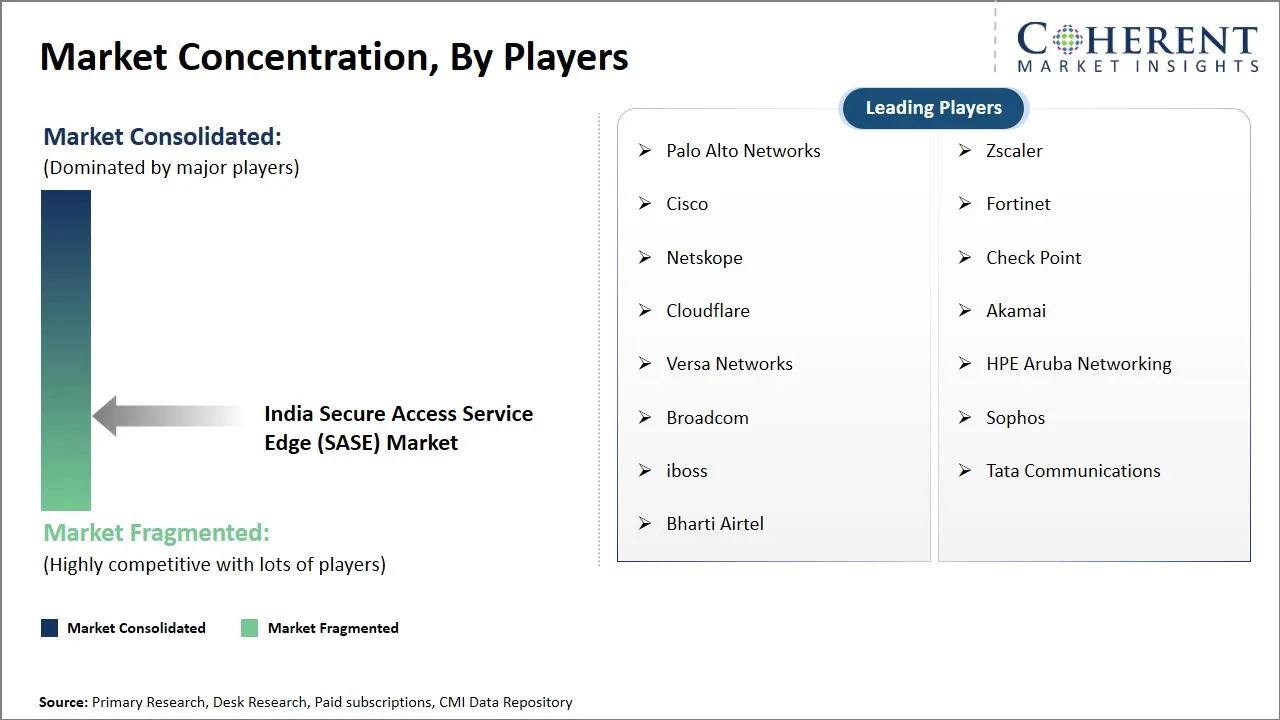
Top Strategies Followed by the India Secure Access Service Edge (SASE) Market Players
- Established players dominate the market through substantial investments in research and development (R&D), continuously innovating to produce high-performance SASE products that cater to the complex needs of enterprises.
- Palo Alto Networks has consistently invested in R&D for its Prisma SASE platform, enhancing it with AI-driven threat detection, unified SD-WAN, and cloud-delivered security.
- Mid-level players in the India Secure Access Service Edge (SASE) market primarily focus on delivering cost-effective solutions that strike a balance between quality and affordability, aiming to attract price-sensitive customers such as small and medium-sized enterprises (SMEs) and budget-conscious organizations.
- Versa Networks, through partnerships with Indian providers like Tata Communications and Ishan Technologies, delivers managed and co-managed SASE offerings that are more affordable for mid-market and SME enterprises.
- Small-scale players in the India Secure Access Service Edge (SASE) market adopt highly specialized and innovative approaches to carve out niche spaces amid intense competition.
- CloudSek (India-based cybersecurity startup) focuses on AI-driven digital risk protection and API security — adjacent to SASE.
Key Developments
- In June 2025, Check Point Software Technologies announced the launch of its India-based data residency instance of Check Point Harmony SASE, reinforcing its commitment to enabling secure digital transformation for Indian enterprises. This new instance brings localized, cloud-delivered network security—designed to address India’s regulatory environment and growing demand for scalable, secure, and compliant cloud adoption.
- In November 2024, Cisco, the leader in enterprise networking and security, announced that LTIMindtree is now leveraging Cisco Secure Access as its Security Service Edge (SSE) solution to enable secure hybrid work experiences for its employees and customers worldwide.
- In August 2024, TruVisor, a visionary technology distributor, announced a new distributor partnership with Versa Networks, the global leader in universal Secure Access Service Edge (SASE).
- In June 2024, Tata Communications announced the launch of its Unified/ Single-Vendor Hosted Secure Access Service Edge (SASE) for global enterprises. In partnership with Versa Networks, a leader in AI-powered Unified SASE, Tata Communications Hosted SASE, converges software-defined wide area networks (SD-WAN) and secure service edge (SSE) capabilities in a single pass technology enabling future ready businesses to fully harness the power and potential of cloud-based environments through exceptional performance, zero-trust security, ease of use, and cost effectiveness.
Market Report Scope
India Secure Access Service Edge (SASE) Market Report Coverage
| Report Coverage | Details | ||
|---|---|---|---|
| Base Year: | 2025 | Market Size in 2026: | USD 645.9 Mn |
| Historical Data for: | 2020 To 2024 | Forecast Period: | 2026 To 2033 |
| Forecast Period 2026 to 2033 CAGR: | 22.3% | 2033 Value Projection: | USD 2,643.2 Mn |
| Segments covered: |
| ||
| Companies covered: | Palo Alto Networks, Zscaler, Cisco, Fortinet, Netskope, Check Point, Cloudflare, Akamai, Versa Networks, HPE Aruba Networking, Broadcom, Sophos, iboss, Tata Communications, and Bharti Airtel | ||
| Growth Drivers: |
| ||
| Restraints & Challenges: |
| ||
Market Dynamics
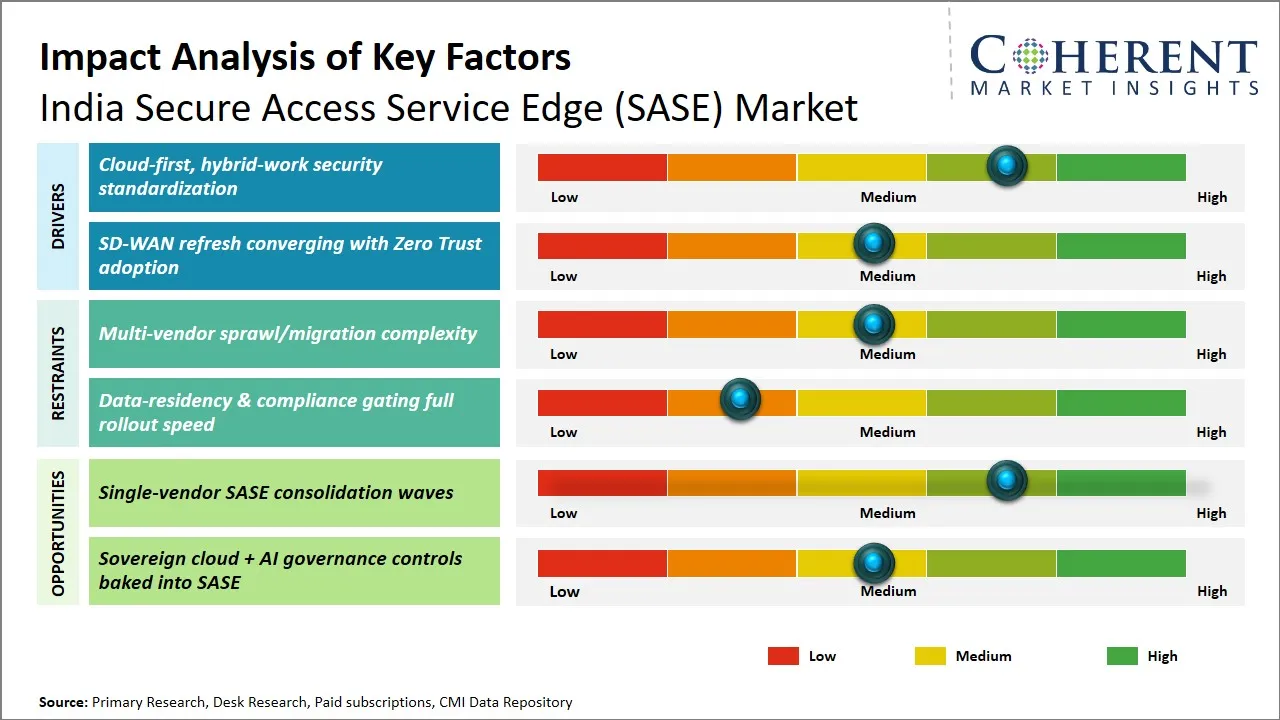
India Secure Access Services Edge (SASE) Market Driver – Cloud-First, Hybrid-Work Security Standardization
The accelerating adoption of cloud-first strategies across Indian enterprises, coupled with the widespread shift towards hybrid work models, is fundamentally reshaping the country’s security landscape, thereby fueling the demand for Secure Access Service Edge (SASE) solutions. Organizations are increasingly prioritizing secure, seamless access to applications and data regardless of location, pushing network and security teams to break down traditional silos and adopt a unified, cloud-native approach. In 2024, Infosys partnered with Palo Alto Networks to integrate Prisma SASE into its managed security offerings for global and India-based clients. This move was aimed at securing hybrid workforces operating across multiple cloud environments, ensuring standardized security frameworks for employees working from both offices and remote locations.
By integrating network security functions such as secure web gateways, zero-trust network access, and firewall-as-a-service into a single platform, SASE simplifies management while enhancing visibility and threat prevention. In India’s context, where digital transformation is paralleled by growing cybersecurity concerns, the drive toward standardized security protocols underpinned by SASE is instrumental in addressing complexity and safeguarding hybrid cloud infrastructures effectively.
India Secure Access Services Edge (SASE) Market Opportunity – Single-Vendor SASE Consolidation Waves
As enterprises in the India accelerate their digital transformation journeys, they are increasingly prioritizing seamless, integrated security and networking solutions to reduce complexity and enhance operational efficiency. The trend towards consolidating multiple point solutions—such as SD-WAN, secure web gateways, firewalls, and zero-trust network access—into a unified, single-vendor SASE platform presents a compelling opportunity for vendors to capture market share. Indian businesses, particularly in sectors like BFSI, IT & ITeS, and manufacturing, are seeking streamlined procurement, simplified management, and consistent policy enforcement across cloud and on-premises environments. In 2024, Tata Communications launched its Hosted SASE solution in collaboration with Versa Networks, delivering a unified single-vendor SASE platform to Indian enterprises.
Furthermore, the growing adoption of cloud-native applications and increased remote workforce demands underscore the need for holistic, scalable SASE solutions that single vendors can uniquely deliver. Leading global and domestic cybersecurity and networking firms are thus positioned to leverage this shift by offering comprehensive, integrated SASE platforms tailored to the nuanced needs of Indian enterprises, capitalizing on strong demand for secure, agile, and cost-effective network architectures.
Analyst Opinion (Expert Opinion)
- The integration of AI/ML for predictive analytics, anomaly detection, and automated policy enforcement is becoming a differentiator. Vendors like Zscaler and Palo Alto Networks are embedding AI engines to enhance real-time security posture management, which is especially valuable for India’s large IT/ITeS workforce managing multi-cloud environments.
- With India’s rapid 5G rollout and edge data center expansion, SASE is extending beyond traditional IT into IoT, smart manufacturing, and telecom verticals. Low-latency secure connectivity at the edge will become a strong use-case, enabling industrial IoT security and real-time monitoring.
- The shift from multi-vendor to unified single-vendor SASE platforms is accelerating, especially in regulated sectors like BFSI and government. This consolidation not only simplifies deployment but also allows vertical-specific customization (e.g., RBI compliance controls for banks, HIPAA-aligned data protection for healthcare).
Speak to the analyst
Want personalized insights?
Take the findings above to one of our principal consultants, or have the report rebuilt around the segments, geographies and competitors you actually track.
Market Segmentation
- Solution Insights (Revenue, USD Mn, 2021 - 2033)
- Secure Web Gateway
- SD-WAN
- Zero Trust Network Access
- Cloud Access Security Broker
- Firewall-as-a-Service
- Digital Experience Monitoring
- Key Players Insights
- Palo Alto Networks
- Zscaler
- Cisco
- Fortinet
- Netskope
- Check Point
- Cloudflare
- Akamai
- Versa Networks
- HPE Aruba Networking
- Broadcom
- Sophos
- iboss
- Tata Communications
- Bharti Airtel
Sources
Primary Research Interviews
Stakeholders
- Chief Information Security Officers (CISOs) at large IT/ITeS firms
- Network & Cloud Security Architects at BFSI companies
- Cybersecurity Consultants specializing in Zero Trust & SASE deployments
- Telecom & Managed Service Providers
- Cloud Infrastructure Providers
- Government & Regulatory Experts on data localization and cybersecurity compliance
- AI and ML Researchers working on adaptive threat detection for secure networks
Databases
- India Ministry of Electronics and Information Technology (MeitY) Data Portal
- Telecom Regulatory Authority of India (TRAI) Statistics
- NASSCOM Industry Reports
- OECD Digital Economy Data
- International Telecommunication Union (ITU) Statistics
Magazines
- Cybersecurity Today (India Edition)
- Network Security Asia Pacific
- Cloud & Data Center Magazine India
- Information Security Buzz
Journals
- International Journal of Information Security
- IEEE Transactions on Network and Service Management
- Journal of Cybersecurity (Oxford Academic)
- Indian Journal of Computer Science and Engineering
- Journal of Cloud Computing: Advances, Systems and Applications
Newspapers
- The Economic Times (India) – Technology Section
- The Hindu Business Line – IT & Telecom
- Financial Express – Digital Economy
- Business Standard – Tech Policy Updates
- The Times of India – Business & Tech
Associations
- Data Security Council of India (DSCI)
- Internet Service Providers Association of India (ISPAI)
- National Association of Software and Service Companies (NASSCOM)
- Cloud Security Alliance (CSA) India Chapter
- Internet Governance Forum (India)
Public Domain Sources
- Ministry of Electronics and IT (MeitY) Open Data Portal
- Telecom Regulatory Authority of India (TRAI) Annual Reports
- World Bank Digital Development Data
- United Nations ESCAP – Digital Connectivity Reports
- ResearchGate Open Access Cybersecurity Studies
Proprietary Elements
- CMI Data Analytics Tool
- Proprietary CMI Existing Repository of information for last 8 years
Get access to 250+ pages report
Every segment, forecast, competitor profile and data table behind the analysis above — available for instant download.
- ESOMAR Member
- ISO 9001:2015 Certified
- D-U-N-S Registered
- GDPR & CCPA Compliant
Missing comfort of reading report in your local language? Find your preferred language:
Transform your Strategy with Exclusive Trending Reports
Frequently Asked Questions
The India Secure Access Service Edge (SASE) market is estimated to be valued at USD 645.9 million in 2026 and is expected to reach USD 2,643.2 million by 2033.
The CAGR of the India Secure Access Service Edge (SASE) market is projected to be 22.3% from 2026 to 2033.
Cloud-first, hybrid-work security standardization and SD-WAN refresh converging with zero trust adoption are the major factors driving the growth of the India Secure Access Service Edge (SASE) market.
Multi-vendor sprawl/migration complexity and data-residency & compliance gating full rollout speed are the major factors hampering the growth of the India Secure Access Service Edge (SASE) market.
In terms of solution, the secure web gateway segment is estimated to dominate the market revenue share in 2026.
A cloud-native framework combining networking (SD-WAN) and security (SWG, ZTNA, CASB, FWaaS) into a unified service.
AI enables predictive threat detection, automated policies, and faster incident response.