

Global Industrial Cybersecurity Market Size and Forecast – 2026-2033
The Global Industrial Cybersecurity Market is estimated to be valued at USD 4.25 Bn in 2026 and is expected to reach USD 7.77 Bn by 2033, exhibiting a compound annual growth rate (CAGR) of 9.0% from 2026 to 2033.
Key Takeaways of the Global Industrial Cybersecurity Market
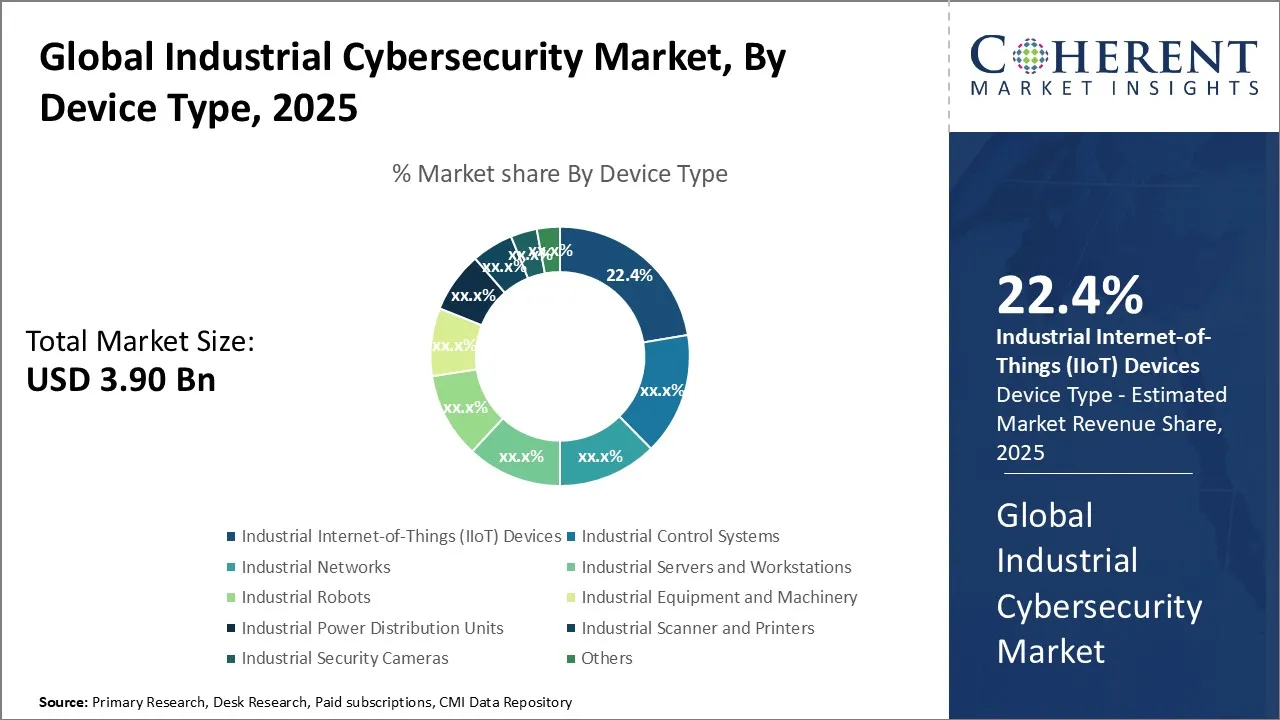
- The Industrial Internet-of-Things (IIoT) devices segment leads the market holding an estimated share of 23.4% in 2026.
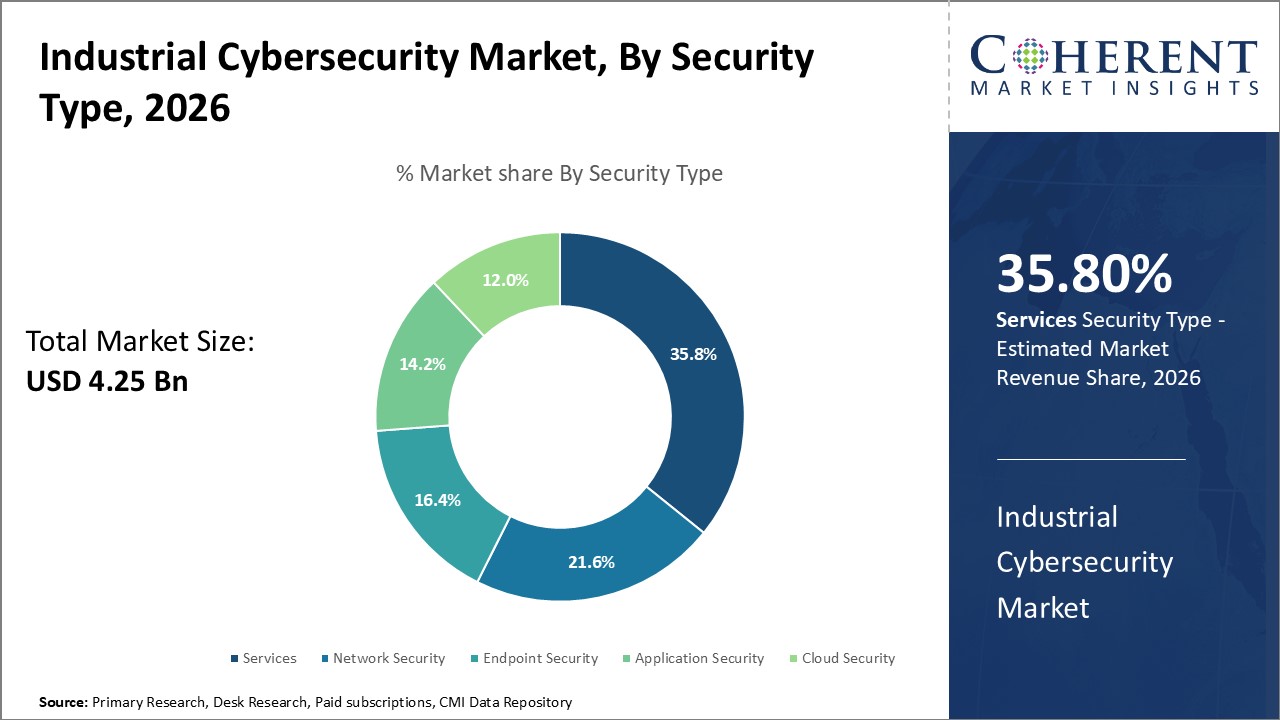
- The services segment is projected to dominate with a share of 35.8% in 2026.
- The transportation segment leads the market holding an estimated share of 41.1% in 2026.
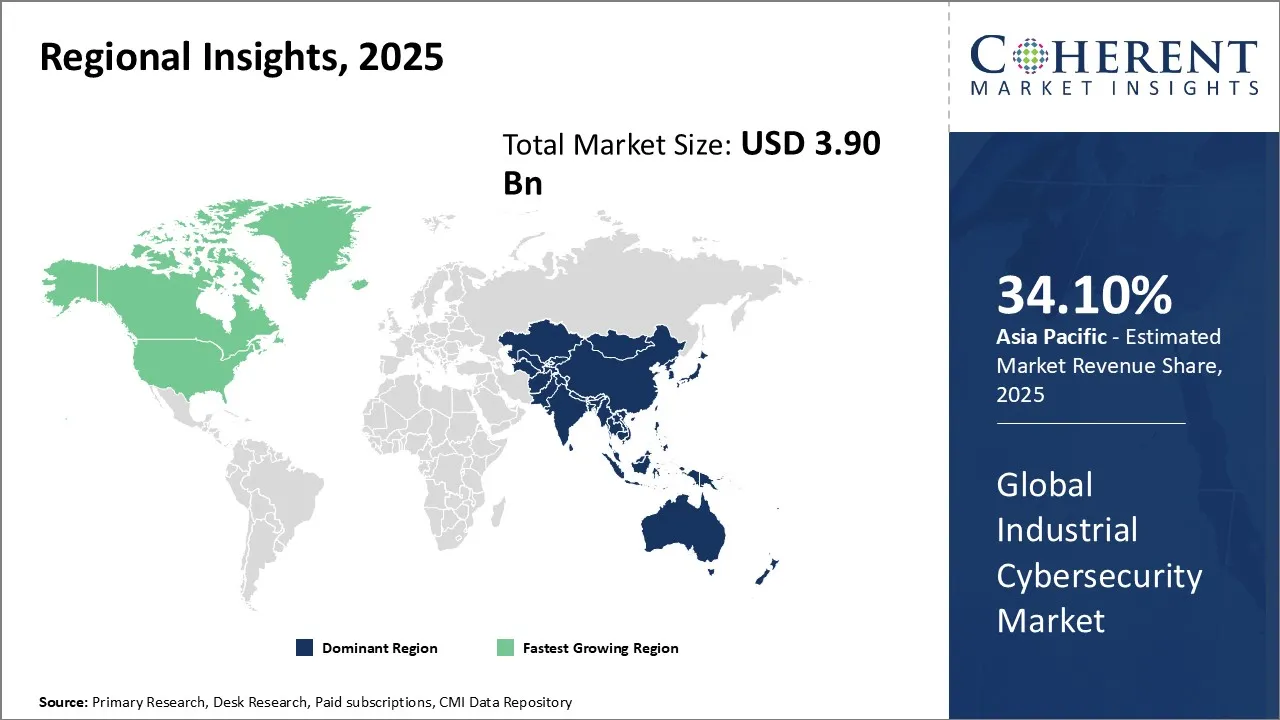
- Asia Pacific is estimated to lead the market with a share of 34.1% in 2026. North America, holding a share of 30.1% in 2026, is projected to be the fastest growing region.
Market Overview
The market is witnessing a rise in the adoption of advanced technologies like AI and machine learning to improve threat detection and response capabilities in industrial environments. Also, growing regulatory compliance requirements and an increase in cyberattacks targeting operational technology (OT) systems are pushing investments in strong industrial cybersecurity frameworks, focusing on proactive defense mechanisms and use of advanced analytics in security protocols.
Current Events and their Impact
Current Events | Description and its impact |
Geopolitical and Trade Developments |
|
Economic and Industrial Trends |
|
Segmental Insights
- Current Industry Events of 2026
- Market Size Estimation
- Regional Breakdown
- Competitive Landscape
- Customer Intelligence
- Segmental Analysis
- Pricing Analysis
- Key Market Drivers, Challenges & Future Trends
- Customized Insights Section
Global Industrial Cybersecurity Market Insights, by Device Type – Expanding IIoT Ecosystem Drives Industrial Internet-of-Things (IIoT) Devices Demand
Industrial Internet-of-Things (IIoT) devices are projected to hold the highest share of 23.4% in the global industrial cybersecurity market in 2026 because of the huge increase in connected devices in industrial environments. The adoption of IIoT devices, like sensors, actuators, and intelligent controllers, has made possible real-time data monitoring, predictive analytics, and remote asset management. However, this connectivity have also added many vulnerabilities, as each connected IIoT device becomes a potential entry point for cyber threats.
For instance, ABB’s Ability Smart Sensor platform connects motors, pumps, and bearings to industrial networks for predictive maintenance. The company complements these IIoT deployments with its Cyber Security Lifecycle Services, using continuous monitoring and vulnerability management to mitigate device-level risks.
Also, the big range of protocols and communication standards used by IIoT devices adds complexity in maintaining strong security. Cybersecurity solutions need to secure data-in-transit and at rest while addressing device-level integrity and access control. The increasing reliance on IIoT for mission-critical applications, like automated production lines and safety monitoring, places a premium on preventing disruptions caused by cyber-attacks. Growing cyber-attacks targeting IIoT devices, like ransomware and sabotage, have also added to investments in penetration testing, anomaly detection, and endpoint protection in this segment. Also, strict regulatory policies and standards mandating IoT security compliance in industrial sectors push organizations to focus on cybersecurity investments at the device level, adding to the segment’s dominance in the industrial cybersecurity landscape.
Global Industrial Cybersecurity Market Insights, by Security Type – Comprehensive Service Offerings Address Evolving Threat Complexity
The services segment is expected to hold the highest share of 35.8% in the global industrial cybersecurity market in 2026 because of the growing complexity and sophistication of cyber threats faced by industrial enterprises. Cybersecurity services include a wide array of support functions like consulting, risk assessment, managed security services, incident response, and continuous monitoring, which are very important for organizations lacking in-house expertise or looking to augment their existing defenses. Industrial environments need specialized knowledge to understand operational technology (OT) intricacies and add cybersecurity measures without disrupting production processes.
Honeywell’s Cybersecurity Services division provides managed threat detection, compliance management, and incident response for refineries and power plants through its Industrial Cybersecurity Centers of Excellence (CoE) in the U.S. and the U.A.E.
The changing nature of cyber risks, including zero-day vulnerabilities and advanced persistent threats, makes companies depend on expert services that offer proactive threat intelligence, vulnerability management, and customized security architecture. Also, ongoing digital transformation initiatives push the adoption of hybrid IT-OT environments, which need smooth security orchestration in multiple domains, a challenge typically addressed through managed services. The shortage of skilled cybersecurity professionals in the industrial sector adds to this reliance on specialized services for effective risk mitigation. Also, regulatory compliance and the necessity to align with industry best practices creating reliance on consulting and auditing services.
Global Industrial Cybersecurity Market Insights, by Industry – Transportation Industry’s Critical Infrastructure Drives Cybersecurity Spending
The transportation segment is anticipated to hold the highest share of 41.1% in the global industrial cybersecurity market in 2026 because of its important role in national economies and the increasing digitization of transportation infrastructure. Transportation networks, like railways, aviation, maritime, and logistics, have seen a lot of automation and digital integration to improve operational efficiency, passenger safety, and real-time traffic management. These advancements also make multifaceted cybersecurity challenges, as the disruption of transportation systems can have huge effects on public safety, supply chain continuity, and economic stability.
Siemens Mobility’s cybersecurity initiative for Deutsche Bahn’s digital rail systems uses network intrusion detection and AI-based monitoring to protect signaling and train control systems.
The sector’s exposure to cyber threats like ransomware, system intrusions, and data breaches has added to the demand for specialized security solutions designed to protect both operational technology and information technology environments. There is a focus on investments in secure communication protocols, intrusion detection systems, and resilient network architectures to protect important assets like signaling systems, onboard equipment, and control centers. Governments and regulatory bodies have also put in place strict cybersecurity mandates for transportation entities to ensure the integrity and reliability of transport services. Also, the increasing adoption of smart transportation technologies like autonomous vehicles and Intelligent Transportation Systems (ITS), adds to the need for strong cybersecurity frameworks to counteract new attack vectors, thereby adding to the segment’s leading position in industrial cybersecurity investments.
Impact of AI on the Global Industrial Cybersecurity Market
Artificial Intelligence (AI) is improving the speed, precision, and adaptability of threat detection and response mechanisms. In industrial settings, where operational technology (OT) networks need to run continuously, AI-powered anomaly detection systems can go through huge volumes of machine data in real time to find irregular patterns that may show cyber intrusions or process malfunctions. This minimizes downtime and reduces human dependency in threat monitoring. AI-driven predictive analytics are also being used to forecast vulnerabilities before they can be exploited, making possible proactive patch management and system hardening in manufacturing plants, power grids, and oil refineries.
Siemens Energy uses AI-powered cybersecurity in its Industrial Defender platform, which uses machine learning to detect deviations in turbine and grid operations caused by potential cyberattacks.
Regional Insights
Asia Pacific Industrial Cybersecurity Market Analysis and Trends
The Asia Pacific region, holding an estimated share of 34.1% in 2026, dominates the industrial cybersecurity market because of fast industrialization, increasing digitization of manufacturing processes, and expanding infrastructure development in countries like China, India, Japan, and South Korea. Governments in the region are focusing on cybersecurity frameworks aligned with global standards, and introducing localized policies to protect important industrial assets from cyber threats.
The presence of a growing industrial base and huge foreign investment make demand for sophisticated cybersecurity solutions. Big companies like Trend Micro (Japan), Huawei (China), and Tata Consultancy Services (India) are advancing cybersecurity initiatives made for different industrial segments, adding to the region's market growth. Also, rising awareness about industrial cyber risks and increasing incidents of cyberattacks have pushed enterprises to make their defenses stronger, making a dynamic growth environment.
North America Industrial Cybersecurity Market Analysis and Trends
North America, holding a share of 30.1% in 2026, is expected to exhibit the fastest growth in the global industrial cybersecurity market because of a strong industrial ecosystem that includes manufacturing, oil & gas, utilities, and critical infrastructure sectors. The region sees strict government regulations and policies for improving cybersecurity resilience in industrial operations, like the NIST Cybersecurity Framework and specific guidelines from the Department of Homeland Security.
The presence of big technology providers and cybersecurity vendors adds to innovation and fast deployment of industrial cybersecurity solutions. Big companies headquartered here, including Honeywell, Cisco Systems, and IBM, contribute a lot by offering integrated cybersecurity platforms made for industrial control systems (ICS) and supervisory control and data acquisition (SCADA) environments. Also, North America’s well-established trade environment adds to the adoption of advanced industrial cybersecurity products across key industries.
Industrial Cybersecurity Market Outlook for Key Countries
U.S. Industrial Cybersecurity Market Analysis and Trends
The U.S. industrial cybersecurity market grows because of advanced technological infrastructure and a mature industrial base including manufacturing, energy, and critical infrastructure sectors. Big players like Honeywell, Cisco Systems, and Palo Alto Networks have made strong footholds by delivering industry-specific cybersecurity solutions addressing regulatory compliance and changing threat landscapes. The U.S. government's proactive stance, with initiatives focusing on the protection of important infrastructure, continuously pushes enterprises toward adopting cutting-edge industrial cybersecurity strategies. The country’s strong R&D ecosystem also adds to innovation in threat detection, anomaly monitoring, and asset protection.
China Industrial Cybersecurity Market Analysis and Trends
China industrial cybersecurity market is fast growing because of its huge industrial expansion and government initiatives focused on cybersecurity sovereignty and digital transformation. State-backed policies like the Cybersecurity Law and Made in China 2026 focus on improving industrial security, pushing enterprises to use advanced cyber defense mechanisms. Domestic firms like Huawei and Hikvision play big roles in making tailored security appliances and industrial-grade threat intelligence platforms. The growing manufacturing and energy sectors create the need for comprehensive cybersecurity measures, making China a big growth driver in the Asia Pacific region.
Germany Industrial Cybersecurity Market Analysis and Trends
Germany leads Europe industrial cybersecurity market because of its strong manufacturing sector. The country’s adherence to strict EU cybersecurity regulations, including GDPR and NIS Directive, pushes industrial enterprises to adopt sophisticated cybersecurity frameworks. Big corporations like Siemens and Bosch are leading, offering integrated cybersecurity solutions embedded in industrial automation systems. Germany’s focus on Industry 4.0 initiatives, focusing on smart factories and connected industrial systems, making demand for advanced cybersecurity technologies.
India Industrial Cybersecurity Market Analysis and Trends
India’s industrial cybersecurity market is fast expanding because of a growing industrial base and high digital adoption in manufacturing, utilities, and transport sectors. The government’s Digital India and Make in India programs show cybersecurity as a big driver for industrial growth, adding to investment in secure industrial infrastructure. Big companies like Tata Consultancy Services (TCS) and Wipro deliver customized cybersecurity solutions and services that address local operational challenges and growing threats. India’s growing industrial ecosystem and rising cyberattack incidents make enterprises adopt proactive industrial cybersecurity measures.
Japan Industrial Cybersecurity Market Analysis and Trends
Japan industrial cybersecurity market grows because of a history of technological innovation and leadership in electronic manufacturing and automotive sectors. Government policies focusing on cyber resilience and business continuity, added with strict industry standards, add to the integration of cybersecurity in industrial control environments. Japanese firms like Trend Micro and NEC actively provide cybersecurity frameworks focusing on threat detection and risk management for industrial clients. Japan’s focus on smart manufacturing and IoT-enabled production systems make a complex threat landscape, adding to the deployment of industrial cybersecurity solutions.
Market Players, Key Development, and Competitive Intelligence
Key Developments
- In September 2025, Nozomi Networks, the global leader in OT, IoT and CPS security, and Mitsubishi Electric Corporation signed an agreement for Mitsubishi Electric to acquire Nozomi Networks.
- In September 2025, Nozomi Networks was named a Leader in The Forrester Wave: IoT Security Solutions, Q3 2025.
- In February 2025, Palo Alto Networks introduced Cortex Cloud, the next version of Prisma Cloud, that mixes new releases of its best-in-class cloud detection and response (CDR) and industry-leading cloud native application protection platform (CNAPP) capabilities.
- In March 2024, industrial cybersecurity startup, Claroty Ltd., raised USD 100 million in strategic growth financing to grow its platform’s approach to cyber-physical systems protection, global expansion, research and development.
Top Strategies Followed by Industrial Cybersecurity Market Players
- Established industry leaders invest a lot in research and development (R&D) to innovate high-performance products that address the complex and evolving challenges of industrial environments.
- Siemens has been investing a lot in its SINEC Security Platform and Siemens Xcelerator ecosystem, using AI, digital twins, and zero-trust principles to protect connected industrial networks.
- Mid-level market participants use strategies that balance quality with affordability, focusing on offering cost-effective cybersecurity solutions to price-sensitive customers.
- Tenable offers simplified, subscription-based OT vulnerability management solutions that add smoothly with existing IT systems, providing strong protection without high infrastructure costs.
- Small-scale players in the industrial cybersecurity market target niche segments with specialized features or innovative product offerings that larger players may overlook.
- SCADAfence focuses on network visibility and asset management for manufacturing and energy sectors.
Market Report Scope
Industrial Cybersecurity Market Report Coverage
| Report Coverage | Details | ||
|---|---|---|---|
| Base Year: | 2025 | Market Size in 2026: | USD 4.25 Bn |
| Historical Data for: | 2020 To 2024 | Forecast Period: | 2026 To 2033 |
| Forecast Period 2026 to 2033 CAGR: | 9.0% | 2033 Value Projection: | USD 7.77 Bn |
| Geographies covered: |
| ||
| Segments covered: |
| ||
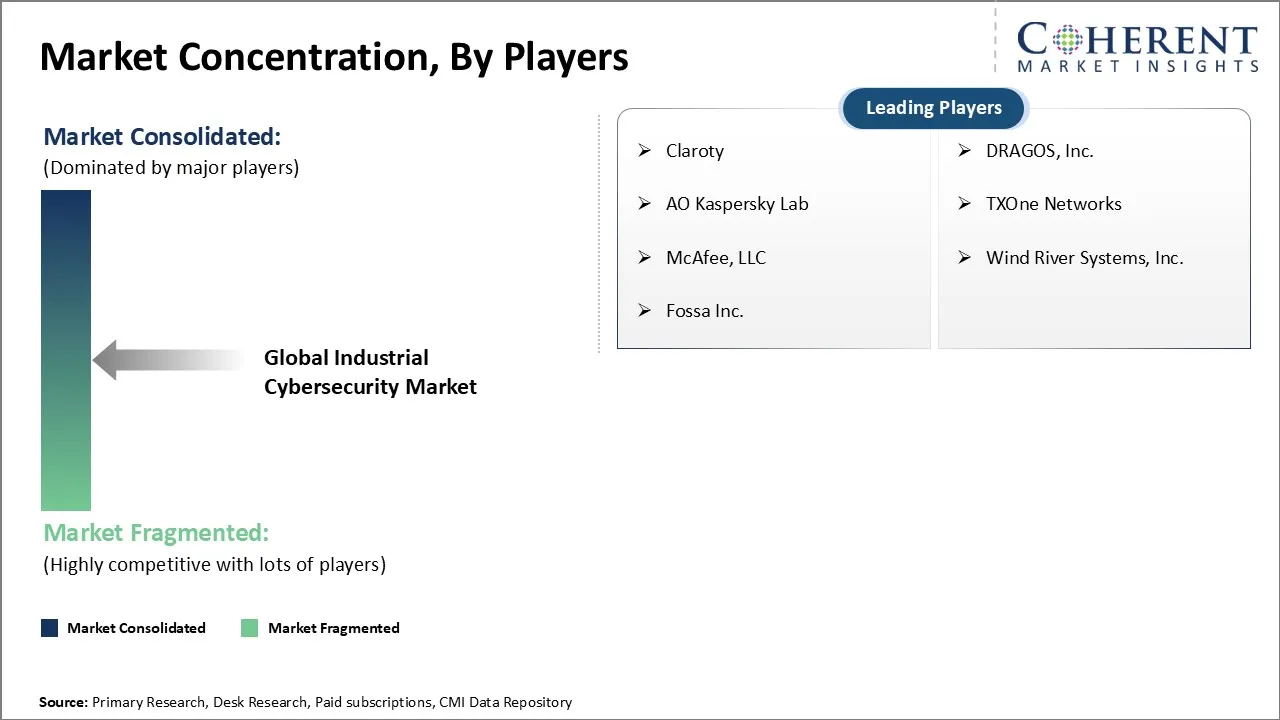
| Companies covered: | Claroty, DRAGOS, Inc., AO Kaspersky Lab, TXOne Networks, McAfee, LLC, Wind River Systems, Inc., and Fossa Inc. | ||
| Growth Drivers: |
| ||
| Restraints & Challenges: |
| ||
Market Dynamics
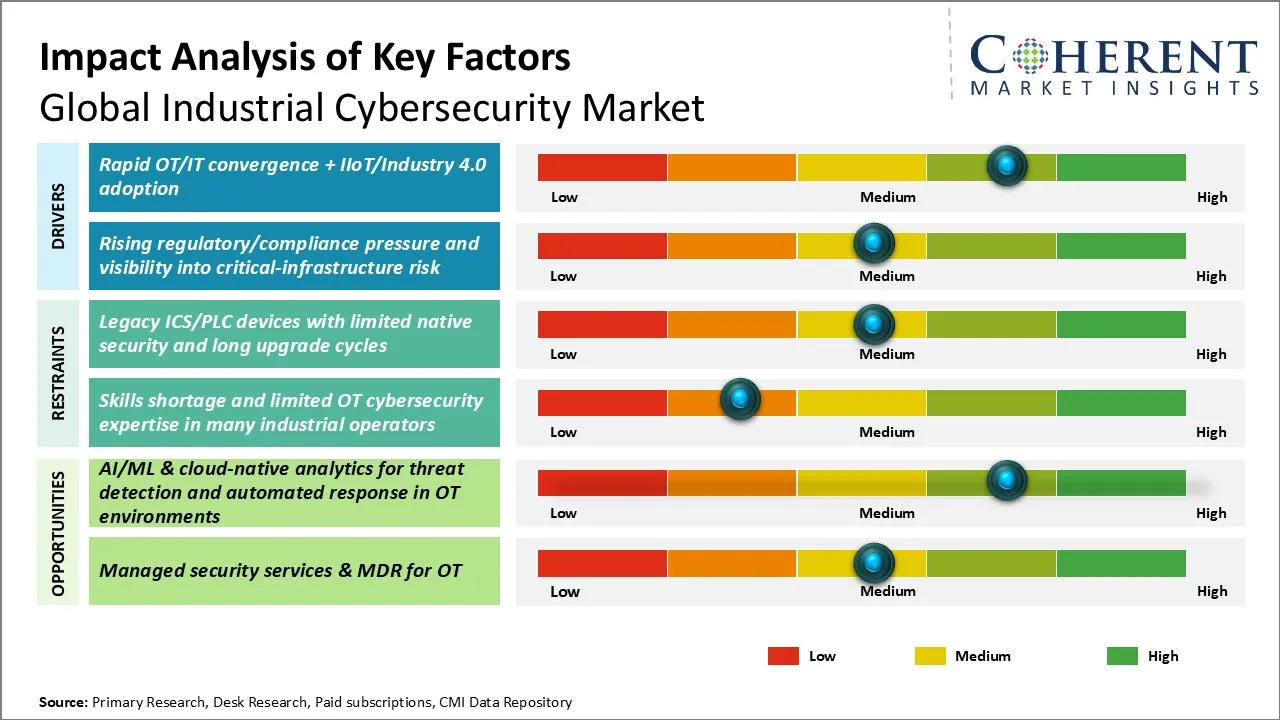
Global Industrial Cybersecurity Market Driver – Rapid OT/IT Convergence + IIoT/Industry 4.0 Adoption
The fast convergence of Operational Technology (OT) and Information Technology (IT) systems, and the high adoption of Industrial Internet of Things (IIoT) and Industry 4.0 initiatives, are making demand for strong industrial cybersecurity solutions. Manufacturing plants and industrial environments increasingly add connected devices, sensors, and smart machinery to their existing infrastructure. This improves operational efficiency but also exposes important assets to new vectors of cyberattacks.
Also, the use of IIoT makes possible real-time data collection and analytics, which, while beneficial, adds more risk points needing advanced cybersecurity frameworks to protect sensitive industrial data and maintain system integrity. In 2023, Siemens partnered with NVIDIA to integrate its Xcelerator industrial platform with NVIDIA’s Omniverse, making a real-time digital twin environment that mixes OT data from factory equipment with IT analytics.
Global Industrial Cybersecurity Market Opportunity – AI/ML and Cloud-Native Analytics for Enhanced Threat Detection and Automated Response in OT Environments
The use of Artificial Intelligence (AI), Machine Learning (ML), and cloud-native analytics into operational technology (OT) security shows a big growth opportunity in the global industrial cybersecurity market. As industrial control systems (ICS) and OT networks become increasingly interconnected with IT infrastructure and Internet of Things (IoT) devices, they become more exposed to sophisticated cyber threats. Traditional security measures often cannot detect and respond to these evolving threats promptly.
AI and ML-driven threat detection tools make possible real-time analysis of huge volumes of data generated in the OT environment. Honeywell’s Cyber Watch, an AI-driven OT cybersecurity monitoring solution, uses machine learning algorithms to detect abnormal behavior and emerging threats across industrial control systems.
Also, cloud-native architectures provide scalable, flexible platforms that support continuous monitoring and threat intelligence sharing in distributed industrial sites, making possible proactive defense mechanisms. Automated response capabilities powered by AI/ML reduce human response time, limiting the impact of breaches and minimizing operational downtime. Also, these advanced technologies support predictive analytics to anticipate vulnerabilities and optimize security postures in dynamic industrial settings.
Analyst Opinion (Expert Opinion)
- The manufacturing sector shows a lot of demand for industrial cybersecurity solutions as factories use automation, robotics, and IIoT technologies under Industry 4.0. The need to protect connected production lines, PLCs, and cloud-integrated control systems is making manufacturers invest in advanced OT visibility, intrusion detection, and zero-trust network solutions.
- Critical infrastructure operators, like in the energy and utilities domain, are increasing cybersecurity budgets fast because of growing risks of ransomware and state-sponsored attacks on power grids and oil & gas facilities. Regulatory mandates like the NERC CIP standards in North America and EU NIS2 Directive in Europe are also pushing this sector to adopt comprehensive, compliance-driven security architectures.
- Beyond traditional industrial verticals, healthcare manufacturing, like medical devices and pharma plants, and transportation infrastructure, like rail networks, ports, and aviation systems, are seeing a lot of demand for industrial cybersecurity. The mix of IT and OT systems in these sectors, added with data sensitivity and operational continuity needs, is making new opportunities for vendors offering specialized, sector-specific security solutions.
Speak to the analyst
Want personalized insights?
Take the findings above to one of our principal consultants, or have the report rebuilt around the segments, geographies and competitors you actually track.
Market Segmentation
- Device Type Insights (Revenue, USD Bn, 2021 - 2033)
- Industrial Internet-of-Things (IIoT) Devices
- Industrial Control Systems
- Industrial Networks
- Industrial Servers and Workstations
- Industrial Robots
- Industrial Equipment and Machinery
- Industrial Power Distribution Units
- Industrial Scanner and Printers
- Industrial Security Cameras
- Others
- Security Type Insights (Revenue, USD Bn, 2021 - 2033)
- Services
- Network Security
- Endpoint Security
- Application Security
- Cloud Security
- Industry Insights (Revenue, USD Bn, 2021 - 2033)
- Transportation
- Utilities
- Chemicals and Manufacturing
- Others
- Regional Insights (Revenue, USD Bn, 2021 - 2033)
- North America
- U.S.
- Canada
- Latin America
- Brazil
- Argentina
- Mexico
- Rest of Latin America
- Europe
- Germany
- U.K.
- Spain
- France
- Italy
- Russia
- Rest of Europe
- Asia Pacific
- China
- India
- Japan
- Australia
- South Korea
- ASEAN
- Rest of Asia Pacific
- Middle East
- GCC Countries
- Israel
- Rest of Middle East
- Africa
- South Africa
- North Africa
- Central Africa
- North America
- Key Players Insights
- Claroty
- DRAGOS, Inc.
- AO Kaspersky Lab
- TXOne Networks
- McAfee, LLC
- Wind River Systems, Inc.
- Fossa Inc.
Sources
Primary Research Interviews
Stakeholders
- Industrial Automation Companies
- Cybersecurity Vendors
- Operational Technology (OT) Managers in Manufacturing and Energy Utilities
- Critical Infrastructure Security Consultants and Risk Analysts
- System Integrators and Managed Security Service Providers (MSSPs)
- Regulatory and Compliance Officers from Energy, Oil & Gas, and Transportation Sectors
- AI and Data Analytics Specialists working on Industrial Threat Detection Systems
Databases
- International Energy Agency (IEA) – Industrial Digital Security Data
- World Economic Forum – Cyber Resilience Reports
- OECD – Digital Economy and Cybersecurity Statistics
- Industrial Internet Consortium (IIC) Knowledge Hub
- U.S. Cybersecurity and Infrastructure Security Agency (CISA) Database
- European Union Agency for Cybersecurity (ENISA) Reports Repository
Magazines
- Industrial Cyber Magazine
- Automation World
- Control Engineering
- Security Today
- Plant Engineering Magazine
- Industrial Safety and Security Source (ISSS)
Journals
- Journal of Industrial Information Integration
- IEEE Transactions on Industrial Informatics
- Journal of Cybersecurity and Digital Transformation
- Computers & Security Journal
- International Journal of Critical Infrastructure Protection
- Journal of Process Control and Automation
Newspapers
- The Wall Street Journal (Technology Section)
- The Economic Times (India) – Industry & Tech Desk
- Financial Times (Cybersecurity Section)
- The Guardian (Technology & Industry Reports)
- Nikkei Asia – Technology and Industry Insights
- Business Standard (India) – Digital Infrastructure Reports
Associations
- International Society of Automation (ISA)
- Industrial Internet Consortium (IIC)
- Cybersecurity and Infrastructure Security Agency (CISA), U.S.
- European Union Agency for Cybersecurity (ENISA)
- Industrial Cybersecurity Center (CCI)
- SANS Institute for Industrial Control Systems (SANS ICS)
- National Institute of Standards and Technology (NIST)
Public Domain Sources
- United Nations Industrial Development Organization (UNIDO)
- World Bank – Digital Infrastructure and Resilience Division
- European Commission – Digital Europe Programme
- U.S. Department of Energy – Cybersecurity, Energy Security, and Emergency Response (CESER)
- National Cyber Security Centre (UK)
- ResearchGate (Industrial Cybersecurity and OT Security Papers)
Proprietary Elements
- CMI Data Analytics Tool
- Proprietary CMI Existing Repository of Information for the Last 8 Years
Get access to 250+ pages report
Every segment, forecast, competitor profile and data table behind the analysis above — available for instant download.
- ESOMAR Member
- ISO 9001:2015 Certified
- D-U-N-S Registered
- GDPR & CCPA Compliant
Missing comfort of reading report in your local language? Find your preferred language:
Transform your Strategy with Exclusive Trending Reports
Frequently Asked Questions
The global industrial cybersecurity market is estimated to be valued at USD 4.25 Bn in 2026 and is expected to reach USD 7.77 Bn by 2033.
The CAGR of global industrial cybersecurity market is projected to be 9.0% from 2026 to 2033.
Rapid OT/IT convergence + IIoT/Industry 4.0 adoption and rising regulatory/compliance pressure and visibility into critical-infrastructure risk are the major factors driving the growth of the global industrial cybersecurity market.
Legacy ICS/PLC devices with limited native security and long upgrade cycles and skills shortage and limited OT cybersecurity expertise in many industrial operators are the major factors hampering the growth of the global industrial cybersecurity market.
In terms of device type, Industrial Internet-of-Things (IIoT) devices are estimated to dominate the market revenue share in 2026.
Claroty, DRAGOS, Inc., AO Kaspersky Lab, TXOne Networks, McAfee, LLC, Wind River Systems, Inc., and Fossa Inc. are the major players.
Asia Pacific is expected to lead the global industrial cybersecurity market in 2026.