

Global IVDR Certification Market Size and Forecast – 2026 To 2033
The global IVDR certification market is expected to grow from USD 6,324.9 Mn in 2026 to USD 9,870.1 Mn by 2033, registering a compound annual growth rate (CAGR) of 6.6% from 2026 to 2033. The market for IVDR certification is poised for significant expansion, fueled by the mandated adoption of the European Union In Vitro Diagnostic Regulation (IVDR), which has greatly expanded the need for conformity assessment and regulatory certification services.
According to the European Commission, the European Union In Vitro Diagnostic Regulation (IVDR) reclassified approximately 80–90% of in vitro diagnostic medical devices that were previously self-certified under the In Vitro Diagnostic Medical Devices Directive (IVDD), requiring the involvement of Notified Bodies before they can be placed on the market in the European Union.
(Source: RegDesk, Inc.)
Key Takeaways of the Global IVDR Certification Market
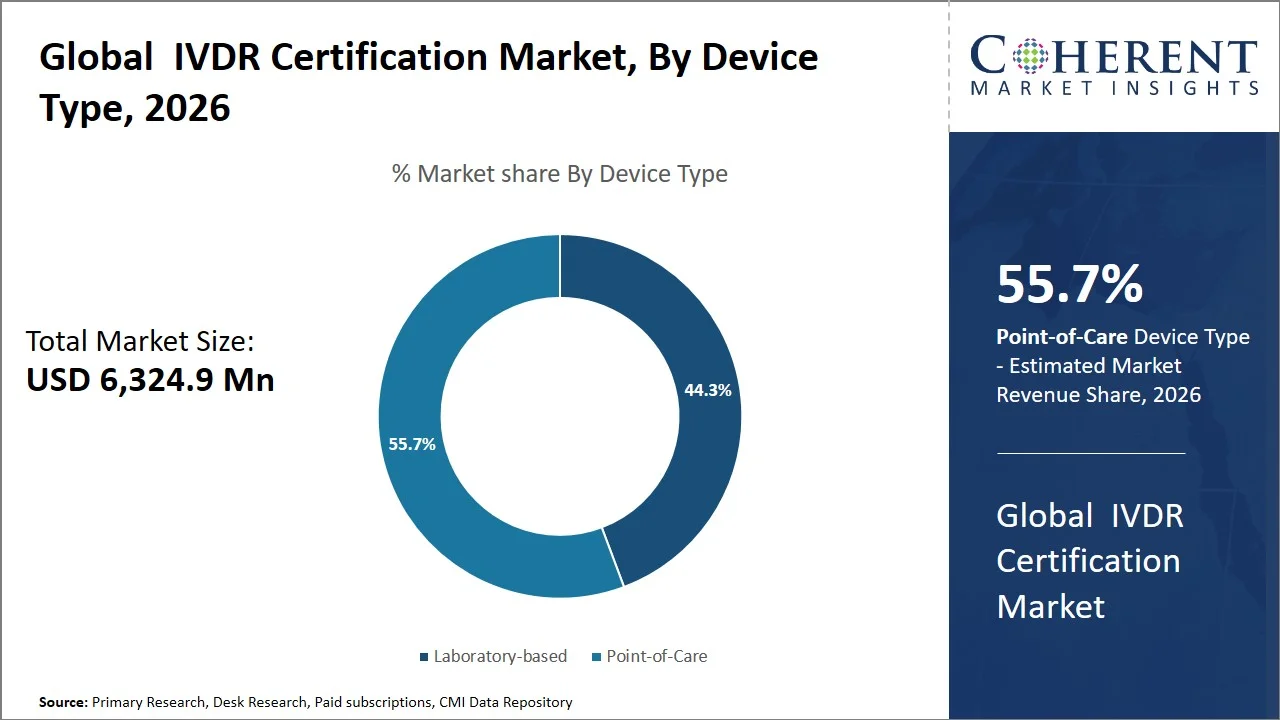
- Point-of-Care is projected to hold 55.7 % of the global IVDR certification market share in 2026, making it the dominant device type segment across Europe where decentralized diagnostics are expanding under the European Union's patient-centric healthcare strategy. For instance, the European Commission has issued dedicated guidance under the European Union In Vitro Diagnostic Regulation for near-patient (point-of-care) testing to ensure safety, performance, and regulatory compliance, supporting increased certification demand for point-of-care devices.
- Class I is projected to hold 38.1 % of the global IVDR certification market share in 2026, making it the dominant regulatory class segment across Europe owing to the high volume of low-risk in vitro diagnostic products, including laboratory consumables and specimen receptacles. For instance, the European Commission's guidance on the classification of in vitro diagnostic medical devices under Regulation (EU) 2017/746 provides the regulatory framework governing Class A devices, supporting consistent conformity assessment and market access across the European Union.
- Outsource is projected to hold 53.6 % of the global IVDR certification market share in 2026, making it the dominant sourcing type segment, across Europe, where manufacturers increasingly rely on specialized regulatory service providers to navigate complex conformity assessment requirements. For instance, the European Commission has designated multiple Notified Bodies under the European Union In Vitro Diagnostic Regulation through the NANDO Information System, encouraging manufacturers to outsource certification activities to accredited organizations with IVDR expertise.
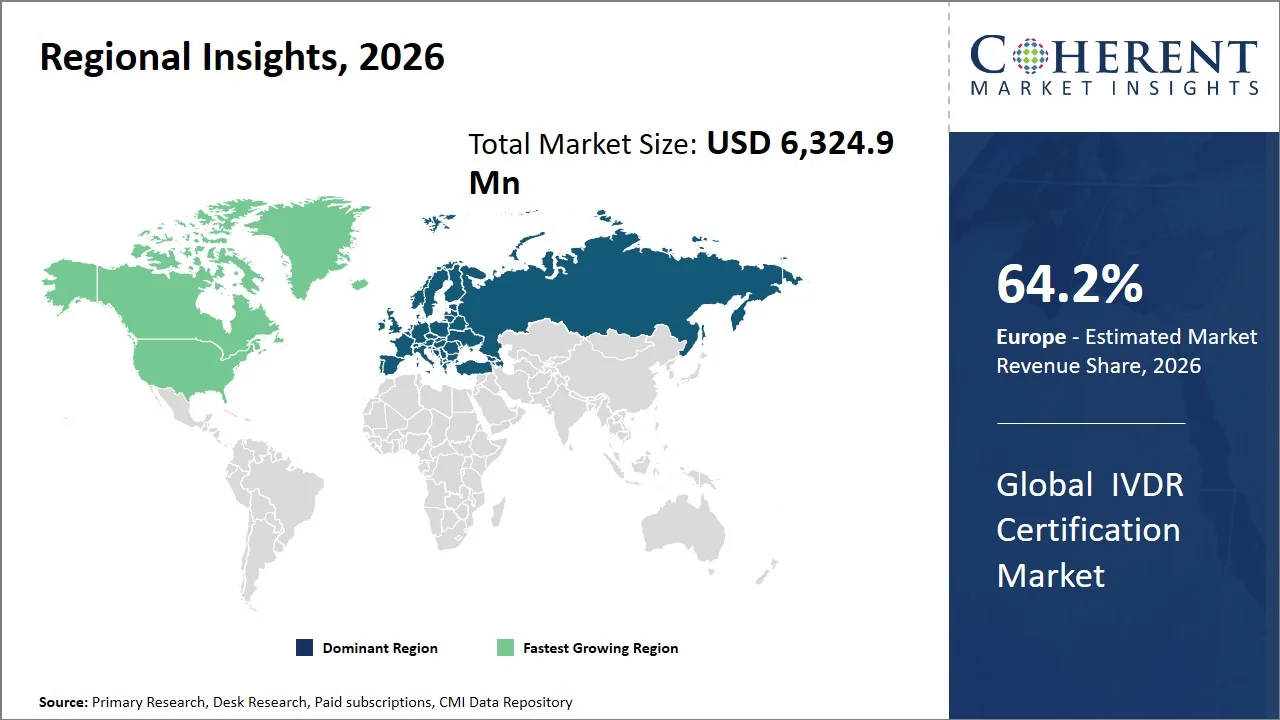
- Europe maintains dominance with an expected share of 64.2 % in 2026, bolstered by the mandatory implementation of the European Union In Vitro Diagnostic Regulation (Regulation (EU) 2017/746) and the high concentration of IVDR-designated Notified Bodies undertaking conformity assessments. For instance, Regulation (EU) 2024/1860 extended the IVDR transition timelines while requiring manufacturers to actively transition to full compliance, further sustaining the demand for IVDR certification services across Europe.
- North America is expected to exhibit the fastest growth with an estimated contribution of 15.9 % share in 2026, propelled by the large number of U.S. and Canadian in vitro diagnostic manufacturers seeking European Union market access through IVDR certification. The region is also witnessing increasing outsourcing of regulatory affairs and conformity assessment activities to specialized certification service providers to meet European Union regulatory requirements.
- Rising Demand for IVDR Certification of AI-Enabled In Vitro Diagnostic Devices: The growing adoption of artificial intelligence (AI) and software-based in vitro diagnostic devices is creating significant opportunities for IVDR certification providers. AI-enabled diagnostics require extensive clinical performance validation, cybersecurity assessment, and continuous regulatory compliance under the European Union In Vitro Diagnostic Regulation, increasing the demand for specialized certification, technical documentation, and post-market support services.
- Expansion of IVDR Certification Services for Companion Diagnostics and Precision Medicine: The rapid growth of companion diagnostics and precision medicine is increasing the need for IVDR certification, as these products require comprehensive clinical evidence and rigorous conformity assessments before commercialization in the European Union. This trend is creating opportunities for certification bodies and regulatory consulting firms to support manufacturers in meeting evolving performance, safety, and quality requirements for advanced molecular diagnostics.
Segmental Insights
Why Does Point-of-Care Dominate the Global IVDR Certification Market?
Point-of-Care is projected to hold a market share of 55.7% in 2026, owing to the growing demand for decentralized diagnostic solutions, which are required to adhere to the stringent safety, analytical and clinical performance standards defined under the European Union In Vitro Diagnostic Regulation prior to market entry. The rising utilization of IVDR certification solutions by hospitals, clinics, and communities, also supports the market expansion, prompting the market participants to receive IVDR certifications for various rapid diagnostic solutions. For instance, in June 2026, Tribun Health released the CaloPix 6, the first of its class IVDR-certified routine diagnostics platform further accelerating the effort to get such a tool IVDR-compliant for greater access to European markets. (Source: Tribun Health)
- Current Industry Events of 2026
- Market Size Estimation
- Regional Breakdown
- Competitive Landscape
- Customer Intelligence
- Segmental Analysis
- Pricing Analysis
- Key Market Drivers, Challenges & Future Trends
- Customized Insights Section
Why Does Class I Represent the Largest Regulatory Class Segment in the IVDR Certification Market?
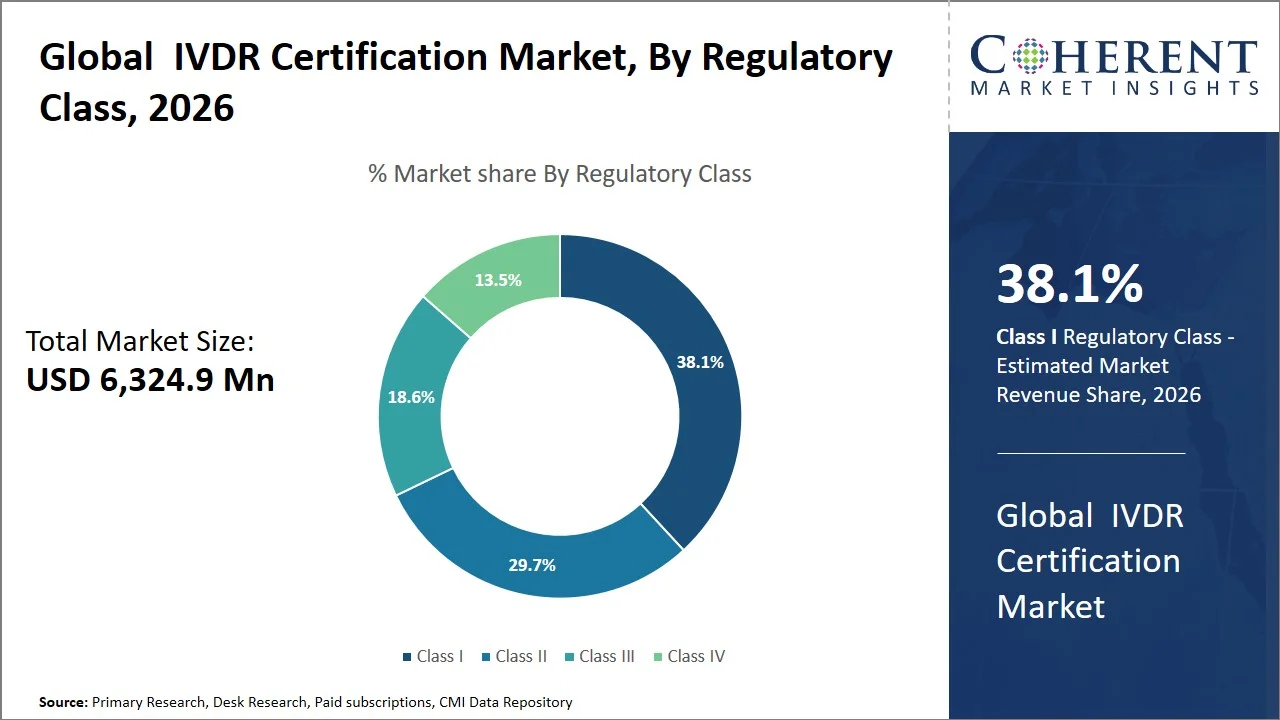
Class I is projected to hold a market share of 38.1% in 2026, driven by high sales volume of low-risk IVDs that are extensively utilized in daily lab/healthcare procedures and workflows. The manufacturers of low-risk IVDs are required to meet the technical documentation, quality management systems, labeling, and post market surveillance criteria mandated by IVDR before market placement in the EU. Their extensive applications, along with a recurring registration of the product in the EU leads to constant demand. For instance, Under Annex VIII, the regulation on in vitro diagnostic medical devices sets a risk-based approach for classifying IVDs into four Classes A, B, C and D depending on their use and the risk that they pose to the patient, thereby defining the applicable conformity assessment pathway for each device class. (Source: European Union)
Outsource Segment Dominates the Global IVDR Certification Market
The outsource segment is projected to hold a market share of 53.6% in 2026, as manufacturers partner with expert regulatory service providers to address various compliance activities such as technical documentation, performance evaluation, quality management system and post-market surveillance based on IVDR regulations. Outsourcing aids manufacturers in complying with stringent and changing regulations, mitigating regulatory complexities, internal resource limitations, and faster certification cycles. For instance, according to Article 10 of Regulation (EU) 2017/746, manufacturers are required to design, document, implement, maintain and continually improve a quality management system. Due to these demanding quality and regulatory responsibilities, many manufacturers prefer to outsource this function to specialized compliance service providers.
Currents Events and their Impact
Current Events | Description and its Impact |
European Commission's Proposal to Simplify Medical Device Regulations (December 2025) |
|
European Commission Launches Targeted Revision of MDR and IVDR Through Call for Evidence (September 2025) |
|
(Source: European Commission)
IVDR Certification Market Dynamics
Market Drivers
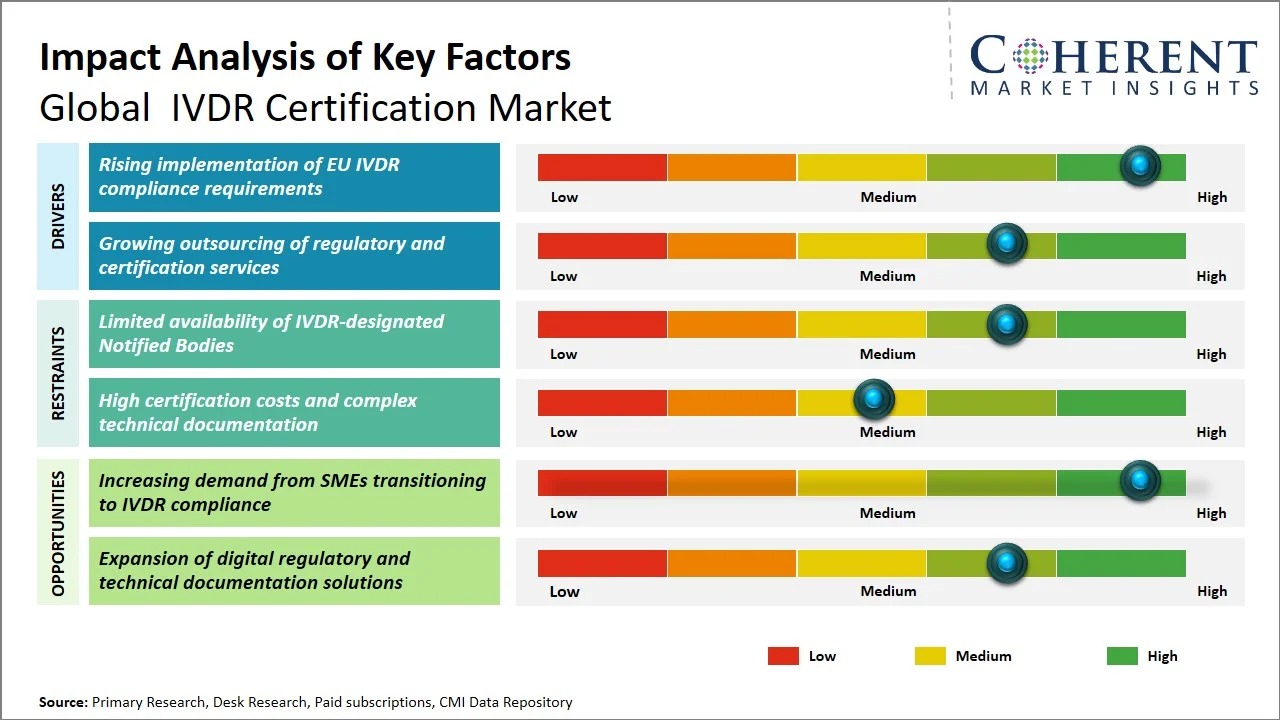
- Rising implementation of EU IVDR compliance requirements: The increasing enforcement of the European Union In Vitro Diagnostic Regulation (IVDR) is a key driver accelerating the global IVDR certification market, as manufacturers must comply with more stringent requirements for clinical evidence, performance evaluation, and quality management systems to maintain access to the European Union market. The complexity of conformity assessment has significantly increased demand for certification and regulatory consulting services globally. For instance, in July 2025, the European Commission updated the list of harmonized standards supporting Regulation (EU) 2017/746 through Implementing Decision (EU) 2025/1391, providing manufacturers with recognized technical standards for demonstrating IVDR conformity and facilitating certification.
- Growing outsourcing of regulatory and certification services: The increasing complexity of the European Union In Vitro Diagnostic Regulation (IVDR) is driving manufacturers to outsource regulatory strategy, technical documentation, clinical performance evaluation, and quality management activities to specialized compliance providers. Outsourcing enables faster market access, reduces internal regulatory burden, and helps manufacturers efficiently address evolving IVDR requirements. For instance, the European Commission requires manufacturers without a registered place of business in the European Union to appoint an authorized representative established within the Union, increasing reliance on external regulatory service providers for IVDR compliance and certification support.
Emerging Trends
- Expansion of Continuous Post-Certification Compliance Services: IVDR certification providers are increasingly extending their offerings beyond initial conformity assessment to include post-market surveillance, periodic safety updates, vigilance reporting, and lifecycle regulatory support. This shift is transforming certification into a long-term compliance service rather than a one-time regulatory activity.
- Increasing Adoption of Remote and Digital Conformity Assessment: Certification bodies are adopting secure digital platforms for technical documentation review, remote quality management system audits, and electronic submission management. These digital workflows are improving assessment efficiency, reducing certification timelines, and enabling manufacturers to manage IVDR compliance more effectively across global operations.
Regional Insights
Why is Europe a Strong Market for IVDR Certification?
Europe leads the global IVDR certification market, accounting for an estimated 64.2% share in 2026, due to the enforced EU In Vitro Diagnostic Regulation which sets one of the most stringent rules across the globe, specifically for In vitro diagnostic medical devices. With a robust network of device makers, notified bodies and regulatory assistance organizations in place to guide device makers throughout the compliance and access process, Europe’s growth as the IVDR certification market is accelerated by its innovative diagnostic device technology supported by clinical trials, innovation-driving government regulations and high awareness for patient care.
For instance, as from May 28, 2026, the European Commission mandated the deployment of the first four modules in the European Database on Medical Devices (EUDAMED): Actor registration, UDI / Device Registration, Notified Bodies and Certificates, and Market Surveillance. This rollout in phases increases the transparency, traceability, and control over medical devices and further strengthens the IVDR certification and compliance need throughout the continent. (Source: European Commission)
Why Does the North America IVDR Certification Market Exhibit High Growth?
The North America IVDR certification market is expected to exhibit the fastest growth with an estimated contribution of 15.9% share to the global market in 2026, due to increasing concentration of in vitro diagnostic manufacturers on commercialization within Europe. The companies within the region have made heavy investments on performance evaluation, IVDR compliant quality management systems and regulatory documentation to satisfy the EU’s mandatory requirements.
In parallel with this development, regulatory bodies across the world are enhancing regulatory co-operation & support to harmonize global standards for medical device quality and compliance in a bid to drive the adoption of EU’s IVDR compliance standards among manufacturers. For instance, the International Medical Device Regulators Forum (IMDRF), with the U.S. Food and Drug Administration and Health Canada as founding members, is working to develop and adopt harmonized regulatory approaches on an international level to the regulation of medical devices, such as in vitro diagnostic medical devices, for purposes of accessing international markets.
Global IVDR Certification Market Outlook for Key Countries
Why is the U.S. Leading Innovation and Adoption in the IVDR Certification Market?
The U.S. holds the largest market share for innovation and adoption in IVDR certification market, as the country has established regulatory affairs, extensive expertise in quality management and integrates global compliance approaches early in the product design phase. Moreover, there are numerous IVD manufacturers (such as Abbott Laboratories, Becton, Dickinson and Company (BD), Bio-Rad Laboratories, QuidelOrtho, and Hologic) focused on products to be commercialized within the European Union, generating the demand for IVDR conformance evaluation services, which contribute to expedited market entry in the EU.
Is U.K. a Favorable Market for the IVDR Certification Market?
U.K. is a promising market for IVDR certification due to an existing large base of in-vitro diagnostic device manufacturers and a mature ecosystem of regulatory consultants to guide market access in the European Union. For U.K.-based IVD manufacturers pursuing European Union market entry, IVDR certification remains an imperative for technical file documentation and a comprehensive regulatory strategy, while at a local level, Manufacturers continue to adhere to the U.K. regulatory framework. The U.K. has also been a front runner in developing robust strategies for clinical evidence generation and quality systems.
Is China Emerging as a Key Growth Hub for the IVDR Certification Market?
China is becoming an important growth area in the IVDR certification market driven by expansion of its in vitro diagnostics (IVD) manufacturing sector and growing exports to EU. The IVD manufacturers (such as Mindray Bio-Medical Electronics, Snibe Diagnostic, Sansure Biotech, BGI Genomics, and Autobio Diagnostics) are investing in IVDR certification process and enhancing their manufacturing facilities with quality management systems, performance testing and regulatory documents. Furthermore, increasing demand for specialized regulatory consulting and certification firms also drive the market growth in this country to ensure better and speedy access in the EU region.
Why Does Germany Top the European IVDR Certification Market?
Germany is the leading IVDR certification market in Europe because the country has a multitude of in vitro diagnostic manufacturers, robust medical industry, and developed ecosystem that allows efficient regulatory compliance. The country possesses proven knowledge about QMS (Quality management system), clinical performance evaluation and technical documentation which helps in producing manufacturers ready to cope up with European Union IVDR requirements. Several IVDR accredited Notified Bodies, and regulatory service consultancies (such as TÜV SÜD Product Service GmbH, TÜV Rheinland LGA Products GmbH, DEKRA Certification GmbH, and DQS Medizinprodukte GmbH) operate from the country making it a perfect place to certify IVDR medical device products.
Is IVDR Certification Market Developing in Japan?
The IVDR Certification market in Japan is gradually expanding due to its advanced in-vitro diagnostics (IVDs) production base and efforts to increase product exports to the European Union. To access the EU markets, Japan-based manufactures have begun to orient product designs, quality management standards, and clinical performance data towards the European Union IVDR regulations. Strong technological competency in the niche of precision diagnostics as well as the awareness of compliance related to these certifications make it an important and expanding market.
Digital Technologies Shaping the Global IVDR Certification Market
Technology | Application in IVDR Certification | Market Impact |
AI-Assisted Technical Documentation Review | Automates document validation and gap analysis | Reduces certification timelines and compliance errors |
Electronic Quality Management Systems (eQMS) | Digital management of quality processes and audits | Improves audit readiness and regulatory compliance |
Regulatory Information Management (RIM) Platforms | Centralized management of regulatory submissions | Enhances submission efficiency and traceability |
Clinical Performance Data Analytics | Supports performance evaluation and clinical evidence generation | Strengthens conformity assessment outcomes |
Digital Post-Market Surveillance Platforms | Continuous monitoring of device safety and performance | Facilitates ongoing IVDR compliance and vigilance |
How is the increasing demand from SMEs transitioning to IVDR compliance creating new growth opportunities in the IVDR certification market?
The increasing number of small and medium enterprises are launching new in vitro diagnostic medical devices and these companies need support to carry out the conformity assessment, the technical documentation, and to build quality management systems. There is huge demand for regulatory support from IVDR certification providers as the new European Union In Vitro Diagnostic Regulation is quite technical and confusing for manufacturers of these new products. For instance, to address this demand and support manufacturers in implementing the new framework, especially small and medium-sized enterprises (SMEs), the European Commission has published guidance documents and implementation tools, indicating a growing trend towards specific IVDR certification and IVDR consultation services.
Market Players, Key Development, and Competitive Landscape
Key Developments
- In March 2026, Devyser launched the first IVDR-compliant next-generation sequencing (NGS) assay for thalassemia and sickle cell disease testing in Europe. The product complies with the EU IVDR framework, enabling standardized genetic diagnostics while expanding the availability of certified molecular testing solutions. The launch highlights the increasing emphasis on IVDR-compliant product development to support regulatory approval and commercialization of advanced in vitro diagnostic technologies.
- In February 2025, Aiforia secured IVDR certification for its AI-powered pathology portfolio and launched three new CE-IVD-marked applications for breast and prostate cancer diagnostics in Europe. The certification enables broader commercialization under the EU IVDR framework, reinforcing the growing importance of IVDR certification in accelerating regulatory approval and market access for innovative in vitro diagnostic solutions.
Competitive Landscape
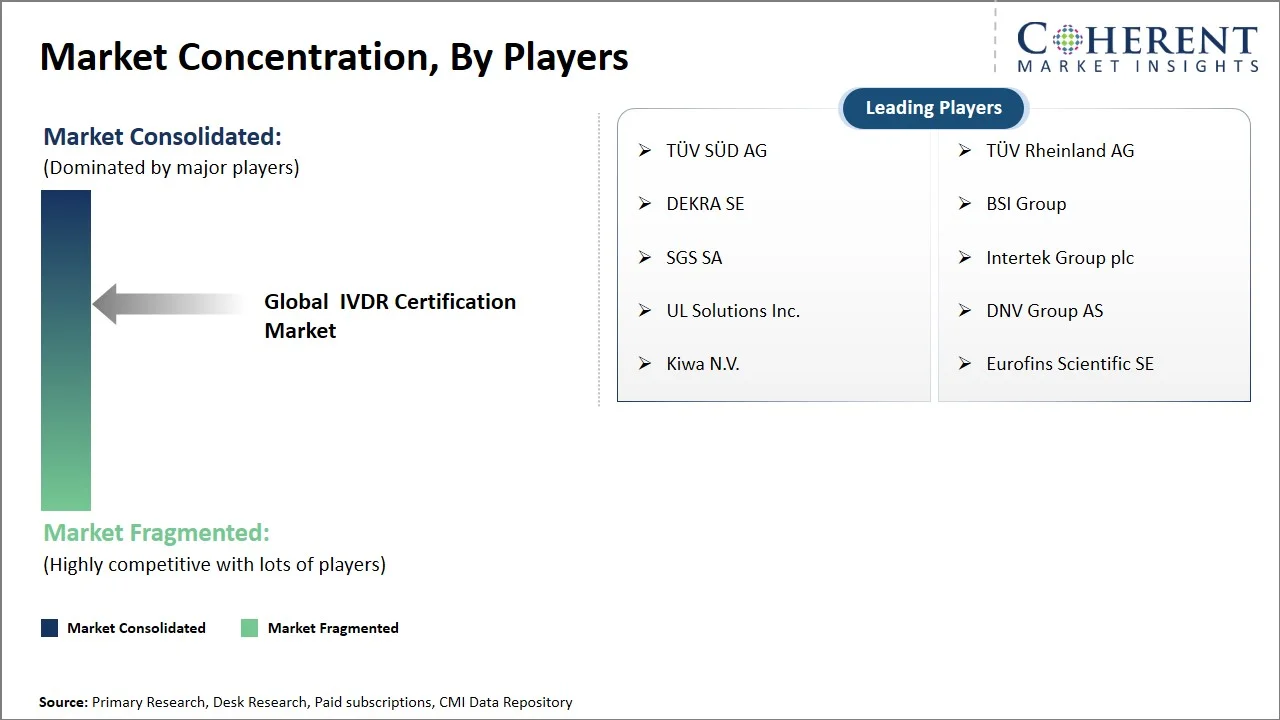
The global IVDR certification market is moderately consolidated, and competition mainly hinges on Notified Bodies, regulatory consulting service providers, and testing firms increasing their service portfolio to serve growing need for the European Union In Vitro Diagnostic Regulation (IVDR) compliance. The market stakeholders are concentrating to strengthen technical documentation review, clinical performance assessment, and quality management system auditing by upscaling their technical expertise and geographically diversifying their footprint through collaborations. Key focus areas include:
- Expansion of IVDR conformity assessment and Notified Body certification capacity
- Regulatory consulting for technical documentation, performance evaluation, and clinical evidence
- Digital compliance platforms for electronic quality management and regulatory documentation
- Strategic partnerships and acquisitions to strengthen European Union regulatory service capabilities
- Specialized certification support for AI-enabled diagnostics, molecular diagnostics, and companion diagnostics
Market Report Scope
IVDR Certification Market Report Coverage
| Report Coverage | Details | ||
|---|---|---|---|
| Base Year: | 2025 | Market Size in 2026: | USD 6,324.9 Mn |
| Historical Data for: | 2020 To 2024 | Forecast Period: | 2026 To 2033 |
| Forecast Period 2026 to 2033 CAGR: | 6.6% | 2033 Value Projection: | USD 9,870.1 Mn |
| Geographies covered: |
| ||
| Segments covered: |
| ||
| Companies covered: | TÜV SÜD AG, TÜV Rheinland AG, DEKRA SE, BSI Group, SGS SA, Intertek Group plc, UL Solutions Inc., DNV Group AS, Kiwa N.V., and Eurofins Scientific SE | ||
| Growth Drivers: |
| ||
| Restraints & Challenges: |
| ||
Analyst Opinion (Expert Opinion)
- The outlook for the IVDR certification market is driven by EU's efforts to reinforce regulations for in vitro diagnostic medical devices and a rise in manufacturer focus on longer term compliance plans, rather than on single certification only. Long-term demand will likely gravitate towards more holistic approaches for certification, consulting, and post market surveillance, particularly those concerning high-risk devices and those that use software.
- The maximum opportunities are foreseen within outsourced IVDR certification services for Class C and Class D in vitro diagnostic medical devices in Europe, especially for molecular diagnostics, companion diagnostics, and artificial intelligence-enabled diagnostic software, where regulatory requirements are more stringent and clinical evidence expectations are higher.
- In order to gain a competitive advantage market players should expand Notified Body capacity, invest in digital regulatory documentation and quality management platforms, strengthen expertise in artificial intelligence and software-based diagnostics, and establish strategic partnerships with in vitro diagnostic manufacturers to provide end-to-end IVDR compliance, certification, and lifecycle regulatory support.
Speak to the analyst
Want personalized insights?
Take the findings above to one of our principal consultants, or have the report rebuilt around the segments, geographies and competitors you actually track.
Market Segmentation
- Device Type Insights (Revenue, USD Mn, 2021 - 2033)
- Laboratory-based
- Point-of-Care
- Regulatory Class Insights (Revenue, USD Mn, 2021 - 2033)
- Class I
- Class II
- Class III
- Class IV
- Sourcing Type Insights (Revenue, USD Mn, 2021 - 2033)
- In-house
- Outsource
- End User Insights (Revenue, USD Mn, 2021 - 2033)
- Medical Device Companies
- Hospitals and Clinics
- Diagnostic Laboratories / Centers
- CDMO and CMO
- Others
- Regional Insights (Revenue, USD Mn, 2021 - 2033)
- North America
- U.S.
- Canada
- Latin America
- Brazil
- Argentina
- Mexico
- Rest of Latin America
- Europe
- Germany
- U.K.
- Spain
- France
- Italy
- Russia
- Rest of Europe
- Asia Pacific
- China
- India
- Japan
- Australia
- South Korea
- ASEAN
- Rest of Asia Pacific
- Middle East
- GCC Countries
- Israel
- Rest of Middle East
- Africa
- South Africa
- North Africa
- Central Africa
- North America
- Key Players Insights
- TÜV SÜD AG
- TÜV Rheinland AG
- DEKRA SE
- BSI Group
- SGS SA
- Intertek Group plc
- UL Solutions Inc.
- DNV Group AS
- Kiwa N.V.
- Eurofins Scientific SE
Sources
Primary Research Interviews
- Regulatory affairs managers specializing in European Union In Vitro Diagnostic Regulation (IVDR) compliance
- Quality assurance and quality management system professionals from in vitro diagnostic manufacturers
- Technical documentation and performance evaluation consultants
- Executives from Notified Bodies designated under the European Union In Vitro Diagnostic Regulation
- Product development and regulatory leaders from molecular diagnostics and point-of-care diagnostic companies
Stakeholders
- In vitro diagnostic medical device manufacturers
- Notified Bodies designated under the European Union In Vitro Diagnostic Regulation
- Regulatory affairs and compliance consulting firms
- Contract Research Organizations (CROs) and Contract Development and Manufacturing Organizations (CDMOs)
- Testing, inspection, and certification service providers
- End-use Sectors
- In vitro diagnostic manufacturers
- Diagnostic laboratories
- Hospitals and healthcare providers
- Research and academic institutes
- Regulatory & Health Bodies
- European Commission
- European Medicines Agency (EMA)
- Medical Device Coordination Group (MDCG)
- Competent Authorities for Medical Devices (CAMD)
- U.S. Food and Drug Administration (FDA)
- Health Canada
- Medicines and Healthcare products Regulatory Agency (MHRA), UK
- Pharmaceuticals and Medical Devices Agency (PMDA), Japan
Databases
- European Commission NANDO Information System
- European Commission EUDAMED
- European Commission Medical Devices Database
- U.S. FDA Medical Device Databases
- ClinicalTrials.gov
Magazines
- Medical Device Network
- MedTech Dive
- Regulatory Focus (RAPS)
- MedTech Intelligence
- European Pharmaceutical Review
Journals
- Nature Biomedical Engineering
- Journal of Medical Devices
- Journal of Clinical Medicine
- BMJ Health & Care Informatics
Newspapers
- Financial Times – Healthcare & Life Sciences
- The Wall Street Journal – Healthcare
- The Economic Times – Healthcare
Associations
- MedTech Europe
- Regulatory Affairs Professionals Society (RAPS)
- European Diagnostic Manufacturers Association (EDMA)
- Association of British HealthTech Industries (ABHI)
- Advanced Medical Technology Association (AdvaMed)
Public Domain Sources
- European Commission
- Medical Device Coordination Group (MDCG)
- European Medicines Agency (EMA)
- U.S. Food and Drug Administration (FDA)
- World Health Organization (WHO)
- Health Canada
- Medicines and Healthcare products Regulatory Agency (MHRA)
- Pharmaceuticals and Medical Devices Agency (PMDA)
Proprietary Elements
- CMI Data Analytics Tool, Proprietary CMI Existing Repository of information for last 10 years.
Get access to 250+ pages report
Every segment, forecast, competitor profile and data table behind the analysis above — available for instant download.
- ESOMAR Member
- ISO 9001:2015 Certified
- D-U-N-S Registered
- GDPR & CCPA Compliant
Missing comfort of reading report in your local language? Find your preferred language:
Transform your Strategy with Exclusive Trending Reports
Frequently Asked Questions
The global IVDR certification market is estimated to be valued at USD 6,324.9 Mn in 2026 and is expected to reach USD 9,870.1 Mn by 2033.
Point-of-Care dominates due to their expanding adoption in decentralized healthcare settings and the increasing need for IVDR certification to ensure regulatory compliance, safety, and clinical performance before commercialization in the European Union.
IVDR certification is the conformity assessment process that verifies that an in vitro diagnostic medical device complies with the requirements of the European Union In Vitro Diagnostic Regulation (Regulation (EU) 2017/746).
The CAGR of the global IVDR certification market is projected to be 6.6% from 2026 to 2033.
Rising implementation of EU IVDR compliance requirements, and growing outsourcing of regulatory and certification services are the major factors driving the growth of the global IVDR certification market.
Limited availability of IVDR-designated notified bodies, and high certification costs and complex technical documentation are the major factors hampering the growth of the global IVDR certification market.
Performance evaluation demonstrates the scientific validity, analytical performance, and clinical performance of an in vitro diagnostic medical device before it receives certification.