

Global Knitting Machine Market and Forecast – 2026 to 2033
Coherent Market Insights estimates that the global knitting machine market is expected to reach USD 6.50 Bn in 2026 and will expand to USD 10.00 Bn by 2033, registering a CAGR of 7.5% between 2026 and 2033.
Key Takeaways of the Knitting Machine Market
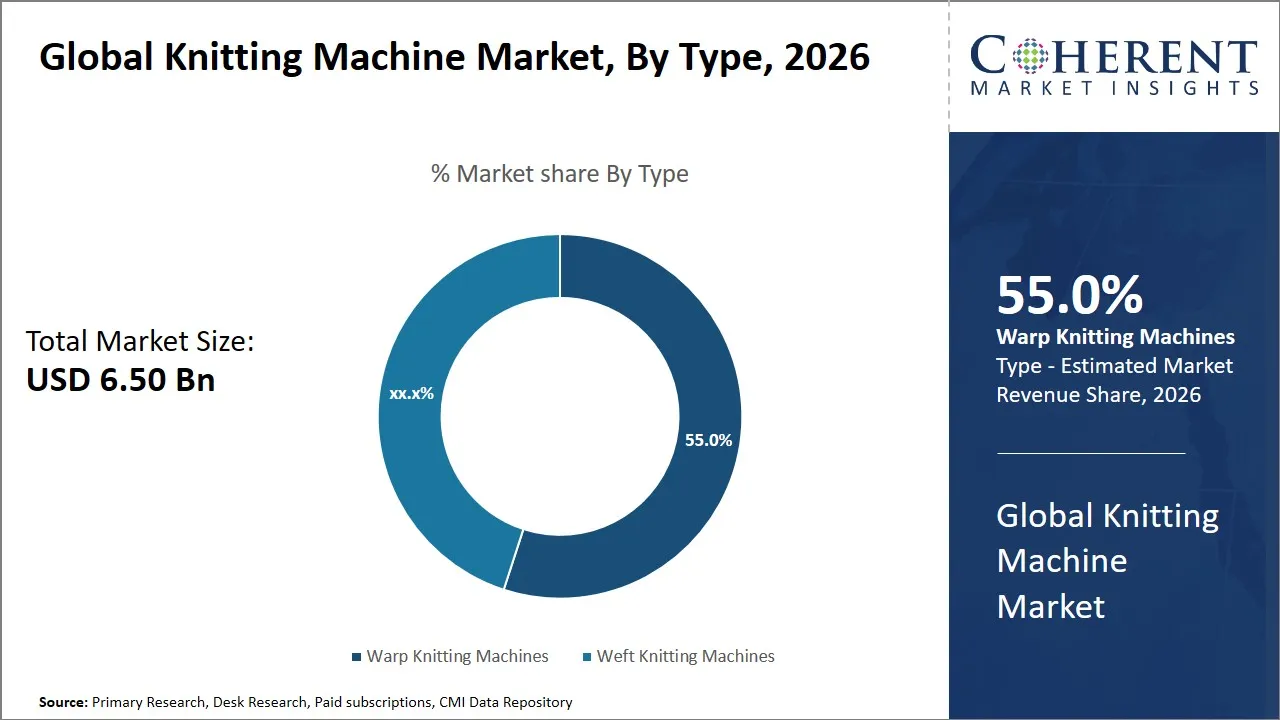
- The warp knitting machines segment is expected to account for 55% of the knitting machine market share in 2026.
- The single knit segment is projected to account for 51% of the market share in 2026.
- The manual segment is expected to account for 39% of the market share in 2026.
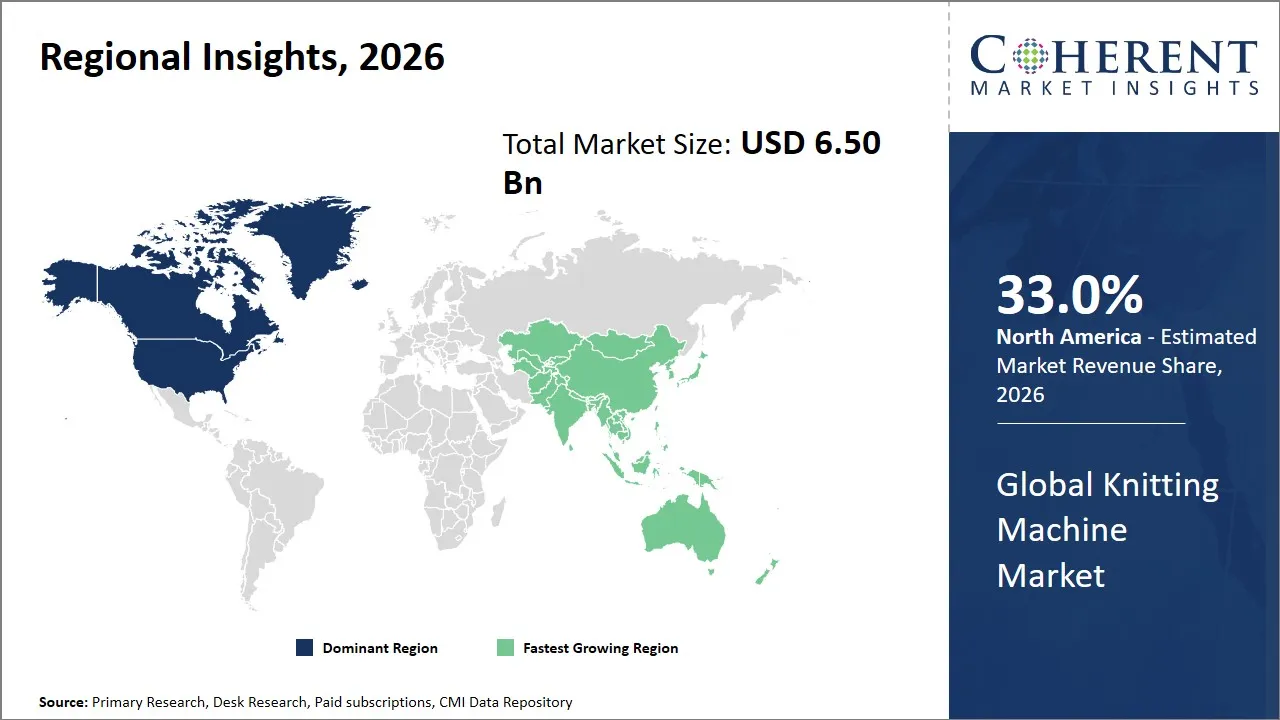
- North America is anticipated to dominate the knitting machine market in 2026 with a 33% market share.
- Asia Pacific is projected to hold 28% of the market share in 2026 and is expected to record the fastest growth over the forecast period.
Currents Events and Its Impacts
Current Events | Description and its Impact |
Karl Mayer Product Launch |
|
Segmental Insights
- Current Industry Events of 2026
- Market Size Estimation
- Regional Breakdown
- Competitive Landscape
- Customer Intelligence
- Segmental Analysis
- Pricing Analysis
- Key Market Drivers, Challenges & Future Trends
- Customized Insights Section
Why is the Warp Knitting Machines Segment Expected to Dominate the Global Knitting Machine Market in 2026
The warp knitting machines segment is expected to account for 55.0% of the global knitting machine market in 2026. Growth stems largely from strong output performance combined with broad adaptability. With several threads running in parallel, warp knitting forms materials that resist stretching more than weft methods while maintaining firmness. As they deliver consistent structure without added weight, these machines see steady demand where resilience matters most and examples include vehicle seating, athletic clothing, and functional fabric applications.
Single Knit Segment Dominates the Global Knitting Machine Market
The single knit segment is expected to account for 51.0% of the global knitting machine market in 2026. Primarily, expansion stems from broad usage alongside efficient manufacturing methods. Beginning with a solitary needle setup, single knit fabric usually shows lower density, permits more air movement, yet uses reduced inputs when made versus double knit versions. Therefore, common usage appears throughout routine apparel categories - including relaxed wear, underlayers, and foot coverings - because of functional characteristics.
Why is Manual the Most Preferred Mode of Operation in the Knitting Machine Market?
The manual segment is expected to account for 39.0% of the global knitting machine market in 2026. Affordability plays a central role in driving adoption, while compatibility with tailored output adds further support. In numerous emerging economies, preference leans toward manual knitting equipment due to minimal upfront investment demands. Because operation remains straightforward, craft workers and local enterprises manage consistent textile creation despite limited access to advanced instruction or heavy setup costs.
Automation & Digital Knitting ROI
ROI Indicator | Estimated Value |
Global automated knitting machine adoption | ~64% of large textile manufacturers |
Reduction in labor dependency | ~52% |
Production speed increase (automation) | ~45% |
Waste reduction from automation | ~18-25% |
Regional Insights
North America Knitting Machine Market Analysis and Trends
North America is expected to account for a market share of 33% in 2026. A shift occurs where technology guides progress across select industries instead of broad fashion output. Automation gains favor because operating expenses push producers toward precision equipment. Digital controls appear more often within factories aiming to balance operational demands. Rising interest shows up in specialized knitting methods suited for limited batches or tailored outputs.
Customization becomes possible through updated warping techniques gaining traction slowly. Cost barriers limit how fast companies replace older models despite clear benefits. Mature infrastructure affects willingness to invest in large-scale upgrades. Machines arrive frequently from overseas suppliers during this transition period. Environmental factors begin influencing which tools earn preference among buyers. Long-term shifts emerge quietly under pressure from modern manufacturing standards.
Asia Pacific Knitting Machine Market Analysis and Trends
Asia Pacific is projected to account for a market share of 28% in 2026 and is expected to register the fastest growth rate over the forecast period. Driven by a mature network of textile producers, steady policy backing, and access to trained workers, expansion takes shape. Industrial foundations in nations including China, India, Japan, and South Korea cover conventional methods alongside modern knitwear techniques.
Support from public institutions, through financial aid and streamlined export rules, strengthens output capacity. Efficient shipping routes combined with preferential trade pacts give regional makers an edge in worldwide distribution. Firms such as Shima Seiki (Japan), Stoll (Germany, present across Asia), and Santoni (Italy-rooted, operating widely in Asia) operate facilities and research hubs that widen technical reach along with range of offerings tailored to varied demand.
Global Knitting Machine Market Outlook for Key Countries
Is China the Next Growth Engine for the Knitting Machine Market?
Despite global shifts, China holds influence through sheer production volume and steady progress in knitwear equipment design. Alongside homegrown firms, international players engage in partnerships producing rapid, mechanized systems meeting internal needs as well as overseas orders. Backed by state-driven initiatives to refine tools of the trade, upgrades continue shaping efficiency gains across factories nationwide. As a result, machine development thrives where demand meets capability.
India Knitting Machine Market Analysis and Trends
A growing demand for knitted garments shapes India's machinery sector, linked closely to widespread availability of cotton and manufactured fibers. Support from national initiatives, including incentives for domestic production, encourages smaller firms to update equipment. Firms like LK Machinery and Smarter hold notable shares, offering tools that improve output precision and material performance. International suppliers adapt by broadening access through extended dealer frameworks across regions. Expansion continues as industry needs align with technological upgrades.
Germany Knitting Machine Market Analysis and Trends
Still ahead in crafting sophisticated knitting machinery, Germany stands out through exactness and original thinking. Supported by a network focused on research growth plus strict production norms, firms like Stoll and Terrot shape much of worldwide output. As attention to smart factory systems runs deep, equipment from this region keeps pace with demands for automated operation, lower power use, and seamless data links across markets far beyond its borders.
Brazil Knitting Machine Market Analysis and Trends
With a strong homegrown textile industry, Brazil sees steady interest in knitting machinery, owing to state-backed programs boosting output and foreign sales. Global makers take note where fabric suppliers operate locally, drawn by varied product needs across the sector. Agreements among Latin American nations open doors abroad, allowing equipment uptake to grow quietly but consistently. A foundation of manufacturing activity keeps momentum building behind the scenes.
Why is the U.S. Emerging as a Major Hub in the Knitting Machine Market?
Innovation shapes much of the knitting machine sector across the U.S., where preference leans toward adaptable, eco-conscious equipment. Rising domestic production of textiles fuels interest in modern machinery capable of precision and efficiency. Firms focused on advancement, alongside global manufacturers, introduce models that reduce power consumption while enabling seamless automation.
Public backing emerges through funding and policies favoring next-generation industrial methods and environmental responsibility. Key players such as Shima Seiki and Stoll operate locally via collaborations and dedicated support hubs to align with regional needs. Growth continues amid strategic investment and evolving production standards.
Market Players, Key Development, and Competitive Intelligence
Key Developments
- In October 2025, Mayer & Cie. showcased its OVJA 2.4 EC II and will provide an overview of its digital and smart solutions. Another focus is on the machines of Mayer & Cie’s “Performance Line”: circular knitting machines, which are the most efficient solution in their respective classes.
Top Strategies Followed by Global Knitting Machine Market Players
- Competition shapes the worldwide knitting machine sector, with firms at various levels pursuing unique paths to gain advantage. Leading names, supported by strong financial backing and recognized identities, focus on R&D efforts aimed at creating new models packed with advanced features. Innovation moves forward through a push for higher output, reduced power needs, and broader function range. Meeting shifting requirements across fabric production remains central to product evolution.
- Offering machines at moderate prices, mid-tier producers aim toward buyers who watch spending closely but still expect reliable operation. While keeping expenses low, their goal involves delivering steady functionality matched with reasonable pricing, especially for smaller firms entering textile production. Built with simplicity in mind, equipment from these suppliers adjusts easily to different tasks while reducing long-term upkeep needs. Customers balancing tight financial limits find such flexibility useful when selecting tools for daily operations.
- Despite limited means, smaller firms in the knitting machine sector find space through focused expertise and new ideas. Driven by necessity, they build equipment designed for narrow uses - examples include circular patterns, flat panels, or whole garments without seams. Their edge often comes from swift moves toward modern tools: automated functions, internet-connected operations, and refined digital controls shape what they provide. These choices help them stand apart where bigger names dominate.
Market Report Scope
Knitting Machine Market Report Coverage
| Report Coverage | Details | ||
|---|---|---|---|
| Base Year: | 2025 | Market Size in 2026: | USD 6.50 Bn |
| Historical Data for: | 2020 To 2024 | Forecast Period: | 2026 To 2033 |
| Forecast Period 2026 to 2033 CAGR: | 7.5% | 2033 Value Projection: | USD 10.00 Bn |
| Geographies covered: |
| ||
| Segments covered: |
| ||
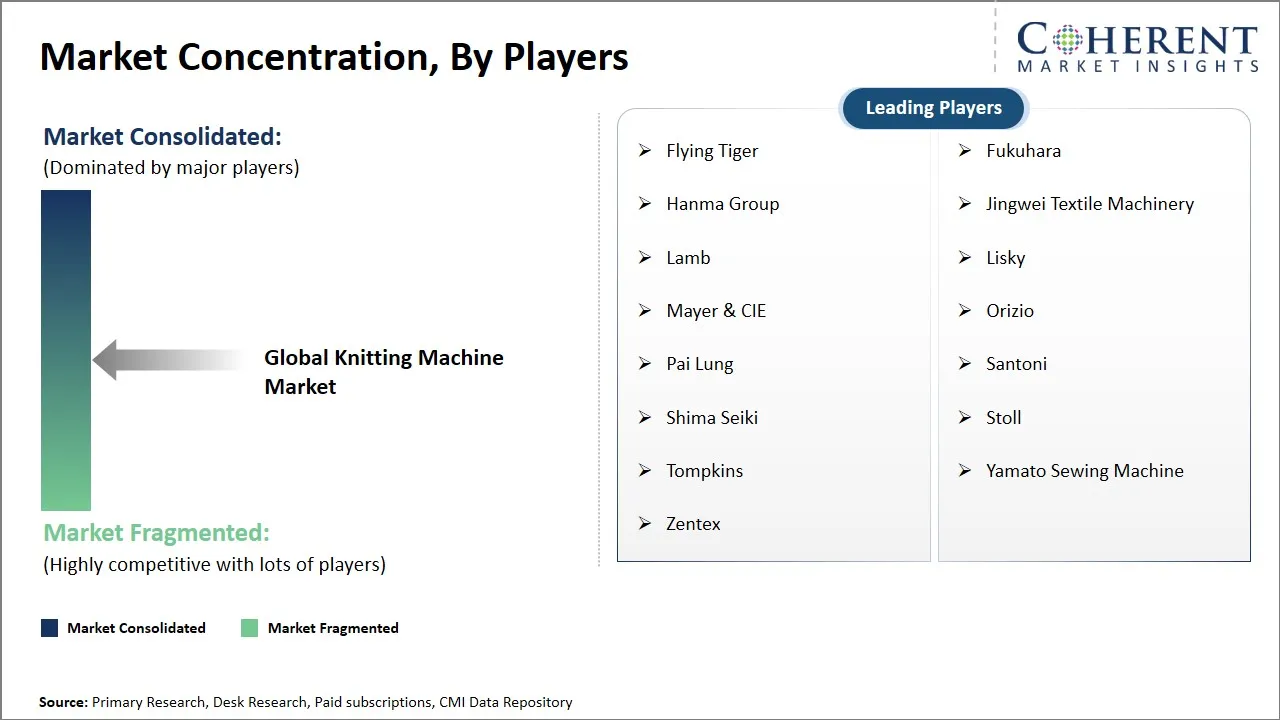
| Companies covered: | Flying Tiger, Fukuhara, Hanma Group, Jingwei Textile Machinery, Lamb, Lisky, Mayer & CIE, Orizio, Pai Lung, Santoni, Shima Seiki, Stoll, Tompkins, Yamato Sewing Machine, and Zentex | ||
| Growth Drivers: |
| ||
| Restraints & Challenges: |
| ||
Global Knitting Machine Market Dynamics
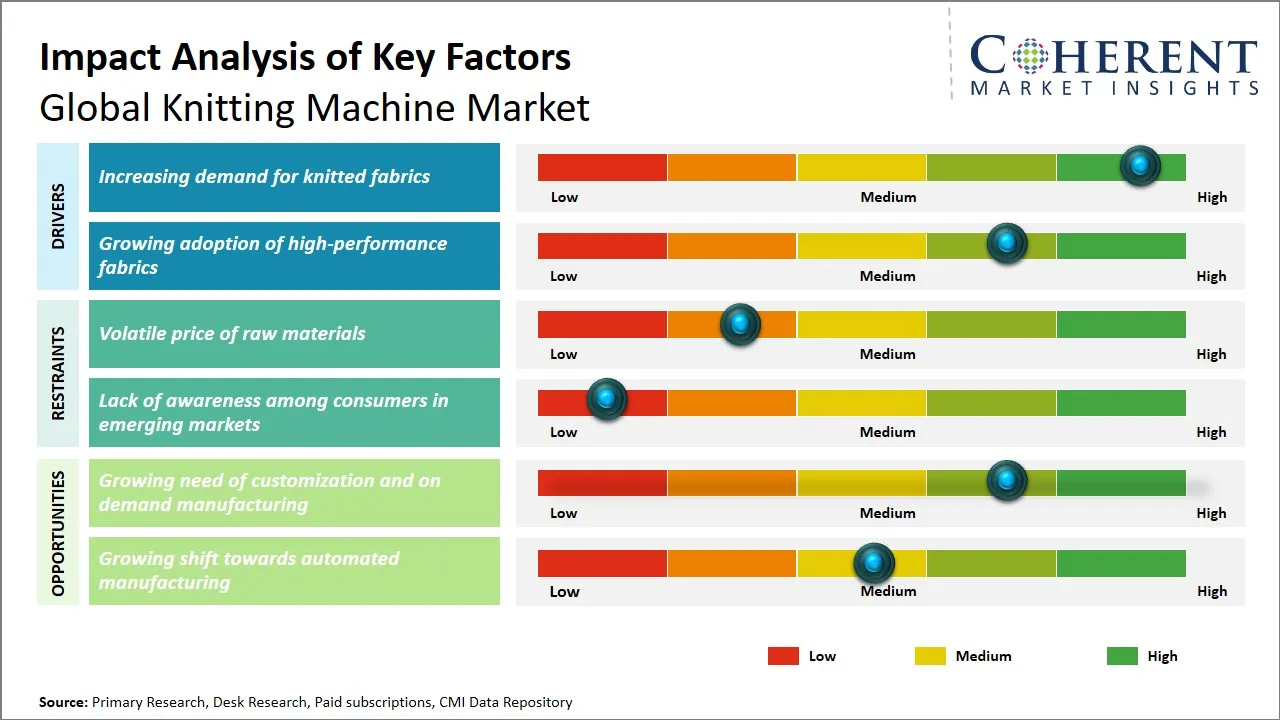
Global Knitting Machine Market Driver - Increasing Demand for Knitted Fabrics
Driven by rising consumer preference for flexible, breathable materials, demand for knitted fabrics shapes expansion in the global knitting machine sector. As these textiles offer superior softness and movement compared to woven types, they appear more frequently across sportswear, everyday garments, and household items. With athletic-inspired fashion gaining ground, emphasis shifts toward cloth behavior, especially motion ease and sweat dispersion. This shift nudges production methods forward, favoring innovation within fabric construction processes.
Global Knitting Machine Market Opportunity - Growing Need of Customization and On Demand Manufacturing
Growth in the global knitting machine market emerges alongside rising interest in tailored garments with performance fabrics and made-to-order production within textiles. Personal choice now guides buying habits, as more people look for distinct pieces rather than standard options found everywhere. Shifts like these push producers toward adaptable systems and improved textile machinery able to handle limited runs while adjusting quickly to new trends. Machines enhanced with digital tools and software-based design support complex textures, unique layouts, and diverse material mixes, achieving such results swiftly, with minimal delays or excess material loss.
Analyst Opinion (Expert Opinion)
- Automation now shapes the core of knitting machinery trends, as digital systems become standard in production settings aiming for steady output and reduced workforce needs. Where machines connect through networked sensors, performance gains follow, especially within sportswear and functional fabric sectors. Though older models remain in use, intelligent setups gain ground due to their ability to adjust patterns without manual input. In regions like China, Germany, and the U.S., factories modernize not only for speed but also to meet varied design requests efficiently. Over time, equipment capable of self-diagnosis and remote tracking influences purchasing choices more than before. Since precision matters across complex orders, adaptive manufacturing tools grow more common in daily operations.
- Even so, steep startup expenses, lack of trained workers, yet tight rules on power usage and disposal practices limit expansion, particularly among midsize and small cloth makers. It is noted that major producers adapt modern stitching methods to align with shifting needs in apparel and material sectors, whereas numerous lesser operations lag behind because investments feel too heavy, processes too involved. Requirements tied to lower emissions, machines using less electricity, also compatibility with reused fibers now shape buying choices, showing ethical goals joining efficiency benchmarks in guiding industry focus. How markets weigh value continues changing under pressure from ecological concerns.
Speak to the analyst
Want personalized insights?
Take the findings above to one of our principal consultants, or have the report rebuilt around the segments, geographies and competitors you actually track.
Market Segmentation
- Type Insights (Revenue, USD Bn, 2021 - 2033)
- Warp Knitting Machines
- Weft Knitting Machines
- Knit Type Insights (Revenue, USD Bn, 2021 - 2033)
- Single Knit
- Double Knit
- Mode of Operation Insights (Revenue, USD Bn, 2021 - 2033)
- Manual
- Semi-Automatic
- Fully Automatic
- End User Insights (Revenue, USD Bn, 2021 - 2033)
- Automotive Textiles
- Sports Textiles
- Apparel Textiles
- Home Textiles
- Others
- Regional Insights (Revenue, USD Bn, 2021 - 2033)
- North America
- U.S.
- Canada
- Latin America
- Brazil
- Argentina
- Mexico
- Rest of Latin America
- Europe
- Germany
- U.K.
- Spain
- France
- Italy
- Russia
- Rest of Europe
- Asia Pacific
- China
- India
- Japan
- Australia
- South Korea
- ASEAN
- Rest of Asia Pacific
- Middle East
- GCC Countries
- Israel
- Rest of Middle East
- Africa
- South Africa
- North Africa
- Central Africa
- North America
- Key Players Insights
- Flying Tiger
- Fukuhara
- Hanma Group
- Jingwei Textile Machinery
- Lamb
- Lisky
- Mayer & CIE
- Orizio
- Pai Lung
- Santoni
- Shima Seiki
- Stoll
- Tompkins
- Yamato Sewing Machine
- Zentex
Sources
Primary Research Interviews
- Knitting machine manufacturers and suppliers
- Textile industry executives and production managers
- Equipment distributors and sales representatives
- Technology providers and automation specialists
Magazines
- Textile World Magazine
- Knitting Industry Magazine
- International Textile Magazine
- Textile Machinery Review
Journals
- Textile Research Journal
- Journal of Textile Engineering
- International Journal of Clothing Science and Technology
Newspapers
- Financial Times
- The Wall Street Journal
- Reuters Business News
- Bloomberg News
Associations
- International Textile Manufacturers Federation (ITMF)
- Textile Machinery Association of India (TMAI)
- European Textile Machinery Association (CEMATEX)
- China Textile Machinery Association (CTMA)
Public Domain Sources
- World Trade Organization (WTO) reports
- International Trade Centre (ITC) statistics
- Government industrial development websites
- United Nations Industrial Development Organization (UNIDO)
Proprietary Elements
- CMI Data Analytics Tool
- Proprietary CMI Existing Repository of information for last 8 years
Get access to 250+ pages report
Every segment, forecast, competitor profile and data table behind the analysis above — available for instant download.
- ESOMAR Member
- ISO 9001:2015 Certified
- D-U-N-S Registered
- GDPR & CCPA Compliant
Missing comfort of reading report in your local language? Find your preferred language:
Transform your Strategy with Exclusive Trending Reports
Frequently Asked Questions
The global knitting machine market stood at USD 6.50 Bn in 2026 and is expected to reach USD 10.00 Bn by 2033.
The CAGR of global knitting machine market is projected to be 7.50% from 2026 to 2033.
Increasing demand for knitted fabrics and growing adoption of high-performance fabrics are the major factors driving the growth of the global knitting machine market.
Volatile price of raw materials and lack of awareness among consumers in emerging markets are the major factors hampering the growth of the global knitting machine market.
In terms of type, warp knitting machines are estimated to dominate the market revenue share in 2026.
Digital controls and IoT integration improve efficiency, quality consistency, and predictive maintenance capabilities.
Sustainability influences demand for energy-efficient machines compatible with recycled and eco-friendly yarns.