

Global Labor Management System Market Size and Forecast – 2026-2033
The global labor management system market is estimated to be valued at USD 5.71 Bn in 2026 and is expected to reach USD 9.97 Bn by 2033, exhibiting a compound annual growth rate (CAGR) of 8.3% from 2026 to 2033.
Key Takeaways of the Global Labor Management System Market
- The time & attendance segment leads the market holding an estimated share of 30.8% in 2026.
- North America is estimated to lead the market with a share of 38. 5% in 2026.
- Asia Pacific, holding an estimated share of 27. 4% in 2026, is projected to be the fastest growing region.
Market Overview
The market is seeing the growing focus on real-time labor tracking and compliance management, which is adding to software adoption globally. Also, the adoption of remote and hybrid work models is pushing organizations to use sophisticated labor management tools that help with workforce scheduling, attendance monitoring, and labor cost control. Also, technological advancements, such as mobile applications and AI-driven predictive analytics, are changing traditional labor management processes, making possible better decision-making and strategic workforce planning.
Current Events and Its Impact
Current Events | Description and its impact |
Paycom's AI-Driven Revenue Growth |
|
Waste Management's Job Reductions Due to Automation |
|
California Labor Federation's AI Surveillance Legislation |
|
Segmental Insights
- Current Industry Events of 2026
- Market Size Estimation
- Regional Breakdown
- Competitive Landscape
- Customer Intelligence
- Segmental Analysis
- Pricing Analysis
- Key Market Drivers, Challenges & Future Trends
- Customized Insights Section
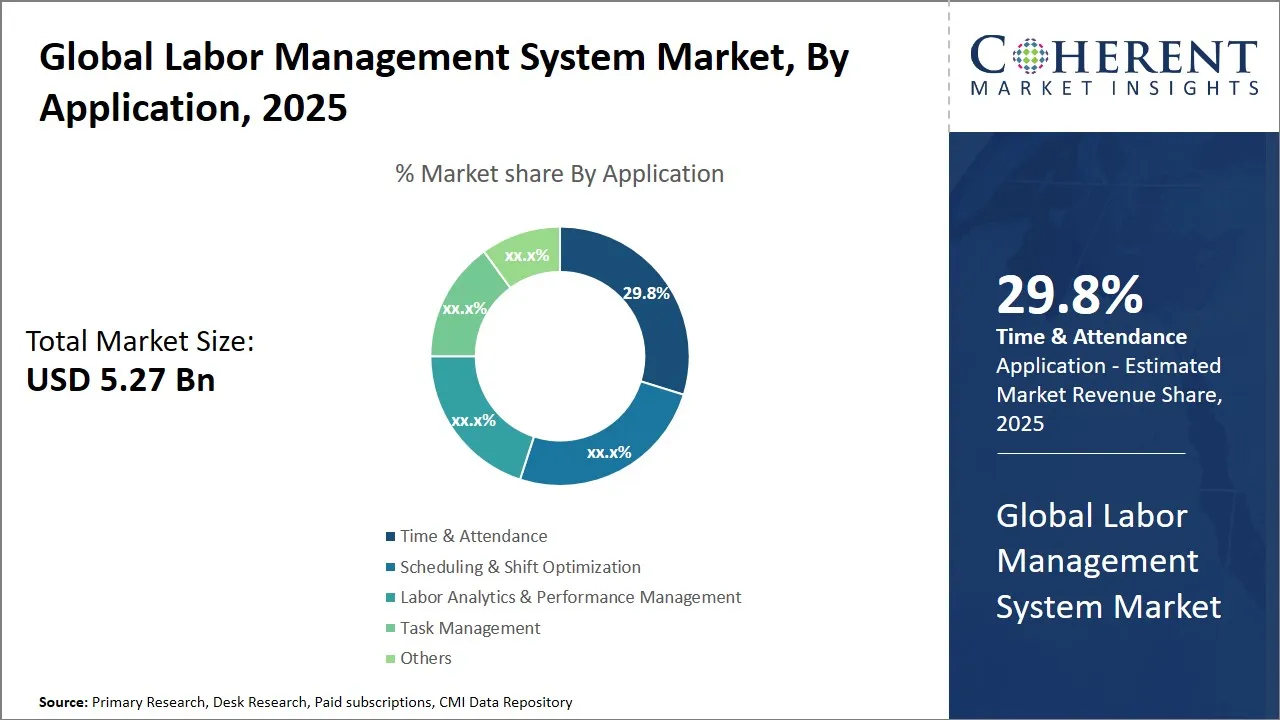
Global Labor Management System Market Insights, by Application – Time & Attendance Leads Because of Increasing Demand for Workforce Accuracy and Regulatory Compliance
In the global labor management system market, the time & attendance segment is expected to hold the dominant share of 30.8% in 2026. The rising complexity of workforce management because of different work shifts, remote working trends, and multi-location operations, has added to the need for automated and reliable time-tracking solutions. Businesses in different industries are using time & attendance systems to minimize errors associated with manual tracking and to reduce instances of payroll fraud or buddy punching. Also, regulations around labor laws and wage compliance have become stricter globally. Employers are pushed to maintain accurate attendance records to follow labor standards, avoid legal penalties, and safeguard employee rights. Technological advancements such as biometric authentication, facial recognition, and mobile-based attendance tracking have further boosted the segment's adoption. Integration capabilities with existing HR and payroll systems simplify the payroll process and empower organizations to carry out data-driven decision-making regarding workforce productivity and scheduling.
In 2024, Amazon expanded the use of palm-scan “Amazon One” technology, originally designed for cash-free retail checkout, to verify employee clock-in and clock-out times at many large warehouses. This system integrates directly with Amazon’s internal HR and payroll platforms, making possible real-time attendance tracking, automatic calculation of overtime, and instant detection of any discrepancies. Also, the rising trend of flexible work arrangements, including part-time, gig, and remote jobs, has made tracking labor hours more complex. Time & attendance software provides scalable solutions to address such diverse workforce requirements.
Impact of AI on the Labor Management System Market
AI technologies are changing the market by automating routine tasks such as scheduling, attendance tracking, and compliance monitoring. This automation reduces administrative overhead and human errors, leading to more accurate and timely operations. For instance, companies like Unilever use AI-driven systems that analyze employee performance and productivity patterns, resulting in a 15% increase in overall efficiency. Such advancements help organizations use resources more effectively, optimize labor costs, and improve workforce management.
While AI brings a lot of improvements in operational efficiency, it also poses challenges related to job displacement and the need for reskilling. The use of AI into LMS can lead to the automation of tasks traditionally performed by human workers, making certain job roles obsolete.
Regional Insights
North America Labor Management System Market Analysis and Trends
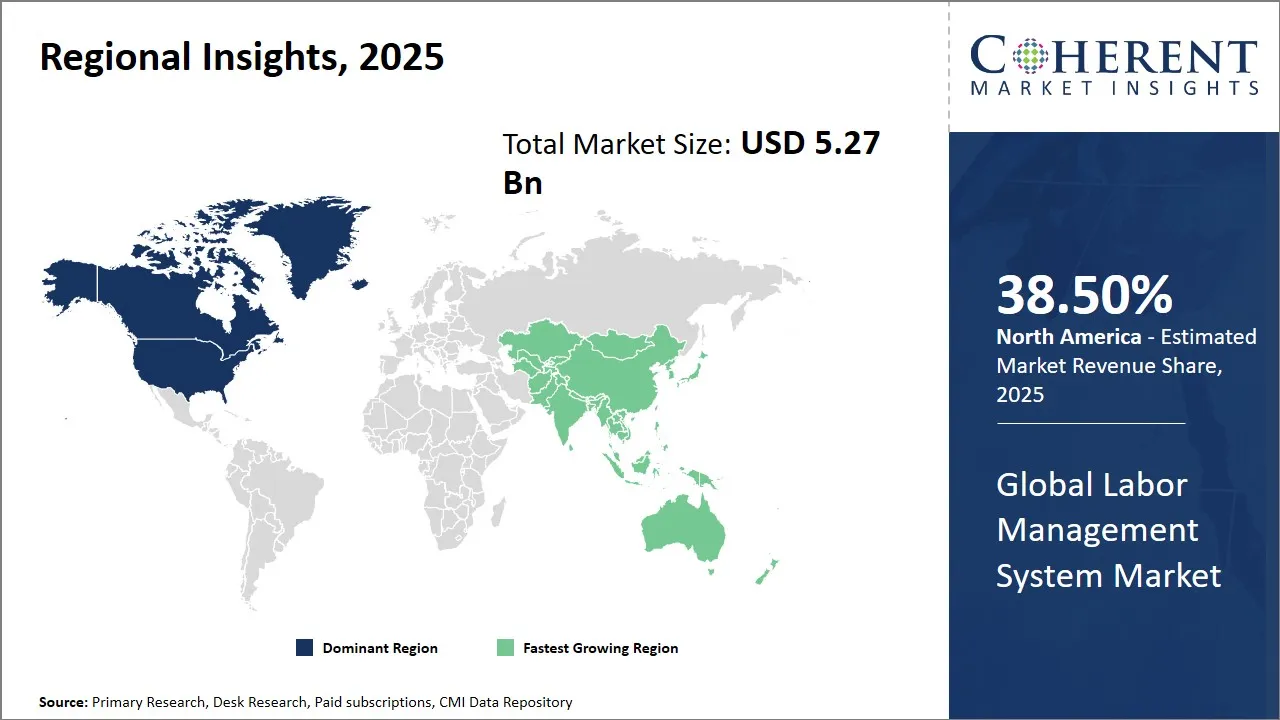
North America, holding a projected share of 38.5% in 2026, dominates the global labor management system market because of a mature technological ecosystem, strong regulatory frameworks, and a strong presence of enterprise software providers.
The presence of leading technology companies such as SAP SuccessFactors and Oracle Workforce Management makes the market stronger by offering innovative, integrated solutions tailored to large enterprises. Furthermore, North America benefits from high labor costs, pushing organizations to invest in software that boosts productivity and ensures compliance with complex labor laws. Additionally, extensive trade and business operations across borders magnify the need for scalable and adaptive labor management platforms.
Asia Pacific Labor Management System Market Analysis and Trends
The Asia Pacific region, holding an estimated share of 27.4% in 2026, exhibits the fastest growth in the labor management system market because of fast industrialization, growing service sectors, and increasing adoption of digital technologies. Countries like China, India, Japan, and Southeast Asian nations are seeing a lot investments in automation and workforce optimization to address large, diverse labor pools and rising labor costs.
Government initiatives supporting “Industry 4.0” and digital transformation support the use of labor management solutions to improve operational efficiency and labor compliance. The growing presence of global providers such as ADP, Kronos, and regional software firms tailored to multi-lingual and regulatory complexities also add to fast market expansion.
Labor Management System Market Outlook for Key Countries
U.S. Labor Management System Market Analysis and Trends
The U.S. is a hub of innovation in labor management software because of different industrial sectors and stringent labor regulations. Market leaders like Kronos Incorporated/UKG and Oracle offer integrated solutions encompassing time tracking, workforce analytics, and compliance management. The U.S. labor management system market is seeing high adoption of cloud-based and AI-driven labor management solutions, with strategic partnerships between technology vendors and enterprises adding to innovation. The country’s mature technology infrastructure and well-established labor laws make organizations continually upgrade software systems for improved workforce productivity and regulatory compliance.
China Labor Management System Market Analysis and Trends
China labor management system market is growing fast because of its large manufacturing base and expansion in retail and service industries. The government’s focus on smart manufacturing and digital transformation adds to adoption of labor management tools that connect with broader enterprise resource planning platforms. Domestic companies like Yonyou and Kingdee, alongside multinational players such as SAP and ADP, customize solutions to handle the complexity of Chinese labor regulations and large employee bases. Also, the focus on cost-efficiency and operational scalability makes organizations invest in automated scheduling, attendance, and labor cost management software, adding to market growth.
Germany Labor Management System Market Analysis and Trends
Germany continues to lead the Europe labor management system market because of its advanced manufacturing sector and well-regulated labor environment. German companies such as SAP provide comprehensive labor management modules, integrated with broader enterprise management systems, facilitating compliance with stringent European Union labor directives and local workforce regulations. The demand for software solutions to manage skilled labor shortages and optimize workforce productivity is high. In addition, Germany’s leadership in Industry 4.0 stimulates the incorporation of predictive analytics, mobile workforce management, and real-time labor monitoring technologies within its labor management software ecosystem.
India Labor Management System Market Analysis and Trends
India labor management system market sees dynamic growth opportunities because of its expanding service and manufacturing sectors. The large informal sector and diverse labor pool challenge companies to adopt flexible and scalable labor management platforms. Indian enterprises use cloud-based software offerings from companies like GreytHR, Zoho, and global vendors such as Kronos (UKG) to address complexities in payroll, attendance, and compliance with evolving labor laws. Government initiatives supporting digital governance and labor reforms improve the appeal for integrated labor management solutions tailored to both large corporates and small-medium businesses. The rise in workforce mobility and gig economy participation also adds to the demand for flexible time and attendance tracking software.
Brazil Labor Management System Market Analysis and Trends
Brazil labor management system market sees complex labor laws and a diverse economy including manufacturing, agriculture, and services. Local solutions providers like TOTVS play a big role alongside international players like ADP, customizing software to meet strict labor regulations and union requirements. Brazilian companies prefer solutions that streamline compliance, automate labor-related reporting, and optimize workforce scheduling in response to the shifting economic conditions and workforce demographics. Increased adoption of cloud platforms and mobile workforce applications add to operational agility, especially in the retail and logistics sectors seeing digital transformation because of e-commerce growth. Government incentives towards technological modernization bolster the further market expansion.
Market Players, Key Development, and Competitive Intelligence
Key Developments
- On September 16, 2025, Workday, Inc., the enterprise AI platform for managing people, money, and agents, entered into a definitive agreement to acquire Sana, a leading AI company building the next generation of enterprise knowledge tools.
- On September 8, 2025, RingCentral, Inc., a global leader in AI-powered business communications, announced the acquisition of CommunityWFM, a cloud-based, AI-first contact center workforce management software solution. The acquisition makes RingCentral's RingCX contact center platform stronger with advanced AI-driven workforce management capabilities, streamlining contact center operations and improving agent experience.
- In October 2024, ADP, a leading global technology company providing Human Capital Management (HCM) solutions, acquired WorkForce Software, a premier workforce management solutions provider that specializes in supporting large, global enterprises. This acquisition added to ADP’s global offering of workforce management solutions and made future innovation possible in the space.
- In August 2024, Blue Yonder, the leader in digital supply chain transformations, announced the closing of its acquisition of One Network Enterprises at an enterprise value of approximately USD 839 million. The acquisition gives Blue Yonder customers the ability to collaborate and share data, from inventory levels to raw and finished goods materials movement, in real time across all trading partners up and down the supply chain.
Top Strategies Followed by Labor Management System Market Players
- Established companies dominate the scene by heavily investing in research and development (R&D) to create innovative, high-performance products that cater to a wide range of industry needs.
- Unilever, a global leader in consumer goods, has invested in a USD 91.7 million (£68 million) Materials Innovation Factory in Liverpool, in collaboration with the University of Liverpool. This facility includes advanced robotics and AI systems to enhance product development processes. Robots and cobots perform tasks such as analyzing foam density and extracting fragrance molecules, significantly accelerating the R&D phase for brands like Hourglass and Vaseline.
- Mid-level players in the labor management system market use a different approach that balances cost and quality to carve out competitive advantages.
- Staffology Payroll by IRIS offers a cloud-based payroll solution designed for UK businesses, emphasizing automation and integration with platforms like QuickBooks and Xero. Starting at USD 52.56 (£39)/month, it gives scalable options for larger firms while maintaining a user-friendly interface and extensive support, making it a useful choice for mid-sized businesses looking for cost-effective solutions.
- Small-scale players in the labor management system market often distinguish themselves by concentrating on specialized product features or pioneering innovations that address niche demands.
- Keka, a workforce management software, caters to startups and early-stage businesses by simplifying HR processes without requiring significant investments.
Market Report Scope
Labor Management System Market Report Coverage
| Report Coverage | Details | ||
|---|---|---|---|
| Base Year: | 2025 | Market Size in 2026: | USD 5.71 Bn |
| Historical Data for: | 2020 To 2024 | Forecast Period: | 2026 To 2033 |
| Forecast Period 2026 to 2033 CAGR: | 8.3% | 2033 Value Projection: | USD 9.97 Bn |
| Geographies covered: |
| ||
| Segments covered: |
| ||
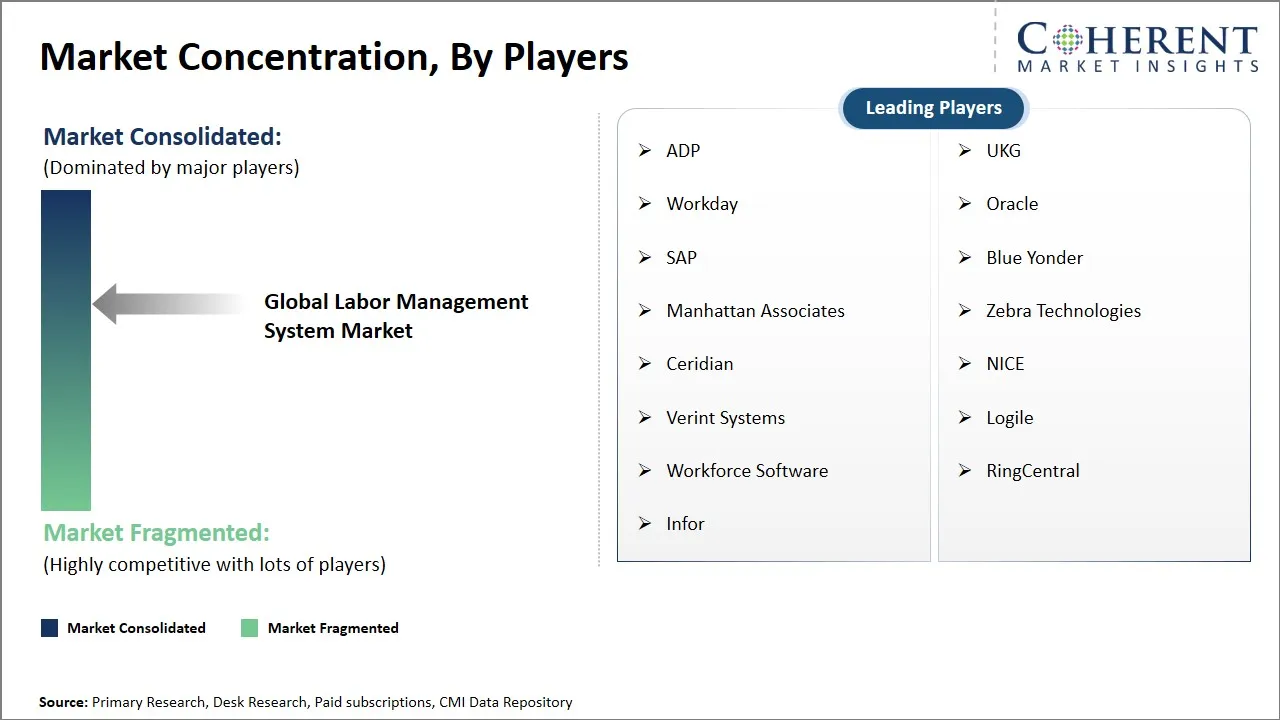
| Companies covered: | ADP, UKG, Workday, Oracle, SAP, Blue Yonder, Manhattan Associates, Zebra Technologies, Ceridian, NICE, Verint Systems, Logile, Workforce Software, RingCentral, and Infor | ||
| Growth Drivers: |
| ||
| Restraints & Challenges: |
| ||
Market Dynamics
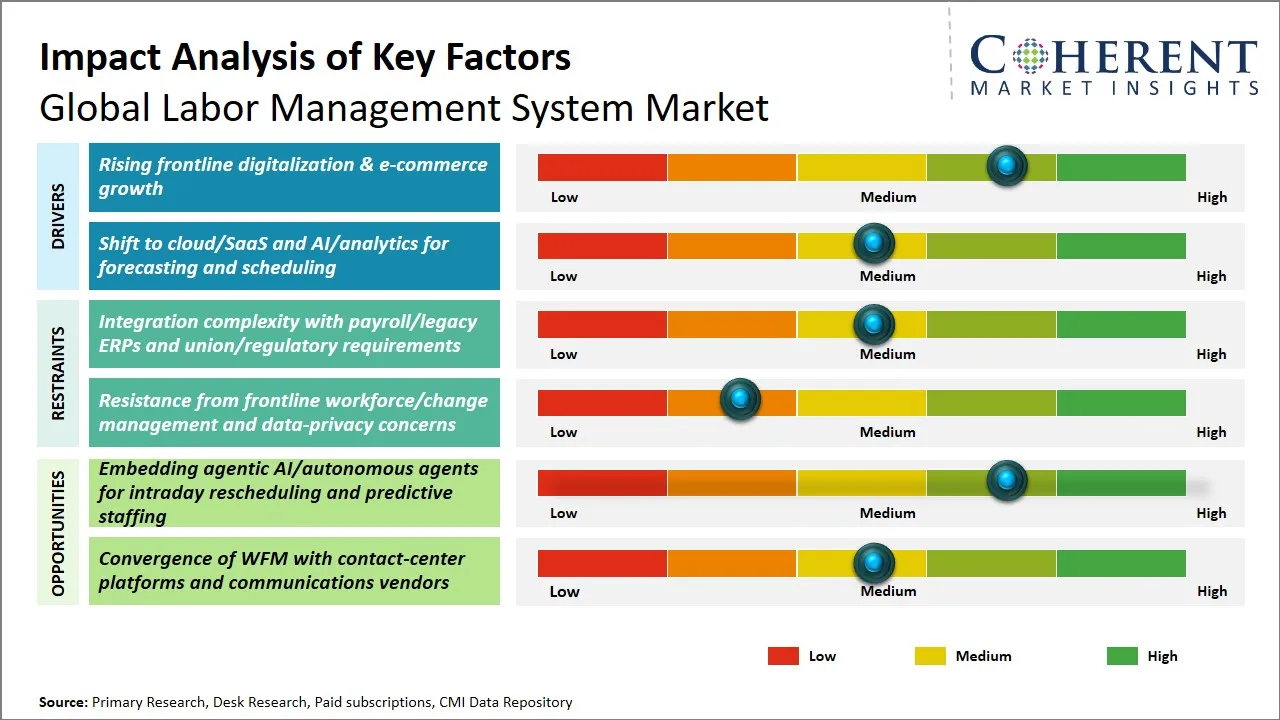
Global Labor Management System Market Driver – Rising Frontline Digitalization & E-Commerce Growth
The fast digital transformation of frontline operations, combined with the rapid expansion of e-commerce, is significantly propelling the adoption of labor management software across industries. As businesses move towards omnichannel retail and online platforms, there is a significant need to optimize workforce scheduling, productivity tracking, and labor cost management in real time.
Frontline workers, who play a big role in fulfillment centers, warehouses, and retail outlets, are now equipped with connected devices and mobile applications that make possible smooth communication and task management. This shift improves operational efficiency and makes demands for sophisticated software solutions that can handle complex labor requirements.
Global Labor Management System Market Opportunity – Embedding Agentic AI/Autonomous Agents for Intraday Rescheduling and Predictive Staffing
The integration of agentic AI and autonomous agents within the global labor management system market presents a significant growth opportunity, particularly in enhancing intraday rescheduling and predictive staffing capabilities. Traditional labor management systems depend on static scheduling based on historical data, which limits their responsiveness to real-time operational changes like sudden leaves, fluctuating demand, or unforeseen events. Embedding agentic AI makes possible dynamic, real-time decision-making by analyzing different data inputs, including workforce availability and customer traffic patterns to optimize schedules instantaneously.
Also, predictive staffing done by advanced AI models predicts labor requirements more accurately by using machine learning algorithms trained on extensive historical and contextual data. This capability reduces overstaffing and understaffing risks, directly impacting cost savings and service quality across industries such as retail, healthcare, and logistics.
Analyst Opinion (Expert Opinion)
- The use of Artificial Intelligence (AI) into LMS platforms adds a lot to its operational efficiency. AI technologies make possible automation of routine tasks such as scheduling, attendance tracking, and compliance monitoring, leading to reduced administrative overhead and minimized human errors. For instance, companies like Bausch + Lomb have put in place AI systems to predict machinery issues, improving production efficiency in their facilities.
- The emergence of AI agents is changing labor management by acting as digital assistants that can handle tasks traditionally performed by human workers. These AI agents can talk with customers, process payments, and perform other administrative duties, thereby reducing the need for human intervention in certain areas. Workday's acquisition of the AI firm Sana and its partnership with Microsoft exemplify this trend, aiming to lead in the enterprise AI agent market.
- While AI adoption in LMS platforms leads to increased efficiency, there are also concerns about job displacement. A report commissioned by Pearson warns that automation could result in a lot of earnings loss for workers, particularly in sectors like construction and manufacturing. Still, AI has the potential to make new job opportunities by adding to economic growth and making possible the development of new products and services.
Speak to the analyst
Want personalized insights?
Take the findings above to one of our principal consultants, or have the report rebuilt around the segments, geographies and competitors you actually track.
Market Segmentation
- Application Insights (Revenue, USD Bn, 2021 - 2033)
- Time & Attendance
- Scheduling & Shift Optimization
- Labor Analytics & Performance Management
- Task Management
- Others
- Regional Insights (Revenue, USD Bn, 2021 - 2033)
- North America
- U.S.
- Canada
- Latin America
- Brazil
- Argentina
- Mexico
- Rest of Latin America
- Europe
- Germany
- U.K.
- Spain
- France
- Italy
- Russia
- Rest of Europe
- Asia Pacific
- China
- India
- Japan
- Australia
- South Korea
- ASEAN
- Rest of Asia Pacific
- Middle East
- GCC Countries
- Israel
- Rest of Middle East
- Africa
- South Africa
- North Africa
- Central Africa
- North America
- Key Players Insights
- ADP
- UKG
- Workday
- Oracle
- SAP
- Blue Yonder
- Manhattan Associates
- Zebra Technologies
- Ceridian
- NICE
- Verint Systems
- Logile
- Workforce Software
- RingCentral
- Infor
Sources
Primary Research Interviews
Stakeholders
- Human Resource Managers and Payroll Specialists
- Warehouse and Logistics Operations Managers
- IT Managers overseeing Workforce Management Software deployments
- Retail and E-commerce Operations Heads
- Small & Medium Enterprise (SME) Owners using LMS solutions
- Labor Unions and Workforce Planning Consultants
- AI and Automation Experts in Human Capital Management
Databases
- U.S. Bureau of Labor Statistics (BLS)
- Eurostat Employment and Productivity Databases
- OECD Labor Market Statistics
- Global Workforce Insights Database (GWID, Proprietary)
Magazines
- Workforce Management Today
- HR Tech Outlook
- Supply Chain & Logistics Management Magazine
- AI in Enterprise Workforce Magazine
Journals
- International Journal of Human Resource Management
- Journal of Workforce Analytics and Automation
- Journal of Operations & Supply Chain Management
- Journal of Industrial Engineering and Management
Newspapers
- HR Executive Online
- The Wall Street Journal – Workforce & Technology Section
- Financial Times – Labor & Automation Insights
- The Economic Times (India) – HR & Tech Section
Associations
- Society for Human Resource Management (SHRM)
- International Labor Organization (ILO)
- American Payroll Association (APA)
- Global Workforce Management Association (GWMA)
Public Domain Sources
- U.S. Census Bureau – Labor Force Reports
- EUROSTAT – Employment and Productivity Data
- United Nations Economic Commission for Europe (UNECE) – Labor Statistics
- World Bank – Human Capital & Labor Analytics Reports
- ResearchGate – Workforce Management & Automation Publications
Proprietary Elements
- CMI Data Analytics Tool, Proprietary CMI Existing Repository of Information for the Last 8 Years
Get access to 250+ pages report
Every segment, forecast, competitor profile and data table behind the analysis above — available for instant download.
- ESOMAR Member
- ISO 9001:2015 Certified
- D-U-N-S Registered
- GDPR & CCPA Compliant
Missing comfort of reading report in your local language? Find your preferred language:
Transform your Strategy with Exclusive Trending Reports
Frequently Asked Questions
The global labor management system market is estimated to be valued at USD 5.71 billion in 2026 and is expected to reach USD 9.97 billion by 2033.
The CAGR of the global labor management system market is projected to be 8.3% from 2026 to 2033.
Rising frontline digitalization & e-commerce growth and shift to cloud/SaaS and AI/analytics for forecasting and scheduling are the major factors driving the growth of the global labor management system market.
Integration complexity with payroll/legacy ERPs and union/regulatory requirements and resistance from frontline workforce/change management and data-privacy concerns are the major factors hampering the growth of the global labor management system market.
LMS is a software solution designed to optimize workforce scheduling, attendance tracking, task management, and productivity analysis.
Retail & e-commerce, logistics & warehousing, manufacturing, healthcare, BFSI, utilities, and public sector organizations.
In terms of application, the time & attendance segment is estimated to dominate the market revenue share in 2026.