

Global Laminated Steel Market Size and Forecast – 2026 To 2033
The global laminated steel market is estimated to be valued at USD 2.21 Bn in 2026 and is expected to reach USD 3.06 Bn by 2033, exhibiting a compound annual growth rate (CAGR) of 4.8% from 2026 to 2033. Global infrastructure spending is entering an unprecedented investment cycle, with annual spending forecast to increase from US$ 4.4 trillion in 2024 to US$ 6.9 trillion by 2050. This surge supports projects in transport, power and industrial sectors — key end users of laminated steel in structural components, electrical equipment, and load‑bearing applications. (Source: pwc)
Key Takeaways of the Global Laminated Steel Market
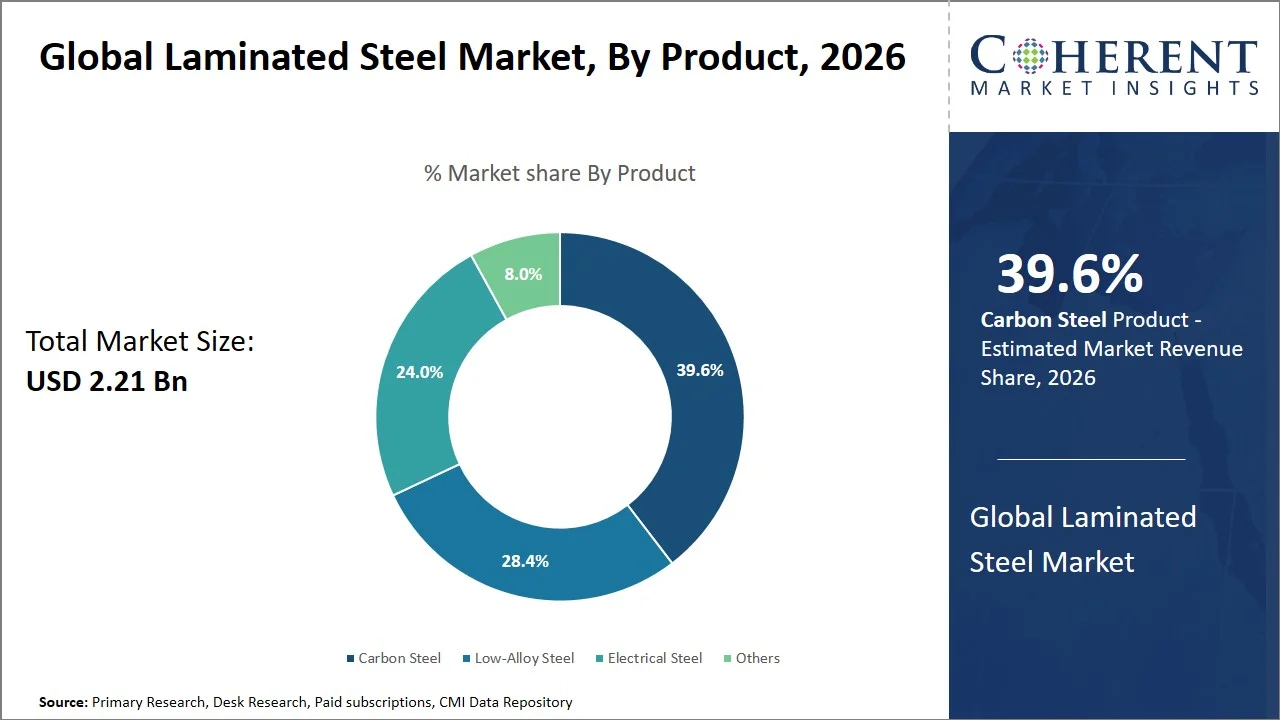
- Carbon steel is expected to hold a 39.6 % of the global laminated steel market share in 2026, owing to its structural reliability and global steel usage patterns. According to the World Steel Association (WSA), carbon (non‑alloy) steel accounted for ~84.6% of total global crude steel production in 2025, underscoring its dominant role in structural laminates (sheet and plate used in automotive, construction, machines).
- The automotive & transportation is projected to account for 39.2 % of the market share in 2026, with vehicle manufacturing playing an important role in the consumption of laminated steel owing to their high strength requirements and efficient use of resources. The total global production of automobiles was estimated to be around 96.4 million by the International Organization of Motor Vehicle Manufacturers (OICA) in 2025. (Source: OICA)
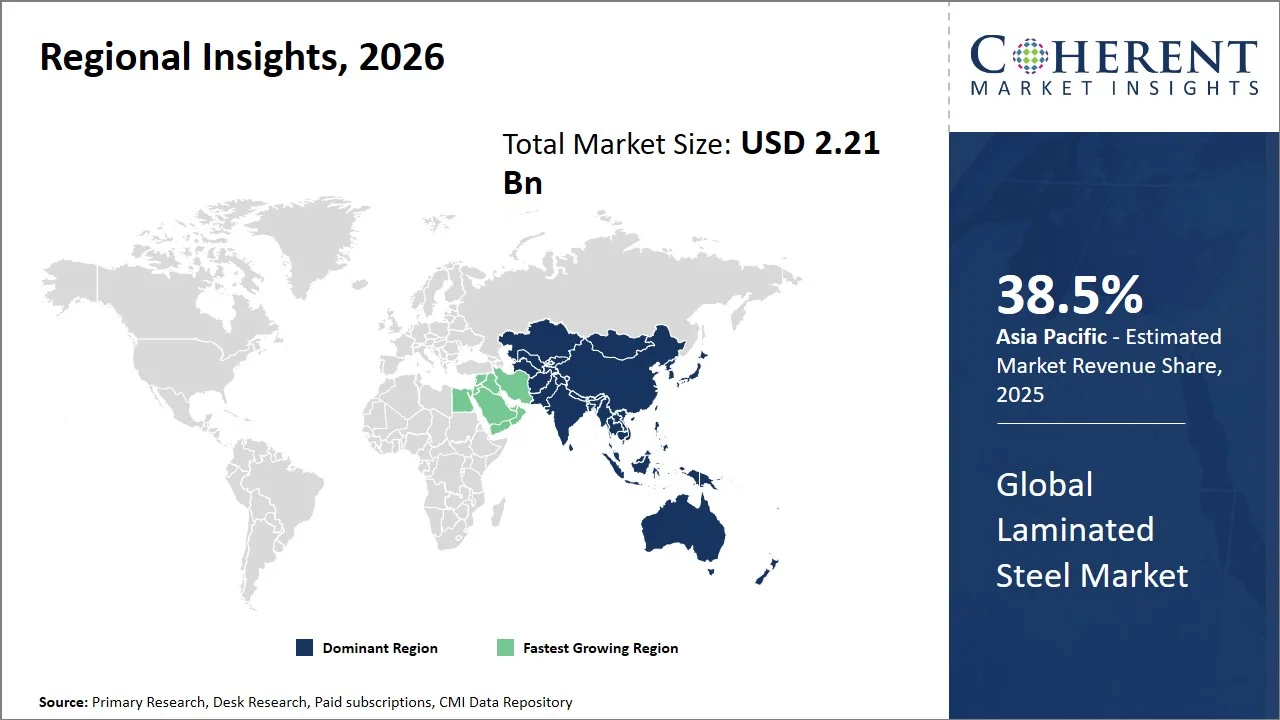
- Asia Pacific leads the global laminated steel market, accounting for an estimated 38.5 % share in 2026. Asia Pacific leads global steel consumption — a proxy for laminated steel usage — with 57% share of global crude steel production in 2025, as reported by the World Steel Association. High manufacturing volumes and rapid infrastructure build‑outs in China, India, and Southeast Asia underlie this dominance. For example, the total amount of crude steel produced by the 70 countries reporting to the World Steel Association was 139.6 million tons (Mt) in December 2025, down 3.7% from December 2024. (Source: World Steel Association)
- Middle East is the fastest growing regional market and expected to hold 14.5 % share in 2026, due to expanding steel demand profiles, supported by mega‑projects and infrastructure diversification. World Steel Association data indicates the Middle East’s finished steel consumption grew by ~6.0% in 2025, one of the highest among major regions. For example, strategic developments such as UAE’s Expo legacy infrastructure, Riyadh Metro, and NEOM (Saudi Arabia) are driving demand for structural steel laminates used in construction, transit systems, and industrial facilities.
- Sustainable Material Alignment: Laminated steel is gaining traction as manufacturers seek recyclable, corrosion-resistant, and low-maintenance materials for packaging, appliances, automotive parts, and construction applications.
- Market Expansion Catalysts: Rising demand for durable, lightweight, and aesthetically finished steel products, combined with growth in fresh food packaging, home appliances, and energy efficient materials, is supporting the expansion of the laminated steel market.
Segmental Insights
Why Does the Carbon Steel Segment Dominate the Global Laminated Steel Market?
Carbon steel is expected to hold a 39.6% of the global laminated steel market share in 2026, because of its strong mechanical properties and broad industrial usability. According to ULMA Forja, S.Coop. carbon steel is practical for industrial use because of its high wear resistance, toughness, and its highly machinable and durable properties, at a low cost.
The application is also particularly common in the construction industry, automotive sector, pipes and tubes, machinery components, fasteners, and railway related applications, demonstrating the performance that translates to real world demand. Owing to its mechanical properties, it is one of the most used and versatile materials around the globe, particularly in industry and engineering. The range of carbon content is 0.08% to 1.40%, depending upon the type of steel. (ULMA Forja, S.Coop.)
- Current Industry Events of 2026
- Market Size Estimation
- Regional Breakdown
- Competitive Landscape
- Customer Intelligence
- Segmental Analysis
- Pricing Analysis
- Key Market Drivers, Challenges & Future Trends
- Customized Insights Section
Automotive & Transportation Segment Dominates the Global Laminated Steel Market
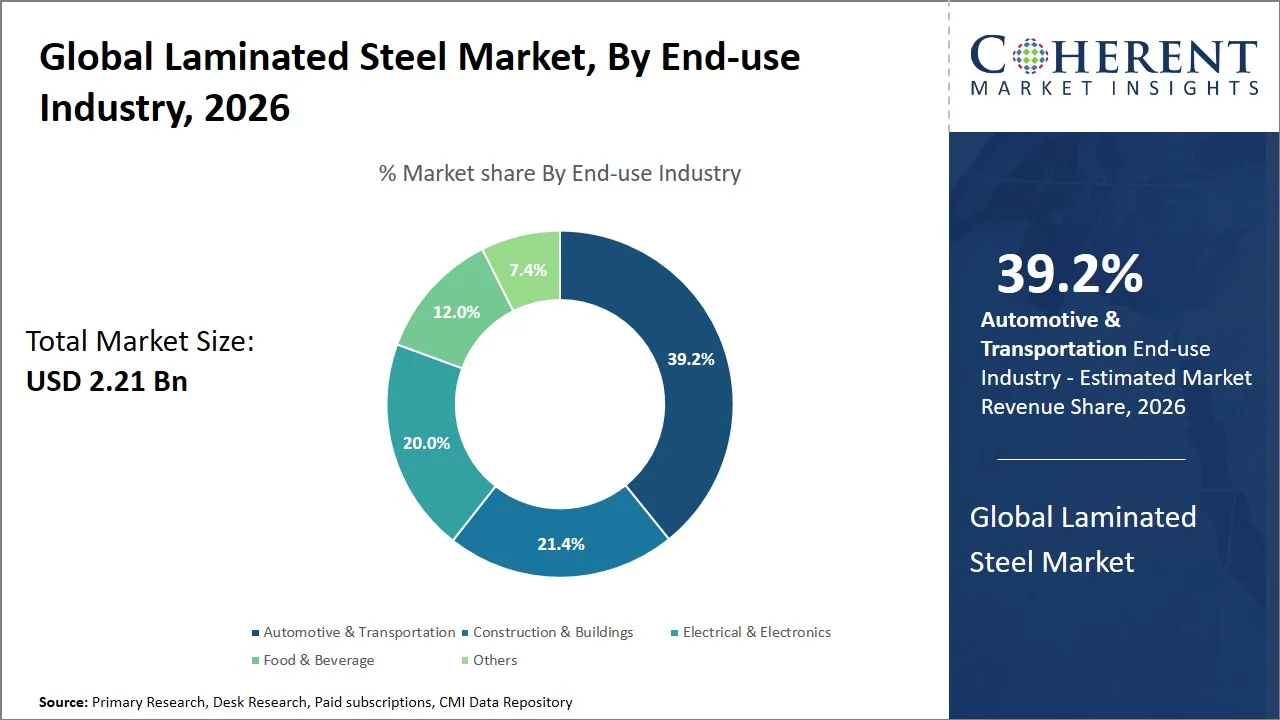
The automotive & transportation segment is expected to account for 39.2% of the global laminated steel market share in 2026. The segment growth is driven by the automotive industry’s increasing use of lightweight, durable, and high-strength materials to improve fuel efficiency, reduce emissions, and meet safety performance standards. Laminated steel is used in automotive body panels, chassis components, structural parts, and other vehicle applications where strength, corrosion resistance, surface protection, and weight optimization are important. Its ability to reduce vehicle weight without compromising durability or crashworthiness makes it suitable for modern vehicle manufacturing. For instance, automotive steel suppliers such as Kenwal support lightweight steel applications that help automakers improve vehicle performance while maintaining structural safety. (Source: Kenwal)
Currents Events and their Impact
Current Events | Description and its Impact |
Rapid Expansion of EV Manufacturing in Asia Pacific |
|
India Electronics Manufacturing Expansion |
|
(Source: pib.gov)
Global Laminated Steel Market Dynamics
Market Driver
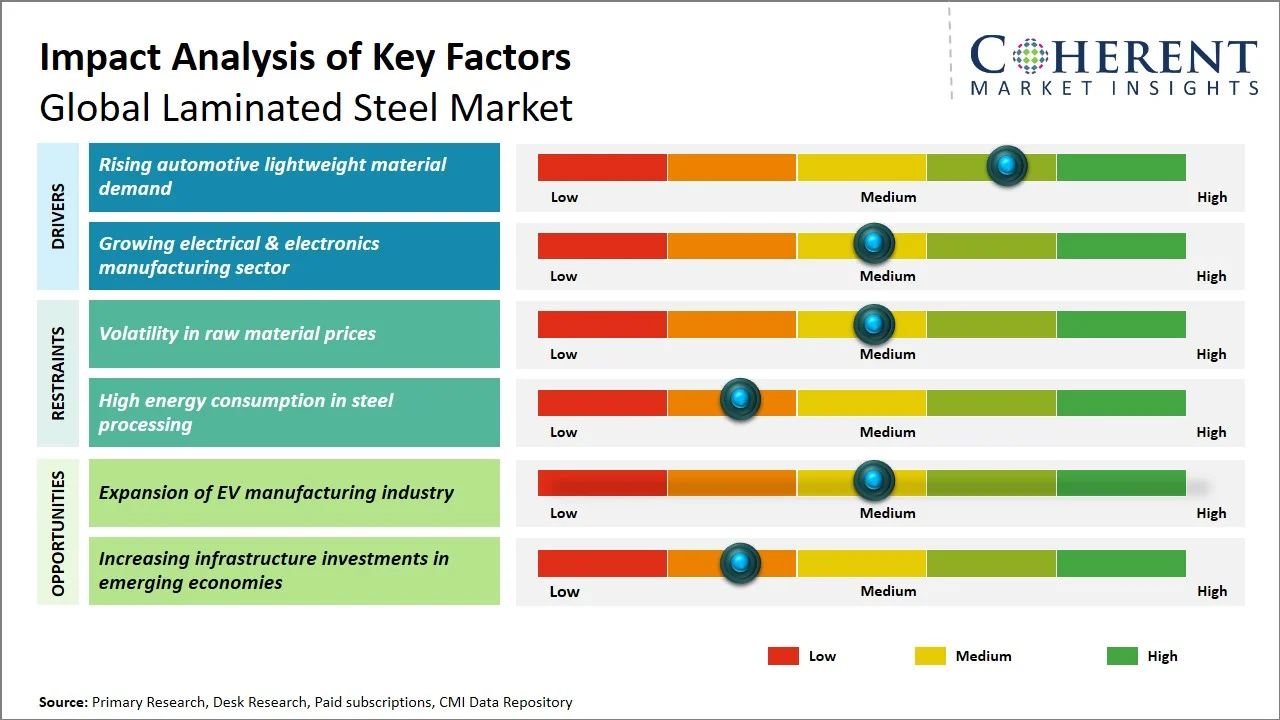
Rising automotive lightweight material demand
The automotive industry’s increasing focus on fuel efficiency and stringent emission regulations globally are driving the demand for lightweight materials, significantly benefiting the laminated steel market. Automakers are actively looking for ways to cut the weight of their vehicles, while maintaining the same level of safety, durability and performance, and laminated steel has an attractive strength-to-weight ratio and improved crashworthiness. Apart from helping to comply with the regulations, laminated steel also contributes to improved vehicle efficiency by decreasing the weight of the vehicle, directly resulting in better fuel economy and CO2 emissions.
For example, Toyota’s use of high‑strength and laminated structural steels in the Toyota Prius and Toyota RAV4 Hybrid platforms has enabled significant weight reduction in the body‑in‑white (BIW) while maintaining crash safety performance. This contributes to improved fuel economy and lower emissions without compromising vehicle rigidity and occupant protection. (Source: Toyota)
Growing electrical & electronics manufacturing sector
The growth of the electrical & electronics manufacturing component industry in India and South East Asia is expected to become a key demand driver for the laminated steel industry. The corrosion resistance, decorative finish, scratch resistance and ease of fabrication characteristics give laminated steel a wide range of applications including in refrigerators, washing machines, microwave ovens, electrical cabinets, air-conditioning systems, telecom equipment and consumer electronics.
With programs like “Make in India” and the Production Linked Incentive (PLI) scheme, India is emerging as one of the biggest electronics manufacturing centers in the world. The Ministry of Electronics & IT reported that the electronics production of India went up from approximately ~USD 24.7 billion (₹1.9 lakh crore) in 2014–2015 to nearly ~USD 156.4 billion (₹12 lakh crore) in 2024–2025, while electronics exports rose by almost eightfold in the same period. The growth in mobile phone manufacturing is from ~USD 2.35 billion (₹18,000 crore) to ~USD 71.0 billion (₹5.45 lakh crore) in the past ten years. (ibef.org)
Emerging Trends
- Shift Towards High Performance & Functional Laminated Steel: Laminated steel is transforming from a traditional protective material to a high-performance engineered material with superior properties such as corrosion resistance, fire protection, acoustic properties, anti-bacterial properties and decorative finishes. Multifunctional laminates are gaining traction in various sectors, from construction to automotive, appliances and industrial use, where longevity, visual appeal and the life cycle are key considerations for end users.
- Increased Laminated Steel Panel and Coated Structural Parts Adoption in Modular and Pre-Engineered Construction: The use of laminated steel panels and coated structural parts are growing rapidly in modular construction, prefabricated buildings and pre-engineered infrastructure. In the realm of factory-fabricated systems, laminated steel is an attractive choice because it is lightweight, easy to install, and durable, making it a suitable option for contemporary urban development and industrial applications.
Regional Insights
Why is Asia Pacific a Strong Market for Laminated Steel?
Asia Pacific leads the global laminated steel market, accounting for an estimated 38.5% share in 2026, as the region has high demand for the market owing to infrastructural development and industrial growth. Carbon steel lamination continues to be the biggest market, driven by robust demand in the automotive and construction industries in China, India and ASEAN.
For example, India’s rapid expansion of electric vehicle manufacturing has led to rising use of laminated high‑strength steels in battery enclosures and lightweight structural parts, with OEMs such as Tata Motors and Mahindra & Mahindra scaling laminated steel usage to meet safety and weight‑optimization targets in models like the Tata Nexon EV.
Why Does Middle East Laminated Steel Market Exhibit Fastest Growth?
Middle East exhibits the fastest growth in the laminated steel market accounting for 14.5% share in 2026, fueled by rapid infrastructure development, urban expansion, and increasing industrial activities. Economic diversification in the region, especially in the UAE, Saudi Arabia and other GCC countries, has resulted in significant investment in the construction, automotive, energy and other sectors, where laminated steel products are required.
The market growth is fueled by a sustained demand for steel products such as laminated/advanced steel materials used in the construction and structural applications that are being generated by projects under the umbrella of Saudi Vision 2030, which includes NEOM, the Red Sea Project, and Riyadh Metro.
Global Laminated Steel Market Outlook for Key Countries
Why is China the Largest Laminated Steel Market in Asia Pacific?
China is still the biggest laminated steel market due to the significant expansion of the country's industrial and electrical infrastructure. Asia Pacific laminated steel market is expected to account for ~45% of global consumption, with China's laminated steel demand expected to surge because of its huge transformer and electric motor manufacturing industry. Significant increase in transformer production and high-grade electrical steel demand in terms of power and renewable infrastructure development projects led by the government (e.g., targeted 450 GW renewable capacity to be achieved by 2030).
Japan Laminated Steel Market Driven by Industrial & Electrical Steel R&D
The demand for laminated steel in Japan is expected to stay stable because of the country's strong manufacturing capability and energy conservation focus on electrical equipment. The finished steel consumption in Japan in 2023 is ~57.2 million tons, with the notable characteristics of steel use in industry and electricity generation, such as laminated electrical steels in motors and transformers. The Ministry of Economy, Trade and Industry (METI) of Japan is also promoting the R&D of next‐generation electrical steel in the context of strategic innovation programs to increase transformer and motor efficiencies for the 2025 initiatives. (Source: Nippon Steel)
How is India’s Energy Transition Driving Laminated Steel Demand?
The energy transition in the country is a key driver for the growth of laminated steel usage in electrical and industrial applications in India. The Government of India made another giant leap in reducing total electricity capacity, pushing over 500GW of capacity, of which over 50% came from non-fossil and renewable, with the scale of T&D infrastructure expansion as a result. The higher the demand for renewable energy targets (500 GW by 2030), the more electrical steel laminations are needed for transformers and motors in the domestic grid. (Source: Pib.gov)
Why is the U.S. Leading Innovation and Adoption in the Laminated Steel Market?
The U.S. laminated steel market is diverse and is split between automotive, construction, and energy applications. National grid modernization and electrification requirements are a strong driver on U.S. laminated and electrical steel consumption. In 2023, the U.S. Department of Energy (DOE) allocated ~US$ 3.46 billion through various federal grid resilience initiatives for transmission upgrades and smart grid resilience, which is a critical component to supporting transformer and electrical equipment deployment – all of which rely on laminated electrical steel cores. (Source: Mercom Capital Group)
Weight & Durability Comparison: Laminated Steel vs Traditional Metals
Property / Metric | Laminated Steel (Base Steel) | Stainless Steel |
Density (g/cm³) | ~7.8 (base steel) | ~7.8–8.0 |
Tensile Strength (approx.) | 250–550 MPa (steel basis) | 505–750 MPa |
Yield Strength | ~200–450 MPa | ~210–515 MPa |
How is the rising demand from the electric vehicle manufacturing industry creating new growth opportunities in the global laminated steel market?
The rapid growth of the electric vehicle (EV) manufacturing industry presents a significant opportunity for the laminated steel market globally. As manufacturers increasingly focus on sustainable transport solutions, there is heightened demand for materials that are strong, durable, and lightweight. Laminated steel offers high strength and safety characteristics, making it ideal for EV applications. By reducing vehicle weight, laminated steel also improves battery efficiency and lifespan. Stringent government carbon emission regulations further accelerate EV adoption, indirectly boosting laminated steel demand.
For example, Tesla’s Model 3 and Model Y production lines use high-strength laminated steels in structural components such as battery enclosures and chassis frames. This material choice allows for weight reduction while maintaining crash safety, directly enhancing vehicle range and battery performance. (Source: tesla.com)
Market Players, Key Development, and Competitive Intelligence
Key Development
- In February 2025, ArcelorMittal announced its plans to construct a new, world-class electrical steel manufacturing facility in Calvert, Alabama. This wholly owned facility will produce up to 150,000 metric tons of non-oriented electrical steel (NOES) annually, catering to the automotive and mobility industries, renewable energy production, and other commercial and industrial applications.
Competitive Landscape
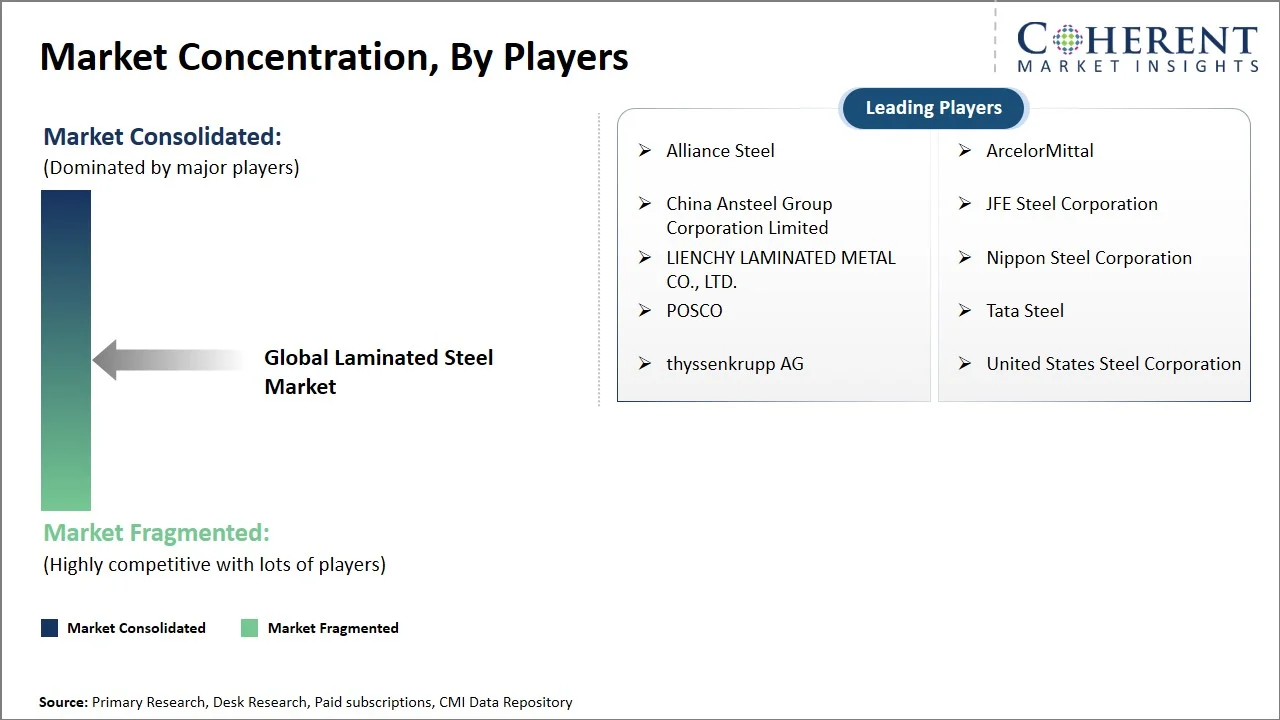
The laminated steel market is moderately consolidated with a large number of players competing in the market owing to the growing demand of the market from the various sectors including construction, automotive, appliances, packaging and industrial manufacturing. Large, integrated steel producers are competing in terms of production scale, advanced coating/lamination technology and long-term OEM relationships, while regional processors and specialized manufacturers are competing in terms of customization, application-specific solutions and price flexibility. The following are key focus areas:
- Laminated steel solutions that are high performance, corrosion resistant and light weight.
- Advanced surface finishes and fireproof, acoustics, anti-bacterial and decorative lamination for product diversification.
- Opportunities in building materials, material systems and applications in the field of EV components, modular construction and pre-engineered buildings
Market Report Scope
Laminated Steel Market Report Coverage
| Report Coverage | Details | ||
|---|---|---|---|
| Base Year: | 2025 | Market Size in 2026: | USD 2.21 Bn |
| Historical Data for: | 2020 To 2024 | Forecast Period: | 2026 To 2033 |
| Forecast Period 2026 to 2033 CAGR: | 4.8% | 2033 Value Projection: | USD 3.06 Bn |
| Geographies covered: |
| ||
| Segments covered: |
| ||
| Companies covered: | Alliance Steel, ArcelorMittal, China Ansteel Group Corporation Limited, JFE Steel Corporation, LIENCHY LAMINATED METAL CO., LTD., Nippon Steel Corporation, POSCO, Tata Steel, thyssenkrupp AG, and United States Steel Corporation | ||
| Growth Drivers: |
| ||
| Restraints & Challenges: |
| ||
Analyst Opinion (Expert Opinion)
- The laminated steel industry is undergoing a structural shift from commodity processing industry to performance-engineered materials markets. Historically, cost effective corrosion protection and decorative options such as in appliances, packaging and construction have driven the demand. Moving forward, there is increasing demand for multi-functional performance like lightweight, durable, thermal resistant, acoustical, sustainable and design flexibility. Laminated steel is anticipated to become more strategic as it has the strength of steel and surface functionality of polymers that allows its use to replace heavier coated metals, plastics and composite materials in certain applications.
- Three macro trends—electrification, urban infrastructure modernization, and industrial sustainability requirements—will have a significant influence on the industry's future. Demand for materials that provide better surface protection, reduced maintenance costs, and better lifecycle performance is driving the adoption of electric vehicles, modular construction, energy-efficient appliances and pre-engineered buildings. The laminated steel is a good fit for the job because it allows the manufacturer to deliver a corrosion resistant and aesthetically pleasing finish, while requiring minimal processing down the stream. Meanwhile, new environmental standards for volatiles and carbon emissions in the production process will drive the transition to more sophisticated laminated and pre-finished steel options, which will cut painting time and solvent consumption, as well as fabricator wastes.
- The region will be the region of opportunity in the future but all opportunities will not be equal in Asia Pacific. India is the most underpenetrated market for construction-grade and appliance-grade laminated steel. The growth of cities, the infrastructure development projects undertaken by the government, the increasing use of prefabricated buildings and the manufacturing of domestic appliances are creating a huge future demand base.
Speak to the analyst
Want personalized insights?
Take the findings above to one of our principal consultants, or have the report rebuilt around the segments, geographies and competitors you actually track.
Market Segmentation
- Product Insights (Revenue, USD Bn, 2021 - 2033)
- Carbon Steel
- Low-Alloy Steel
- Electrical Steel
- Others
- End-use Industry Insights (Revenue, USD Bn, 2021 - 2033)
- Automotive & Transportation
- Construction & Buildings
- Electrical & Electronics
- Food & Beverage
- Others
- Regional Insights (Revenue, USD Bn, 2021 - 2033)
- North America
- U.S.
- Canada
- Latin America
- Brazil
- Argentina
- Mexico
- Rest of Latin America
- Europe
- Germany
- U.K.
- Spain
- France
- Italy
- Russia
- Rest of Europe
- Asia Pacific
- China
- India
- Japan
- Australia
- South Korea
- ASEAN
- Rest of Asia Pacific
- Middle East
- GCC Countries
- Israel
- Rest of Middle East
- Africa
- South Africa
- North Africa
- Central Africa
- North America
- Key Players Insights
- Alliance Steel
- ArcelorMittal
- China Ansteel Group Corporation Limited
- JFE Steel Corporation
- LIENCHY LAMINATED METAL CO., LTD.
- Nippon Steel Corporation
- POSCO
- Tata Steel
- thyssenkrupp AG
- United States Steel Corporation
Sources
Primary Research Interviews
- Laminated steel manufacturer
- Supply Chain Director of flat steel processing company
- Technical Director of coated and laminated metals producer
- Sustainability Officer of steel packaging/materials company
Stakeholders
- Manufacturers of Laminated Steel Products
- End-use Sectors
- Automotive Manufacturers
- Construction & Infrastructure Companies
- Appliance Manufacturers
- Packaging & Industrial Equipment Producers
- Regulatory & Certification Bodies: World Steel Association, ASTM International, and International Organization for Standardization
- Technology Integration Players: SSAB, voestalpine AG
Databases
- UN Comtrade Database (HS Codes related to flat-rolled and laminated steel products)
- Eurostat Trade Statistics for Iron & Steel Products
- USITC DataWeb for steel imports and exports
- OECD Steel Market Developments Reports
- World Steel Association Statistical Yearbook
- India Import Export (EXIM) Database
Magazines
- Steel Times International – Laminated steel demand and production trends
- Metal Bulletin – Steel pricing and supply chain updates
- American Metal Market – Trade and pricing intelligence
- Construction World – Steel usage in infrastructure
- Industrial Heating – Lamination and coating technologies
Journals
- Journal of Materials Processing Technology – Steel lamination technologies
- Materials Science and Engineering – Mechanical performance of laminated steel
- Construction and Building Materials – Structural applications of steel laminates
- Surface and Coatings Technology – Corrosion resistance and coating innovations
- Ironmaking & Steelmaking – Steel production and processing methods
Newspapers
- The Wall Street Journal – Steel demand and industrial activity
- Financial Times – Global steel trade developments
- Business Standard – Indian steel sector growth
- Nikkei Asia – Asia Pacific steel manufacturing trends
Associations
- World Steel Association
- American Iron and Steel Institute
- European Steel Association
- Steel Manufacturers Association
Public Domain Sources
- World Steel Association – Global crude steel production reports
- OECD – Steel market outlook and sustainability reports
- US Geological Survey (USGS) – Mineral commodity summaries for iron and steel
- International Energy Agency (IEA) – Industrial decarbonization and steel sector insights
- European Commission – Trade and anti-dumping regulations for steel products
- International Trade Administration (ITA) – Steel import monitoring reports
Proprietary Elements
- CMI Data Analytics Tool, Proprietary CMI Existing Repository of information for last 10 years.
Get access to 250+ pages report
Every segment, forecast, competitor profile and data table behind the analysis above — available for instant download.
- ESOMAR Member
- ISO 9001:2015 Certified
- D-U-N-S Registered
- GDPR & CCPA Compliant
Missing comfort of reading report in your local language? Find your preferred language:
Transform your Strategy with Exclusive Trending Reports
Frequently Asked Questions
The global laminated steel market is estimated to be valued at USD 2.21 Bn in 2026 and is expected to reach USD 3.06 Bn by 2033.
Laminated steel is a type of steel formed by bonding multiple layers together, often with insulation or polymer layers, to improve electrical, mechanical, and thermal performance. It is widely used in motors, transformers, automotive components, and construction applications.
The CAGR of global laminated steel market is projected to be 4.8% from 2026 to 2033.
Laminated steel improves motor efficiency, reducing power loss in EV traction motors.
Rising automotive lightweight material demand and growing electrical & electronics manufacturing sector are the major factors driving the growth of the global laminated steel market.
Volatility in raw material prices and high energy consumption in steel processing are the major factors hampering the growth of the global laminated steel market.
In terms of product, carbon steel is estimated to dominate the market revenue share in 2026.