

Latin America Spine Implants Market Size and Forecast – 2026 to 2033
The Latin America spine implants market is estimated to be valued at USD 785.7 Mn in 2026 and is expected to reach USD 996.1 Mn by 2033, exhibiting a compound annual growth rate (CAGR) of 4.8% from 2026 to 2033. This steady growth reflects increasing investments in healthcare infrastructure and rising prevalence of spine-related disorders across the region. The expanding aging population and technological advancements in implant materials and design are also key factors driving market expansion during this period.
Key Takeaways of the Latin America Spine Implants Market
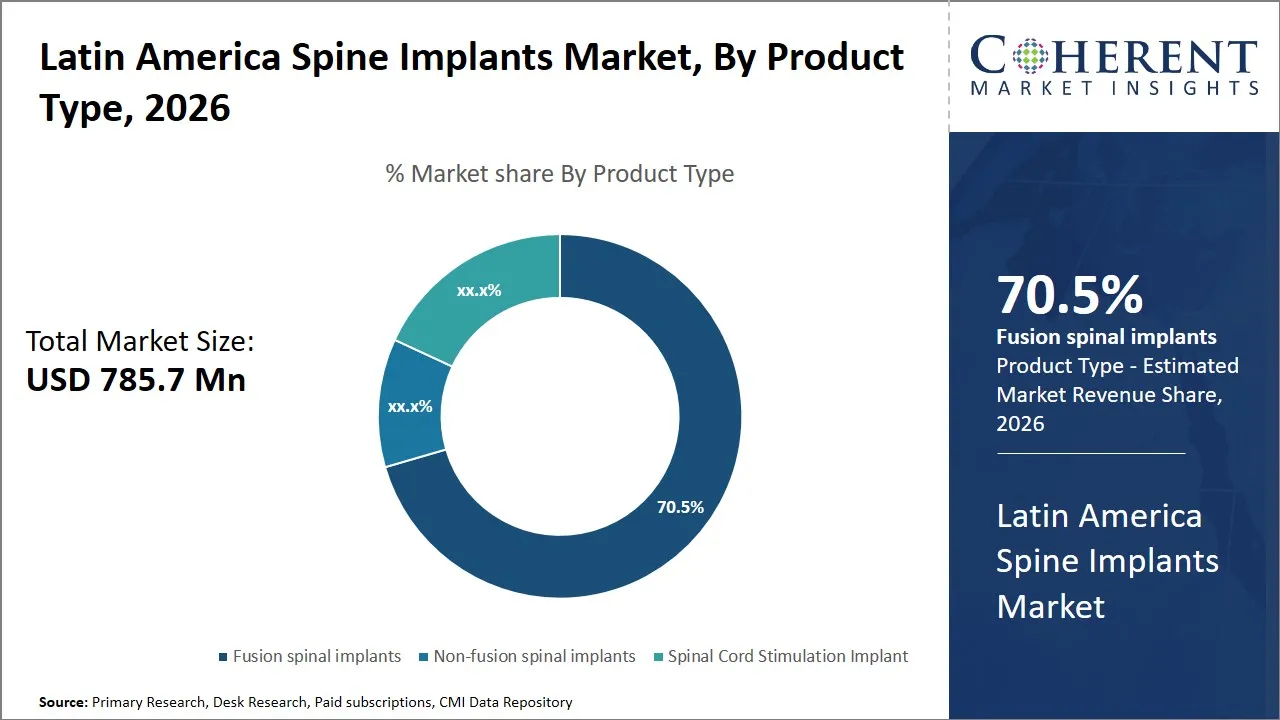
- Fusion spinal implants segment is expected to lead the Latin America spine implants market, capturing 70.5% share in 2026.
- Titanium segment is estimated to represent 41.7% of the Latin America spine implants market share in 2026.
- Open surgery segment is projected to dominate with 59.3% of the Latin America spine implants market share in 2026.
Market Overview
- The Latin America spine implants market is a developing but steadily expanding market, supported by rising demand for spinal procedures and broader adoption of implant-based treatment across key countries such as Brazil and Mexico.
- Growth is being driven mainly by an aging population, increasing incidence of degenerative spine disorders, and stronger clinical demand for surgical intervention in chronic back and spinal instability cases.
- Minimally invasive spine procedures are gaining traction across the region, creating higher demand for advanced cages, fixation systems, and procedure-specific implant technologies.
- Market expansion is also being supported by improving reimbursement in some markets and rising private healthcare investment, although access remains uneven across public and private systems.
Currents Events and their Impact
Current Events | Description and its Impact |
Regional rollout of new spinal correction and fixation systems across Latin America |
|
Stronger surgeon education and distributor-led market development in Latin America |
|
Segmental Insights
- Current Industry Events of 2026
- Market Size Estimation
- Regional Breakdown
- Competitive Landscape
- Customer Intelligence
- Segmental Analysis
- Pricing Analysis
- Key Market Drivers, Challenges & Future Trends
- Customized Insights Section
Why Does the Fusion Spinal Implants Segment Dominate the Latin America Spine Implants Market in 2026?
The fusion spinal implants segment is expected to hold the largest market share of 70.5% in 2026, due to their established role in stabilizing the spine and treating a broad spectrum of spinal disorders. Fusion spinal implants are meant to support the growth of bones amongst the vertebrae thus permanently stabilizing the spine in the degenerative disc disease, spinal fractures, scoliosis deformity, and chronic back pain. Demand of fusion implants is inspired by the high rates of such disorders in the region, which are caused by aging, the increase in the incidence of trauma and degenerative diseases.
The strength and durability of the fusion techniques is one of the main forces that have contributed to the dominance of the segment. The fusion implants also have longer history of use in clinical practice compared to some non-fusion alternatives and hence more surgeon confidence and patient acceptance. In Latin America, surgeons prefer the fusion forms of implantation due to positive results that are predictable, performance in stabilization of the spinal parts, pain relief and restoration of functions, which is a very important aspect in the complex operations.
For instance, on January 3, 2026, Spineway announced the commercial launch of its Twin Peaks range in Colombia, a line that includes spinal fusion implants aimed at treating severe spine disorders. This is a relevant example of the fusion spinal implants segment in Latin America, as it shows continued regional rollout of fusion-focused implant systems through local distributor expansion.
(Source- Spineway)
Why Does the Titanium Segment Dominate the Latin America Spine Implants Market in 2026?
The titanium segment is expected to hold 41.7% of the market share in 2026, can be attributed to titanium’s unique combination of mechanical strength, corrosion resistance, and biocompatibility. These attributes ensure that titanium is the material of choice to spinal implant manufacturers and even the surgeons in this region where the safety and longevity of the implant are the main concerns.
The resistance to the corrosion of the body in titanium provides a stability to the structure of the implant thus reducing the chances of the implant to fail or the patient has to undergo revision surgeries. Secondly, titanium interacts with MRI imaging, a vital instrument in the postoperative spinal observation, which makes it more useful as it can be assessed in detail without interference.
The Open Surgery Segment Dominates the Latin America Spine Implants Market
The open surgery segment is expected to hold the largest market share of 59.3% in 2026, supported by its suitability for a wide range of spinal conditions, particularly complex and multi-level deformities. Although the use of Minimally Invasive Surgery (MIS) is increasingly becoming common, open surgery is still the ideal one in Latin America because of the clinical preference and the infrastructural factors.
The capability to provide a complete access to the spinal anatomy is one of the main growth driving factors that open surgery provides especially in massive fusion surgeries, deformity repairs and revision surgery. The open surgeries allow the surgeon to have a firsthand view of the location and manipulate the spine easily so they can treat the complex morbidities of the spinal structures. This specifically applies to the cases of severe spinal instability or trauma, which are typical in Latin America.
Total Spinal Surgeries Including Fusion and MIS in the Latin America Spine Implants Market
Metric | Description | Market Relevance | Expected Impact on Latin America Spine Implants Market |
Total Spinal Surgeries | Refers to the overall number of spinal procedures performed across Latin America, including both fusion surgeries and minimally invasive spine procedures | Serves as a core demand indicator for spine implants, as higher procedure volumes directly support implant consumption | Rising total spinal surgeries indicate stronger demand for pedicle screw systems, cages, rods, plates, and other fixation implants |
Fusion Surgeries | Includes spinal procedures involving permanent joining of vertebrae, commonly used in degenerative disc disease, deformity correction, trauma, and instability cases | Fusion surgeries are a major revenue contributor because they require multiple implant components and higher procedural complexity | Growth in fusion procedures supports demand for high-value implant systems and benefits manufacturers with broad fusion portfolios |
Minimally Invasive Spine Surgeries | Includes less invasive spinal procedures using smaller incisions, specialized instruments, and faster recovery approaches | Reflects technology adoption and surgeon preference shift toward lower hospital stay and reduced recovery time | Increasing MIS volumes create opportunities for companies offering advanced implants, navigation-compatible systems, and procedure-specific devices |
Market Players, Key Developments, and Competitive Intelligence
Key Developments
- On January 6, 2026, VB Spine completed the acquisition of Stryker’s spinal implant manufacturing facility in Cestas, France, adding the site’s employees, infrastructure, and manufacturing processes to strengthen its global spine production platform. The company said the facility would play a central role in its worldwide manufacturing strategy and support expanded medical education and training activities in Europe.
- In November 2025, Zavation Medical Products, LLC announced the release of its next-generation NanoPrime Labyrinth Cervical Interbody implant, integrating NanoPrime titanium ion bond technology with its proprietary Labyrinth porous PEEK structure. The implant is designed to combine the mechanical strength and imaging advantages of PEEK with the biological benefits of titanium, supporting improved bone integration and spinal fusion outcomes.
- In February 2025, CG MedTech said it was strengthening its Latin America expansion and planned to launch new posterior fixation solutions across North and South America in 2025, while entering four new regional markets including Puerto Rico and the Dominican Republic. That is a direct growth signal for spine implants across the broader Latin American footprint.
Reimbursement Scenario for the Latin America Spine Implants Market
- Reimbursement Coverage - Public reimbursement in Latin America is still unequal, and access to it differs greatly across countries and between the public and private care systems. Improved reimbursement is one of the growth support indicators suggested by market outlook sources, and research in Brazil has also revealed that obstacles associated with insurers may continue to obstruct or limit access to spine procedures.
- Out-of-Pocket Costs - The out-of-pocket spending continues to be a significant limitation in the area, particularly in cases where private coverage is not readily available or the accessibility to public coverage is postponed. OECD statistics on Latin America and the Caribbean provide a continuing dependence on direct household health expenditures, whereas Mexico-specific reporting indicates that patient-paid high costs continue to cause a barrier to spine care access and procedure uptake.
Top Strategies Followed by Latin America Spine Implants Market Players
Player Type | Strategic Focus | Examples |
Established Market Leaders | Established players stay ahead by investing in R&D, launching advanced implant systems, and using partnerships and broad distribution networks to deepen their reach across Latin America. Their edge comes from stronger clinical credibility, surgeon relationships, and the ability to scale faster in high-growth markets. | DePuy Synthes, part of Johnson & Johnson MedTech, fits this well. In August 2024, it launched the VELYS Active Robotic-Assisted System for spine surgery, strengthening its advanced spine technology portfolio, and it benefits from Johnson & Johnson’s broad surgeon relationships, clinical credibility, and international distribution reach, which supports deeper penetration across growth markets including Latin America. |
Mid-Level Players | Mid-level players compete by offering reliable spine implants at more affordable price points, which helps them fit the budget realities of many Latin American hospitals and clinics. They usually strengthen their position through distributor partnerships, surgeon training, and tighter supply-chain execution rather than trying to outspend the biggest global brands. | In July 2024, the Spineway company used the SILACO Congress in Mexico to work closely with its Latin American distributors and expand visibility for its spine portfolio in the region, showing how a mid-sized player can grow through partnerships and targeted regional commercialization. |
Small-Scale Players | Small-scale players carve out space by focusing on niche spine implant products, faster product adaptation, and local clinical needs that bigger companies often overlook. Their advantage is speed and flexibility, especially when they work with regional hospitals, surgeons, or local manufacturing partners to build visibility in targeted markets. | American Implant is a strong example from Argentina. Recent industry reporting described it as one of the clearest local spine manufacturers in the country, with dedicated production capacity for pedicle screws, facet screws, and interbody cages, showing how a smaller player can compete through focused manufacturing and a specialized spine portfolio rather than broad multinational scale. |
Market Report Scope
Latin America Spine Implants Market Report Coverage
| Report Coverage | Details | ||
|---|---|---|---|
| Base Year: | 2025 | Market Size in 2026: | USD 785.7 Mn |
| Historical Data for: | 2020 To 2024 | Forecast Period: | 2026 To 2033 |
| Forecast Period 2026 to 2033 CAGR: | 4.8% | 2033 Value Projection: | USD 996.1 Mn |
| Segments covered: |
| ||
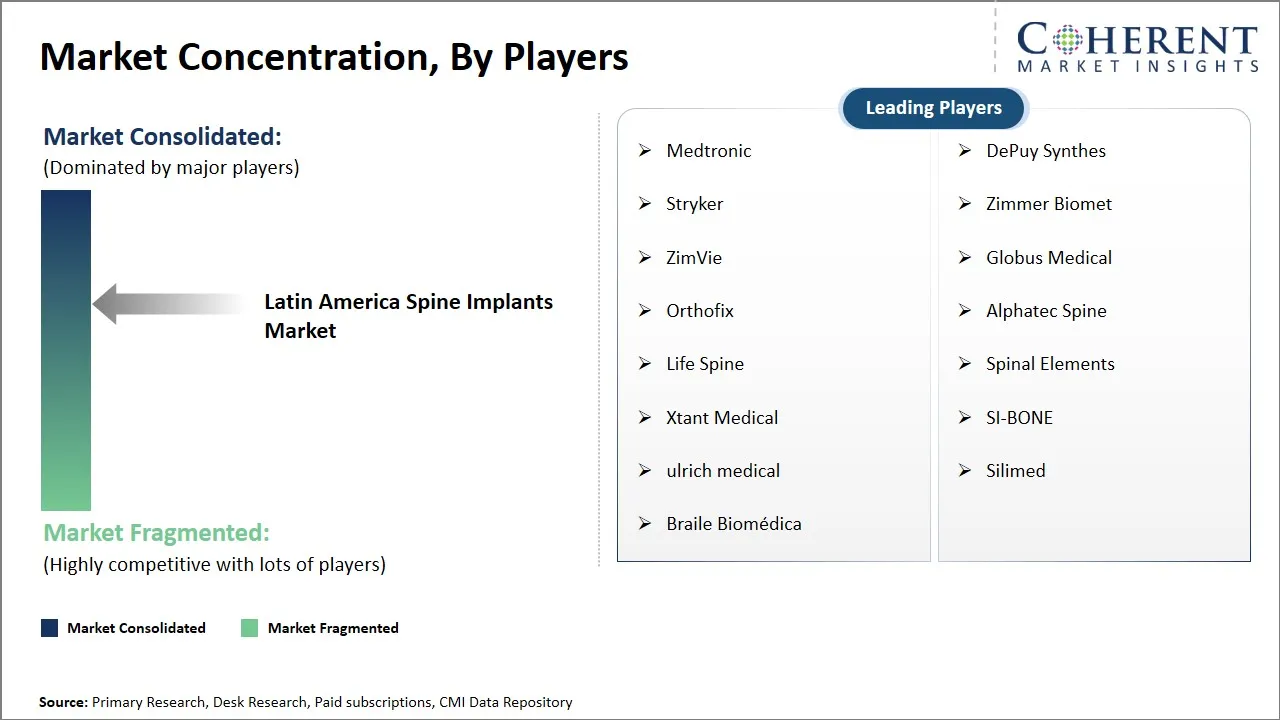
| Companies covered: | Medtronic, DePuy Synthes, Stryker, Zimmer Biomet, ZimVie, Globus Medical, Orthofix, Alphatec Spine, Life Spine, Spinal Elements, Xtant Medical, SI-BONE, ulrich medical, Silimed, and Braile Biomédica | ||
| Growth Drivers: |
| ||
| Restraints & Challenges: |
| ||
Latin America Spine Implants Market Dynamics
Latin America Spine Implants Market Driver - Rising Incidence of Degenerative Spine Disorders
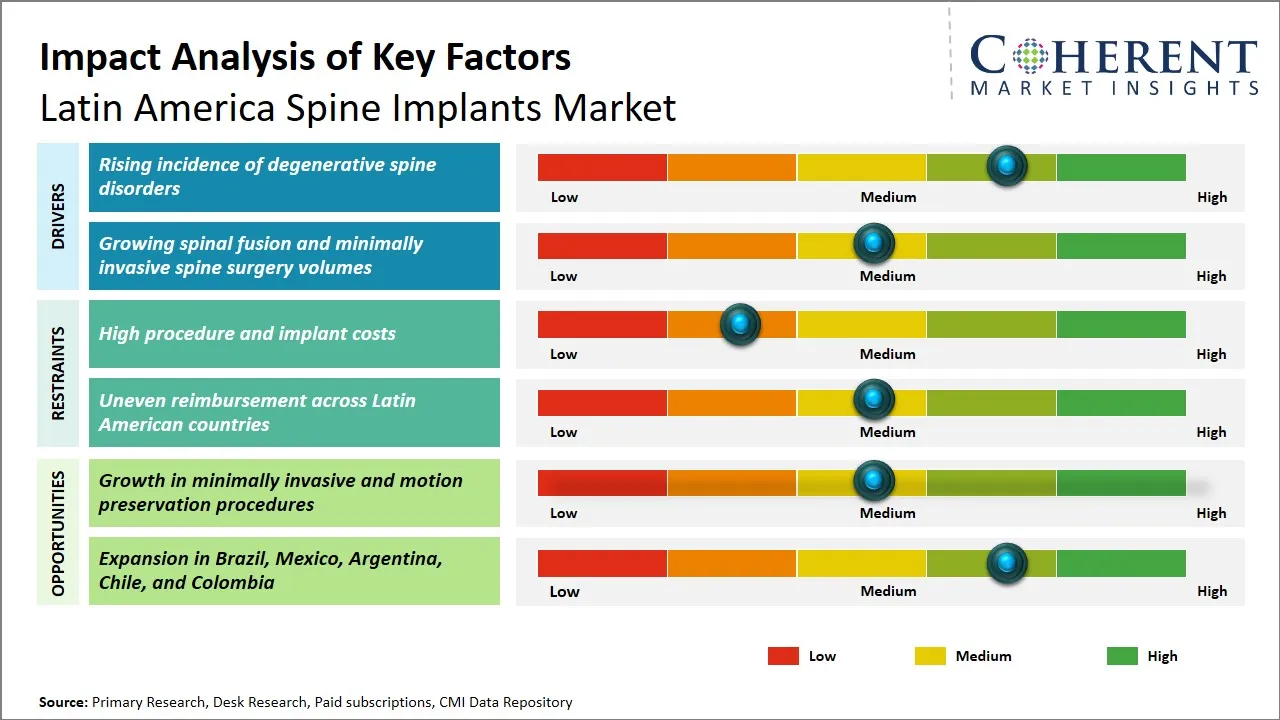
The rising number of degenerative spine diseases in Latin America is a major force that is affecting the market of spine implants in the region. Aging, inactive living, and the increase in obesity are also known to accelerate the increase in the number of spinal stenosis, herniated disc, and osteoarthritis cases, which in most cases require surgery.
Since the disorders limit mobility and lead to chronic pain, there is increasingly an increased dependence on spine implants to regain the stability of the spine and relieve symptoms. Also, the progress in diagnostic methods has increased the cases of early detection and therefore, more patients have been diagnosed to undergo corrective procedures. This upward trend in degenerative conditions of the spine has therefore led to the providers and surgeons embracing new implant technologies, which only advance the outcome of the treatment.
Latin America Spine Implants Market Opportunity - Growth in Minimally Invasive and Motion Preservation Procedures
The Latin America spine implants market has a great opportunity to cash in on the improving use of minimally invasive and motion preservation surgery. These superior methods have significant advantages over conventional open surgeries such as less operative trauma, less hospitalization, quicker patient recovery, and less postoperative complications. With more and more healthcare systems in Latin America modernizing themselves and focusing on patient-centered care, more and more surgeons and patients are opting to perform Minimally Invasive Spine Surgeries (MISS).
The area is also experiencing the increased awareness and demand of motion preservation devices as well as artificial disc implantation and dynamic stabilization implants which are designed to preserve the spinal mobility as well as to minimize adjacent segment degeneration which is a typical side effect of traditional fusion surgery. The increase in the number of the spinal disorders pushed by the aging trends, changes in lifestyle and the rising levels of obesity are additional factors that add to the demand of these new procedures.
For instance, in December 2025, Spinal Simplicity received the U.S. FDA clearance for its Minuteman G6 MIS Fusion Device, a next-generation minimally invasive spinal implant platform, with a commercial launch planned for Q1 2026. The device is designed to stabilize the spine through a tissue-sparing approach while preserving anatomical structures, supporting faster recovery and reduced surgical trauma. This launch highlights the growing shift toward minimally invasive and motion-preserving spine procedures in modern spinal care.
(Source - Spinal Simplicity)
Analyst Opinion (Expert Opinion)
- Latin America spine implants market is expanding consistently due to the increasing degenerative spine disorders, ageing population and the increased use of minimally invasive surgeries. The most important markets are still the Brazil and Mexico and the largest opportunities lie in the advanced fixation systems, the cervical implants, and the adoption of the technology by the surgeons. The biggest problem is the unequal access between nations which is caused by reimbursement disparities, regulatory cogwheel, and reliance on the demand of individual hospitals.
- Recent activity in the industry indicates that the market has been increasingly becoming competitive. Programs like the SILACO and AO Spine have enabled better education of surgeons, clinical exchange and exposure of newer implant technologies in the region. Simultaneously, the presence of product expansion initiatives by the companies like CG MedTech demonstrates that Latin America is not being viewed as a secondary market anymore, but as a growth region of the manufacturers of spine implants.
Speak to the analyst
Want personalized insights?
Take the findings above to one of our principal consultants, or have the report rebuilt around the segments, geographies and competitors you actually track.
Market Segmentation
- Product Type Insights (Revenue, USD Mn, 2021 - 2033)
- Fusion spinal implants
- Cages
- Plates
- Rods
- Screws
- Non-fusion spinal implants
- Artificial disc
- Expandable rods
- Spinal Cord Stimulation Implant
- Fusion spinal implants
- Material Type Insights (Revenue, USD Mn, 2021 - 2033)
- Titanium
- Titanium-alloy
- Stainless Steel
- Plastics
- Surgery Type Insights (Revenue, USD Mn, 2021 - 2033)
- Open Surgery
- Minimally Invasive Surgery
- End User Insights (Revenue, USD Mn, 2021 - 2033)
- Hospitals
- Orthopedic Clinics
- Ambulatory Surgery Centers
- Others
- Key Players Insights
- Medtronic
- DePuy Synthes
- Stryker
- Zimmer Biomet
- ZimVie
- Globus Medical
- Orthofix
- Alphatec Spine
- Life Spine
- Spinal Elements
- Xtant Medical
- SI-BONE
- ulrich medical
- Silimed
- Braile Biomédica
Sources
Primary Research Interviews
Industry Stakeholders List
- Spine surgeons practicing in Brazil
- Spine surgeons practicing in Mexico
- Hospital procurement managers for orthopedic and neurospine devices
- Medical device regulatory consultants in Latin America
- Distributors of orthopedic and spine implants in Latin America
- Clinical education managers in spine surgery centers
End Users List
- Orthopedic spine specialists
- Neurosurgeons performing spinal procedures
- Hospital administrators at tertiary care hospitals
- Operating room managers
- Rehabilitation specialists involved in post-spine surgery care
- Patients undergoing spinal fusion or minimally invasive spine procedures
Government and International Databases
- PAHO Health Information Platform for the Americas
- WHO Global Health Observatory
- Brazil ANVISA medical device resources
- Mexico COFEPRIS medical device resources
- Colombia INVIMA medical device resources
- LILACS via PAHO/BIREME
Trade Publications
- Orthopedics This Week
- MassDevice
- Medical Device Network
- MedTech Dive
- DOTmed Business News
- Healthcare Purchasing News
Academic Journals
- Global Spine Journal
- Spine
- The Spine Journal
- European Spine Journal
- Coluna/Columna
- Neurospine
Reputable Newspapers
- The Wall Street Journal
- Financial Times
- The New York Times
- The Washington Post
Industry Associations
- AO Spine
- Sociedad Ibero Latinoamericana de Columna
- International Society for the Advancement of Spine Surgery
- Sociedad Interamericana de Cirugía de Columna de Mínima Invasión
- AOSpine Latin America
- International Medical Device Regulators Forum
Public Domain Resources
- PAHO Medical Devices resources
- WHO musculoskeletal health resources
- WHO spinal cord injury resources
- PAHO technical documents on medical devices
- National regulatory guidance from ANVISA
- National regulatory guidance from COFEPRIS
Proprietary Elements
- CMI Data Analytics Tool: Proprietary analytics tool to analyze real-time market trends, consumer behavior, and technology adoption in market
- Proprietary CMI Existing Repository of Information for Last 8 Years
Get access to 250+ pages report
Every segment, forecast, competitor profile and data table behind the analysis above — available for instant download.
- ESOMAR Member
- ISO 9001:2015 Certified
- D-U-N-S Registered
- GDPR & CCPA Compliant
Missing comfort of reading report in your local language? Find your preferred language:
Transform your Strategy with Exclusive Trending Reports
Frequently Asked Questions
The Latin America spine implants market is estimated to be valued at USD 785.7 million in 2026 and is expected to reach USD 996.1 million by 2033.
The CAGR of Latin America spine implants market is projected to be 4.8% from 2026 to 2033.
Rising incidence of degenerative spine disorders and growing spinal fusion and minimally invasive spine surgery volumes are the major factors driving the growth of the Latin America spine implants market.
Brazil remains the largest spine implants market in Latin America by revenue, while Mexico is one of the most important access points because of its size, private hospital base, and regulatory relevance. Argentina is also becoming more visible due to its local manufacturing base and growing spine market.
High procedure and implant costs and uneven reimbursement across Latin American countries are the major factors hampering the growth of the Latin America spine implants market.
Minimally invasive spine systems and newer fixation platforms are gaining momentum.
In terms of product type, fusion spinal implants are estimated to dominate the market revenue share in 2026.