

Surgical Lasers Market Size and Trends - 2026 to 2033
The Surgical Lasers Market is estimated to be valued at USD 10.3 Bn 2026 and is expected to reach USD 19.1 Bn by 2033, growing at a compound annual growth The rate (CAGR) of 9.2% from 2026 to 2033.
Key Takeaways
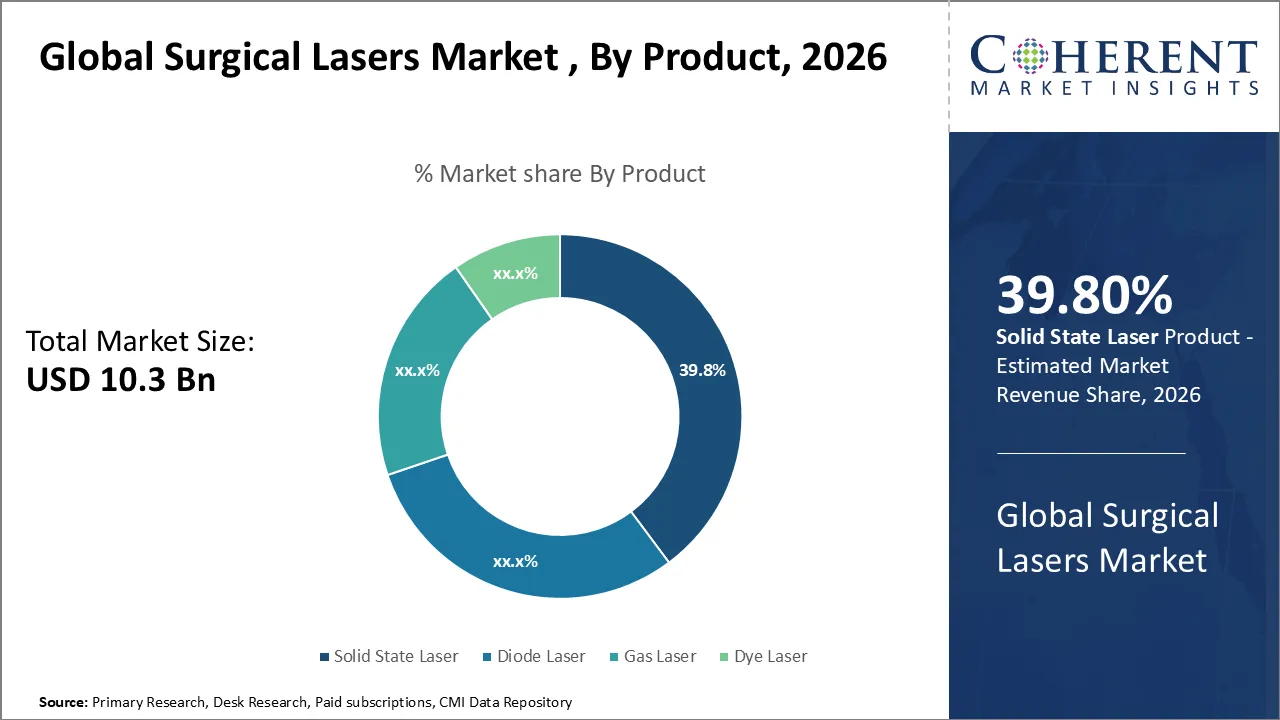
- Based on Product, the Solid State Laser segment is expected to lead the market with 39.80% share in 2026 owing to its precision, versatility, and broad clinical adoption.
- Based on Application, the Ophthalmology segment is expected to hold 32.40% share of the market in 2026 driven by high use of precision lasers in eye surgeries.
- Based on Surgery Type, the Open Surgery segment is expected to hold 31.70% share of the market in 2026 due to widespread usage in major surgical procedures.
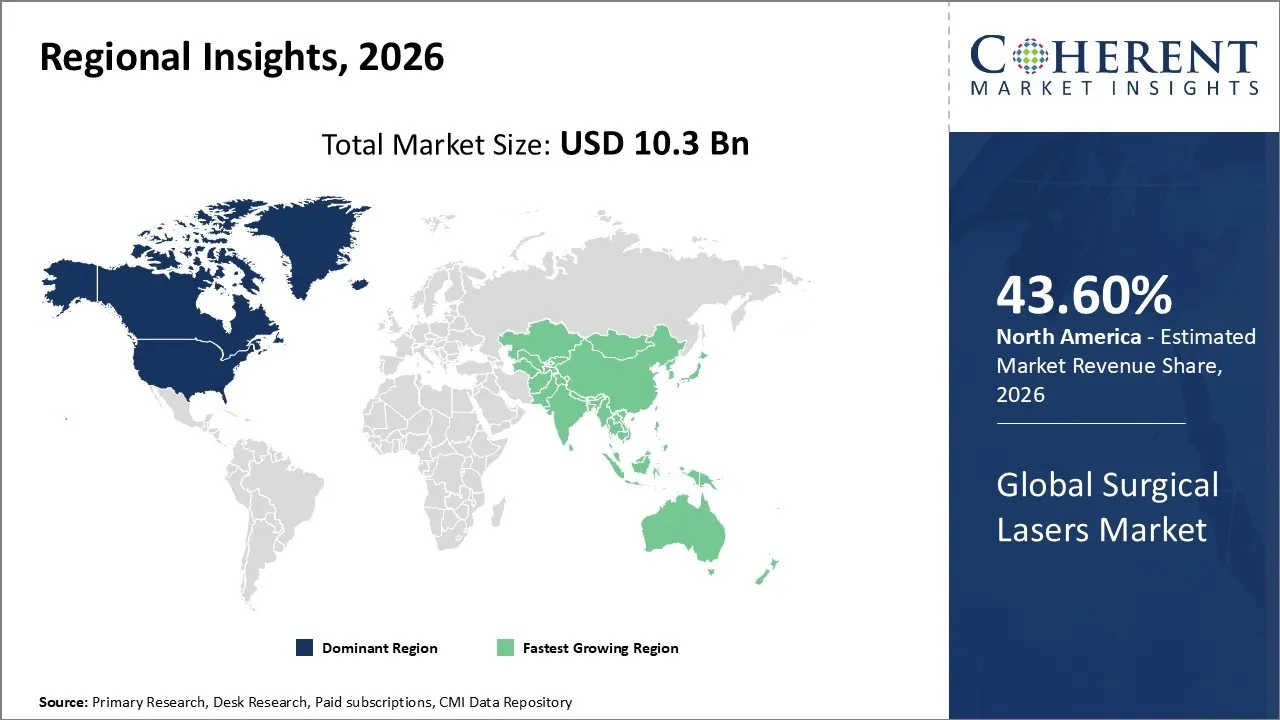
- Based on Region, North America is set to lead the market with 43.60% share in 2026. While, Asia Pacific is anticipated to be the fastest growing region.
Market Overview
The Surgical Lasers Market is advancing significantly driven by its expanding role in minimally invasive procedures, precision oncology, and aesthetic medicine. The increasing demand for outpatient surgeries and tightening clinical safety standards are expected to drive market growth over the forecast period. Surgical lasers are high-intensity light sources mainly categorized as solid-state, gas (CO₂), and diode systems that deliver concentrated energy to cut, coagulate, or vaporize biological tissue with submillimeter accuracy. They are fundamental instruments in modern healthcare sectors, including ophthalmology, urology, and dermatology, owing to their ability to provide bloodless surgical fields and superior tissue-sealing properties.
The ongoing innovation in fiber optic delivery and pulse duration technology is reshaping the surgical laser industry. The demand for compact, high-performance systems is increasing across hospitals, ambulatory surgical centers (ASCs), and specialized dental clinics. These advancements have broadened the functional scope of medical lasers by improving beam stability, cooling efficiency, and depth of penetration control. The top companies in the industry are making strategic acquisitions and introducing AI-integrated multi-wavelength platforms designed mainly for personalized surgical interventions.
Current Events and Its Impacts on the Surgical Lasers Market
Current Event | Description and the Impact |
Technological Innovations and Clinical Advances
|
|
Economic and Healthcare Infrastructure Trends
|
|
Competitive and Market Dynamics |
|
Segmental Insights
- Current Industry Events of 2026
- Market Size Estimation
- Regional Breakdown
- Competitive Landscape
- Customer Intelligence
- Segmental Analysis
- Pricing Analysis
- Key Market Drivers, Challenges & Future Trends
- Customized Insights Section
Surgical Lasers Market Insights, By Product – Solid State Laser Leads Due to its Precision and Versatility
In terms of product, the solid state laser segment contributes the highest share of 39.80% in 2026 of the market. This is owing to its unparalleled versatility and the physical reliability of its construction. This structural integrity ensures that the devices can maintain precise alignment and consistent power output even during long, complex procedures. This provides surgeons with a level of dependability that is critical when performing delicate maneuvers. One of the main reasons for their leadership is their ability to produce sheer variety of wavelengths, ranging from the visible spectrum to the mid-infrared. The evolution of diode-pumped technology has also solidified this segment’s lead by substantially improving energy efficiency and thermal management, which allows for smaller, air-cooled units that fit easily into crowded surgical suite. The durability of the solid-state medium results in these systems having reduced consumable costs and less frequent maintenance compared to older laser technologies, making them a financially appealing option for healthcare administrators.
Surgical Lasers Market Insights, By Application – Ophthalmology Leads with High Use of Precision Lasers in Eye Surgeries
In terms of application, the ophthalmology segment contributes the highest share of 32.40% in the market in 2026. The eye’s unique anatomical transparency allows laser wavelengths to pass through clear tissues such as the cornea and lens for the treatment of internal structures like the retina or the trabecular meshwork. This unparalleled access makes lasers an indispensable tool for a wide array of procedures like myopia and astigmatism using excimer and femtosecond lasers. The advances like LASIK, SMILE, and laser-assisted cataract surgery have transformed complex operations into precise, minimally invasive outpatient procedures that provide rapid recovery times and superior visual outcomes.
The increasing global prevalence of ocular disorders, particularly among an aging population also ensures a continual high procedural volume. In addition, the rise in chronic lifestyle diseases like diabetes has spurred a greater demand for photocoagulation treatments to prevent blindness. Because these laser interventions are often safer and more effective than traditional surgical alternatives, they remain the gold standard in eye care, driving the ophthalmology segment to the forefront of the surgical laser industry.
Surgical Lasers Market Insights By, Surgery Type – Open Surgery Leads Due to Widespread Usage in Major Surgical Procedures
In terms of surgery type, the open surgery segment contributes the highest share of 31.70% in 2026 of the market due to its foundational role in traditional operative procedures and its widespread utility in complex tissue management. Open surgery provides a direct and unobstructed view of the surgical site, thereby allowing for the precise application of laser energy across extensive tissue areas that require aggressive ablation, coagulation, or resection. Furthermore, many specialized laser wavelengths are optimized for surface-level interactions, making them the preferred choice for open-air procedures where fiber-optic constraints are less restrictive.
Regional Insights
North America Surgical Lasers Market Analysis & Trends
North America has remained the dominant region, with 43.60% in 2026 of the global Surgical Lasers Market over the past decade by leveraging a highly sophisticated healthcare network. The major companies in the US and Canada are driving innovation by introducing cutting-edge femtosecond and picosecond laser systems. The hospitals and private clinics are investing in these technologies to meet the rising demand for minimally invasive surgeries. In addition, insurance providers offer favorable reimbursement policies for laser-assisted treatments in urology and oncology, which contributes to the growth of the market. In addition, insurance providers offer favorable reimbursement policies for laser-assisted treatments in urology and oncology, which contributes to the growth of the market. The high volume of elective cosmetic procedures spurs market development, with patients drawn to precise effects and reduced recovery. As a result, North America maintains its position as the global leader through technical expertise and high per capita healthcare spending.
For instance, in February 2024, Meridian Medical AG announced that it would be bringing three new ophthalmic lasers to the U.S. market. These are the Microruptor (MR) Q lasers, which include MR Q, MR Q SLT, and MR Q supine.
Asia Pacific Surgical Lasers Market Analysis & Trends
The Asia Pacific region is likely to register the fastest expansion in the surgical lasers industry throughout the forecast period. This is owing to massive infrastructure investments and a growing middle class. The governments in China and India are modernizing rural and urban medical facilities by purchasing versatile disorder laser systems. The growing medical tourism continues to fuel market growth, particularly as Thailand and South Korea emerge as preferred destinations for low-cost laser-assisted cosmetic and dental treatments. In addition, the increasing aging population boosts local demand for ophthalmic surgeries treating cataracts and glaucoma. The rising disposable income levels are enabling a broader segment of the population to afford premium vision correction and dermatological treatments. As a result, the region functions as a critical node across the surgical laser value chain, encompassing both manufacturing and end-use consumption.
For instance, in September 2025, Alcon India unveiled the UNITY® Vitreoretinal Cataract System (VCS) and the UNITY® Cataract System (CS) in India. The platform aims to improve the efficiency of vitreoretinal and cataract surgeries.
Surgical Lasers Market Outlook Country-Wise
The US Surgical Lasers Market Trends
The US maintains its global leadership by integrating advanced laser technologies into a sophisticated healthcare network. The surgeons are utilizing femtosecond and solid-state lasers to perform high-precision ophthalmic and urological procedures. Hospitals and ambulatory surgical centers drive this demand as they prioritize minimally invasive techniques that reduce patient recovery times. In addition, the aesthetic sector experiences steady growth because consumers spend billions on laser-based skin resurfacing and hair removal. The robust insurance coverage and high research investment ensure that the US remains the primary hub for surgical laser innovation and revenue generation.
For instance, in June 2025, Coherent Corp., a world leader in photonics, has announced the release of their Thulium Fiber Laser, also known as the ACE FL Series. It was made exclusively for therapeutic medical uses, especially for treating lithotripsy and benign prostatic hyperplasia (BPH).
China Surgical Lasers Market Trends
China is expected to register fast growth in the surgical lasers sector by rapidly modernizing its medical facilities and increasing domestic production. The government is funding the installation of versatile diode and CO₂ lasers in provincial hospitals to boost public health access. The rising middle-class affluence is emerging as a key driver behind increased adoption of elective cosmetic and refractive procedures. In addition, local manufacturers lower operational costs, which allows smaller clinics to adopt sophisticated laser systems. This combination of government support and rising disposable income transforms China into a vital center for both the consumption and manufacturing of surgical laser technology.
Market Report Scope
Surgical Lasers Market Report Coverage
| Report Coverage | Details | ||
|---|---|---|---|
| Base Year: | 2025 | Market Size in 2026: | USD 10.3 Bn |
| Historical Data for: | 2020 To 2024 | Forecast Period: | 2026 To 20323 |
| Forecast Period 2026 to 2033 CAGR: | 9.2% | 2033 Value Projection: | USD 19.1 Bn |
| Geographies covered: |
| ||
| Segments covered: |
| ||
| Companies covered: | Alma Lasers, Abbott Laboratories, Inc., Biolitec AG, BISON MEDICAL Co. Ltd., Boston Scientific Corporation, Cynosure, Inc., Fotona d.o.o., Lumenis, IPG Photonics Corporation, and Spectranetics Corporation. | ||
| Growth Drivers: |
| ||
| Restraints & Challenges: |
| ||
Surgical Lasers Market Drivers
Increasing demand for minimally invasive procedures
The global surgical lasers market is experiencing a significant surge because of the rising demand for minimally invasive procedures. The patients and healthcare providers favor these techniques over traditional open surgeries due to clinical benefits such as reduced postoperative pain, minimal scarring, and substantially shorter recovery times. Surgical lasers are at the forefront of this trend, since they offer unmatched precision and bloodless cuts that minimize trauma to surrounding tissues. The integration of the technology in various specialties like urology, ophthalmology, and oncology enables the provision of accurate procedures like laser ablation and photocoagulation. In addition, the rapid expansion of ambulatory surgical centers has accelerated adoption because laser-based procedures facilitate same-day discharge and high patient turnover, essential for outpatient care. This transition from hospital-based major surgeries to clinic-based laser interventions remains the primary engine driving the market toward a significantly higher valuation in the coming years.
For instance, in September 2023, Gleneagles Hospital Kengeri launched the advanced RecoSMA laser technology. This groundbreaking technology offers a method for repairing damaged human tissue while prioritizing patient safety and minimizing the invasiveness of procedures.
Analyst Opinion (Expert Opinion)
The global surgical lasers market continues to gain traction across multiple medical specialties due to the growing emphasis on precision, minimally invasive procedures, and improved patient outcomes. Surgical lasers are widely used in dermatology, ophthalmology, urology, gynecology, dentistry, and oncology, where controlled tissue interaction and reduced collateral damage are critical. Their ability to deliver accurate cutting, ablation, and coagulation supports shorter recovery times and improved procedural efficiency, reinforcing adoption across hospitals and ambulatory surgical centers.
Technological innovation remains a key market driver. Advancements in beam control, wavelength specificity, and real-time energy modulation have expanded the clinical scope of laser-based procedures. Carbon dioxide and diode laser systems are among the most commonly utilized platforms due to their versatility and reliability across a broad range of surgical applications. Integration with digital imaging, robotic-assisted surgery, and navigation systems is further enhancing procedural accuracy and consistency.
Regionally, developed healthcare systems continue to lead in adoption due to established surgical infrastructure and higher procedure volumes. Emerging markets are showing increasing uptake as healthcare investment expands and access to advanced surgical technologies improves. Regulatory approvals and clinician training programs also play a significant role in shaping adoption patterns.
Speak to the analyst
Want personalized insights?
Take the findings above to one of our principal consultants, or have the report rebuilt around the segments, geographies and competitors you actually track.
Surgical Lasers Industry News
- In October 2025, Cynosure Lutronic, a global provider of aesthetic medical devices that utilize lasers and energy, has introduced the eCO2 3D, touted as the most versatile fractional CO2 laser in the aesthetics field. The eCO2 3D sets a new benchmark for CO2 laser resurfacing. It enhances the established framework of the eCO2 Plus by integrating power, precision, and control into a single platform that boasts unparalleled adaptability.
- In September 2025, the Technology Innovation Institute (TII), which is part of Abu Dhabi's Advanced Technology Research Council (ATRC), has announced the introduction of its 2 micrometers (µm) high-power fiber laser sources. It is a novel technology that establishes new standards for safety, performance, and versatility in the fields of medication manufacturing and materials processing.
- In February 2025, Alcon, a leading company in the eye care industry, committed to helping individuals achieve clear vision, have recently announced that the Voyager™ DSLT, the first and only Direct Selective Laser Trabeculoplasty device (DSLT), is now available for commercial use in the US. The Voyager DSLT is uniquely positioned to accelerate the adoption of laser treatment as a first-line option, making it accessible to a larger number of patients.
Market Segmentation
- Product Insights (Revenue, USD Bn, 2026 - 2033)
- Diode Laser
- Dye Laser
- Gas Laser
- Solid State Laser
- Application Insights (Revenue, USD Bn, 2026 - 2033)
- Cardiology
- Dermatology
- Dentistry
- Gynecology
- Ophthalmology
- Oncology
- Urology
- Others
- Surgery Type Insights (Revenue, USD Bn, 2026 - 2033)
- Laparoscopic Surgery
- Percutaneous Surgery
- Open Surgery
- Regional Insights (Revenue, USD Bn, 2026 - 2033)
- North America
- U.S.
- Canada
- Latin America
- Brazil
- Argentina
- Mexico
- Rest of Latin America
- Europe
- Germany
- U.K.
- France
- Italy
- Russia
- Rest of Europe
- Asia Pacific
- China
- India
- Japan
- Australia
- South Korea
- ASEAN
- Rest of Asia Pacific
- Middle East
- GCC
- Israel
- Rest of Middle East
- Africa
- North Africa
- Central Africa
- South Africa
- Key Players Insights
- Alma Lasers
- Abbott Laboratories, Inc.
- Biolitec AG
- BISON MEDICAL Co. Ltd.
- Boston Scientific Corporation
- Cynosure, Inc.
- Fotona d.o.o.
- Lumenis
- IPG Photonics Corporation
- Spectranetics Corporation
Sources
Primary Research Interviews
- Surgical Laser Manufacturers (CO₂, Diode, Nd:YAG, Er:YAG)
- Medical Device OEM Executives & Product Managers
- Surgeons (General, Ophthalmology, Dermatology, ENT, Urology, Gynecology)
- Hospital Biomedical Engineers
- Ambulatory Surgical Center (ASC) Administrators
- Regulatory & Clinical Affairs Specialists
- Others
Databases
- Bloomberg Terminal
- Thomson Reuters Eikon
- IHS Markit
- GlobalData Healthcare
- Euromonitor International
- S&P Global Market Intelligence
- Others
Magazines
- Medical Device and Diagnostic Industry (MDDI)
- Laser Focus World
- Photonics Media
- Healthcare Design Magazine
- MedTech Dive
- Others
Journals
- Lasers in Surgery and Medicine
- Journal of Biomedical Optics
- Photomedicine and Laser Surgery
- Journal of Clinical Laser Medicine & Surgery
- Applied Optics
- Others
Newspapers
- Financial Times
- The Wall Street Journal
- Reuters
- Bloomberg News
- The Economic Times (Healthcare & MedTech)
- Others
Associations
- American Society for Laser Medicine and Surgery (ASLMS)
- International Society for Optics and Photonics (SPIE)
- Optical Society (Optica)
- Advanced Medical Technology Association (AdvaMed)
- European Medical Laser Association (EMLA)
- Others
Public Domain Sources
- U.S. Food and Drug Administration (FDA) – Medical Devices & Radiological Health
- National Institutes of Health (NIH) / PubMed
- World Health Organization (WHO)
- European Commission – Medical Devices Regulation (MDR)
- ClinicalTrials.gov
- Others
Proprietary Elements
- CMI Data Analytics Tool
- Proprietary CMI Existing Repository of Information for the Last 8 Years
Definition: The Surgical Lasers Market encompasses advanced medical-grade systems that utilize highly focused light energy to perform precise, controlled, minimally invasive clinical procedures across multiple medical specialties. This sector focuses on using diverse laser technologies such as CO2, ND YAG, and diode lasers to handle critical surgical tasks like tissue incision, ablation, and vaporization with extreme accuracy. These systems are widely adopted in hospitals, specialized clinics, and ambulatory surgical centers (ASCs), where precision, bloodless fields, and sterile environments are essential to modern medical standards. The demand for these solutions comes from healthcare providers and specialized clinics that must comply with stringent medical safety guidelines. The growth is fueled by an increasing patient preference for faster recovery times and reduced scarring.
Get access to 250+ pages report
Every segment, forecast, competitor profile and data table behind the analysis above — available for instant download.
- ESOMAR Member
- ISO 9001:2015 Certified
- D-U-N-S Registered
- GDPR & CCPA Compliant
Missing comfort of reading report in your local language? Find your preferred language:
Transform your Strategy with Exclusive Trending Reports
Frequently Asked Questions
The Surgical Lasers Market is estimated to be valued at USD 10.3 Bn in 2026, and is expected to reach USD 19.1 Bn by 2033.
The CAGR of the Surgical Lasers Market is projected to be 9.2%from 2026 to 2033.
Rising prevalence of diseases such as cancer, cataract, kidney stones, and others and rising demand for minimally invasive surgeries are some of the major factors driving the growth of the Surgical Lasers Market.
Limitations such as surgeons’ specialized training, strict safety precautions, and high cost of laser therapy are some of the major factors hampering the growth of the Surgical Lasers Market.
In terms of product, the solid state laser segment is estimated to dominate the market revenue share in 2026.
Alma Lasers, Abbott Laboratories, Inc., Biolitec AG, BISON MEDICAL Co. Ltd., Boston Scientific Corporation, Cynosure, Inc., Fotona d.o.o., Lumenis, IPG Photonics Corporation, and Spectranetics Corporation are the major players.
North America is expected to lead the Surgical Lasers Market in 2026.