

Global Leaf Blowers Market Size and Forecast – 2026-2033
According to Coherent Market Insights, the global leaf blowers market is estimated to be valued at USD 2.23 Bn in 2026 and is expected to reach USD 3.44 Bn by 2033, expanding at a compound annual growth rate (CAGR) of 6.4% from 2026 to 2033.
Key Takeaways of the Leaf Blowers Market
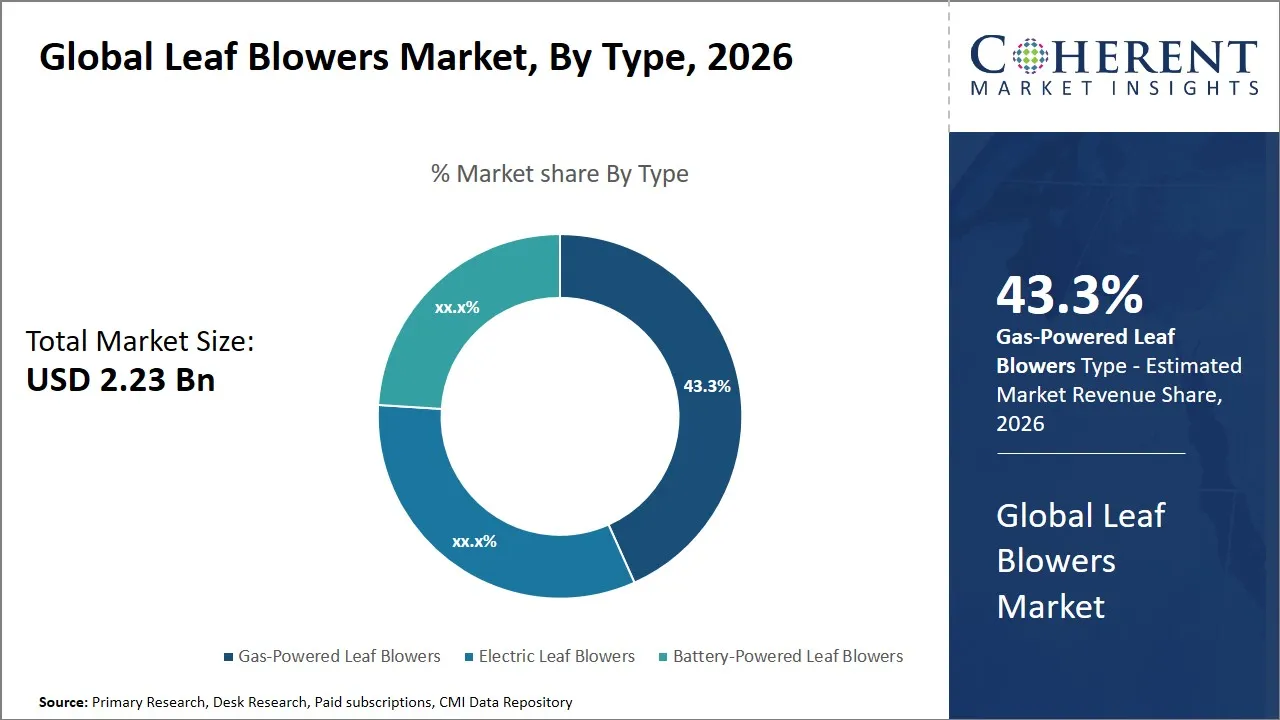
- Gas-powered leaf blowers segment is projected to hold 43.3 % of the market share in 2026.
- The residential segment is expected to hold 56.3 % of the global leaf blowers market share in 2026.
- The online retail segment is set to capture 67.8% of the leaf blowers market share in 2026.
- North America is expected to lead the leaf blowers market with a 43.2 % share in 2026.
- The Asia Pacific region is projected to show the fastest growth, contributing 18.3 % of the market share in 2026.
Market Overview
- Current market trends highlight a shift towards battery-powered and cordless leaf blowers due to rising environmental concerns and stringent emission regulations.
- Additionally, advancements in lightweight design and noise control system technology are improving user experience, expanding market adoption.
- The growing landscaping and gardening industry, combined with the rising emphasis on maintenance of green spaces, continues to propel the market forward, making leaf blowers an essential tool for efficient outdoor cleaning.
Current Events and Its Impact
Current Events | Description and its Impact |
Shift to Electric/Battery Models Driven by Regulation & Demand |
|
Advancements in Battery Technology & E‑Commerce |
|
Segmental Insights
- Current Industry Events of 2026
- Market Size Estimation
- Regional Breakdown
- Competitive Landscape
- Customer Intelligence
- Segmental Analysis
- Pricing Analysis
- Key Market Drivers, Challenges & Future Trends
- Customized Insights Section
Why Does the Gas-Powered Leaf Blowers Segment Dominate the Global Leaf Blowers Market in 2026?
Gas-powered leaf blowers segment is projected to hold 43.3% share in 2026, as it offers superior performance options that are desirable to all classes of consumers, with home owners and professional landscapers being the main targeted users. The major reason why gas-powered blowers are in high demand is that it has high speed in air delivery, which allows effective movement of the leaves and debris at large and dense areas outdoors. This unrefined power is particularly important to commercial use and huge residential buildings where electric or battery-based options might not perform as effectively and as long.
For instance, professional landscapers often rely on gas-powered leaf blowers for large-scale commercial projects, such as maintaining parks or golf courses, where a fast, reliable, and long-lasting tool is required to cover extensive areas in a short period.
Residential Segment Dominates the Leaf Blowers Market
The residential segment is expected to account for 56.3% of the leaf blowers market share in 2026, propelled by a rising enthusiasm for home gardening and outdoor recreational spaces. In most areas, the development of suburban districts with personal gardens has provided a constantly increasing clientele that is committed to keeping their outside spaces clean and attractive. This has in turn triggered high demand of user-friendly leaf blowers to suit domestic demands emphasizing on convenience, safety and ease of operation.
The increased demand in the residential segment can be greatly linked to the increasing popularity and acceptance of landscaping as a hobby and home enhancement. The homeowners are also spending more on landscaping equipment that can maintain the lawns, flower beds and patios with minimal time and effort. Mostly electric powered or occasionally gas powered depending on the size of the property, lightweight, noisy, and easy-to-hand, these leaf blowers are popular with casual users who are concerned with maintenance, but not with high-performance.
Online Retail Leads due to Convenience, Wider Selection, and Competitive Pricing
Online retail segment is expected to hold 67.8% of the global leaf blowers market share in 2026, driven by evolving consumer behavior favoring convenience, accessibility, and choice. This is because buyers can now make informed choices in terms of products being researched in detail and comparing specifications and also consult online on the best products and do this without regard to traditional times of retailing or even the geographical position. This online shopping advantage is especially applicable to leaf blowers where customers can enjoy the advantage of having a wide range of choices that include gas-powered, electric, and battery-powered leaf blowers.
The large range of products provided by online platforms enables the manufacturers and sellers to provide entry-level and high-end leaf blowers where the needs and purchasing power of consumers are met. The fact that consumers can see detailed descriptions of the products, video demonstrations, and even virtual support via chatbots or customer services is an added value that makes people feel more confident in their purchases of relatively specific power equipment even when not shopping in brick-and-mortar stores.
Regional Insights

North America Leaf Blowers Market Analysis and Trends
The North America region is projected to lead the market with a 43.2% share in 2026, because the market-based ecosystem will include residential, commercial and municipal customers who seek efficient landscaping and ground maintenance machinery. The numbers of people using the battery-powered and environmentally-friendly leaf blowers are in line with strict environmental laws and the rise in consumer sensitivity in the area of sustainability, particularly in the U.S. and Canada.
The government policies that promote emission reduction have brought manufacturers to be innovative and have presented cordless and electric models to replace the traditional gas-powered models. Moreover, other well-known competitors that have a large impact on the market exist in North America such as Husqvarna, Stihl, and Echo that have large distribution channels and extensive research and development opportunities. Their ever-changing product development in terms of ease of use to users and environmental concerns consolidates more of the leading position of North Americas.
Asia Pacific Leaf Blowers Market Analysis and Trends
The Asia Pacific region is expected to exhibit the fastest growth in the market contributing 18.3% share in 2026, propelled by rapid urbanization, infrastructural development, and rising disposable incomes. The rise in the demand of landscaping tools is being registered in countries like China, Japan, India, and South Korea among the commercial, residential complexes, and municipalities. This growth is highly encouraged by the shifting market ecosystem that is shifting away towards mechanized solutions to ground maintenance, which is less manual in nature.
Also, the positive governmental policies on urban green areas and clean cities help to increase the demands of efficient landscaping devices. Local manufacture like Shindaiwa and green activities by the multinational corporations play a big role in fulfilling the demanded expectations in the region. Further, the export based manufacturing centers in the area are enjoying the changing trade relations meaning that the manufacturers are able to focus on the domestic and global markets at the same time.
Leaf Blowers Market Outlook for Key Countries
Why is the U.S. Leaf Blowers Market Shifting Towards Battery-Operated and Electric Models?
The leaf blowers industry in the U.S. is typified by a very high level of consumer sensitivity towards the environmental sustainability, and consequently, the battery-operated and the electric powered leaf blowers are in high demand. Stihl and Husqvarna are leading companies with an influential role due to the innovation of product ranges with a focus on noise reduction, and zero emissions. The regulatory system used by the US government to curb diminished air pollution by small engines drives the manufacturers to focus on green technologies. The established landscaping services industry also drives the need to have sophisticated leaf blowers that could be used in various terrain and high scale maintenance.
Why is Germany Becoming a Key Player in the Leaf Blowers Market?
The advantage of the Germany leaf blowers market is its strong industrial background and focus on environmentally friendly technologies in line with the strict environmental and safety policies of the country. The major consumers in the market are the professional landscapers and residential consumers who will want equipment of high quality that is durable and which is associated with brands such as Bosch and Stihl. Subsidies and the government encouraging sustainable gardening products also facilitate the development of the market. The strategic location of Germanys in Europe allows it to trade with all parts of the continent thereby making it a distribution and innovation center in the landscape equipment.
China Leaf Blowers Market Trends
China is among the rapidly growing markets because of the high rate of urbanization and the growing emphasis on the beautification of both the public and the private landscapes. The domestic firms as well as the multinational ones such as Shindaiwa and Makita serve a wide market of consumers that include both urban dwellers and commercial landscapers and municipal authorities. The trend of the Chinese governments towards green and smart city projects extends faster, which promotes the use of electric and battery-powered leaf blower. In addition to this, China is a major manufacturing hub that is affecting the supply chain and the cost efficiencies of manufacturing in the region.
Japan Leaf Blowers Market Trends
The marketing of leaf blowers in Japan has been influenced by the inclination towards highly technical, small, and energy-saving leaf blowers that would meet the specifics of landscaping in the country and insufficient exterior territory. The domination is run by such companies as Ryobi and Honda which provide innovative models of electric and cordless works that focus on quiet functioning and ergonomics. The supportive policies of the governments on the sustainable development of the urban setting and the existence of the mature population of consumers who prioritize on the quality and reliability further enhances the competitive position of Japan’s market.
India Leaf Blowers Market Trends
The market of leaf blowers in India is developing at an accelerated rate because of the rise in awareness in the contemporary landscaping and the growing urbanity. A combination of local producers and foreign product brands like Greenworks and Bosch are used by commercial and residential consumers. Market is expanding owing to government efforts to enrich the city surroundings and landscapes, as well as, increasing popularity of garden care among the middle-class families. The changing supply chain logistics and trade relations in the countries improve access to a wide variety of product lines in the countries, and increase consumer adoption.
Noise & Emission Regulation Impact Mapping
Region | Regulation Type | Regulation Details | Examples of Affected Companies |
EU | Noise Regulation | Noise limits for outdoor equipment (max 90 dB for handheld blowers) | Husqvarna, Stihl, Echo |
U.S. (California) | Noise Regulation | California Code of Regulations for outdoor equipment (maximum 65-75 dB for residential zones) | Toro, Craftsman, GreenWorks |
EU | Emission Regulation | EURO 5 standards for small engines (limits on CO, HC, NOx emissions) | Stihl, Husqvarna, Makita |
Market Players, Key Development, and Competitive Intelligence

Key Developments
- In October 2024, Whisper Aero unveiled its first electric "tow behind" leaf blower powered by WhisperDrive technology. Delivering 250N performance while maintaining under 65 dBA, it targets golf courses, landscape management, and large-scale maintenance. The blower addresses the growing demand for quieter, high-performance outdoor equipment amidst increasing noise regulations. Whisper Aero aims to partner with manufacturers to integrate WhisperDrive into future products.
- In September 2024, the town of Woodside has approved a rebate program for electric leaf blowers in partnership with Acterra, a Palo Alto-based environmental nonprofit. The program aims to promote the use of electric tools, with additional funding from a grant application to Peninsula Clean Energy. A vote on banning gas-powered leaf blowers was postponed for further review of exceptions and alternative approaches.
- In August 2024, RedMax launched its new EBZ9000 Backpack Blower and EBZ9000 RH models, designed for heavy-duty leaf blowing. With 1,245 CFM and 56 Newtons of blowing force, they efficiently clear large areas of leaves and debris. Featuring AutoTune technology, these blowers optimize performance in diverse weather conditions. Weighing just 26.5 pounds, they provide enhanced user comfort with adjustable straps, a hip belt, and a ventilated back pad.
- In June 2024, engineering students at Johns Hopkins developed a patent-pending silencer attachment for leaf blowers, reducing noise pollution by 37% and eliminating the high-pitched whine. Sponsored by Stanley Black & Decker, the design is set to be sold within two years. The innovation aims to address widespread complaints about leaf blower noise, often leading to bans in residential areas.
Top Strategies Followed by Global Leaf Blowers Market Players
Player Type | Strategic Focus | Example |
Established Market Leaders | Heavy investment in R&D and innovation | For example, Stihl has invested heavily in R&D to come up with an assortment of battery-powered leaf blowers which not only cut carbon emissions but are also less noisy than their analogues which use gas, which is also in line with sustainability trends. Another case is Husqvarna which has concentrated on incorporating noise-cutting technologies in their products in order to comply with high noise levels in cities. |
Mid-Level Players | Balance cost and sustainability | As an example, Black and Decker has been able to concentrate on lightweight and compact products, which would appeal to price-sensitive customers (DIY users and small business). In order to achieve a competitive edge, these medium players will tend to pursue strategic alliances and cooperations with suppliers or technology provider. |
Small-Scale Players | Niche specialization & innovative variants | For example, Greenworks, a smaller company, is making ultra-lightweight leaf blowers with high ergonomic designs, which would be ideal to the elderly or physically challenged consumer. The other example is EGO Power that has entered into the IoT (Internet of Things)-powered leaf blowers that enable users to track the battery percentage and the health of the machine through smartphone applications. |
Market Report Scope
Leaf Blowers Market Report Coverage
| Report Coverage | Details | ||
|---|---|---|---|
| Base Year: | 2025 | Market Size in 2026: | USD 2.23 Bn |
| Historical Data for: | 2020 To 2024 | Forecast Period: | 2026 To 2033 |
| Forecast Period 2026 to 2033 CAGR: | 6.4% | 2033 Value Projection: | USD 3.44 Bn |
| Geographies covered: |
| ||
| Segments covered: |
| ||
| Companies covered: | STIHL AG & Co. KG, Husqvarna Group, Echo, Inc., Makita Corporation, DeWalt (Stanley Black & Decker), Toro Company, Ryobi (TTI), Black+Decker, Navigating the Noise, MTD Products Inc., Schiller Grounds Care, Inc., Bosch Power Tools, and Craftsman (Stanley Black & Decker) | ||
| Growth Drivers: |
| ||
| Restraints & Challenges: |
| ||
Leaf Blowers Market Dynamics
Leaf Blowers Market Driver - Increasing Demand for Efficient Yard Maintenance Tools Among Homeowners
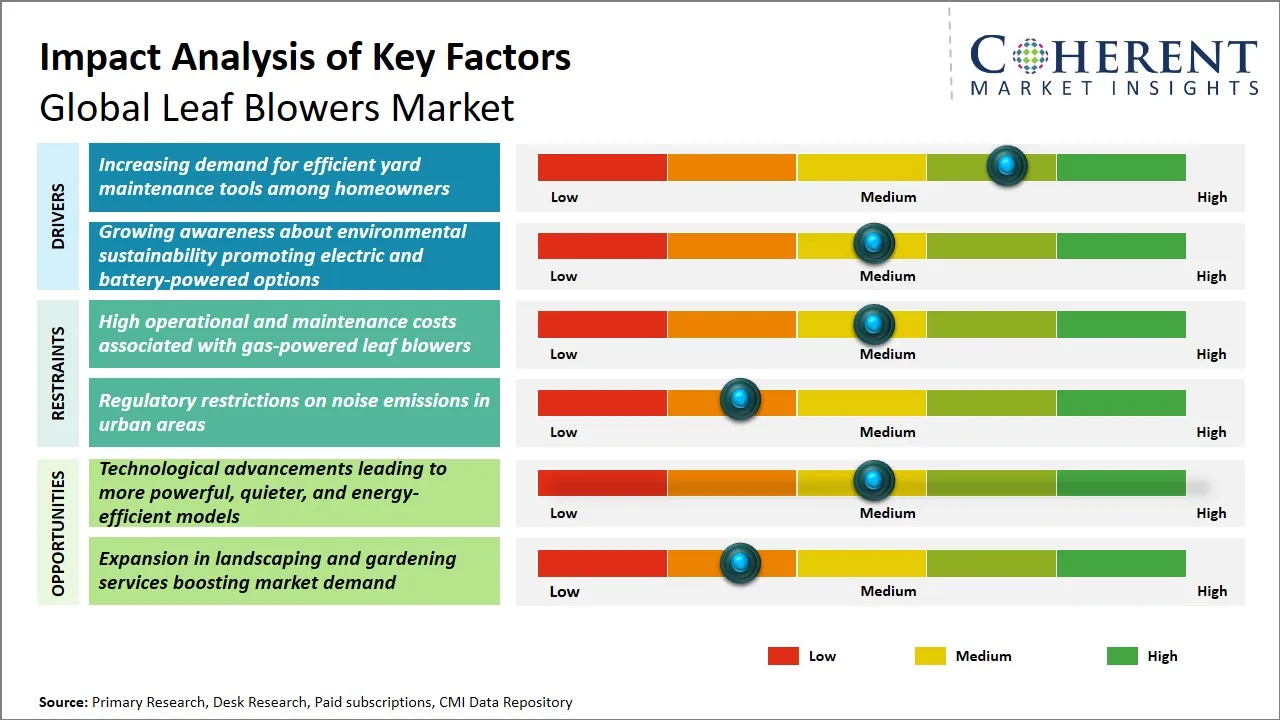
The increased tendency of home owners to have clean and aesthetically appealing outdoor environments has caused a lot of increase in demand of effective yard maintenance products especially of the leaf blower. With the growing size and complexity of residential landscapes, the conventional practices like raking have become more conceived as time-depleting and labor intensive. Leaf blowers provide a simple and effective alternative, as the debris, grasses and leaf cover can be cleared rapidly and with ease, hence improving the maintenance of the yard with little physical work. Moreover, these tools have been made more accessible and friendlier to common usage thanks to the innovative technologies of battery and more silent motor design.
For example, Cordless Leaf Blower 320iB is intended to be used by people who live at home. The leaf blower is easy to carry, effective as well as equipped with a high-tech battery technology thus making the homeowners to work on their lawns better.
Leaf Blowers Market Opportunity - Technological Advancements Driving Enhanced Leaf Blower Performance
Global leaf blowers market is enjoying tremendous growth prospects occasioned by the fast technological change that has resulted in more power full quieter and energy efficient models. Battery technology, including the advent of high capacity lithium-ion batteries, has provided the leaf blower with the massive battery performance, where users have the freedom to move more with the leaf blower without sacrifices in the power performance. These innovations are not only convenient to the users but also act as a solution to the rising environmental issues by lowering the gasoline consumption that leads to air and noise pollution among other gadgets.
For example, an example of technological developments in the leaf blower industry is Toros 60V Max Power System Cordless Leaf Blower. This is a model with high capacity lithium ion batteries that ensure greater runtime as well as better power delivery than the traditional cordless models.
(Source: https://flexforce.toro.com/product-category/leaf-blower/)
Analyst Opinion (Expert Opinion)
- The leaf blowers industry is undergoing dynamic expansion, owing to the rising consumer demand towards landscaping, and outdoor home maintenance especially with the homeowner demanding effective yard maintenance schemes. The experiences of the International Green Industry Conference (2023) and the Outdoor Power Equipment Expo (2022) have pinpointed the main trends, and such companies as Husqvarna and STIHL are the pioneers of battery-powered and electric machinery that would appeal to environmentally-conscious customers.
- The recent introduction of new model of ultra-quiet, battery-powered, and noise-reducing leaf blowers by Husqvarnas underlines the tendency of the industry to develop sustainable and consumer-friendly solutions, and decrease the amount of noise pollution without losing the performance.
- Contributions at these conferences highlighted the increasing demand of lightweight and easy to use equipment marketed to consumers in homes, and the increasing desire of multifunctional equipment. But a range of issues like changing battery prices and rivalry with the standard gasoline-powered models were often mentioned as impediments to making inroads into the market. Firms that focus on R&D to enhance their battery technology and forge new alliances with retailers to reach consumers well will probably achieve a competitive advantage. After all, the success of the market of leaf blowers will depend on its capacity to continuously innovate and respond to the changing consumer preferences in the reliability and convenience.
Speak to the analyst
Want personalized insights?
Take the findings above to one of our principal consultants, or have the report rebuilt around the segments, geographies and competitors you actually track.
Market Segmentation
- Type Insights (Revenue, USD Bn, 2021 - 2033)
- Gas-Powered Leaf Blowers
- Electric Leaf Blowers
- Battery-Powered Leaf Blowers
- Application Insights (Revenue, USD Bn, 2021 - 2033)
- Residential
- Commercial
- Distribution Channel Insights (Revenue, USD Bn, 2021 - 2033)
- Online Retail
- Offline Retail
- Supermarkets/Hypermarkets
- Specialty Stores
- Home Improvement Stores
- Regional Insights (Revenue, USD Bn, 2021 - 2033)
- North America
- U.S.
- Canada
- Latin America
- Brazil
- Argentina
- Mexico
- Rest of Latin America
- Europe
- Germany
- U.K.
- Spain
- France
- Italy
- Russia
- Rest of Europe
- Asia Pacific
- China
- India
- Japan
- Australia
- South Korea
- ASEAN
- Rest of Asia Pacific
- Middle East
- GCC Countries
- Israel
- Rest of Middle East
- Africa
- South Africa
- North Africa
- Central Africa
- North America
- Key Players Insights
- STIHL AG & Co. KG
- Husqvarna Group
- Echo, Inc.
- Makita Corporation
- DeWalt (Stanley Black & Decker)
- Toro Company
- Ryobi (TTI)
- Black+Decker
- Navigating the Noise
- MTD Products Inc.
- Schiller Grounds Care, Inc.
- Bosch Power Tools
- Craftsman (Stanley Black & Decker)
Sources
Primary Research Interviews
- CEO – Leading Leaf Blower Manufacturer (e.g., Husqvarna or Echo Incorporated equivalent)
- Supply Chain Director – Major Outdoor Power Equipment Distributor
- Production Lead – Battery-Powered Leaf Blower Manufacturer
- Sustainability Officer – Outdoor Power Equipment Certification Authority
Stakeholders
- Manufacturers
- End-use Sectors
- Residential Landscaping Users
- Commercial Lawn Care Services
- Municipal Grounds Maintenance (Parks, Public Spaces)
- Regulatory & Certification Bodies (e.g., EPA for small off-road engines, CARB compliance in California)
- E-commerce Platforms and Retailers (Amazon, Home Depot, Lowe's, Alibaba Industrial Suppliers)
- Technology Integration Players: Battery-powered and cordless leaf blower innovators
Databases
- UN Comtrade Database (HS codes for leaf blowers, e.g., 8414.59)
- India Import Export (EXIM) Database (leaf blower trade data)
- USITC Trade Data (U.S. imports/exports of outdoor power equipment)
- Eurostat Trade Statistics for Machinery and Equipment
Magazines
- Lawn & Landscape – Trends in outdoor power equipment
- Green Industry Pros – Leaf blowers market updates
- Landscape Management – Industry news on leaf blowers
- Turf & Ornamental News – Equipment innovations
- Professional Contractor – Commercial landscaping tools
Journals
- Journal of Agricultural Engineering – Leaf blower efficiency studies
- Resources Policy – Supply chain for outdoor power tools
- Journal of Cleaner Production – Environmental impact of gas vs. electric blowers
Newspapers
- The Wall Street Journal – Global demand for landscaping equipment
- Business Standard (India) – Growth in garden tools imports
- Reuters – Price trends in outdoor power equipment
Associations
- Outdoor Power Equipment Institute (OPEI)
- California Landscape Contractors Association (CLCA)
- European Outdoor Power Equipment Association equivalents
- American National Standards Institute (ANSI) for safety standards
- Green Industry Associations
Public Domain Sources
- EPA – Guidelines for small off-road engines (SORE) in leaf blowers
- California Air Resources Board (CARB) – Zero-emission regulations for leaf blowers
- World Health Organization – Noise and emission standards for garden equipment
- USGS – N/A (adapted to relevant mineral components if any)
- OECD – Trade and sustainability reports for machinery
Proprietary Elements
- CMI Data Analytics Tool, Proprietary CMI Existing Repository of information for last 8 years.
Get access to 250+ pages report
Every segment, forecast, competitor profile and data table behind the analysis above — available for instant download.
- ESOMAR Member
- ISO 9001:2015 Certified
- D-U-N-S Registered
- GDPR & CCPA Compliant
Missing comfort of reading report in your local language? Find your preferred language:
Transform your Strategy with Exclusive Trending Reports
Frequently Asked Questions
The global leaf blowers market is estimated to be valued at USD 2.23 Bn in 2026 and is expected to reach USD 3.44 Bn by 2033.
The market for outdoor equipment used to clear debris, leaves, and dust in residential, commercial, and industrial spaces.
The CAGR of global leaf blowers market is projected to be 6.4% from 2026 to 2033.
Power, run time, weight, noise, maintenance, and cost of ownership.
Increasing demand for efficient yard maintenance tools among homeowners and growing awareness about environmental sustainability promoting electric and battery-powered options are the major factors driving the growth of the global leaf blowers market.
High operational and maintenance costs associated with gas-powered leaf blowers and regulatory restrictions on noise emissions in urban areas are the major factors hampering the growth of the global leaf blowers market.
In terms of type, gas-powered leaf blowers are estimated to dominate the market revenue share in 2026.