

Global Light Tower Market Size and Forecast 2026-2033
The Global Light Tower Market is estimated to be valued at USD 2.56 Bn in 2026 and is expected to reach USD 3.67 Bn by 2033, exhibiting a compound annual growth rate (CAGR) of 5.3% from 2026 to 2033.
Key Takeaways of the Light Tower Market
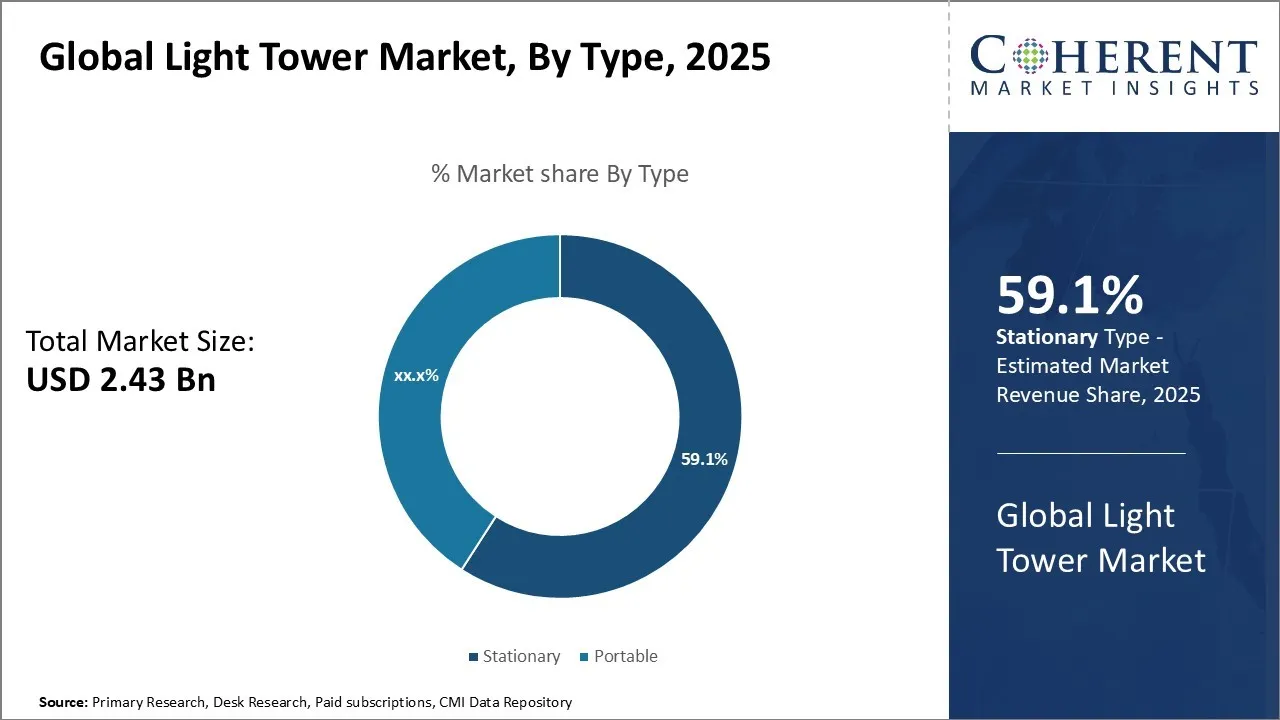
- The stationary segment is expected to account for 60.1% of the market in 2026, largely due to its remarkable stability and durable design, making it ideal for long-term use.
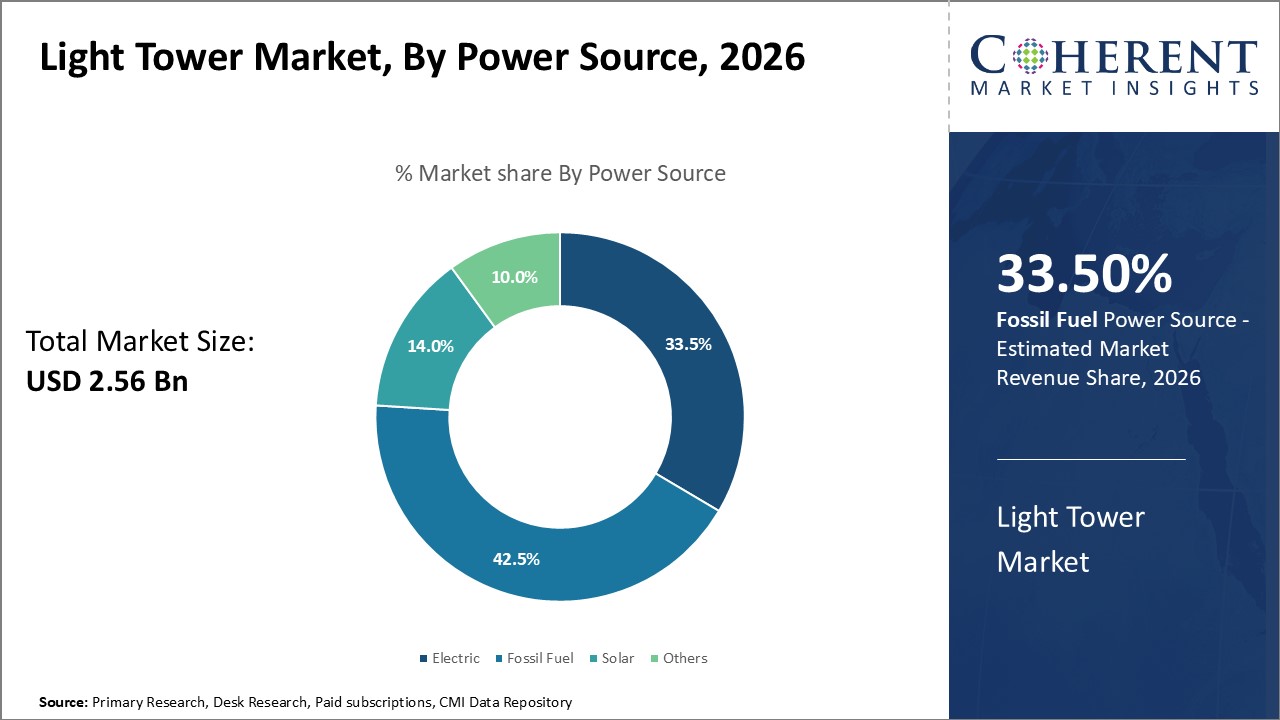
- The electric segment is projected to capture a 33.5% share of the market in 2026, driven by the increasing focus on energy efficiency and environmental sustainability across key end-use industries.
- The hydraulic segment is expected to dominate the market in 2026, with a 68.7% share, owing to its superior ease of operation and improved safety features compared to manual alternatives.
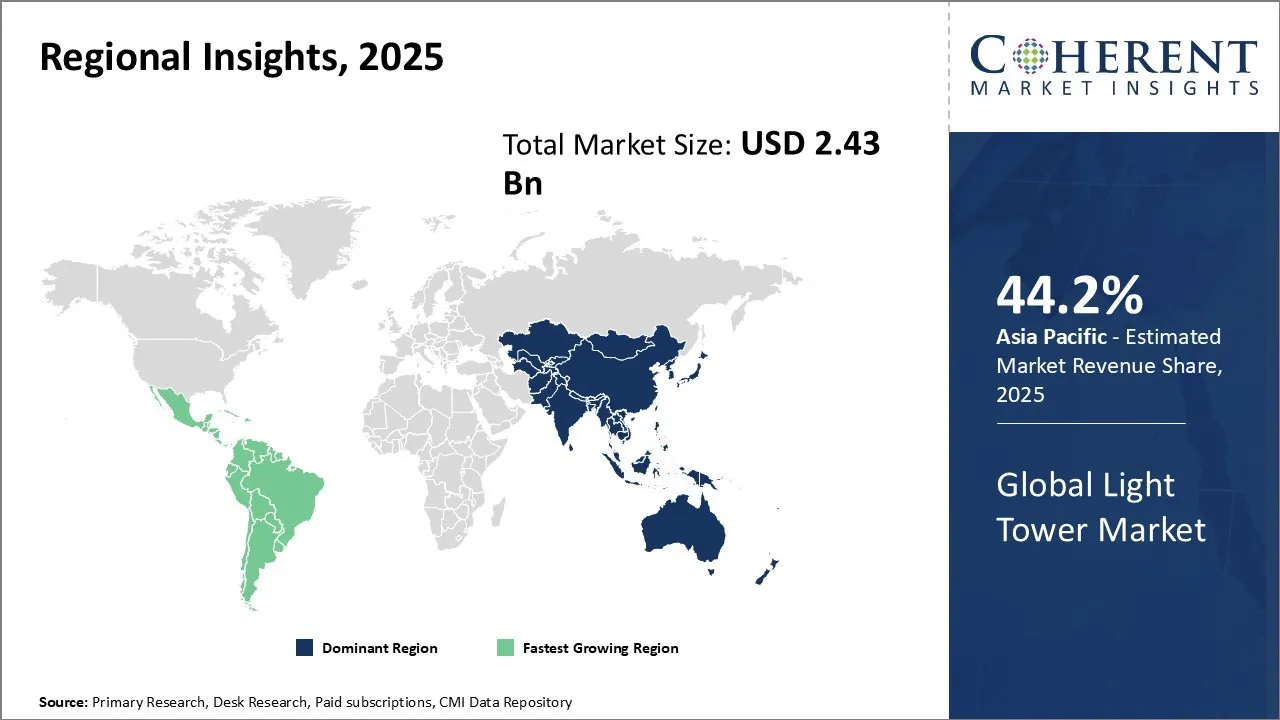
- Asia Pacific is set to lead the global light tower market in 2026 with a 44. 2% share, driven by rapid industrialization, construction activities, and infrastructure development. Latin America, with a 19.5% share, will be the fastest-growing region, fueled by increasing demand for temporary lighting solutions in construction and mining sectors, as well as rising government investments in infrastructure projects.
Market Overview
Key market trends include the rising adoption of eco-friendly, energy-efficient LED light towers and the integration of smart features such as remote monitoring and IoT connectivity. Additionally, growing emphasis on sustainability and regulatory compliance is prompting manufacturers to innovate around low-emission and solar-powered solutions, including the integration of solar PV panels, thereby enhancing operational efficiency and reducing environmental impact across various industries.
Currents Events and their Impact
Current Events | Description and its impact |
Infrastructure Investment Surge in Emerging Markets |
|
Transition to Sustainable and Energy-Efficient Technologies |
|
Segmental Insights
- Current Industry Events of 2026
- Market Size Estimation
- Regional Breakdown
- Competitive Landscape
- Customer Intelligence
- Segmental Analysis
- Pricing Analysis
- Key Market Drivers, Challenges & Future Trends
- Customized Insights Section
Light Tower Market Insights, By Type – Stationary Segment Dominates the Market due to their Stability and Robustness
The stationary segment is expected to hold 60.1% share of the market in 2026, primarily driven by its exceptional stability and robust design suited for long-term applications. Stationary light towers are engineered to remain fixed at a particular site, making them ideal for large-scale construction projects, industrial sites, and emergency response locations where continuous and reliable illumination is critical. The fixed nature of these light towers reduces the need for frequent repositioning, which consequently lowers operational disruptions and enhances productivity onsite.
One of the main factors encouraging the adoption of stationary light towers is their ability to support high-intensity lighting systems due to their sturdy framework. Their stable fixed base allows the mounting of more powerful lamp arrays compared to portable units, which often face limitations to maintain balance and safety during operation. This capability is essential in scenarios such as mining or offshore drilling where extensive illumination coverage is mandatory to ensure operational safety and efficiency during night hours or in low-light conditions.
Light Tower Market Insights, By Power Source – Electric Segment Leads due to Environmental Considerations and Efficiency
Electric segment is expected to hold 33.5% share of the market in 2026, owing to growing emphasis on energy efficiency and environmental sustainability in key end-use industries. Electric light towers are increasingly preferred as they offer cleaner and quieter operation compared to traditional fossil fuel-powered models, aligning with stricter environmental regulations and corporate sustainability goals. The rising awareness about reducing carbon footprints and minimizing noise pollution in urban and sensitive environments drives the demand for electric solutions in sectors such as events, municipalities, and urban construction.
Electric power sources also benefit from advancements in battery technology and increasing availability of grid electricity at job sites, allowing for longer operational hours without refueling hassles associated with diesel or gasoline alternatives. The ease of integrating electric light towers with renewable energy systems like solar power further enhances their appeal, making them adaptable to future shifts towards greener energy ecosystems. Operators appreciate the lower maintenance requirements of electric units due to fewer moving parts, which reduces operational expenses and unplanned downtime.
Light Tower Market Insights, By Lifting Method – Hydraulic Segment Dominates the Market due to Enhanced Efficiency and Safety
The hydraulic segment is projected to hold 68.7% share of the market in 2026, due to its superior ease of operation and enhanced safety features relative to manual alternatives. Hydraulic systems enable quick and precise extension or retraction of the mast with minimal physical effort, greatly improving operational efficiency on job sites. This mechanized approach considerably reduces the risk of injury associated with manual lifting, which often requires multiple personnel and exposes workers to strain or accidents during mast deployment. Safety is a paramount concern in the selection of lifting methods, and hydraulic technology addresses this by offering controlled, smooth mast movement with built-in fail-safes.
Regional Insights
Asia Pacific Light Tower Market Analysis and Trends
The Asia Pacific region is projected to lead the market with a 44.2% share in 2026, due to rapid urbanization, infrastructure development, and industrial expansion in emerging economies like India, China, and Southeast Asian nations. Government initiatives focused on improving public infrastructure, roadways, and construction activities, coupled with increasing investments in energy and mining sectors, contribute to the accelerating demand for portable and durable light towers.
Moreover, the growing manufacturing footprint of international and local companies such as Doosan Portable Power, SANY Group, and Jiangsu Hengtong Light Tower further strengthens the market ecosystem by enhancing product availability and cost competitiveness. Favorable trade policies and increasing adoption of smart, fuel-efficient technologies also underpin this region’s rapid growth trajectory.
Latin America Light Tower Market Analysis and Trends
The Latin America region is expected to exhibit the fastest growth in the market contributing 19.5% share in 2026, driven by the increasing demand for portable lighting solutions in the region’s growing infrastructure and construction sectors. Countries like Brazil, Mexico, and Argentina are experiencing significant investments in urbanization and road development, fueling the need for reliable and mobile lighting equipment on construction sites and during major events.
Government initiatives aimed at improving infrastructure, coupled with a growing focus on energy efficiency, further bolster the market's expansion. Local and international companies such as Atlas Copco, Generac, and JCB have been expanding their presence in the region, offering innovative, fuel-efficient light towers to cater to the diverse demands of the market. The shift towards cleaner and more sustainable energy solutions is also driving the adoption of solar-powered light towers, adding to the market's growth potential.
Light Tower Market Outlook for Key Countries
U.S. Light Tower Market Trends
The U.S. light tower market is characterized by high demand from construction, event management, and emergency services sectors, driven by pronounced regulatory frameworks around occupational safety and energy efficiency. Major companies like Generac and Allmand Bros. offer technologically advanced light towers incorporating LED lighting and remote management systems, meeting stringent emission standards and operational reliability expectations. The robust aftermarket ecosystem and leasing services available in the U.S. also facilitate easier access to light towers for short-term applications, enhancing market penetration.
China Light Tower Market Trends
China’s light tower market reflects remarkable expansion fueled by massive infrastructural projects, mining activities, and increasing urbanization. The government’s focus on smart city initiatives and infrastructure connectivity propels the demand for modern, fuel-efficient light towers. Domestic manufacturers such as SANY and Jiangsu Hengtong bolster market growth through cost-effective products tailored to local requirements, while international players continue to collaborate via joint ventures or technology transfers. Additionally, China’s extensive export activities influence regional trade dynamics by serving neighboring Asia Pacific markets with competitively priced products.
India Light Tower Market Trends
India continues to lead in the Asia Pacific region owing to sustained investment in industrial infrastructure, transportation networks, and renewable energy projects. Government programs aimed at enhancing rural electrification and road safety create steady demand for portable lighting solutions, including light towers. Companies like Doosan Portable Power and local manufacturers are expanding their presence through distribution networks and product customization to suit diverse climatic and operational conditions. The country’s emphasis on ‘Make in India’ policies also encourages domestic production, thereby reducing dependency on imports and stimulating innovation within the market.
Germany Light Tower Market Trends
Germany’s light tower market is driven by advanced industrial applications and rigorous environmental regulations emphasizing energy conservation and low emissions. The country hosts key regional players such as Wacker Neuson SE and Atlas Copco, which offer high-quality, technologically sophisticated light towers with intelligent control features. The strong automotive, construction, and event management sectors sustain demand, supplemented by governmental incentives promoting sustainable equipment. Additionally, Germany’s strategic position in Europe facilitates efficient trade and distribution across the continent, bolstering its market leadership within the region.
Brazil Light Tower Market Trends
Brazil’s light tower market experiences growth supported by expanding mining operations, agricultural mechanization, and energy infrastructure development. The government’s focus on improving rural infrastructure and addressing lighting needs in remote areas drives light tower adoption. International players like Generac and Terex collaborate with local distributors to offer reliable, rugged equipment suited for tropical and rugged environments. The country also benefits from favorable trade agreements within Latin America, allowing access to imported advanced technology and after-sales support pivotal for sustained market expansion.
End User Feedback and Unmet Needs in the Light Tower Market
Recurring Themes in User Feedback
- Product Performance: Users across the construction, mining, and event sectors consistently highlight the value of advanced LED and hybrid models for their energy efficiency, powerful illumination, and operational longevity. The advent of smart, remotely managed light towers has also been commended for enhancing onsite safety and reducing downtime, particularly in environments with variable lighting needs.
- Accessibility and Cost: A prevalent concern, particularly among small- and medium-sized enterprises (SMEs) and public sector operators, is the high initial investment associated with modern light towers, especially those featuring solar-hybrid systems or advanced controls. This financial barrier often restricts access to technological improvements and limits market penetration in cost-sensitive segments.
- Integration and Operational Challenges: End users desire seamless integration with existing site power sources, simplified maintenance procedures, and modular product architectures for customized deployment. Technical challenges such as downtime due to repairs, difficulties in operating advanced models, and the complexity of integrating smart features have been cited as operational pain points.
Despite Technological Progress, Several Unmet Needs Persist
- Technological Gaps: There is a demand for more affordable and easily maintainable hybrid (solar-diesel) and battery-powered models that retain high performance but reduce cost and complexity for users with limited technical resources.
- Customization and Modularity: Users seek flexible design options, such as interchangeable light heads or modular tower sections, to better align with varied site layouts and application-specific requirements.
Market Players, Key Development, and Competitive Intelligence
Key Developments
- In January 2024, Generac Mobile unveiled the GLT Series, a new range of mobile lighting towers focused on enhanced performance and sustainability. These towers are designed with compact structures, improved fuel efficiency, and reduced noise emissions, making them well-suited for urban and noise-sensitive areas. The GLT Series is available in both diesel and hybrid models, with optional LED lighting technology. This launch underscores Generac's dedication to providing innovative and eco-friendly equipment solutions.
- In December 2023, Atlas Copco Group introduced its first hybrid light tower, the HiLight HVT 500, which integrates both battery and diesel technologies. This model is engineered to reduce fuel consumption by up to 70% and significantly lower CO₂ emissions. It operates quietly in battery mode, making it perfect for urban and noise-sensitive locations. This launch demonstrates Atlas Copco's commitment to delivering sustainable and energy-efficient equipment solutions.
Top Strategies Followed by Global Light Tower Market Players
- Established market leaders tend to invest heavily in research and development (R&D) to innovate and deliver high-performance light tower products that meet the rigorous demands of industries such as construction, mining, and emergency services. These companies prioritize integrating advanced technologies like LED lighting, solar power options, and IoT connectivity to enhance operational efficiency and sustainability.
- For example, Generac Power Systems, Inc., a global leader in mobile power generation, has significantly advanced its light tower solutions by incorporating LED lighting, solar power, and IoT connectivity. These technologies not only enhance energy efficiency but also improve operational sustainability, allowing users to reduce their carbon footprints.
- Mid-level competitors in the global light tower market focus on balancing quality and affordability to appeal to price-sensitive customers who seek reliable yet cost-effective lighting solutions for temporary or demanding work environments. These players often emphasize efficient production techniques and lean operations to keep costs down without compromising essential features and durability. To enhance their capabilities and market reach, mid-level companies actively pursue collaborations with technology providers, component suppliers, or even larger firms to access innovations and scale their manufacturing.
- For example, Atlas Copco Group has introduced its HiLight HVT 500 hybrid light tower, combining battery and diesel technologies to reduce fuel consumption by up to 70%. This strategy allows Atlas Copco to cater to both price-conscious customers and those prioritizing environmental sustainability.
- Small-scale players and startups adopt a more specialized approach to compete in the global light tower market by focusing on niche segments or offering innovative, differentiated products that address unique customer requirements. Many of these companies integrate cutting-edge technologies—such as advanced battery storage, wireless control systems, or environmentally friendly materials—to stand out from established competitors and meet emerging regulatory standards.
Market Report Scope
Light Tower Market Report Coverage
| Report Coverage | Details | ||
|---|---|---|---|
| Base Year: | 2025 | Market Size in 2026: | USD 2.56 Bn |
| Historical Data for: | 2020 To 2024 | Forecast Period: | 2026 To 2033 |
| Forecast Period 2026 to 2033 CAGR: | 5.3% | 2033 Value Projection: | USD 3.67 Bn |
| Geographies covered: |
| ||
| Segments covered: |
| ||
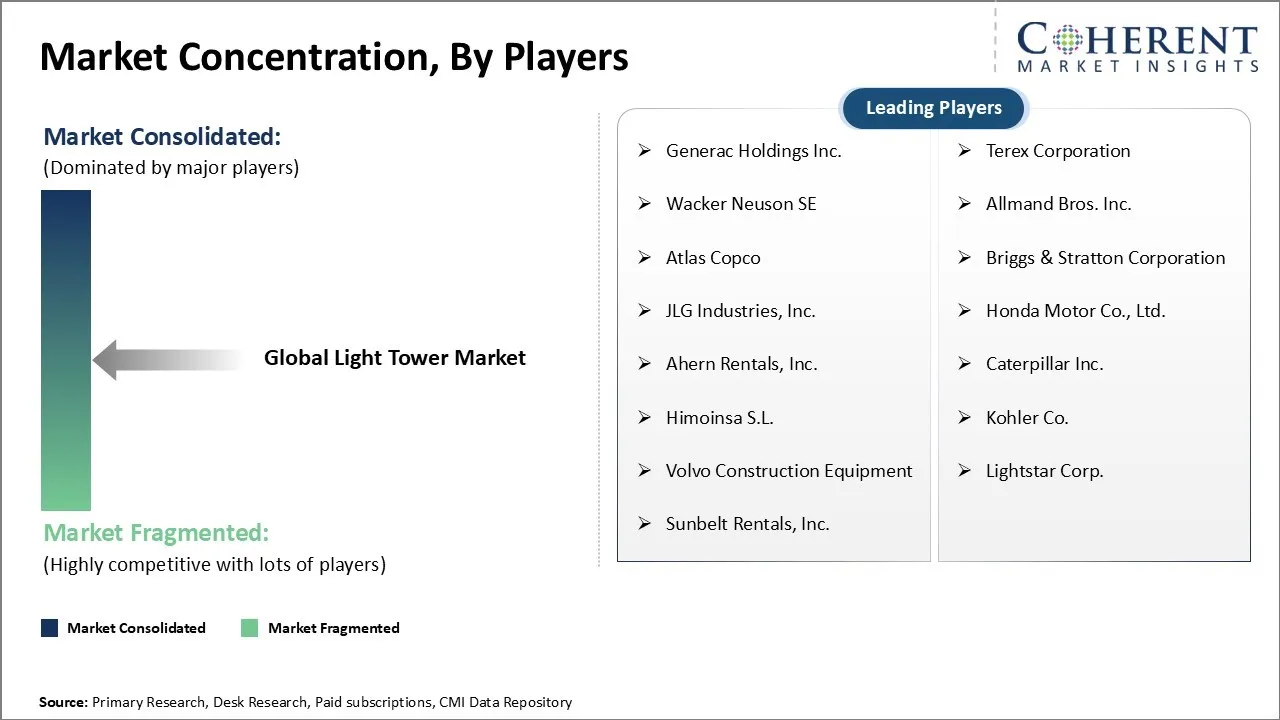
| Companies covered: | Generac Holdings Inc., Terex Corporation, Wacker Neuson SE, Allmand Bros. Inc., Atlas Copco, Briggs & Stratton Corporation, JLG Industries, Inc., Honda Motor Co., Ltd., Ahern Rentals, Inc., Caterpillar Inc., Himoinsa S.L., Kohler Co., Volvo Construction Equipment, Lightstar Corp., and Sunbelt Rentals, Inc. | ||
| Growth Drivers: |
| ||
| Restraints & Challenges: |
| ||
Light Tower Market Dynamics
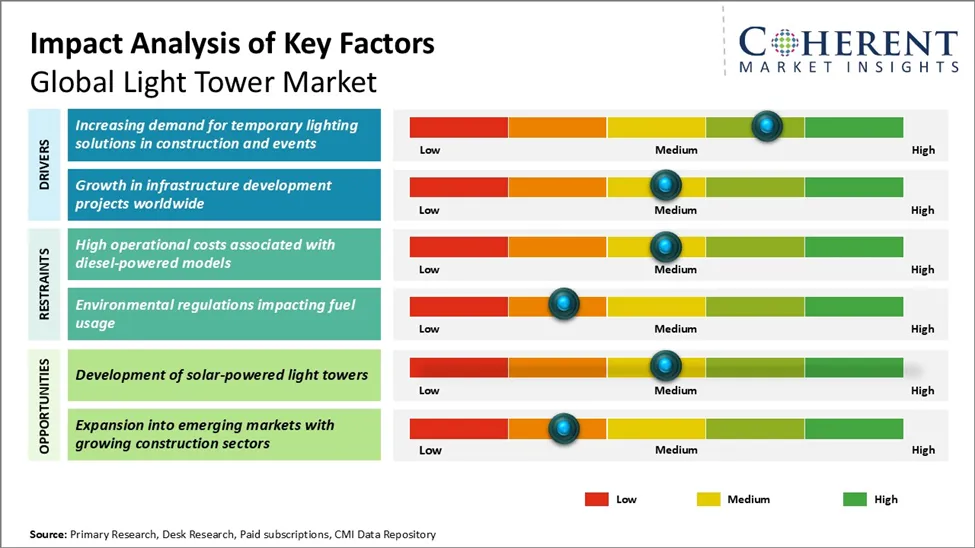
Light Tower Market Driver - Increasing Demand for Temporary Lighting Solutions in Construction and Events
The growing need for efficient and flexible lighting solutions in construction sites and event management has emerged as a key driver for the global light tower market. Construction projects, especially those extending into nighttime or low-light conditions, require reliable illumination to ensure worker safety, improve productivity, and meet stringent regulatory standards. Light towers offer a portable and easily deployable option, allowing for effective lighting without the need for permanent fixtures. Similarly, the event management industry increasingly relies on temporary lighting setups to cater to outdoor concerts, festivals, sports events, and emergency response situations.
As one of the largest construction projects in the U.S., this massive urban development required lighting solutions for construction work that often extended into the nighttime. The project used light towers to ensure proper illumination for workers, which was crucial for safety, preventing accidents, and meeting safety regulations.
Light Tower Market Opportunity - Development of Solar-Powered Light Towers for the Global Market
The global light tower market presents a significant opportunity through the development and adoption of solar-powered light towers, driven by increasing demand for sustainable and environment-friendly lighting solutions across various industries. Traditional light towers primarily rely on diesel engines, contributing to greenhouse gas emissions, fuel costs, and noise pollution. Solar-powered alternatives leverage photovoltaic technology combined with energy storage systems, offering a clean, silent, and cost-effective lighting solution.
For instance, Volvo has introduced a range of solar-powered light towers designed specifically for the construction industry. These solar-powered units use photovoltaic panels to generate power, providing a green alternative to conventional diesel-powered lighting. The solar-powered light towers have been particularly popular in large construction sites and mining operations where traditional fuel costs and emissions can be significant.
Analyst Opinion (Expert Opinion)
- The global light tower market is experiencing a dynamic shift, primarily driven by the growing demand for temporary lighting solutions in construction, events, and emergency response sectors. Insights from the International Construction and Utility Equipment Exposition (2023) and the Global Lighting Conference (2022) revealed a significant trend towards energy-efficient and solar-powered light towers.
- Companies like Atlas Copco are leading the way with innovative products that incorporate LED technology, which not only reduce energy consumption but also extend operational life. For instance, Atlas Copco’s recent launch of a hybrid light tower model exemplifies a commitment to sustainability while meeting the needs of diverse applications. Furthermore, discussions emphasized the importance of portability and ease of use in light tower designs, particularly for remote site operations.
- As regulations increasingly favor sustainable practices and energy efficiency, manufacturers that invest in advanced technologies and robust designs will likely capture a larger market share. Ultimately, the future of the light tower market hinges on innovation and the ability to adapt to evolving industry demands, further solidifying the role of light towers in enhancing safety and productivity across various sectors.
Speak to the analyst
Want personalized insights?
Take the findings above to one of our principal consultants, or have the report rebuilt around the segments, geographies and competitors you actually track.
Market Segmentation
- Type Insights (Revenue, USD Bn, 2021 - 2033)
- Stationary
- Portable
- Power Source Insights (Revenue, USD Bn, 2021 - 2033)
- Electric
- Fossil Fuel
- Solar
- Others
- Lifting Method Insights (Revenue, USD Bn, 2021 - 2033)
- Hydraulic
- Manual
- End-use Industry Insights (Revenue, USD Bn, 2021 - 2033)
- Construction
- Mining
- Events
- Emergency Services
- Others
- Regional Insights (Revenue, USD Bn, 2021 - 2033)
- North America
- U.S.
- Canada
- Latin America
- Brazil
- Argentina
- Mexico
- Rest of Latin America
- Europe
- Germany
- U.K.
- Spain
- France
- Italy
- Russia
- Rest of Europe
- Asia Pacific
- China
- India
- Japan
- Australia
- South Korea
- ASEAN
- Rest of Asia Pacific
- Middle East
- GCC Countries
- Israel
- Rest of Middle East
- Africa
- South Africa
- North Africa
- Central Africa
- North America
- Key Players Insights
- Generac Holdings Inc.
- Terex Corporation
- Wacker Neuson SE
- Allmand Bros. Inc.
- Atlas Copco
- Briggs & Stratton Corporation
- JLG Industries, Inc.
- Honda Motor Co., Ltd.
- Ahern Rentals, Inc.
- Caterpillar Inc.
- Himoinsa S.L.
- Kohler Co.
- Volvo Construction Equipment
- Lightstar Corp.
- Sunbelt Rentals, Inc.
Sources
Primary Research Interviews
- Product Development Manager – Leading Light Tower Manufacturer
- Procurement Head – Major Construction Equipment Distributor
- Sales Director – Global Rental Equipment Firm
- Energy Manager – Infrastructure Project Developer
Stakeholders
- Manufacturers
- End-Use Sectors
- Construction
- Mining & Quarries
- Oil & Gas Exploration (strong demand in North America, Middle East, Asia-Pacific)
- Events & Emergency Response (public events, disaster relief, military)
- Regulatory & Certification Bodies (e.g., OSHA, European Commission, various national safety authorities)
- E-commerce Platforms and Rental Providers
- Technology Integration Players Providers of telematics, smart control, and LED/solar hybrid lighting systems
Databases
- UN Comtrade Database
- India Import Export (EXIM) Database
Magazines
- International Rental News – Global construction/rental industry trends
- Construction Equipment Guide – Product innovations, end-use applications for light towers
- Power Equipment Trade – Advances in generator-powered light towers
- Energy & Mining International – Usage of light towers in mining and energy sectors
- Infrastructure Today – Market demand across large public works projects
Journals
- Journal of Construction Engineering and Management – Use cases and operational studies on portable site lighting
- International Journal of Lighting Research & Technology – Technology innovations (LED, solar, hybrid systems)
- IEEE Transactions on Industrial Electronics – Power system integration and energy efficiency in mobile lighting
- Renewable & Sustainable Energy Reviews – Assessments of solar/hybrid deployment in temporary lighting solutions
Newspapers
- The Financial Times – Global construction, infrastructure, and equipment market coverage
- The Wall Street Journal – M&A, financial results for major light tower market players and infrastructure spending trends
- Construction Week – Regional insights (Middle East, Asia Pacific)
- Mining Weekly – Updates on industry projects, safety, and operational requirements for lighting solutions
Associations
- Association of Equipment Manufacturers (AEM)
- International Powered Access Federation (IPAF)
- European Rental Association (ERA)
- American Rental Association (ARA)
- Construction Plant-hire Association (CPA, UK)
Public Domain Sources
- US Occupational Safety and Health Administration (OSHA)
- European Commission – Machinery and equipment safety regulations
- International Energy Agency (IEA) – Oil & gas project data, energy sector trends
- World Bank & OECD – Infrastructure investment statistics and mobility trends in construction equipment
Proprietary Elements
- CMI Data Analytics Tool, Proprietary CMI Existing Repository of information for last 8 years.
Get access to 250+ pages report
Every segment, forecast, competitor profile and data table behind the analysis above — available for instant download.
- ESOMAR Member
- ISO 9001:2015 Certified
- D-U-N-S Registered
- GDPR & CCPA Compliant
Missing comfort of reading report in your local language? Find your preferred language:
Transform your Strategy with Exclusive Trending Reports
Frequently Asked Questions
The global light tower market is estimated to be valued at USD 2.56 Bn in 2026 and is expected to reach USD 3.67 Bn by 2033.
Light towers are used for providing temporary illumination in outdoor areas, especially during construction, events, or emergencies.
The CAGR of global light tower market is projected to be 5.3% from 2026 to 2033.
Increasing demand for temporary lighting solutions in construction and events and growth in infrastructure development projects worldwide are the major factors driving the growth of the global light tower market.
High operational costs associated with diesel-powered models and environmental regulations impacting fuel usage are the major factors hampering the growth of the global light tower market.
In terms of type, stationary is estimated to dominate the market revenue share in 2026.
Generac Holdings Inc., Terex Corporation, Wacker Neuson SE, Allmand Bros. Inc., Atlas Copco, Briggs & Stratton Corporation, JLG Industries, Inc., Honda Motor Co., Ltd., Ahern Rentals, Inc., Caterpillar Inc., Himoinsa S.L., Kohler Co., Volvo Construction Equipment, Lightstar Corp., and Sunbelt Rentals, Inc. are the major players.