

Global Lithium Niobate Market Size and Forecast – 2026 to 2033
According to Coherent Market Insights, the global lithium niobate market is estimated to be valued at USD 4.87 Bn in 2026 and is expected to reach USD 8.03 Bn by 2033, expanding at a compound annual growth rate (CAGR) of 7.4% from 2026 to 2033.
Key Takeaways of the Lithium Niobate Market
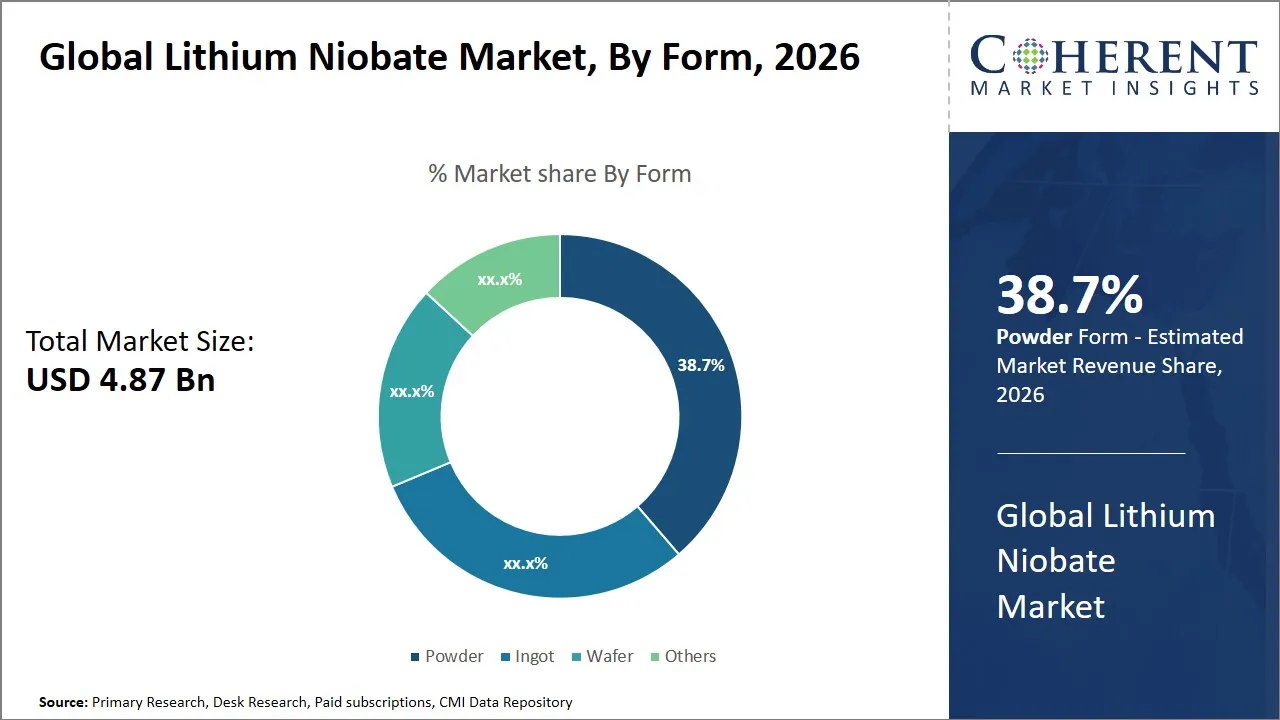
- Powder segment is expected to hold 38.7% of the global lithium niobate market share in 2026.
- Electronic grade segment is estimated to capture 45.9% of the market share in 2026.
- Telecommunications segment is projected to account for 31.9% of the lithium niobate market share in 2026.
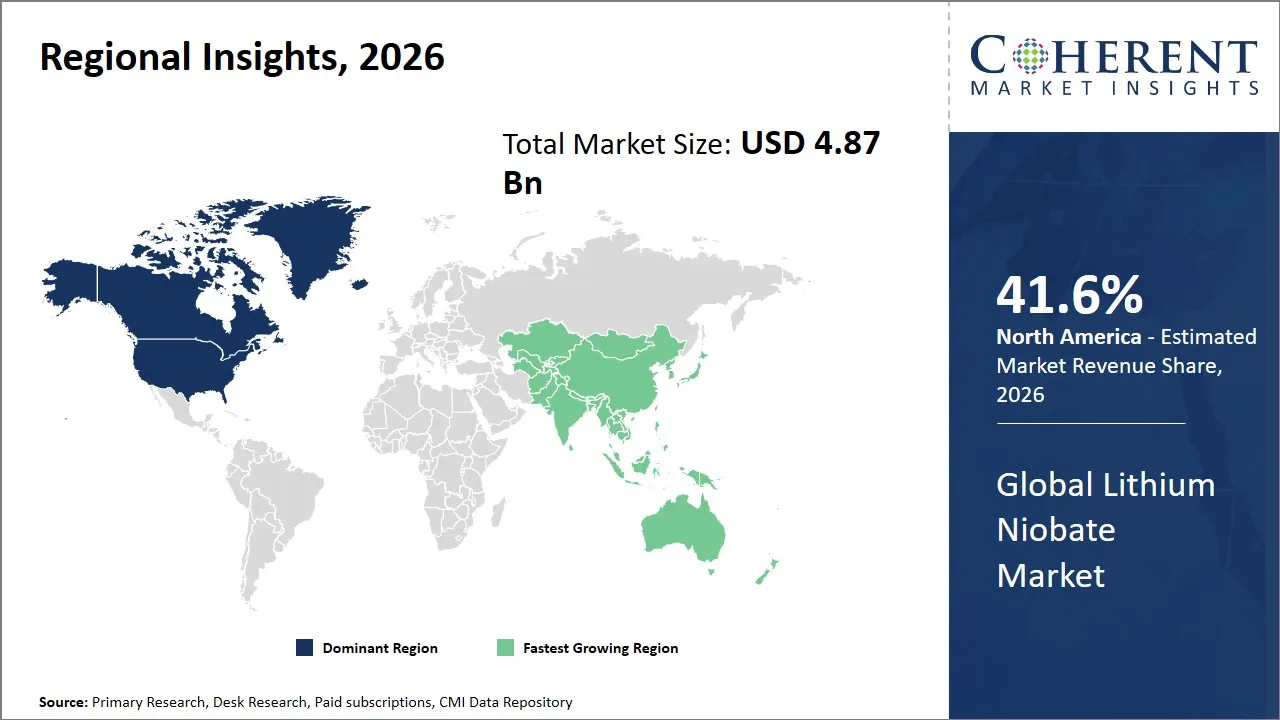
- North America is projected to lead the lithium niobate market with a 41.6% share in 2026.
- Asia Pacific will hold 23.3% share in 2026 and record the fastest growth.
Market Overview
- Market trends indicate a rising adoption of lithium niobate in advanced photonics and integrated optics, driven by the expansion of 5G networks and high-speed data transmission needs.
- Additionally, innovations in lithium niobate thin-film technology are boosting performance efficiencies, while growing investments in electric vehicles and green energy sectors further propel market expansion.
- Manufacturers are also focusing on developing cost-effective production methods to meet the rising demand sustainably.
Currents Events and Its Impacts
Current Events | Description and its Impact |
CSEM spun off CCRAFT as a dedicated TFLN photonic IC foundry (May 2025) |
|
ULVAC highlighted mass-production direction for TFLN etching/manufacturing equipment (October 2025) |
|
Segmental Insights
- Current Industry Events of 2026
- Market Size Estimation
- Regional Breakdown
- Competitive Landscape
- Customer Intelligence
- Segmental Analysis
- Pricing Analysis
- Key Market Drivers, Challenges & Future Trends
- Customized Insights Section
Why Does the Powder Segment Dominate the Global Lithium Niobate Market in 2026?
The powder segment is expected to hold 38.7% of the lithium niobate market share in 2026, due to its broad applicability and convenience in handling and processing. Being a crystalline substance that is extensively used in high-energy electronic and photonic applications, lithium niobate powder is a key raw material in the fabrication of wafers and ingots and other specialized items. The small particle size and high purity of the powders enable the manufacturers to be able to control precisely the material properties during the synthesis and subsequent growth processes, which is necessary to comply with very high performance requirements in end-use devices.
For instance, in the production of lithium niobate wafers used in telecommunications and data storage, the powder's ability to be precisely controlled in terms of particle size and purity is crucial. This precision allows manufacturers to produce devices with superior optical properties, such as electro-optic modulation, which are essential in high-speed communication systems like fiber-optic networks.
Why is Electronic Grade Lithium Niobate the Preferred Choice for High-Performance Electronic Applications?
Electronic grade segment is projected to hold 45.9% of the global lithium niobate market share in 2026, due to crystalline perfection necessary for cutting-edge electronic and optoelectronic devices. The increase in the significance of electronic grade in the market is attributed to its importance in the telecommunication infrastructure, integrated photonics, and signal processing technologies. Such applications require materials that have exceptional electro-optic, piezoelectric and nonlinear optical behavior that can only be ensured by rigorous grading.
The very rapid increases in data transmission and the worldwide transition to 5G and beyond have increased the demand for electronic grade lithium niobate components because they can modulate and control light signals with little losses and at high speeds unlike any other material. They generate optical modulators, frequency converters, and integrated waveguide devices that are the key to the contemporary networking and communication systems. As a result, the manufacturers are focusing on electronic grade lithium niobate in order to attain high reliability and efficiency of the devices.
Telecommunications Segment Dominates the Global Lithium Niobate Market
Telecommunications segment is projected to capture 31.9% of the lithium niobate market share in 2026, due to the increasing volume of data globally and the continued demand to have improved and higher-speed communication systems. Its outstanding electro-optic, nonlinear optical and piezoelectric properties render lithium niobates to be essential in the development of optical modulators, optical switches, and optical filters which are the foundation of fiber-optic communication systems. The devices allow fast transfer of data with little signal degradation when transferring long distances, which meet the important needs of the contemporary telecommunication networks.
The shift towards high bandwidth technologies, including 5G networks and data centers, increases the need to use lithium niobate-based components capable of supporting increasing signal modulation and multiplexing. The fact that it can be integrated into optical transceivers and modulators has offered it with good performance in low voltage operation, wide band and temperature stability. This is a technical competitive edge that is contributing greatly to the adoption in the telecommunications equipment production, which increases the market share of this application segment.
Regional Insights
North America Lithium Niobate Market Analysis and Trends
The North America region is projected to lead the market with a 41.6% share in 2026, propelled by its focus on cutting-edge applications including aerospace, defense, and next-generation photonics. The area boasts of strong innovation systems that are based in the United States where strategic government funding and initiatives have been made to facilitated higher research in the electro-optic material such as lithium niobate. In response to the increasing need to become smaller and faster, North American manufacturers are incorporating lithium niobate into high value products like quantum computing components, optical modulators, and LiDAR systems.
Trade also works in favor of domestic production as a result of changing supply chains preferences to minimize dependency on foreign imports, particularly those of Asian origin. The top corporations such as Coherent Inc., Gooch and housego and TRUMPF Photonics work on enhancing the quality of crystal and creating enhanced coatings to enhance their product features. Their partnerships with research institutes are able to speed up technological innovation and commercial implementation in various industries.
Asia Pacific Lithium Niobate Market Analysis and Trends
The Asia Pacific region is expected to exhibit the fastest growth in the market contributing 23.3% share in 2026, driven by a well-established manufacturing ecosystem, significant industry presence, and strong support from government policies aimed at advancing electronics and photonics sectors. China, Japan, and South Korea are a few of the high-technological manufacturers that have large depository of Lithium niobate that they use in optical communication equipment, sensors, and acoustic wave filters. The supply chains and large R&D bases are advantageous to the region, which is supported by government efforts to encourage innovation in materials science and semiconductor technologies.
In addition, import-export synergies in Asia Pacific contribute to maintaining stable flow of raw materials which enhances stability in the market. Individual firms like Hengtong Optoelectronics (China), Shin-Etsu Chemical (Japan) and LG Innotek (South Korea) play a key role in product development and market penetrations across Asia Pacific. The contribution of these companies is in high crystal growth technology and diversification in the end user segment such as in telecommunications and consumer electronics.
Global Lithium Niobate Market Outlook for Key Countries
What is the Reason behind China Lithium Niobate Market’s Dominance?
The market of China lithium niobate is a decisive force in the Asia Pacific region, supported by its leading level of manufacturing capacities and strategic investments in the infrastructure of photonics. Large Chinese companies like Hengtong Optoelectronics make use of the large supply chain networks and government supported projects to improve production efficiency and innovation. The focus of 5G networks and optical communication in Chinas will lead to high demand of lithium niobate wafers and devices. Also, the policies that encourage the development of advanced materials and facilitation of exports help Chinas to achieve competitive position such that it allows local firms to scale up and compete at the global level.
What are the Key Trends Driving the U.S. Lithium Niobate Market in High-Technology Applications?
High-technology applications and material innovation remain the core focus of the U.S. in the development of the lithium niobate market. The ground-breakers of the high-purity lithium niobate crystals production include American businesses such as Gooch and Housego and Coherent Inc. that are utilized in defense, aerospace, and quantum photonics. Indeed, government awards and partnership with academic organizations encourage continued research in crystal engineering and miniaturization of the device that stretches limits. The tightening production in the U.S. market is also an advantage of the region in case of the global uncertainties, which may affect the supply chain critically.
Japan Lithium Niobate Market Trends
The position of Japan as a major lithium niobate market in the Asian Pacific region is based on their technological mastery and the decades of experience in the production of crystals. Other companies like Shin-Etsu Chemical and Fujifilm have also played a major role in advancing the method of synthesis and the increase of the applications to an end-use in the telecommunications and consumer electronics.
Japan government encourages innovation by funding and collaboration that emphasizes on next-generation materials to enable it sustain the competitive advantage in the country. The quality and precision manufacturing approach of the country adds reliability and preference of products in the market both locally and internationally.
South Korea Lithium Niobate Market Trends
The lithium niobate market of South Korea owes its success to the strong electronics and telecommunications industries. Optical systems are engaged in R&D by companies such as LG Innotek, which is designing customized lithium niobate component that can be used in mobile devices. South Korea enjoys the advantage of active state strategies in the development of semiconductor and other advanced materials, which promote the collaboration of the private and the government. Trade policies that support exportation and importation processes also promote accessibility to raw materials and international markets, which support constant growth in the country.
Germany Lithium Niobate Market Trends
Germany is one of the European markets where lithium niobate finds a good application in automotive sensors, industries, and photonics instruments. Established firms such as TRUMPF Photonics are leading precision crystal processing and integrated photonic solution providers. The strategic position in Europe also contributes to effective trade and distribution in the whole of Europe, which makes Germanys a strong regional center.
Supply Chain Concentration & Single-Source Risk
Dataset Pointer | Explanation | Market Implication |
Raw Material Source Concentration | Lithium and niobium inputs are sourced from a limited number of mining regions and refiners globally | Geographic disruptions can quickly impact lithium niobate crystal production |
Limited Crystal Growers | High-purity lithium niobate crystal growth is controlled by a small group of specialized manufacturers | Creates supply bottlenecks and pricing power for leading suppliers |
Wafer & Component Fabrication Dependency | Device manufacturers often rely on a few suppliers for wafers and optical components | Supply disruption delays telecom and photonics equipment manufacturing |
Market Players, Key Development, and Competitive Intelligence
Key Developments
- In January 2026, Theon International finalized the acquisition of a 9.8% stake in Exosens SA for US$ 311 million (€ 268.7 million). Announced in October 2025, the transaction secured a strategic supply chain for Theon’s night vision products. The deal reinforced the long-standing commercial partnership between the companies, including an extended supply agreement through 2030.
- In December 2025, Hamamatsu Photonics introduced the HyperGauge In-Plane Film Thickness Meter (Model C17319-11) to enhance semiconductor manufacturing productivity. The device enables full-surface, high-speed film thickness measurements, improving quality control and throughput. This launch highlights the company’s leadership in precision materials and photonics technology innovation.
- In December 2025, NTT Research, collaborating with Cornell and Stanford, published in Nature Physics a lithium niobate-based 2D programmable photonic waveguide offering around 10,000 spatial degrees of freedom for precise light wave control. The simply fabricated chip, programmed via illumination patterns as virtual electrodes, performed all-optical neural network inference, enabling complex optical computations for datacenters, communications, and beyond.
Top Strategies Followed by Global Lithium Niobate Market Players
Player Type | Strategic Focus | Example |
Established Market Leaders | Heavy investment in R&D and innovation | For example, companies such as Sumitomo Osaka Cement and Jinan Jingzheng Electronics still continue to expand wafer production and to advance thin-film lithium niobate platforms in high-speed optical communication modules and next-generation photonic integrated circuits. |
Mid-Level Players | Balance cost and sustainability | For example, firms like HC Photonics and Red Optronics are supplying lithium niobate crystals and modulators specifically designed to work with laser systems and laboratory use at a cost-effective price, without significant performance loss. |
Small-Scale Players | Niche specialization & innovative variants | For instance, Xiamen Powerway Advanced Material Co. Ltd. focuses on producing specialized lithium niobate crystals for non-linear optics and quantum computing applications. These products are tailored to meet the exacting standards of niche markets like quantum optics and photonic crystal development, areas that may be underserved by larger market players. |
Market Report Scope
Lithium Niobate Market Report Coverage
| Report Coverage | Details | ||
|---|---|---|---|
| Base Year: | 2025 | Market Size in 2026: | USD 4.87 Bn |
| Historical Data for: | 2020 To 2024 | Forecast Period: | 2026 To 2033 |
| Forecast Period 2026 to 2033 CAGR: | 7.4% | 2033 Value Projection: | USD 8.03 Bn |
| Geographies covered: |
| ||
| Segments covered: |
| ||
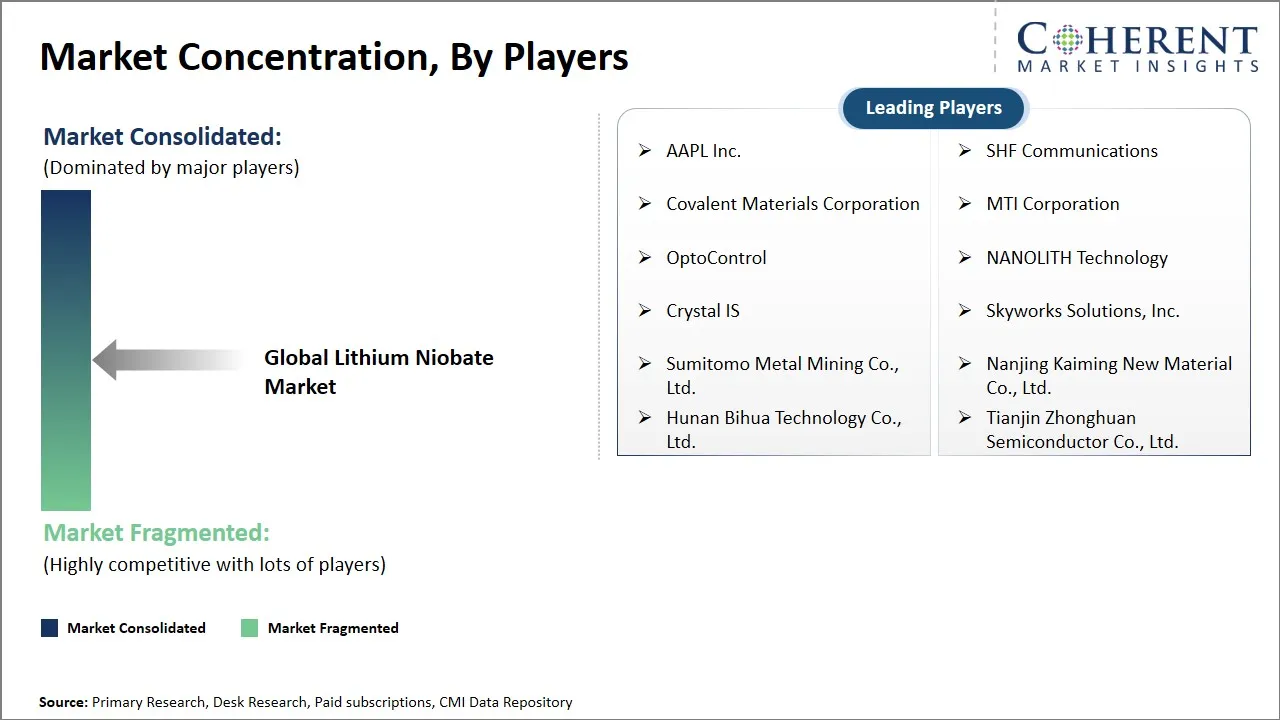
| Companies covered: | AAPL Inc., SHF Communications, Covalent Materials Corporation, MTI Corporation, OptoControl, NANOLITH Technology, Crystal IS, Skyworks Solutions, Inc., Sumitomo Metal Mining Co., Ltd., Nanjing Kaiming New Material Co., Ltd., Hunan Bihua Technology Co., Ltd., and Tianjin Zhonghuan Semiconductor Co., Ltd. | ||
| Growth Drivers: |
| ||
| Restraints & Challenges: |
| ||
Lithium Niobate Market Dynamics
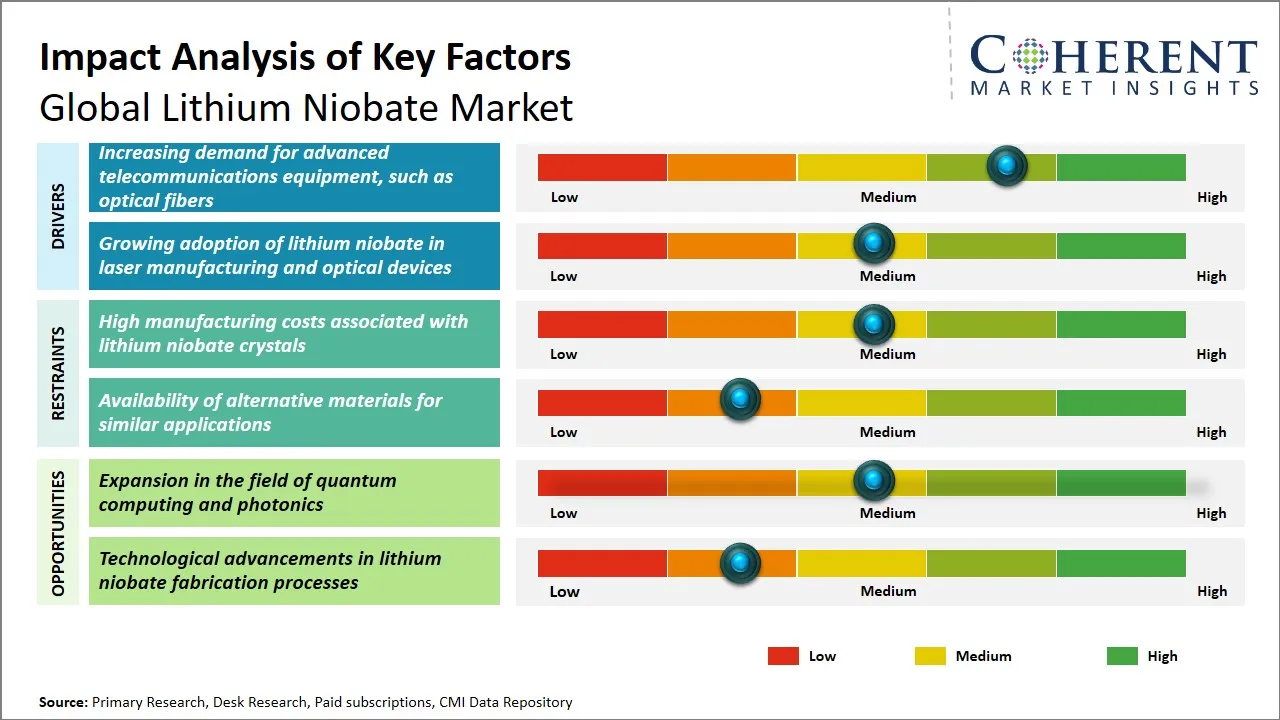
Lithium Niobate Market Driver - Increasing Demand for Advanced Telecommunications Equipment, Such as Optical Fibers
The increasing requirements of high speed and dependable communication networks have played a key role in stimulating the demand of advanced telecommunications equipment that are in turn facilitating the expansion of lithium niobate market. Lithium niobate is an essential element of the modern telecommunication, telecom towers infrastructure since it is the basis of optical fibers, which demand high levels of nonlinear and piezoelectric characteristics. Such properties allow an effective modulation and signal processing, so lithium niobate is essential in the devices of modulation, waveguide, and frequency converter in the fiber optic communication mode.
For example, lithium-niobate-based modulators used in coherent optical transmission systems by Companies like Huawei, Nokia, and Ciena to transmit very high-speed data and data rates (greater than 400G to 800G per channel) are used in data centers, cloud computing, and backbone networks.
Lithium Niobate Market Opportunity - Expansion in the Field of Quantum Computing and Photonics
Lithium niobate has a major growth prospect in the global market due to the emerging developments in quantum computing and photonics. The material, lithium niobates, has exceptional electro-optic, nonlinear optical, and piezoelectric characteristics, essential in the creation of photonic integrated circuits (PICs), important components in quantum computing systems and enhanced photonics systems. With the growing proximity of quantum computing to commercial viability, there is a growing need to have high-performing, stable, and scalable materials to support low-energy quantum information processing and communication.
As an example, lithium niobate systems are being used by Firms and research groups, including Intel Labs, Xanadu and multiple European quantum research groups, to construct photonic quantum processors and secure quantum communication systems, where lithium niobate material can be used to enable ultra-fast optical switching, quantum signal modulation and efficient photon generation needed by next-generation quantum computing and photonic networks.
Analyst Opinion (Expert Opinion)
- Lithium niobate market is currently undergoing a boom period as the substance is finding more and more uses in case of telecommunications, aerospace and electronics because of its special electro-optic characteristics. The International Conference on Advanced Photonics (2023) and the Lithium-Ion Battery Summit (2022) provided these insights, with such companies as Nisshinbo Chemical and Korthite being the first to make progress in lithium niobate-based components.
- The introduction of high-performance lithium niobate waveguides to optical communications by Nisshinbos is just an example of how the industry is experiencing the need to improve the efficiency and bandwidth of communication systems. At conferences, miniaturization and lithium niobate devices integration were discussed as the next-generation photonic applications as well as in data centers and 5G telecommunications are increasingly in demand.
- Nevertheless, the fact that production costs were high, and specialized manufacturing technologies were often required was commonly mentioned as an impediment to further adoption. Businesses investing in research and development and concentrating on scalable production with the help of technological companies to design solutions are likely to have an advantage over their competitors. Finally, the expansion of the lithium niobate market will rely on the sustained innovativeness and its capacity to address the dynamic demands of the high-tech critical applications in communications among others.
Speak to the analyst
Want personalized insights?
Take the findings above to one of our principal consultants, or have the report rebuilt around the segments, geographies and competitors you actually track.
Market Segmentation
- Form Insights (Revenue, USD Bn, 2021 - 2033)
- Powder
- Ingot
- Wafer
- Others
- Grade Insights (Revenue, USD Bn, 2021 - 2033)
- Electronic Grade
- Industrial Grade
- Agricultural Grade
- Application Insights (Revenue, USD Bn, 2021 - 2033)
- Telecommunications
- Optical Devices
- Industrial Automation
- Consumer Electronics
- Others (e.g., medical devices, sensors)
- Regional Insights (Revenue, USD Bn, 2021 - 2033)
- North America
- U.S.
- Canada
- Latin America
- Brazil
- Argentina
- Mexico
- Rest of Latin America
- Europe
- Germany
- U.K.
- Spain
- France
- Italy
- Russia
- Rest of Europe
- Asia Pacific
- China
- India
- Japan
- Australia
- South Korea
- ASEAN
- Rest of Asia Pacific
- Middle East
- GCC Countries
- Israel
- Rest of Middle East
- Africa
- South Africa
- North Africa
- Central Africa
- North America
- Key Players Insights
- AAPL Inc.
- SHF Communications
- Covalent Materials Corporation
- MTI Corporation
- OptoControl
- NANOLITH Technology
- Crystal IS
- Skyworks Solutions, Inc.
- Sumitomo Metal Mining Co., Ltd.
- Nanjing Kaiming New Material Co., Ltd.
- Hunan Bihua Technology Co., Ltd.
- Tianjin Zhonghuan Semiconductor Co., Ltd.
Sources
Primary Research Interviews
- CEO – Leading Lithium Niobate Crystal Producer (e.g., Stanford Advanced Materials or American Elements equivalent)
- Supply Chain Director – Major Photonic Materials Distributor
- Production Lead – Thin-Film Lithium Niobate Manufacturer
- Sustainability Officer – Lithium Niobate Certification Authority
Stakeholders
- Manufacturers
- End-use Sectors
- Telecommunications (Optical Modulators, SAW Devices)
- Electronics & Photonics Producers
- Healthcare (Medical Imaging, Sensors)
- Regulatory & Certification Bodies (e.g., EPA TSCA for lithium niobate, REACH compliance in EU)
- E-commerce Platforms and Retailers (Alibaba, Industrial Suppliers, Sigma-Aldrich, Merck)
- Technology Integration Players: Thin-film photonics and integrated optics producers using lithium niobate
Databases
- UN Comtrade Database (HS codes for inorganic compounds incl. niobates)
- India Import Export (EXIM) Database
- USGS Mineral Commodity Summaries (Lithium, Niobium-related)
- Eurostat Trade Statistics for Chemicals
Magazines
- Photonics Spectra – Trends in lithium niobate photonics
- Laser Focus World – Lithium niobate in optical devices
- Advanced Photonics – Lithium niobate thin-film applications
- Industrial Minerals – Market dynamics for lithium niobate crystals
- Optics & Photonics News – Integrated photonics innovations
Journals
- ACS Photonics – Lithium niobate meta-optics and photonics
- Science – Lithium niobate photonics review
- Journal of Materials Science – Lithium niobate crystal synthesis
- Advanced Photonics – Thin-film lithium niobate lasers
- Optics Express – Electro-optic applications of lithium niobate
Newspapers
- The Wall Street Journal – Global photonics demand for lithium niobate
- Business Standard (India) – Specialty chemicals imports and Asia photonics growth
- Reuters – Supply chain in advanced materials like lithium niobate
- Chemical Week – Disruptions in crystal production
Associations
- International Photonics Society (or equivalent)
- IEEE Photonics Society
- Optica (formerly Optical Society of America)
- European Photonics Industry Consortium (EPIC)
- Society of Photo-Optical Instrumentation Engineers (SPIE)
- Green Photonics Initiative
Public Domain Sources
- EPA – TSCA guidelines for lithium niobate (LiNbO3)
- European Commission – REACH regulations on lithium niobate
- World Health Organization – Safety standards for niobium compounds
- USGS – Niobium and lithium statistics and trade assessments
- OECD – Critical raw materials trade reports (incl. niobium)
Proprietary Elements
- CMI Data Analytics Tool
- Proprietary CMI Existing Repository of information for last 8 years.
Get access to 250+ pages report
Every segment, forecast, competitor profile and data table behind the analysis above — available for instant download.
- ESOMAR Member
- ISO 9001:2015 Certified
- D-U-N-S Registered
- GDPR & CCPA Compliant
Missing comfort of reading report in your local language? Find your preferred language:
Transform your Strategy with Exclusive Trending Reports
Frequently Asked Questions
The global lithium niobate market is estimated to be valued at USD 4.87 Bn in 2026 and is expected to reach USD 8.03 Bn by 2033.
Lithium niobate is a crystalline material with exceptional electro‑optic, acousto‑optic, and nonlinear optical properties, widely used in telecommunications, photonics, sensors, and piezoelectric devices.
The CAGR of global lithium niobate market is projected to be 7.4% from 2026 to 2033.
Increasing demand for advanced telecommunications equipment, such as optical fibers and growing adoption of lithium niobate in laser manufacturing and optical devices are the major factors driving the growth of the global lithium niobate market.
High manufacturing costs associated with lithium niobate crystals and availability of alternative materials for similar applications are the major factors hampering the growth of the global lithium niobate market.
In terms of form, powder is estimated to dominate the market revenue share in 2026.
AAPL Inc., SHF Communications, Covalent Materials Corporation, MTI Corporation, OptoControl, NANOLITH Technology, Crystal IS, Skyworks Solutions, Inc., Sumitomo Metal Mining Co., Ltd., Nanjing Kaiming New Material Co., Ltd., Hunan Bihua Technology Co., Ltd., and Tianjin Zhonghuan Semiconductor Co., Ltd. are the major players.