

Global Logic Semiconductor Market and Forecast – (2026-2033)
Coherent Market Insights estimates that the global logic semiconductor market stood at USD 147 Bn in 2025 and will expand to USD 225 Bn by 2033, registering a CAGR of 5.5% between 2026 and 2033.
Key Takeaways of the Logic Semiconductor Market
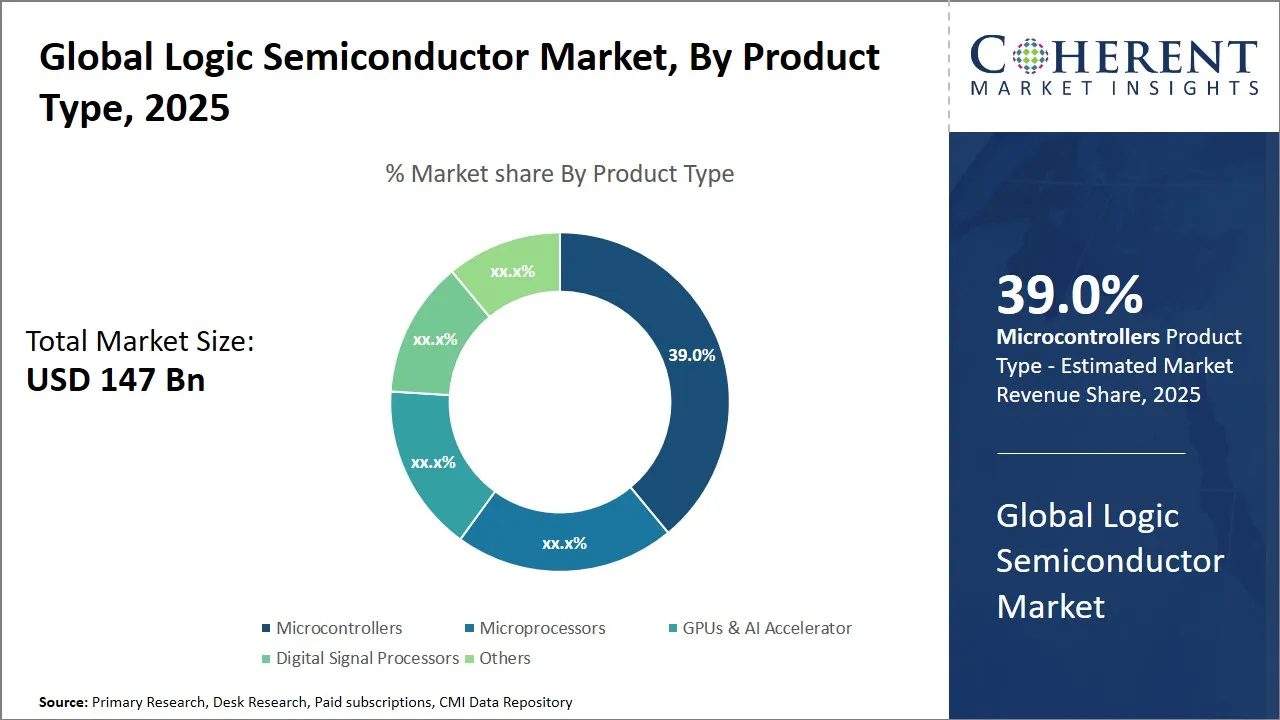
- The microcontrollers segment accounted for 39% of the logic semiconductor market share in 2025.
- The mature nodes (above 28 nm) segment captured 41.5% of the market share in 2025.
- The consumer electronics segment held 36.3% of the global logic semiconductor market share in 2025.
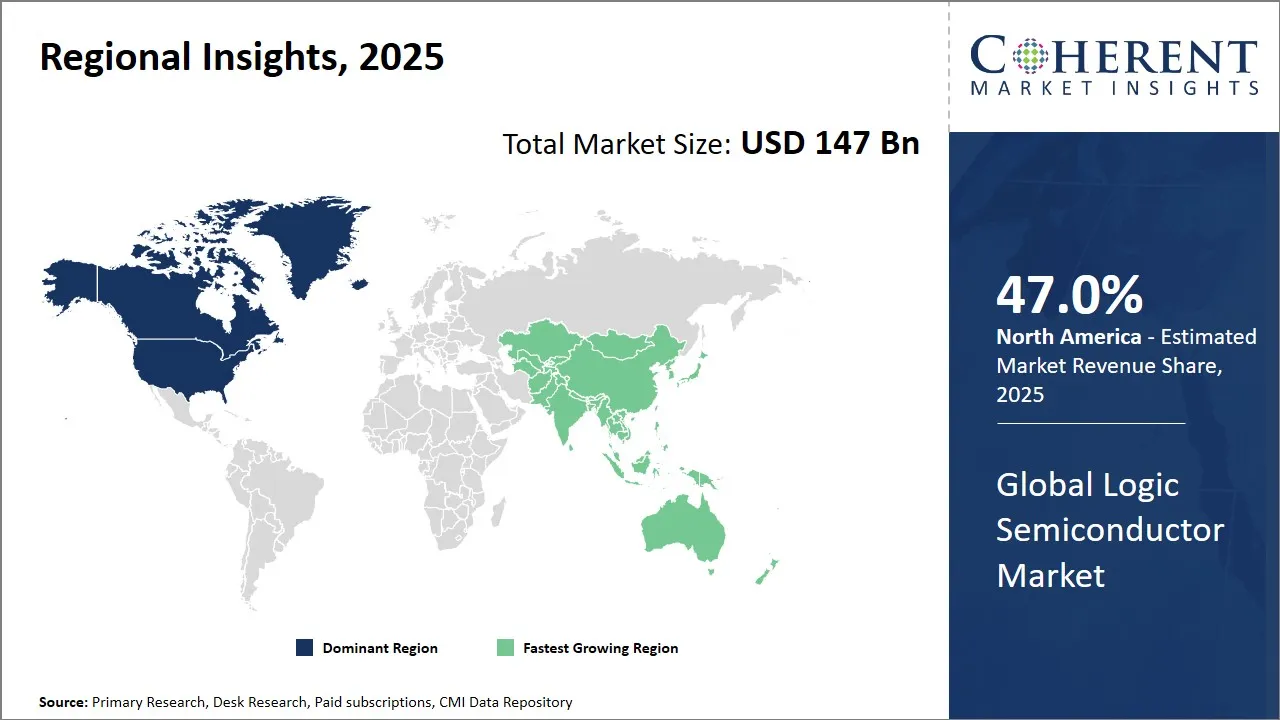
- North America dominated the logic semiconductor market in 2025 with a 47%
- Asia Pacific held 21% share in 2025 and recorded the fastest growth.
Currents Events and Its Impact
Current Events | Description and its Impact |
Intel Platform Launch |
|
Segmental Insights
- Current Industry Events of 2026
- Market Size Estimation
- Regional Breakdown
- Competitive Landscape
- Customer Intelligence
- Segmental Analysis
- Pricing Analysis
- Key Market Drivers, Challenges & Future Trends
- Customized Insights Section
Why Does Microcontrollers Segment Dominate the Global Logic Semiconductor Market in 2025?
The microcontrollers segment accounted for 39.0% of the global logic semiconductor market share in 2025. A major reason behind the growth is how easily these chips adapt, combining multiple roles within a small, affordable design. Microcontrollers are essential in their role of overseeing electronics, whether in basic home tools or advanced factory equipment.
For instance, on November 18, 2025, STMicroelectronics launched the STM32V8, a new generation of high-performance microcontrollers (MCUs) for demanding industrial applications.
Mature Nodes (Above 28 nm) Segment Dominate the Global Logic Semiconductor Market
The mature nodes (above 28 nm) segment held 41.5% of the market share in 2025. A reason behind this growth lies in lower expenses, consistent production output, and stability of established methods. Although newer process nodes allow more transistors per area, difficulties arising from complex fabrication steps influence decisions. High price tags tied to cutting-edge techniques push industries toward older alternatives.
Why is Consumer Electronics the Most Widespread End User in the Logic Semiconductor Market?
The consumer electronics segment captured 36.3% of the logic semiconductor market share in 2025. Expansion unfolds as smart, connected devices spread globally. When performance expectations rise, better circuits follow in response. Phones, wearables, home helpers, and media players carry advanced chips today. Improved capabilities meet actual demands, not only what technology allows. What people require shapes progress more than what engineers can build.
For instance, on October 15, 2025, Apple unveiled the M5 silicon chip, intended for use across Macs, iPads, and Vision Pro devices. With construction rooted in a refined 3 nm architecture, processing power joins graphics performance alongside neural computation within one unified chip structure.
EDA & IP Stack Dependency Mapping
Metric | Data / Value |
Top EDA Vendors Market Share | ~31% Synopsys, ~30% Cadence, ~13% Siemens EDA |
Combined Dominance of Top 3 EDA Players | ~75% total share |
EDA Annual License Cost (Advanced Node) | >USD 1M per seat (advanced suite) |
SMB Access to Full EDA Solutions | ~15% of startups can afford full featured toolchains |
EDA Vendor IP Revenue Influence | ~70% of global IP market accounted by top IP suppliers |
Estimated reliance on U.S. EDA tools | >60% of global chip design workflows depend on U.S. EDA |
Regional Insights
North America Logic Semiconductor Market Analysis and Trends
North America accounted for a market share of 47% in 2025. Driven largely by a robust network for technological advancement, the rise stems from influential fabless chip developers alongside active governmental backing for local fabrication efforts. Boosted through legislative moves that favor homegrown output and more resilient sourcing channels, such as those seen under the U.S. CHIPS initiative, investment has climbed across the U.S. and Canada.
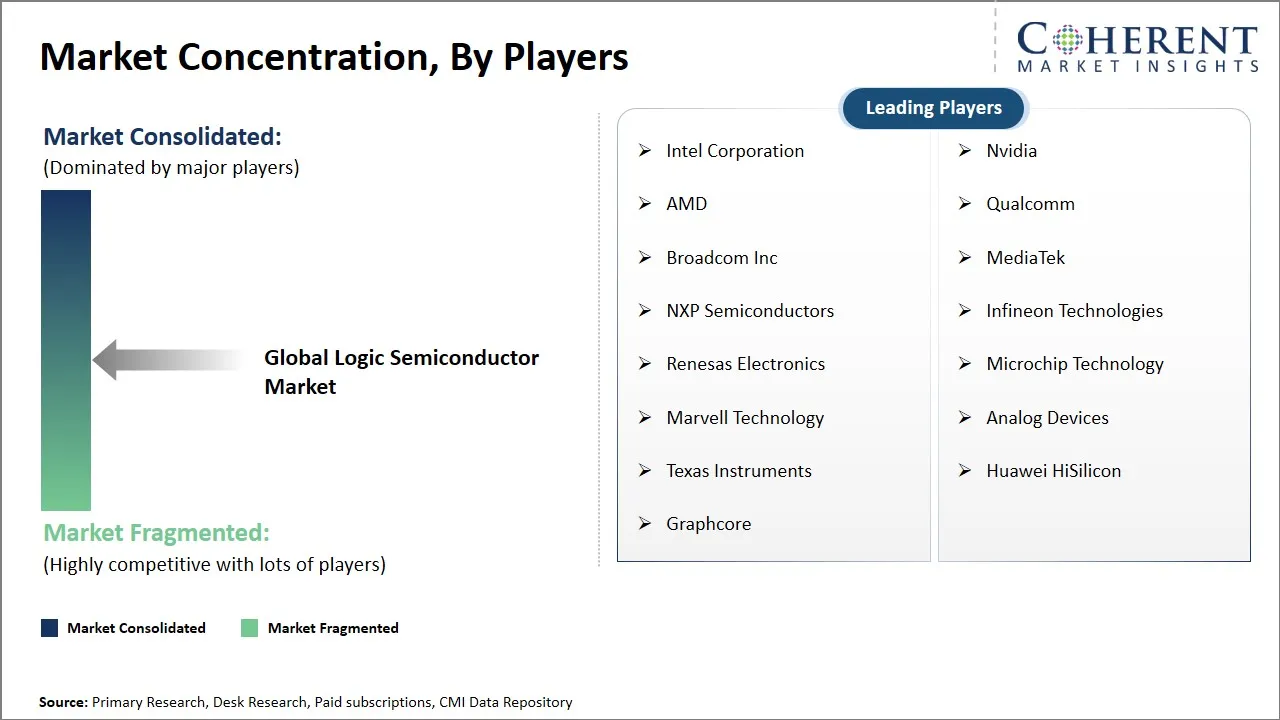
Firms including Intel, NVIDIA, AMD, and Qualcomm set direction in logic design, high-speed computation, and intelligent systems, shaping much of the regional momentum. Innovation speeds ahead where entrepreneurial ventures flourish and collaboration between research institutions and enterprises is common practice. Growth shows most clearly within focused areas of advanced digital processing hardware.
Asia Pacific Logic Semiconductor Market Analysis and Trends
Asia Pacific accounted for a market share of 21% in 2025 and registered the fastest growth rate over the forecast period. Driven primarily by a mature manufacturing base, expansion stems from widespread semiconductor fabrication and design operations across key nations. While Taiwan, Japan, South Korea, and China anchor production activities, their roles span packaging, testing, and complex wafer fabrication processes. Backed by dense supplier networks, these locations maintain operational continuity underpinned by regional coordination. Government strategies prioritizing technological advancement enable sustained funding flows into research facilities and next-generation development projects. Initiatives in China emphasize domestic chip independence, whereas policy direction in South Korea emphasizes breakthroughs in processing architecture.
Leading firms including Samsung Electronics, TSMC, and Sony Semiconductor shape output levels through precision engineering and scaled logic device creation. Trade patterns across the Asia Pacific reinforce influence, moving high-volume units abroad where demand remains steady within electronic devices, transportation systems, and automated equipment sectors.
Global Logic Semiconductor Market Outlook for Key Countries
Is Taiwan the Next Growth Engine for the Logic Semiconductor Market?
In Taiwan, the logic semiconductor market holds major influence within international supply chains, led by TSMC. What sets the company apart is its early mastery of cutting-edge chip manufacturing methods - this strength defines the region's reputation. Backed by state-driven incentives and upgraded facilities, the local industry gains consistent momentum. Progress continues as technological refinement takes priority alongside production growth. Resilience in output shapes how worldwide markets receive these critical components.
South Korea Logic Semiconductor Market Analysis and Trends
South Korea relies on Samsung Electronics and SK Hynix to power its logic chip industry. Because it controls production from start to finish, Samsung moves fast while streamlining operations. Backed by state investment, research initiatives grow alongside factory development plans. Trade thrives globally due to strong overseas demand for these electronic components.
Why is U.S. Emerging as a Major Hub in the Logic Semiconductor Market?
Among those shaping the U.S. logic semiconductor market are firms without fabrication facilities like NVIDIA and AMD stand out, while others, like Intel, handle both design and production internally. Driven partly by policy shifts, efforts to lessen reliance on overseas chip sources have strengthened local fabrication capacity. Innovation in circuit architecture for artificial intelligence, vehicle systems, and data centers emerges prominently here. This concentration of advanced development makes the region influential in next-generation semiconductor progress.
China Logic Semiconductor Market Analysis and Trends
Driven by national strategy, China advances its chip industry through focused funding initiatives tied to long-term industrial goals. Although limited by export controls and restricted know-how transfer, domestic players such as SMIC and HiSilicon prioritize progress in circuit architecture and fabrication methods. Growth in local tech-driven industries creates sustained pressure for higher volumes of advanced processing units. Progress unfolds unevenly, yet momentum builds from internal needs rather than external validation.
Japan Logic Semiconductor Market Analysis and Trends
Despite its modest size, Japan holds influence in specialized semiconductor areas. Leading firms like Renesas Electronics dominate microcontroller development. Imaging sensor innovation comes largely through Sony Semiconductor Corporation. Demand from industrial equipment supports consistent market activity. Cooperation among authorities, businesses, and academic centers strengthens progress. Research into advanced materials ensures long-term relevance. Progress in fabrication methods remains a quiet priority.
Advanced Node Dependency & Risk Index
Node/Metric | Capacity Share/Risk Factor |
TSMC 3 nm Production Share | ~90% global 3 nm capacity |
TSMC 7 nm+5 nm+3 nm Revenue Contribution | ~74% revenue from <=7 nm nodes |
TSMC Total Foundry Market Share | ~70.2% overall foundry share |
Advanced Node Dependency (>=5 nm) | >90% of sub-7 nm capacity held by TSMC & Samsung |
Capacity Risk Index (Advanced Nodes) | High (3 nm supply ~3× short of demand) |
Pricing Pressure for 3 nm/2 nm Processes | ~25–50% higher wafer cost vs 5 nm (industry estimate) |
Market Players, Key Development, and Competitive Intelligence
Key Developments
- On August 4, 2025, Taiwan Semiconductor Manufacturing Company (TSMC) launched its cutting-edge logic process technology, A14, to global customers. Compared with the N2 process, A14 will offer up to 15% speed improvement at the same power, or up to 30% power reduction at the same speed, along with more than 20% increase in logic density.
- On January 7, 2025, SEMI, in its World Fab Forecast Report published that the semiconductor industry is expected to start 18 new fab construction projects in 2025. The new projects include three 200mm and fifteen 300mm facilities, the majority of which are expected to begin operations from 2026 to 2027.
Top Strategies Followed by Global Logic Semiconductor Market Players
Player Type | Strategic Focus | Example |
Established Market Leaders | Texas Instruments Product Launch | On September 16, 2025, Texas Instruments introduced the C2000 real-time microcontrollers (MCU). The F28E120SC and F28E120SB MCUs deliver 30% faster computing power compared to previous C2000 MCUs, helping transform the performance of home appliances, from washing machines and dishwashers to vacuum cleaners and power tools. |
Mid-Level Players | Infineon Product Launch | on February 6, 2025, Infineon launched the OPTIREG TLF35585 power management IC for demanding automotive applications. The OPTIREG Power Management IC portfolio enables highly efficient voltage regulation, offering pre- and post-regulator architectures with DC/DC and linear regulators as well as trackers. |
Small-Scale Players | Business Collaboration | On September 18, 2024, Analog Devices announced a strategic partnership to explore potential cooperative manufacturing opportunities. The collaboration aims to enhance strategic and business cooperation, explore opportunities for semiconductor manufacturing in India, and use ADI's products in Tata applications like electric vehicles and network infrastructure. |
Market Report Scope
Global Logic Semiconductor Market Report Coverage
| Report Coverage | Details | ||
|---|---|---|---|
| Base Year: | 2025 | Market Size in 2025: | USD 147 Bn |
| Historical Data for: | 2020 To 2024 | Forecast Period: | 2026 To 2033 |
| Forecast Period 2026 to 2033 CAGR: | 5.5% | 2033 Value Projection: | USD 225 Bn |
| Geographies covered: |
| ||
| Segments covered: |
| ||
| Companies covered: | Intel Corporation, Nvidia, AMD, Qualcomm, Broadcom Inc, MediaTek, NXP Semiconductors, Infineon Technologies, Renesas Electronics, Microchip Technology, Marvell Technology, Analog Devices, Texas Instruments, Huawei HiSilicon, and Graphcore | ||
| Growth Drivers: |
| ||
| Restraints & Challenges: |
| ||
Global Logic Semiconductor Market Dynamics
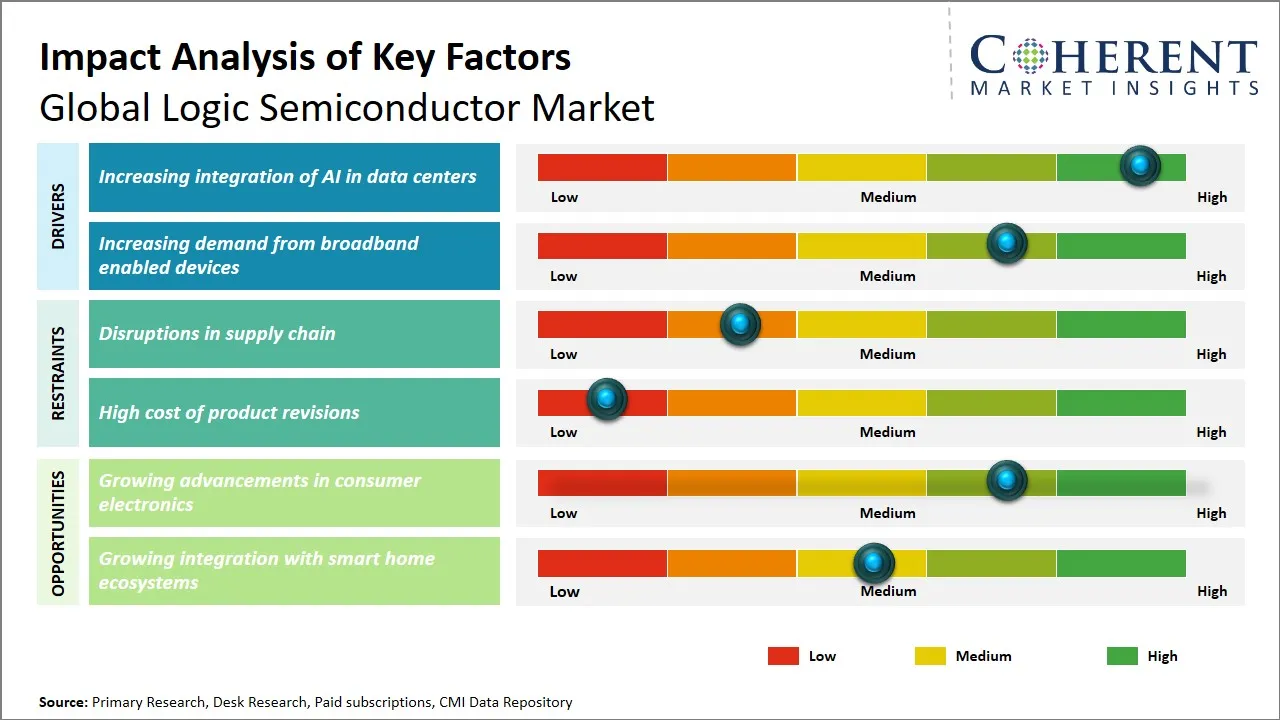
Global Logic Semiconductor Market Driver - Increasing Integration of AI in Data Centers
Data center networking is increasingly turning to artificial intelligence which has increased the pace of logic semiconductor development. As machine learning, deep learning, and live data analysis place heavy demands, systems require chips that deliver speed without excessive power draw. Performance expectations shift as computations grow larger and more intricate. Rapid information handling becomes possible through improved chip architecture. Processing in parallel gains importance when managing expansive algorithmic structures. Efficiency matters just as much as raw capability within modern server environments.
For instance, on February 24, 2025, Intel launched the Xeon 6 chips that features 86 performance-focused cores. These deliver top-tier results in data center tasks while doubling prior AI computation speeds.
Global Logic Semiconductor Market Opportunity - Growing Advancements in Consumer Electronics
Growth in the global logic semiconductor sector links closely to progress in consumer electronics. As people look for devices that respond quicker, connect easier, fit better into routines, expectations rise. New forms like bendable phones emerge alongside tools worn on the body, altering what hardware must deliver. Performance demands shift when experiences blend real and digital views through AR or VR systems. Household items gain computing abilities, asking more from internal components. Chips now handle layered operations once managed by multiple units. Efficiency matters just as much as speed within these compact spaces. Intelligence built directly into circuits supports smoother interactions across networks.
For instance, on December 19, 2025, Samsung officially unveiled the Exynos 2600 chipset, which is reported to be the first smartphone‑targeted SoC manufactured on a true 2 nm Gate‑All‑Around (GAA) process.
Analyst Opinion (Expert Opinion)
- A shift is underway in the worldwide logic semiconductor market, now seeing firmer structural expansion because of rising AI adoption, smarter personal devices, alongside steady needs from vehicles and manufacturing uses. While attention often goes to cutting-edge transistors at 5 nanometers or smaller - fueled by high-speed processors and top-tier system-on-chips - older process technologies from 28 nanometers upward still play vital roles in microcontrollers, low-power circuits, and wireless components.
- When it comes to competition, firms like TSMC, Intel, Samsung, AMD, Qualcomm deploy vast funding and artificial intelligence focused plans to hold position, others of moderate or reduced scale gain ground via concentrated focus areas, alliance structures, support tied to national programs. Though leadership once centered on manufacturing edge, advantage now spreads across layers that bind hardware to real-world deployment. Firms adapting fastest rethink where value forms, not only how fast chips improve.
Speak to the analyst
Want personalized insights?
Take the findings above to one of our principal consultants, or have the report rebuilt around the segments, geographies and competitors you actually track.
Market Segmentation
- Product Type Insights (Revenue, USD Bn, 2021 - 2033)
- Microcontrollers
- Microprocessors
- GPUs & AI Accelerator
- Digital Signal Processors
- Others
- Process Node Insights (Revenue, USD Bn, 2021 - 2033)
- Mature Nodes (Above 28 nm)
- Intermediate Nodes (7 to 28 nm)
- Advanced Nodes (Below 7 nm)
- End User Insights (Revenue, USD Bn, 2021 - 2033)
- Consumer Electronics
- Data Centers and Cloud
- Automotive
- Industrial
- Others
- Regional Insights (Revenue, USD Bn, 2021 - 2033)
- North America
- U.S.
- Canada
- Latin America
- Brazil
- Argentina
- Mexico
- Rest of Latin America
- Europe
- Germany
- U.K.
- Spain
- France
- Italy
- Russia
- Rest of Europe
- Asia Pacific
- China
- India
- Japan
- Australia
- South Korea
- ASEAN
- Rest of Asia Pacific
- Middle East
- GCC Countries
- Israel
- Rest of Middle East
- Africa
- South Africa
- North Africa
- Central Africa
- North America
- Key Players Insights
- Intel Corporation
- Nvidia
- AMD
- Qualcomm
- Broadcom Inc
- MediaTek
- NXP Semiconductors
- Infineon Technologies
- Renesas Electronics
- Microchip Technology
- Marvell Technology
- Analog Devices
- Texas Instruments
- Huawei HiSilicon
- Graphcore
Sources
Primary Research Interviews
- Logic IC manufacturers and foundries
- Semiconductor design engineers and R&D professionals
- Electronics OEMs and system integrators
- Semiconductor distributors and supply chain managers
Databases:
- Semiconductor Industry Association (SIA) Database
- IC Insights Database
- World Semiconductor Trade Statistics (WSTS) Database
Magazines
- Electronic Design Magazine
- Semiconductor Engineering Magazine
- EE Times Magazine
- Electronics Weekly Magazine
Journals
- IEEE Journal of Solid-State Circuits
- Solid-State Electronics Journal
- Microelectronics Journal
Newspapers
- Financial Times
- The Wall Street Journal
- Nikkei Asian Review
- Reuters Technology News
Associations
- Semiconductor Industry Association (SIA)
- SEMI (Semiconductor Equipment and Materials International)
- Global Semiconductor Alliance (GSA)
- European Semiconductor Industry Association (ESIA)
Public Domain Sources
- U.S. Securities and Exchange Commission (SEC) filings
- Company annual reports and investor presentations
- Government statistical offices and trade bureaus
- Patent databases and technology publications
Proprietary Elements
- CMI Data Analytics Tool
- Proprietary CMI Existing Repository of information for last 8 years
Get access to 250+ pages report
Every segment, forecast, competitor profile and data table behind the analysis above — available for instant download.
- ESOMAR Member
- ISO 9001:2015 Certified
- D-U-N-S Registered
- GDPR & CCPA Compliant
Missing comfort of reading report in your local language? Find your preferred language:
Transform your Strategy with Exclusive Trending Reports
Frequently Asked Questions
The global logic semiconductor market stood at USD 147 Bn in 2025 and is expected to reach USD 225 Bn by 2033.
The CAGR of global logic semiconductor market is projected to be 5.5% from 2026 to 2033.
Increasing integration of AI in data centers and increasing demand from broadband enabled devices are the major factors driving the growth of the global logic semiconductor market.
Disruptions in supply chain and high cost of product revisions are the major factors hampering the growth of the global logic semiconductor market.
In terms of product type, microcontrollers dominated the market revenue share in 2026.
Intel Corporation, Nvidia, AMD, Qualcomm, Broadcom Inc, MediaTek, NXP Semiconductors, Infineon Technologies, Renesas Electronics, Microchip Technology, Marvell Technology, Analog Devices, Texas Instruments, Huawei HiSilicon, and Graphcore are the major players.
North America is expected to lead the global logic semiconductor market in 2026.