

Electrically Erasable Programmable Read Only Memory Market Size and Forecast — 2026-2033
Overview
Electrically erasable programmable read only memory (EEPROM) is a non-volatile memory used in computers, smartphones, and electronic devices to store small volumes of data. Increasing demand for high speed, highly scalable memory devices, and low power consuming devices are major factors driving growth of electrically erasable programmable read only memory market. Increasing adoption of high speed internet and Internet of Things (IoT) devices have propelled the demand for high speed memory devices, which are expected to fuel growth of electrically erasable programmable read only memory market in IOT devices.
Electrically Erasable Programmable Read Only Memory Market Size and Forecast – 2026 – 2033
The Electrically Erasable Programmable Read Only Memory Market size is estimated to be valued at USD 4.13 billion in 2026 and is expected to reach USD 7.41 billion by 2033, exhibiting a compound annual growth rate (CAGR) of 8.7% from 2026 to 2033.
Key Takeaways
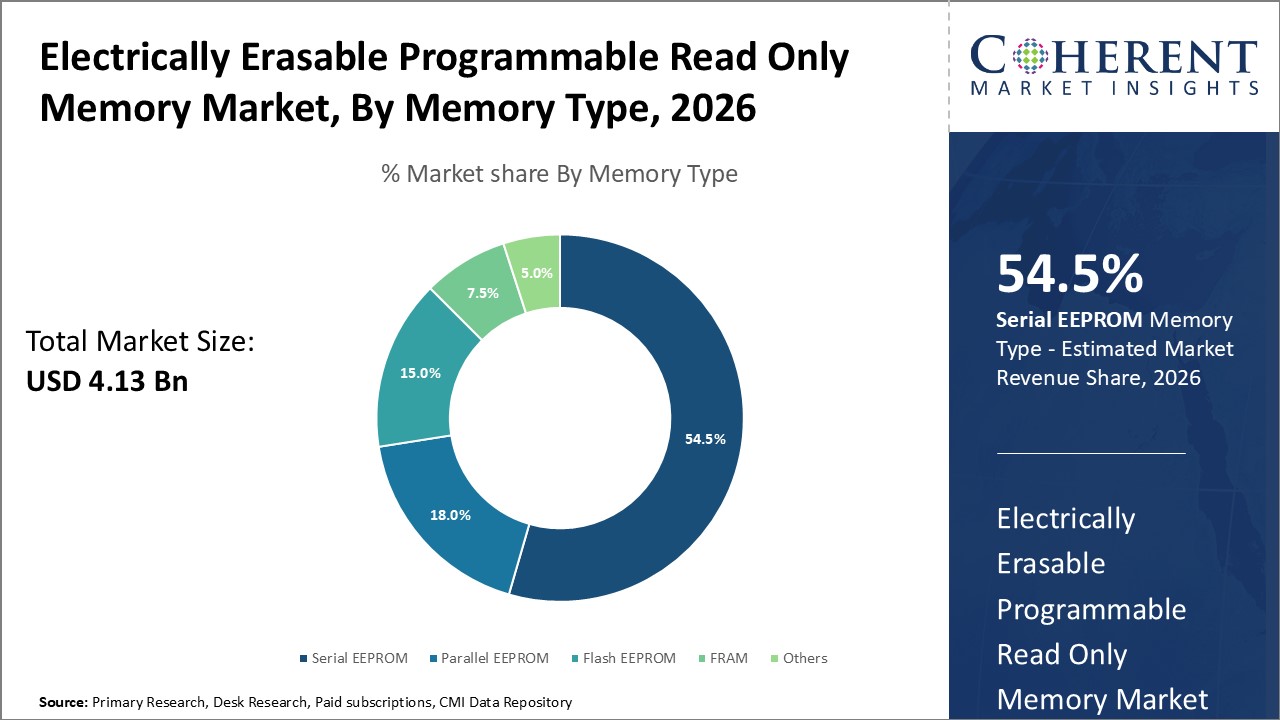
The Serial EEPROM sub segment leads in market share due to its widespread usage in diverse applications requiring serial communication, notably owning over 54.5% of the memory type segment market share.
Automotive applications are the strongest growth driver within the application segment, reflecting increased electrification and smart system integration globally. Industrial automation sub segment is rapidly gaining traction due to growing factory digitization and the need for reliable memory solutions in robotics and control systems.
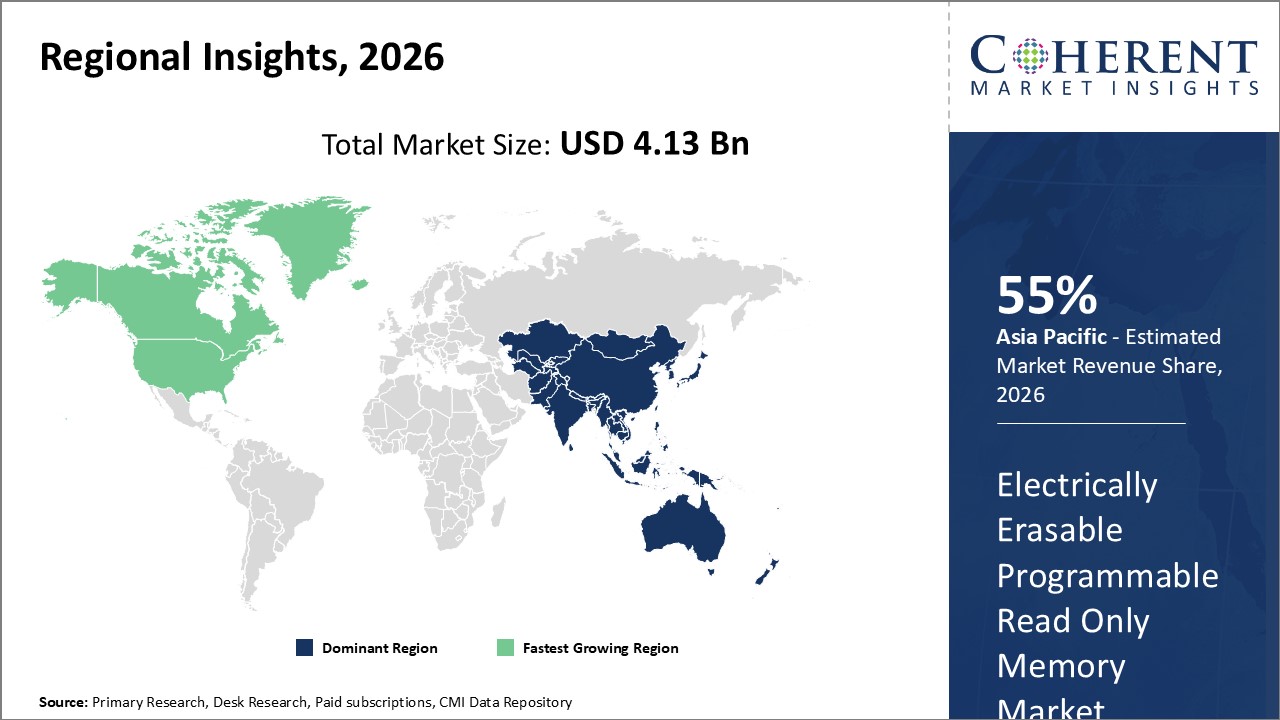
Asia Pacific secures the dominant position with over 55% industry share attributed to manufacturing supremacy and R&D investments in semiconductor technology clusters.
North America follows as a leader in innovation and high-value custom EEPROM deployments across automotive and aerospace sectors. Europe maintains steady demand, focusing on automotive and defense markets, bolstered by stringent regulatory compliance enhancing product quality standards.
Electrically Erasable Programmable Read Only Memory Market – Segmentation Analysis
Electrically Erasable Programmable Read Only Memory Market Insights, By Memory Type
In terms of memory type, the market is segmented into Serial EEPROM, Parallel EEPROM, Flash EEPROM, FRAM, and Others, among which Serial EEPROM dominates the market share, accounting for 54.3% of the segment. This dominance stems from Serial EEPROM’s simplicity, lower pin count, and suitability for space-constrained embedded systems requiring non-volatile data storage. Its extensive adoption across consumer electronics and automotive units is a primary growth driver.
Electrically Erasable Programmable Read Only Memory Market Insights, By Application
The application segment includes Automotive, Consumer Electronics, Industrial Automation, Telecommunications, Aerospace & Defense, Medical Devices, and Others. Automotive applications lead the market owing to stringent requirements for reliable, durable, and efficient memory components in electric vehicles and ADAS. Consumer Electronics consistently grows driven by demand for compact, energy-efficient memory in mobile phones, laptops, and wearables.
Electrically Erasable Programmable Read Only Memory Market Insights, By End-User Industry
Based on end-user industry, the market is divided into Automotive OEMs, Electronics Manufacturers, Telecom Equipment Providers, Healthcare Technology Firms, and Industrial Entities. Automotive OEMs dominate due to escalated use of EEPROM in electric and hybrid vehicle systems necessitating high-reliability memory for control modules.
Electrically Erasable Programmable Read Only Memory Market Insights, By Geography
Asia Pacific Electrically Erasable Programmable Read Only Memory Market Analysis and Trends
In Asia Pacific, the dominance in the Electrically Erasable Programmable Read Only Memory market is supported by high manufacturing output, governmental policies favoring technological innovation, and well-established semiconductor ecosystems in China, Taiwan, and South Korea. The coordinated efforts in expanding production capacity and integrating advanced memory technologies have cemented Asia Pacific’s leadership with above 55% market share. Key players such as Winbond Electronics and Macronix International significantly contribute to regional revenue, supplying memory components globally.
North America Electrically Erasable Programmable Read Only Memory Market Analysis and Trends
Meanwhile, North America exhibits the fastest growth, driven by technology innovation hubs and growing adoption of EEPROM in aerospace, automotive, and industrial automation sectors. Factors such as increased R&D spending, stricter industry standards, and an emphasis on high-reliability EEPROM devices have driven this growth at a CAGR of 9.2%. Renesas Electronics and Micron Technology lead the market growth by delivering customized, high-end memory solutions, contributing robustly to business growth in the U.S. and Canada.
Electrically Erasable Programmable Read Only Memory Market Outlook for Key Countries
United States Electrically Erasable Programmable Read Only Memory Market Trends
The USA's Electrically Erasable Programmable Read Only Memory market benefits from strong semiconductor innovation ecosystems and strategic partnerships with automotive and aerospace industries. Advanced R&D in low-power, high-density EEPROM chips has positioned U.S. firms as pioneers in high-reliability memory solutions. Several initiatives to bolster semiconductor manufacturing domestically, alongside collaborations with automotive OEM giants for deploying EEPROM in electric vehicles, have reinforced the industry size and technology maturity. Companies such as Micron and Texas Instruments are instrumental in driving state-of-the-art EEPROM applications, maintaining leadership in market revenue and growth strategies.
Japan Electrically Erasable Programmable Read Only Memory Market Trends
Japan's market maintains significant relevance due to its pioneering role in electronics manufacturing and automotive technologies. Japan’s semiconductor firms focus on developing automotive-grade EEPROMs that withstand rigorous temperature and endurance tests, which aligns with the country's robust automotive sector needs. Players such as Renesas Electronics contribute to a sizable proportion of EEPROM demand domestically, with ongoing investments to improve chip reliability and production efficiency. Government incentives supporting next-gen semiconductor technology and automotive electronics integration propel the nation’s continuous market expansion and technology leadership.
Analyst Opinion
Enhanced production capacity and cost optimization in semiconductor fabs have been central to increasing the supply-side robustness of EEPROM products. For instance, significant capacity expansions in fabs across East Asia in 2025 have bolstered shipment volumes by approximately 13% compared to the previous year, enabling economies of scale and competitive pricing strategies.
On the demand side, industries such as automotive electronics have emerged as dominant end-users, consuming nearly 31% of total EEPROM shipments globally in 2026 as vehicles increasingly integrate smart control units requiring reliable non-volatile memory. Pricing dynamics improved as premium automotive-grade EEPROM components maintained a price premium of 11%-16%, reflecting high durability requirements.
Micro-indicators reveal that manufacturers enhanced memory cell density through novel transistor architectures, resulting in 21% increase in chip storage capacity in 2025, directly influencing market revenue growth. New wafer-level packaging and 3D NAND stack techniques further boosted EEPROM functionality, driving adoption in wearables and medical electronics.
Nano-indicators reflecting regional trade data show that Asia Pacific accounted for over 55% of EEPROM exports in 2025, led by China, Taiwan, and South Korea, indicating robust supply chain integration and export-driven business growth strategies. Import statistics illustrate rising demand in North America by 18% in Y-O-Y terms, underlying market expansion and diversification.
- Current Industry Events of 2026
- Market Size Estimation
- Regional Breakdown
- Competitive Landscape
- Customer Intelligence
- Segmental Analysis
- Pricing Analysis
- Key Market Drivers, Challenges & Future Trends
- Customized Insights Section
Market Scope
| Report Coverage | Details | ||
|---|---|---|---|
| Base Year: | 2025 | Market Size in 2026: | USD 4.13 billion |
| Historical Data for: | 2020 To 2024 | Forecast Period: | 2026 To 2033 |
| Forecast Period 2026 to 2033 CAGR: | 8.7% | 2033 Value Projection: | USD 7.41 billion |
| Geographies covered: |
| ||
| Segments covered: |
| ||
| Companies covered: | Micron Technology, STMicroelectronics, Texas Instruments, Renesas Electronics Corporation, ON Semiconductor, Cypress Semiconductor, Macronix International, Winbond Electronics, Infineon Technologies, Toshiba Memory Corporation, ROHM Semiconductor. | ||
| Growth Drivers: |
| ||
Growth factors
Industry growth is primarily attributed to the surging automotive electronics sector needing highly reliable data storage solutions under stringent operating conditions. The incorporation of advanced driver assistance systems (ADAS) has increased EEPROM demand significantly. Another powerful growth driver is the expansion of IoT devices, where remote sensors and smart appliances require efficient, non-volatile memory to store critical operational firmware and calibration data. Additionally, innovations resulting in higher memory density with lower power profiles have enabled broader adoption in wearable and medical devices, expanding the application spectrum. Finally, governmental incentives in the Asia Pacific region to support semiconductor manufacturing have improved supply chain resilience and accelerated business growth, with reported investments exceeding USD 15 billion in 2025.
Electrically Erasable Programmable Read Only Memory Market Development
- In May 2026, Shenzhen-based embedded computing specialist Make Your Idea Real (MYIR) has announced the launch of a rugged gadget designed to act as a gateway for industrial automation projects: the MY-EVC700S-V2 IPC Box. The Allwinner T113-i system-on-chip, which comes with a single HiFi4 digital signal processing (DSP) coprocessor and two Arm Cortex-A7 CPU cores operating at up to 1.2GHz, powers the tough system. The system has 32kB of electrically erasable programmable read-only memory (EEPROM), 4GB of on-board eMMC storage, and 512MB of DDR3 RAM.
Market Trends
Over the recent years, the Electrically Erasable Programmable Read Only Memory market has observed a gradual shift towards integrating EEPROM with other non-volatile memories, enabling hybrid memory solutions optimized for energy efficiency and faster access speeds. For example, industry players introduced multi-layer stacked EEPROM chips in 2025 that reduce latency by 16% compared to conventional architectures. Additionally, the move towards miniaturization has accelerated, evidenced by ultraportable consumer electronics demanding highly compact EEPROM modules without compromising functionality. Another emerging trend is the diversification towards automotive-grade and industrial-grade EEPROM devices featuring extended temperature ranges and enhanced endurance, critical for harsh environment applications. Regional shifts are also notable, as Asia Pacific increasingly dominates production capacity, while North America focuses on design innovation and application-specific solutions.
Key Players
STMicroelectronics
Texas Instruments
Renesas Electronics Corporation
ON Semiconductor
Cypress Semiconductor
Macronix International
Winbond Electronics
Infineon Technologies
Toshiba Memory Corporation
ROHM Semiconductor
Leading companies have leveraged strategic acquisitions and expanded R&D investments to strengthen their market presence. For example, Renesas Electronics’ acquisition of IDT’s memory IP assets in 2025 enhanced their EEPROM technology stack, enabling delivery of lower power consumption modules that boosted customer retention. Micron’s collaboration with automotive OEMs has resulted in customized EEPROM solutions surpassing automotive qualification standards, securing long-term supply agreements that influence their market share positively.
Electrically Erasable Programmable Read Only Memory Market Future Outlook
The market for Electrically Erasable Programmable Read Only Memory (EEPROM) is expected to rise steadily in the future due to increased demand from a variety of industries, including consumer electronics, automotive, industrial automation, and Internet of Things devices. The growing use of EEPROM in wearable electronics, smart systems, electric cars, and advanced driver-assistance systems (ADAS) is driving this expansion. These applications demand dependable, non-volatile memory solutions with high endurance and low power consumption.
EEPROM usage is anticipated to be further boosted by technological developments that concentrate on higher memory densities, energy efficiency, faster write/erase capabilities, and smaller footprints. Because of their sizable manufacturing bases, concentration of data centers, and electronics production, regional markets in North America and Asia-Pacific are anticipated to be important growth drivers. The overall need for affordable, safe, and adaptable memory solutions guarantees that the EEPROM market will continue to be vibrant and promising throughout the course of the projection period, despite obstacles such competition from alternative memory technologies and changes in the price of raw materials. The market will continue to grow as a result of strategic advancements and growing applications in linked devices and embedded systems.
Historical Analysis
In July 2019, Micro-Star International Co., Ltd, Taiwanese multinational information Technology Corporation, announced a launch of new revisions of AMD 300 and 400 motherboards with 256Mb EEPROM BIOS Chips.
In April 2018, Holtek Semiconductor, Taiwan-based semiconductor provider, announced the launch of its new HT69F2562 Flash MCU, featuring the special characteristics of ultra-low power and integrated LCD driver circuit and EEPROM.
In September 2018, Fujitsu Semiconductor Limited, Japan-based Company, announced the launch of MB85RS4MT, a 4Mbit FRAM that had the upper compatibility to EEPROM and highest density in Fujitsu's serial interface family of FRAM non-volatile memories.
In December 2018, Microchip, a provider of microcontroller, mixed-signal, analogue and Flash-IP solutions, announced a launch of its new low-cost, low-risk memory solution named “I2C EERAM” memory. Comprised of EEPROM and SRAM, the latest offering provided unlimited endurance and safe data storage at power loss.
In January 2016, STMicroelectronics, French-Italian multinational electronics and semiconductor manufacturer, extended its M24 serial EEPROM family, M24LR64, with four new devices that used the industry-standard 4-ball WLCSP (Wafer Level Chip Scale Package) footprint.
Sources
Primary Research interviews:
Integrated circuit (IC) product managers
Memory chip distributors
Consumer electronics OEMs
Automotive electronics R&D teams
Databases:
PubMed (for biomedical device applications using EEPROM)
SpringerLink
ProQuest Dissertations & Theses
Magazines:
Electronics Weekly
Semiconductor Digest
Chip Scale Review
Electronic Design
Journals:
Journal of Semiconductor Technology and Science
Microelectronics Journal
Solid-State Electronics
Journal of Applied Physics
Newspapers:
The Wall Street Journal – Tech Section
The New York Times – Technology Section
Financial Times – Electronics & Semiconductor Coverage
Nikkei Asia – Electronics & Semiconductor Section
Associations:
Japan Electronics and Information Technology Industries Association (JEITA)
China Semiconductor Industry Association (CSIA)
Global Semiconductor Alliance (GSA)
Get access to 250+ pages report
Every segment, forecast, competitor profile and data table behind the analysis above — available for instant download.
- ESOMAR Member
- ISO 9001:2015 Certified
- D-U-N-S Registered
- GDPR & CCPA Compliant
Missing comfort of reading report in your local language? Find your preferred language:
Transform your Strategy with Exclusive Trending Reports
Frequently Asked Questions
The dominant players include Micron Technology, STMicroelectronics, Texas Instruments, Renesas Electronics Corporation, and ON Semiconductor, who collectively contribute significant market share through innovation and strategic partnerships.
The market size is projected to grow from USD 4.13 billion in 2026 to USD 7.41 billion by 2033, driven by rising adoption in automotive electronics and IoT device segments.
The automotive sector holds the largest growth opportunity, propelled by increasing demand for advanced driver assistance systems and electronic control units integrating EEPROM.
Market trends indicate a shift towards integrated hybrid memory architectures, miniaturized EEPROM modules, and expansion of automotive- and industrial-grade products catering to specialized environments.
The competitive landscape is marked by aggressive innovation, capacity expansions, and strategic collaborations. However, challenges include semiconductor supply chain fluctuations and rising production costs impacting market dynamics.
Companies focus on customizable solutions, R&D investment, strategic acquisitions, and establishing strong supply chain partnerships with OEMs to secure market presence and drive business growth.