

Global Magnetometer Sensor Market Size and Forecast – 2026 To 2033
The global magnetometer sensor market is expected to grow from USD 4.30 Bn in 2026 to USD 7.95 Bn by 2033, registering a compound annual growth rate (CAGR) of 9% from 2026 to 2033. The global magnetometer sensor market is driven by expansive growth in industrial automation and robotics. On January 6, 2026, Arm launched a dedicated Physical AI business unit to accelerate robotics development, bringing together automotive and robotics technologies that rely on advanced sensor platforms for factory automation and autonomous machines. (Source: Arm)
Key Takeaways of the Global Magnetometer Sensor Market
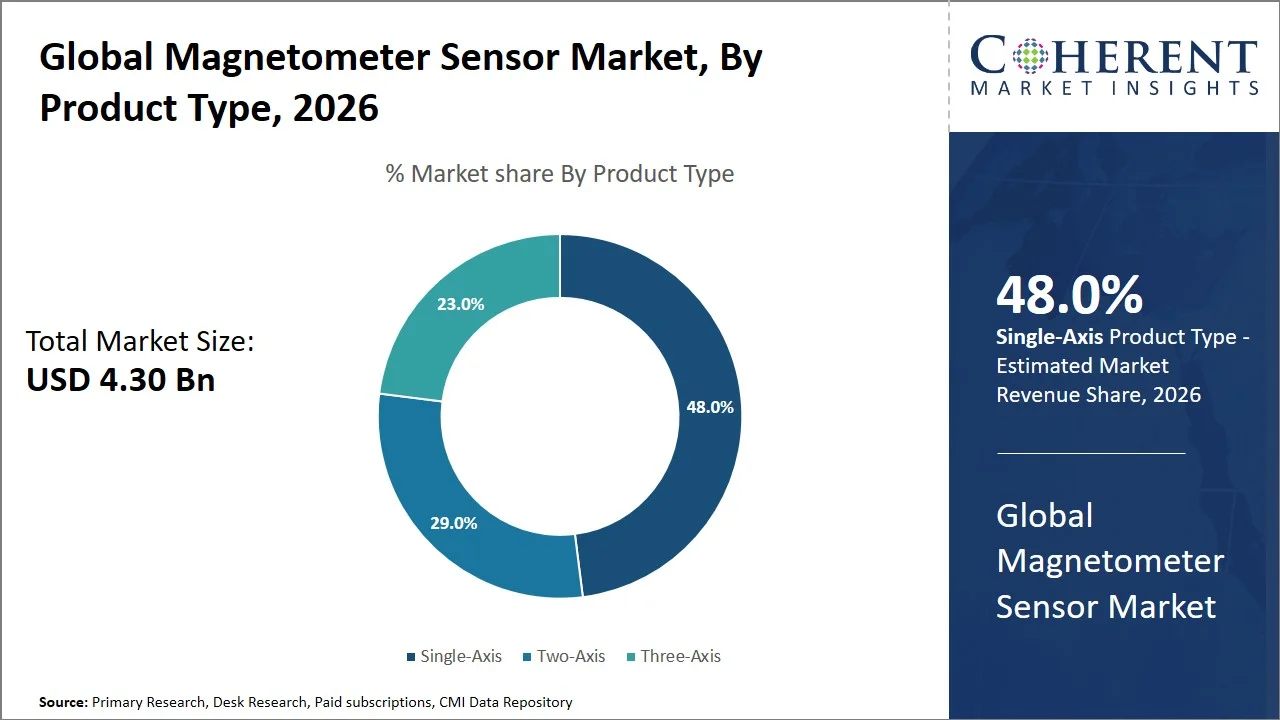
- The single-axis segment is expected to account for 48.0 % of the global magnetometer sensor market share in 2026. Increasing use of drones and UAV applications is driving the growth of the segment. On September 24, 2025, Skydio launched the R10 autonomous indoor drone, designed for first responders, industrial inspections, and infrastructure monitoring.
- The scalar magnetometers segment is estimated to capture 55.0 % of the market share in 2026. Growing demand for electronic compass functionality is majorly driving the growth of the segment. On March 18, 2025, Core Devices unveiled the Pebble Time 2 and Pebble 2 Duo smartwatches, both incorporating electronic compass functionality through integrated magnetometer sensors to improve navigation, fitness tracking, and outdoor orientation.
- The MEMS magnetometers segment is estimated to capture 34.0 % of the market share in 2026. Advancements in MEMS-based magnetometer technology is driving the growth of the segment. On March 6, 2025, Core Devices announced launch of the Pebble Time 2 and Pebble 2 Duo smartwatches with electronic compass capability using built-in magnetic sensors to assist navigation, fitness tracking and outdoor orientation. (Source: STMicroelectronics)
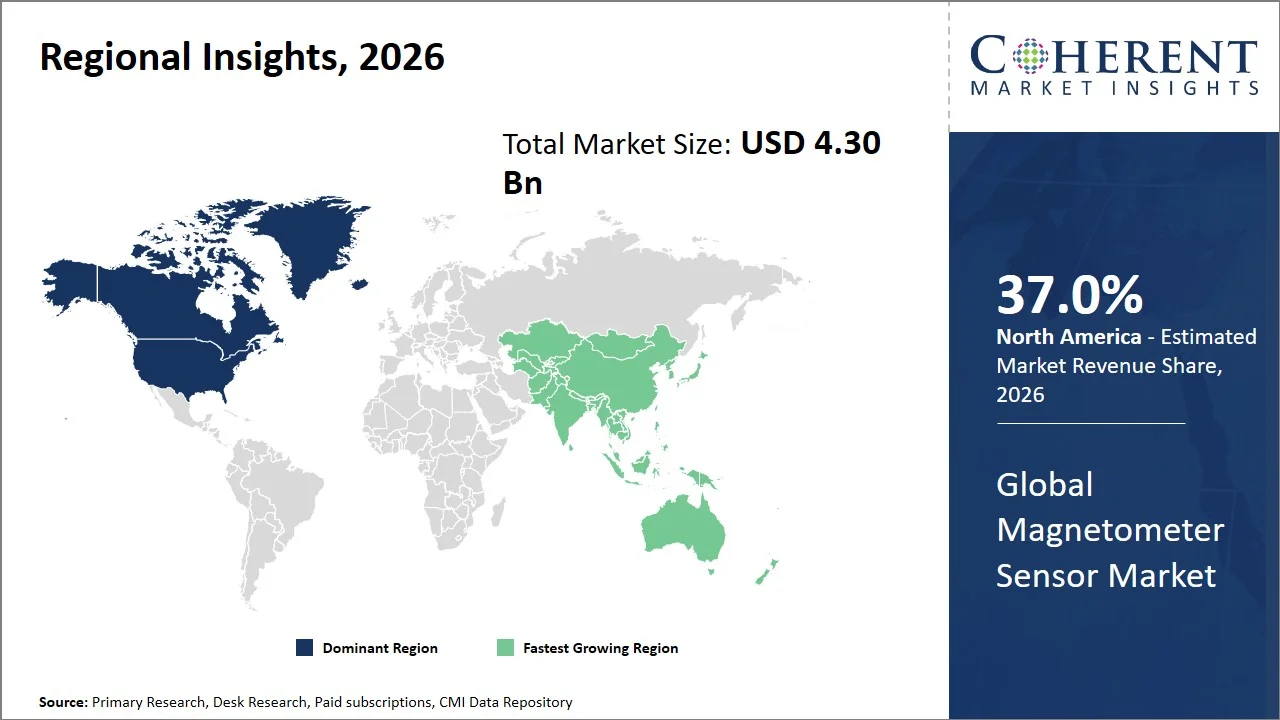
- North America is expected to dominate the magnetometer sensor market in 2026 with a market share of 37.0 %. Growing satellite and space exploration programs in North America is driving the growth of the regional market. On June 25, 2026, NASA selected Rocket Lab to provide the launch service for both the agency’s PolSIR (Polarized Submillimeter Ice-cloud Radiometer) and Total and Spectral Solar Irradiance Sensor-2 (TSIS-2) missions. (Source: NASA)
- Asia Pacific is expected to account for 31.0 % share in 2026 and is projected to record the fastest growth over the forecast period. Development of quantum and ultra-sensitive magnetometers in Asia Pacific is driving the growth of the regional market. On April 14, 2026, Deteqt, an Australian deep tech company building one of the world's most compact quantum magnetic sensors, closed a USD 3.45 million seed funding round. The company also received a three-year Australian Department of Defence contract to develop field-deployable ultra-sensitive magnetic sensors for navigation and defense applications.
- Rapid Adoption of MEMS-Based Magnetometer Sensors: Micro-Electro-Mechanical Systems magnetometers are becoming the technology of choice because of their small size, low power consumption and cost efficiency. Their seamless integration into smartphones, wearable devices, drones and IoT equipment is driving demand, while continual advancements in sensitivity and accuracy are broadening their utility in industrial and automotive applications.
- Growing Integration with AI-Driven Sensor Fusion Systems: Magnetometer sensors are being progressively coupled with accelerometers, gyroscopes, GNSS and AI algorithms for very accurate orientation, navigation and placement. Better performance in autonomous car, robotics, unmanned aerial vehicles and industrial automation through improved sensor fusion and reduced drift is a burgeoning trend in the market.
Segmental Insights
Why Does Single-Axis Dominate the Global Magnetometer Sensor Market?
The single-axis segment is expected to account for 48.0% of the global magnetometer sensor market share in 2026. The single-axis magnetometer sensor is still a popular choice in the market as it provides a very cost-effective solution for applications that require detection of magnetic fields in a single direction only without the complexity of multi-axis sensing. Their simple architecture means they use less power, are compact and are easier to integrate into automotive components, industrial equipment, electronic compasses and proximity sensing devices. They are an attractive choice for high-volume applications where reliable performance and affordability are the primary purchasing criteria. On September 26, 2024, Melexis expanded its innovative Triaxis magnetic sensing integrated circuit (IC) range with stacked dual-die variants of the MLX90425 and MLX90426. Featuring a 5 mT stray field immunity (SFI) and 360° rotary detection of the magnet, these ICs support safety requirements for steering wheel and accelerator pedal position sensing, enabling a higher level of autonomous driving. (Source: Melexis)
- Current Industry Events of 2026
- Market Size Estimation
- Regional Breakdown
- Competitive Landscape
- Customer Intelligence
- Segmental Analysis
- Pricing Analysis
- Key Market Drivers, Challenges & Future Trends
- Customized Insights Section
Why are Scalar Magnetometers the Most Preferred Measurement Type?
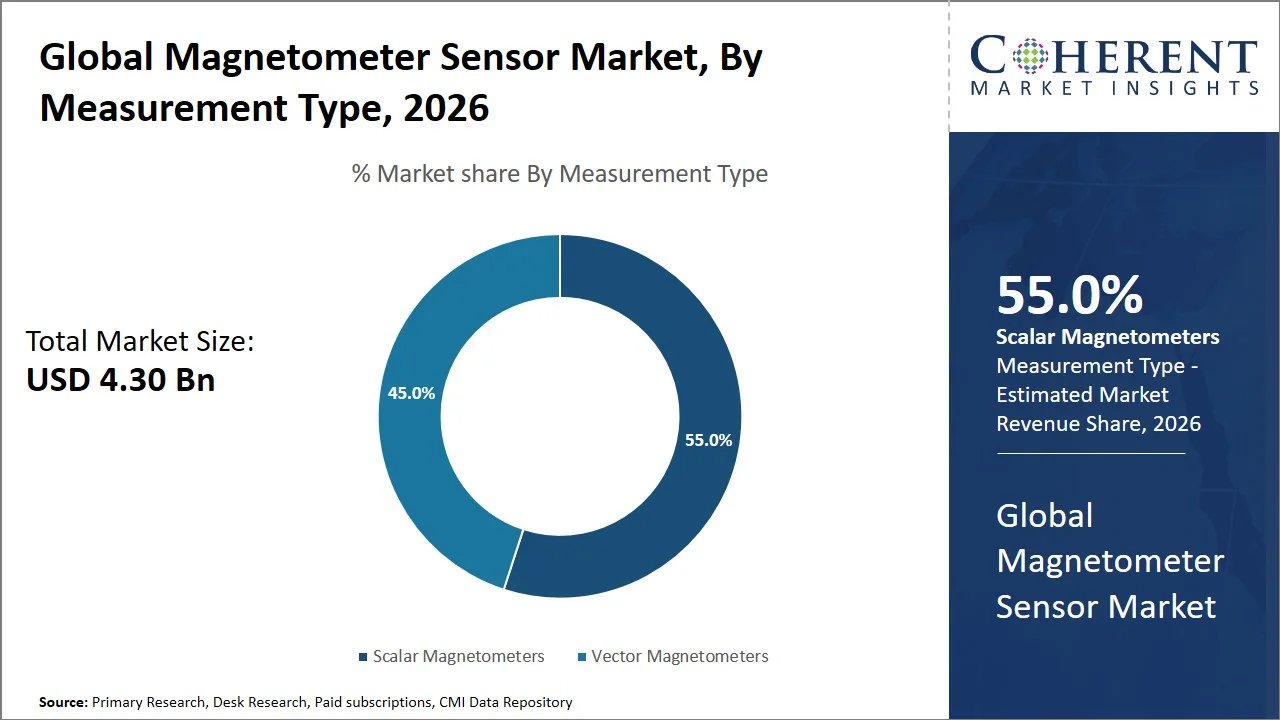
The scalar magnetometers segment is expected to account for 55.0% of the global magnetometer sensor market share in 2026. Scalar magnetometers are usually favored as they measure the whole magnitude of the magnetic field, regardless of its direction. This provides a very stable and precise measurement which is not very sensitive to the sensor orientation. This is especially useful in geophysical surveys, mineral exploration, military, marine navigation and space research where accurate measurements of magnetic field intensity are needed for dependable data collecting under a variety of operating situations. On April 14, 2025, Q-CTRL successfully completed flight demonstrations of its optically pumped quantum magnetometer for GPS-denied navigation, proving scalar magnetic field measuring technology for aerospace and defense applications.
MEMS Magnetometers Segment Dominates the Global Magnetometer Sensor Market
The MEMS magnetometers segment is expected to account for 34.0% of the global magnetometer sensor market share in 2026. MEMS magnetometers have been widely used due to their small size, low power consumption, and cost-effective fabrication with great integration capacity. Compatible with established semiconductor fabrication processes, MEMS enables manufacturers to seamlessly integrate sensors into smartphones, wearable devices, automotive electronics, drones, and industrial IoT equipment while supporting high-volume production. This combination of scalability, durability and affordability makes MEMS technology the ideal for mass-market applications needing accurate magnetic field sensing. On April 27, 2026, Infineon and Valeo announced the integration of Infineon’s 2D MEMS technology with Valeo’s laser beam scanning ground projection module for next-generation automotive systems, as well as continued investment in automotive-grade MEMS sensing technologies and high-volume semiconductor integration.
Currents Events and their Impact
Current Events | Description and its Impact |
European Union - Cyber Resilience Act (CRA) |
|
U.S. CHIPS and Science Act |
|
Magnetometer Sensor Market Dynamics
Market Drivers
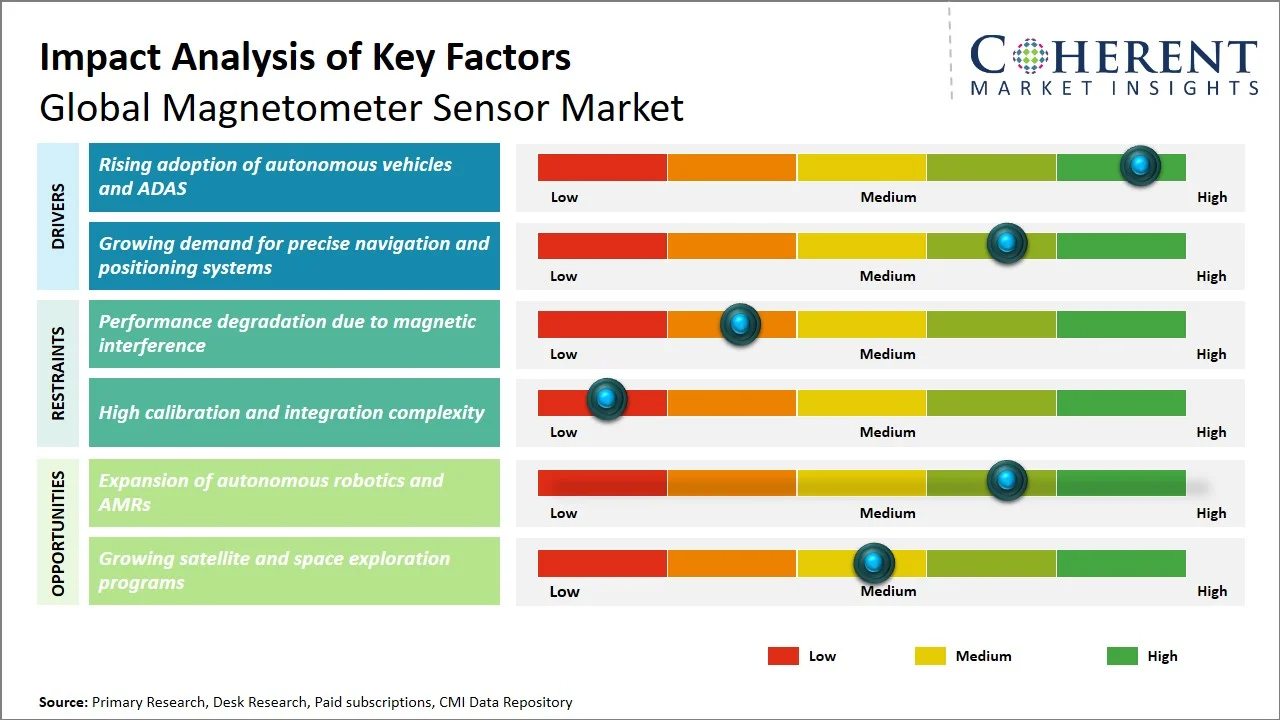
- Rising adoption of autonomous vehicles and ADAS: The rising use of autonomous vehicles and advanced driver assistance systems (ADAS) is driving the demand for magnetometer sensors that offer precise orientation, heading, and location information. They work along with gyroscopes, accelerometers, GNSS, and other sensing technologies to increase vehicle navigation, lane positioning, electronic compass capabilities, and sensor fusion algorithms. As car manufacturers continue to incorporate increased levels of driving automation and intelligent safety features, the demand for compact, high-precision and interference-resistant magnetometer sensors continues to expand across both electric and conventional vehicle platforms. On January 5, 2026, Mobileye announced that a U.S. carmaker selected the Mobileye EyeQ 6H to enable future advanced driver assistance systems with hands-free driving on specified highways in millions of vehicles around the world. The agreement demonstrates growing demand for Mobileye Surround ADAS systems internationally and Mobileye now expects delivery of more than 19 million EyeQ6H-based Surround systems in the future.
- Growing demand for precise navigation and positioning systems: Increasing demand for precise navigation and positioning systems is propelling the use of magnetometer sensors in automotive, aerospace, defense, marine, robotics, and consumer electronics applications Magnetometers measure the Earth magnetic field and offer accurate heading and directional information, and are often combined with the Global Navigation Satellite System (GNSS), accelerometers and gyroscopes. As industries increasingly depend on precise real-time positioning for autonomous operations and asset tracking, the need for high-performance magnetometer sensors is on the rise. On March 19, 2025, Hexagon announced the closure of the acquisition of Septentrio NV, a manufacturer of GPS/GNSS locating technology for autonomy and mission critical applications. The purchase of Septentrio would reinforce Hexagon’s position as the leader in the robust, assured positioning solutions market and give clients with increased accessibility to high-accuracy and high-performance positioning technology with the size, weight and power (SWaP) optimized platform.
Emerging Trends
- Rising Demand from Electric Vehicles and Advanced Driver Assistance Systems (ADAS): The increasing number of electric and autonomous vehicles is creating more use of high-precision magnetometer sensors to help provide steering angle detection, vehicle positioning, motor control and electronic compass functions. Automotive makers are looking for small, dependable and interference-free sensors to power next generation mobility systems.
- Advancements in High-Sensitivity Magnetometer Technologies for Scientific and Medical Applications: There has been rising investment by manufacturers and research organizations in quantum, tunnel magnetoresistance (TMR) and optically pumped magnetometer technologies to attain ultra-high sensitivity. These advancements are opening new markets in biomagnetic diagnostics, geophysical exploration, space research, defense surveillance, and precision industrial measurement, greatly expanding the commercial potential of magnetometer sensors.
Regional Insights
Why is North America a Strong Market for Magnetometer Sensors?
North America is expected to account for a market share of 37.0% in 2026. The North America region is the main regional market for magnetometer sensors, due to large adoption in aerospace, defense, autonomous mobility, and space exploration. The U.S. Department of Defense continues to integrate high-precision magnetic sensing into inertial navigation systems, unmanned aerial vehicles and underwater surveillance platforms. Fluxgate and scalar magnetometers are used on missions such as the Artemis program and Earth observation satellites by agencies including NASA.
In the commercial sector, automotive manufacturers such as Tesla, General Motors and Ford integrate MEMS magnetometers into advanced driver assistance systems and navigation modules, while semiconductor companies such as Honeywell, Allegro MicroSystems and Analog Devices boost regional supply with high-performance magnetic sensing solutions. On October 21, 2025, Allegro MicroSystems, Inc. announced the industry’s first commercially available magnetic current sensor to reach a 10 MHz bandwidth using Allegro’s sophisticated XtremeSense TMR (tunneling magnetoresistance) technology. The new ACS37100 TMR current sensor enables power system designers to govern the control signal chain and unleash the full potential of fast-switching GaN and SiC FETs.
Why Does the Asia Pacific Magnetometer Sensor Market Exhibit High Growth?
Asia Pacific is projected to account for 31.0% of the global magnetometer sensor market and is expected to register the fastest growth. Asia Pacific is the fastest growing market since it is the hub for consumer electronics manufacturing, electric car manufacturing and semiconductor fabrication. The region hosts key sensor manufacturers such as TDK Corporation, Murata Manufacturing, Alps Alpine, AKM (Asahi Kasei Microdevices), STMicroelectronics, etc. that produce magnetometers for smartphones, wearable devices, industrial automation equipment and automotive electronics. China, Japan and South Korea continue to boost domestic semiconductor manufacturing and intelligent vehicle programs. Electronics manufacturers like Samsung, Xiaomi and Sony are adding small three-axis MEMS magnetometers to flagship smartphones, smartwatches and IoT gadgets. On May 28, 2026, TDK enhanced its magnetic sensor portfolio for the Asia Pacific region with the release of a dual-output 3D Hall-effect switch family for accurate motor speed and direction sensing in automotive and industrial applications.
Global Magnetometer Sensor Market Outlook for Key Countries
Why is the U.S. Emerging as a Major Hub in the Magnetometer Sensor Market?
The U.S. ecosystem of defense contractors, semiconductor developers and aerospace groups continues to provide the U.S. an edge in technology. Honeywell International manufactures high-precision magnetometers for navigation systems in aviation and defense. Allegro MicroSystems offers magnetic sensing solutions for traction motors, industrial automation and electric power steering. NASA missions such as the Magnetospheric Multiscale (MMS) mission and Artemis-related research are still using advanced magnetometers for scientific measurements, and autonomous vehicle developers such as Waymo are integrating magnetometer-based sensor fusion with GNSS, LiDAR, and inertial sensors to improve vehicle localization.
Is China the Next Growth Engine for the Magnetometer Sensor Market?
Rapid growth of electric vehicles, consumer electronics and industrial robotics has made China one of the leading users of magnetometer sensors. Domestic EV manufacturers such as BYD, NIO, and XPeng use magnetometer sensors extensively in their navigation systems, electronic compass functions, and vehicle orientation modules. Smartphone makers such as Huawei, Xiaomi, and OPPO integrate three-axis MEMS magnetometers into their flagship mobile devices. Government initiatives toward the localization of semiconductors and intelligent connected vehicles are expected to drive the increased adoption of locally manufactured magnetic sensing components in automotive and industrial applications.
Germany Magnetometer Sensor Market Analysis and Trends
Germany is the center of premium vehicle manufacture and complex industrial automation. Companies such as Bosch, Continental, BMW, Mercedes-Benz and Volkswagen use magnetometer sensors into electronic stability systems, steering angle sensing, digital navigation and autonomous driving platforms. Likewise, industrial players as Siemens are also utilizing magnetic sensing technologies in factory automation, robotics, and predictive maintenance systems as part of Industry 4.0 ambitions, which, in turn, is driving continuous demand for high-reliability magnetometer solutions.
Japan Magnetometer Sensor Market Analysis and Trends
Japan continues to be an innovation hub for magnetometer sensors across the globe owing to its leadership in precision electronics and automotive technology. A lot of smartphones, industrial equipment, robotics and automotive systems from companies such as TDK Corporation, Murata Manufacturing, Alps Alpine and AKM (Asahi Kasei Microdevices) use advanced MEMS and magnetic sensing devices. In the automotive sector, Toyota, Honda, and Denso are among the companies that use magnetometer sensors for vehicle navigation, electronic compass modules, and advanced driver assistance systems. Japanese robotics companies continue to adopt high-precision magnetic sensors in autonomous industrial robots.
South Korea Magnetometer Sensor Market Analysis and Trends
South Korea holds a strong position with its leadership in semiconductors, consumer electronics and next-generation mobility technology. Samsung Electronics employs high-performance magnetometer sensors into Galaxy smartphones, smartwatches and health wearables, and LG Electronics integrates magnetic sensing technologies into smart home products and automobile infotainment systems. Hyundai Motor and Kia are also using the country’s advanced semiconductor ecosystem led by Samsung Electronics and SK hynix to use magnetometer-enabled navigation and sensor fusion systems throughout its electrified and autonomous car platforms.
Global Magnetometer Sensor Market - Aerospace Navigation Systems Using Magnetometers
Metric | 2026 Estimate |
Total aerospace navigation systems using magnetometers (installed base) | ~410,000 systems |
New aerospace platforms integrating magnetometers (annual shipments) | ~36,000 systems/year |
Commercial aircraft adoption | Very High (≈95% of new aircraft) |
Military aircraft adoption | Very High (≈98%) |
UAV/Drone aerospace adoption | High (≈88%) |
Global Magnetometer Sensor Market - EVs Equipped with Magnetometer-Based Position Sensors
Region | EVs Equipped with Magnetometer-Based Position Sensors (Million Vehicles) | Average Magnetometer-Based Position Sensors per EV | Dominant EV Type |
North America | 2.65 | 6-8 | BEV |
Europe | 3.35 | 6-9 | BEV & PHEV |
Asia Pacific | 8.40 | 5-8 | BEV |
Latin America | 0.65 | 4-6 | BEV |
Middle East & Africa | 0.75 | 4-6 | BEV |
How is the Expansion of Autonomous Robotics and AMRs Creating New Growth Opportunities in the Magnetometer Sensor Market?
The increasing adoption of autonomous robotics and autonomous mobile robots (AMRs) is creating huge growth prospects in the magnetometer sensor market as demand for accurate orientation, heading, and navigation capabilities in dynamic indoor and outdoor situations rises. Magnetometer sensors are integrated into inertial measurement units, LiDAR, cameras, and simultaneous localization and mapping (SLAM) systems to enhance the positioning accuracy, particularly in warehouses, manufacturing plants, hospitals, and logistics centers where GNSS signals are constrained or unavailable. With firms such as Amazon Robotics, ABB, KUKA, FANUC and Omron continuing to enhance robotic automation for material handling and industrial activities, the demand for compact, low power and high precision magnetometer sensors is likely to grow consistently. On April 14, 2026, Google introduced Gemini Robotics-ER 1.6, a significant upgrade to its reasoning-first model that enables robots to understand their environments with unprecedented precision. By enhancing spatial reasoning and multi-view understanding, Google is bringing a new level of autonomy to the next generation of physical agents. (Source: Google)
Market Players, Key Development, and Competitive Intelligence
Key Developments
- On May 15, 2024, Infineon Technologies AG introduced the new XENSIV TLE49SR angle sensor family, which combines excellent stray field immunity with high accuracy. The sensors are ideal for applications of safety-critical automotive chassis systems such as electric power steering and vehicle height leveling.
- On February 28, 2024, Asahi Kasei Microdevices Corporation started mass production of the CZ39 series of coreless current sensors. The CZ39 device family is particularly well-suited to electric vehicle (EV) applications due to its 100 ns response time, low heat generation, and noise immunity. These properties are highly compatible with the silicon carbide (SiC)- and gallium nitride (GaN)-based power devices favored by OEMs for their reduced form factor and high efficiency.
Competitive Landscape
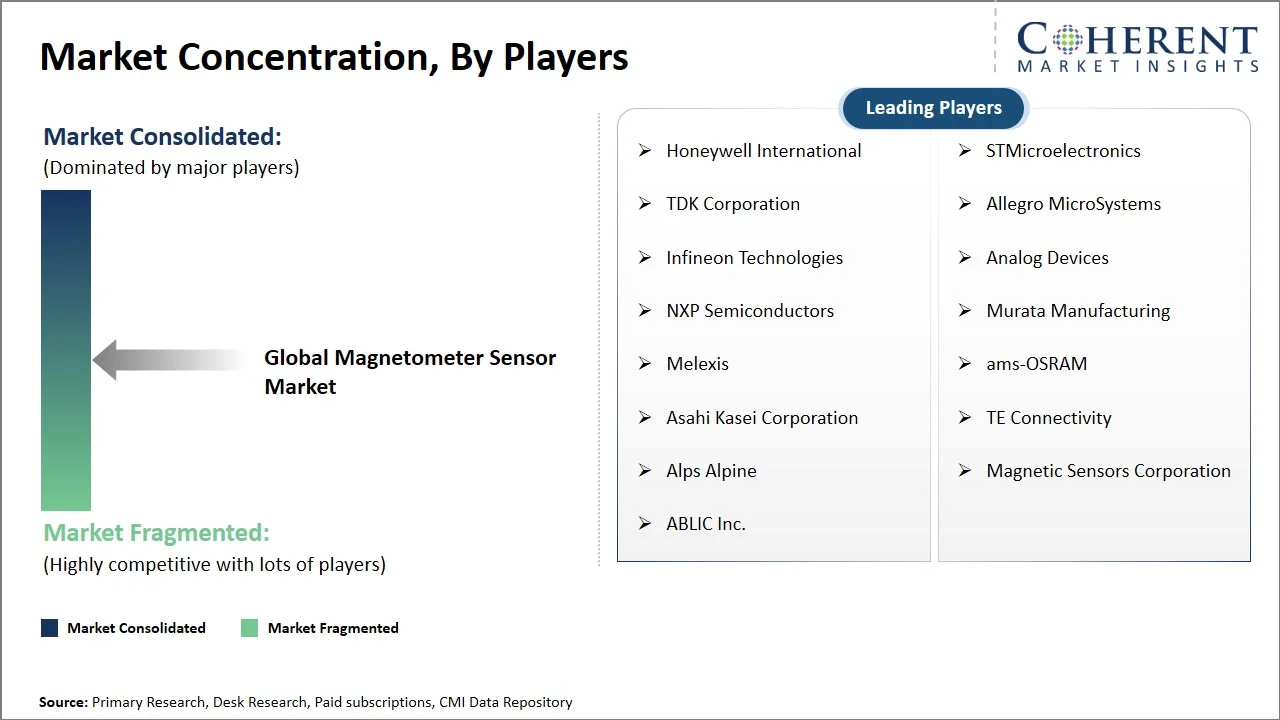
Globally, the magnetometer sensor market is a competitive one where semiconductor manufacturers and specialized magnetic sensing companies compete with each other. It’s not just about pricing, but differentiation relies on sensor accuracy, power efficiency, miniaturization and integration capabilities. STMicroelectronics, TDK Corporation, Infineon Technologies, Honeywell International, Analog Devices, NXP Semiconductors, Allegro MicroSystems and Melexis are expanding their MEMS and magnetometer sensor portfolios to meet the needs of automotive electrification, industrial automation and consumer electronics. The strategic focus is on integrated inertial measurement units (IMUs), multi-axis sensing platforms and sensor fusion software and partnerships with car OEMs, robotics businesses and aerospace contractors are strengthening long-term supply arrangements. The product qualification for automotive functional safety requirements and innovative packaging technologies has been a crucial competitive differentiation, especially for high reliability applications.
Market Report Scope
Magnetometer Sensor Market Report Coverage
| Report Coverage | Details | ||
|---|---|---|---|
| Base Year: | 2025 | Market Size in 2026: | USD 4.30 Bn |
| Historical Data for: | 2020 To 2024 | Forecast Period: | 2026 To 2033 |
| Forecast Period 2026 to 2033 CAGR: | 9% | 2033 Value Projection: | USD 7.95 Bn |
| Geographies covered: |
| ||
| Segments covered: |
| ||
| Companies covered: | Honeywell International, STMicroelectronics, TDK Corporation, Allegro MicroSystems, Infineon Technologies, Analog Devices, NXP Semiconductors, Murata Manufacturing, Melexis, ams-OSRAM, Asahi Kasei Corporation, TE Connectivity, Alps Alpine, Magnetic Sensors Corporation, and ABLIC Inc. | ||
| Growth Drivers: |
| ||
| Restraints & Challenges: |
| ||
Analyst Opinion (Expert Opinion)
- The magnetometer sensor market will be defined by further developments in sensor integration; comprehensive motion sensing platforms will create more value than isolated magnetometer sensors. The demand for highly integrated MEMS solutions with lower power consumption, better resilience to magnetic interference, and interoperability with AI-based sensor fusion algorithms is growing. There is also growing investment in tunnel magnetoresistance (TMR) and other high-sensitivity magnetic sensing technologies, and product development is increasingly targeted at automotive safety certifications, industrial automation requirements and next-generation navigation systems.
- The magnetometer sensor market will be driven by the confluence of autonomous mobility, intelligent robots, satellite navigation and precise industrial automation. Greater adoption is expected for electric aircraft, autonomous drones, collaborative robots and advanced healthcare equipment, where compact high-accuracy magnetic sensing will continue to be key for positioning and motion control. Emerging technologies like quantum magnetometers and advanced TMR sensors, along with AI-enabled calibration techniques, are expected to expand commercial applications beyond traditional navigation, while regional semiconductor manufacturing initiatives in the U.S., Europe, Japan, South Korea and India are expected to bolster supply resilience and accelerate innovation in the global market.
Speak to the analyst
Want personalized insights?
Take the findings above to one of our principal consultants, or have the report rebuilt around the segments, geographies and competitors you actually track.
Market Segmentation
- Product Type Insights (Revenue, USD Billion, 2021 - 2033)
- Single-Axis
- Two-Axis
- Three-Axis
- Measurement Type Insights (Revenue, USD Billion, 2021 - 2033)
- Scalar Magnetometers
- Vector Magnetometers
- Technology Type Insights (Revenue, USD Billion, 2021 - 2033)
- MEMS Magnetometers
- Fluxgate Magnetometers
- Hall-Effect Magnetometers
- Optical Pumping Magnetometers
- Magnetoresistive Magnetometers
- SQUID Magnetometers
- Application Insights (Revenue, USD Billion, 2021 - 2033)
- Navigation and Positioning
- Electronic Compass
- Consumer Electronics
- Industrial Automation
- Automotive
- Aerospace and Defense
- Geophysical Surveying
- Healthcare and Biomedical
- Robotics and Drones
- End User Insights (Revenue, USD Billion, 2021 - 2033)
- Automotive
- Consumer Electronics
- Aerospace and Defense
- Industrial Manufacturing
- Healthcare
- Energy and Utilities
- Research and Scientific Institutions
- Regional Insights (Revenue, USD Billion, 2021 - 2033)
- North America
- U.S.
- Canada
- Latin America
- Brazil
- Argentina
- Mexico
- Rest of Latin America
- Europe
- Germany
- U.K.
- Spain
- France
- Italy
- Russia
- Rest of Europe
- Asia Pacific
- China
- India
- Japan
- Australia
- South Korea
- ASEAN
- Rest of Asia Pacific
- Middle East
- GCC Countries
- Israel
- Rest of Middle East
- Africa
- South Africa
- North Africa
- Central Africa
- North America
- Key Players Insights
- Honeywell International
- STMicroelectronics
- TDK Corporation
- Allegro MicroSystems
- Infineon Technologies
- Analog Devices
- NXP Semiconductors
- Murata Manufacturing
- Melexis
- ams-OSRAM
- Asahi Kasei Corporation
- TE Connectivity
- Alps Alpine
- Magnetic Sensors Corporation
- ABLIC Inc.
Sources
Primary Research Interviews
- Magnetometer Sensor Manufacturers & OEMs
- Defense & Aerospace Electronics Specialists
- Consumer Electronics & IoT Device Developers
- Automotive Navigation System Integrators
Magazines
- Sensor Magazine
- Electronic Design Magazine
- IEEE Spectrum
- Defense Electronics Magazine
Journals
- Journal of Magnetism and Magnetic Materials (Elsevier)
- Sensors and Actuators A: Physical (Elsevier)
- IEEE Transactions on Magnetics
Associations
- MEMS & Sensors Industry Group (MSIG)
- Institute of Electrical and Electronics Engineers (IEEE)
- Semiconductor Industry Association (SIA)
- AeroSpace and Defence Industries Association of Europe (ASD)
Public Domain Sources
- U.S. Geological Survey (USGS) – Geomagnetic Research & Data
- NASA Technical Reports Server (NTRS) – Space & Navigation Sensor Publications
- European Space Agency (ESA) – Magnetometer Mission Data
- U.S. Department of Defense (DoD) – Defense Electronics & Navigation Reports
Proprietary Elements
- CMI Data Analytics Tool
- Proprietary CMI Existing Repository of Information for the Last 10 Years
Get access to 250+ pages report
Every segment, forecast, competitor profile and data table behind the analysis above — available for instant download.
- ESOMAR Member
- ISO 9001:2015 Certified
- D-U-N-S Registered
- GDPR & CCPA Compliant
Missing comfort of reading report in your local language? Find your preferred language:
Transform your Strategy with Exclusive Trending Reports
Frequently Asked Questions
The global magnetometer sensor market is expected to stand at USD 4.30 Bn in 2026 and is expected to reach USD 7.95 Bn by 2033.
The CAGR of the global magnetometer sensor market is projected to be 9% from 2026 to 2033.
In terms of product type, the single-axis segment is estimated to dominate the market revenue share in 2026.
They provide heading and orientation data that improve navigation and positioning accuracy.
They enable digital compass functionality and enhance location-based services.
Performance degradation due to magnetic interference and high calibration and integration complexity are the major factors hampering the growth of the global magnetometer sensor market.
Rising adoption of autonomous vehicles and ADAS and growing demand for precise navigation and positioning systems are the major factors driving the growth of the global magnetometer sensor market.