

Electronic Nose Market Size and Forecast – 2026-2033
The electronic nose market size is estimated to be valued at USD 34.14 Bn in 2026 and is expected to reach USD 88.62 Bn by 2033, exhibiting a compound annual growth rate (CAGR) of 14.6% from 2026 to 2033.
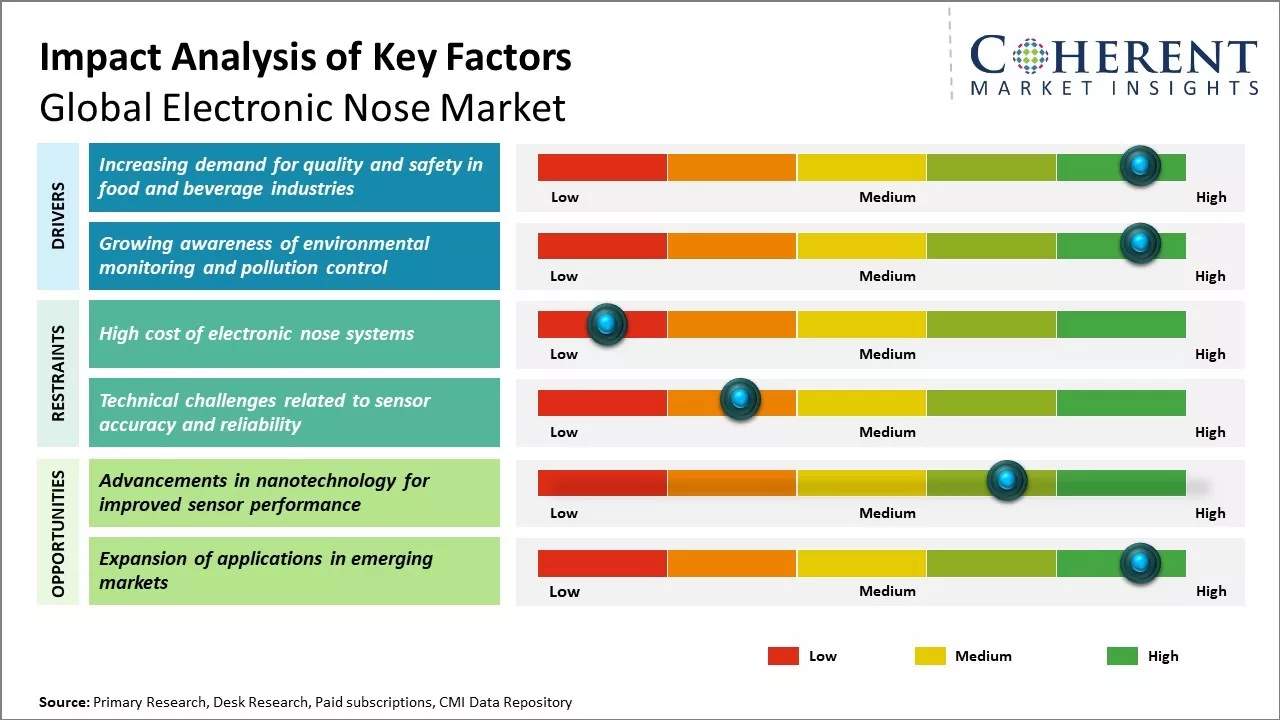
Key Takeaways of the Global Electronic Nose Market
- By technology, the metal-oxide sensors segment is expected to lead the electronic nose market, accounting for a 47.1% market share in 2026. This dominance is driven by their high sensitivity, cost-effectiveness, and ability to detect a broad range of volatile organic compounds, making them suitable for diverse applications.
- By application, the food and beverage segment is projected to contribute the highest share of the market at 39% in 2026. Increasing demand for quality control, aroma profiling, and contamination detection in food production is fueling growth in this segment.
- By end user, the industrial segment is anticipated to hold the largest market share of 54.3% in 2026, owing to the rising need for advanced sensing technologies in sectors such as manufacturing, environmental monitoring, and chemical processing.
Market Overview
Electronic nose market is expected to witness positive growth driven by increasing need for food quality inspection and process monitoring across various industries. Growing use of electronic noses for health and wellness applications such as diagnosing diseases, detection of skin ailments and intake of contaminated air is anticipated to offer lucrative opportunities.
Further, rising concerns over food safety and growing focus on product quality check are factors boosting the market growth. Technological advancements leading to the development of compact devices with high sensitivity and selectivity for complex odor detection will further aid the electronic nose market growth through 2032.
In the meantime, high up-front expenses, lack of standardization, and difficulties in replicating human olfactory function continue to hold back mass commercialization. Increasing applications in disease diagnosis and defense surveillance are anticipated to open new doors to the market growth.
Current Events and Their Impact on the Electronic Nose Market
Current Events | Description and its impact |
Technological Integration and Industry 4.0 Adoption
|
|
Public Health Trends
|
|
Market Trends
Advancements in Sensor Technology and AI Integration
Enhanced sensor technology and the integration of artificial intelligence (AI) are significantly enhancing the performance of electronic noses. AI enables more accurate identification, classification, and analysis of odors, resulting in improved performance across a broad spectrum of sectors like food safety, environmental monitoring, and healthcare diagnostics.
In 2024, an innovative healthcare company, Ainos, Inc., announced a breakthrough with its AI Nose technology. The groundbreaking system achieved 79% detection accuracy in recognizing 761 samples of 22 different volatile organic compounds (VOCs). This technological breakthrough represents a significant advancement in factory protection in industrial production and intelligent manufacturing, with AI-driven electronic noses having the capability to efficiently monitor and sense danger in real-time in factory environments.
Increased Demand for Non-Invasive Health Monitoring
There is a growing demand for non-invasive diagnostics in healthcare, particularly in the identification of early disease stages of lung cancer, diabetes, and metabolic disorders. E-nose technology, with its potential to detect volatile organic compounds (VOCs) in breath, is gaining growing popularity as an effective, non-invasive diagnostic method in healthcare.
In November 2024, researchers validated SpiroNose, an integrated device combining e-nose technology with spirometry for exhaled breath analysis. The system offered 78% to 88% diagnostic accuracy in discriminating among healthy individuals and patients suffering from diseases like asthma, chronic obstructive pulmonary disease (COPD), and lung cancer. The combination yields a novel, non-invasive method for exhaled breath analysis, elevating early detection and monitoring of respiratory diseases.
SpiroNose technology is a breakthrough to the application of e-nose systems to early diagnostics, providing medical practitioners with a new tool to assess respiratory status in a non-invasive manner.
Market Opportunity: Advancements in Nanotechnology for Improved Sensor Performance
One of the key opportunities for growth in the global electronic nose market is the advancements happening in the area of nanotechnology. Researchers are exploring the use of advanced nanomaterials like carbon nanotubes, TiO2 nanoparticles, gold nanoparticles, and others for developing highly selective and responsive sensors. These nanoscale materials exhibit improved adsorption capabilities and transducer properties.
Electronic noses that deploy nanotechnology-enabled sensors can detect trace levels of volatile compounds with high accuracy. This leads to improved identification abilities. The miniaturization of sensor components also brings down the overall device costs. For instance, in September 2024, Professor Heungjoo Shin in the Department of Mechanical Engineering and Professor Jae Joon Kim in the Department of Electrical Engineering at UNIST integrated in a new ultra-small electronic nose that can accurately measure both the type and concentration of gases.
- Current Industry Events of 2026
- Market Size Estimation
- Regional Breakdown
- Competitive Landscape
- Customer Intelligence
- Segmental Analysis
- Pricing Analysis
- Key Market Drivers, Challenges & Future Trends
- Customized Insights Section
Segmental Analysis
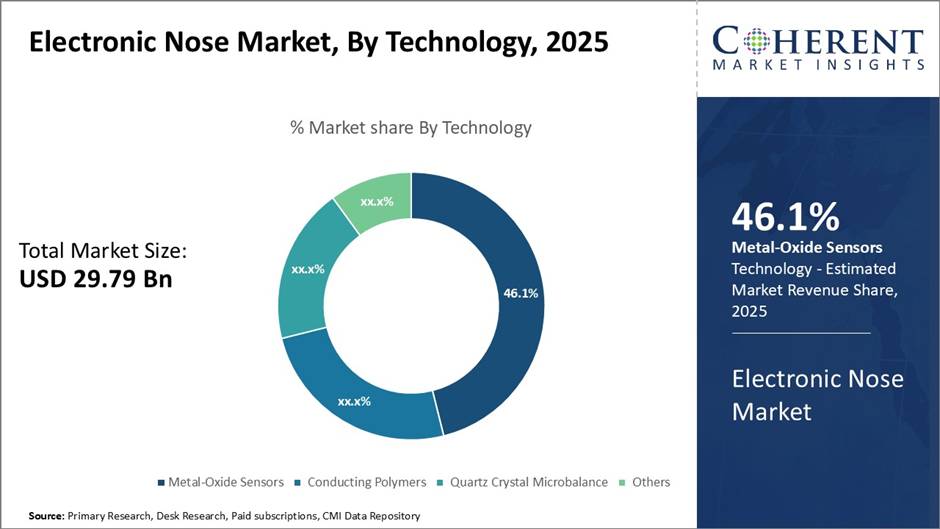
Global Electronic Nose Market Insights, By Technology
In terms of technology, metal-oxide sensors segment is expected to capture the highest market share of 47.1% in 2026. Metal-oxide sensors are made up of semiconducting metal oxides like tin dioxide (SnO2), zinc oxide (ZnO), and tungsten oxide (WO3). The electrical conductivity of synthetic metal oxides is different when exposed to different gases. This makes them highly sensitive in the detection of volatile organic compounds (VOCs) emitted by a variety of foods, beverages, or environmental samples.
Metal-oxide sensors became the technical solution for the majority of deployments of electronic nose in a host of applications in industries. In May 2024, researchers developed a zinc oxide (ZnO)-based chemiresistive gas sensor capable of detecting carbon monoxide (CO) at low temperatures. The sensor demonstrated around 8% sensitivity at 50°C with a rapid response time of approximately 10 seconds. This enhanced performance is attributed to the interaction between CO molecules and oxygen vacancies in ZnO, improving charge carrier movement.
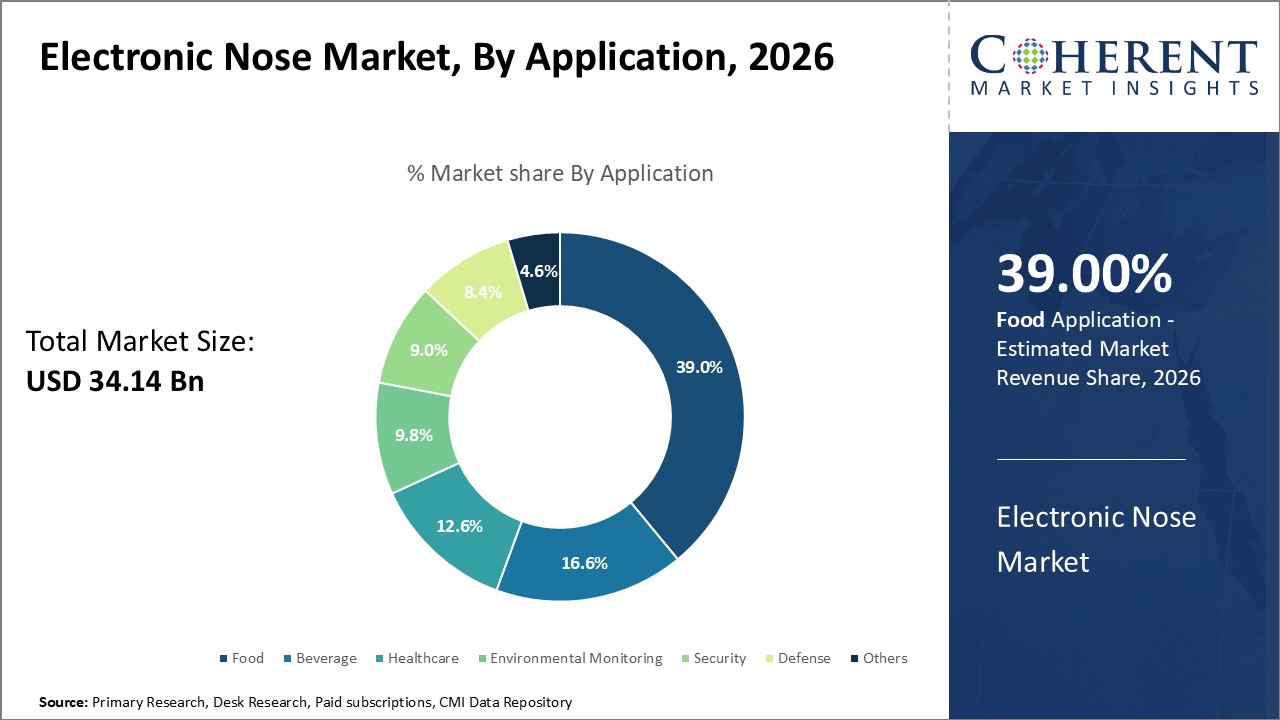
Global Electronic Nose Market Insights, By Application
In terms of application, food and beverage segment is estimated to contribute the highest market share of 39% in 2026. This is because electronic noses are increasingly being adopted for quality testing and process monitoring in the food and beverage industry.
Moreover, electronic noses can discriminate between subtle odor characteristics to distinguish between similar food items or batches. Their use is growing for applications like freshness grading of meat and dairy, authenticity testing of wine, brewing and distillation monitoring. The demand from food and beverage manufacturers makes it currently the largest application segment.
Global Electronic Nose Market Insights, By End User
In terms of end user, industrial segment is estimated to contribute the highest market share of 55.3% in 2026. Electronic nose systems are commonly installed by various process industries to monitor air/gas quality at different points. The demand from power plants, oil/gas refineries, pharmaceutical manufacturing, chemical processing, and other major industries has propelled the industrial end user segment to dominance. Its large size installations also contribute significantly to industry revenues.
Emerging Innovations in the Electronic Nose Market
AI-Enhanced Sensing and Machine Learning Algorithms
- Application: Modern electronic nose systems are embedding advanced machine learning and AI-based algorithms to greatly improve odor pattern identification, real-time interpretation of data, and sensor drift compensation. These technologies allow e-noses to identify sophisticated VOC patterns in most environments such as clinical diagnostics, spoilage detection in food, and toxic gas detection.
- Example: In October 2024, researchers at Nanyang Technological University (NTU) Singapore developed an artificial intelligence-enabled electronic nose that mimics the mammalian olfactory system to detect meat freshness. The device relies on a colorimetric barcode that changes color depending on gases emitted by spoiled meat. A deep convolutional neural network-based smartphone application reads color changes to estimate meat freshness. When used on industrially packaged beef, fish, and chicken, the e-nose correctly classified freshness levels 98.5% of the time. The technology offers a non-destructive, rapid, and consistent method of monitoring food quality in real-time, potentially reducing food waste and enhancing consumer safety.
Multimodal Sensing with Hybrid Sensor Arrays
- Application: Future electronic noses are combining hybrid sensor arrays with metal-oxide semiconductors (MOS), quartz crystal microbalances (QCM), and electrochemical sensors. These multimodal platforms offer a wider detection range and greater chemical specificity, thereby broadening their applications in medical diagnostics, food quality control, and environmental monitoring.
- Example: In May 2023, researchers at the University of Tokyo developed an e-nose system using electrospun nanofibers of composite metal oxides, including tin dioxide (SnO₂), copper oxide (CuO), indium oxide (In₂O₃), and zinc oxide (ZnO). The hybrid sensor array was able to differentiate five health-related volatile organic compounds (VOCs), underlining its potential in non-invasive breath analysis and individual health monitoring.
Regional Insights
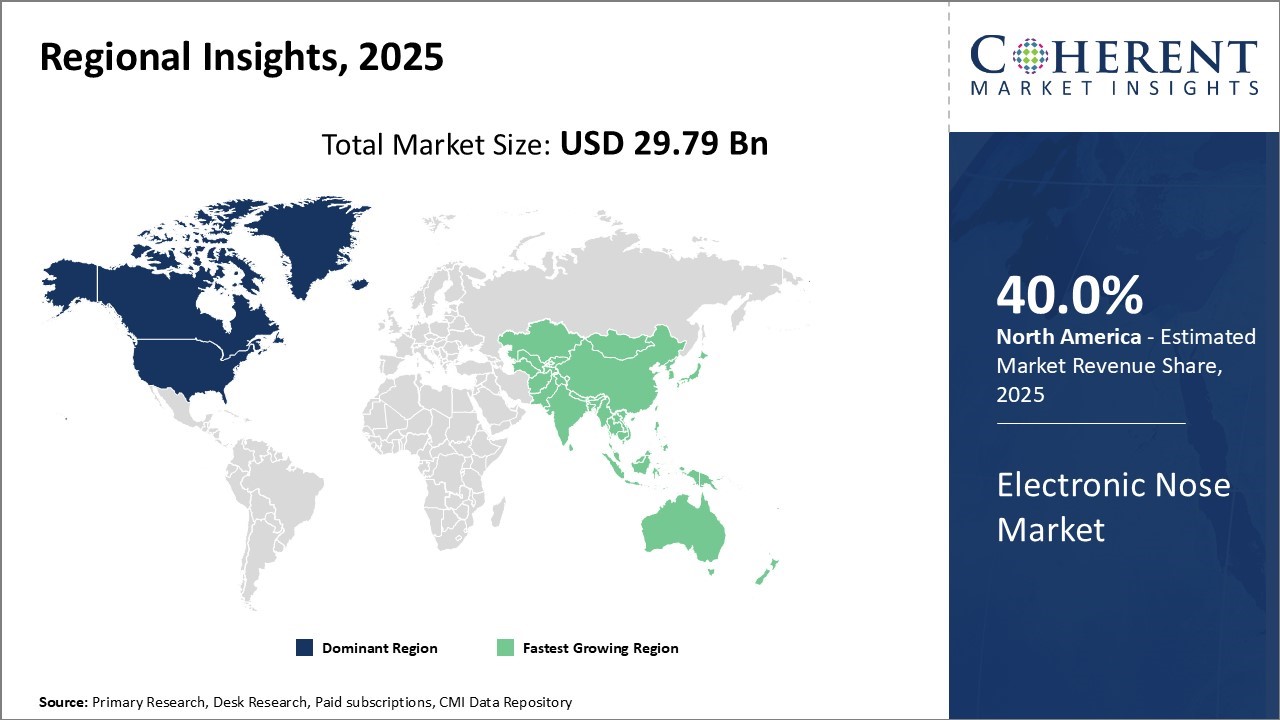
North America Electronic Nose Market Analysis and Trends
North America has been the largest and most dominant regional market for electronic nose globally with an expected 40.0% share in 2026. This can be attributed to the strong presence of leading electronic nose manufacturers within the region. Countries like the U.S. and Canada are home to top players in this space, such as Alpha MOS, Airsense Analytics, and Sensigent who have been pioneering product innovation. In addition, the North America region has had stringent regulations around food safety, environment and disease diagnostics which has necessitated increased deployment of sophisticated analytical instruments like electronic noses.
For instance, the rising incidence of diseases such as lung cancer, tuberculosis, and diabetes, coupled with the growing need for early detection, significantly contributes to the expansion of the market. According to the American Cancer Society, it is estimated that in 2023, approximately 59,910 women and 88,900 men in the U.S. will succumb to lung and bronchial cancer.
Asia Pacific Electronic Nose Market Analysis and Trends
The Asia Pacific region has emerged as the fastest growing market for electronic noses in recent years and this growth is expected to accelerate further. Rapid industrialization and urbanization across developing nations like China, India, and South East Asian countries are increasing demand for environmental monitoring and food quality control. At the same time, these markets are also witnessing increased focus on disease diagnostics and healthcare given their growing population base. This has prompted local manufacturers to invest substantially in developing low-cost electronic nose solutions.
Countries like China have additionally utilized their electronics manufacturing strengths and low-cost economies of scale to become major export hubs for electronic noses targeting other global markets. With its huge market size and double-digit economic growth rates, Asia Pacific is seen as an attractive and lucrative market for existing as well as new players in this field looking for high growth opportunities.
U.S. Electronic Nose Market Analysis and Trends
The U.S. electronic nose market continues to lead globally, fueled by advances in sensor miniaturization, AI integration, and strong industry uptake in healthcare, food safety, and industrial automation. Increasing demand for non-invasive diagnostics, smart manufacturing equipment, and environmental monitoring systems is steadily fueling the market growth. Federal research grants and the presence of core tech innovators also support this trend.
For instance, in February 2024, researchers from MIT developed a portable machine learning-augmented e-nose system that can detect early-stage lung cancer from a breath exhaled at over 85% accuracy. The breakthrough is representative of a new U.S. trend towards point-of-care diagnostics and translating sensor technologies from the laboratory to marketable healthcare products.
Pricing Analysis for the Electronic Nose Market
Device Cost by Application Segment
- Consumer-Grade and Food Quality E-Noses
The coffee flavor characterization, food freshness detectors, and packaging integrity instruments are usually in the range of US$ 300 to US$ 2,500. They are equipped with small polymer or metal-oxide sensors and limited cloud-based analytics.
Example: Handheld e-noses for food analysis that were sold to small-scale suppliers and retailers in North America are between US$ 500–1,000, depending on the sensor lifespan and sampling accuracy.
- Industrial and Environmental Monitoring E-Noses
More sophisticated gas leak detection, air quality control, or toxic VOC monitoring models are more expensive—usually between US$ 3,000 to US$ 10,000, depending on the number of sensors, ruggedness, and calibration systems.
They are typically built into factory automation or mobile monitoring stations, adding value in the form of real-time alerting systems and predictive maintenance software.
Operational and Maintenance Costs
- Sensor Replacement and Calibration:
Sensors in e-noses degrade from constant exposure to complex environments. Replacement costs are determined by:
US$ 100–500 per metal-oxide and polymer sensor module.
Industrial or medical-grade calibration services may cost US$ 200–800 annually.
- Software Licensing and AI Analytics
Cloud-based dashboards or mobile integration for real-time data interpretation and storage are now provided by most manufacturers.
Subscription fees of analytics platforms will range from US$ 100 to US$ 1,000/year, based on depth of features and customization.
Market Report Scope
Electronic Nose Market Report Coverage
| Report Coverage | Details | ||
|---|---|---|---|
| Base Year: | 2025 | Market Size in 2026: | USD 34.14 Bn |
| Historical Data for: | 2020 To 2024 | Forecast Period: | 2026 To 2033 |
| Forecast Period 2026 to 2033 CAGR: | 14.6% | 2033 Value Projection: | USD 88.62 Bn |
| Geographies covered: |
| ||
| Segments covered: |
| ||
| Companies covered: | Alpha MOS, SciSens, Odotech, eNose Company, AromaBit, Sensigent, G.A.S. Gesellschaft für analytische Sensorsysteme mbH, Robosense, Nanosensors, The Good Food Institute (GFI), Kiiroo, Neotronics, Scentia, Interscience, and Flavorman | ||
| Growth Drivers: |
| ||
| Restraints & Challenges: |
| ||
Electronic Nose Industry News
- In April 2024, an engineering team at Princess Sumaya University for Technology (PSUT) developed a prototype electronic nose system capable of detecting various types of bacteria and microbes present in foods, particularly those found in commercial products and public spaces.
- In January 2024, researchers in Taiwan developed an electronic nose (e-nose) that they say can correctly identify a coffee based on its aroma with up to 98% accuracy. A team led by Mr. Chung-Hong Lee, a professor in the Department of Electrical Engineering at the National Kaohsiung University of Science and Technology (Taiwan) employed AI learning algorithms to the new e-nose.
Analyst View
- The global electronic nose market is being driven by the fast pace of sensor miniaturization, AI, and nanotechnology. These technologies are making it possible to have highly precise, non-invasive smell detection with a wide range of applications in fields spanning from healthcare diagnosis and food safety to environmental monitoring and industrial automation. Advances such as SpiroNose and Ainos' AI Nose reflect a movement towards clinical-grade breath analysis and factory-grade safety monitoring.
- However, despite strong growth potential, cost barriers remain a key obstacle. Sophisticated e-nose systems can start at US$ 50,000, limiting accessibility for small businesses and consumers. Additionally, challenges in replicating the complexity of human olfaction and lack of sensor standardization continue to hinder broader adoption. Sensor degradation and maintenance costs also affect operational efficiency in long-term use cases.
- The future of the electronic nose market is in hybrid sensor systems, AI-driven odor mapping, and integration with IoT and digital health platforms. Companies using nanomaterials, multi-sensor arrays, and machine learning algorithms will be likely to outperform others, especially in applications that demand high specificity and real-time data.
- As smart cities, personalized diagnostics, and factory automation come of age, firms able to reconcile cost-effectiveness with high-performance sophistication will have an edge. The maturation of e-noses as mainstream diagnostic tools and predictive maintenance systems is a harbinger of a shift from niche novelty to ubiquitous utility in high-growth verticals.
Market Segmentation
- Technology Insights (Revenue, US$ Bn, 2021 - 2033)
- Metal-Oxide Sensors
- Conducting Polymers
- Quartz Crystal Microbalance
- Others
- Application Insights (Revenue, US$ Bn, 2021 - 2033)
- Food and Beverage
- Healthcare
- Environmental Monitoring
- Security and Defense
- Others
- End User Insights (Revenue, US$ Bn, 2021 - 2033)
- Industrial
- Commercial
- Residential
- Regional Insights (Revenue, US$ Bn, 2021 - 2033)
- North America
- U.S.
- Canada
- Latin America
- Brazil
- Argentina
- Mexico
- Rest of Latin America
- Europe
- Germany
- U.K.
- Spain
- France
- Italy
- Russia
- Rest of Europe
- Asia Pacific
- China
- India
- Japan
- Australia
- South Korea
- ASEAN
- Rest of Asia Pacific
- Middle East
- GCC Countries
- Israel
- Rest of Middle East
- Africa
- South Africa
- North Africa
- Central Africa
- North America
- Key Players Insights
- Alpha MOS
- SciSens
- Odotech
- eNose Company
- AromaBit
- Sensigent
- A.S. Gesellschaft für analytische Sensorsysteme mbH
- Robosense
- Nanosensors
- The Good Food Institute (GFI)
- Kiiroo
- Neotronics
- Scentia
- Interscience
- Flavorman
Sources
Primary Research Interviews:
Stakeholders:
- Electronic Nose Device Manufacturers (e.g., Alpha MOS, Sensigent, AromaBit)
- Sensor Technology Experts and Material Scientists
- Healthcare Professionals Using E-Nose Diagnostics (e.g., Pulmonologists, Oncologists)
- Food Safety and Quality Assurance Specialists
- Environmental Monitoring Agencies and Labs
- Industrial Safety Officers (Chemical, Oil & Gas, Manufacturing)
- Academic Researchers in AI, Olfaction, and Nanotechnology
- IoT and Smart Device Integration Specialists
Databases:
- PubMed & MEDLINE
- IEEE Xplore Digital Library
- ScienceDirect
- NIH RePORTER
- ClinicalTrials.gov
- World Health Organization (WHO) Global Health Observatory
- GlobalData Technology & Healthcare Database
- United States Environmental Protection Agency (EPA) Air Quality Database
Magazines:
- Sensors Online
- Industrial Safety & Hygiene News (ISHN)
- TechCrunch (Wearables and IoT sections)
- Medical Device + Diagnostic Industry (MD+DI)
- Food Quality & Safety Magazine
- AI in Healthcare
Journals:
- Sensors and Actuators B: Chemical
- Journal of Breath Research
- Biosensors and Bioelectronics
- Food Chemistry
- Analytica Chimica Acta
- Environmental Science & Technology
- Journal of Medical Devices
Newspapers:
- The Wall Street Journal (Tech & Healthcare Sections)
- The New York Times (Science & Tech Sections)
- The Guardian (Sustainability and Health Tech Coverage)
- Financial Times (Innovation & Industrial Tech)
Associations:
- International Society for Olfaction and Chemical Sensing (ISOCS)
- Institute of Electrical and Electronics Engineers (IEEE) Sensors Council
- American Chemical Society (ACS)
- International Food Protection Association (IFPA)
- American Lung Association (ALA)
- European Respiratory Society (ERS)
- World Health Organization (WHO)
Public Domain Sources:
- U.S. Food and Drug Administration (FDA) – Medical Devices
- European Medicines Agency (EMA)
- Centers for Disease Control and Prevention (CDC) – Environmental Health
- World Health Organization (WHO)
- U.S. Environmental Protection Agency (EPA)
- National Institutes of Health (NIH)
- ClinicalTrials.gov
- European Food Safety Authority (EFSA)
- OECD Science and Technology Indicators
Proprietary Elements:
- CMI Data Analytics Tool, and Proprietary CMI Existing Repository of Information for Last 8 Years
Get access to 250+ pages report
Every segment, forecast, competitor profile and data table behind the analysis above — available for instant download.
- ESOMAR Member
- ISO 9001:2015 Certified
- D-U-N-S Registered
- GDPR & CCPA Compliant
Missing comfort of reading report in your local language? Find your preferred language:
Transform your Strategy with Exclusive Trending Reports
Frequently Asked Questions
The Electronic Nose Market is estimated to be valued at USD 34.14 Bn in 2026, and is expected to reach USD 88.62 Bn by 2033.
The CAGR of the Electronic Nose Market is projected to be 14.6% from 2026 to 2033.
Increasing demand for quality and safety in food and beverage industries and growing awareness of environmental monitoring and pollution control are the major factors driving the growth of global electronic nose market.
High cost of electronic nose systems and technical challenges related to sensor accuracy and reliability are the major factors hampering the growth of global electronic nose market.
In terms of technology, metal-oxide sensors segment is estimated to dominate the market in 2026.
Alpha MOS, SciSens, Odotech, eNose Company, AromaBit, Sensigent, G.A.S. Gesellschaft für analytische Sensorsysteme mbH, Robosense, Nanosensors, The Good Food Institute (GFI), Kiiroo, Neotronics, Scentia, Interscience, and Flavorman are the major players.
North America is expected to lead the global electronic nose market.