

Global Maritime Surveillance Market Size and Forecast – 2026 To 2033
The global maritime surveillance market is expected to grow from USD 30 Bn in 2026 to USD 48 Bn by 2033, registering a compound annual growth rate (CAGR) of 8% from 2026 to 2033. The global maritime surveillance market is driven by growing deployment of satellite-based maritime surveillance systems. On October 16, 2025, ICEYE, the global leader in Synthetic Aperture Radar (SAR) satellite operations for Earth observation, and IHI Corporation, the Japanese leader in aerospace and defense industries, signed a procurement contract to build an Earth observation satellite constellation for security, civilian, and commercial use.
Key Takeaways of the Global Maritime Surveillance Market
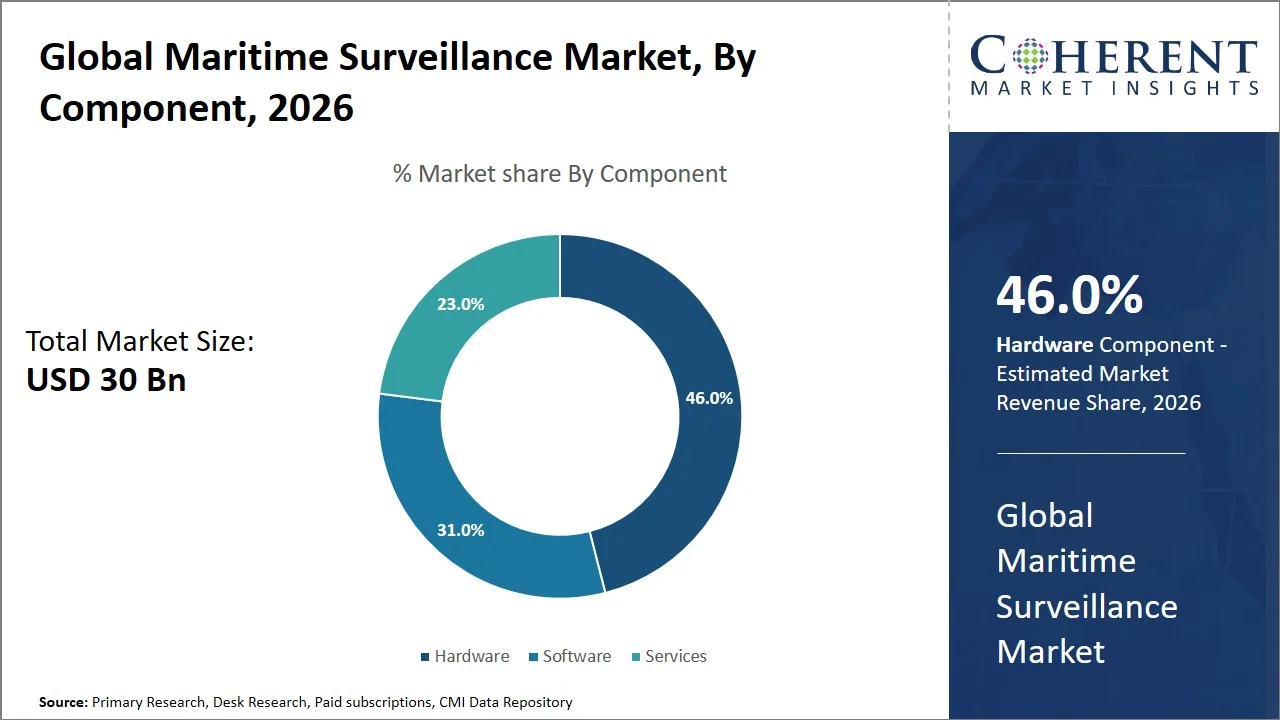
- The Hardware segment is expected to account for 46.0 % of the global maritime surveillance market share in 2026. Expansion of coastal surveillance infrastructure is driving the growth of the segment. On July 16, 2025, Terma has signed an agreement with the Danish Defence Acquisition and Logistics Organisation (DALO) to deliver 32 modern coastal surveillance radars.
- The Coastal Surveillance Systems segment is estimated to capture 39.0 % of the market share in 2026. Increasing adoption of AI enabled maritime domain awareness platforms is majorly driving the growth of the segment. On April 15, 2026, Windward and Vantor announced a strategic partnership to integrate Vantor’s space-based Sentry persistent monitoring system into Windward’s Maritime AI platform.
- The Radar segment is estimated to capture 36.0 % of the market share in 2026. Rising investments in unmanned maritime surveillance vehicles is driving the growth of the segment. On September 10, 2025, Anduril Industries received a major boost when the Australian Government announced a USD 1.20 billion investment to procure dozens of Ghost Shark extra-large autonomous underwater vehicles (XL-AUVs) for the Royal Australian Navy.
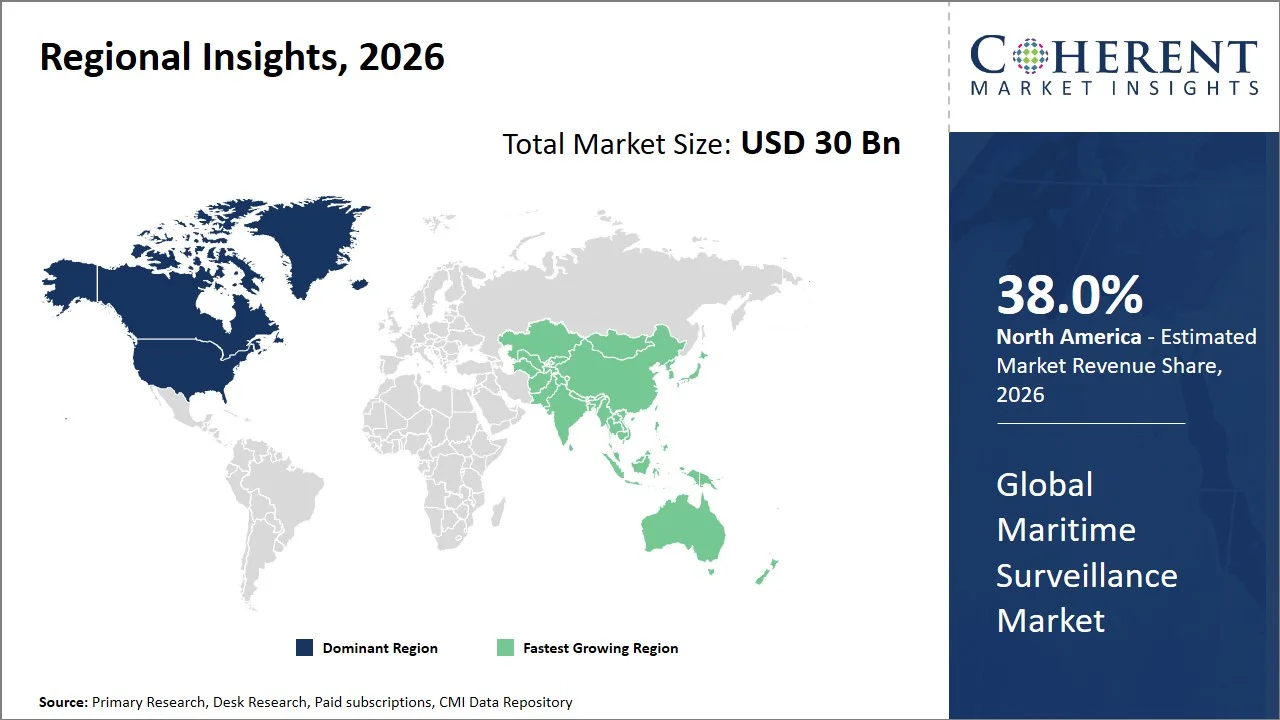
- North America is expected to dominate the maritime surveillance market in 2026 with a market share of 38.0 %. Increasing integration of AI and predictive analytics into surveillance platforms in North America is driving the growth of the regional market. On December 8, 2025, Thales Canada announced a partnership agreement with Cohere to provide agentic Artificial Intelligence (AI) for naval and maritime in-service support services.
- Asia Pacific is expected to account for 31.0 % share in 2026 and is projected to record the fastest growth over the forecast period. Development of smart ports with real time surveillance capabilities across Asia Pacific is driving the growth of the regional market. On July 23, 2025, Singapore Technologies Engineering Ltd announced that the Group secured about USD 4.7 billion worth of new contracts in the second quarter of 2025. These comprised USD 1.5 billion from Commercial Aerospace segment, USD 1.5 billion from Defence & Public Security segment and USD 1.7 billion from Urban Solutions & Satcom segment.
- Growing Integration of Artificial Intelligence for Maritime Domain Awareness: Artificial intelligence and machine learning are increasingly being incorporated into maritime surveillance platforms to automatically detect anomalous vessel behavior, identify unauthorized maritime activities, prioritize threats and support faster operational decision making. Artificial intelligence analytics are boosting situational awareness and reducing operator workload in the naval, coast guard, and commercial maritime domains.
- Expansion of Space-Based Maritime Surveillance Networks: Governments and private satellite operators are extending constellations equipped with synthetic aperture radar, marine electronics, optical imagery and Automatic Identification System payloads to enable global ocean monitoring on a continuous basis. These capabilities enable continuous tracking of vessels beyond coastal radar coverage and hence enable marine security, fishery management, environmental monitoring, and catastrophe response.
Segmental Insights
Why Does Hardware Dominate the Global Maritime Surveillance Market?
The hardware segment is expected to account for 46.0% of the global maritime surveillance market share in 2026. The hardware segment holds the major share in the worldwide marine surveillance market, mainly because it forms the backbone of every surveillance network. Critical equipment for detecting, tracking, and monitoring maritime activities over large oceanic areas includes coastal radar systems, electro-optical and infrared cameras, sonar arrays, satellite communication terminals, automatic identification system receivers, and command and control infrastructure. Spending on hardware continues to outpace spending on software and services, owing to the large capital investments and periodic upgrades that these systems require to fulfill changing security requirements. On April 9, 2026, Sensor solutions provider HENSOLDT UK secured two contracts with SRT Marine System Solutions Ltd (SRT), a UK-based civil-defence maritime surveillance systems company, to supply a total of 50 radar systems for deployment within integrated national coastal surveillance systems.
- Current Industry Events of 2026
- Market Size Estimation
- Regional Breakdown
- Competitive Landscape
- Customer Intelligence
- Segmental Analysis
- Pricing Analysis
- Key Market Drivers, Challenges & Future Trends
- Customized Insights Section
Why are Coastal Surveillance Systems the Most Preferred Platform?
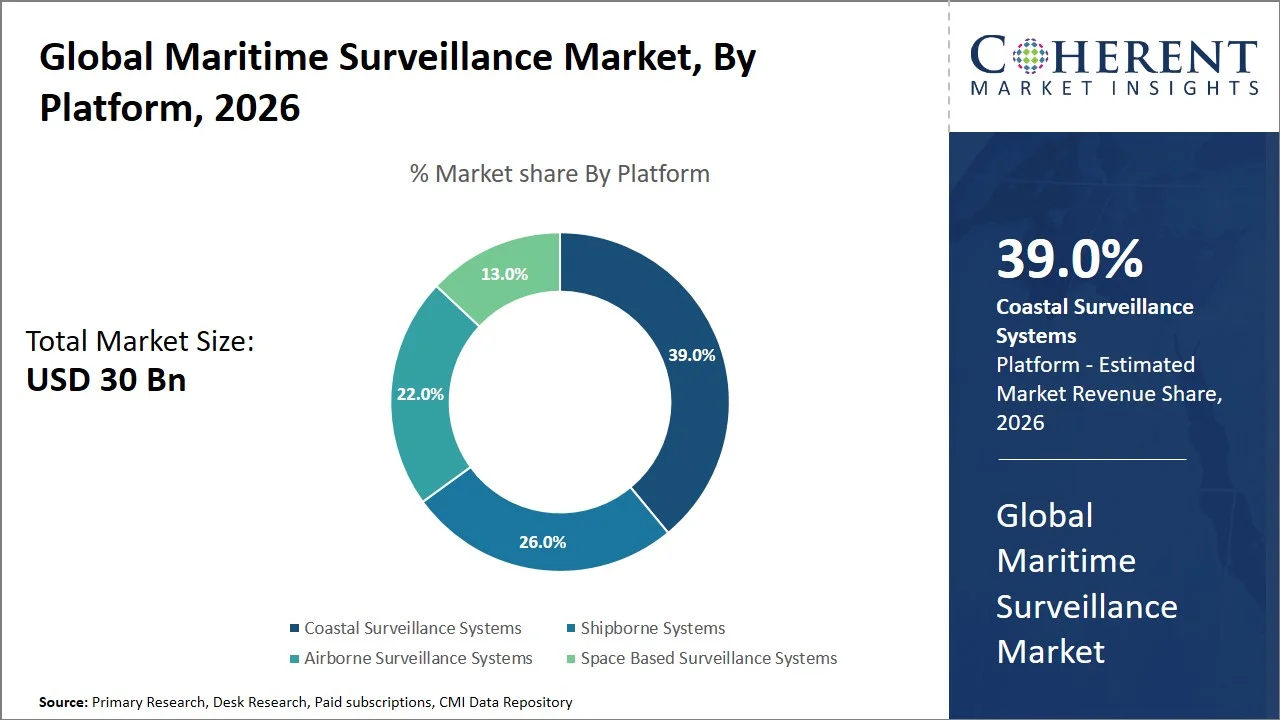
The coastal surveillance systems segment is expected to account for 39.0% of the global maritime surveillance market share in 2026. The most favored platform is the coastal surveillance systems that are able to continuously monitor in real-time territorial seas, ports, shipping lanes, and exclusive economic zones from fixed shore-based installations. These platforms have integrated radar, electro-optical sensors, automatic identification system receivers and communication networks that enable early detection of suspicious vessels, illegal fishing, smuggling, piracy and unauthorized border crossings, while offering wide-area coverage with lower operating costs than airborne or space-based surveillance assets. On May 6, 2026, Raytheon won an order from Blue Raven for 120 SharpSight radars, the largest single order yet for the new system and an important move in making it available to customers around the world.
Radar Dominates the Global Maritime Surveillance Market
The radar segment is expected to account for 36.0% of the global maritime surveillance market share in 2026. Radar holds the most share in the global marine surveillance market, thanks to its ability to reliably detect over long ranges and provide continuous monitoring irrespective of darkness, fog, rain, or bad weather. Radar systems are an essential component of modern coastal, naval, and offshore surveillance networks to detect, track, and categorize ships over large maritime areas. These systems are critical for border security, anti-smuggling operations, search and rescue missions, navigation safety and maritime domain awareness. On October 8, 2025, the German government selected Raytheon to provide its Raytheon-built SPY-6(V)1 radar for installation aboard eight of its F127 frigates under a requested foreign military sales deal with the U.S. Navy.
Current Events and their Impact
Current Events | Description and its Impact |
International Maritime Organization Strategy on Reduction of Greenhouse Gas Emissions from Ships |
|
European Union Maritime Single Window Environment Regulation (EU) 2019/1239 |
|
Maritime Surveillance Market Dynamics
Market Drivers
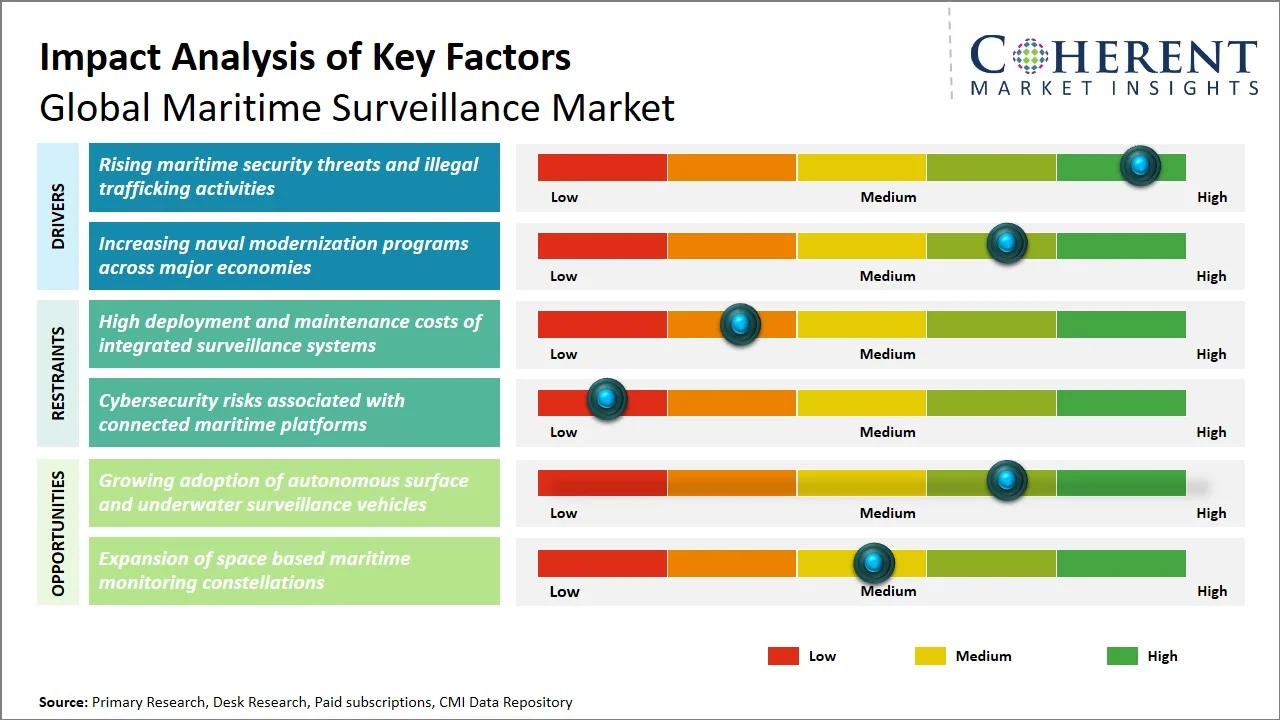
- Rising maritime security threats and illegal trafficking activities: The increasing cases of piracy, illegal fishing, maritime terrorism, drug trafficking, human smuggling, and unlawful border crossings have considerably boosted the demand for continuous maritime surveillance across the world. Governments are expanding coastal radar networks, satellite-based vessel monitoring systems, automatic identification system infrastructure, and unmanned surveillance platforms to improve maritime domain awareness, safeguard key sea lanes, and protect offshore energy infrastructure and national maritime boundaries from emerging security threats. On May 12, 2026, Ocean Power Technologies, Inc. announced the active deployment of three PowerBuoy systems supporting U.S. Department of Homeland Security (DHS) maritime surveillance operations, with all units simultaneously transmitting real-time data from offshore environments.
- Increasing naval modernization programs across major economies: Major economies are significantly boosting defense budgets for the modernization of naval fleets with next-generation surveillance and reconnaissance capabilities leading to enhanced operational effectiveness in the maritime environment. Demand for advanced maritime surveillance solutions to support national security and strategic maritime operations remains high, with increased investments in integrated command and control systems, artificial intelligence-enabled surveillance, long-range coastal radar and unmanned maritime vehicles, maritime patrol aircraft, and space-based monitoring systems. On July 20, 2026, Fincantieri inked a USD 3 billion contract with the Portuguese Government for the construction of three FREMM multi-purpose frigates. The deal comprises advanced naval combat systems, integrated surveillance sensors, long-term sustainment and knowledge transfer and is a major pillar of Portugal’s navy modernization agenda.
Emerging Trends
- Increasing Adoption of Autonomous Maritime Surveillance Platforms: Unmanned surface vessels, autonomous underwater vehicles and long-endurance unmanned aircraft systems are being employed to undertake persistent maritime surveillance at lower operational costs and with less risk to crew. These autonomous platforms are increasingly being connected with shore-based command centers to increase surveillance coverage in distant and high-risk maritime areas.
- Rising Deployment of Multi-Sensor Integrated Surveillance Systems: Maritime surveillance systems are merging coastal radar, electro-optical and infrared cameras, sonar, satellite imaging, AIS data and communication intelligence into a single command platform. The multi-sensor fusion approach provides real time maritime situational awareness, improves accuracy of target detection and enhances border security, port protection, and naval operations.
Regional Insights
Why is North America a Strong Market for Maritime Surveillance?
North America is expected to account for a market share of 38.0% in 2026. North America is expected to dominate the maritime surveillance market, due to the presence of large coastal security infrastructure and advanced naval capabilities, along with continuing investment in marine domain awareness. The U.S. Coast Guard has more than 240 coastal radar sites, and the Nationwide Automatic Identification System (NAIS) monitors vessel movements throughout U.S. coastal seas and interior waterways. The U.S. Navy’s Integrated Undersea Surveillance System (IUSS) and Naval Integrated Fire Control-Counter Air (NIFC-CA) architecture includes continual ocean surveillance supported by maritime patrol aircraft such as the Boeing P-8A Poseidon and MQ-4C Triton unmanned aircraft. Canada continues to strengthen its Arctic maritime surveillance with the Polar Epsilon satellite surveillance program, the RADARSAT Constellation Mission and investments under the National Shipbuilding Strategy, enhancing surveillance across the Northwest Passage and Arctic waters.
Why Does Asia Pacific Maritime Surveillance Market Exhibit High Growth?
Asia Pacific is projected to account for 31.0% of the global maritime surveillance market in 2026 and expected to register the fastest growth. Asia Pacific is the fastest-growing regional market due to increasing geopolitical tensions, territorial disputes in the South China Sea and East China Sea, and large-scale naval modernization. Countries in the region are building integrated coastal radar chains, satellite surveillance, long-range unmanned systems and underwater sensor networks. Japan, India, Australia, South Korea, Singapore, and China are investing money into maritime domain awareness platforms to watch over vital shipping lanes that transport a large proportion of global seaborne trade. The regional authorities are also using AI-powered command centers, satellite-based AIS, and unmanned maritime platforms to bolster border security, fishery enforcement and the protection of offshore energy installations.
Global Maritime Surveillance Market Outlook for Key Countries
Why is U.S. Emerging as a Major Hub in the Maritime Surveillance Market?
The U.S. is the largest market owing to constant modernization by the U.S. Coast Guard Department of Homeland Security. The Coast Guard patrols more than 95,000 miles of coastline and manages one of the world’s largest Exclusive Economic Zones, extending about 4.5 million square miles. Surveillance capabilities include the Nationwide Automatic Identification System, Maritime Domain Awareness architecture, Boeing P-8A Poseidon aircraft, MQ-4C Triton high-altitude unmanned aircraft, National Security Cutters, and coastal radar networks with sophisticated capabilities. Dozens of partner nations use the SeaVision maritime information-sharing platform to follow vessels in real time, and organizations such as NOAA fuse satellite images and ocean monitoring data to improve marine surveillance and disaster response.
Is China the Next Growth Engine for the Maritime Surveillance Market?
China has constructed one of the world’s most extensive maritime surveillance systems for activities in the South China Sea, East China Sea, and important commercial shipping lanes. The China Coast Guard possesses one of the largest coast guard fleets in the world, with abundant coastal radar installations, electro-optical monitoring stations, long-range UAVs, and satellite constellations, including the Haiyang ocean observation satellites and Gaofen Earth observation satellites. China has also constructed integrated command centers and surveillance facilities throughout Hainan Island and manmade islands in the South China Sea, giving it the ability to continually monitor marine traffic, fisheries, offshore energy assets and contested waters.
Japan Maritime Surveillance Market Analysis and Trends
Japan has one of the most technologically sophisticated marine surveillance networks, given its island location and the necessity to monitor approaches to the East China Sea. The Japan Coast Guard maintains about 450 patrol ships and aircraft, supported by a network of coast-based radar stations, satellite-based shipping tracking and sophisticated command and control systems. The Japan Maritime Self-Defense Force (JMSDF) uses P-1 maritime patrol aircraft, P-3C Orion aircraft, advanced sonar and unmanned systems in anti-submarine warfare and maritime reconnaissance. A constant watch on the Senkaku Islands has sped up the deployment of high-resolution radar and electro-optical monitoring devices.
India Maritime Surveillance Market Analysis and Trends
India is fast increasing its marine surveillance capability to protect the 7,500 km coastline, island territories and the strategically crucial Indian Ocean Region. The Indian Coastal Surveillance Network is a network of over 70 radar stations established along the mainland and island regions and networked through the Information Management and Analysis Centre (IMAC) at Gurugram. India has also set up coastal radar chains in partner nations such as Maldives, Mauritius, Seychelles, Sri Lanka, and Myanmar for better regional marine domain awareness. The Indian Navy has P-8I Poseidon aircraft, MQ-9B SeaGuardian unmanned systems, satellite-based monitoring systems and the Information Fusion Centre – Indian Ocean Region (IFC-IOR) in association with over 25 partner countries and a large number of multinational organizations to share real-time maritime information.
U.K. Maritime Surveillance Market Analysis and Trends
The U.K. has stepped up its maritime surveillance to defend the North Atlantic, the English Channel and key offshore energy installations. The Royal Navy uses P-8A Poseidon MRA1 maritime patrol aircraft, Type 26 and Type 31 frigates with modern radar and sonar systems, and Protector RG Mk1 remotely piloted aircraft for persistent maritime intelligence. The National marine Information Centre (NMIC) combines the Royal Navy, Border Force, Maritime and Coastguard Agency and intelligence services to develop a single marine operating picture. The U.K. also employs advanced surveillance capabilities to secure offshore wind farms, underwater communication cables and energy installations in the North Sea and works closely with NATO allies on maritime security missions.
Global Maritime Surveillance Market - Space-Based AIS Coverage By Region (2025)
Region | Estimated Space-Based AIS Coverage Level | Primary Coverage Areas | Major Satellite AIS Providers |
North America | Very High | Atlantic Ocean, Pacific Coast, Arctic waters, Gulf of Mexico | ORBCOMM, Spire Global, HawkEye 360 |
Europe | Very High | North Sea, Baltic Sea, Mediterranean, Arctic shipping routes | Kongsberg Satellite Services (KSAT), ExactEarth (Spire), European Maritime Safety Agency |
Asia Pacific | High | South China Sea, East China Sea, Indian Ocean, Western Pacific | Spire Global, ORBCOMM, PierSight, ICEYE (integrated SAR-AIS) |
Middle East & Africa | Medium | Arabian Gulf, Red Sea, Gulf of Aden, East African coast | ORBCOMM, Spire Global |
Latin America | Medium | Caribbean Sea, South Atlantic, Pacific Coast | ORBCOMM, Spire Global |
Global Maritime Surveillance Market - Electro-Optical and Infrared Surveillance Sensor Adoption (2025)
End-Use Segment | Estimated EO/IR Sensor Adoption Rate | Primary EO/IR Sensor Types | Major Applications |
Naval Surface Combatants | 96% | Long-range EO cameras, MWIR/LWIR thermal imagers, laser rangefinders | Surface target identification, fire control support, anti-piracy patrols, force protection |
Coast Guard & Maritime Security Agencies | 92% | Pan-tilt EO/IR cameras, thermal imaging systems, HD daylight cameras | Border surveillance, illegal fishing detection, search & rescue, law enforcement |
Maritime Patrol Aircraft | 90% | Stabilized EO/IR turrets, multispectral imaging systems | Long-range maritime reconnaissance, vessel identification, intelligence collection |
Offshore Patrol Vessels (OPVs) | 88% | Thermal cameras, HD EO cameras, laser illuminators | EEZ patrol, offshore infrastructure protection, anti-smuggling missions |
Unmanned Surface Vehicles (USVs) | 82% | Compact EO/IR payloads, AI-enabled vision cameras | Autonomous surveillance, port security, persistent coastal monitoring |
Unmanned Underwater Vehicles (AUVs/UUVs) | 38% | Low-light optical cameras, underwater imaging cameras | Harbor inspection, underwater infrastructure inspection, mine countermeasure support |
Coastal Surveillance Towers | 86% | Fixed EO/IR surveillance cameras, thermal imaging systems | Coastal monitoring, harbor security, vessel tracking |
Port & Harbor Authorities | 80% | PTZ EO cameras, thermal security cameras | Port perimeter protection, vessel traffic monitoring, critical infrastructure security |
How is Growing Adoption of Autonomous Surface and Underwater Surveillance Vehicles Creating New Growth Opportunities in the Maritime Surveillance Market?
The increasing deployment of autonomous surface vehicles (ASVs) and autonomous underwater vehicles (AUVs) is opening up new growth opportunities by providing persistent surveillance in high-risk inaccessible maritime environments that are inefficient for traditional patrol ships and manned aircraft. Naval organizations are using more and more platforms such as L3Harris’ Iver4 AUV, Kongsberg’s HUGIN autonomous underwater vehicle, Saildrone Voyager, and Ocean Aero Triton for intelligence gathering, anti-submarine warfare, seabed mapping, mine countermeasure operations, critical subsea cable inspection, offshore wind farm monitoring, and exclusive economic zone patrols.
These platforms come with synthetic aperture sonar, side-scan sonar, electro-optical sensors, AIS receivers, acoustic sensors, satellite communications and onboard AI-based analytics, which enable them to provide real-time surveillance data to maritime command centers, while being able to operate continuously for days or weeks with minimal human intervention. The swift growth of offshore energy infrastructure, underwater communication cables and strategic maritime chokepoints is also hastening the procurement of autonomous surveillance fleets, which offers large opportunities for manufacturers of autonomous platforms, sensor payloads, mission software, secure communication systems and AI-enabled maritime analytics.
On March 11, 2026, The Albanese Government announced it will strengthen Australia’s maritime security with a USD 176 million investment to deliver 40 new Australian-designed and built Bluebottle uncrewed surface vessels (USV), one of the world’s largest sovereign USV fleets.
Market Players, Key Development, and Competitive Landscape
Key Developments
- On May 12, 2025, Helsing unveiled Lura and SG-1 Fathom to digitalise and defend the oceans. Drawing insights from Helsing’s experience in the air and land domains, Lura is a software platform and advanced AI system developed from first principles to rethink maritime surveillance.
- On May 8, 2025, Saildrone announced its partnership with the Danish Armed Forces in a groundbreaking initiative to enhance maritime surveillance and intelligence gathering around Northern Europe. Four Saildrone Voyager uncrewed surface vehicles (USVs) will be deployed in Danish waters during the summer of 2025.
Competitive Landscape
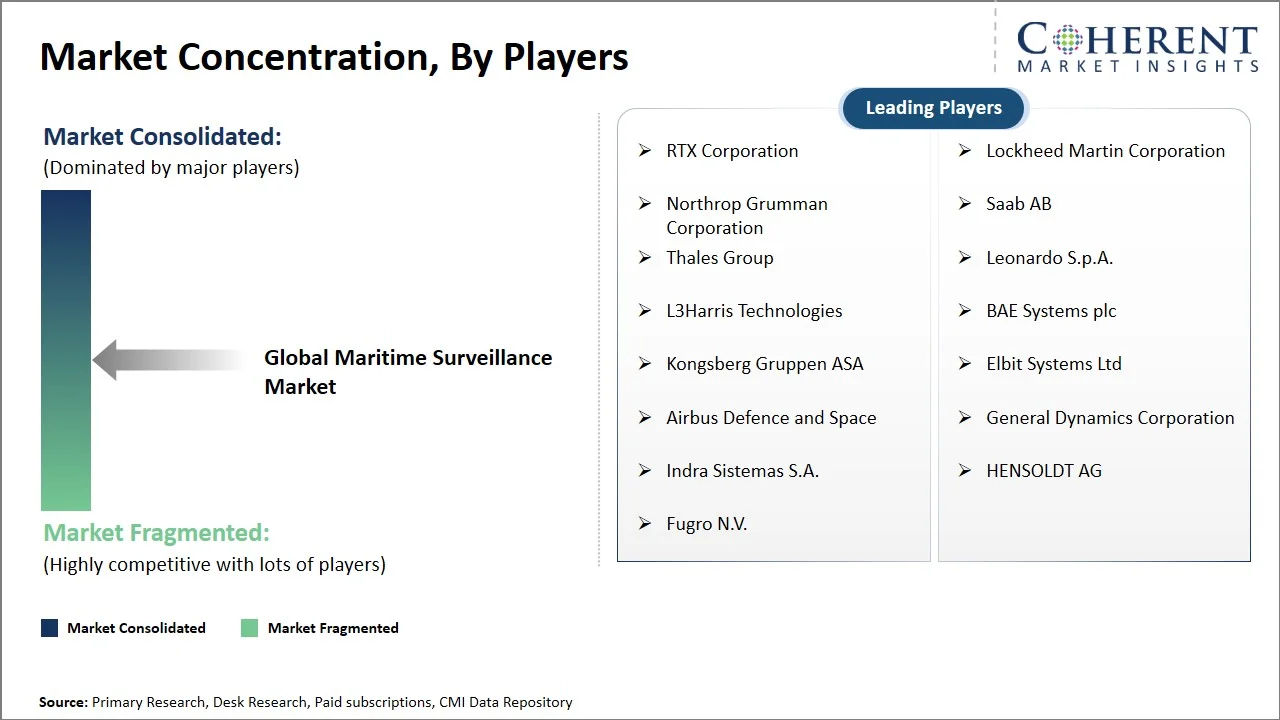
The global maritime surveillance market is led by RTX Corporation, Thales Group, Saab AB, Lockheed Martin, Northrop Grumman, L3Harris Technologies, Leonardo, and Kongsberg Gruppen, all of which compete through integrated multi-domain surveillance portfolios rather than standalone sensors. For navy customers, RTX is well-positioned with AN/SPY radar systems, maritime command-and-control solutions and AI-enabled sensor fusion technology. Thales is focused on bringing together CoastShield coastal surveillance, Ground Master radar and satellite-enabled maritime domain awareness technologies for border security agencies.
Saab has increased its roll-out of its Coast Control system with the Giraffe radar family, and introduced AIS capabilities for coastal surveillance agencies. Kongsberg is capitalizing on the increasing demand for autonomous maritime surveillance with its HUGIN autonomous underwater vehicles and sophisticated sonar systems. L3Harris is expanding its use of the Iver4 AUV for mine countermeasures and persistent underwater intelligence missions. Lockheed Martin and Northrop Grumman continue emphasizing network-centric surveillance by integrating radar, unmanned systems, space assets, and AI-powered mission management into unified maritime surveillance architectures.
Market Report Scope
Maritime Surveillance Market Report Coverage
| Report Coverage | Details | ||
|---|---|---|---|
| Base Year: | 2025 | Market Size in 2026: | USD 30 Bn |
| Historical Data for: | 2020 To 2024 | Forecast Period: | 2026 To 2033 |
| Forecast Period 2026 to 2033 CAGR: | 8% | 2033 Value Projection: | USD 48 Bn |
| Geographies covered: |
| ||
| Segments covered: |
| ||
| Companies covered: | RTX Corporation, Lockheed Martin Corporation, Northrop Grumman Corporation, Saab AB, Thales Group, Leonardo S.p.A., L3Harris Technologies, BAE Systems plc, Kongsberg Gruppen ASA, Elbit Systems Ltd, Airbus Defence and Space, General Dynamics Corporation, Indra Sistemas S.A., HENSOLDT AG, Fugro N.V. | ||
| Growth Drivers: |
| ||
| Restraints & Challenges: |
| ||
Analyst Opinion (Expert Opinion)
- The strongest long-term growth is expected to come from the convergence of satellite surveillance, autonomous maritime platforms, and artificial intelligence rather than from conventional coastal radar deployments alone. Future procurement programs are increasingly specifying integrated maritime domain awareness ecosystems capable of fusing satellite imagery, AIS, radar, electro-optical sensors, sonar, and unmanned vehicle data into a single operational picture. Vendors with proven sensor fusion and AI analytics capabilities are therefore expected to outperform suppliers focused on individual hardware components.
- The most attractive opportunity is expected to be offered by autonomous surveillance platforms for Indian naval and coast guard applications, with the rapid expansion of the Coastal Surveillance Network, the Information Fusion Centre – Indian Ocean Region and Indian Ocean security initiatives creating demand for persistent unmanned monitoring solutions. Another high-growth potential is underwater surveillance systems to assist offshore wind farms, undersea communication cables, and crucial energy infrastructure in the North Sea and Indo-Pacific maritime corridors.
- To achieve competitive advantage, market participants should look beyond the product itself and focus on the integrated surveillance ecosystem, combining autonomous surface vessels, autonomous underwater vehicles, coastal radar, satellite intelligence and AI enabled analytics within a common command platform. Strategic partnerships with satellite operators, defense ministries, and naval shipbuilders, together with investments in open-architecture software that supports interoperability with existing maritime command systems, will be critical for securing large multi-year modernization contracts.
Speak to the analyst
Want personalized insights?
Take the findings above to one of our principal consultants, or have the report rebuilt around the segments, geographies and competitors you actually track.
Market Segmentation
- Component Insights (Revenue, USD Billion, 2021 - 2033)
- Hardware
- Software
- Services
- Platform Insights (Revenue, USD Billion, 2021 - 2033)
- Coastal Surveillance Systems
- Shipborne Systems
- Airborne Surveillance Systems
- Space Based Surveillance Systems
- Technology Insights (Revenue, USD Billion, 2021 - 2033)
- Radar
- Automatic Identification System
- Electro Optical and Infrared Systems
- Satellite Surveillance
- Sonar
- Communication Intelligence
- Application Insights (Revenue, USD Billion, 2021 - 2033)
- Maritime Security
- Search and Rescue
- Fisheries Monitoring
- Environmental Monitoring
- Border and Coastal Protection
- Port and Harbor Surveillance
- End User Insights (Revenue, USD Billion, 2021 - 2033)
- Naval Forces
- Coast Guard
- Port Authorities
- Commercial Shipping Companies
- Offshore Oil and Gas Operators
- Maritime Security Agencies
- Regional Insights (Revenue, USD Billion, 2021 - 2033)
- North America
- U.S.
- Canada
- Latin America
- Brazil
- Argentina
- Mexico
- Rest of Latin America
- Europe
- Germany
- U.K.
- Spain
- France
- Italy
- Russia
- Rest of Europe
- Asia Pacific
- China
- India
- Japan
- Australia
- South Korea
- ASEAN
- Rest of Asia Pacific
- Middle East
- GCC Countries
- Israel
- Rest of Middle East
- Africa
- South Africa
- North Africa
- Central Africa
- North America
- Key Players Insights
- RTX Corporation
- Lockheed Martin Corporation
- Northrop Grumman Corporation
- Saab AB
- Thales Group
- Leonardo S.p.A.
- L3Harris Technologies
- BAE Systems plc
- Kongsberg Gruppen ASA
- Elbit Systems Ltd
- Airbus Defence and Space
- General Dynamics Corporation
- Indra Sistemas S.A.
- HENSOLDT AG
- Fugro N.V.
Sources
Primary Research Interviews
- Maritime Domain Awareness (MDA) Specialists
- Coastal Surveillance System Integrators
- Radar and Sonar Technology Manufacturers
- Satellite Maritime Surveillance Solution Providers
Magazines
- The Maritime Executive
- Maritime Reporter & Engineering News
- Safety at Sea
- Port Technology International
- Lloyd's List
Journals
- Journal of Navigation
- Journal of Marine Science and Technology
- Journal of Marine Engineering & Technology
Associations
- International Maritime Organization
- International Hydrographic Organization
- International Association of Marine Aids to Navigation and Lighthouse Authorities
Public Domain Sources
- International Maritime Organization
- U.S. Coast Guard
- National Oceanic and Atmospheric Administration
- European Maritime Safety Agency
- European Space Agency
Proprietary Elements
- CMI Data Analytics Tool
- Proprietary CMI Existing Repository of Information for the Last 10 Years
Get access to 250+ pages report
Every segment, forecast, competitor profile and data table behind the analysis above — available for instant download.
- ESOMAR Member
- ISO 9001:2015 Certified
- D-U-N-S Registered
- GDPR & CCPA Compliant
Missing comfort of reading report in your local language? Find your preferred language:
Transform your Strategy with Exclusive Trending Reports
Frequently Asked Questions
The global maritime surveillance market is expected to stand at USD 30 Bn in 2026 and is expected to reach USD 48 Bn by 2033.
The CAGR of the global maritime surveillance market is projected to be 8% from 2026 to 2033.
Rising maritime security threats and illegal trafficking activities and increasing naval modernization programs across major economies are the major factors driving the growth of the global maritime surveillance market.
High deployment and maintenance costs of integrated surveillance systems and cybersecurity risks associated with connected maritime platforms are the major factors hampering the growth of the global maritime surveillance market.
In terms of component, hardware segment is estimated to dominate the market revenue share in 2026.
Automatic identification system technology provides real-time vessel identification and tracking to improve maritime safety and security.
Satellite surveillance enables continuous monitoring of vessels across vast ocean regions beyond the range of coastal radar.