

U.S. Law Enforcement Training Market Size and Forecast – 2026-2033
The U.S. law enforcement training market is estimated to be valued at USD 4.16 Bn in 2026 and is expected to reach USD 5.73 Bn by 2033, exhibiting a compound annual growth rate (CAGR) of 4.7% from 2026 to 2033.
Key Takeaways of the U.S. Law Enforcement Training Market
- The basic training segment leads the market holding an estimated share of 30.5 % in 2026.
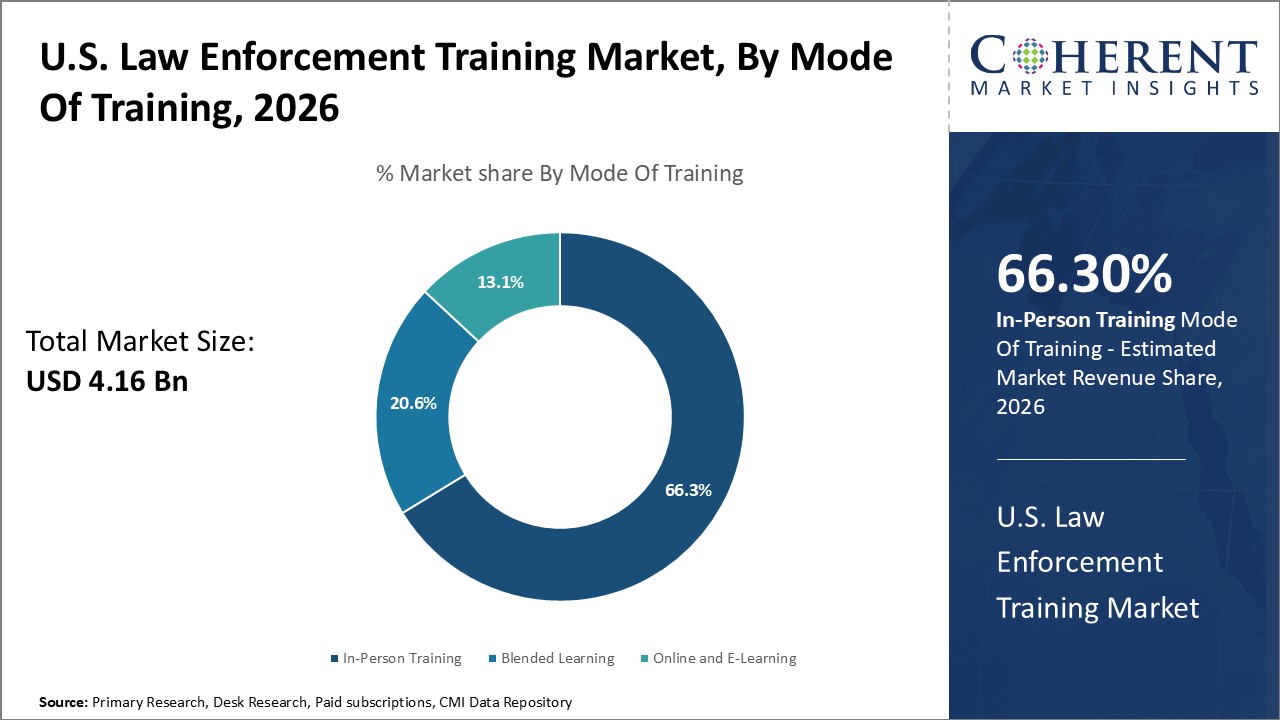
- The in-person training segment is projected to dominate with a share of 66.3 % in 2026.
- The government agencies segment is estimated to lead the market with a share of 78.5 % in 2026.
Market Overview
The market is seeing the adoption of virtual reality (VR) and simulation-based training modules, which improve experiential learning and reduce training costs. Also, there is a growing focus on mental health and de-escalation techniques to improve officer and civilian safety. The use of data analytics to assess training effectiveness and tailor programs is also becoming popular, showing a shift towards more personalized and technology-driven law enforcement training solutions.
Current Events and their Impact
Current Events | Description and its Impact |
Cybersecurity & Data Concerns |
|
Government Grants & Funding Initiatives |
|
Segmental Insights
- Current Industry Events of 2026
- Market Size Estimation
- Regional Breakdown
- Competitive Landscape
- Customer Intelligence
- Segmental Analysis
- Pricing Analysis
- Key Market Drivers, Challenges & Future Trends
- Customized Insights Section
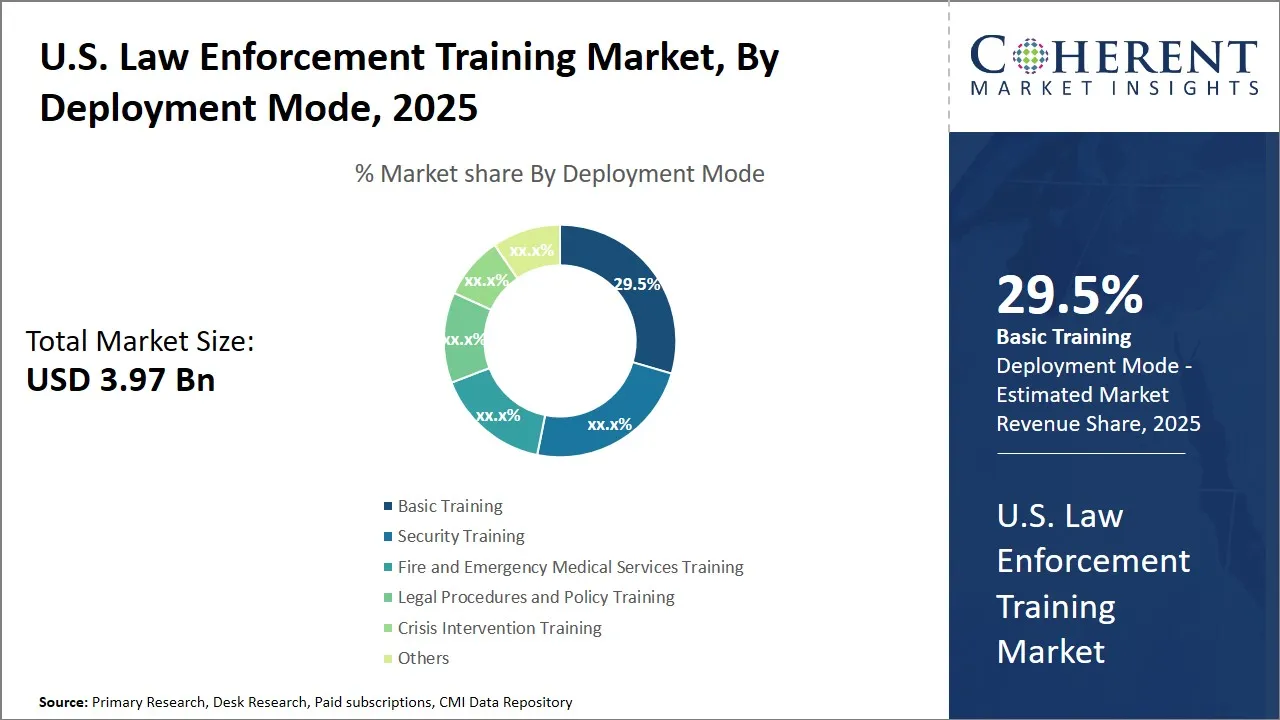
U.S. Law Enforcement Training Market Insights, by Deployment Mode – Focus on Foundational Competency Adds to Dominance of Basic Training
Basic training is expected to hold the largest share of 30.5% in the U.S. law enforcement training market in 2026 because it serves as an foundation for all law enforcement personnel. There is a lot of need for standardized and comprehensive initial training that prepares recruits to handle the demands of policing effectively. Basic training teaches core competencies like firearms proficiency, physical fitness, patrol techniques, and community interaction skills, which are very important for officers before entering active duty. The growing complexity of law enforcement challenges, including rising crime rates in some jurisdictions and evolving threats like cybercrime, add to the importance of thorough fundamental training.
Also, the strict certification and licensing requirements put in place by different states and federal guidelines make extensive basic training necessary, thereby making consistent demand. Agencies ensure that new recruits meet these strict standards to maintain operational effectiveness and legal compliance. To add, social and political pressures to improve law enforcement accountability have led to improvements in basic curriculum content, adding topics like ethics, cultural sensitivity, and de-escalation techniques. These inclusions make the scope of basic training bigger and make it important in shaping officers’ attitudes and behaviors from the onset.
Also, investments in advanced training facilities and updated resources specifically for basic training have pushed departments to allocate big budget portions to this segment. Because recruits spend a lot of hours in academies undergoing this training, the segment naturally holds the largest market share.
U.S. Law Enforcement Training Market Insights, by Mode of Training – Preference for In-Person Training Rises Because of Hands-On Skill Development and Realistic Scenario Practice
In-person training remains the leading segment in the U.S. law enforcement training market, holding an estimated share of 66.3% in 2026, because of the benefits it provides in immersive, experiential learning needed for policing. Law enforcement competency relies a lot on physical skills and decision-making under pressure. In-person settings help trainees engage in live simulations, tactical drills, and use-of-force exercises that need real-time feedback from experienced instructors, improving muscle memory and judgment accuracy.
The need for physical presence is especially important for training involving firearms handling, tactical response, and emergency medical interventions, where precise movements and fast reactions can be life-saving. Virtual or remote training modes often cannot replicating the psychological and physiological stress officers see in actual situations. As a result, agencies prefer traditional in-person formats to ensure comprehensive preparation.
Also, in-person training allows for better interpersonal communication and team cohesion, which are important for effective field operations. Officers benefit from peer learning, role-playing exercises, and mentorship that build trust and camaraderie. The networking and relationship-building opportunities in classroom or simulation environments add to a cohesive police force and support continual learning throughout a career. Government policies and funding priorities often allocate resources specifically for facility-based training programs, adding to institutional trust in in-person methods.
U.S. Law Enforcement Training Market Insights, by Service Provider Type – Government Agencies Lead Through Institutional Expertise and Regulatory Authority in Training Provision
Government Agencies are projected to hold the highest share of 78.5% in the U.S. law enforcement training market in 2026. Their leadership comes from their authoritative role in setting training standards, providing institutional expertise, and fulfilling regulatory requirements that mandate law enforcement preparation. As primary overseers of public safety, federal, state, and local government, agencies design and operate official police academies and training centers that offer comprehensive curricula aligned with statutory mandates.
Government agencies see direct access to public funding, making possible sustained investments in infrastructure, training technologies, and instructor development. Also, government-sponsored training generally has official accreditation, making it the preferred or sometimes mandatory option for departments looking for lawful certification for their officers.
End User Feedback & Unmet Needs in the U.S. Law Enforcement Training Market
- Many officers say classroom sessions or outdated videos don’t prepare them for the stress of actual encounters. They want training that recreates the pressure, emotions, and unpredictability of the field. In a Police1 survey, officers noted that traditional role-playing sometimes “feels staged,” while VR-based training helped them practice judgment in a way that felt more real. One Arizona department reported officers who used VirTra simulators said it felt “like being in a real call.”
- Officers often feel that firearm and tactics training gets more time than learning how to calm a situation down. There’s growing demand for verbal skills, empathy-based training, and handling people in mental health crises. After DOJ funding under the “Safer Outcomes” initiative, some departments added new de-escalation modules. Officers gave feedback that practicing conversations in VR helped them feel more confident when facing someone in crisis.
- Smaller and rural police departments struggle to afford advanced simulators or travel for specialized training. They want affordable, portable, and easy-to-use tools that don’t require huge budgets. A sheriff’s office in Montana shared that budget limits kept them from adopting VR simulators until they received a federal grant. Before that, training mostly relied on classroom lectures and basic range work, leaving gaps in decision-making practice.
Market Players, Key Development, and Competitive Intelligence
Key Developments
- In September 2025, Federal Law Enforcement Training Centers (FLETC) was tasked with training 10,000 new ICE Enforcement and Removal Operations officers and 1,000 Homeland Security Investigations agents by the end of 2025.
- In January 2025, InVeris announced the launch of fats LIVE, an innovative new hybrid training system combining the best of virtual training, including instant data capture and reporting, with the unmatched realism of live fire shooting.
- In January 2024, VirTra, Inc., a global provider of judgmental use of force training simulators, firearms training simulators for the law enforcement and military markets, announced new video-based scenarios for its training simulators and unveiled its True-Fire recoil kit, which is designed to minimize false firing incidents.
- In October 2023, Axon released new true to life TASER VR controllers to enhance officer training.
Top Strategies Followed by the U.S. Law Enforcement Training Market Players
- Established market leaders invest a lot in research and development (R&D) to continuously innovate and launch high-performance training products like advanced simulators, virtual reality systems, and integrated software platforms.
- In July 2025, Axon launched its AI-powered Verbal Skills Training, developed through extensive R&D, and expanded its VR Training library.
- Mid-level competitors in the U.S. law enforcement training sector focus on cost-effective solutions that offer a balance between decent quality and affordability.
- VirTra’s True-Fire recoil kits allow agencies to upgrade existing training firearms instead of buying entirely new simulator systems. This cost-effective solution helps smaller agencies adopt more realistic training without breaking budgets.
- Small-scale players in the market make their niche by focusing on specialized training features or highly innovative products designed to address unique operational requirements.
- Mantis (MantisX system) provides data-driven firearms training for both law enforcement and civilians, focusing on precision dry-fire analytics rather than full VR setups.
Market Report Scope
U.S. Law Enforcement Training Market Report Coverage
| Report Coverage | Details | ||
|---|---|---|---|
| Base Year: | 2025 | Market Size in 2026: | USD 4.16 Bn |
| Historical Data for: | 2020 To 2024 | Forecast Period: | 2026 To 2033 |
| Forecast Period 2026 to 2033 CAGR: | 4.7% | 2033 Value Projection: | USD 5.73 Bn |
| Segments covered: |
| ||
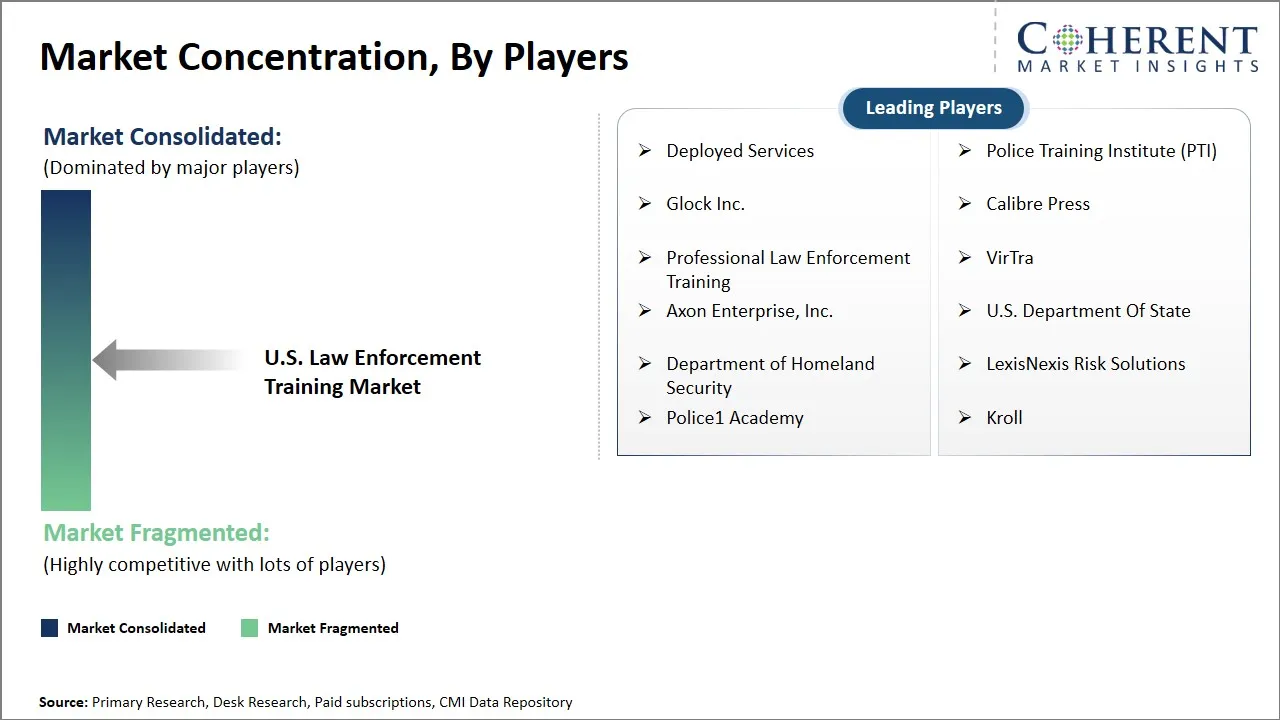
| Companies covered: | Deployed Services, Police Training Institute (PTI), Glock Inc., Calibre Press, Professional Law Enforcement Training, VirTra, Axon Enterprise, Inc., U.S. Department Of State, Department of Homeland Security, LexisNexis Risk Solutions, Police1 Academy, and Kroll | ||
| Growth Drivers: |
| ||
| Restraints & Challenges: |
| ||
Market Dynamics
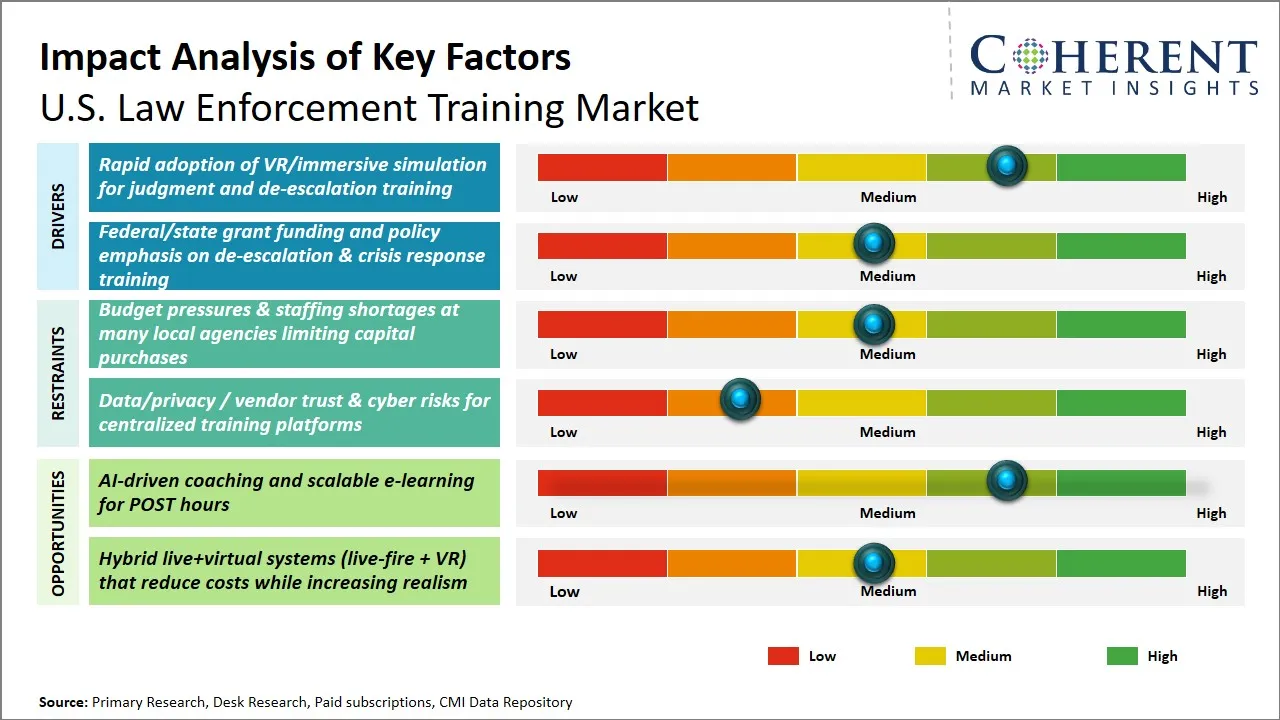
U.S. Law Enforcement Training Market Driver – Rapid Adoption of VR/Immersive Simulation for Judgment and De-Escalation Training
The U.S. law enforcement training sector is using virtual reality (VR) and immersive simulation software as powerful tools to improve officers’ judgment and de-escalation skills. VR offers repeatable, customizable scenarios that adjust to different complexity levels, allowing trainees to learn critical thinking and emotional regulation in dynamic situations. Also, immersive simulation makes possible data-driven performance evaluation, helping agencies see strengths and weaknesses in individual decision-making processes. This innovative approach addresses growing public and institutional demands for effective de-escalation strategies and improved officer accountability. As departments focus on community safety and transparency, investment in VR-based training platforms is a big driver adding to the evolution of law enforcement preparedness and professional development in the U.S.
U.S. Law Enforcement Training Market Opportunity – AI-Driven Coaching and Scalable E-Learning for POST Hours
The U.S. law enforcement training market sees a big opportunity through the use of AI-driven coaching and scalable e-learning platforms made for Peace Officer Standards and Training (POST) hours. AI-driven coaching makes possible personalized learning experiences by analyzing individual officer performance, finding knowledge gaps, and changing content dynamically to improve retention and practical application. This personalization improves training effectiveness and reduces training time and associated costs.
Also, scalable e-learning platforms offer unparalleled flexibility, helping agencies in different states and jurisdictions to deliver standardized yet customizable training remotely, pushing consistency in law enforcement competencies nationwide. The use of interactive simulations and scenario-based modules powered by AI can improve decision-making skills and critical thinking under pressure.
Analyst Opinion (Expert Opinion)
- South U.S. has the highest concentration of law enforcement agencies and training academies, because of its large population and many county sheriff’s offices. Here, there is a lot of demand for traditional firearms/range training and blended VR headsets and modules, as many agencies look for cost-effective upgrades while balancing large officer bases.
- Western states like California, Arizona, and Nevada, are early adopters of VR, hybrid simulators, and AI-based training because of proximity to tech hubs and innovation-driven procurement. Pilot projects like Axon VR TASER training used in Arizona show how the West leads in experimenting with immersive solutions.
- Demand in the Northeast & Midwest is more policy- and compliance-driven, as agencies focus on de-escalation, crisis response, and POST-mandated courses. Platforms like Lexipol and Relias see a lot of uptake for e-learning and policy-integrated training, showing the regulatory-heavy environment in these regions.
Speak to the analyst
Want personalized insights?
Take the findings above to one of our principal consultants, or have the report rebuilt around the segments, geographies and competitors you actually track.
Market Segmentation
- Deployment Mode Insights (Revenue, USD Bn, 2021 - 2033)
- Basic Training
- Security Training
- Fire and Emergency Medical Services Training
- Legal Procedures and Policy Training
- Crisis Intervention Training
- Others
- Mode Of Training Insights (Revenue, USD Bn, 2021 - 2033)
- In-Person Training
- Blended Learning
- Online and E-Learning
- Service Provider Type Insights (Revenue, USD Bn, 2021 - 2033)
- Government Agencies
- Private Training Companies and Academic Institutions
- Key Players Insights
- Deployed Services
- Police Training Institute (PTI)
- Glock Inc.
- Calibre Press
- Professional Law Enforcement Training
- VirTra
- Axon Enterprise, Inc.
- U.S. Department Of State
- Department of Homeland Security
- LexisNexis Risk Solutions
- Police1 Academy
- Kroll
Sources
Primary Research Interviews
Stakeholders
- Law Enforcement Agencies
- Simulation & Training System Providers
- Policy & Compliance Training Providers
- Firearms Training and Range Equipment Manufacturers
- State POST (Peace Officer Standards and Training) Boards and Training Academies
- Federal Training Centers
- Police Union Representatives and Officer Associations
Databases
- U.S. Census Bureau – Law Enforcement Employment & Demographics Data
- Bureau of Justice Statistics (BJS) – Police Employment, Training, and Use-of-Force Studies
- FBI UCR (Uniform Crime Reports) & LEOKA (Law Enforcement Officers Killed & Assaulted) Data
- Department of Justice (DOJ) COPS Office Reports
- Congressional Research Service (CRS) Reports on Police Training and Funding
Magazines
- Police Chief Magazine (International Association of Chiefs of Police)
- Law Enforcement Technology (LET)
- Police1 Magazine
- Tactical Response Journal
- American Police Beat
Journals
- Police Quarterly
- Journal of Law Enforcement
- Criminal Justice Policy Review
- Journal of Police and Criminal Psychology
- Public Safety Technology Journal
Newspapers
- The Washington Post (U.S. policing and training coverage)
- The New York Times (public safety and law enforcement policy)
- USA Today (national coverage of policing reforms)
- The Guardian (U.S. Edition) (critical coverage of policing practices)
- Police1 News Reports
Associations
- International Association of Chiefs of Police (IACP)
- National Sheriffs’ Association (NSA)
- Fraternal Order of Police (FOP)
- Police Executive Research Forum (PERF)
- International Law Enforcement Educators and Trainers Association (ILEETA)
Public Domain Sources
- U.S. Census Bureau
- Bureau of Justice Statistics (BJS)
- FBI UCR Program
- Department of Justice (DOJ)
- Congressional Research Service (CRS) Reports
- ResearchGate (open-access policing and training research)
Proprietary Elements
- CMI Data Analytics Tool, Proprietary CMI Existing Repository of information for last 8 years
Get access to 250+ pages report
Every segment, forecast, competitor profile and data table behind the analysis above — available for instant download.
- ESOMAR Member
- ISO 9001:2015 Certified
- D-U-N-S Registered
- GDPR & CCPA Compliant
Missing comfort of reading report in your local language? Find your preferred language:
Transform your Strategy with Exclusive Trending Reports
Frequently Asked Questions
The U.S. law enforcement training market is estimated to be valued at USD 4.16 billion in 2026 and is expected to reach USD 5.73 billion by 2033.
The CAGR of U.S. law enforcement training market is projected to be 4.7% from 2026 to 2033.
Rapid adoption of VR/immersive simulation for judgment and de-escalation training and federal/state grant funding and policy emphasis on de-escalation & crisis response training are the major factors driving the growth of the U.S. law enforcement training market.
Budget pressures & staffing shortages at many local agencies limiting capital purchases and data/privacy/vendor trust & cyber risks for centralized training platforms are the major factors hampering the growth of the U.S. law enforcement training market.
In terms of deployment mode, basic training is estimated to dominate the market revenue share in 2026.
Deployed Services, Police Training Institute (PTI), Glock Inc., Calibre Press, Professional Law Enforcement Training, VirTra, Axon Enterprise, Inc., U.S. Department Of State, Department of Homeland Security, LexisNexis Risk Solutions, Police1 Academy, and Kroll are the major players.
Grants like DOJ’s Safer Outcomes initiative boost demand for de-escalation and crisis-response training.