

Global Metaverse in Healthcare Market Size and Forecast – 2026-2033
The global metaverse in healthcare market is expected to grow from USD 18.7 Bn in 2026 to USD 118.9 Bn by 2033, registering a compound annual growth rate (CAGR) of 30.2%. The adoption of metaverse in the healthcare sector is driven by the widespread incorporation of digital health technologies and immersive solutions. In March 2024, Siemens Healthineers broadened its digital health platform through AI-assisted imaging, digital twins, and immersive visualization solutions that will help with decision-making and diagnoses from afar for metaverse-driven healthcare services. The surge in virtual training and remote consultations is certainly fueling demand for metaverse in healthcare.
Furthermore, global health organizations are emphasizing the importance of investment in digital health. The World Health Organization has pointed out that a modest annual investment of USD 0.24 per patient in digital health solutions can substantially bolster healthcare systems and enhance patient outcomes.
(Source: World Health Organization)
Key Takeaways of the Global Metaverse in Healthcare Market
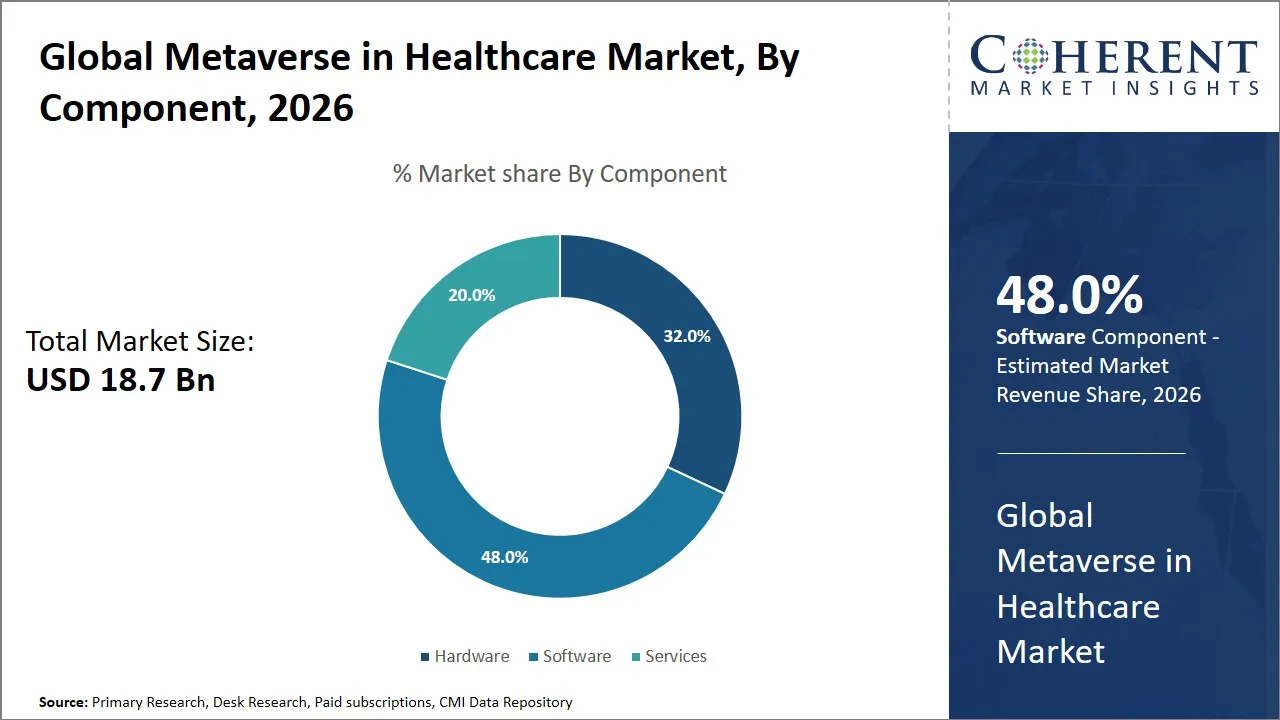
- Software is projected to hold 48.0 % of the global metaverse in healthcare market share in 2026, making it the dominant component segment. The software segment is particularly dominant within North America, driven by the advanced health systems in the region and the high adoption rate of virtual platforms, with over 100 AR/VR-based medical software solutions approved by the U.S. Food & Drug Administration, reflecting strong clinical integration of immersive technologies.
- Augmented Reality (AR)/ Virtual Reality (VR) is projected to hold 38.0 % of global metaverse in healthcare market share in 2026, making it the dominant technology segment. AR and VR technologies are extensively used in North America and Europe because of their increased use in training and simulations in medicine, as well as the increase in regulations and usage in hospitals and research centers.
- Telemedicine is projected to hold 33.0% of the global metaverse in healthcare market share in 2026, making it the dominant application segment, owing to the growing trend of remote healthcare services. The segment is highly prominent in Asia Pacific due to the growing initiatives in the field of digital health, with government of India sponsored eSanjeevani platform providing over 150 million tele consults.
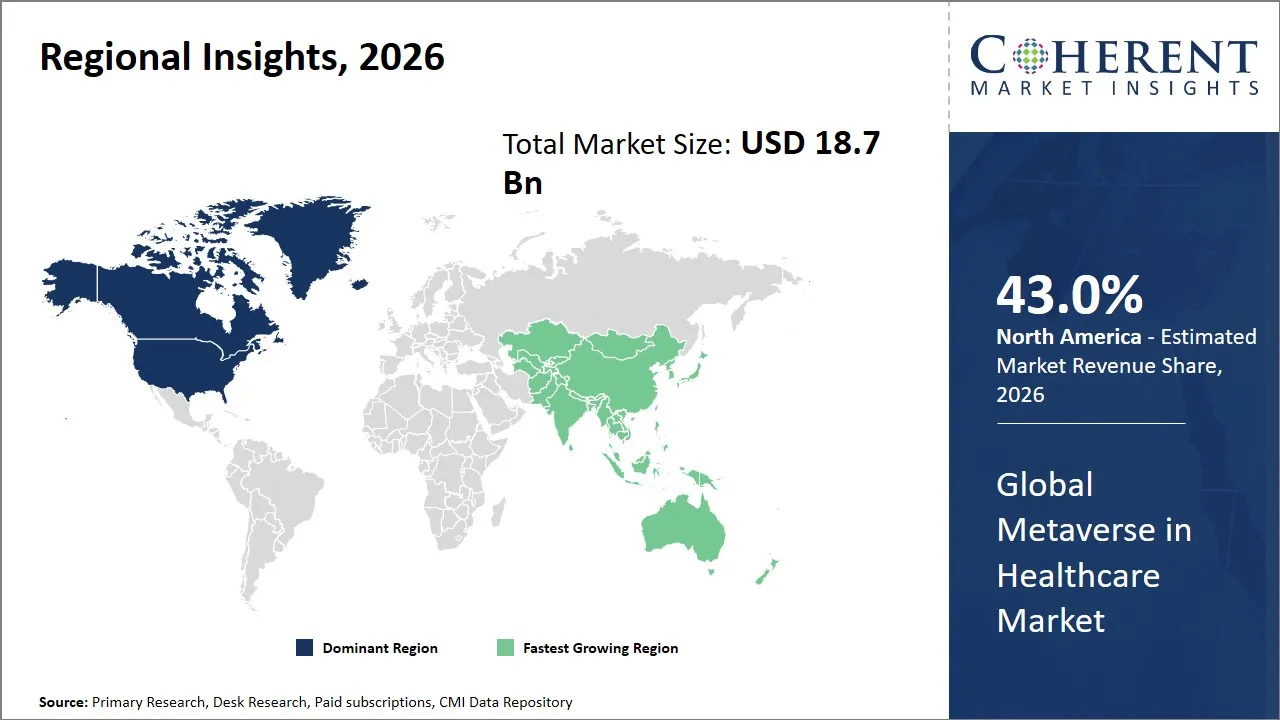
- North America maintains its market dominance with an expected share of 43.0 % in 2026. The region's advanced digital health infrastructure, widespread adoption of AR/VR technologies, and robust governmental backing for digital initiatives drive its leadership position. According to the U.S. Centers for Medicare & Medicaid Services, healthcare spending in the U.S. climbed by 4.1% in 2022, totaling USD 4.5 trillion, highlighting strong investment capacity for the adoption of cutting-edge technologies such as metaverse-based healthcare solutions. (Source: U.S. Centers for Medicare & Medicaid Services)
- Asia Pacific is expected to contribute 22.0 % of the global market share in 2026, with India emerging as a key growth driver supported by strong government-led digital health initiatives. The Ayushman Bharat Digital Mission has generated over 8.9 million (73.98 crore) digital health IDs as of February 2025, enabling seamless digital health records and accelerating virtual care adoption. Furthermore, India's Ministry of Health and Family Welfare reports that the country has over 1.4 million registered allopathic doctors, underscoring a vast healthcare landscape that's increasingly incorporating digital and immersive technologies to improve access. (Source: Ministry of Health and Family Welfare)
- Interoperability Between Virtual Healthcare Ecosystems: The increased need for interoperability between various metaverse platforms, Electronic Health Record (EHR) technologies, and digital health solutions is creating a new opportunity for a standardized and connected ecosystem of healthcare solutions. The ability to communicate between virtual worlds and physical worlds is a critical factor in the expansion of the market.
- Emergence of Virtual Healthcare Economies: The integration of blockchain-based token systems and digital incentives within metaverse platforms is creating a new revenue stream within the healthcare industry. This encourages patients to engage in healthier behaviors and share information by rewarding them for their participation, thus creating a shift within the healthcare industry.
Segmental Insights
Why Does the Software Segment Dominate the Metaverse in Healthcare Market?
Software is projected to hold a market share of 48.0% in 2026. The significance of software stems primarily from its foundational role in platform-based ecosystems, its facilitation of platform interoperability, and its capacity to streamline clinical integrations. In contrast to hardware, which functions as an access point, software is indispensable for the execution of diverse functionalities. These encompass virtual environments, digital twins, real-time processing, and artificial intelligence applications.
The dominant position of software in the metaverse in healthcare market is further supported by global policies operating the market. According to the World Health Organization, global policies are focusing on the development of a digital health architecture and data exchange standards such as HL7 and FHIR that are interoperable with each other. This ensures the seamless integration of the metaverse platforms with the EHR system.
(Source: World Health Organization)
Furthermore, the accelerated growth of regulated digital health software and artificial intelligence-based medical software is also contributing to the segment’s dominance in the market. The U.S. FDA stepped up its regulation and approval of Software as a Medical Device (SaMD). This points to software’s increasing role in diagnostics, monitoring, and therapeutic applications. Software, therefore, emerges as a dominant revenue generator and a driver of innovation in the metaverse in healthcare market.
(Source: U.S. Food & Drug Administration)
- Current Industry Events of 2026
- Market Size Estimation
- Regional Breakdown
- Competitive Landscape
- Customer Intelligence
- Segmental Analysis
- Pricing Analysis
- Key Market Drivers, Challenges & Future Trends
- Customized Insights Section
Why is Augmented Reality (AR)/ Virtual Reality (VR) the Most Preferred Technology in Metaverse in Healthcare Market?
Augmented Reality (AR)/ Virtual Reality (VR) is projected to hold a market share of 38.0% in 2026, primarily because of their unparalleled ability to offer a completely immersive, interactive, and simulation-based platform where real-life scenarios can be created. Unlike other digital technologies, AR and VR technologies offer a real-time visualization of complex structures, thereby providing a high level of accuracy in surgeries.
AR technology helps in providing a real-time overlay of accurate information, whereas VR technology helps in providing a realistic simulation of surgeries (Source: ScienceDirect). Regulatory bodies such as the U.S. Food and Drug Administration (FDA) have already acknowledged AR and VR technologies as revolutionary technologies that possess a potential to bring a paradigm shift in providing accurate diagnostic and treatment tools through content delivery. This is perfectly in sync with the metaverse technology, where a persistent, interactive, and 3D environment is a necessity. (Source: U.S. Food and Drug Administration)
Moreover, the high clinical efficacy and performance enhancement of AR/VR play a crucial role in the selection of these technologies over other technologies. Various research papers have shown that knowledge retention, decision-making, and clinical performances are improved through VR-based training compared to conventional methods. It has been observed that there is an improvement in surgical performances by up to 230% through VR-based training, and this is implemented or planned in 77% of healthcare organizations for medical training purposes. In addition, it is recognized that AR/VR can result in better patient engagement, rehabilitation, and mental health treatments by providing a tailored environment. (Source: Telemedicine Technologies)
Telemedicine Segment Dominates the Global Metaverse in Healthcare Market
The telemedicine segment is expected to lead and hold 33.0% of the global metaverse in healthcare market share in 2026, primarily due to its s established regulatory validation and integration into national healthcare delivery systems. In India, NITI Aayog in association with the Ministry of Health and Family Welfare has framed a framework for healthcare delivery, termed as ‘Telemedicine Practice Guidelines.’ Telemedicine, remote consultations, e-prescription, and follow-up have been provided formal legal validation, thereby standardizing telemedicine as a mode for healthcare delivery (Source: NITI Aayog). At a global level, telemedicine is recognized by the World Health Organization as a key component for ensuring universal healthcare through improved access, continuity, and efficiency in healthcare delivery.
Currents Events and their Impact
Current Events | Description and its Impact |
Regulatory Push for Digital Health & AI Governance (2024–2025) |
|
Geopolitical Shift: Global Data Privacy Regulations Impacting Digital Health (2024–2026) |
|
(Source: World Health Organization, U.S. Department of Health and Human Sciences)
Metaverse in Healthcare Market Dynamics
Market Drivers
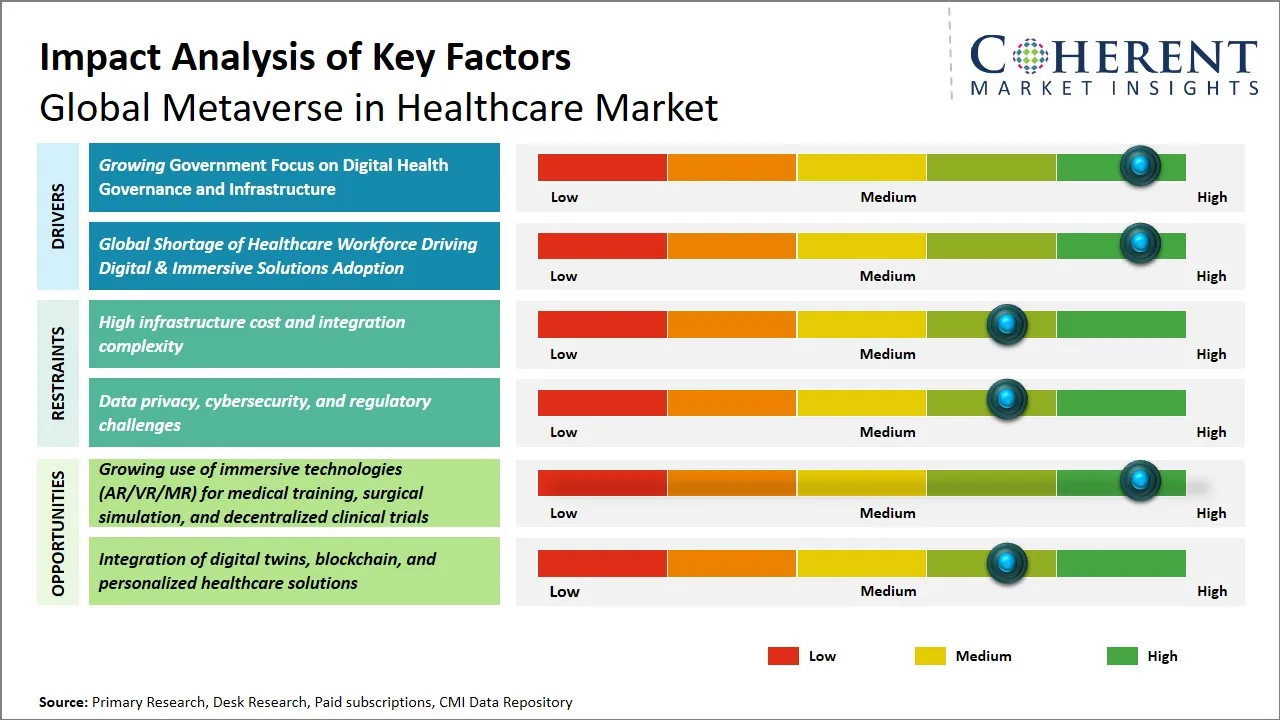
- Growing Government Focus on Digital Health Governance and Infrastructure: Countries across the globe are showing greater interest in the development of a digital infrastructure for the healthcare industry. In a report published by the World Health Organization, more than 120 countries have developed a digital health strategy, which is either implemented or in the process of implementation. This shows the institution's commitment to digital healthcare services. Moreover, the WHO emphasized the importance of standardized digital infrastructure, which is essential for the exchange of data between countries. This is facilitating the integration of AR/VR platforms, virtual care, and health records, which is promoting the adoption of the metaverse. (Source: World Health Organization)
- Global Shortage of Healthcare Workforce Driving Digital & Immersive Solutions Adoption: According to a report by the World Health Organization, the world is expected to face a shortage of 11 million healthcare workers by 2030, with the majority being from low- and lower-middle-income countries. This is a huge gap in the delivery of healthcare services. The shortage of healthcare professionals is leading to the increased adoption of virtual technologies, which is enabling healthcare organizations to become more efficient. (Source: World Health Organization)
Emerging Trends
- Expansion of Immersive Medical Training & Simulation: Healthcare institutions are exploring ways to utilize metaverse platforms for purposes such as surgical training, simulations, and skill-building exercises. This has led to a more efficient training process, with procedures carried out with precision. The workforce within the healthcare sector is also being catered to.
- Rise of Virtual Care Ecosystems Beyond Telemedicine: The healthcare landscape is undergoing a transformation, moving beyond simple teleconsultations toward fully immersive virtual care settings. These encompass virtual hospitals, patient monitoring systems, and interactive treatment protocols. This evolution is fostering increased patient engagement, improved accessibility, and enhanced continuity of care, especially within healthcare systems that are digitally advancing.
Regional Insights
Why is North America a Strong Market for Metaverse in Healthcare?
North America leads the global metaverse in healthcare market, accounting for an estimated 43.0% share in 2026, owing to its existing robust digital health environment, favorable regulatory scenario, and high willingness to adapt to new technology. The region includes countries such as the U.S. which is benefiting from the progressive steps taken by government bodies such as the Food and Drug Administration (FDA) and the National Institutes of Health (NIH). This is encouraging the development and approval of digital health technologies such as AR/VR technologies and Software as a Medical Device (SaMD).
Moreover, the high willingness to spend on digital health (U.S. healthcare expenditure reached ~USD 5.3 trillion, accounting for ~18% of GDP in 2024), coupled with favorable government policies (Medicare Telehealth Services Expansion and Remote Patient Monitoring (RPM) reimbursement policies) from bodies such as the Centers for Medicare & Medicaid Services, has led to the growth of telehealth services in the region. All these factors have created a favorable environment for the rapid adoption of AR/VR technologies in the region, thus making North America an important region for the market.
Why Does Asia Pacific Exhibit High Growth in Metaverse in Healthcare Market?
The Asia Pacific metaverse in healthcare market is expected to exhibit the fastest growth with an estimated contribution of 22.0% share to the global market in 2026, due to its high growth rate in terms of digitalization (region accounting for ~2.87 billion internet users in 2025), growth of healthcare infrastructure, and initiatives taken by governments towards digital health in emerging countries.
India has a telemedicine platform with over 200 million teleconsultations till 2024. Countries such as China are accelerating the growth of virtual health solutions through initiatives taken by the National Health Commission of China. For instance, the Commission has promoted the establishment of “Internet Hospitals” since 2018, enabling online consultations, e-prescriptions, and integration with public hospital systems to expand digital healthcare access nationwide.
Global Metaverse in Healthcare Market Outlook for Key Countries
Why is the U.S. Leading Innovation and Adoption in the Metaverse in Healthcare Market?
The U.S. showcases high adoption rate of digital health technologies among healthcare providers, with significant federal support. According to the Centers for Disease Control and Prevention, over 80% of physicians in the U.S. have adopted telemedicine, with a significant increase from around 16% in 2019 to 2021. (Source: Centers for Disease Control and Prevention)
With significant federal support (policies such as the 21st Century Cures Act) as well as having one of the highest expenditures in healthcare in the world, the U.S. can be considered a forerunner in terms of innovation in a metaverse environment.
Is China a Favorable Market for Metaverse in Healthcare Market?
China is an attractive market for the metaverse in the healthcare owing to its large-scale adoption of digital health services, robust ecosystem facilitated by the China government, and large-scale growth of online healthcare users. As per data provided by the China Internet Network Information Center, the number of internet medical users in China reached approximately 364 million as of 2023, with a significant market penetration of approximately 33.8% of the total internet users. (Source: China Internet Network Information Center)
Moreover, there has been significant growth in digital health services owing to national efforts coordinated by the National Health Commission of China. As a result, there has been a shift from traditional healthcare informatization to advanced internet healthcare services.
In addition, there has been significant improvement in healthcare service distribution with the help of digital health services, especially in rural areas. As per reports, online consultations were up more than 20 times during peak periods (Source: ScienceDirect). All these factors make China an attractive market for the metaverse in the healthcare owing to its large-scale growth of online healthcare users.
Is Germany Emerging as a Key Growth Hub for the Metaverse in Healthcare Market?
Germany is developing as a significant growth center for metaverse in healthcare due to its strong government push for the development of digital healthcare, significant funding, and the development of digital technologies in the country’s standard healthcare system.
The Germany government, through the Federal Ministry of Health, has developed a well-structured legislative framework for the development and growth of the country’s digital healthcare sector. The country has developed a Digital Healthcare Act and electronic patient records. It has also curated a Transformation Fund of USD 57.7 billion (€50 billion) (2026-2035) for the development of hospital infrastructure and the development of digital and interoperable healthcare systems (Source: Cisco Blogs). The country’s healthcare system is the biggest in Europe with a total expenditure of over USD 620 billion (€538 billion).
Additionally, the country’s policies allow physicians to prescribe reimbursable digital health applications (DiGA) to over 70 million insured individuals.
Why Does the U.K. Top the European Metaverse in Healthcare Market?
The U.K. holds the highest position in the Europe metaverse in healthcare market due to its well-established digital health strategy, adoption of virtual healthcare, and its centralized healthcare system, facilitating the quick adoption of technology.
Various initiatives (NHS Long Term Plan launched in 2019) undertaken by the National Health Service and NHS England have helped speed up the adoption of telehealth, AI, and other technologies within healthcare systems. Strong government funding (Innovate UK’s “Mindset XR” programme) and regulatory support for digital health innovations also help quicken the adoption of AR/VR-based solutions within the healthcare sector.
(Source: UKRI)
Is Metaverse in Healthcare Market Developing in Japan?
Japan, made an effort to achieve digital transformation through its government, and a gradual shift towards the creation of virtual care infrastructure, even though this process is ongoing. The Japanese government, through Digital Agency Japan, has come up with a roadmap towards Medical DX, with a target to have standardized electronic medical records in almost all medical institutions by 2030, thus paving the way for the development of advanced digital and immersive healthcare solutions in Japan.
(Source: Government of Japan)
In addition, the Japanese government, through its Ministry of Health, Labour and Welfare, has been promoting telemedicine as a national policy, with the number of institutions using telemedicine services increasing from 4,378 in 2020 to 7,156 in 2021, thus indicating a gradual move towards virtual care in Japan. Although the current uptake of virtual care is still moderate, this strong initiative by the Japanese government, coupled with their aging population and gradual move towards digitalization, is thus positioning Japan as an emerging market for metaverse-based healthcare solutions.
(Source: JMA Journal)
Regional Regulatory Landscape for Metaverse in Healthcare Market
Region
| Key Regulation | Impact Level | Scope & Relevance to Metaverse Healthcare |
North America | FDA (Digital Health Center of Excellence), HIPAA, HITECH Act | High | Regulates AR/VR and Software-as-a-Medical-Device (SaMD), while ensuring strict patient data privacy, cybersecurity, and compliance in virtual healthcare environments. |
Europe | GDPR, MDR (Medical Device Regulation), EMA Guidelines | High | Strong data protection laws and strict medical device regulations govern immersive technologies used in diagnostics, training, and therapy. |
Asia Pacific | China PIPL, India Digital Personal Data Protection Act (DPDP), Japan PMDA Regulations | Medium-High | Focus on data localization, patient consent, and evolving frameworks supporting AI, telemedicine, and immersive healthcare adoption. |
Middle East & Africa | UAE Health Data Law, Saudi Health Information Exchange Policies, South Africa POPIA | Low-Medium | Emphasis on data sovereignty, cybersecurity, and expansion of digital health infrastructure; regulatory maturity varies across countries. |
Latin America | Brazil LGPD, Mexico Health Data Regulations | Medium | Developing regulatory ecosystem with increasing alignment to global data privacy standards; still evolving for metaverse-specific use cases. |
How is the development of digital twin ecosystems for precision medicine creating new growth opportunities in the metaverse in healthcare market?
The integration of digital twin technology in metaverse platforms indicates a promising development in precision healthcare, which allows real-time simulations of patients' conditions and therapeutic outcomes. This area of application currently enjoys active support from government agencies. The Virtual Human Twin program (2023-2027) by the European Commission has allocated more than USD 115 million (€100 million) for the development of digital twins of human physiology, highlighting a high level of support for the integration of immersive technologies in the healthcare industry.
(Source: European Commission)
Furthermore, the National Institutes of Health is actively working towards the further development of computational modeling and digital twin technology with the help of its “All of Us” Research Program, which focuses on the creation of diverse data sets to allow for the simulation of personalized care.
(Source: National Institutes of Health)
All these government-backed projects highlight a shift towards data-driven healthcare system that is predictive and personalized in nature, with digital twins of the metaverse acting as a platform for interaction. Thus, it is evident that digital twin ecosystems for precision medicine are creating new growth opportunities in the metaverse in healthcare market.
Market Players, Key Development, and Competitive Intelligence
Key Developments
- In November 2024, Newbase unveiled its VR-driven medical training platform, 'Medicrew,' designed to improve immersive clinical education. This platform offers realistic, simulation-based training for healthcare professionals, thereby lessening the need for extensive physical resources. The launch underscores the increasing use of VR training solutions within the healthcare sector's metaverse.
- In February 2023, Indegene unveiled metaverse capabilities designed to assist life sciences companies in crafting immersive healthcare experiences. This solution opens the door to various applications, including virtual medical congresses, HCP education, and patient engagement within digital environments.
Competitive Landscape
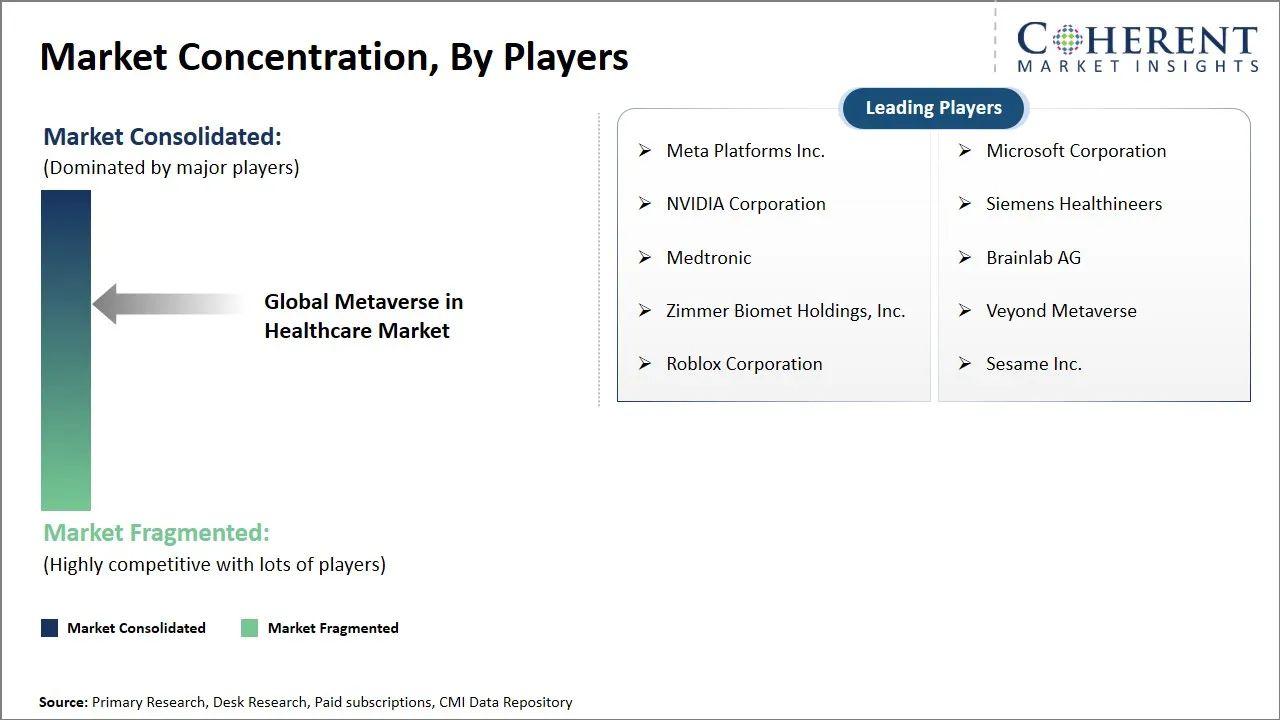
The metaverse in healthcare market is a highly competitive and dynamic environment with many global technology players, healthcare organizations, and start-ups competing with each other. Players with robust capabilities in terms of AR/VR technologies, AI integration, and healthcare data interoperability are likely to have a higher chance of entering into long-term collaborations with hospitals, pharmaceutical organizations, etc. At the same time, there are signs of consolidation in the metaverse in healthcare market, with players aiming to expand their digital ecosystem. Key focus areas include:
- Development of Integrated Immersive Platforms (AR/VR + AI + Digital Twins)
- Regulatory Compliance and Data Security (HIPAA, GDPR, AI governance)
- Strategic Partnerships with Healthcare Providers and Tech Firms
Market Report Scope
Metaverse in Healthcare Market Report Coverage
| Report Coverage | Details | ||
|---|---|---|---|
| Base Year: | 2025 | Market Size in 2026: | USD 18.7 Bn |
| Historical Data for: | 2020 To 2024 | Forecast Period: | 2026 To 2033 |
| Forecast Period 2026 to 2033 CAGR: | 30.2% | 2033 Value Projection: | USD 118.9 Bn |
| Geographies covered: |
| ||
| Segments covered: |
| ||
| Companies covered: | Meta Platforms Inc., Microsoft Corporation, NVIDIA Corporation, Siemens Healthineers, Medtronic, Brainlab AG, Zimmer Biomet Holdings, Inc., Veyond Metaverse, Roblox Corporation, Sesame Inc. | ||
| Growth Drivers: |
| ||
| Restraints & Challenges: |
| ||
Analyst Opinion (Expert Opinion)
- The future of the metaverse in the healthcare market is expected to be shaped by the integration of AR/VR, AI, and digital health ecosystems. The future market will see the healthcare industry move beyond the pilot phase to a larger-scale, fully integrated virtual environment.
- The highest potential for the metaverse in the healthcare market is expected to come from the field of immersive medical training and simulation. North America is expected to see the highest potential for the adoption of the metaverse in the healthcare industry. The region is expected to have the best infrastructure for healthcare, making the adoption of the metaverse in the industry a reality. In addition, the market for virtual care platforms in the Asia Pacific region, especially in India and China, is expected to see a significant potential for growth.
- To achieve a competitive advantage in the market, players will have to focus on developing the metaverse in a way that is compatible with other platforms. In addition, the players will have to comply with the changing rules regarding data privacy. Furthermore, the players will have to focus on developing the metaverse in a way that is innovative, using AI, analytics, and design.
Speak to the analyst
Want personalized insights?
Take the findings above to one of our principal consultants, or have the report rebuilt around the segments, geographies and competitors you actually track.
Market Segmentation
- Component Insights (Revenue, USD Bn, 2021 - 2033)
- Hardware
- Software
- Services
- Technology Insights (Revenue, USD Bn, 2021 - 2033)
- Augmented Reality (AR)/ Virtual Reality (VR)
- Artificial Intelligence (AI)
- Blockchain
- Mixed Reality
- Others
- Application Insights (Revenue, USD Bn, 2021 - 2033)
- Telemedicine
- Medical Training and Education
- Diagnosis and Treatment Planning
- Drug Discovery and Personalized Medicine
- Others
- End User Insights (Revenue, USD Bn, 2021 - 2033)
- Healthcare Providers
- MedTech Companies
- Pharmaceutical and Biotech Companies
- Others
- Regional Insights (Revenue, USD Bn, 2021 - 2033)
- North America
- U.S.
- Canada
- Latin America
- Brazil
- Argentina
- Mexico
- Rest of Latin America
- Europe
- Germany
- U.K.
- Spain
- France
- Italy
- Russia
- Rest of Europe
- Asia Pacific
- China
- India
- Japan
- Australia
- South Korea
- ASEAN
- Rest of Asia Pacific
- Middle East
- GCC Countries
- Israel
- Rest of Middle East
- Africa
- South Africa
- North Africa
- Central Africa
- North America
- Key Players Insights
- Meta Platforms Inc.
- Microsoft Corporation
- NVIDIA Corporation
- Siemens Healthineers
- Medtronic
- Brainlab AG
- Zimmer Biomet Holdings, Inc.
- Veyond Metaverse
- Roblox Corporation
- Sesame Inc.
Sources
Primary Research Interviews
- Chief Technology Officer (CTO) of a digital health / metaverse platform provider
- Head of Innovation / Digital Transformation at a multi-specialty hospital
- Clinical Training Lead using AR/VR-based simulation platforms
- Product Manager of AR/VR healthcare solutions company
- Healthcare IT / Interoperability Specialist (EHR, HL7, FHIR systems)
Stakeholders
- Metaverse in Healthcare Solution Providers: AR/VR platform developers, digital twin solution providers, virtual care platform companies
- Technology Providers: AI, cloud computing, and healthcare interoperability solution providers (e.g., EHR vendors, cloud hyperscalers)
- End-use Sectors
- Hospitals & Clinics (public and private hospital networks)
- Medical Training Institutes & Universities
- Pharmaceutical & Life Sciences Companies
- Rehabilitation & Mental Health Centers
Databases
- World Bank – healthcare expenditure & digital infrastructure data
- OECD – digital health and healthcare system statistics
- CMS – National Health Expenditure Data
- WHO – Global Digital Health Observatory
Magazines
- Healthcare IT News – digital health and virtual care trends
- HIMSS Insights – healthcare digital transformation and interoperability
- MedTech Dive – emerging healthcare technologies and innovation
Journals
- Journal of Medical Internet Research (JMIR) – digital health & telemedicine
- NPJ Digital Medicine – AI, AR/VR in healthcare
- The Lancet Digital Health – digital transformation in healthcare
- IEEE Journal of Biomedical and Health Informatics – healthcare technology systems
Newspapers
- Financial Times – global digital health investments
- The Wall Street Journal – healthcare technology and innovation
- The Guardian – public healthcare system digitization trends
- The Economic Times – India digital health ecosystem developments
Associations
- Healthcare Information and Management Systems Society
- American Medical Association
- Digital Medicine Society
- International Society for Telemedicine and eHealth
Public Domain Sources
- World Health Organization – digital health policies and guidelines
- U.S. Department of Health and Human Services – healthcare IT & compliance
- Centers for Disease Control and Prevention – digital health usage trends
- European Commission – digital health and AI regulatory frameworks
Proprietary Elements
- CMI Data Analytics Tool, Proprietary CMI Existing Repository of information for last 10 years.
Get access to 250+ pages report
Every segment, forecast, competitor profile and data table behind the analysis above — available for instant download.
- ESOMAR Member
- ISO 9001:2015 Certified
- D-U-N-S Registered
- GDPR & CCPA Compliant
Missing comfort of reading report in your local language? Find your preferred language:
Transform your Strategy with Exclusive Trending Reports
Frequently Asked Questions
The global metaverse in healthcare market is estimated to be valued at USD 18.7 Bn in 2026 and is expected to reach USD 118.9 Bn by 2033.
Software dominates due to its critical role in enabling core functionalities such as virtual platforms, 3D simulation environments, AI-driven analytics, digital twin modeling, and interoperability with existing healthcare IT systems.
Metaverse in healthcare is a virtual ecosystem that is immersive in nature using AR/VR technology, AI, and digital twins for remote healthcare services, medical training, and patient interactions in a simulated environment.
The CAGR of global metaverse in healthcare market is projected to be 30.2% from 2026 to 2033.
Rapid adoption of AR/VR and AI technologies in healthcare delivery and training, and expansion of telemedicine and digital healthcare ecosystems are the major factors driving the growth of the global metaverse in healthcare market.
High infrastructure cost and integration complexity, and data privacy, cybersecurity, and regulatory challenges are the major factors hampering the growth of the global metaverse in healthcare market.
In terms of technology, Augmented Reality (AR)/ Virtual Reality (VR) is estimated to dominate the market revenue share in 2026.