

Global Mining Truck Market Size and Forecast – 2026 to 2033
Coherent Market Insights estimates that the global mining truck market is expected to reach USD 26 Bn in 2026 and will expand to USD 42 Bn by 2033, registering a CAGR of 6% between 2026 and 2033.
Key Takeaways of the Mining Truck Market
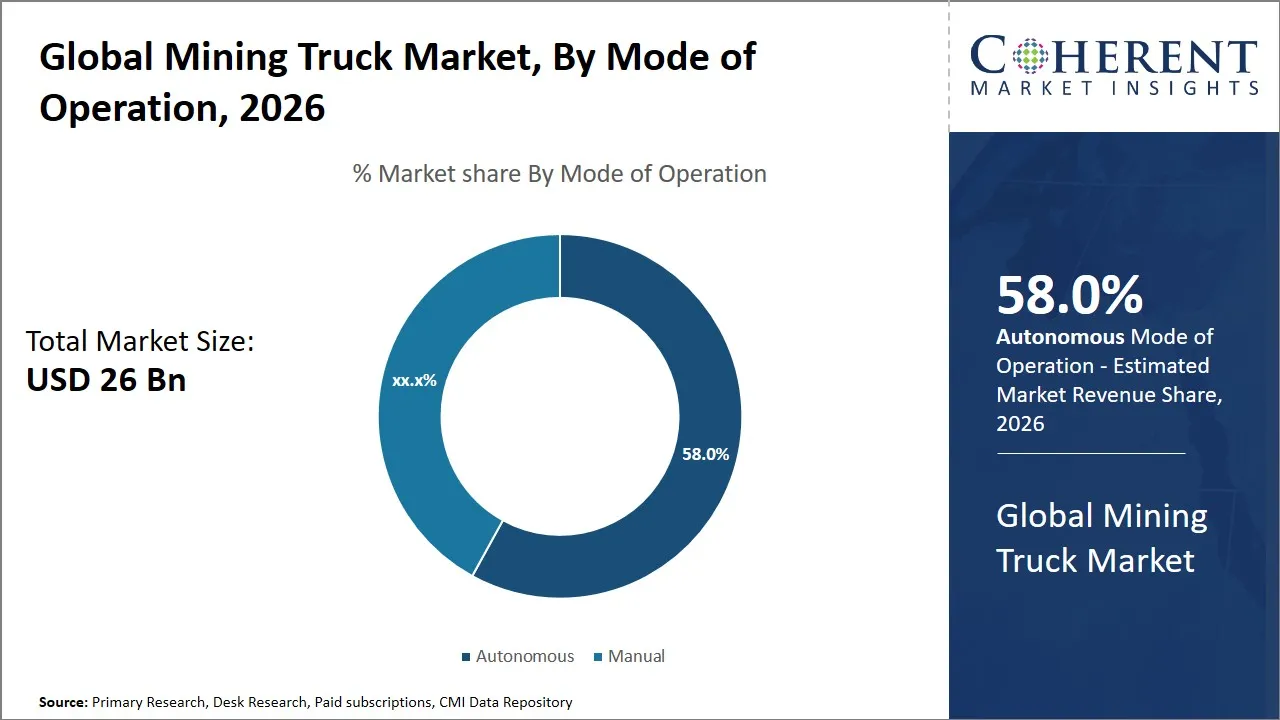
- The autonomous segment is expected to account for 58% of the mining truck market share in 2026.
- The rigid frame haul trucks segment is estimated to capture 39% of the market share in 2026.
- The diesel segment is projected to hold 46% of the global mining truck market share in 2026.
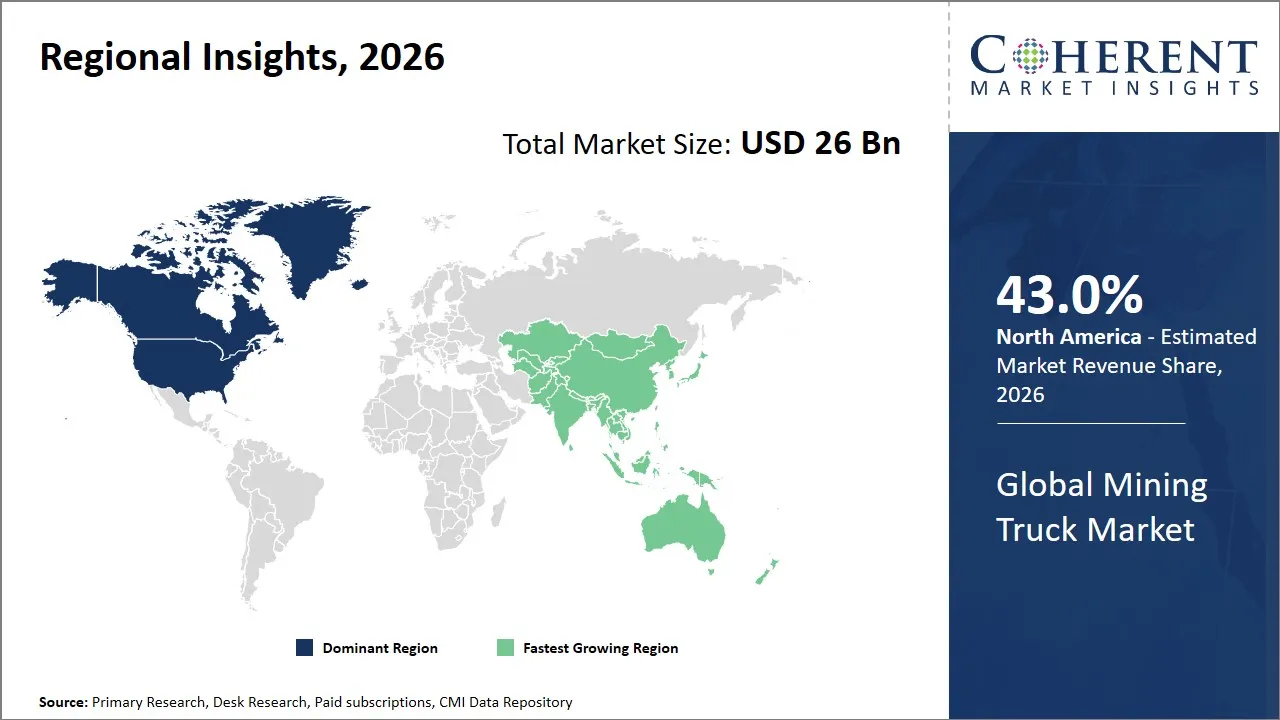
- North America is projected to dominate the mining truck market in 2026 with a 43%
- Asia Pacific is expected to hold 31% share in 2026 and is expected to record the fastest growth over the forecast period.
Currents Events and Its Impacts
Current Events | Description and its Impact |
Caterpillar AWT Launch |
|
Segmental Insights
- Current Industry Events of 2026
- Market Size Estimation
- Regional Breakdown
- Competitive Landscape
- Customer Intelligence
- Segmental Analysis
- Pricing Analysis
- Key Market Drivers, Challenges & Future Trends
- Customized Insights Section
Why Does the Autonomous Segment Dominate the Global Mining Truck Market in 2026?
The autonomous segment is expected to account for 58.0% of the global mining truck market share in 2026. Growth stems from how these vehicles reshape safety, output, and spending. Despite long shifts, humans tend to get tired while machines do not. Where attention fades, automated systems continue, unaffected by dust or darkness. Movement persists through night and storm, unbroken by breaks or delays. Efficiency climbs when cycles run without pause. Value forms not in speed alone, but in steady presence under extreme conditions. As global need swells for ore and stone, consistency gains importance over bursts of effort. Performance matters most where endurance counts.
Rigid Frame Haul Trucks Segment Dominates the Global Mining Truck Market
The rigid frame haul trucks segment is expected to account for 39.0% of the global mining truck market share in 2026. Even with harsh terrain, these vehicles transport dense loads effectively due to durable construction. Resting on solid chassis designs, hauling significant volumes of ore proceeds without regular malfunctions. In extreme environments, integrity remains intact despite ongoing pressure. When operations demand mass transit, consistent function proves vital across open-pit sites. Endurance counts during routine shifts moving stone along with discarded matter.
Why is Diesel the Most Preferred Propulsion in the Global Mining Truck Market?
The diesel segment is expected to account for 46.0% of the global mining truck market share in 2026. Even with new tools arriving, diesel still runs below ground, shaped by decades of steady operation. Where tunnels stretch and mines dig deep, such motors supply power without wasting fuel - valuable where weights change fast, surfaces stay uneven. Reliance forms over time, especially when equipment performs far beneath the surface; this kind has proven itself again and again. When stress climbs, results count above all; in that regard, past behavior guides present choices.
For instance, on September 19, 2024, Caterpillar announced it is designing a modular Cat 793 large mining truck platform with powertrain flexibility. This platform will include diesel mechanical, diesel electric and battery electric options.
Global Mining Truck Market - Emission Regulations & Decarbonization Mandates
Regulation | Applicability | Key Targets |
EU CO₂ Emission Standards for Heavy-Duty Vehicles | Fleet-wide average CO₂ reductions for heavy trucks and similar vehicles | Progressive targets aiming to cut CO₂ emissions across new heavy trucks, with stepped reductions and near-zero/zero-emission adoption by mid-century; substantial cuts planned by 2030, 2035, and 2040 under updated Regulation (EU) 2019/1242. |
US EPA Nonroad / Off-Highway Diesel Engine Emission Standards (Tier 4 / Tier 4 Final) | Applies to diesel engines used in off-road equipment such as construction and mining machinery | Stringent limits on NOx and particulate matter (PM), significantly lower than earlier tiers (up to ~95% reductions); applies by engine power categories; relevant to engines powering mining trucks. |
China Non-Road Diesel Engine Standards (Stages I–IV) | National non-road engine emissions regime covering mobile machinery | Progressive tightening of NOx and PM limits through Stage IV and equivalent requirements, aligned with some EU Stage V elements in recent updates. |
California Air Resources Board (CARB) Heavy-Duty Truck Rules | State-level California standards (historically stricter than federal) for heavy-duty truck emissions including low-NOx and zero-emission mandates | Zero-emission heavy-duty vehicle requirements by mid-2040s (subject to political/legal change); low-NOx rules intended to cut NOx significantly. |
International Mining Industry Decarbonization Initiatives | Industry-led frameworks (e.g., International Council on Mining and Metals | Encourage operational readiness for zero-GHG mining trucks, supporting net-zero by 2050 goals and promoting adoption of zero-emission vehicles by 2030 and beyond. |
Regional Insights
North America Mining Truck Market Analysis and Trends
The North America region is projected to lead the market with a 43% share in 2026. Steady need for large open-pit mines shapes North American mining truck trends, backed by ongoing output in metals, coal, and industrial minerals. With well-developed extraction systems in place, the area sees broad use of modern machinery, guided by goals around operational precision, worker protection, and ecological care. Fuel savings, reduced exhaust levels, and vehicles built for automated functions now rank higher in procurement choices - sparking greater attention toward electric, hybrid, and self-driving hauling units. Major builders hold firm positions here, relying on extensive support channels and enduring client ties; yet momentum also comes from routine tech enhancements and renewal of aging vehicle sets. Growth continues, fed less by new entrants and more by incremental system updates alongside planned fleet turnover cycles.
For instance, on September 19, 2025, Caterpillar introduced a smarter articulated truck design with built-in automatic features for the next generation Cat 725, 730, 730 EJ and 735 models. The upgraded interior puts control at fingertips, with all functions accessible through a sleek touchscreen or a smooth, responsive keypad.
Asia Pacific Mining Truck Market Analysis and Trends
The Asia Pacific region is expected to exhibit the fastest growth in the market contributing 31% share in 2026. Growth stems from vast mineral resources, alongside rising mining efforts and steady industrial expansion. In places such as China and Australia, progress advances through focused policy support for building projects and raw material recovery. Major firms including CNHTC, together with Caterpillar’s production sites in Australia, contribute depth to the area’s operational framework. Driven by these elements, momentum continues without reliance on fleeting trends. What also plays a role is supportive trade regulation, along with increasing financial commitment to equipment automation, pushing need for mining trucks upward. Supported by smooth-flowing supply structures, progress in specialized technology adjusts well to tough extraction conditions found across nations such as India and Indonesia.
Global Mining Truck Market Outlook for Key Countries
Why is the U.S. Emerging as a Major Hub in the Mining Truck Market?
Driven by extraction of coal, gold, and molybdenum, the U.S. sustains consistent need for versatile mining trucks. While companies like Caterpillar and Terex operate widely, their reach extends through dense distribution channels and long-term maintenance systems. Because regulations focus on worker protection and exhaust limits, design improvements emerge alongside automated functions. Though deeply established, the network of builders, technicians, and innovators advances performance and environmental responsibility at a gradual pace.
Is China the Next Growth Engine for the Mining Truck Market?
Across China, mining unfolds on a vast scale, where machinery improvements steadily raise production while advancing safety standards. Though companies like CNHTC focus on domestic activity, international players such as Caterpillar and Komatsu hold notable influence in the region. Despite differing origins, these entities shape the sector through sustained operational investment. Recently, preference has shifted toward higher tonnage vehicles; at the same time, electrified models are gaining ground gradually. Supportive regulations focused on progress in technology plus environmental care help speed up integration of newer truck designs. Clusters that combine extraction with industrial production exist widely, which strengthens logistics networks along with follow-up maintenance offerings, thus contributing to steady industry movement forward.
Australia Mining Truck Market Analysis and Trends
Open-pit extraction remains widespread across Australia, especially within iron ore and coal operations. Firms such as Hitachi Construction Machinery, together with Liebherr, uphold industry function via robust truck designs suited to harsh conditions. Because safety standards and environmental responsibility grow stricter, demand shifts gradually toward efficient machines capable of autonomous operation. Overseas deliveries, combined with government-backed initiatives, ensure that machinery procurement continues steadily forward. This consistent renewal positions the region prominently within worldwide supply networks.
Chile Mining Truck Market Analysis and Trends
Standing among top global copper suppliers, Chile depends heavily on consistent access to robust mining trucks. While firms such as Caterpillar operate here, others including Volvo provide machinery built for extreme elevation shifts alongside arid conditions. Because mine efficiency influences international standing, officials support modernization through policy frameworks rather than subsidies. Although geographic challenges persist, cross-border pacts with nations across the Pacific Ocean open logistical advantages. Equipment demand grows quietly under these structural forces, shaped more by terrain than trends.
Brazil Mining Truck Market Analysis and Trends
Driven by extensive iron ore reserves, Brazil sees steady need for mining trucks. Alongside, interest grows in extracting bauxite and gold across varied landscapes. Firms including Komatsu and Mercedes-Benz supply durable vehicles built for harsh, humid terrains. Their presence adds stability to equipment availability. From federal strategies, export regulations take form, guiding raw material transport with greater clarity. Meanwhile, improvements to roads reduce pressure on logistics. Inland activities see machinery replacing human effort gradually. These changes unfold without fanfare, yet mark distinct progress. This shift quietly lifts vehicle requirements.
Market Players, Key Development, and Competitive Intelligence
Key Developments
- On October 27, 2025, Rio Tinto and China State Power Investment Corporation (SPIC) Qiyuan have launched a trial of battery swap electric haul truck technology at the Oyu Tolgoi copper mine in Mongolia. The trial is Rio Tinto’s first use of battery swap electric haul trucks in surface mining operations.
- On October 12, 2025, Caterpillar Inc entered into an agreement to acquire RPMGlobal Holdings Limited, an Australian-based software company. RPMGlobal is a leading provider of mining software solutions with a legacy dating back to 1977. RPMGlobal has deep domain expertise in mining technology enablement, providing global customers with data-driven software solutions at every stage of the mining lifecycle.
Top Strategies Followed by Global Mining Truck Market Players
Player Type | Strategic Focus | Example |
Established Market Leaders | Business Collaboration | On September 19, 2025, Cummins Inc and Komatsu Ltd signed a memorandum of understanding (MoU) to collaborate on the development of hybrid powertrains for surface haulage heavy mining equipment. |
Mid-Level Players | Battery Electric Haul Trucks Trial at BHP Iron-Ore Mine in Australia | On December 5, 2025, BHP, Rio Tinto, and Caterpillar jointly initiated trials of battery‑electric haul trucks at BHP’s Pilbara iron ore mine to assess viability of electric haulage solutions as part of broader sustainability and emissions reduction strategies. |
Small-Scale Players | Industry Recognition | On February 3, 2026, Didcom was awarded the 2025 Mexican Customer Value Leadership Recognition in the Intelligent Mobility & Connected Truck Telematics sector for its outstanding achievements in engineering innovation, ecosystem partnerships, and customer-focused operational transformation. |
Market Report Scope
Mining Truck Market Report Coverage
| Report Coverage | Details | ||
|---|---|---|---|
| Base Year: | 2025 | Market Size in 2026: | USD 26 Bn |
| Historical Data for: | 2020 To 2024 | Forecast Period: | 2026 To 2033 |
| Forecast Period 2026 to 2033 CAGR: | 6% | 2033 Value Projection: | USD 42 Bn |
| Geographies covered: |
| ||
| Segments covered: |
| ||
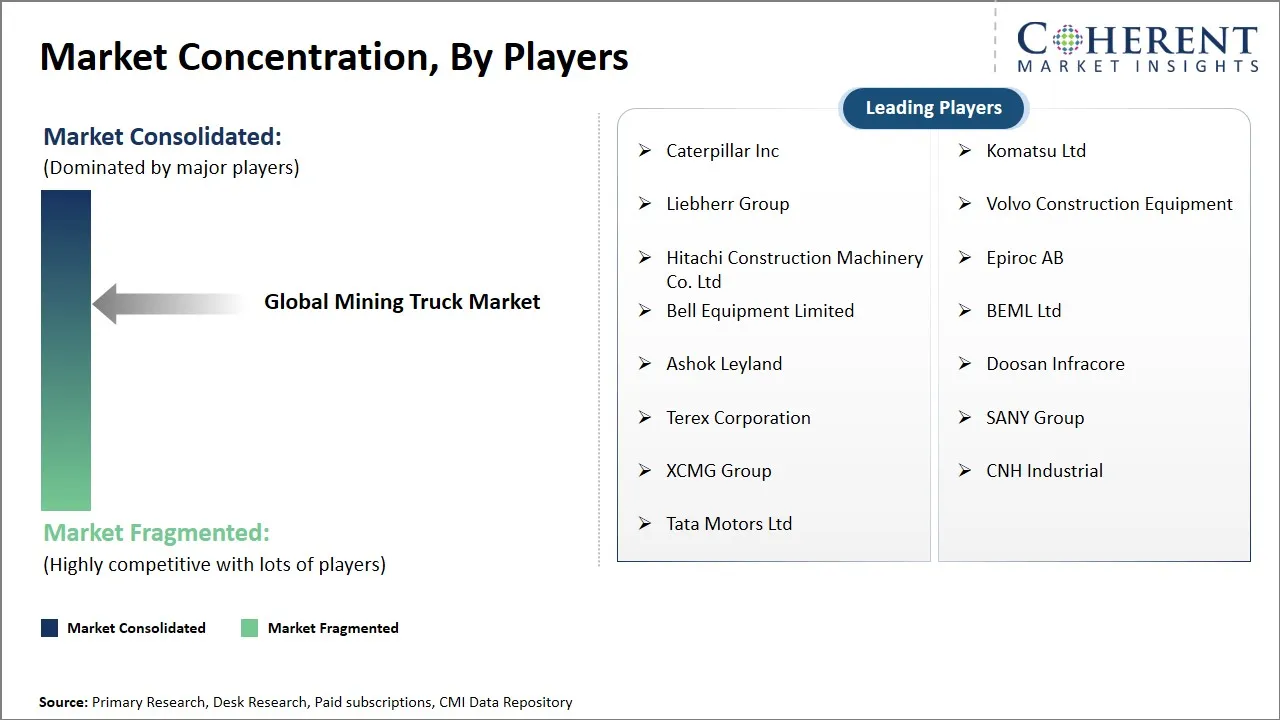
| Companies covered: | Caterpillar Inc, Komatsu Ltd, Liebherr Group, Volvo Construction Equipment, Hitachi Construction Machinery Co. Ltd, Epiroc AB, Bell Equipment Limited, BEML Ltd, Ashok Leyland, Doosan Infracore, Terex Corporation, SANY Group, XCMG Group, CNH Industrial, and Tata Motors Ltd | ||
| Growth Drivers: |
| ||
| Restraints & Challenges: |
| ||
Global Mining Truck Market Dynamics
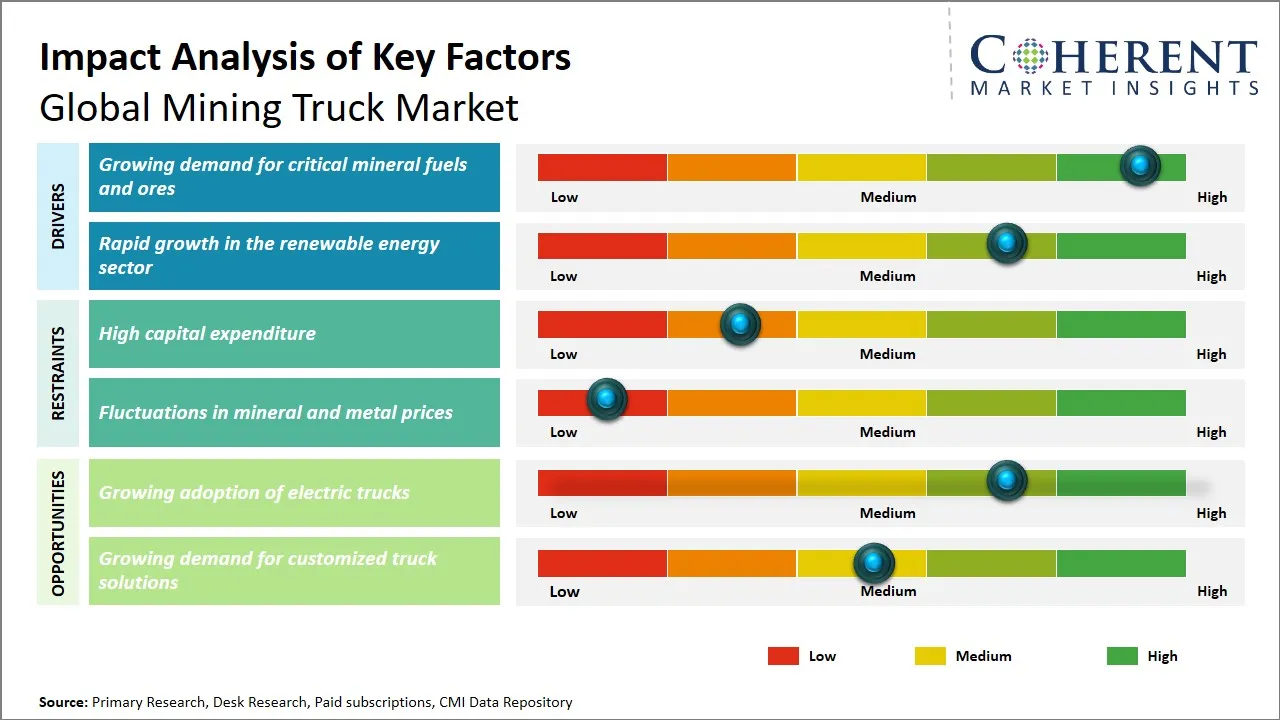
Global Mining Truck Market Driver - Growing Demand for Critical Mineral Fuels and Ores
With growing worldwide dependence on key mineral ores and fossil inputs, pressure builds on equipment used throughout extraction processes. As sectors including green power systems, battery-powered transportation, aviation technology, and digital hardware continue gaining momentum, appetite grows for materials such as lithium, cobalt, nickel, and uncommon metallic compounds. Foundational to producing storage cells, intelligent gadgets, and emission-reducing technologies, these substances require consistent access.
For instance, on January 8, 2026, Energy Fuels Inc., a leading U.S. producer of uranium, rare earth elements (REEs), and critical materials, released the results of its updated Feasibility Study (FS) for its 100%-owned Vara Mada project in Madagascar. The FS confirms the project's exceptional economics, its world class quantities of high-quality rare earth, titanium, and zircon Mineral Reserves and Resources, and an initially modeled 38-year mine life which the Company expects to be significantly expanded with planned refinements to the mine plan and additional drilling.
Global Mining Truck Market Opportunity - Growing Adoption of Electric Trucks
Growing focus on eco-friendly operations, alongside tighter environmental rules worldwide, creates strong potential for electric trucks within the global market. With shifting benchmarks, mining companies now lean toward electric mining equipment rather than holding exclusively to traditional types. Because they reduce emissions, operating costs tend to decline over time. Their lower fuel demand results in diminished exhaust levels throughout work cycles. Owing to reduced part count, maintenance intervals stretch beyond those typical of legacy diesel variants. Efficiency gains appear not just in power usage but also through longer intervals between service needs.
For instance, on April 30, 2024, Vale and Caterpillar signed an agreement to test battery electric large trucks and energy transfer systems, as well as conduct studies on ethanol-powered trucks. The aim is to support Vale in achieving its goals of reducing scope 1 and 2 (direct and indirect) carbon emissions by 33% by 2030 and zeroing its net emissions by 2050.
Analyst Opinion (Expert Opinion)
- Despite slowing economic cycles, need for raw materials holds firm due to expanding cities and large-scale power shifts across nations. Productivity gains matter more than ever, pushing equipment users toward stronger, smarter hauling solutions. Older machines get phased out gradually, particularly where mines have operated for decades. New sources emerge where terrain has seen little activity, bringing shifts in need. With time, scale adjusts, shaped more by lasting supply demands than sudden funding surges.
- A noticeable change continues to unfold, driven by automated processes, electrical power integration, one step at a time. Growth in approval appears for autonomous haulage systems, thanks to improved site safety along with more consistent workflows. Focus shifts slowly to electric and hybrid versions, driven by stricter emission standards together with environmental pledges. Future gains come not from scale but from adaptation strength, supported by long-term service frameworks, innovative structures, matched with ecological responsibility. Movement ahead benefits players linking creation with sustainable material use.
Speak to the analyst
Want personalized insights?
Take the findings above to one of our principal consultants, or have the report rebuilt around the segments, geographies and competitors you actually track.
Market Segmentation
- Mode of Operation Insights (Revenue, USD Bn, 2021 - 2033)
- Autonomous
- Manual
- Truck Type Insights (Revenue, USD Bn, 2021 - 2033)
- Rigid Frame Haul Trucks
- Articulated Haul Trucks
- Off Highway Trucks
- Underground Mining Trucks
- Propulsion Insights (Revenue, USD Bn, 2021 - 2033)
- Diesel
- Hybrid Electric
- Others
- Payload Capacity Insights (Revenue, USD Bn, 2021 - 2033)
- Less than 100 tons
- 100 to 200 tons
- 200 to 300 tons
- Above 300 tons
- Regional Insights (Revenue, USD Bn, 2021 - 2033)
- North America
- U.S.
- Canada
- Latin America
- Brazil
- Argentina
- Mexico
- Rest of Latin America
- Europe
- Germany
- U.K.
- Spain
- France
- Italy
- Russia
- Rest of Europe
- Asia Pacific
- China
- India
- Japan
- Australia
- South Korea
- ASEAN
- Rest of Asia Pacific
- Middle East
- GCC Countries
- Israel
- Rest of Middle East
- Africa
- South Africa
- North Africa
- Central Africa
- North America
- Key Players Insights
- Caterpillar Inc
- Komatsu Ltd
- Liebherr Group
- Volvo Construction Equipment
- Hitachi Construction Machinery Co. Ltd
- Epiroc AB
- Bell Equipment Limited
- BEML Ltd
- Ashok Leyland
- Doosan Infracore
- Terex Corporation
- SANY Group
- XCMG Group
- CNH Industrial
- Tata Motors Ltd
Sources
Primary Research Interviews
- Mining Equipment Manufacturers
- Mining Company Fleet Managers
- Mining Truck Dealers and Distributors
- Mining Industry Consultants
Databases
- Euromonitor International Database
- Bloomberg Terminal Database
Magazines
- Mining Magazine
- International Mining
- Mining Technology Magazine
- World Mining Equipment
Journals
- International Journal of Mining Science and Technology
- Mining Engineering Journal
- Journal of Mining and Metallurgy
Newspapers
- Financial Times
- The Wall Street Journal
- Mining Weekly
- Reuters Mining News
- Bloomberg Mining Reports
Associations
- International Association of Mining Equipment Manufacturers (IAMEM)
- Society for Mining, Metallurgy & Exploration (SME)
- International Council on Mining and Metals (ICMM)
- Mining Industry Association
Public Domain Sources
- U.S. Geological Survey (USGS)
- International Energy Agency (IEA)
- World Bank Mining Data
- United Nations Statistics Division
Proprietary Elements
- CMI Data Analytics Tool
- Proprietary CMI Existing Repository of information for last 8 years
Get access to 250+ pages report
Every segment, forecast, competitor profile and data table behind the analysis above — available for instant download.
- ESOMAR Member
- ISO 9001:2015 Certified
- D-U-N-S Registered
- GDPR & CCPA Compliant
Missing comfort of reading report in your local language? Find your preferred language:
Transform your Strategy with Exclusive Trending Reports
Frequently Asked Questions
The global mining truck market is expected to stand at USD 26 Bn in 2026 and is expected to reach USD 42 Bn by 2033.
The CAGR of global mining truck market is projected to be 6 % from 2026 to 2033.
Growing demand for critical mineral fuels and ores and rapid growth in the renewable energy sector are the major factors driving the growth of the global mining truck market.
High capital expenditure and fluctuations in mineral and metal prices are the major factors hampering the growth of the global mining truck market.
In terms of mode of operation, autonomous is estimated to dominate the market revenue share in 2026.
Electric and hybrid trucks help reduce emissions and lower long-term operating costs.
Caterpillar Inc, Komatsu Ltd, Liebherr Group, Volvo Construction Equipment, Hitachi Construction Machinery Co. Ltd, Epiroc AB, Bell Equipment Limited, BEML Ltd, Ashok Leyland, Doosan Infracore, Terex Corporation, SANY Group, XCMG Group, CNH Industrial, and Tata Motors Ltd are the major players.