

South East Asia Gas Detection Device Market
South East Asia gas detection device market is estimated to be valued at USD 363.0 Mn in 2026 and is expected to reach USD 685.2 Mn in 2033, exhibiting a compound annual growth rate (CAGR) of 9.5% from 2026 to 2033.
Key Takeaways
- Based on Type, the Portable segment is projected to account for 60.1% of the market share in 2026, due to its mobility, ease of use, and suitability for industries like petrochemicals, mining, and construction.
- Based on Device, the Detector segment is expected to capture the largest share of the South East Asia gas detection device market in 2026, driven by a combination of regulatory, industrial, and technological factors.
- Based on Application, the Petrochemical segment is projected to hold the highest share of the market in 2026, due to the high-risk handling of flammable and toxic gases.
Market Overview
The South East Asia gas detection device market is growing due to stricter safety regulations, industrial expansion, and increased workplace safety awareness. Industries like petrochemicals, mining, oil and gas, and construction are driving the South East Asia gas detection device market demand.
Advancements in portable and multi-gas detectors with real-time monitoring capabilities, along with company investments in employee safety, are further boosting adoption. Overall, regulatory focus, industrial growth, and technology innovations are key factors fueling market demand in the region.
Current Events and Its Impact
Current Event | Description and its Impact |
Southeast Asia Gas Extraction and LNG Development Acceleration |
|
Enhanced Workplace Safety Regulatory Framework Implementation |
|
Role of AI in the South East Asia Gas Detection Device Market
Artificial Intelligence (AI) is playing a pivotal role in the South East Asia Gas Detection Device Market, enhancing safety, operational efficiency, and regulatory compliance across industries such as oil & gas, chemicals, manufacturing, and utilities. AI-powered gas detection systems analyze sensor data in real time, enabling early detection of hazardous gases and supporting predictive maintenance to prevent equipment failures. Advanced AI models improve the accuracy and sensitivity of sensors, allowing for detection of low-concentration gases and complex mixtures, which is critical for industrial safety. Integration with IoT and cloud platforms facilitates centralized monitoring, trend analysis, and remote diagnostics across multiple sites.
For instance, in July 2024, Indosat Ooredoo Hutchison launched a suite of AI-powered, cloud-based solutions to enhance Indonesia's upstream oil and gas sector. The offerings, introduced through Indosat Business and its subsidiary Lintasarta, aim to improve efficiency, safety, and sustainability in the industry. Indosat Intelligent Surveillance addresses safety concerns by reducing potentially fatal injuries by 95% and fires by 90%.
- Current Industry Events of 2026
- Market Size Estimation
- Regional Breakdown
- Competitive Landscape
- Customer Intelligence
- Segmental Analysis
- Pricing Analysis
- Key Market Drivers, Challenges & Future Trends
- Customized Insights Section
Installation Of Gas Detection Device Market in South East Asia
The installation of gas detection devices in South East Asia is witnessing significant growth, driven by increasing industrialization, stringent safety regulations, and a focus on workplace safety across multiple sectors. Industries such as petrochemicals, oil & gas, chemical manufacturing, mining, and construction are the primary adopters of these devices, as they operate in environments with a high risk of gas leaks or hazardous emissions.
Companies are investing in both fixed and portable gas detection systems, with a growing preference for wireless and IoT-enabled solutions that allow real-time monitoring and remote management. Countries like Singapore, Malaysia, Thailand, Indonesia, the Philippines, and Vietnam are leading this trend due to industrial expansion and regulatory mandates requiring continuous gas monitoring. The adoption of advanced technologies, including cloud-based analytics and wirelessHART integration, is further facilitating faster and more efficient installation processes.
Overall, the increasing need to enhance safety, comply with regulations, and optimize industrial operations is driving the South East Asia Gas Detection Device Market for installations across the region.
For instance, in August 2025, Geronik Asia has secured a significant gas detection system installation project at a major construction site in Singapore. Following extensive technical discussions and site inspections, the proposed solution gained the client's full trust and approval. The agreement includes a comprehensive, turnkey solution encompassing equipment supply, system design, and on-site installation. The selected gas detection equipment boasts high accuracy and stability, meeting stringent safety and operational standards required for construction sites.
Segmental Insights
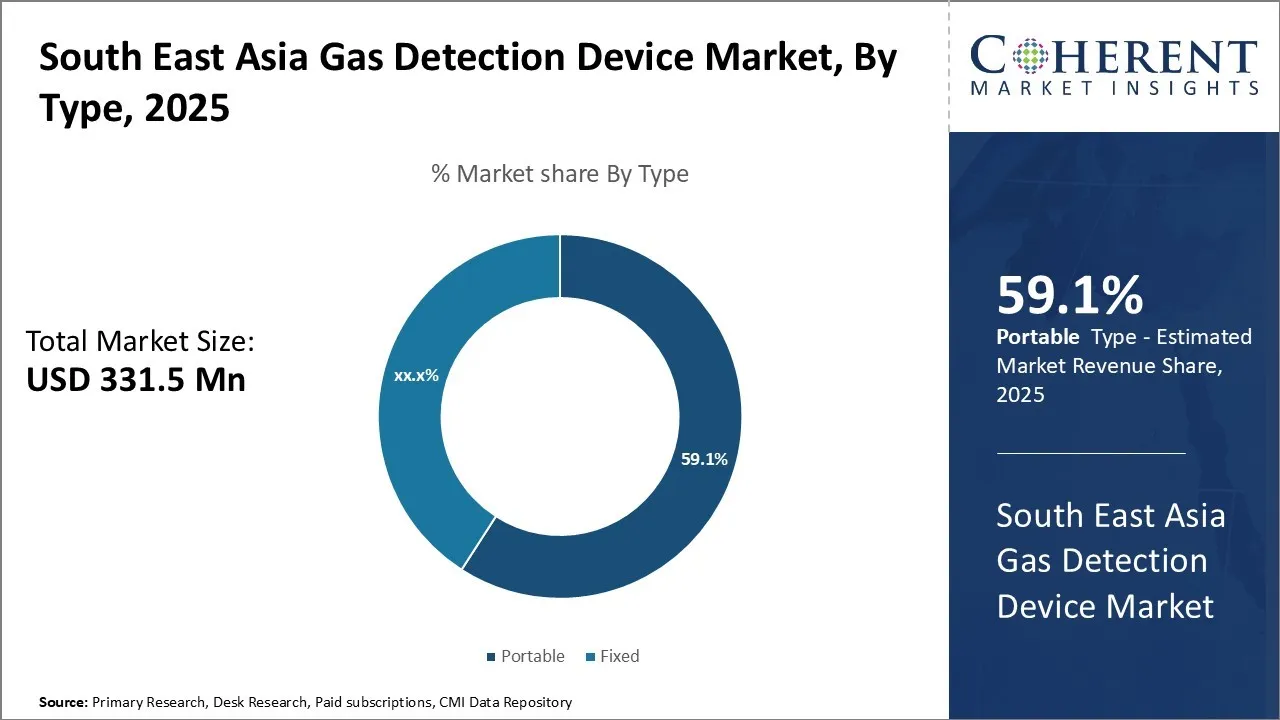
South East Asia Gas Detection Device Market Insights, By Type - Portable Segment Acquires the Largest Share
In terms of type, the portable segment is projected to hold 60.1% share of the market in 2026, due to its mobility, ease of use, and suitability for industries like petrochemicals, mining, and construction. Portable devices allow real-time monitoring across different locations, quickly detecting toxic or flammable gases. Features such as multi-gas sensing, alarms, and IoT connectivity enhance safety and compliance, driving the South East Asia gas detection device market demand.
For instance, in January 2026, DD-Scientific launched the MceL gas sensor, a groundbreaking innovation that reduces sensor volume by 75% with a compact footprint of just 8.3mm x 14.4mm. This design enables manufacturers to create smaller, more wearable, and feature-rich gas detection instruments. The MceL sensor's reduced size allows for increased functionality within existing enclosures, accommodating additional hardware like larger batteries or communication modules.
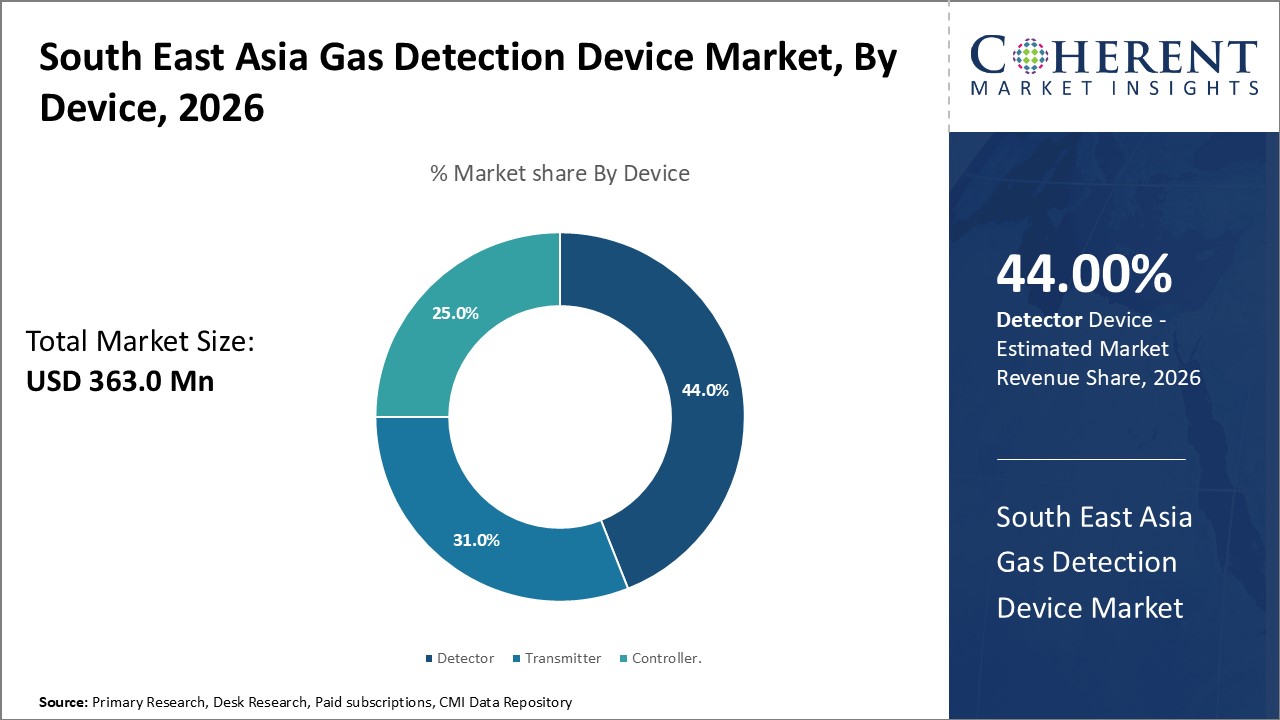
South East Asia Gas Detection Device Market Insights, By Device - Detector Segment holds the dominant share
In terms of device, the detector segment is expected to hold the largest share in the South East Asia gas detection device market in 2026, driven by a combination of regulatory, industrial, and technological factors. Governments in countries such as Singapore, Malaysia, and Thailand have implemented strict occupational health and safety standards, requiring industries to monitor hazardous gases to ensure compliance. Rapid industrial growth in sectors like petrochemicals, oil and gas, manufacturing, and construction has further increased the need for reliable gas detection systems to protect workers and equipment. At the same time, companies are placing greater emphasis on workplace safety, adopting detectors to prevent accidents and maintain safe environments.
For instance, in March 2025, ION Science launched the ARA-X4, a rugged 4-gas compliance monitor designed to enhance worker safety in hazardous environments. This compact device offers real-time detection of oxygen (O₂), carbon monoxide (CO), hydrogen sulfide (H₂S), hydrogen cyanide (HCN), sulfur dioxide (SO₂), and lower explosive limit (LEL) gases. Ideal for confined space entry and personal health protection, the ARA-X4 features a user-friendly interface with green and red backlighting, a flip-screen LCD, and a “SAFE” icon indicating no alarm conditions.
South East Asia Gas Detection Device Market Insights, By Application - Petrochemical dominates the Market Due To the High-Risk Handling of Flammable and Toxic Gases
In terms of application, the petrochemical segment is projected to account for the highest share of the market in 2026, due to the high-risk handling of flammable and toxic gases. Strict safety and environmental regulations in countries like Singapore, Malaysia, and Thailand require continuous monitoring to prevent accidents. Rapid industrial growth and the need for operational efficiency are prompting investments in advanced, portable, and IoT-enabled gas detection devices, making petrochemical a leading contributor to the South East Asia gas detection device market demand.
For instance, in February 2025, TANDA Development Pte. Ltd. introduced advanced firefighting solutions tailored for the petrochemical industry. Their offerings include explosion-proof gas detectors and distributed fiber optic temperature monitoring systems, designed to detect and prevent potential hazards in high-risk environments.
South East Asia Gas Detection Device Market Analysis Country-Wise
Singapore South East Asia Gas Detection Device Market Trends
In Singapore, the market is dominating, holding a share of 29.5% due to the adoption of gas detection devices in advanced industrial infrastructure and strict occupational health and safety regulations. Petrochemical and manufacturing facilities handle hazardous gases, requiring continuous monitoring to prevent accidents. Regulatory mandates encourage the use of reliable and technologically advanced detectors, including portable, multi-gas, and IoT-enabled systems.
For instance, in July 2025, Singapore's Maritime and Port Authority (MPA) conducted a large-scale chemical spill drill simulating a methanol leak ahead of the upcoming issuance of the first batch of methanol bunkering licences. This exercise tested safety protocols and emerging technologies. The drill involved 11 vessels and over 150 personnel from more than 10 government agencies and industry stakeholders.
Indonesia South East Asia Gas Detection Device Market Trends
In Indonesia, the market is scoring about 21.8% share in 2025, due to rapid industrialization in mining, oil & gas, and manufacturing exposes workers to hazardous gases like carbon monoxide and hydrogen sulfide. To ensure safety and regulatory compliance, companies are adopting advanced gas detection devices, including portable, fixed, and IoT-enabled monitors for real-time detection. The high-risk working conditions and industrial growth make Indonesia a key contributor to the South East Asia gas detection device market demand.
For instance, in August 2025, Shenzhen Safewill Co., Ltd., a leading provider of industrial gas detection and environmental monitoring systems, participated in the Emergency Disaster Reduction and Rescue (EDRR) Expo 2025 in Jakarta. The company offers high-precision gas detectors and air quality monitoring solutions designed for emergency responders, industrial operators, and safety specialists worldwide.
Thailand South East Asia Gas Detection Device Market Trends
In Thailand, the growth of the petrochemical, chemical, and manufacturing sectors is driving demand for gas detection devices with a 14.8% market share. Handling flammable and toxic gases requires continuous monitoring to prevent accidents and ensure worker safety. Strict regulatory standards mandate the use of reliable detection systems, prompting companies to adopt advanced and IoT-enabled gas monitors. This combination of industrial expansion and safety compliance is boosting the South East Asia gas detection device market demand in Thailand.
For instance, in June 2025, IntelliView Technologies has announced a strategic partnership with SDA Group to enhance energy operations in Thailand and Southeast Asia. SDA Group, a Bangkok-based marine technology importer and supplier, will promote, sell, integrate, and service IntelliView's AI-driven leak detection solutions in the region. IntelliView's Intelligent Vision Systems (IVS) offer edge-based, real-time monitoring to detect hazardous leaks, aiming to improve safety, reduce environmental risks, and lower operational costs.
Philippines South East Asia Gas Detection Device Market Trends
In the Philippines, rising industrial and construction activities are increasing the need for gas detection devices with 13.43% of market share. Expanding manufacturing, oil & gas, and chemical facilities create environments where hazardous gases must be monitored. Growing awareness of workplace safety and stricter regulatory compliance are prompting companies to adopt advanced portable and IoT-enabled gas detectors, boosting the South East Asia gas detection device market demand.
For instance, in July 2025, President Ferdinand Marcos Jr. has expressed strong support for the ongoing Phase 4 drilling operations at the Malampaya gas field, emphasizing their critical role in ensuring a stable and affordable power supply for Luzon. During a recent aerial inspection of the Noble Viking drilling rig off Palawan, Marcos highlighted the urgency of tapping new gas reserves as existing resources deplete.
Malaysia South East Asia Gas Detection Device Market Trends
In Malaysia, the demand for gas detection devices with 10.31% share, is driven by large petrochemical, oil & gas, and chemical industries that handle flammable and hazardous gases. Strict safety regulations require continuous monitoring to prevent accidents and ensure compliance. The adoption of advanced multi-gas detectors, portable sensors, and IoT-enabled systems enhances safety, operational efficiency, and asset protection, making Malaysia a key contributor to the South East Asia gas detection device market growth.
For instance, in April 2025, in the aftermath of the devastating gas pipeline explosion in Putra, authorities have intensified safety measures. To ensure a comprehensive search for potential gas leaks, the Fire and Rescue Department has utilized loaned gas detectors from neighboring states. These advanced devices are crucial for detecting residual gas pockets that may pose further risks.
Vietnam South East Asia Gas Detection Device Market Trends
In Vietnam, holding a market share of 6.38% due to rapid industrial growth, expanding manufacturing and processing facilities, and infrastructure development are driving the adoption of gas detection devices. Companies use these devices to ensure worker safety, monitor hazardous gases, and comply with evolving safety regulations, boosting the South East Asia gas detection device market demand.
For instance, in May 2025, Raythink's thermal cameras offer advanced solutions for gas leak detection by identifying temperature variations caused by gas emissions. These infrared devices can monitor large areas from a distance, detecting invisible leaks without direct contact. Particularly effective in hazardous environments like power utilities and oil & gas fields, they provide real-time surveillance and early warning capabilities.
Market Report Scope
South East Asia Gas Detection Device Market Report Coverage
| Report Coverage | Details | ||
|---|---|---|---|
| Base Year: | 2025 | Market Size in 2026: | USD 363.0 Mn |
| Historical Data for: | 2020 To 2024 | Forecast Period: | 2026 To 2033 |
| Forecast Period 2026 to 2033 CAGR: | 9.5% | 2033 Value Projection: | USD 685.2 Mn |
| Geographies covered: | Singapore, Malaysia, Indonesia, Thailand, Vietnam, Myanmar, Brunei, Philippines, Rest of South East Asia | ||
| Segments covered: |
| ||
| Companies covered: | Emerson Electric Co., Halma plc., Schneider Electric SE, Xylem Inc., Yokogawa Electric Corporation, Airtest Technologies, Inc., Crowncon Detection Instruments Limited, Hanwei Electronics Group Corporation, Lynred, and Schauenburg Group. | ||
| Growth Drivers: |
| ||
| Restraints & Challenges: |
| ||
Market Dynamics
South East Asia Gas Detection Device Market Drivers
Rising demand for remote monitoring and reduced operational expenses is expected to propel the South East Asia gas detection device market growth over the forecast period
Gas detection devices offer constant monitoring of work areas and the detection of hazardous gases in the environment. It allows organizations to decrease health and safety risks by monitoring and detect gases beforehand. Furthermore, gas detection devices are expected to reduce the time needed for the assessment of gases by removing manual monitoring of the potential explosion of gases in the area. With rising adoption of work safety equipment in numerous countries are focused on the design and development of gas detection controllers to monitor remote gases, which further trigger audio or visual alarms to alert the risk. Hence, these factors are expected to propel the South East Asia Gas detection device market growth in the near future.
For instance, GE Vernova has inaugurated a state-of-the-art Remote Monitoring and Diagnostics (M&D) Center in Kuala Lumpur, Malaysia, underscoring its commitment to the Asia-Pacific region. This facility will oversee 200 power generation assets across 70 power plants in 10 countries. Housing over 85 engineering experts, the M&D Center employs advanced analytics and digital twin models to monitor plant performance in real-time, enabling proactive maintenance and reducing downtime.
South East Asia Gas Detection Market Opportunities
Development gas detectors with advanced technologies can provide business opportunities
The rapid advancement of technology has led to the development of advanced and innovative products in the gas detection device market. Technologies such as cloud computing and wirelessHART are being integrated with gas detectors to enhance coverage and detection points while reducing installation costs by eliminating the need for fixed wiring. Many manufacturers are now developing wireless gas detectors to provide effective solutions for both remote and local applications.
For example, United Electric Controls, based in the U.S., has distributors in Singapore, Indonesia, and Malaysia, offering wirelessHART-enabled gas detectors for oil and gas production facilities. These technological innovations are expected to positively influence the South East Asia gas detection device market forecast, driving growth and adoption across the region.
South East Asia Gas Detection Market Trends
Growing adoption of gas detectors in marine and oil & gas industries
Increasing activities in the petrochemical industry, particularly in the offshore and oil & gas sector boosting the demand for effective gas detectors across South East Asia. Moreover, the demand for enhanced and modified gas detectors is increasing, and driving oil & gas companies to upgrade or replace their existing gas detectors. Apart from this, the adoption of gas detectors in the marine industry is growing owing to the policies and regulations provided by the International Maritime Organization (IMO). The use of gas detectors by shipbuilders and ship owners is increasing, in order to provide safety to the crew members from hazardous and toxic gases on board.
Analyst Opinion (Expert Opinion)
The Southeast Asia gas detection device market is witnessing a pivotal transformation, driven by escalating industrialization and stringent safety regulations. This evolution signifies a shift from traditional safety measures to advanced, integrated solutions that prioritize real-time hazard detection and proactive risk management.
The market is increasingly characterized by the adoption of smart gas detection systems, which offer enhanced sensitivity, multi-gas detection capabilities, and seamless integration with Industrial Internet of Things (IIoT) platforms. These advancements enable continuous monitoring, data analytics, and predictive maintenance, thereby reducing downtime and operational costs. The integration of wireless communication technologies further facilitates remote monitoring, ensuring safety across expansive industrial sites.
Industries such as oil and gas, chemicals, and manufacturing are at the forefront of adopting these advanced detection systems. In the oil and gas sector, for instance, the implementation of smart gas detectors has led to a significant reduction in gas leak incidents and enhanced compliance with environmental safety standards. Regulatory bodies across the region are increasingly mandating the use of advanced gas detection technologies, thereby accelerating market growth.
Speak to the analyst
Want personalized insights?
Take the findings above to one of our principal consultants, or have the report rebuilt around the segments, geographies and competitors you actually track.
Recent Developments
- In July 2025, German safety technology company Dräger has launched two advanced safety devices in Indonesia to enhance workplace protection. The X-am 2600 is a portable multi-gas detector capable of monitoring oxygen, carbon monoxide, hydrogen sulfide, and combustible gases. The SCBA PSS 3000E is a lightweight self-contained breathing apparatus designed for hazardous environments. These products were introduced during a safety workshop in Jakarta, attended by industry professionals from sectors such as manufacturing, oil and gas, chemicals, mining, and construction.
- In June 2025, Safetyware, a leading provider of occupational safety solutions, showcased its latest innovations at Thailand Safe@Work #37, at the IMPACT Exhibition and Convention Center in Muang Thong Thani. The event, Southeast Asia's premier workplace safety fair, attracted professionals across various industries. Safetyware's booth, D31 & D32, featured advanced personal protective equipment (PPE), including chemical-resistant gloves, flame-retardant apparel, ergonomic safety footwear, and respiratory solutions like half-face and full-face masks. Additionally, the company presented portable gas detectors and other hazard detection systems. Attendees had opportunities to engage with industry experts and participate in networking sessions.
- In February 2025, Thailand is intensifying its air quality improvement efforts by integrating renewable energy and innovative technologies. Collaborations among key agencies, including the Ministry of Energy and the Pollution Control Department, aim to reduce emissions and enhance public health. Initiatives such as implementing energy-efficient technologies and promoting cleaner fuels are central to this strategy. The government's commitment to sustainable energy solutions reflects a broader vision for a cleaner, healthier environment.
Market Segmentation
- Type Insights (Revenue, USD Mn, 2021 - 2033)
- Fixed
- Portable
- Device Insights (Revenue, USD Mn, 2021 - 2033)
- Detector
- Transmitter
- Controller
- Application Insights (Revenue, USD Mn, 2021 - 2033)
- Mining, Steel Mill
- Petro Chemical
- Construction
- Automobile
- Material
- Food & Beverage Processing
- Electronics
- Marine
- Utility Services
- Government
- Security
- Medical
- Environment Detection
- Country Insights (Revenue, USD Mn, 2021 - 2033)
- Singapore
- Malaysia
- Indonesia
- Thailand
- Vietnam
- Myanmar
- Brunei
- Philippines
- Rest of South East Asia
- Key Players Insights
- Emerson Electric Co.
- Halma plc.
- Schneider Electric SE
- Xylem Inc.
- Yokogawa Electric Corporation
- Airtest Technologies, Inc.
- Crowncon Detection Instruments Limited
- Hanwei Electronics Group Corporation
- Lynred
- Schauenburg Group.
Sources
Primary Research Interviews from the following stakeholders
Stakeholders
- Interviews with gas detection device manufacturers, industrial safety equipment suppliers, facility managers, HSE (Health, Safety, Environment) heads, procurement managers, and technical consultants across key South East Asia markets.
Specific stakeholders
- HSE and operations managers at oil & gas, chemical, and mining companies (e.g., Petronas, PTT Group, Chevron, Freeport Indonesia)
- Facility managers and safety officers at manufacturing plants and industrial zones in Singapore, Thailand, Malaysia, and Indonesia
- Procurement heads and technical leads at utilities and energy companies (e.g., electricity generation and distribution companies)
- Safety and risk management consultants for industrial and petrochemical projects
- Product managers and engineers at gas detector OEMs and component suppliers (e.g., sensors, controllers, alarm systems)
- Compliance officers at industrial regulatory authorities
Databases
- World Trade Organization (WTO) Trade Statistics
- UN Comtrade Database
- ASEAN Statistics Database
- Ministry of Industry, Indonesia
- Department of Statistics Malaysia
- Department of Trade and Industry, Philippines
- Singapore Department of Statistics (SingStat)
- Thailand Board of Investment (BOI)
Magazines
- Industrial Safety & Security Source
- Hazardous Area & Gas Detection Journal
- Occupational Health & Safety (OHS) Asia
- Process & Control Today
- Safety+Health Asia
- Industrial Automation Asia
Journals
- Journal of Loss Prevention in the Process Industries
- Safety Science (Elsevier)
- Journal of Occupational and Environmental Hygiene
- IEEE Sensors Journal
- Journal of Hazardous Materials
Newspapers
- The Straits Times – Industry & Safety
- Post – Industrial & Energy Sector
- The Jakarta Post – Business & Manufacturing
- The Star (Malaysia) – Industry & Safety News
- South China Morning Post – Industrial Safety & Technology
Associations
- International Society of Automation (ISA) – Safety Division
- Institution of Occupational Safety and Health (IOSH) – Asia Chapter
- National Fire Protection Association (NFPA)
- Gas Detection and Safety Association (regional chapters)
- ASEAN Federation of Industrial Safety and Health
Public Domain Sources
- Ministry of Energy, Thailand
- Ministry of Manpower & Safety, Singapore
- Directorate General of Oil and Gas, Indonesia
- U.S. National Institute of Standards and Technology (NIST) – Gas Detection Standards
- ASEAN Industry Reports – Safety Equipment
- Regional Industrial Safety Guidelines and Technical Publications
Proprietary Elements
- CMI Data Analytics Tool, and Proprietary CMI Existing Repository of information for last 8 years
Get access to 250+ pages report
Every segment, forecast, competitor profile and data table behind the analysis above — available for instant download.
- ESOMAR Member
- ISO 9001:2015 Certified
- D-U-N-S Registered
- GDPR & CCPA Compliant
Missing comfort of reading report in your local language? Find your preferred language:
Transform your Strategy with Exclusive Trending Reports
Frequently Asked Questions
The global South East Asia Gas Detection Device Market size was valued at USD 194.1 million in 2021 and is expected to reach USD 408.5 million in 2027.
The South East Asia gas detection device market was valued at US$ 194.1 million in 2019 and is estimated to exhibit a CAGR of 9.7% between 2021 and 2027.
Petrochemical segment held the major market share in 2019 owing to growing emphasis on health and safety regulations across industries
Major factor driving the growth of South East Asia gas detection device market during the forecast period is strict regulatory policies regarding workplace safety.
Major factors hampering the growth of the gas detection market during the forecast period is reduced profit margins.
Singapore gas detection device market is expected to generate the highest revenue during the forecast period.
Leading services in the Southeast Asia gas detection device market include calibration, maintenance, and training services.