

Global Mobile Encryption Market Size and Forecast – 2026 To 2033
The global mobile encryption market is expected to grow from USD 3.30 Bn in 2026 to USD 8.25 Bn by 2033, registering a compound annual growth rate (CAGR) of 9% from 2026 to 2033. The global mobile encryption market is driven by growing enterprise mobility and remote workforce. On January 28, 2025, Remote, the global authority on remote employment, launched Remote Contractor of Record. Leveraging Remote’s technology and expertise in remote employment, companies can use Remote Contractor of Record to engage and pay global contractors without administrative or compliance burdens. (Source: Remote)
Key Takeaways of the Global Mobile Encryption Market
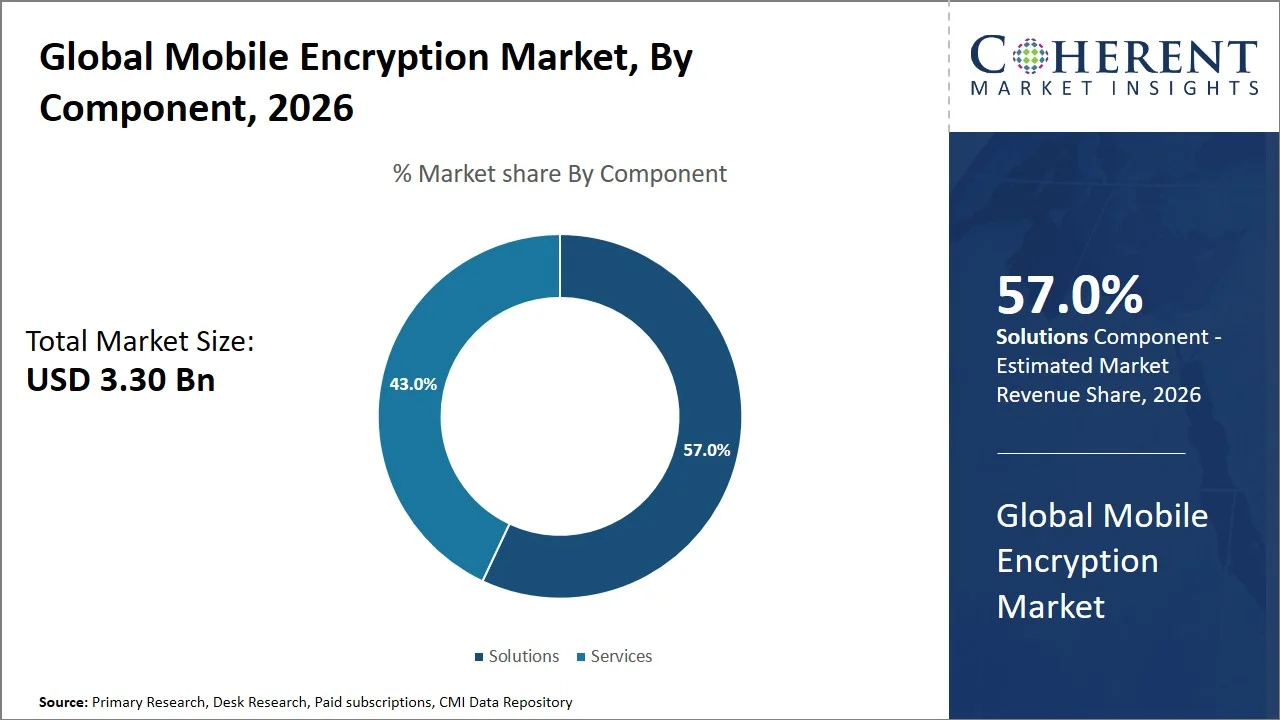
- The solutions segment is expected to account for 57.0 % of the global mobile encryption market share in 2026. Rapid growth in mobile banking and digital payments is driving the growth of the solutions segment. On April 7, 2025, Revolut announced that it has received full authorization from the Reserve Bank of India (RBI) to issue Prepaid Payment Instruments (PPI) in India, including prepaid cards and prepaid wallets with UPI payments. (Source: Revolut)
- The cloud segment is estimated to capture 61.0 % of the market share in 2026. Expansion of cloud-based mobile applications is a major factor driving the growth of the segment. On February 4, 2025, AT&T announced that it is extending its voice core relationship with Nokia in a multi-year expansion deal that will support the U.S. operator in delivering on its vision of securely providing customer-focused networks and automation that drive new services, faster deployment times, and operational efficiencies. (Source: Nokia)
- The disk encryption segment is estimated to capture 46.0 % of the market share in 2026. Increasing adoption of Zero Trust security architectures is driving the growth of the segment. On February 11, 2026, Palo Alto Networks announced the completion of its acquisition of CyberArk, establishing Identity Security as a core pillar of its platformization strategy.
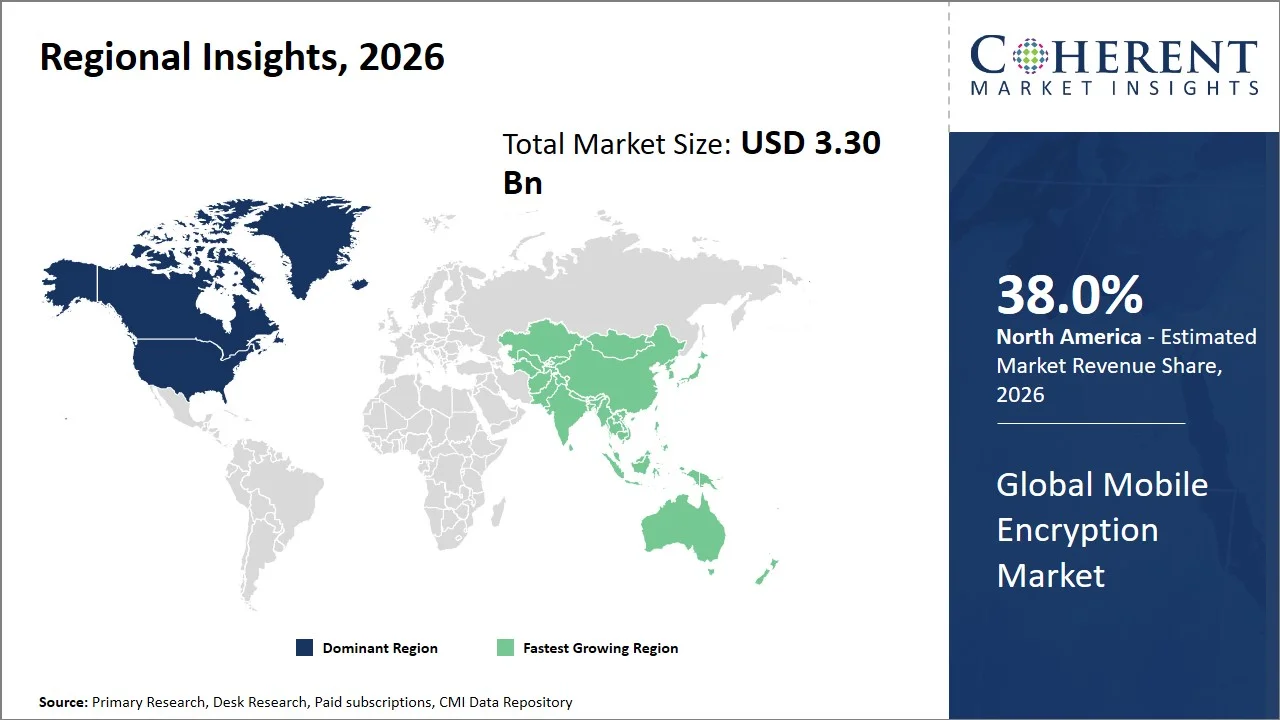
- North America is expected to dominate the mobile encryption market in 2026 with a market share of 38.0 %. Increasing adoption of secure mobile healthcare applications in North America is driving the growth of the regional market. On March 5, 2025, Google expanded Health Connect by introducing support for Fast Healthcare Interoperability Resources (FHIR) medical records, enabling Android healthcare applications to securely exchange clinical data with electronic health record systems.
- Asia Pacific is expected to account for 27.0 % of the market share in 2026 and is projected to record the fastest growth over the forecast period. Expansion of government digital identity programs in Asia Pacific is driving the growth of the regional market. On September 30, 2024, Dagang NeXchange Berhad and Google Cloud announced a multi-year agreement to deliver next-generation sovereign cloud services in Malaysia. This strategic partnership addresses the country’s growing demand for cloud solutions that meet strict data residency, security, and privacy requirements.
- Integration of AI-Driven Encryption and Threat Detection: Mobile encryption solutions are increasingly integrating artificial intelligence and machine learning to detect suspicious activity, identify zero-day threats and auto-adjust encryption policies. AI-enhanced security provides real-time risk management and flexible encryption, which increases resilience to complex cyberattacks and reduces the strain on device performance.
- Growing Adoption of Zero Trust Security Frameworks: Businesses are implementing mobile encryption into Zero Trust frameworks, where every user, device and app is continually vetted before gaining access to corporate assets. This trend is generating demand for end-to-end encryption, identity-based authentication, encrypted mobile communications and secure access controls across organizational systems.
Segmental Insights
Why Does the Solutions Segment Dominate the Global Mobile Encryption Market?
The solutions segment is expected to account for 57.0% of the global mobile encryption market share in 2026. As enterprises extend remote work and bring your own device (BYOD) initiatives, the increasing enterprise demand for complete data protection on smartphones, tablets and other mobile endpoints helps the solutions category. Standalone encryption solutions are becoming a critical component of cybersecurity strategies for modern businesses. Enterprises are looking at integrated mobile encryption solutions that provide full-device, file, application and communication encryption, centralized policy management, compliance monitoring, and seamless integration with enterprise mobility management platforms. On September 16, 2025, Omnissa, a leading digital work platform company, announced Workspace ONE Vulnerability Defense, a new AI-driven security offering that transforms how organizations manage vulnerabilities across all endpoints and apps, both physical and virtual. (Source: Omnissa)
- Current Industry Events of 2026
- Market Size Estimation
- Regional Breakdown
- Competitive Landscape
- Customer Intelligence
- Segmental Analysis
- Pricing Analysis
- Key Market Drivers, Challenges & Future Trends
- Customized Insights Section
Why is Cloud the Most Preferred Deployment Type?
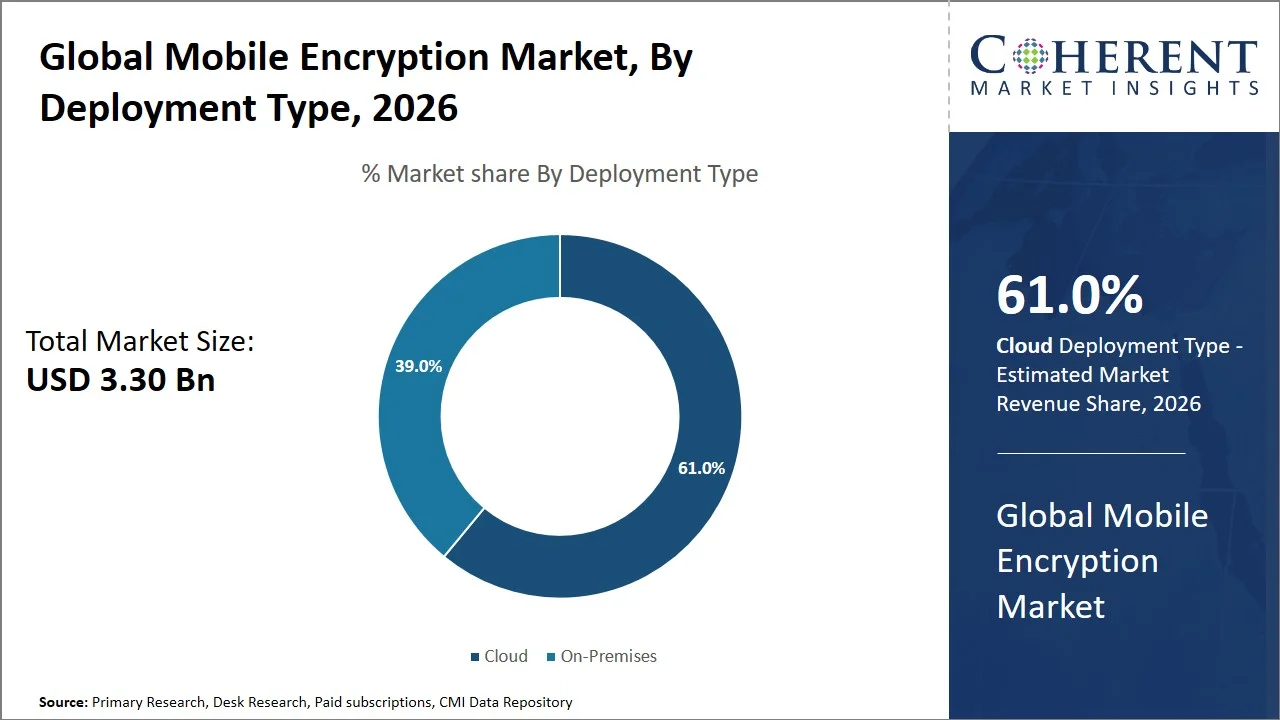
The cloud segment is expected to account for 61.0% of the global mobile encryption market share in 2026. Many firms prefer cloud deployment because it allows them to centrally manage encryption rules, security updates, encryption keys and compliance needs for thousands of mobile devices without a large on-premises infrastructure. This centralized strategy not only decreases operational complexity and allows for rapid scalability for remote workforces, but it also helps organizations to apply standardized mobile security measures, while decreasing maintenance costs and increasing responsiveness to new cyber threats. On April 9, 2026, Microsoft and Samsung improved the integration between Microsoft Intune and Samsung Knox Mobile Enrollment, allowing companies to automatically enroll corporate Android devices into cloud-based endpoint management when they are turned on.
Disk Encryption Dominates the Global Mobile Encryption Market
The disk encryption segment is expected to account for 46.0% of the global mobile encryption market share in 2026. Disk encryption is still the most popular use case, providing the strongest level of protection for all data on a mobile device, including OS files, programs, user documents and cached data, in the event of a lost or stolen device. Its ability to automatically encrypt the full storage volume without user intervention makes it a favored security step for enterprises and government organizations seeking to comply with rigorous data protection regulations and cut the risk of unauthorized data access. On April 15, 2016, Microsoft announced that it was bringing full-disk encryption management capabilities to Microsoft Intune, allowing organizations to centrally specify full-disk encryption policies, escrow recovery keys, track encryption compliance, and automate device encryption across Windows laptops and tablets from a cloud-based console.
Currents Events and their Impact
Current Events | Description and its Impact |
European Union - Cyber Resilience Act (CRA) |
|
U.S. - Executive Order 14144 |
|
Global Mobile Encryption Market - Encryption Algorithm Adoption
Mobile encryption is moving away from dependence on legacy cryptographic methods to a crypto-agile architecture that integrates symmetric and asymmetric encryption with quantum-resistant technologies. AES-256 is still the standard for securing data at rest in 2025-2026, and ECC stays popular for secure key exchange and digital signatures due of its efficiency on mobile devices. Even with the emergence of post-quantum cryptography (PQC) standards from NIST, RSA is widely used in many legacy corporate systems and the need for migration planning is even more pressing due to the heightened worry regarding harvest now, decrypt later attacks. Key points include:
- AES-256: The most popular encryption method for full-device, file, and storage encryption for Android and iOS enterprise deployments in 2025.
- ECC: Continued to be the dominant public-key cryptography technique for mobile authentication, TLS connections and digital signatures in 2025, as it requires less processing overhead than RSA.
- RSA: Maintained support for traditional certificate infrastructures and enterprise authentication in 2025, however, many firms started to develop phased migration plans to address future quantum computing threats.
- Post-quantum cryptography became a major investment area in 2025-2026, with telecom operators, financial institutions, and cybersecurity vendors starting pilot installations based on newly standardized NIST PQC algorithms.
- Mobile application readiness: A survey of over 4,000 Android applications in 2025 found broad use of RSA and classical encryption, but no production deployment of post-quantum cryptographic algorithms, indicating an early-stage migration landscape.
Global Mobile Encryption Market - Hardware-Backed Encryption Adoption (2025-2026)
Hardware-backed encryption has become a fundamental security need for enterprise mobile devices as it isolates encryption keys and sensitive credentials from the operating system, considerably lowering the risk of key theft even if the device software is compromised. In 2025–2026, smartphone makers and enterprise platform vendors deployed more and more trusted hardware components such as Apple Secure Enclave, Samsung Knox Vault and TPM 2.0 to enable stronger device authentication, secure key storage and hardware-rooted encryption for enterprise mobility and zero trust environments. Key points include:
- Samsung Knox Vault continued to roll out across Galaxy enterprise devices, delivering an independent secure processor and isolated memory to protect cryptographic keys, biometric credentials and hardware-backed Android Keystore keys.
- Samsung announced an update to its Knox Vault architecture, offering improved tamper detection, secure storage, and protection against software and hardware based assaults, further strengthening hardware-rooted encryption for enterprise deployments.
- TPM 2.0 was still required for supported enterprise devices in Windows 11. TPM was the hardware root of trust for BitLocker, Windows Hello, secure key generation, and device attestation.
- A study of roughly 490,000 Android apps discovered that hardware-backed key storage is broadly accessible through the Android Keystore, but only a minority of apps employ the most robust secure hardware (secure elements), revealing significant potential for future uptake.
- Apple Secure Enclave, Samsung Knox Vault and TPM-backed security remained the preferred hardware-rooted platform to protect encryption keys, passkeys, biometric authentication and enterprise credentials across premium mobile and enterprise endpoint ecosystems.
Global Mobile Encryption Market - Secure Mobile Edge Computing Adoption (2025-2026)
As businesses shift away from depending on centralized cloud infrastructure and instead handle sensitive data closer to people and linked devices, secure mobile edge computing is becoming more crucial. Over 2025-2026, telecom operators, cloud providers and enterprise technology companies scaled up multi-access edge computing (MEC) deployment with encryption, zero trust security, confidential computing and AI-driven threat protection incorporated to secure mobile apps enabling manufacturing, healthcare, logistics, autonomous systems and smart city operations. Key points include:
- Telecom operators scaled 5G multi-access edge computing (MEC) deployments to serve latency-sensitive enterprise applications, while enabling end-to-end encryption and secure edge connection for mobile workloads.
- In conjunction with edge computing platforms, enterprises have increasingly adopted zero trust network access (ZTNA) to encrypt communication between mobile devices, edge nodes, and cloud infrastructure, minimizing the attack surface for distributed applications.
- Cloud providers like Microsoft Azure, Google Cloud and Amazon Web Services have extended confidential computing and encrypted edge services to help enterprises secure critical workloads processed at edge locations.
- All these advantages led to an increase in the adoption of AI-powered edge computing platforms for manufacturing, logistics, healthcare and smart city projects that could encrypt operational data before transmitting it to centralized cloud settings, thus boosting security and regulatory compliance.
- More mobile edge computing deployments with hardware-backed trusted execution environments (TEEs), secure key management and encrypted data processing to protect enterprise applications running on distributed edge infrastructure.
Mobile Encryption Market Dynamics
Market Drivers
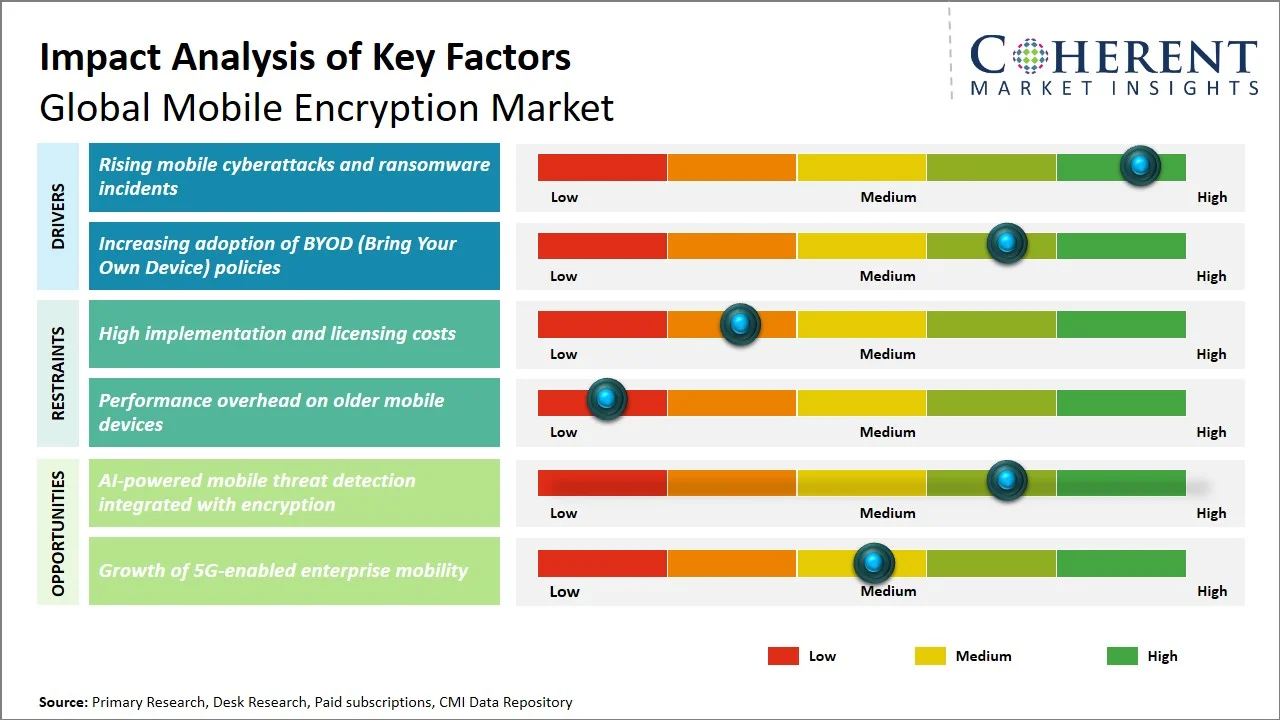
- Rising mobile cyberattacks and ransomware incidents: The rise in the number and complexity of mobile assaults and ransomware threats is forcing enterprises to improve the security of smartphones, tablets and other mobile endpoints accessing critical corporate data. Cybercriminals are increasingly targeting mobile devices through phishing, malicious applications and ransomware campaigns. Enterprises are leveraging advanced mobile encryption solutions to protect data at rest, secure communications, prevent unauthorized access and ensure business continuity while meeting evolving cybersecurity and regulatory requirements. On April 20, 2026, Zimperium released a report revealing 741% increase in iOS injection assaults in 2025, owing to more complex malware and attack methodologies fueled by AI. The company cautioned that attackers are going after mobile applications that deal with financial and enterprise data, leading organizations to beef up encryption and mobile endpoint protections.
- Increasing adoption of BYOD (Bring Your Own Device) policies: The rise of bring your own device (BYOD) policies in enterprises is driving the demand for robust mobile encryption solutions. Employees are accessing corporate applications and sensitive business data on their personal smartphones and tablets. Organizations are deploying encryption technologies to protect sensitive data on various devices, mitigating the risk of data breaches and ensuring compliance with corporate security standards, without limiting the mobility or productivity of the workforce. On March 4, 2026, Hexnode announced Hexnode Identity Provider (IdP) and Hexnode XDR, unifying identity management, multi-factor authentication, endpoint detection and unified endpoint management into a single platform.
Emerging Trends
- Expansion of Cloud-Based Mobile Encryption Platforms: Enterprises are moving from traditional on-device encryption to cloud-managed encryption services that provide centralized policy management, remote key administration, automatic compliance reporting, and seamless security updates. Cloud-native encryption solutions are becoming more popular as they are scalable, flexible and allow hybrid work environments.
- Increasing Adoption of Quantum-Resistant Encryption Technologies: As quantum computing progresses, firms are starting to consider and implement post-quantum cryptographic methods for long-term mobile data security. Mobile security providers are looking at quantum-safe encryption frameworks to protect sensitive communications and enterprise data from future quantum-powered cyber threats, notably in government, financial services and defense industries.
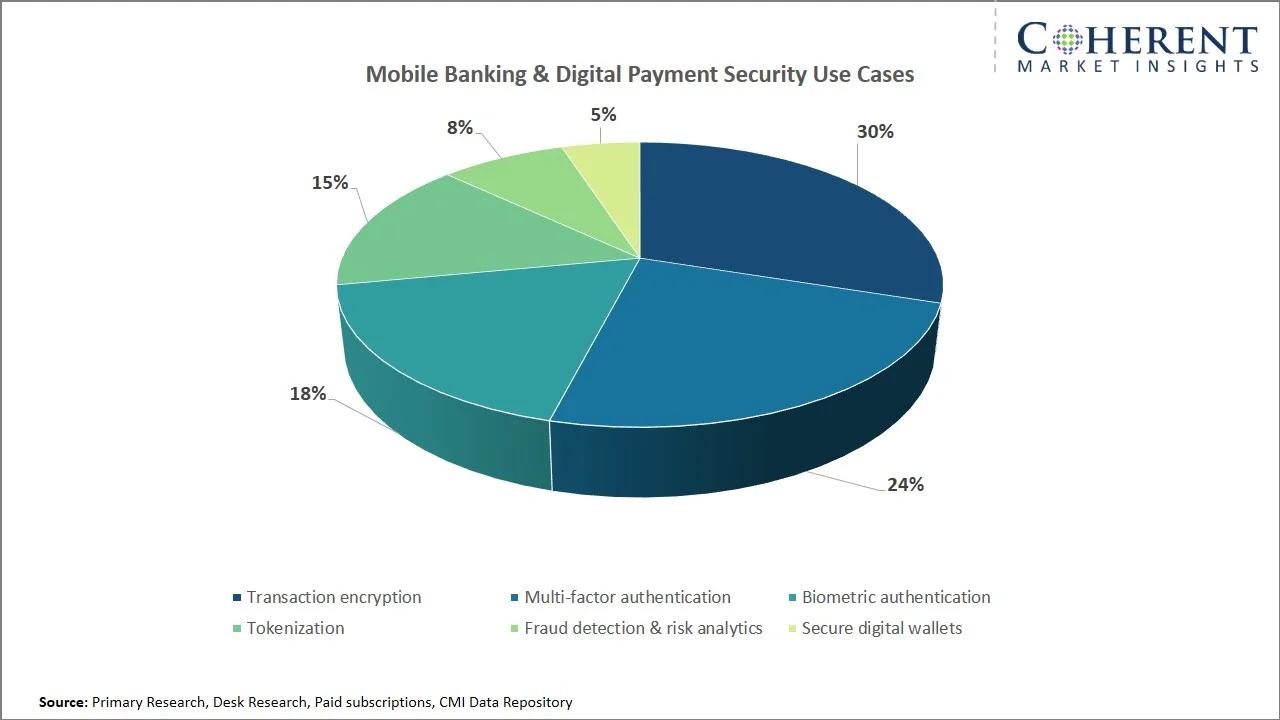
Global Mobile Encryption Market - Mobile Banking & Digital Payment Security Use Cases
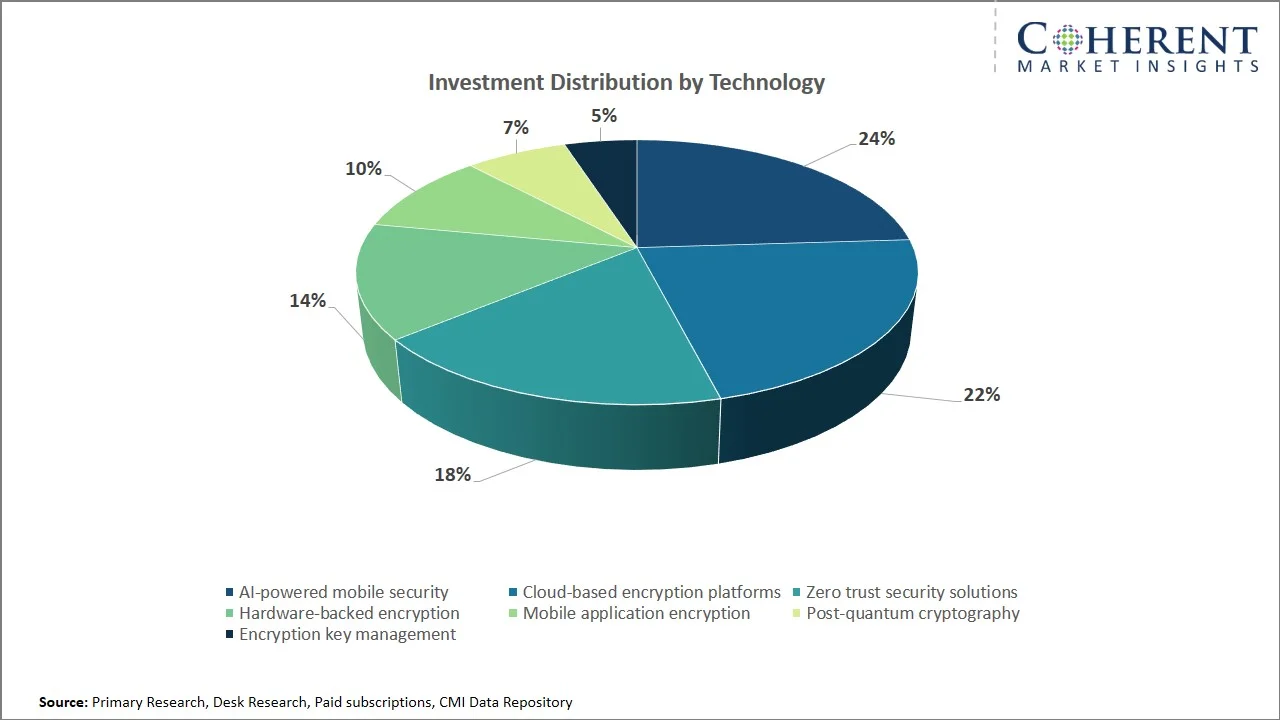
Global Mobile Encryption Market - Investment Distribution by Technology
Regional Insights
Why is North America a Strong Market for Mobile Encryption?
North America is expected to account for a market share of 38.0% in 2026. The North America region continues to be the largest regional market, driven by the increasing adoption of corporate mobility and cybersecurity platforms in the U.S. and Canada. Leading technology companies, including Microsoft, IBM, Broadcom, and VMware, are embedding sophisticated mobile encryption into enterprise security platforms, including Microsoft Intune, Microsoft Defender for Endpoint, and Workspace ONE. Federal efforts, such as the Cybersecurity and Infrastructure Security Agency’s Zero Trust strategy, have spurred encryption adoption among government agencies. The region also saw substantial adoption of encrypted mobile devices in banking, healthcare, defense and critical infrastructure sectors, where firms have to adhere to tight data protection and cybersecurity rules. On May 11, 2026, Apple and Google announced a collaborative effort to bring end-to-end encryption to Rich Communication Services (RCS), making the cross-platform messaging format that replaces traditional SMS more secure and private.
Why Does the Asia Pacific Mobile Encryption Market Exhibit High Growth?
Asia Pacific is projected to account for 27.0% of the global mobile encryption market and expected to register the fastest growth. Asia Pacific is the fastest growing regional market, driven by rapid enterprise digitalization, rising smartphone penetration and government-led cybersecurity initiatives in China, Japan, South Korea, India and Singapore. Financial institutions are providing encrypted mobile banking services and telecom carriers are rolling out safe 5G enterprise mobility solutions with inbuilt encryption. Singapore moves ahead with secure mobile identity via Singpass, Japan strengthens cybersecurity further under its Digital Agency and India speeds up enterprise mobile security adoption by implementing the Digital Personal Data Protection framework and expanding digital public infrastructure. On December 24, 2025, Appknox announced its AI-native mobile application security plan for 2026, focusing on the rising use of automated mobile application security testing across banking, fintech and government institutions in Asia Pacific.
Global Mobile Encryption Market Outlook for Key Countries
Why is the U.S. Emerging as a Major Hub in the Mobile Encryption Market?
The U.S. is the global leader in the mobile encryption market due to the widespread use by federal agencies, defense groups, financial institutions, and Fortune 500 companies. The Department of Defense and civilian agencies are increasingly adopting Zero Trust architectures that require encrypted mobile communications. Companies such as Microsoft, Apple, Google, and IBM are continuously enhancing encryption features within enterprise mobility management and endpoint security platforms. Demand for advanced mobile encryption technology is also driven by increased use of secure mobile access by healthcare providers, financial services and government contractors.
Is China the Next Growth Engine for the Mobile Encryption Market?
China has built a robust mobile encryption ecosystem, driven by local cybersecurity rules and widespread deployment of secure mobile platforms across government agencies, financial institutions and large corporations. Encryption has been embedded by technology companies like Huawei, Tencent, and Alibaba Cloud in enterprise mobility, cloud services, and mobile payment ecosystems, along with the Regulations on Network Data Security Management pushing up the requirements to secure sensitive digital information. The demand for secure mobile encryption solutions is increasing in the country due to the widespread usage of mobile payments and enterprise digital platforms.
Germany Mobile Encryption Market Analysis and Trends
Germany is one of the most mature markets for mobile encryption in Europe, driven by strong cybersecurity compliance requirements and a high level of industrial digitalization. Manufacturing giants such as Siemens, Bosch and Volkswagen are increasingly protecting staff mobile devices used for factory automation, industrial maintenance and remote operations using enterprise encryption and mobile device management solutions. The country’s focus on Industry 4.0, along with regulatory requirements under the General Data Protection Regulation and the NIS2 Directive, has driven the adoption of encrypted enterprise communications and mobile endpoint protection.
Japan Mobile Encryption Market Analysis and Trends
In Japan, the mobile encryption market is characterized by considerable company investment in secure mobile communications across manufacturing, financial services, telecoms and public administration. Mobile encryption is integrated into corporate cellphones and remote workforce solutions by companies such as NTT, Fujitsu, NEC and Hitachi, while the government’s Digital Agency is also continuing to push forward the development of secure digital government services that require strong security of mobile data. The country’s early adoption of 5G enterprise networks has further added to the demand for encrypted mobile applications and secure device management.
U.K. Mobile Encryption Market Analysis and Trends
The U.K. is emerging as a crucial market as investments in cybersecurity grow in the financial services, healthcare, government and legal sectors. The UK General Data Protection Regulation and the Network and Information Systems Regulations have led to organizations increasing their use of encrypted mobile devices and the National Cyber Security Centre continues to publish guidance encouraging encrypted communications and secure mobile device management. The growth of global financial institutions in London has further fueled the use of enterprise-grade mobile encryption to safeguard sensitive financial transactions and secret business communications.
Global Mobile Encryption Market - Mobile Encryption Key Management Deployment
Deployment Type | Average Encryption Key Rotation Frequency | Centralized Key Management Adoption (%) |
Cloud-based Key Management | Every 30-60 days | 94.2 |
On-premises Key Management | Every 60-90 days | 88.5 |
Hybrid Key Management | Every 30-45 days | 91.8 |
Global Mobile Encryption Market - Mobile Encryption Adoption by Industry
Industry Vertical | Organizations Using Mobile Encryption (%) | Average Encrypted Mobile Devices per Organization | Cloud-based Deployment Share (%) | BYOD Encryption Adoption (%) |
BFSI | 96.2 | 6,850 | 71.5 | 83.4 |
Government & Defense | 94.8 | 8,420 | 54.3 | 58.6 |
Healthcare | 91.7 | 3,980 | 74.8 | 76.2 |
IT & Telecommunications | 93.5 | 5,760 | 82.6 | 89.1 |
Retail & E-commerce | 86.9 | 2,940 | 80.8 | 84.7 |
Manufacturing | 82.8 | 2,310 | 67.9 | 69.5 |
Energy & Utilities | 84.3 | 2,620 | 63.7 | 61.4 |
Transportation & Logistics | 81.6 | 3,180 | 70.6 | 73.8 |
Education | 76.8 | 1,560 | 72.1 | 67.9 |
How is AI-Powered Mobile Threat Detection Integrated with Encryption Creating New Growth Opportunities in the Mobile Encryption Market?
The convergence of artificial intelligence and mobile encryption is opening up huge growth opportunities. It allows security platforms to detect suspicious activity, malware, phishing and unauthorized access in near real time, and automatically enhance encryption policies based on the level of risk assessed. AI-driven analytics can recognize anomalous device activity, dynamically encrypt important files and communications, and automate incident response, all without interrupting user productivity, rendering mobile security more proactive and adaptive. This combination is fueling adoption by corporations, financial institutions, healthcare organizations, and government agencies that demand intelligent, continuous protection of mobile endpoints from ever more complex cyber threats. On March 31, 2026, Unit 42 released a report demonstrating how AI agents hosted on Google Cloud Vertex AI could be misused for harmful purposes if not adequately secured. Organizations responded to the results by enhancing AI-powered threat detection, encrypted communications and zero trust security measures to protect enterprise mobile applications and cloud-connected devices from developing AI-powered attack approaches.
Market Players, Key Development, and Competitive Landscape
Key Developments
- On May 6, 2026, Zimperium announced the launch of its Mobile SOC Agent, a force multiplier for security analysts confronting the rise of mobile threats aimed at iOS and Android mobile devices. Leveraging Zimperium’s unmatched expertise in mobile security, Mobile SOC Agent is an agentic AI solution that enhances Zimperium’s industry-leading Mobile Threat Defense (MTD), enabling security teams to rapidly identify, prioritize, and remediate mobile threats in real time.
- On July 7, 2025, Samsung introduced Knox Enhanced Encrypted Protection (KEEP), a new architecture designed to safeguard the next generation of personalized, AI-powered features, as its latest innovation in mobile security. KEEP creates encrypted, app-specific storage environments within the device’s secure storage area, ensuring that each app can access only its own sensitive information and nothing more.
Competitive Landscape
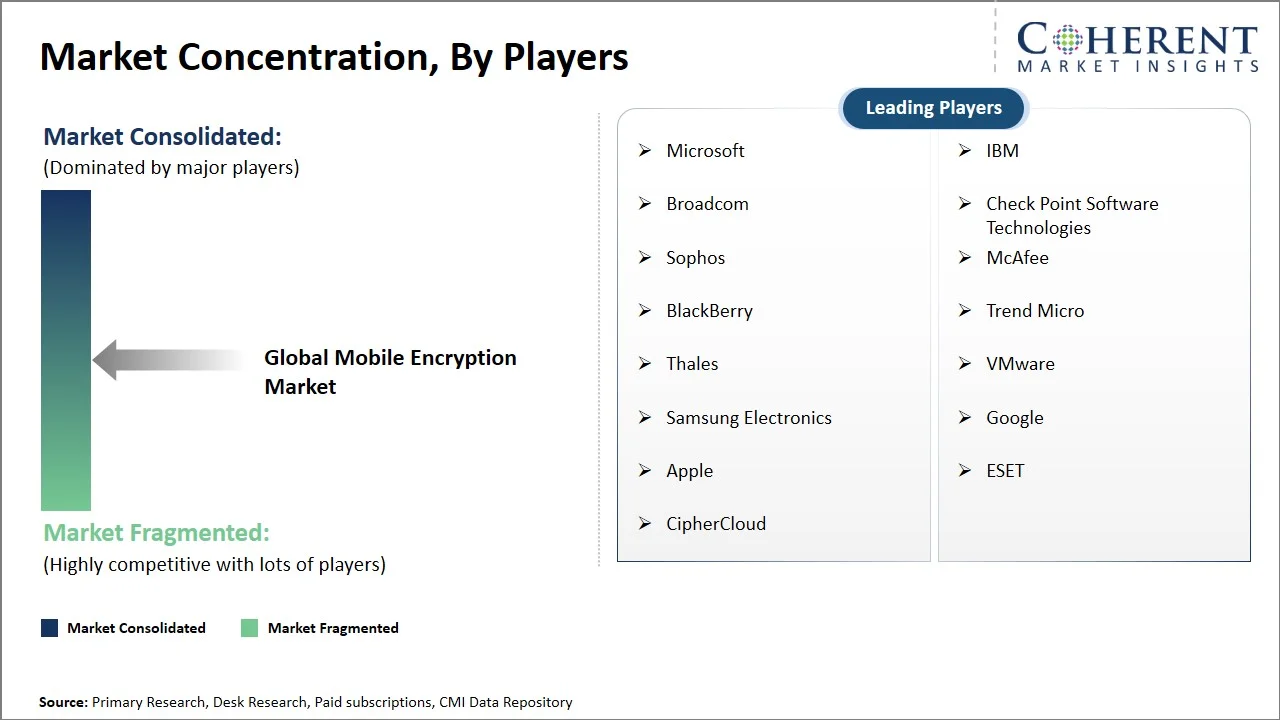
The global mobile encryption industry is competitive and consists of cybersecurity professionals, enterprise software providers, mobile operating system developers and endpoint security vendors competing on integrated security platforms rather than stand-alone encryption products. Leading manufacturers are aiming at providing full solutions that combine mobile encryption with unified endpoint management, mobile threat prevention, identity and access management, secure access service edge (SASE) and zero trust capabilities. Companies are focusing strategically on cloud-native encryption management, post-quantum cryptography research, AI-assisted security operations, and seamless integration with enterprise mobility platforms.
Market Report Scope
Mobile Encryption Market Report Coverage
| Report Coverage | Details | ||
|---|---|---|---|
| Base Year: | 2025 | Market Size in 2026: | USD 3.30 Bn |
| Historical Data for: | 2020 To 2024 | Forecast Period: | 2026 To 2033 |
| Forecast Period 2026 to 2033 CAGR: | 9% | 2033 Value Projection: | USD 8.25 Bn |
| Geographies covered: |
| ||
| Segments covered: |
| ||
| Companies covered: | Microsoft, IBM, Broadcom, Check Point Software Technologies, Sophos, McAfee, BlackBerry, Trend Micro, Thales, VMware, Samsung Electronics, Google, Apple, ESET, and CipherCloud | ||
| Growth Drivers: |
| ||
| Restraints & Challenges: |
| ||
Analyst Opinion (Expert Opinion)
- The mobile encryption market is moving from traditional device-level encryption to smart, policy-driven security architectures controlled by centralized cloud systems. Encryption interoperability with identity management, endpoint detection and response and compliance automation are becoming more important. More investments are being made in quantum-resistant encryption algorithms and AI-enabled security capabilities. Competitive differentiation is expected to be less about only encryption strength and more about management efficiency, automation, scalability and integration across complex enterprise security ecosystems.
- The future is likely to witness the convergence of mobile security, artificial intelligence, and cloud-native enterprise infrastructure, which is predicted to influence the mobile encryption industry. With the rise of encrypted mobile apps for digital banking, telemedicine, industrial field operations, and government digital services, encryption is expected to extend beyond standard device protection. As companies quickly embrace unified security architectures for hybrid workforces and connected mobile ecosystems, the market is expected to move toward adaptive encryption platforms that can deliver real-time policy enforcement, automated key lifecycle management, and seamless protection for smartphones, tablets, wearable devices, and emerging edge computing environments.
Speak to the analyst
Want personalized insights?
Take the findings above to one of our principal consultants, or have the report rebuilt around the segments, geographies and competitors you actually track.
Market Segmentation
- Component Insights (Revenue, USD Billion, 2021 - 2033)
- Solutions
- Services
- Deployment Type Insights (Revenue, USD Billion, 2021 - 2033)
- Cloud
- On-Premises
- Application Insights (Revenue, USD Billion, 2021 - 2033)
- Disk Encryption
- File Encryption
- Communication Encryption
- Cloud Encryption
- End User Insights (Revenue, USD Billion, 2021 - 2033)
- BFSI
- Government
- Healthcare
- IT and Telecommunications
- Retail
- Aerospace and Defense
- Manufacturing
- Others
- Regional Insights (Revenue, USD Billion, 2021 - 2033)
- North America
- U.S.
- Canada
- Latin America
- Brazil
- Argentina
- Mexico
- Rest of Latin America
- Europe
- Germany
- U.K.
- Spain
- France
- Italy
- Russia
- Rest of Europe
- Asia Pacific
- China
- India
- Japan
- Australia
- South Korea
- ASEAN
- Rest of Asia Pacific
- Middle East
- GCC Countries
- Israel
- Rest of Middle East
- Africa
- South Africa
- North Africa
- Central Africa
- North America
- Key Players Insights
- Microsoft
- IBM
- Broadcom
- Check Point Software Technologies
- Sophos
- McAfee
- BlackBerry
- Trend Micro
- Thales
- VMware
- Samsung Electronics
- Apple
- ESET
- CipherCloud
Sources
Primary Research Interviews
- Chief Information Security Officers (CISOs) of Large Enterprises
- Chief Technology Officers (CTOs) of Mobile Security Solution Providers
- Vice Presidents of Cybersecurity & Enterprise Mobility
Magazines
- SC Media
- SecurityWeek
- Cyber Defense Magazine
- Infosecurity Magazine
Journals
- IEEE Transactions on Information Forensics and Security
- IEEE Security & Privacy
- ACM Transactions on Privacy and Security (TOPS)
- Journal of Cybersecurity (Oxford University Press)
Associations
- Information Systems Security Association
- Internet Engineering Task Force
- National Cybersecurity Alliance
- Open Web Application Security Project
Public Domain Sources
- National Institute of Standards and Technology
- Cybersecurity and Infrastructure Security Agency
- European Union Agency for Cybersecurity
- National Security Agency
Proprietary Elements
- CMI Data Analytics Tool
- Proprietary CMI Existing Repository of information for last 10 years
Get access to 250+ pages report
Every segment, forecast, competitor profile and data table behind the analysis above — available for instant download.
- ESOMAR Member
- ISO 9001:2015 Certified
- D-U-N-S Registered
- GDPR & CCPA Compliant
Missing comfort of reading report in your local language? Find your preferred language:
Transform your Strategy with Exclusive Trending Reports
Frequently Asked Questions
The global mobile encryption market is expected to stand at USD 3.30 Bn in 2026 and is expected to reach USD 8.25 Bn by 2033.
The CAGR of the global mobile encryption market is projected to be 9% from 2026 to 2033.
Rising mobile cyberattacks and ransomware incidents and increasing adoption of BYOD (Bring Your Own Device) policies are the major factors driving the growth of the global mobile encryption market.
High implementation and licensing costs and performance overhead on older mobile devices are the major factors hampering the growth of the global mobile encryption market.
In terms of component, the solutions segment is estimated to dominate the market revenue share in 2026.
It safeguards business data on employee smartphones and tablets used to access enterprise applications from remote locations.
AI enhances mobile encryption by detecting threats in real time and automatically adapting encryption policies based on risk levels.