

Mobile Virtual Network Operators Market Size And Share Analysis - Growth Trends And Forecasts (2026-2033)
Global mobile virtual network operator's market is estimated to be valued at USD 99.90 Bn in 2026 and is expected to reach USD 175.64 Bn by 2033, exhibiting a compound annual growth rate (CAGR) of 8.4% from 2026 to 2033.
Key Takeaways
- On the basis of Service, the 4G MVNO segment is projected to hold a 51.2% market share in 2026 due to its affordability and wide coverage.
- On the basis of Operational Model, the Full MVNO segment is projected to hold a 49% market share in 2026, driven by operational flexibility and strategic partnership with host networks.
- On the basis of end user, the consumer segment is expected to dominate with a 59.8% market share in 2026, driven by MVNOs personalized and affordable mobile plans with tailored offerings for diverse user needs.
- Based on Region, North America is projected to lead the global MVNO market with a 36.8% share in 2026, driven by strong consumer acceptance of alternative telecom options. Popular MVNOs like TarcFone thrive by offering value-driven bundles and flexible plans tailored to diverse needs.
Market Overview
The Mobile Virtual Network Operator market is experiencing significant global growth, driven by technological advancements, regulatory, and evolving consumer preferences. As Mobile virtual network operators expand their services offering and enter new markets, they are set to play a significant role in shaping the future of global telecommunications.
Current Events and their Impact on the Mobile Virtual Network Operator's Market
Current events | Description and its impacts |
Technological Evolution in Telecommunications |
|
Customer Behavioral and Nano-level Market Trends |
|
Role of Artificial Intelligence (AI) in the Mobile Virtual Network Operators Market
Artificial Intelligence (AI) is significantly transforming the Mobile Virtual Network Operator (MVNO) market, enhancing customer experiences, streamlining operations, and driving revenue growth. For instance, the use of AI-driven network optimization has led to a 20% decrease in latency, significantly boosting connection speed and responsiveness. This advancement is especially vital in today’s environment, where seamless real-time communication and data transmission are essential.
In June 2025, Amdocs launched MVNO&GO, a cloud-native, AI-powered SaaS platform designed to help entrepreneurs, enterprises, and digital brands quickly and easily launch and scale mobile virtual network operators (MVNOs). The platform offers pre-integrated tools and technologies tailored to various MVNO models, including digital-first brands, wholesale MVNOs, and fiber or IoT service providers.
- Current Industry Events of 2026
- Market Size Estimation
- Regional Breakdown
- Competitive Landscape
- Customer Intelligence
- Segmental Analysis
- Pricing Analysis
- Key Market Drivers, Challenges & Future Trends
- Customized Insights Section
Segmental Insights
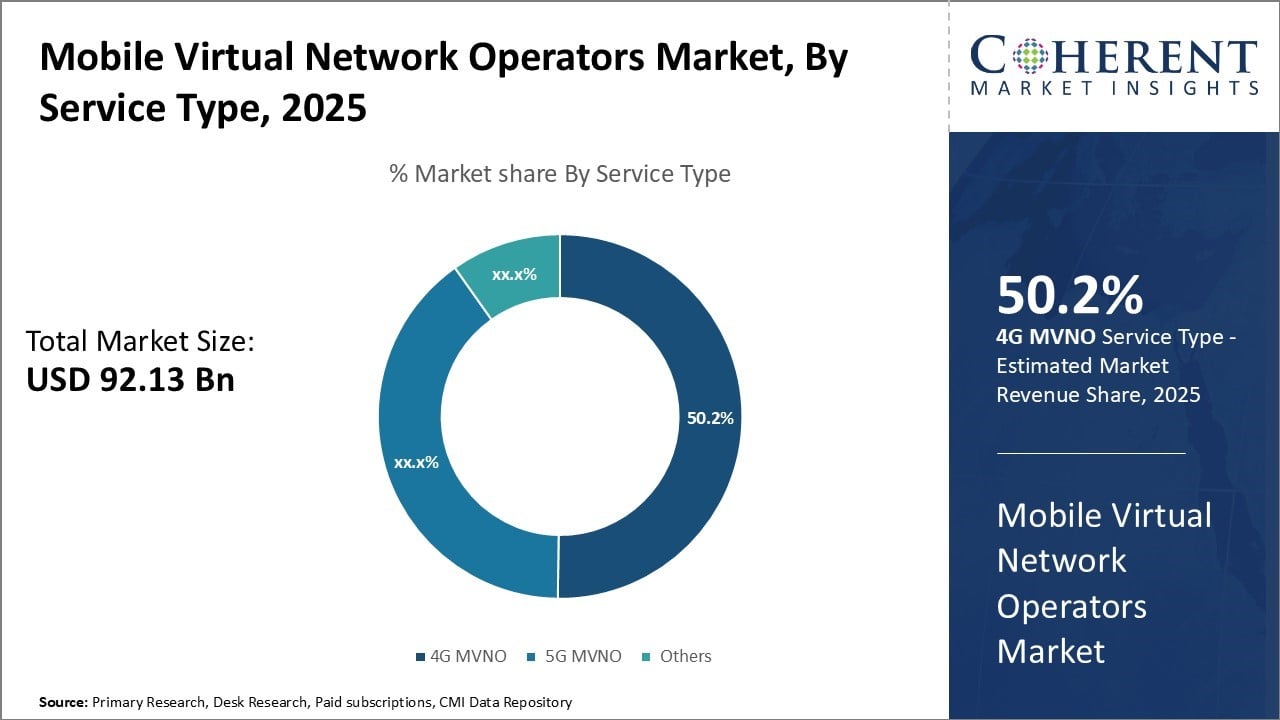
Mobile Virtual Network Operators Market Insights, By Service Type: 4G MVNO Acquires the Largest Share
In terms of service type, 4G MVNO segment is estimated to contribute the highest market share of 51.2% in 2026, owing to the affordability and coverage it offers to consumers. 4G MVNO plans are often significantly cheaper than traditional postpaid plans from major carriers, thus, making mobile services accessible to more budget-conscious users. By avoiding the high costs of building and maintaining their own network infrastructure, 4G MVNOs are able to offer low-priced plans while still providing nationwide coverage through wholesale agreements with host networks.
Fonehouse has introduced IQ Mobile, a SIM-only mobile virtual network operator (MVNO) that it says is among the first to offer 4G connectivity from launch. Operating on the EE network, IQ Mobile will be available starting next month and will offer 30 different consumer tariff plans, including both 12-month contracts and 30-day rolling options.
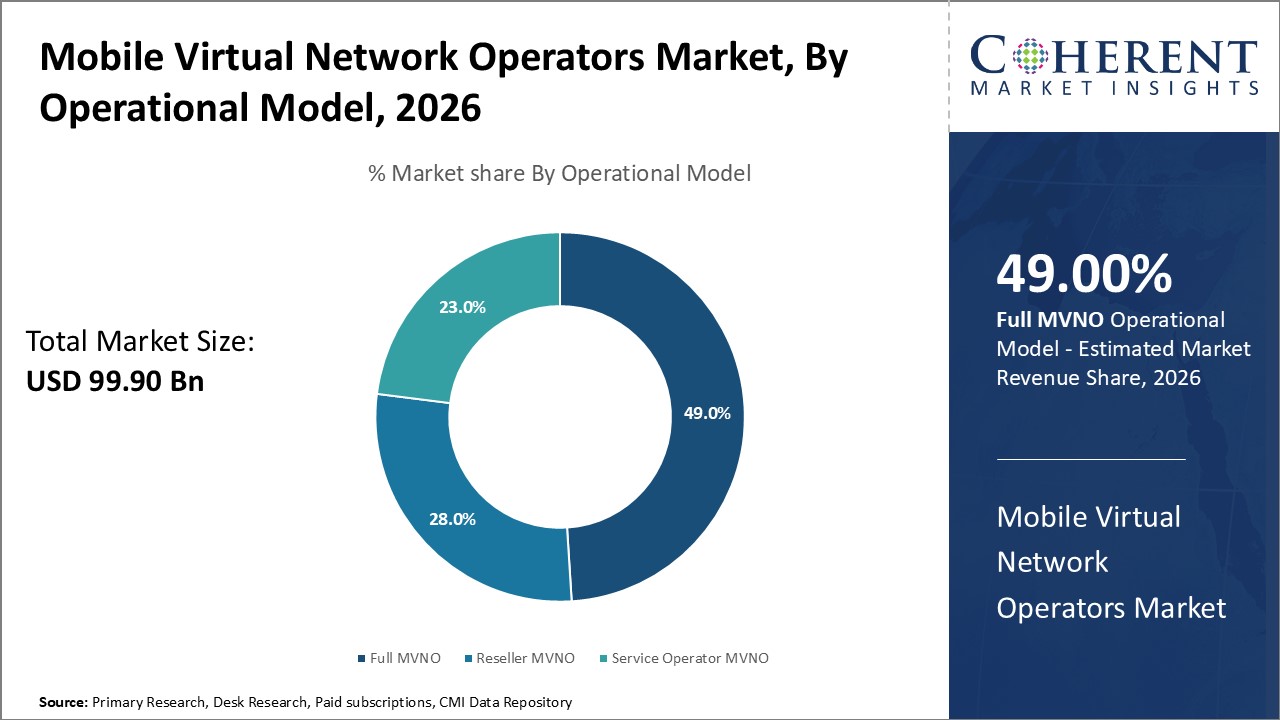
Mobile Virtual Network Operators Market Insights, By Operational Model: Partnership Models Drive Full MVNO Dominance
In terms of operational model, the full MVNO segment is estimated to contribute the highest market share of 49% in 2026, owing to the partnership and operational flexibility it provides. As full MVNOs control their own branding, marketing and customer management while gaining access to host networks, these have more leverage than other MVNO types to differentiate through segmentation, customization and value-added services. This allows Full MVNOs to target a wider variety of customer niches compared to resellers with less autonomy. Full MVNOs also face lower barriers to entry as these can launch operations quickly by partnering with major MNOs and negotiating favorable terms. The independent operational model has enabled Full MVNOs to establish diverse partner networks covering multiple host providers, providing flexibility in sourcing capacity, further propelling the mobile virtual network operators market revenue.
In June 2025, Amdocs launched MVNO&GO, a cloud-native, AI-powered SaaS platform designed to help businesses quickly and easily launch and grow mobile virtual network operators (MVNOs). It offers pre-integrated tools and technologies tailored for various MVNO models, including digital brands, wholesale providers, fiber, and IoT services.
Mobile Virtual Network Operators Market Insights, By End User: Tailored Plans Drive MVNO Consumer Dominance
In terms of end user, consumer segment is estimated to contribute the highest market share of 59.8% in 2026, owing to tailored plan offerings targeted specifically to their diverse needs. MVNOs have risen to meet these varying needs through extensive plan bundles, including plans tailored for light users, heavy streamers or international travellers. Some examples include plans bundled with streaming subscriptions, unlimited social media packages or low-cost roaming-enabled plans. MVNOs also offer flexible plans of shorter durations to suit lifestyle changes. Such personalized options at competitive prices have resonated well with consumers looking for tailored mobile value.
Regional Insights
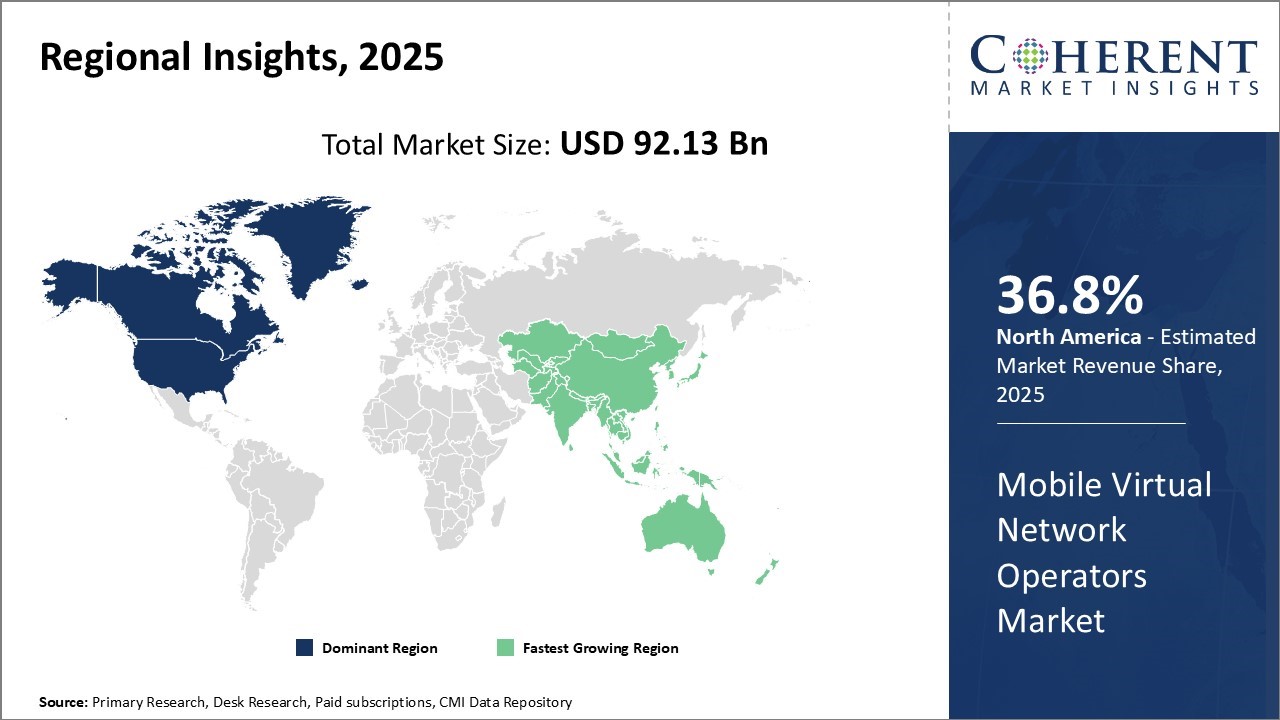
North America Mobile Virtual Network Operators Market
North America has emerged as the dominant region in the global mobile virtual network operators’ market with an estimated market share of 36.8% in 2026, due to presence of MVNOs in the region. North American consumers have shown high acceptance towards alternative telecom options beyond traditional carriers. This can be evidenced from the popularity of MVNO brands that bring disruptive offers focusing on value, flexibility or specialized customer needs. Quebecor is excited to introduce its new Mobile Virtual Network Operator (MVNO) service and to expand the coverage areas of its Videotron, Fizz, and Freedom Mobile brands across Canada. This gradual rollout will allow millions more Canadians to access their services. This is further proliferating the mobile virtual network operators market share.
Asia Pacific Mobile Virtual Network Operators Market
Asia Pacific region, especially emerging countries like India and Indonesia, are witnessing the fastest growth rates in the market. A major factor driving their appeal is the large population segments still untapped by traditional mobile operators. By focusing on these customers with low-cost prepaid offers, MVNOs aim to gain sizeable market shares in the near future.
Some Asia Pacific nations also have more relaxed regulatory frameworks than Western countries, allowing smooth MVNO operations. For example, Indonesia has incentivized infrastructure sharing that reduces barriers of MVNO operations. Their pro-consumer regulations and investments in network upgrades can drive the market growth. For instance, China increased its 5G infrastructure by adding 410,000 new base stations in 2024. Apart from this, the rising imports of affordable smartphones combined with rising data consumption boosts demand for flexible mobile data plans that independent MVNO brands provides.
United States Mobile Virtual Network Operators Market
The U.S. Mobile Virtual Network Operators Market is poised for continued expansion, driven by technological advancements and evolving consumer preferences. Moreover, the growth of the industry is driven by consumer demand for affordable and flexible mobile services. U.S.based virtual network operator that delivers talk, text, and data services by operating on the network of T-mobile, Verizon Wireless, and AT&T. The U.S. Mobile has Over 1,000,000 customers as of 2024. This number is further accelerating the mobile virtual network operators market growth.
Japan Mobile Virtual Network Operators Market
Japan’s Mobile Virtual Network Operators Market is characterized by a robust base, significant market share, and a favorable regulatory environment, positioning it as a mature and evolving segment within the telecommunication industry. Moreover, Japan’s favorable regulatory policies and technological advancements is also accelerating the industry growth.
In July 2026, Rakuten Mobile, Japan's next-generation mobile network, announced that it had exceeded 9 million subscribers as of July 7, 2026.
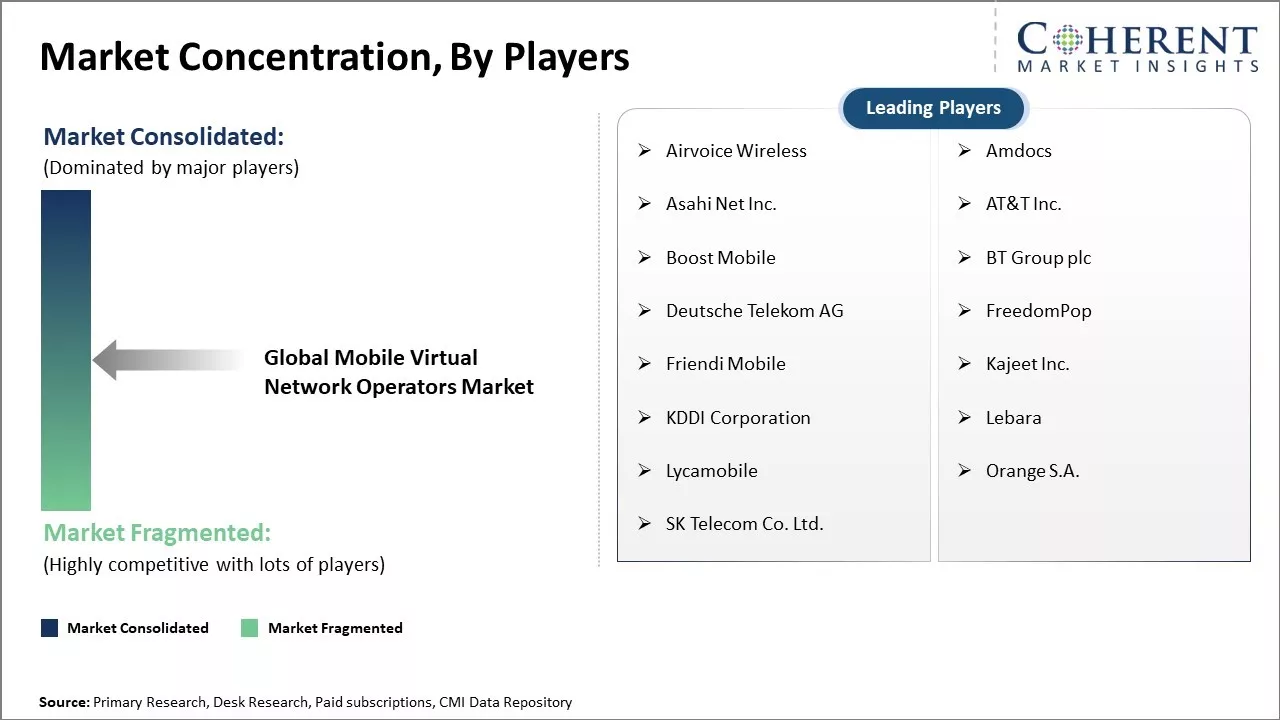
Market Concentration and Competitive Landscape
Mobile Virtual Network Operators Industry News
- In May 2025, Revolut announced plans to launch MVNO services in the UK and Europe, offering monthly mobile plans with unlimited calls, texts, and data, along with 20GB of roaming in Europe and the US.
- In May 2025, New York Mobile became the first U.S. MVNO to launch on Telness Tech’s new Seamless OS platform, enabling it to offer next-generation wireless services over T-Mobile’s leading 5G network.
- In July 2023, Lyca Mobile, a mobile virtual network operator, announced a partnership with BT Wholesale. This strategic alliance aims to provide Lyca Mobile's customers in the U.K. with direct access to EE's 4G and 5G networks.
- In May 2023, Mobi, a U.S.-based wireless carrier, announced an exclusive, multi-year MVNO (Mobile Virtual Network Operator) agreement with T-Mobile, a 5G network provider. This partnership enables Mobi customers to access the power and nationwide coverage of T-Mobile's network, allowing them to stay connected both at home in the islands and throughout the continental United States.
- In July 2022, Boost Mobile launched its Connected Car solution, providing a turnkey in-vehicle internet service with flexible pricing options. This offering enables anyone to easily add Wi-Fi connectivity to their car, allowing them to connect multiple devices such as tablets, laptops, and smartphones while on the road. During long drives, passengers can now stream content, browse the web, and enjoy their favorite audio without consuming data from their personal mobile plans.
Market Report Scope
Mobile Virtual Network Operators Market Report Coverage
| Report Coverage | Details | ||
|---|---|---|---|
| Base Year: | 2025 | Market Size in 2026: | USD 99.90 Bn |
| Historical Data for: | 2020 To 2024 | Forecast Period: | 2026 To 2033 |
| Forecast Period 2026 to 2033 CAGR: | 8.4% | 2033 Value Projection: | USD 175.64 Bn |
| Geographies covered: |
| ||
| Segments covered: |
| ||
| Companies covered: | Airvoice Wireless, Amdocs, Asahi Net Inc., AT&T Inc., Boost Mobile, BT Group plc, Deutsche Telekom AG, FreedomPop, Friendi Mobile, Kajeet Inc., KDDI Corporation, Lebara, Lycamobile, Orange S.A., SK Telecom Co. Ltd. | ||
| Growth Drivers: |
| ||
| Restraints & Challenges: |
| ||
Mobile Virtual Network Operators Market Growth Drivers
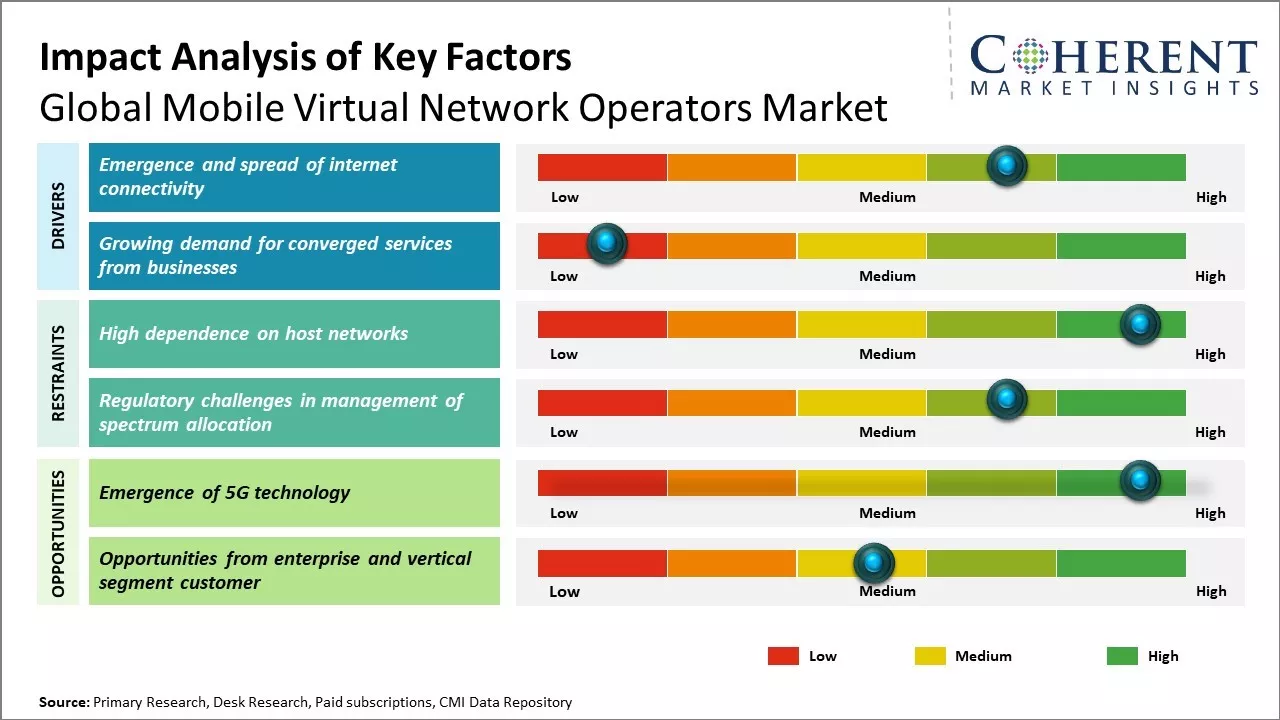
The market growth is driven by increasing need among consumers for comparatively inexpensive cellular plans and more customized offerings. Rising IoT connectivity broadens the subscriber base for MVNOs and allows new business models to emerge. However, cut-throat competition from telecom giants and regulatory challenges can hamper the market growth.
- Emergence and spread of internet connectivity
The emergence and spread of internet connectivity has revolutionized how individuals utilize telecommunication services. With greater availability of affordable smartphones and high-speed data plans, people are increasingly using their mobile devices for a myriad daily tasks beyond just phone calls. This changing usage behavior has encouraged mobile virtual network operators (MVNOs) to offer innovative service packages that cater to different customers based on their connectivity needs. MVNOs serve as an agile alternative for consumers seeking specialized plans tailored to their preferences like opting for unlimited text or data while restricting talk time. By leveraging the infrastructure of traditional mobile network operators, MVNOs have greater flexibility to launch customized plans without bearing heavy network investment costs.
For instance, in June 2022, plan.com, a leading provider of business connectivity solutions in the U.K., expanded its mobile network offerings by launching a second network on its my.plan platform through a mobile virtual network operator (MVNO) agreement with BT Wholesale. This partnership enables plan.com to offer its customers access to EE's 4G and 5G networks, providing them with more choice, flexibility, and superfast connectivity speeds. As an expert in delivering innovative productivity and connectivity solutions to U.K. businesses of all sizes, plan.com continues to enhance its my.plan platform, ensuring its customers can take full advantage of the latest mobile technologies to drive their success.
- Growing demand for converged services from businesses
Growing demand for converged services from businesses can also drive the market growth. As digital transformation of enterprises gathers pace, reliable connectivity forms the backbone for supporting new applications and solutions. MVNOs provide multi-device connectivity solutions for businesses to seamlessly link their office infrastructure, employee mobile devices and Internet of Things solutions. This enables enterprises to simplify management of telecom services across their organisation. MVNOs package dedicated business plans with capabilities like fleet management, enterprise mobility management and virtual private networks. These assist companies of varied sizes to mobilize their workforce, boost productivity and optimize communication costs. Particularly for small and medium enterprises with smaller and geographically dispersed operations, MVNOs emerge as a cost-effective way to meet all telecom requirements through one provider. This trend of enterprises increasingly turning to MVNOs for their connectivity requirement can offer market opportunities.
Key Takeaways from Analyst
The MVNO market is reaching a critical juncture where operational efficiency and differentiated value propositions have become non-negotiable for long-term viability. The traditional MVNO model—centered on price competition and brand-driven customer acquisition—is no longer sufficient to ensure profitability or retention in an environment dominated by network owners that are aggressively defending their margins and customer base.
Recent developments underscore this shift. In May 2025, New York Mobile became the first U.S.-based MVNO to launch on Telness Tech’s Seamless OS, a cloud-native platform that enables full-stack service orchestration. This marks a significant inflection point. Early adopters of Seamless OS in Europe have reported operational cost reductions of up to 30% and a 25% improvement in average revenue per user (ARPU) through automation and personalized service delivery. These performance gains are not marginal—they represent the future state of MVNO operations.
Additionally, the move by Revolut to launch MVNO services in the UK and EU, with bundled offerings including unlimited data and 20GB of transatlantic roaming, illustrates how fintech players are leveraging their digital ecosystems to drive cross-sell and lock-in. Revolut is not entering telecom for margin—it is entering to deepen engagement within its 40+ million user base. This type of ecosystem-led MVNO poses a serious threat to traditional standalone operators.
The MVNOs that fail to vertically integrate—or align with digital service providers offering API-first, modular network access—will face increasing pressure. As wholesale network pricing stabilizes and margins tighten, those lacking digital maturity will be unable to defend ARPU or innovate on services. Already, more than 60% of small-scale MVNOs in Western Europe are operating at EBITDA margins below 5%, according to internal operator benchmarks. This is unsustainable.
Moreover, 5G has not been the commercial panacea many MVNOs hoped for. Without access to differentiated quality-of-service tiers (QoS) or network slicing, most MVNOs are effectively reselling undifferentiated connectivity. This commoditization problem will only deepen with the rise of eSIM-based switching and digital onboarding, which accelerates churn. Churn rates among MVNOs are already 1.5x higher than those of MNOs in mature markets like Germany and the Netherlands, driven largely by the absence of embedded services or sticky bundles.
Market Segmentation
- Service Type Insights (Revenue, USD Bn, 2021 - 2033)
- 4G MVNO
- 5G MVNO
- Others
- Operational Model Insights (Revenue, USD Bn, 2021 - 2033)
- Full MVNO
- Reseller MVNO
- Service Operator MVNO
- End User Insights (Revenue, USD Bn, 2021 - 2033)
- Consumer
- Enterprise
- Regional Insights (Revenue, USD Bn, 2021 - 2033)
- North America
- U.S.
- Canada
- Latin America
- Brazil
- Argentina
- Mexico
- Rest of Latin America
- Europe
- Germany
- U.K.
- France
- Russia
- Rest of Europe
- Asia Pacific
- China
- India
- Japan
- Australia
- South Korea
- ASEAN
- Rest of Asia Pacific
- Middle East & Africa
- GCC Countries
- South Africa
- Rest of Middle East & Africa
- North America
- Key Players Insights
- Airvoice Wireless
- Amdocs
- Asahi Net Inc.
- AT&T Inc.
- Boost Mobile
- BT Group plc
- Deutsche Telekom AG
- FreedomPop
- Friendi Mobile
- Kajeet Inc.
- KDDI Corporation
- Lebara
- Lycamobile
- Orange S.A.
- SK Telecom Co. Ltd.
Sources
Primary Research Interviews
Interviews conducted with executives from MVNOs, network infrastructure providers, telecom regulators, and mobile technology vendors; discussions with industry experts and senior managers from leading telecom operators and MVNEs (Mobile Virtual Network Enablers).
Databases
- World Bank Data
- International Telecommunication Union (ITU) Statistics
- OECD Telecom Database
- U.S. Federal Communications Commission (FCC) databases
Magazines
- Telecom Review
- Mobile Europe
- Wireless Week
- FierceWireless
- Total Telecom
Journals
- Telecommunications Policy (Elsevier)
- IEEE Communications Magazine
- Journal of Mobile Networks and Applications (Springer)
- International Journal of Information Management
- Journal of Telecommunications and the Digital Economy.
Newspapers
- The Wall Street Journal – Technology Section
- Financial Times – Telecoms
- The Economic Times (Telecom)
- The Guardian – Technology
- Nikkei Asia
Associations
- GSMA (GSM Association)
- CTIA – The Wireless Association
- European Telecommunications Network Operators’ Association (ETNO)
- Asia-Pacific Telecommunity (APT)
- Telecom Regulatory Authority of India (TRAI)
- International Telecommunication Union (ITU)
Public Domain Sources
- Company annual reports and investor presentations, regulatory filings (e.g., 10-K, 20-F), government publications, press releases from telecom.
- operators and MVNOs, public tender announcements, speeches from telecom summits and forums.
Proprietary Elements
- CMI Data Analytics Tool, Proprietary CMI Existing Repository of information for last 8 years.
Get access to 250+ pages report
Every segment, forecast, competitor profile and data table behind the analysis above — available for instant download.
- ESOMAR Member
- ISO 9001:2015 Certified
- D-U-N-S Registered
- GDPR & CCPA Compliant
Missing comfort of reading report in your local language? Find your preferred language:
Transform your Strategy with Exclusive Trending Reports
Frequently Asked Questions
The Mobile Virtual Network Operators Market is estimated to be valued at USD 99.90 Bn in 2026, and is expected to reach USD 175.64 Bn by 2033.
The CAGR of the Mobile Virtual Network Operators Market is projected to be 8.4% from 2026 to 2033.
Emergence and spread of internet connectivity and growing demand for converged services from businesses are the major factors driving the global mobile virtual network operators market growth.
High dependence on host networks and regulatory challenges in management of spectrum allocation are the major factors hampering the growth of global mobile virtual network operators market.
In terms of service type, 4G MVNO segment is estimated to dominate the market in 2026.
Airvoice Wireless, Amdocs, Asahi Net Inc., AT&T Inc., Boost Mobile, BT Group plc, Deutsche Telekom AG, FreedomPop, Friendi Mobile, Kajeet Inc., KDDI Corporation, Lebara, Lycamobile, Orange S.A., SK Telecom Co. Ltd. are the major players.
North America is expected to lead the global mobile virtual network operators market in 2026.