

Global Music Recognition App Market Size and Forecast – 2026-2033
The global music recognition app market is estimated to be valued at USD 9.13 Bn in 2026 and is expected to reach USD 17.68 Bn by 2033, exhibiting a compound annual growth rate (CAGR) of 9.9% from 2026 to 2033.
Key Takeaways of the Global Music Recognition App Market
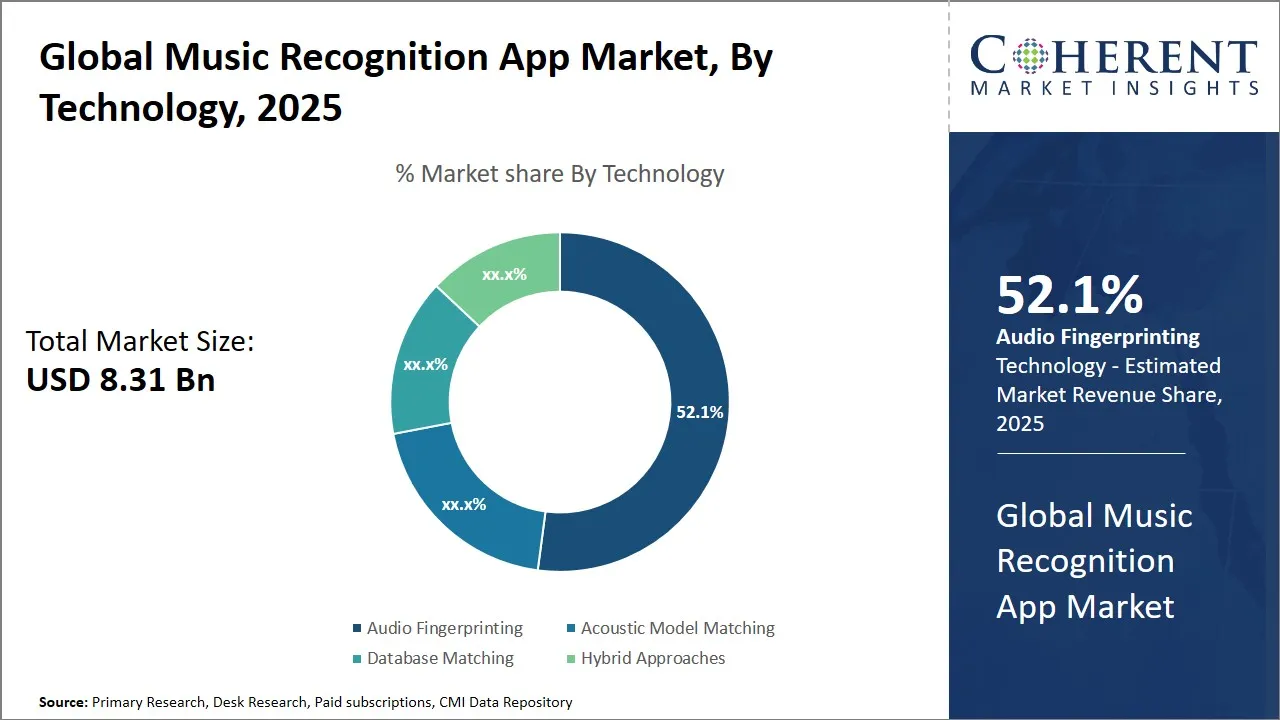
- The audio fingerprinting segment leads the market holding an estimated share of 53.1 % in 2026.
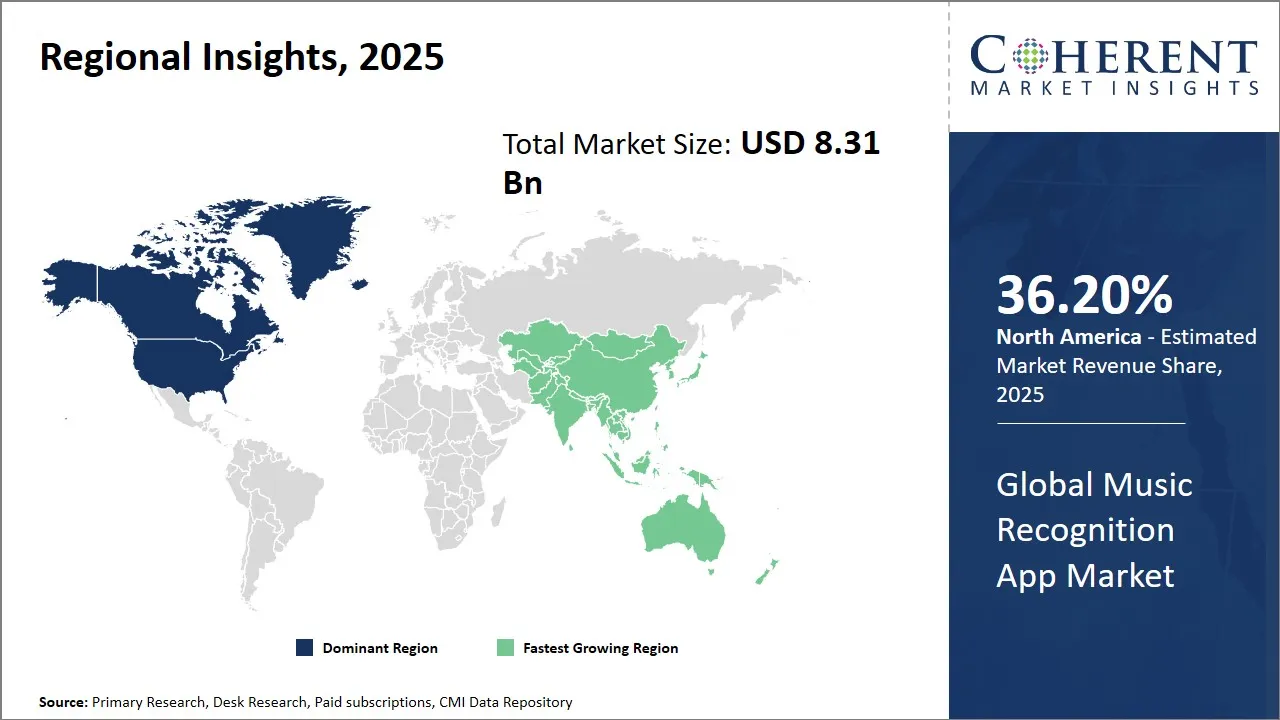
- North America is estimated to lead the market with a share of 36.2% in 2026.
- Asia Pacific, holding a share of 28.2 % in 2026, and it is projected to be the fastest growing region.
Market Overview
The market is seeing the use of AI-powered features such as real-time song identification, lyric display, and social sharing capabilities. Also, collaborations between music recognition apps and audio streaming services are adding to user reach and monetization opportunities. The popularity of smart devices and voice assistants also adds to adoption, making possible seamless music discovery and personalized content delivery in different user environments globally.
Current Events and Its Impact
Current Events | Description and its Impact |
SoundHound AI — Record Q2 2025 Results & Raised Outlook |
|
SoundHound Expands Automotive Integrations |
|
ACRCloud Signs Broadcaster/Rights-Body Partnerships |
|
Segmental Insights
- Current Industry Events of 2026
- Market Size Estimation
- Regional Breakdown
- Competitive Landscape
- Customer Intelligence
- Segmental Analysis
- Pricing Analysis
- Key Market Drivers, Challenges & Future Trends
- Customized Insights Section
Global Music Recognition App Market Insights, by Technology – Audio Fingerprinting Segment Lead the Market Because of Accuracy and Speed
The audio fingerprinting segment is expected to capture 53.1% share in 2026. This technology makes a unique digital summary or “fingerprint” of an audio track, which helps quickly identify songs even with background noise or distortions. It can operate effectively across multiple platforms such as smartphones, smart speakers, and wearable devices. Whether audio is recorded in a noisy café, through compressed streaming services, or during live performances, this technology can still find distinguishing features and deliver precise matching results. Shazam, owned by Apple, uses audio fingerprinting to identify millions of songs worldwide in just a few seconds, even in noisy environments like cafés, concerts, or public spaces.
Impact of AI on the Music Recognition App Market
Artificial intelligence highly improves speed, accuracy, and contextual understanding. Modern AI models can identify songs from extremely short or noisy samples, distinguish between live and studio versions, and even recognize cover performances by analyzing melody and harmonic structures. AI also makes possible on-device recognition that protects user privacy and reduces latency, while powering advanced recommendation engines that link recognition events to playlists, concerts, and merchandise.
SoundHound, collaborated with Stellantis to add AI-powered voice and music recognition in its infotainment systems. Using SoundHound’s deep neural networks, drivers can identify songs playing on the radio or from external sources with natural voice commands.
Regional Insights
North America Music Recognition App Market Analysis and Trends
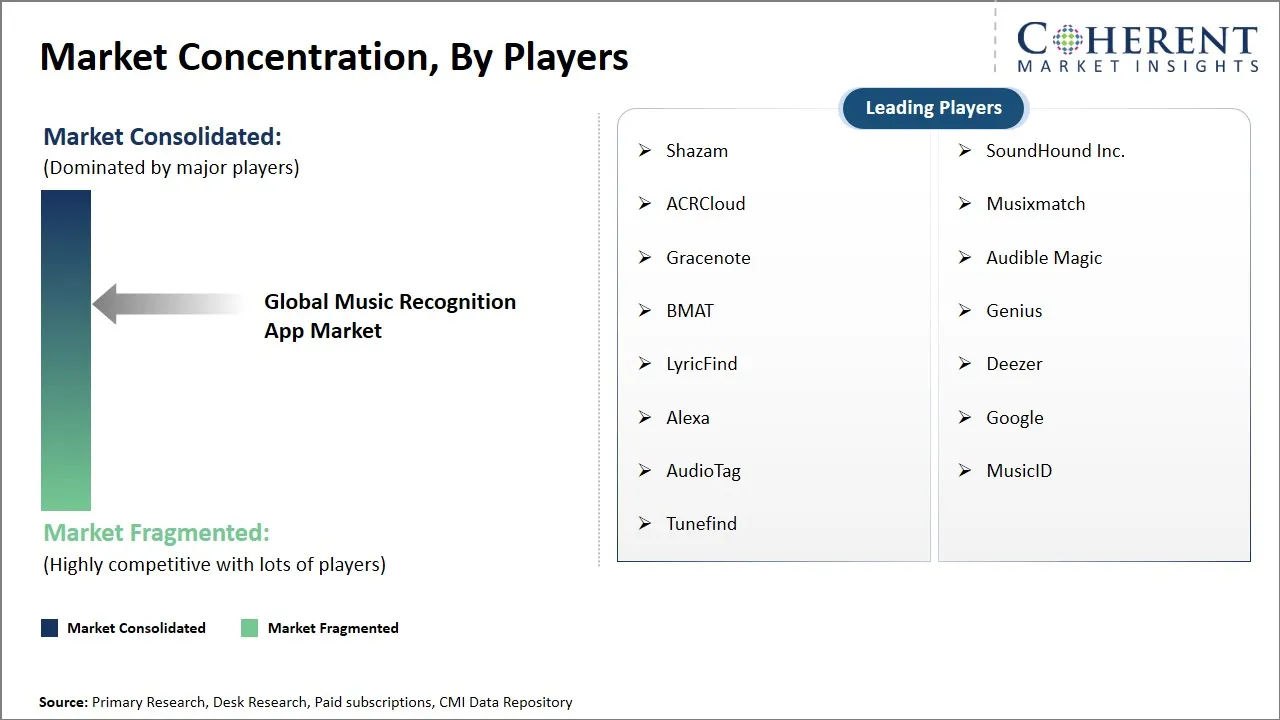
North America, holding a projected share of 36.2% in 2026, dominates the global music recognition app market because of a highly mature technology ecosystem, widespread smartphone penetration, and strong consumer demand for music discovery and streaming services. The region sees a strong digital infrastructure and innovation-friendly regulatory frameworks, which adds to the use of advanced technologies like AI and machine learning in music recognition apps. Also, key industry players like Shazam, SoundHound Inc., and Musixmatch have their headquarters or major operations in this region, adding to continuous product development and market penetration. The presence of leading music streaming platforms also complements music recognition apps, making a synergistic ecosystem that reinforces North America’s market leadership.
Asia Pacific Music Recognition App Market Analysis and Trends
The Asia Pacific, holding an estimated share of 28.2% in 2026, exhibits the fastest growth in the music recognition app market because of fast smartphone adoption, expanding internet accessibility, and increasing disposable income in emerging economies. Government initiatives focusing on digitization and the promotion of local cultural content have also added to the demand for music recognition technology. The diverse linguistic landscape in APAC adds to innovation in apps that can recognizing regional and vernacular music tracks, giving rise to localized solutions by companies such as Tencent Music Entertainment (China), Gaana (India), and Resso.
Global Music Recognition App Market Outlook for Key Countries:
U.S. Music Recognition App Market Analysis and Trends
The U.S. remains the largest and most competitive, with big players like Apple, via Shazam, and Google offering sophisticated music recognition services into their ecosystems. Extensive R&D investments and partnerships with major music labels make possible seamless user experiences, further improved by AI advancements. The U.S. music recognition app market regulatory environment adds to innovation, and consumer openness to technology adoption shows potential for continued leadership and early deployment of feature-rich apps.
China Music Recognition App Market Analysis and Trends
China music recognition app market sees a unique ecosystem shaped by government regulations and local industry giants. Tencent Music Entertainment leads in adding music recognition features to its social and streaming platforms such as QQ Music and WeSing. The market here focuses on apps that cater to local dialects and music preferences because of its regional diversity. Cross-platform integration and state-supported digitization add to market expansion despite the restricted entry of many Western companies.
India Music Recognition App Market Analysis and Trends
India’s fast expanding smartphone user base and increased internet penetration have added to the rise of music recognition apps tailored to its multilingual audience. Companies like Gaana and JioSaavn incorporate music ID features improving the user experience. Government initiatives promoting digital infrastructure and affordable data plans make the market dynamics stronger. The competitive landscape also sees international players collaborating with local firms to tap into India’s large and culturally diverse market.
U.K. Music Recognition App Market Analysis and Trends
The U.K. continues to lead Europe music recognition app market because of strong digital infrastructure and high smartphone adoption. Local players such as SoundHound and global giants like Shazam operate extensively here. The U.K. music industry’s global influence and presence of major record labels add to strategic collaborations, making possible access to comprehensive music libraries. Also, the regulatory environment supports innovation and protects intellectual property, adding to a steady market growth.
Brazil Music Recognition App Market Analysis and Trends
Brazil is a major country in Latin American region where growing smartphone adoption and cultural affinity towards music are big drivers for music recognition technology. Localized app content and partnerships with regional streaming services help firms like Deezer and local startups get traction. Increasing investments in digital infrastructure and government encouragement of the creative economy add to the expansion of music recognition apps despite economic volatility.
Market Players, Key Development, and Competitive Intelligence
Key Developments
- On September 9, 2025, SoundHound AI, Inc., a global leader in voice and conversational AI, announced the acquisition of Interactions, a pioneer in AI for customer service and workflow orchestration. This strategic deal is expected to strengthen and extend SoundHound’s growing leadership in Agentic AI and accelerate its market penetration in customer service across enterprise businesses.
- In August 2025, SoundHound AI, Inc. took a major step forward in automotive Artificial Intelligence (AI) with the launch of its generative AI-powered voice assistant in select Jeep vehicles across European regions. This marked a significant milestone for the company as it deepened its presence in one of the most competitive segments for applied AI, connected mobility.
- In November 2024, Shazam, owned by Apple, officially surpassed over 100 billion song recognitions since it launched.
- In July 2024, SoundHound AI, Inc., a global leader in voice artificial intelligence, announced its SoundHound Chat AI voice assistant with integrated ChatGPT is now live and in production in Peugeot, Opel, and Vauxhall vehicle brands across 11 European regions including Austria, France, Germany, Italy, Spain, and the U.K.
Top Strategies Followed by Music Recognition App Market Players
- Established market leaders emphasize heavy investments in research and development (R&D) to continuously innovate and offer high-performance, accurate, and user-friendly music recognition solutions.
- Apple continues to invest in advanced on-device audio fingerprinting and machine-learning algorithms for Shazam. In recent iOS updates, Apple integrated Shazam’s recognition into the system-level Control Center and Siri, enabling near-instant song identification and tighter Apple Music linkage.
- Mid-level companies in the music recognition app arena adopt a different approach, focusing primarily on delivering cost-effective solutions that balance quality and affordability.
- ACRCloud offers scalable music and audio recognition APIs with usage-based pricing, making it attractive for smaller apps, broadcasters, and regional streaming services that need robust recognition without building costly infrastructure.
- Small-scale entrants in the global music recognition app market carve out distinct niches by concentrating on specialized features or innovative product offerings that differentiate them from larger competitors.
- BMAT specializes in broadcast monitoring and royalty tracking rather than broad consumer music discovery.
Market Report Scope
Music Recognition App Market Report Coverage
| Report Coverage | Details | ||
|---|---|---|---|
| Base Year: | 2025 | Market Size in 2026: | USD 9.13 Bn |
| Historical Data for: | 2020 To 2024 | Forecast Period: | 2026 To 2033 |
| Forecast Period 2026 to 2033 CAGR: | 9.9% | 2033 Value Projection: | USD 17.68 Bn |
| Geographies covered: |
| ||
| Segments covered: |
| ||
| Companies covered: | Shazam, SoundHound Inc., ACRCloud, Musixmatch, Gracenote, Audible Magic, BMAT, Genius, LyricFind, Deezer, Alexa, Google, AudioTag, MusicID, and Tunefind | ||
| Growth Drivers: |
| ||
| Restraints & Challenges: |
| ||
Market Dynamics
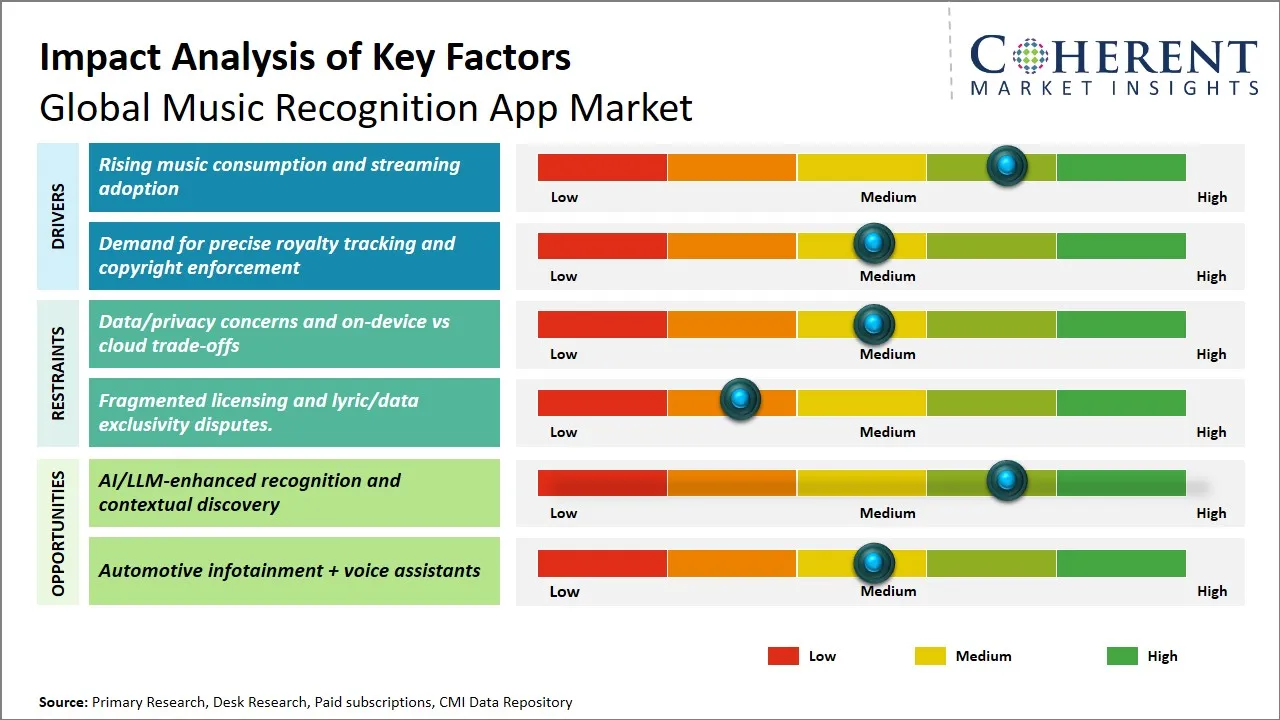
Global Music Recognition App Market Driver – Rising Music Consumption and Streaming Adoption
As consumers get on-demand access to huge music libraries, the ease of discovering and identifying songs through music recognition apps improves the overall listening experience, making these apps very useful. Also, the integration of streaming services with smart devices and social media platforms has added to user engagement, making demand for real-time song identification and sharing. The growing penetration of smartphones adds to this trend, and so does improved internet connectivity, making possible seamless access to music content anytime and anywhere. Also, personalized music recommendations and curated playlists offered by streaming platforms are helping listeners' explore new genres and artists, which, in turn, increases the reliance on music recognition technology.
Global Music Recognition App Market Opportunity – AI/LLM-Enhanced Recognition and Contextual Discovery
Traditional music recognition primarily relies on audio fingerprinting, which, while effective, can fall short in providing deeper contextual understanding and personalized recommendations. By using advancements in AI and Large Language Models (LLMs), music recognition apps can deliver nuanced contextual discovery like identifying genres, moods, lyrical themes, and related cultural information. This opens new areas for richer user engagement, adding to longer app sessions and increased brand loyalty. Also, AI-driven improvements make possible the recognition of partial or low-quality audio snippets, cover versions, and live performances with greater accuracy, addressing common pain points faced by users. LLMs make possible natural language querying, allowing users to interact with apps using conversational commands or requests. To add, these models help music platforms generate dynamic playlists and content recommendations based on individual preferences and listening history, integrating seamlessly with streaming and social media ecosystems.
Analyst Opinion (Expert Opinion)
- Advanced AI/ML models are becoming the primary competitive edge in music recognition apps. Beyond simple audio fingerprinting, these models make possible noise-resilient recognition, cover/version detection, and cross-platform contextual recommendations.
- A big trend is adding LLMs and generative AI into recognition apps. By analyzing lyrical content, mood, and user behavior, apps can give context-aware suggestions, playlists, and conversational interactions, offering a richer engagement experience that adds to retention and monetization potential.
- On-device recognition powered by AI is getting a lot of traction, especially for privacy-conscious regions and automotive integrations. On-device models reduce latency, protect user data, and make possible offline recognition, positioning apps for broader adoption in cars, wearables, and IoT-connected devices, while lowering dependency on cloud infrastructure.
Speak to the analyst
Want personalized insights?
Take the findings above to one of our principal consultants, or have the report rebuilt around the segments, geographies and competitors you actually track.
Market Segmentation
- Technology Insights (Revenue, USD Bn, 2021 - 2033)
- Audio Fingerprinting
- Acoustic Model Matching
- Database Matching
- Hybrid Approaches
- Regional Insights (Revenue, USD Bn, 2021 - 2033)
- North America
- U.S.
- Canada
- Latin America
- Brazil
- Argentina
- Mexico
- Rest of Latin America
- Europe
- Germany
- U.K.
- Spain
- France
- Italy
- Russia
- Rest of Europe
- Asia Pacific
- China
- India
- Japan
- Australia
- South Korea
- ASEAN
- Rest of Asia Pacific
- Middle East
- GCC Countries
- Israel
- Rest of Middle East
- Africa
- South Africa
- North Africa
- Central Africa
- North America
- Key Players Insights
- Shazam
- SoundHound Inc.
- ACRCloud
- Musixmatch
- Gracenote
- Audible Magic
- BMAT
- Genius
- LyricFind
- Deezer
- Alexa
- AudioTag
- MusicID
- Tunefind
Sources
Primary Research Interviews
Stakeholders
- Music Streaming Platforms and Digital Service Providers
- Music Recognition App Developers
- Record Labels and Music Publishers
- Automotive Infotainment Providers integrating music recognition
- Technology Consultants specializing in AI/ML and audio signal processing
- Social Media & UGC Platform Managers overseeing copyright enforcement
Databases
- Global Digital Music Insights Database
- International Audio Recognition Analytics (IARA)
- Streaming Analytics & Trends Repository (STAR)
Magazines
- MusicTech Today
- Digital Audio Insights
- Streaming Platform Monthly
- AI & Audio Innovation Review
Journals
- Journal of Music Information Retrieval
- International Journal of Audio, Speech and Music Processing
- Journal of Digital Entertainment and Media Technology
- AI in Multimedia Applications Journal
Newspapers
- The Music Business Daily
- Billboard (Digital Music Section)
- TechCrunch – Audio & Streaming Features
- The Verge – Music & AI Technology
Associations
- International Federation of the Phonographic Industry (IFPI)
- Music & Audio Recognition Alliance (MARA)
- Audio Engineering Society (AES)
- Association for the Advancement of AI in Media (AAIM)
Public Domain Sources
- United Nations Creative Economy Reports
- World Intellectual Property Organization (WIPO) Music & Copyright Data
- Global Streaming Industry Reports by UNESCO
- ResearchGate (Music Recognition & AI Studies)
Proprietary Elements
- CMI Data Analytics Tool, Proprietary CMI Existing Repository of information for last 8 years
Get access to 250+ pages report
Every segment, forecast, competitor profile and data table behind the analysis above — available for instant download.
- ESOMAR Member
- ISO 9001:2015 Certified
- D-U-N-S Registered
- GDPR & CCPA Compliant
Missing comfort of reading report in your local language? Find your preferred language:
Transform your Strategy with Exclusive Trending Reports
Frequently Asked Questions
The global music recognition app market is estimated to be valued at USD 9.13 billion in 2026 and is expected to reach USD 17.68 billion by 2033.
The CAGR of the global music recognition app market is projected to be 9.9% from 2026 to 2033.
Rising music consumption and streaming adoption and demand for precise royalty tracking and copyright enforcement are the major factors driving the growth of the global music recognition app market.
Data/privacy concerns and on-device vs cloud trade-offs and fragmented licensing and lyric/data exclusivity disputes. are the major factors hampering the growth of the global music recognition app market.
In terms of technology, the audio fingerprinting segment is estimated to dominate the market revenue share in 2026.
It is an app that identifies songs by analyzing audio, metadata, or lyrics.
They improve accuracy, handle noisy samples, and enable contextual recommendations.